Japan FDM and SLA Materials Market Size & Growth Rate
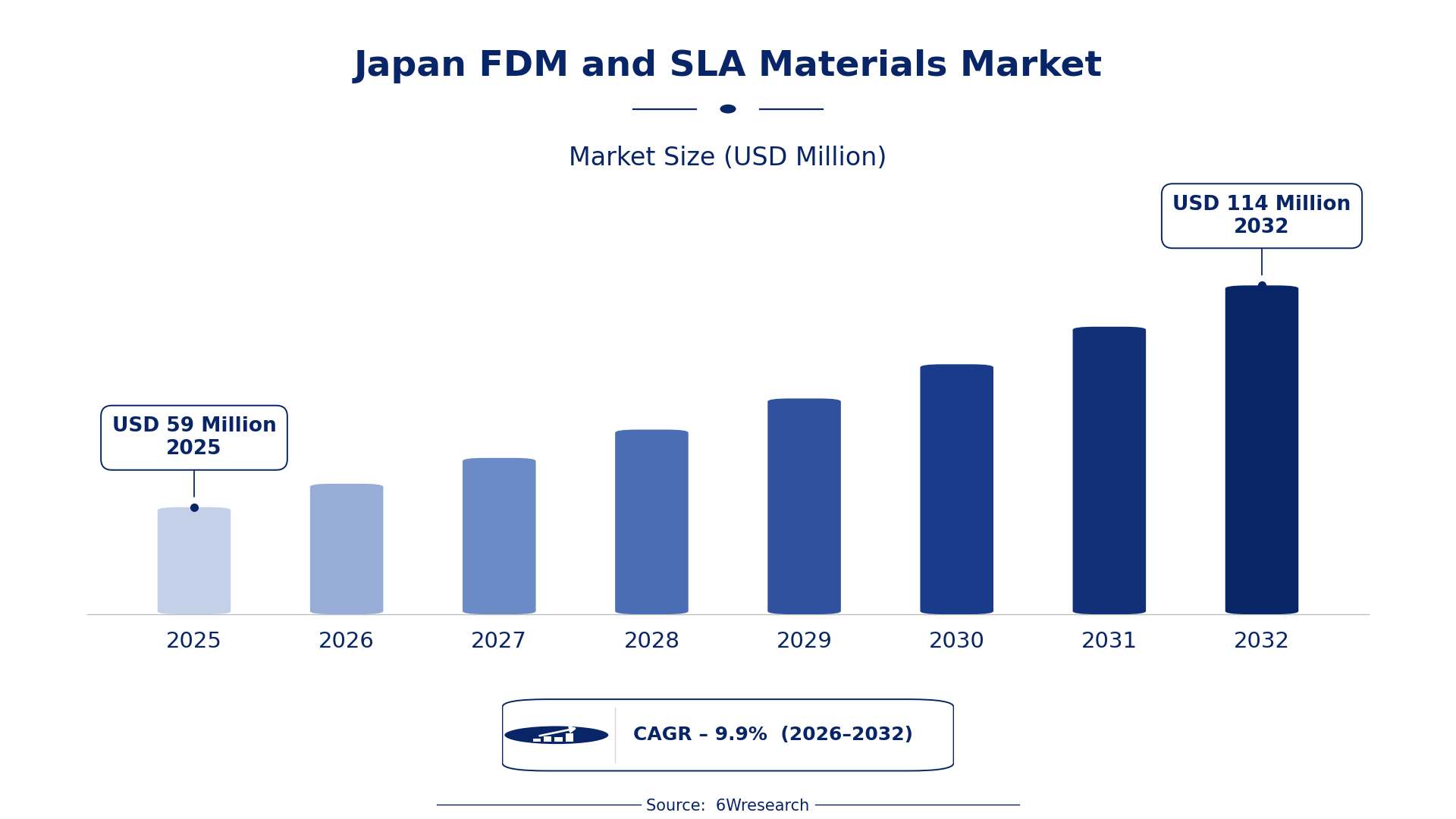
According to 6Wresearch internal database and industry insights, the Japan FDM and SLA Materials Market was valued at USD 59 Million in 2025 and is projected to reach USD 114 Million by 2032, growing at a CAGR of approximately 9.9% during 2026–2032.
Japan FDM and SLA Materials Market Highlights
| Report Metric | Details |
| Report Name | Japan FDM and SLA Materials Market (2026-2032) |
| Market Size 2025 | USD 59 Million |
| Market Size 2032 | USD 114 Million |
| Absolute Growth 2025–2032 | USD 55 Million |
| CAGR 2026–2032 | 9.9% |
| Peak Annual Growth | 12.1% in 2032 |
| Forecast Period | 2026–2032 |
| Historical Data | 2022–2025 |
| Base Year | 2025 |
| Leading Material Type, 2025 | PLA (40% share) |
| Leading Printing Technology, 2025 | FDM (65% share) |
| Leading Distribution Channel, 2025 | Online Platforms (46% share) |
| Leading End User, 2025 | Engineering Teams (37% share) |
| Fastest-Growing Material Type | Tough Resin (14.0% CAGR) |
| Fastest-Growing Printing Technology | SLA (14.2% CAGR) |
| Fastest-Growing End User | Makerspaces (12.9% CAGR) |
| Growing Sector | 3D printing |
| Key End Users | Engineering teams, automotive sector, healthcare sector, educational institutions |
Japan FDM and SLA Materials Market Year-wise Growth Rate and Key Drivers (2022–2032)
This graph illustrates the annual growth rates of the market from 2022 to 2032, highlighting a steady upward trajectory and projected market expansion over the forecast period.
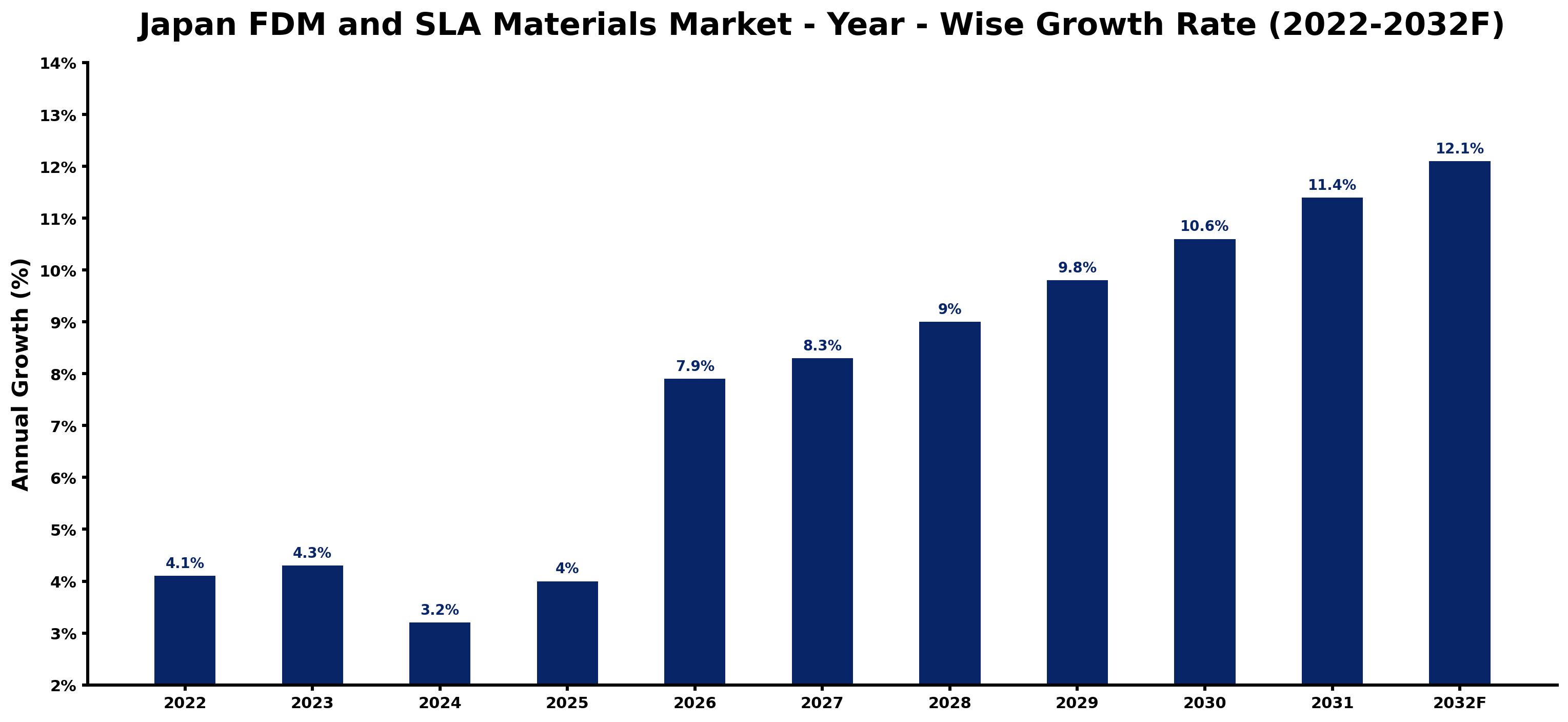
Annual growth estimates for each year appear below with the principal reason behind them, explaining the shifts that set the pace of the market.
| Year | Estimated Annual Growth (%) | Market Rationale |
| 2022 | 4.1 | The market experienced steady growth due to increasing interest in 3D printing technologies. |
| 2023 | 4.3 | Growth accelerated as more sectors adopted FDM and SLA materials for prototyping. |
| 2024 | 3.2 | A slowdown occurred as some sectors reassessed their 3D printing investments. |
| 2025 | 4.0 | Demand increased again as engineering teams sought rapid prototyping solutions. |
| 2026 | 7.9 | Investment in decarbonisation initiatives is expected to boost demand for sustainable materials. |
| 2027 | 8.3 | Technological advancements in 3D printing will enhance material capabilities and applications. |
| 2028 | 9.0 | The market is projected to gain momentum as educational institutions expand their 3D printing programs. |
| 2029 | 9.8 | Growing interest in custom parts manufacturing will drive further demand increases. |
| 2030 | 10.6 | The trend towards sustainability in production processes is expected to continue rising. |
| 2031 | 11.4 | Engineering teams will increasingly integrate advanced materials into their product development. |
| 2032 | 12.1 | The market is projected to peak as demand surges for high-precision printing applications. |
Note: Market size estimations and growth projections presented in this report are based on 6Wresearch's proprietary forecasting methodology, utilizing the latest available industry data, government publications, and primary research inputs.
Japan FDM and SLA Materials Market Synopsis
FDM and SLA materials are thermoplastic filaments and photopolymer resins crucial for 3D printing, used in prototyping and custom part manufacturing. The Japan FDM and SLA Materials Market is growing due to rising investments in decarbonisation, targeting approximately JPY 150 trillion over ten years. Major buyers include the automotive and healthcare sectors, which are driving demand for advanced materials and technologies, as demonstrated by the 2023 program that improves 3D printing capabilities in SMEs.
Market Dynamics Impact Analysis (2026–2032)
| Factor | Type | Impact | Primary Segment Affected |
| Growing investment in decarbonisation initiatives is driving demand for sustainable materials. | Driver | High | PLA |
| The increasing adoption of 3D printing technology in various sectors is creating new opportunities. | Driver | High | FDM |
| The shift towards custom part manufacturing presents significant market opportunities. | Opportunity | High | Tough Resin |
| The expansion of makerspaces is fostering innovation and material usage in 3D printing. | Opportunity | High | Makerspaces |
| Compliance with chemical regulations can increase production costs for manufacturers. | Restraint | Medium | Resin |
| Limited awareness of advanced materials may hinder market penetration in certain sectors. | Restraint | Medium | ABS |
| Cost pressures from raw material prices can impact profit margins for suppliers. | Challenge | High | FDM |
| Capacity constraints in production facilities may limit supply to meet rising demand. | Challenge | High | SLA |
Evaluation of Drivers in Japan FDM and SLA Materials Market (2026–2032)
These are the developments adding the most demand over the forecast period.
| Drivers | Primary Segment Affected | Why It Matters (Evidence) |
| Investment in decarbonisation initiatives. | PLA | Japan's GX Basic Policy targets JPY 150 trillion for decarbonisation, increasing demand for sustainable materials. |
| Rising adoption of 3D printing technology. | FDM | The automotive sector's integration of FDM materials for rapid prototyping is boosting purchasing activity. |
| Growing interest in custom parts manufacturing. | Tough Resin | The demand for durable, impact-resistant parts in healthcare applications is driving purchases. |
| Expansion of makerspaces promoting 3D printing. | Makerspaces | With over 300 makerspaces in Japan, innovation is increasing material usage among users. |
| Technological advancements in 3D printing. | SLA | New SLA technologies are enhancing precision, attracting engineering teams to invest in high-quality materials. |
The automotive sector is increasingly adopting FDM materials for rapid prototyping, which drives demand. The healthcare industry is seeking durable custom parts, resulting in increased purchases of Tough Resin. The presence of over 300 makerspaces in Japan boosts material usage as innovation flourishes. New SLA technologies improve precision, encouraging engineering teams to invest in high-quality materials.
Evaluation of Restraints in Japan FDM and SLA Materials Market
The following restraints limit how fast demand can grow.
| Market Restraint | Primary Segment Affected | Why It Matters (Evidence) |
| Compliance with chemical regulations raises production costs. | Resin | The PRTR Law requires businesses to report chemical substance releases, increasing operational costs for producers. |
| Limited awareness of advanced materials restricts market penetration. | ABS | Many firms remain unaware of the benefits of using advanced materials, affecting their purchasing decisions. |
| Cost pressures from raw material prices affect profit margins. | FDM | Fluctuations in raw material costs can lead to higher prices for end-users, reducing demand. |
| Capacity constraints in production facilities limit supply. | SLA | Increased demand for high-precision printing may outpace current production capabilities. |
| Supply chain disruptions can delay material availability. | Tough Resin | Global supply chain issues have led to delays in sourcing essential materials for production. |
Japan FDM and SLA Materials Market Challenges
Producers encounter supply challenges as reliance on specific thermoplastic filaments can delay production timelines, raising costs by 15% for manufacturers. Skills shortages in advanced 3D printing techniques compel producers to seek external expertise, incurring an average of ¥1 million in training costs per firm. Many producers face technology gaps, as outdated processes reduce output quality and efficiency, directly affecting buyer satisfaction. Compliance with standards like ISO/ASTM 52900 imposes additional burdens on suppliers, leading to delays in product launches and reducing their competitiveness in the market.
Trends in the Japan FDM and SLA Materials Market
Below are the shifts with the largest effect on the Japan FDM and SLA Materials Market.
- Shift from Traditional to Advanced Materials: Engineering teams are increasingly adopting advanced materials for 3D printing, particularly in the Tokyo region, where innovation thrives. The average price of PLA filament is around ¥3,000 per kg, reflecting the move towards higher-quality materials.
- Transition from In-House to Outsourced 3D Printing: Makerspaces are gaining popularity for outsourcing 3D printing needs, especially in urban areas. With over 300 makerspaces in Japan, this trend enables users to access advanced technologies without heavy investment.
- Emergence of Sustainability Standards in 3D Printing: ISO/ASTM 52900, introduced in 2023, is establishing new benchmarks for additive manufacturing. This standard encourages manufacturers to adopt eco-friendly practices, influencing material selection and usage in the industry.
- Growing Integration of 3D Printing in Education: Educational institutions are increasingly incorporating 3D printing into their curricula, particularly in the Tokyo region. This trend is supported by the popularity of PLA, widely used for educational 3D printing applications.
Investment Opportunities in the Japan FDM and SLA Materials Market
The following areas offer the clearest openings for investors and suppliers in the Japan FDM and SLA Materials Market.
- Supply of Sustainable Materials: With Japan targeting a 46% reduction in greenhouse-gas emissions by fiscal 2030, there is a rising demand for sustainable materials like PLA. B2B distributors can take advantage of this trend by expanding their offerings.
- Investment in 3D Printing Facilities: The Tokyo region is a hub for 3D printing innovation, presenting opportunities for investment in new facilities. With over 300 makerspaces, suppliers can collaborate with local entities to strengthen their market presence.
- Development of Custom Parts Manufacturing: The demand for custom parts is on the rise, particularly in the automotive sector. Engineering teams are actively seeking suppliers who can provide advanced materials tailored to their requirements.
- Expansion of Online Distribution Channels: Online platforms held a 46% share in 2025, indicating a gap for suppliers. Investing in e-commerce strategies will enable businesses to reach a broader customer base.
Government Initiatives in the Japan FDM and SLA Materials Market
The PRTR Law and the Chemical Substances Control Law create a framework for chemical management, requiring businesses to report and evaluate chemical substances. Compliance with these regulations ensures that producers uphold safety and environmental standards, influencing material selection in 3D printing. The GX Promotion Act, enacted in 2023, supports decarbonisation efforts, encouraging investments in sustainable practices within the industry.
The Ministry of Economy, Trade and Industry backs 3D printing initiatives through funding and approvals. This includes programmes that promote capabilities in SMEs, focusing on sustainable practices and innovation in the sector. Funding for these initiatives has reached JPY 10 billion, benefiting numerous small and medium enterprises.
Future Insight of the Japan FDM and SLA Materials Market
By 2032, advancements in additive manufacturing will reshape demand for FDM and SLA materials, driven by Japan's ambitious decarbonisation investment of JPY 150 trillion over ten years. Enhanced capabilities in SMEs will facilitate quicker prototyping and production, particularly benefiting sectors like automotive and healthcare. The commitment to net zero emissions by 2050 will propel the adoption of sustainable 3D printing practices. An increasing number of innovation hubs will enable collaboration, allowing suppliers to effectively meet evolving market demands.
Market Segmentation Analysis
Japan FDM and SLA Materials Market report covers a detailed analysis of the following market segments:
By Material Type – PLA Leads, Tough Resin Expected to Grow Fastest
According to Saurav Kr Singh, Senior Research Analyst at 6Wresearch, PLA took 40% of material type revenue in 2025, more than any other category. PLA holds the largest share in Japan due to its widespread use in educational institutions, where its biodegradable properties are highly valued for various 3D printing applications. The material's affordability, averaging around ¥3,000 per kg, makes it an accessible choice for many users. Tough Resin is set to record the highest CAGR in this split, 14.0% over 2026–2032. The Tough Resin segment is experiencing rapid growth as industries increasingly require materials that offer impact resistance and durability for advanced applications. This trend is particularly evident in sectors prioritising high-performance prototypes, suggesting a shift towards more robust materials. Suppliers should focus on enhancing the availability of Tough Resin to meet the rising demand in specific industrial applications.
By Printing Technology – FDM Leads, SLA Expected to Grow Fastest
The largest printing technology category in 2025 was FDM, at 65% of revenue. FDM is the leading technology in Japan's 3D printing market, primarily due to its versatility and suitability for a wide range of applications, including rapid prototyping. This technology is extensively utilised by engineering teams in various sectors, ensuring its dominant position. SLA is projected to grow fastest, at a CAGR of 14.2% during 2026–2032. SLA is witnessing the fastest growth as it caters to industries that demand high-precision printing, such as healthcare and automotive design. The increasing need for detailed prototypes is driving this growth, suggesting a shift in focus towards precision technologies. Buyers seeking precision in their 3D printing projects should consider investing in SLA technology to enhance their product development capabilities.
By Distribution Channel – Online Platforms Lead and Record the Fastest Growth
Online Platforms held 46% of the Japan FDM and SLA Materials Market by distribution channel in 2025. Online Platforms dominate the distribution channel for 3D printing materials in Japan, providing convenient access to a diverse range of products for various users. This accessibility is crucial for both individual and professional buyers looking to source materials efficiently, solidifying its leading status. The same category are also set to grow fastest, at a CAGR of 11.7% during 2026–2032. The Online Platforms segment is also the fastest-growing channel, as more users prefer the convenience and variety offered by digital marketplaces. This trend is likely to continue as the 3D printing community expands, reinforcing the dominance of online sales. Suppliers must optimise their online presence to capture the growing demand and enhance customer engagement.
By End User – Engineering Teams Lead, Makerspaces Expected to Grow Fastest
With 37% of end user revenue in 2025, Engineering Teams was the largest category. Engineering Teams represent the largest end-user group in Japan, as they integrate 3D printing into their product development processes for rapid prototyping and testing. Their significant involvement in sectors like automotive drives the demand for FDM materials, ensuring their leading position. Over 2026–2032, Makerspaces are expected to post the fastest growth, at a CAGR of 12.9%. Makerspaces are the fastest-growing end-user segment, reflecting a surge in community-driven innovation with 3D printing technologies. These spaces are becoming vital for fostering creativity and skills development, indicating a shift towards collaborative environments. Suppliers should consider targeting makerspaces to tap into the growing interest in 3D printing among hobbyists and innovators.
Key Attractiveness of the Report
- 10 Years of Market Numbers
- Historical Data Starting from 2022 to 2025
- Base Year 2025
- Forecast Data until 2032
- Key Performance Indicators Impacting the Market
- Major Upcoming Developments and Projects
Key Highlights of the Report:
- Japan FDM and SLA Materials Market Outlook
- Market Size of Japan FDM and SLA Materials Market, 2025
- Forecast of Japan FDM and SLA Materials Market, 2032
- Historical Data and Forecast of Japan FDM and SLA Materials Revenues & Volume for the Period 2022-2032F
- Japan FDM and SLA Materials Market Trend Evolution
- Japan FDM and SLA Materials Market Drivers and Challenges
- Japan FDM and SLA Materials Price Trends
- Japan FDM and SLA Materials Porter's Five Forces
- Japan FDM and SLA Materials Industry Life Cycle
- Historical Data and Forecast of Japan FDM and SLA Materials Market Revenues & Volume By Material Type for the Period 2022-2032F
- Historical Data and Forecast of Japan FDM and SLA Materials Market Revenues & Volume By PLA for the Period 2022-2032F
- Historical Data and Forecast of Japan FDM and SLA Materials Market Revenues & Volume By Resin for the Period 2022-2032F
- Historical Data and Forecast of Japan FDM and SLA Materials Market Revenues & Volume By ABS for the Period 2022-2032F
- Historical Data and Forecast of Japan FDM and SLA Materials Market Revenues & Volume By Tough Resin for the Period 2022-2032F
- Historical Data and Forecast of Japan FDM and SLA Materials Market Revenues & Volume By Printing Technology for the Period 2022-2032F
- Historical Data and Forecast of Japan FDM and SLA Materials Market Revenues & Volume By FDM for the Period 2022-2032F
- Historical Data and Forecast of Japan FDM and SLA Materials Market Revenues & Volume By SLA for the Period 2022-2032F
- Historical Data and Forecast of Japan FDM and SLA Materials Market Revenues & Volume By FDM for the Period 2022-2032F
- Historical Data and Forecast of Japan FDM and SLA Materials Market Revenues & Volume By SLA for the Period 2022-2032F
- Historical Data and Forecast of Japan FDM and SLA Materials Market Revenues & Volume By Distribution Channel for the Period 2022-2032F
- Historical Data and Forecast of Japan FDM and SLA Materials Market Revenues & Volume By 3D Print Material Stores for the Period 2022-2032F
- Historical Data and Forecast of Japan FDM and SLA Materials Market Revenues & Volume By Online Platforms for the Period 2022-2032F
- Historical Data and Forecast of Japan FDM and SLA Materials Market Revenues & Volume By B2B Distributors for the Period 2022-2032F
- Historical Data and Forecast of Japan FDM and SLA Materials Market Revenues & Volume By Specialty Retailers for the Period 2022-2032F
- Historical Data and Forecast of Japan FDM and SLA Materials Market Revenues & Volume By End User for the Period 2022-2032F
- Historical Data and Forecast of Japan FDM and SLA Materials Market Revenues & Volume By Makerspaces for the Period 2022-2032F
- Historical Data and Forecast of Japan FDM and SLA Materials Market Revenues & Volume By Design Studios for the Period 2022-2032F
- Historical Data and Forecast of Japan FDM and SLA Materials Market Revenues & Volume By Prototyping Firms for the Period 2022-2032F
- Historical Data and Forecast of Japan FDM and SLA Materials Market Revenues & Volume By Engineering Teams for the Period 2022-2032F
- Japan FDM and SLA Materials Import Export Trade Statistics
- Market Opportunity Assessment By Material Type
- Market Opportunity Assessment By Printing Technology
- Market Opportunity Assessment By Distribution Channel
- Market Opportunity Assessment By End User
- Japan FDM and SLA Materials Top Companies Market Share
- Japan FDM and SLA Materials Competitive Benchmarking By Technical and Operational Parameters
- Japan FDM and SLA Materials Company Profiles
- Japan FDM and SLA Materials Key Strategic Recommendations
Market Covered
The report covers the following segments.
By Material Type
- PLA
- Resin
- ABS
- Tough Resin
By Printing Technology
- FDM
- SLA
By Distribution Channel
- 3D Print Material Stores
- Online Platforms
- B2B Distributors
- Specialty Retailers
By End User
- Makerspaces
- Design Studios
- Prototyping Firms
- Engineering Teams































