Japan FDM Printing Market Size & Growth Rate
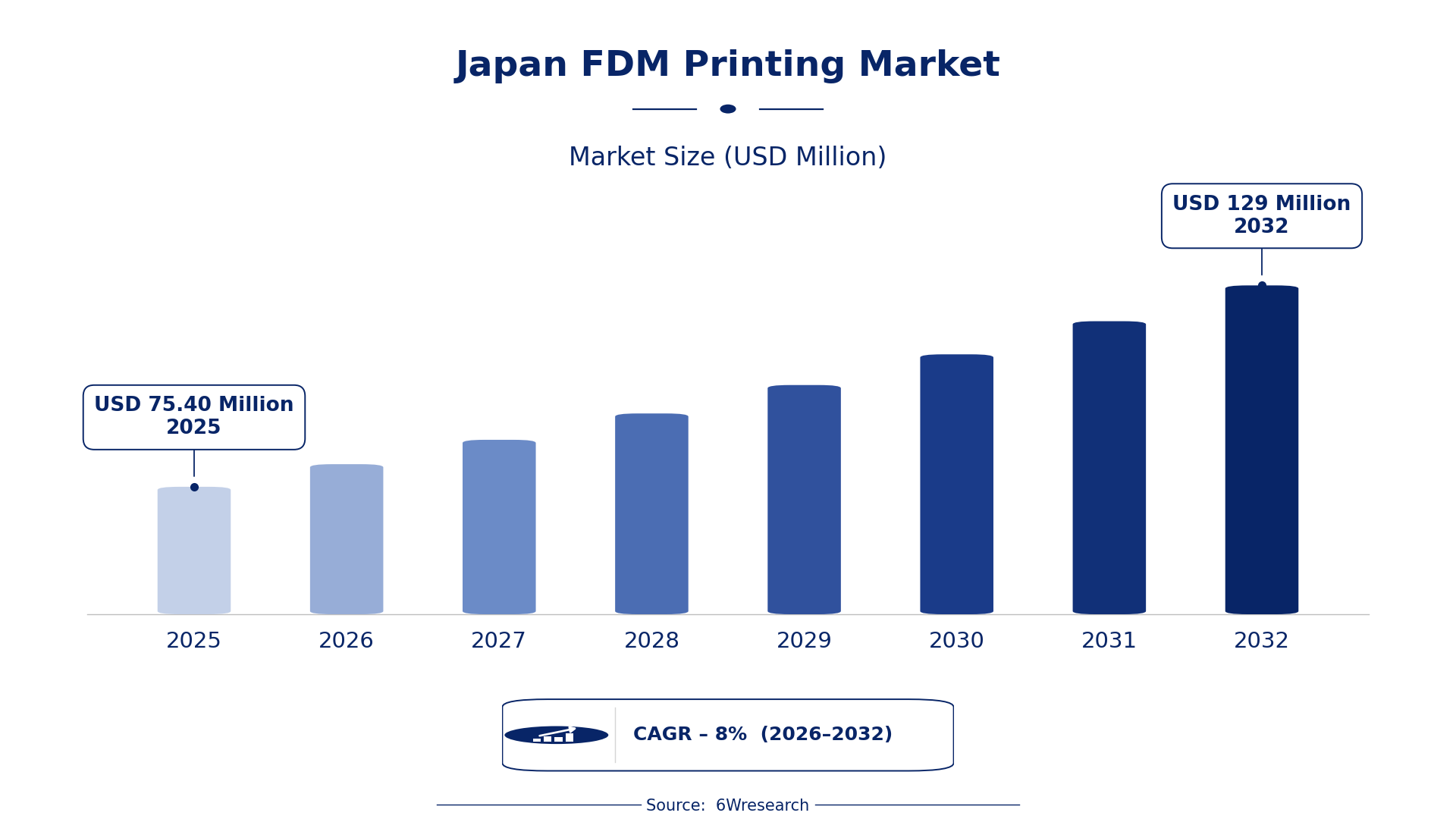
According to 6Wresearch internal database and industry insights, the Japan FDM Printing Market was valued at USD 75.40 Million in 2025 and is projected to reach USD 129 Million by 2032, growing at a CAGR of approximately 8% during 2026–2032.
Japan FDM Printing Market Highlights
| Report Metric | Details |
| Report Name | Japan FDM Printing Market (2026-2032) |
| Market Size 2025 | USD 75.40 Million |
| Market Size 2032 | USD 129 Million |
| Absolute Growth 2025–2032 | USD 53.60 Million |
| CAGR 2026–2032 | 8% |
| Peak Annual Growth | 10.7% in 2026 |
| Forecast Period | 2026–2032 |
| Historical Data | 2022–2025 |
| Base Year | 2025 |
| Leading Printer Type, 2025 | Desktop FDM Printers (47% share) |
| Leading Application Area, 2025 | Education (45% share) |
| Leading Distribution Channel, 2025 | Online Marketplaces (41% share) |
| Leading End User, 2025 | Schools & Colleges (40% share) |
| Fastest-Growing Printer Type | Industrial FDM Printers (10.7% CAGR) |
| Fastest-Growing Application Area | Manufacturing (9.1% CAGR) |
| Fastest-Growing Distribution Channel | B2B Sales (9.8% CAGR) |
| Fastest-Growing End User | Prototyping Labs (10.0% CAGR) |
| Growing Sector | Education |
| Key End Users | Schools & Colleges, Manufacturing Firms, Engineering Firms, Prototyping Labs |
Japan FDM Printing Market Year-wise Growth Rate and Key Drivers (2022–2032)
This graph illustrates the annual growth rates of the market from 2022 to 2032, highlighting a steady upward trajectory and projected market expansion over the forecast period.
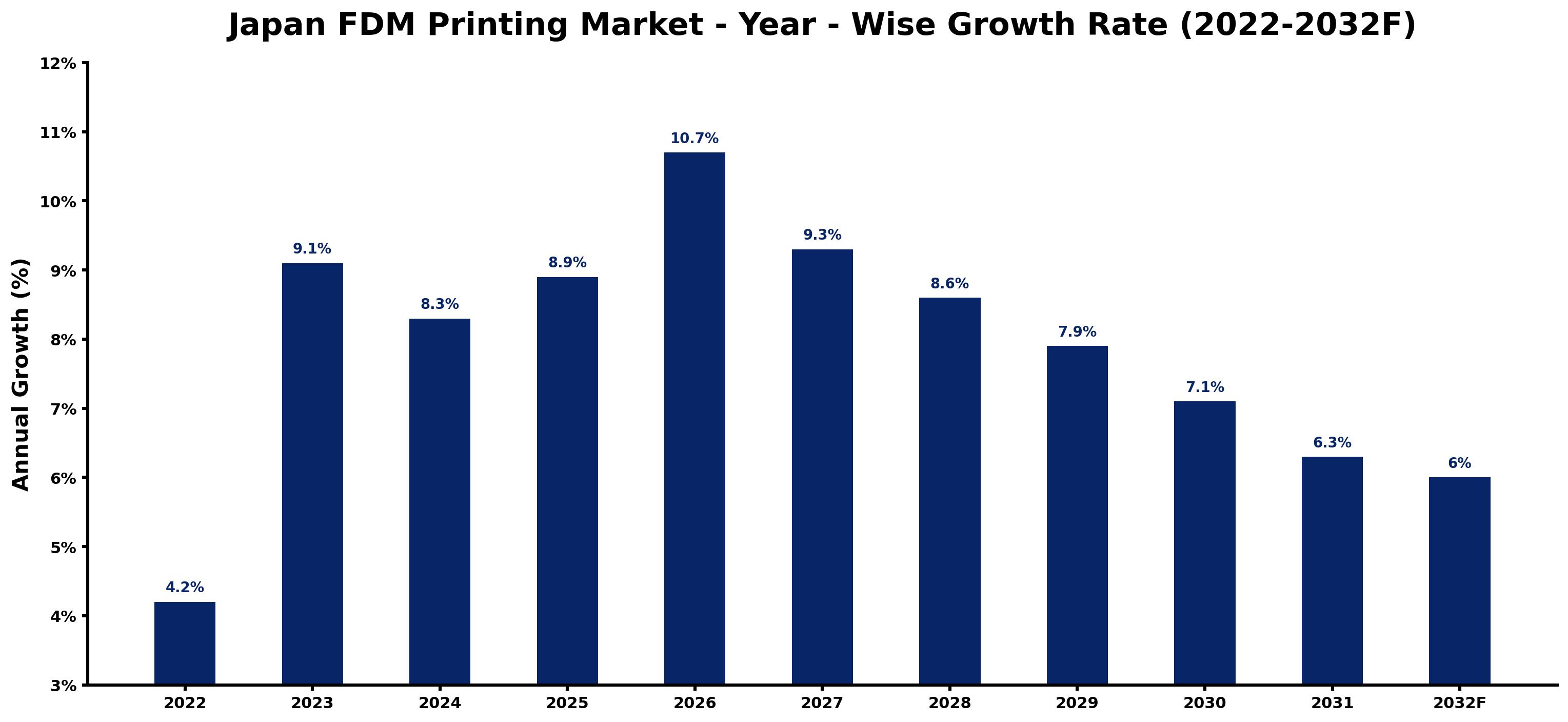
Year by year, the estimates below pair each growth rate with the development that shaped it.
| Year | Estimated Annual Growth (%) | Market Rationale |
| 2022 | 4.2 | The market showed steady activity with a growing interest in 3D printing technologies. |
| 2023 | 9.1 | Growth accelerated due to increased adoption of FDM technology in educational institutions. |
| 2024 | 8.3 | Growth slowed as the market adjusted to previous high levels of demand. |
| 2025 | 8.9 | Demand rose again as educational programs integrated FDM printing into curricula. |
| 2026 | 10.7 | A peak in growth is expected as manufacturing sectors expand their use of FDM. |
| 2027 | 9.3 | Growth is projected to slow slightly as the market stabilises after the peak in 2026. |
| 2028 | 8.6 | Continued interest in FDM technology will maintain steady growth in the market. |
| 2029 | 7.9 | The market is expected to experience a further slowdown as saturation in some sectors occurs. |
| 2030 | 7.1 | Growth will continue to slow as competition increases among manufacturers. |
| 2031 | 6.3 | A gradual slowdown is projected to persist as the market matures and demand stabilises. |
| 2032 | 6.0 | The market is expected to maintain a steady growth rate as new applications emerge. |
Note: Market size estimations and growth projections presented in this report are based on 6Wresearch's proprietary forecasting methodology, utilizing the latest available industry data, government publications, and primary research inputs.
Japan FDM Printing Market Synopsis
FDM printing is an additive manufacturing technology that creates three-dimensional objects by extruding thermoplastic filaments layer by layer. The Japan FDM Printing Market is experiencing growth driven by increased adoption in educational institutions and the manufacturing sector's need for rapid prototyping. In 2023, the Ministry of Education launched a program to integrate 3D printing into school curricula, further boosting market activity. The Tokyo region is a major hub for FDM innovations, reflecting a strong demand from both domestic users and imports.
Market Dynamics Impact Analysis (2026–2032)
| Factor | Type | Impact | Primary Segment Affected |
| Growing adoption of FDM technology in education | Driver | High | Education |
| Increased demand for rapid prototyping in manufacturing | Driver | High | Manufacturing |
| Expansion of educational institutions integrating FDM printing | Opportunity | High | Education |
| Rising interest in FDM technology among engineering firms | Opportunity | Medium | Engineering Firms |
| High initial investment costs for FDM printers | Restraint | High | Desktop FDM Printers |
| Limited awareness of FDM capabilities among small businesses | Restraint | Medium | B2B Sales |
| Compliance with safety regulations in educational settings | Challenge | High | Schools & Colleges |
| Capacity constraints in production facilities | Challenge | Medium | Prototyping Labs |
Evaluation of Drivers in Japan FDM Printing Market (2026–2032)
Below are the drivers that matter most for revenue growth, with supporting evidence.
| Drivers | Primary Segment Affected | Why It Matters (Evidence) |
| Integration of 3D printing in educational curricula | Education | In 2023, over 500 educational institutions adopted FDM printing for hands-on learning, increasing demand for printers. |
| Demand for rapid prototyping in manufacturing | Manufacturing | The Japanese manufacturing sector increasingly utilises FDM technology for efficient prototyping, with a notable rise in usage reported in the Tokyo region. |
| Growing interest in FDM technology in engineering | Engineering Firms | The average installed base of FDM printers is estimated at 10 units per firm, reflecting increased adoption in design processes. |
| Support from government initiatives for advanced manufacturing | Manufacturing | The Ministry of Economy, Trade and Industry promotes additive manufacturing as part of Industry 4.0, driving demand for FDM solutions. |
| Rising sales of FDM printers | Desktop FDM Printers | In 2023, the Japan 3D Printing Association reported a 25% increase in FDM printer sales, indicating strong market interest. |
Buyers are expanding capacity as educational institutions increasingly incorporate FDM printing into their curricula, with over 500 schools adopting this technology for hands-on learning. The manufacturing sector is also broadening its use of FDM for rapid prototyping, reflecting a trend towards greater efficiency. In 2023, the average installed base of FDM printers in engineering firms reached 10 units, indicating heightened adoption.
Evaluation of Restraints in Japan FDM Printing Market
Below are the constraints most often cited by buyers and suppliers, with the segment each affects.
| Market Restraint | Primary Segment Affected | Why It Matters (Evidence) |
| High initial investment costs for FDM printers | Desktop FDM Printers | The cost of advanced FDM printers can deter small educational institutions from adoption, with prices often exceeding 20% higher than alternatives. |
| Limited awareness of FDM capabilities among small businesses | B2B Sales | Many small businesses lack knowledge about the benefits of FDM printing, hindering market growth and limiting potential buyers. |
| Compliance with safety regulations in educational settings | Schools & Colleges | Educational institutions must adhere to strict safety regulations, complicating FDM adoption and increasing operational costs. |
| Capacity constraints in production facilities | Prototyping Labs | Many prototyping labs face limitations in their ability to scale production effectively, which restricts their service offerings. |
| Market saturation in certain segments | Manufacturing | As more manufacturers adopt FDM, competition increases, leading to potential market saturation and reduced profit margins. |
Japan FDM Printing Market Challenges
High material costs restrict buyers' ability to invest in FDM printing, with thermoplastic filaments priced 20% higher than in other regions. Limited supplier options in Japan lead to sourcing delays, extending project timelines for manufacturers. A shortage of skilled technicians affects production efficiency, resulting in longer project completions for engineering firms. Outdated technology in some facilities prevents suppliers from meeting ISO/ASTM 52900 standards, complicating hospitals' efforts to prototype medical devices effectively.
Trends in the Japan FDM Printing Market
Buyers and suppliers in the Japan FDM Printing Market are adjusting to the following trends.
- Shift in Educational Focus to 3D Printing: Educational institutions are prioritising 3D printing technology in their curricula, with over 500 schools adopting FDM printing for hands-on learning. This shift reflects a growing emphasis on practical skills in design and engineering education.
- Increased Adoption of FDM in Manufacturing: The manufacturing sector is experiencing a surge in FDM technology adoption, driven by the need for rapid prototyping. In 2023, a 25% increase in FDM printer sales was reported, indicating strong market interest.
- Expansion of FDM Applications in Healthcare: FDM printing is finding new applications in the healthcare sector, particularly for prototyping medical devices. This trend is supported by increasing demand for customised medical solutions, indicating the market's growth potential.
- Growth of Online Marketplaces for FDM Products: Online marketplaces are becoming a primary channel for purchasing FDM printers and materials, with 41% market share in 2025. This trend simplifies access for educational institutions and small businesses.
Investment Opportunities in the Japan FDM Printing Market
Where to invest in the Japan FDM Printing Market: the main openings are set out below.
- Timing for Educational Investment: With over 500 educational institutions adopting FDM technology, now is an opportune time to supply FDM printers and materials. The Ministry of Education's programme supports this integration, creating a demand surge.
- Supply for Manufacturing Prototyping Needs: The Japanese manufacturing sector's increasing reliance on rapid prototyping presents a notable opportunity. Investing in advanced FDM printers can cater to this growing demand, particularly in the Tokyo region.
- Expansion in Prototyping Labs: Prototyping labs are expanding their capabilities, with a growing need for FDM technology. Investing in these facilities can meet the rising demand for rapid product development solutions.
- Gap in Small Business Awareness: With limited awareness of FDM capabilities among small businesses, there is an opportunity to provide educational resources and FDM solutions. Targeting small businesses can open new market segments.
Government Initiatives in the Japan FDM Printing Market
The Industrial Safety and Health Act (1972) mandates employer responsibilities regarding hazardous substances and machinery, impacting FDM printing operations. This law ensures safety standards are upheld in educational and manufacturing settings, requiring compliance from producers and users alike. The GX Promotion Act (2023) further supports the integration of advanced manufacturing technologies, including FDM printing, as part of Japan's climate strategy.
In 2023, the Ministry of Economy, Trade and Industry allocated funding to support initiatives for advanced manufacturing technologies. The Digital Agency, established in September 2021, leads the government’s digital transformation efforts, ensuring common system standards that benefit FDM printing producers and users.
Future Insight of the Japan FDM Printing Market
The Ministry of Education's programme to integrate 3D printing in school curriculums will prepare a new generation of skilled technicians by 2032, benefiting both buyers and suppliers. FDM technology will see increased adoption in the manufacturing sector, enhancing rapid prototyping capabilities. The Tokyo Metropolitan Government's subsidy programme will support small businesses in adopting advanced FDM technologies, expanding market participation. By 2032, FDM printer sales are projected to exceed 1,000 units annually, with over 500 educational institutions utilising this technology for hands-on learning.
Market Segmentation Analysis
Japan FDM Printing Market report covers a detailed analysis of the following market segments:
By Printer Type – Desktop FDM Printers Lead, Industrial FDM Printers Expected to Grow Fastest
According to Saurav Kr Singh, Senior Research Analyst at 6Wresearch, Desktop FDM Printers accounted for 47% of the market by printer type in 2025. Desktop FDM Printers hold the largest share as they are extensively utilised in over 500 educational institutions across Japan for hands-on learning. This high penetration reflects the growing interest in 3D printing technologies among students and educators, making them a primary choice for educational purposes. Industrial FDM Printers are projected to grow fastest, at a CAGR of 10.7% during 2026–2032. Industrial FDM Printers are experiencing rapid growth driven by the Japanese manufacturing sector's increasing emphasis on creating functional prototypes. This segment's expansion is supported by the need for efficient and reliable prototyping solutions, indicating a shift towards more advanced manufacturing practices. This trend suggests that suppliers should focus on both educational and industrial sectors to capture a broader market share.
By Application Area – Education Leads, Manufacturing Expected to Grow Fastest
With 45% of application area revenue in 2025, Education was the largest category. Education is the leading application area for FDM printing, as it is integral in teaching design and engineering concepts within schools and colleges. The recent initiative by the Ministry of Education to integrate 3D printing into curriculums further solidifies this segment's dominance. Over 2026–2032, Manufacturing is expected to post the fastest growth, at a CAGR of 9.1%. Manufacturing is the fastest-growing application area, driven by the critical need for rapid prototyping and production in various industries. The increasing adoption of FDM technology in manufacturing processes is propelling this segment forward. Buyers in manufacturing should consider investing in advanced FDM solutions to stay competitive.
By Distribution Channel – Online Marketplaces Lead, B2B Sales Expected to Grow Fastest
The largest distribution channel category in 2025 was Online Marketplaces, at 41% of revenue. Online Marketplaces lead the distribution channel, serving as vital platforms for purchasing printers and materials, appealing to a diverse customer base. Their accessibility aligns with the rising interest in 3D printing technologies among various user groups. B2B Sales is set to record the highest CAGR in this split, 9.8% over 2026–2032. B2B Sales are the fastest-growing distribution channel, driven by a direct sales approach that effectively addresses the specific needs of industrial clients. The increasing demand for customised solutions in the industrial sector fuels this growth. Suppliers must refine their B2B sales strategies to effectively tap into the expanding industrial market.
By End User – Schools & Colleges Lead, Prototyping Labs Expected to Grow Fastest
Schools & Colleges held 40% of the Japan FDM Printing Market by end user in 2025. Schools & Colleges represent the largest end users of FDM printers, employing them extensively for educational purposes and practical learning experiences. The integration of 3D printing into educational curriculums has reinforced their dominant position in the market. The quickest growth will come from Prototyping Labs, forecast to expand at a CAGR of 10.0% between 2026 and 2032. Prototyping Labs are the fastest-growing end user segment, as dedicated facilities increasingly seek rapid prototyping capabilities for product development. This trend indicates a broader shift towards innovation in product design and development. Focusing on solutions tailored for prototyping labs could provide substantial opportunities for suppliers.
Key Attractiveness of the Report
- 10 Years of Market Numbers
- Historical Data Starting from 2022 to 2025
- Base Year 2025
- Forecast Data until 2032
- Key Performance Indicators Impacting the Market
- Major Upcoming Developments and Projects
Key Highlights of the Report:
- Japan FDM Printing Market Outlook
- Market Size of Japan FDM Printing Market, 2025
- Forecast of Japan FDM Printing Market, 2032
- Historical Data and Forecast of Japan FDM Printing Revenues & Volume for the Period 2022-2032F
- Japan FDM Printing Market Trend Evolution
- Japan FDM Printing Market Drivers and Challenges
- Japan FDM Printing Price Trends
- Japan FDM Printing Porter's Five Forces
- Japan FDM Printing Industry Life Cycle
- Historical Data and Forecast of Japan FDM Printing Market Revenues & Volume By Printer Type for the Period 2022-2032F
- Historical Data and Forecast of Japan FDM Printing Market Revenues & Volume By Desktop FDM Printers for the Period 2022-2032F
- Historical Data and Forecast of Japan FDM Printing Market Revenues & Volume By Industrial FDM Printers for the Period 2022-2032F
- Historical Data and Forecast of Japan FDM Printing Market Revenues & Volume By Dual-Extruder Printers for the Period 2022-2032F
- Historical Data and Forecast of Japan FDM Printing Market Revenues & Volume By Large Format Printers for the Period 2022-2032F
- Historical Data and Forecast of Japan FDM Printing Market Revenues & Volume By Application Area for the Period 2022-2032F
- Historical Data and Forecast of Japan FDM Printing Market Revenues & Volume By Education for the Period 2022-2032F
- Historical Data and Forecast of Japan FDM Printing Market Revenues & Volume By Manufacturing for the Period 2022-2032F
- Historical Data and Forecast of Japan FDM Printing Market Revenues & Volume By Product Design for the Period 2022-2032F
- Historical Data and Forecast of Japan FDM Printing Market Revenues & Volume By Architecture Models for the Period 2022-2032F
- Historical Data and Forecast of Japan FDM Printing Market Revenues & Volume By Distribution Channel for the Period 2022-2032F
- Historical Data and Forecast of Japan FDM Printing Market Revenues & Volume By Online Marketplaces for the Period 2022-2032F
- Historical Data and Forecast of Japan FDM Printing Market Revenues & Volume By B2B Sales for the Period 2022-2032F
- Historical Data and Forecast of Japan FDM Printing Market Revenues & Volume By OEMs for the Period 2022-2032F
- Historical Data and Forecast of Japan FDM Printing Market Revenues & Volume By Print Solution Providers for the Period 2022-2032F
- Historical Data and Forecast of Japan FDM Printing Market Revenues & Volume By End User for the Period 2022-2032F
- Historical Data and Forecast of Japan FDM Printing Market Revenues & Volume By Schools & Colleges for the Period 2022-2032F
- Historical Data and Forecast of Japan FDM Printing Market Revenues & Volume By Prototyping Labs for the Period 2022-2032F
- Historical Data and Forecast of Japan FDM Printing Market Revenues & Volume By Engineering Firms for the Period 2022-2032F
- Historical Data and Forecast of Japan FDM Printing Market Revenues & Volume By Design Firms for the Period 2022-2032F
- Japan FDM Printing Import Export Trade Statistics
- Market Opportunity Assessment By Printer Type
- Market Opportunity Assessment By Application Area
- Market Opportunity Assessment By Distribution Channel
- Market Opportunity Assessment By End User
- Japan FDM Printing Top Companies Market Share
- Japan FDM Printing Competitive Benchmarking By Technical and Operational Parameters
- Japan FDM Printing Company Profiles
- Japan FDM Printing Key Strategic Recommendations
Market Covered
The study includes the following segmentation.
By Printer Type
- Desktop FDM Printers
- Industrial FDM Printers
- Dual-Extruder Printers
- Large Format Printers
By Application Area
- Education
- Manufacturing
- Product Design
- Architecture Models
By Distribution Channel
- Online Marketplaces
- B2B Sales
- OEMs
- Print Solution Providers
By End User
- Schools & Colleges
- Prototyping Labs
- Engineering Firms
- Design Firms































