Japan Feed Yeast Market Size & Growth Rate
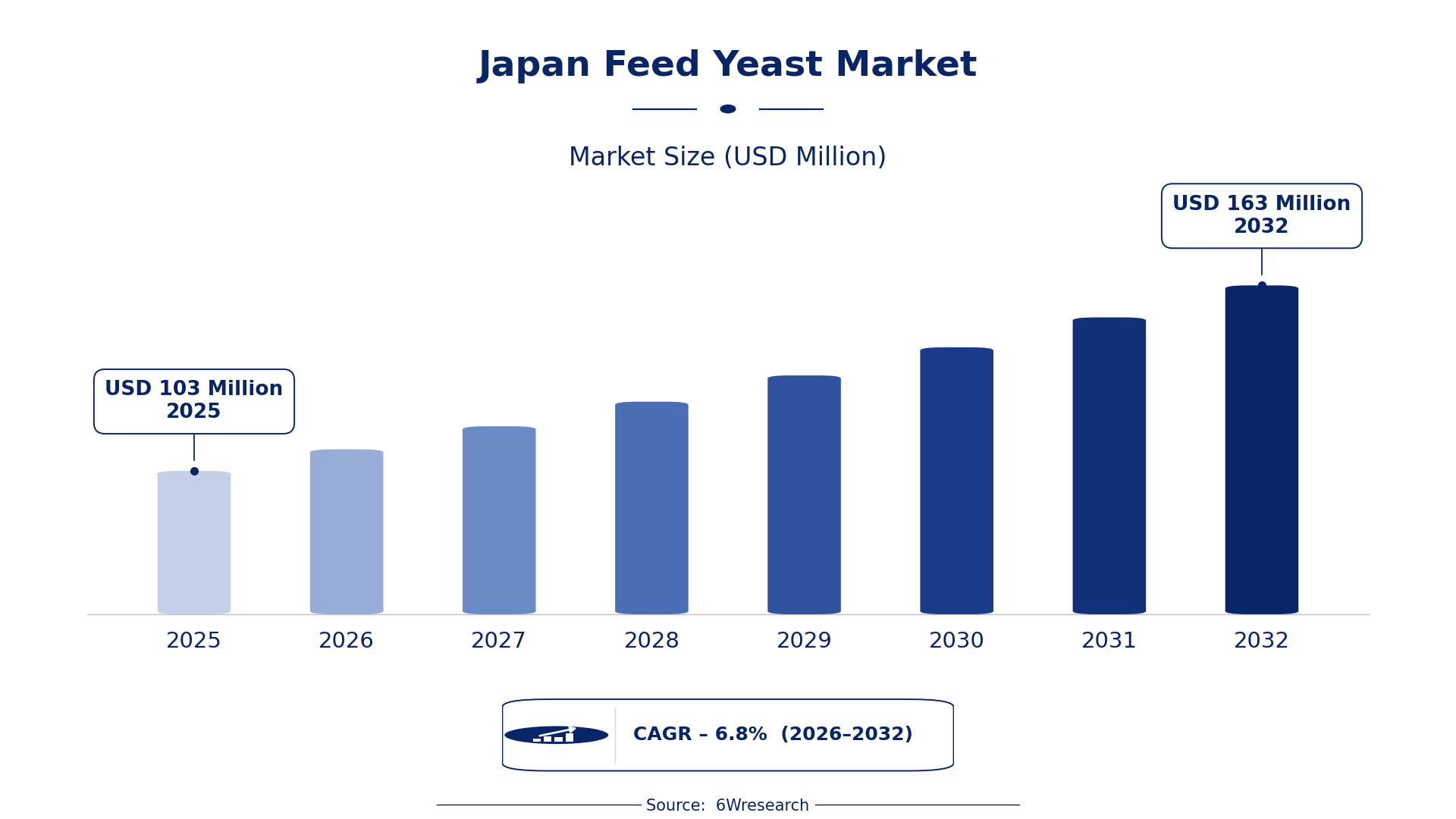
According to 6Wresearch internal database and industry insights, the Japan Feed Yeast Market was valued at USD 103 Million in 2025 and is projected to reach USD 163 Million by 2032, growing at a CAGR of approximately 6.8% during 2026–2032.
Japan Feed Yeast Market Highlights
| Report Metric | Details |
| Report Name | Japan Feed Yeast Market (2026-2032) |
| Market Size 2025 | USD 103 Million |
| Market Size 2032 | USD 163 Million |
| Absolute Growth 2025–2032 | USD 60 Million |
| CAGR 2026–2032 | 6.8% |
| Peak Annual Growth | 7.7% in 2029 |
| Forecast Period | 2026–2032 |
| Historical Data | 2022–2025 |
| Base Year | 2025 |
| Leading Form, 2025 | Dry (49% share) |
| Leading Types, 2025 | Live Yeast (56% share) |
| Leading Livestock, 2025 | Poultry (32% share) |
| Fastest-Growing Types | Yeast Derivatives (9.3% CAGR) |
| Fastest-Growing Livestock | Swine (8.6% CAGR) |
| Growing Sector | Swine |
| Key End Users | Poultry, Swine, Ruminants, Aquatic Animals |
Japan Feed Yeast Market Year-wise Growth Rate and Key Drivers (2022–2032)
This graph illustrates the annual growth rates of the market from 2022 to 2032, highlighting a steady upward trajectory and projected market expansion over the forecast period.
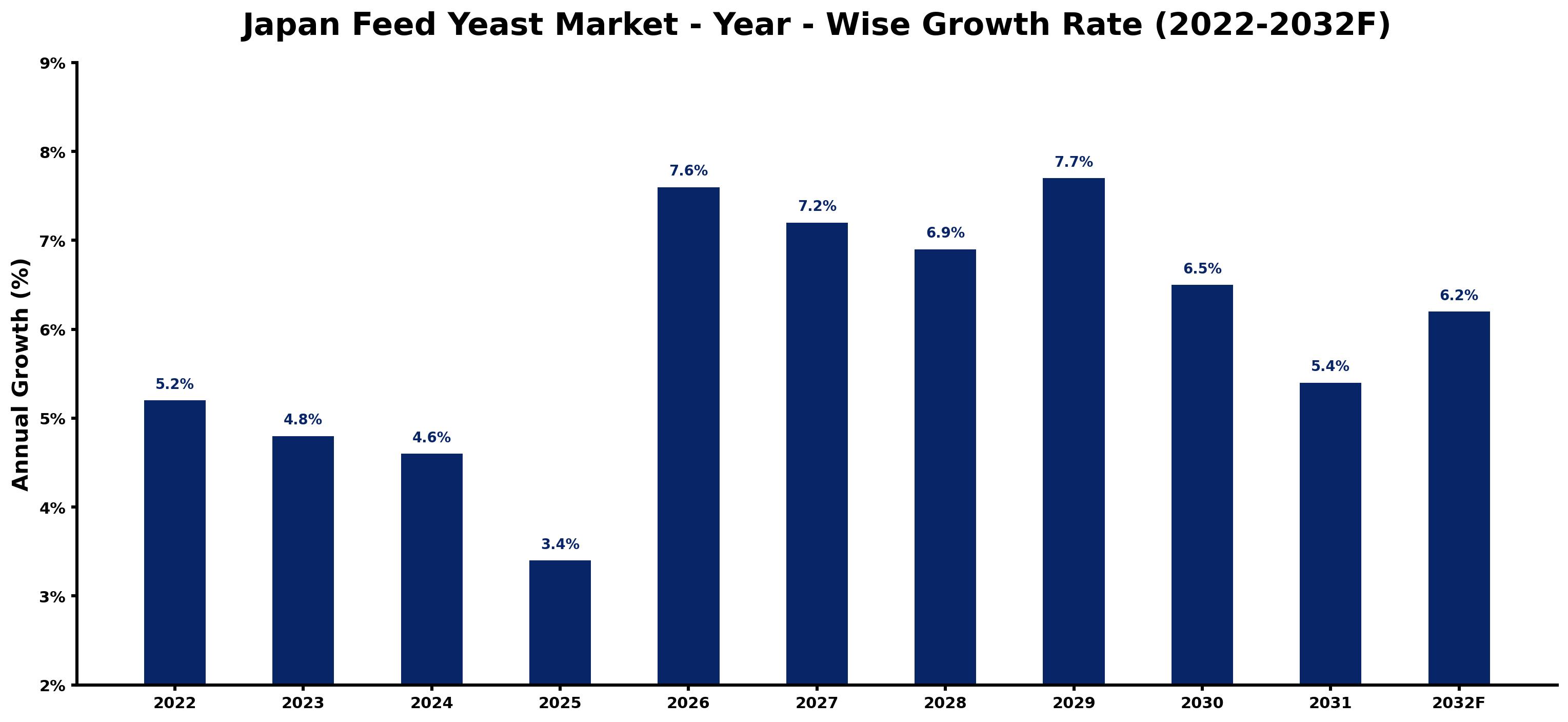
Below, each year's estimated growth is shown next to the factor that most influenced it.
| Year | Estimated Annual Growth (%) | Market Rationale |
| 2022 | 5.2 | The market experienced steady growth due to strong demand from the poultry sector. |
| 2023 | 4.8 | Growth slowed as feed prices increased, impacting purchasing decisions among livestock producers. |
| 2024 | 4.6 | A continued rise in feed costs restrained growth as producers sought more economical alternatives. |
| 2025 | 3.4 | Demand growth further slowed as the market adjusted to higher operational costs. |
| 2026 | 7.6 | Growth is expected to accelerate as investments in livestock production begin to yield results. |
| 2027 | 7.2 | A slight slowdown is projected as production stabilises and market conditions shift. |
| 2028 | 6.9 | Growth is expected to moderate as the market adjusts to new supply chain realities and pricing. |
| 2029 | 7.7 | Demand is projected to surge due to heightened investments in livestock health and productivity. |
| 2030 | 6.5 | Growth is expected to slow as market conditions normalise after a peak in demand. |
| 2031 | 5.4 | The market will continue to grow but at a more moderate pace as supply adjusts. |
| 2032 | 6.2 | Growth is projected to rise again as investments in sustainable practices take hold. |
Note: Market size estimations and growth projections presented in this report are based on 6Wresearch's proprietary forecasting methodology, utilizing the latest available industry data, government publications, and primary research inputs.
Japan Feed Yeast Market Synopsis
Feed yeast improves nutrition and promotes growth in livestock, produced through fermentation processes. The Japan Feed Yeast Market is growing due to rising poultry production, which reached approximately 150 million in 2022. Government support through the Industrial Standardization Act and an allocation of ¥2 billion for livestock feed improvement initiatives drives demand. Increased awareness of feed yeast's contribution to feed efficiency and animal health also fuels market expansion.
Market Dynamics Impact Analysis (2026–2032)
| Factor | Type | Impact | Primary Segment Affected |
| Rising livestock production | Driver | High | Poultry |
| Government support for livestock feed improvement | Driver | High | Swine |
| Growing demand for high-quality animal nutrition | Opportunity | High | Ruminants |
| Increasing focus on sustainable animal feed practices | Opportunity | Medium | Aquatic Animals |
| High feed prices impacting purchasing decisions | Restraint | High | Poultry |
| Limited shelf life of fresh yeast affecting market penetration | Restraint | Medium | Fresh |
| Supply chain disruptions affecting feed availability | Challenge | High | Swine |
| Competition from alternative feed additives | Challenge | Medium | Ruminants |
Evaluation of Drivers in Japan Feed Yeast Market (2026–2032)
Demand rests on the following drivers, each shown with the segment it touches most.
| Drivers | Primary Segment Affected | Why It Matters (Evidence) |
| Increased investments in livestock production | Poultry | This leads to higher feed demand, with poultry feed consumption reaching about 2.5 million tons annually. |
| Government initiatives supporting livestock health | Swine | These initiatives promote better feed quality, driving demand for feed yeast as a nutritional supplement. |
| Growing awareness of feed yeast benefits | Ruminants | Producers are increasingly adopting yeast to improve digestion and nutrient absorption, boosting overall productivity. |
| Rising consumer demand for sustainable animal products | Aquatic Animals | This trend encourages the use of feed yeast to promote healthier growth in aquaculture. |
| Adoption of ISO 9001 standards in feed production | Dry | This ensures quality management, increasing trust and demand for feed yeast in formulations. |
Most of the extra volume comes from increased investments in livestock production, particularly in poultry, which has a population of around 150 million. The average feed conversion ratio for poultry is approximately 1.7, spurring demand for efficient feed solutions. Awareness of feed yeast's benefits is rising, leading to higher adoption rates in ruminant diets. The push for sustainable practices in aquaculture is creating new opportunities for feed yeast applications.
Evaluation of Restraints in Japan Feed Yeast Market
Below are the constraints most often cited by buyers and suppliers, with the segment each affects.
| Market Restraint | Primary Segment Affected | Why It Matters (Evidence) |
| High feed prices impacting purchasing decisions | Poultry | Increased costs have led producers to seek more economical feed alternatives, limiting yeast purchases. |
| Limited shelf life of fresh yeast affecting market penetration | Fresh | Shorter shelf life restricts its use, resulting in a preference for more stable forms like dry yeast. |
| Supply chain disruptions affecting feed availability | Swine | Logistical challenges have delayed feed deliveries, impacting production schedules and yeast usage. |
| Competition from alternative feed additives | Ruminants | Producers may opt for cheaper alternatives that do not include yeast, affecting overall demand. |
| Regulatory challenges in feed formulation | Dry | Compliance with JIS standards complicates the introduction of new feed products. |
Japan Feed Yeast Market Challenges
A shortage of skilled workers in fermentation processes limits production capabilities, delaying output by up to six months for suppliers. Rising raw material costs from global supply chain issues increase production expenses by around 15%, forcing livestock producers to pay higher prices for feed. Buyers encounter difficulties sourcing quality feed yeast that meets JIS standards, which can lead to inconsistent livestock health and productivity. Suppliers face challenges in adopting new technologies, resulting in slower innovation and reduced market competitiveness, ultimately affecting buyers' access to advanced nutritional solutions.
Trends in the Japan Feed Yeast Market
Below are the shifts with the largest effect on the Japan Feed Yeast Market.
- Launch of Sustainable Animal Feed Initiative: In 2023, Japan initiated a programme to promote sustainable animal feed practices, aiming to reduce environmental impacts. This initiative is projected to increase the adoption of feed yeast, which supports animal health and productivity.
- Shift towards ISO 9001 Standards in Feed Production: The adoption of ISO 9001 standards is becoming prevalent in Japan's feed industry, ensuring quality management. This shift is increasing consumer trust and an increase in feed yeast usage, particularly among poultry producers.
- Increased Focus on Probiotics in Livestock Diets: Health agencies are encouraging the use of probiotics, including yeast, in livestock diets. This trend is expected to drive demand for feed yeast, with average poultry feed consumption reaching about 2.5 million tons annually.
- Growth in Aquaculture Production: Japan's aquaculture production reached 600,000 tons in 2022, with feed yeast playing a significant role in improving growth rates. This trend is likely to expand as producers seek efficient feed solutions.
Investment Opportunities in the Japan Feed Yeast Market
The opportunities below stand out in the Japan Feed Yeast Market for new entrants and existing suppliers.
- Partnerships with Local Livestock Producers: Establishing joint ventures with local livestock producers can facilitate market entry, particularly in regions like Hokkaido. The growing poultry population presents an opportunity, with an estimated 150 million birds requiring efficient feed solutions.
- Investment in Feed Production Facilities: With the Japanese government allocating ¥2 billion for livestock feed improvement programs, there is a clear opportunity to invest in new feed production facilities. This investment can cater to the increasing demand for high-quality feed yeast.
- Expansion into Ruminant Feed Market: The ruminant feed market is expanding, with a growing need for nutritional supplements. Producers are increasingly looking for effective solutions, creating opportunities for suppliers to introduce innovative feed yeast products.
- Focus on Yeast Derivatives for Enhanced Nutrition: The demand for yeast derivatives is rising, driven by their nutritional benefits. Suppliers can target this segment by developing products that meet the specific needs of livestock producers.
Government Initiatives in the Japan Feed Yeast Market
The Industrial Standardization Act governs quality assurance and improvement in livestock feed. This law encourages producers to adopt best practices in feed formulation, ensuring that feed yeast is effectively used to support animal health and productivity. The government also promotes research on yeast applications, which is important for advancing feed technology and improving livestock nutrition. In 2023, the government allocated ¥2 billion to support these initiatives, which include funding for research and development in feed formulations.
The Ministry of Agriculture, Forestry and Fisheries oversees various programs aimed at improving livestock feed quality. This funding helps producers access high-quality feed yeast, ensuring that they can meet the nutritional needs of their livestock effectively. In 2023, the ministry approved several projects focused on enhancing feed formulations, benefiting local livestock producers.
Future Insight of the Japan Feed Yeast Market
Investment in livestock feed improvement programs will create a surge in demand for feed yeast, providing growth opportunities for suppliers. By 2032, advancements in fermentation technology will enhance production efficiency and quality control. Government initiatives supporting research on yeast applications will lead to more effective nutritional solutions for livestock. As Japan's aquaculture production remains robust at 600,000 tons, the need for high-quality feed yeast will continue to strengthen, benefiting both buyers and suppliers.
Market Segmentation Analysis
Japan Feed Yeast Market report covers a detailed analysis of the following market segments:
By Form – Dry Leads and Records the Fastest Growth
According to Ravi Bhandari, Research Head at 6Wresearch, Dry took 49% of form revenue in 2025, more than any other category. The dry form of feed yeast commands the largest share as it is widely used in feed formulations, facilitating easier storage and handling. This characteristic is particularly advantageous for large-scale poultry operations, where efficient feed management is paramount. Dry is also forecast to expand faster than any other category, at a CAGR of 9.0% over 2026–2032. The dry form is also the fastest-growing segment, as its convenience aligns with the rising demand for efficient feed solutions in the poultry sector. With Japan's poultry population at approximately 150 million, this trend is likely to persist. Suppliers should prioritise improving the availability and quality of dry feed yeast to satisfy increasing market requirements.
By Types – Live Yeast Leads, Yeast Derivatives Expected to Grow Fastest
With 56% of types revenue in 2025, Live Yeast was the largest category. Live yeast holds the largest share as it is actively used to improve gut health and digestion in livestock, which is essential for optimal performance. Its widespread application in poultry diets is highlighted by the average consumption of 2.5 million tons annually in this sector. The quickest growth will come from Yeast Derivatives, forecast to expand at a CAGR of 9.3% between 2026 and 2032. Yeast derivatives are experiencing rapid growth due to their nutritional benefits and functional properties in feed formulations. The increasing emphasis on enhancing animal nutrition in Japan is propelling this segment forward. Suppliers should focus on promoting yeast derivatives to meet the growing demand for improved animal nutrition.
By Livestock – Poultry Leads, Swine Expected to Grow Fastest
Poultry held 32% of the Japan Feed Yeast Market by livestock in 2025. Poultry is the dominant segment, as it is a major consumer of feed yeast for growth promotion, reflecting the high feed conversion ratio of around 1.7 in this sector. The substantial poultry population in Japan underscores the importance of feed yeast in this market. Swine is set to record the highest CAGR in this split, 8.6% over 2026–2032. Swine is the fastest-growing segment, with production heavily reliant on feed yeast for improved feed efficiency. This growth is driven by increasing swine production and the need for cost-effective feeding strategies. Suppliers should tailor their products to meet the specific needs of the swine sector to capitalise on this growth opportunity.
Key Attractiveness of the Report
- 10 Years of Market Numbers
- Historical Data Starting from 2022 to 2025
- Base Year 2025
- Forecast Data until 2032
- Key Performance Indicators Impacting the Market
- Major Upcoming Developments and Projects
Key Highlights of the Report:
- Japan Feed Yeast Market Outlook
- Market Size of Japan Feed Yeast Market, 2025
- Forecast of Japan Feed Yeast Market, 2032
- Historical Data and Forecast of Japan Feed Yeast Revenues & Volume for the Period 2022-2032
- Japan Feed Yeast Market Trend Evolution
- Japan Feed Yeast Market Drivers and Challenges
- Japan Feed Yeast Price Trends
- Japan Feed Yeast Porter's Five Forces
- Japan Feed Yeast Industry Life Cycle
- Historical Data and Forecast of Japan Feed Yeast Market Revenues & Volume By Form for the Period 2022-2032
- Historical Data and Forecast of Japan Feed Yeast Market Revenues & Volume By Dry for the Period 2022-2032
- Historical Data and Forecast of Japan Feed Yeast Market Revenues & Volume By Fresh for the Period 2022-2032
- Historical Data and Forecast of Japan Feed Yeast Market Revenues & Volume By Instant for the Period 2022-2032
- Historical Data and Forecast of Japan Feed Yeast Market Revenues & Volume By Types for the Period 2022-2032
- Historical Data and Forecast of Japan Feed Yeast Market Revenues & Volume By Yeast Derivatives for the Period 2022-2032
- Historical Data and Forecast of Japan Feed Yeast Market Revenues & Volume By Spent Yeast for the Period 2022-2032
- Historical Data and Forecast of Japan Feed Yeast Market Revenues & Volume By Live Yeast for the Period 2022-2032
- Historical Data and Forecast of Japan Feed Yeast Market Revenues & Volume By Livestock for the Period 2022-2032
- Historical Data and Forecast of Japan Feed Yeast Market Revenues & Volume By Poultry for the Period 2022-2032
- Historical Data and Forecast of Japan Feed Yeast Market Revenues & Volume By Ruminants for the Period 2022-2032
- Historical Data and Forecast of Japan Feed Yeast Market Revenues & Volume By Swine for the Period 2022-2032
- Historical Data and Forecast of Japan Feed Yeast Market Revenues & Volume By Aquatic Animals for the Period 2022-2032
- Historical Data and Forecast of Japan Feed Yeast Market Revenues & Volume By Pet Animals for the Period 2022-2032
- Historical Data and Forecast of Japan Feed Yeast Market Revenues & Volume By Other Livestock for the Period 2022-2032
- Japan Feed Yeast Import Export Trade Statistics
- Market Opportunity Assessment By Form
- Market Opportunity Assessment By Types
- Market Opportunity Assessment By Livestock
- Japan Feed Yeast Top Companies Market Share
- Japan Feed Yeast Competitive Benchmarking By Technical and Operational Parameters
- Japan Feed Yeast Company Profiles
- Japan Feed Yeast Key Strategic Recommendations
Market Covered
This report examines the market across the segments below.
By Form
- Dry
- Fresh
- Instant
By Types
- Yeast Derivatives
- Spent Yeast
- Live Yeast
By Livestock
- Poultry
- Ruminants
- Swine
- Aquatic Animals
- Pet Animals
- Other Livestock































