Japan Ferro-alloys Market Size & Growth Rate
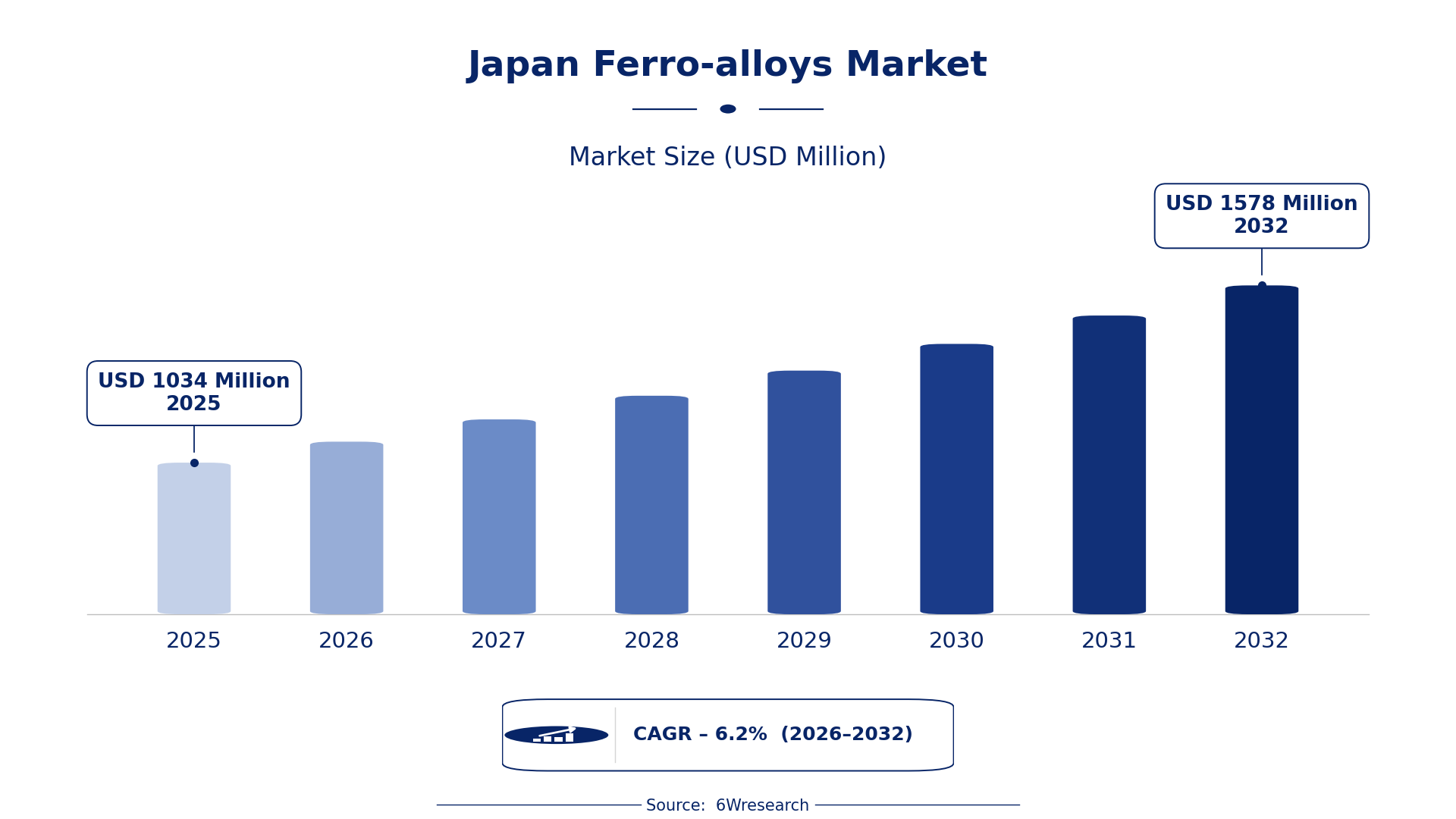
According to 6Wresearch internal database and industry insights, the Japan Ferro-alloys Market was valued at USD 1,034 Million in 2025 and is projected to reach USD 1,578 Million by 2032, growing at a CAGR of approximately 6.2% during 2026–2032.
Japan Ferro-alloys Market Highlights
| Report Metric | Details |
| Report Name | Japan Ferro-alloys Market (2026-2032) |
| Market Size 2025 | USD 1,034 Million |
| Market Size 2032 | USD 1,578 Million |
| Absolute Growth 2025–2032 | USD 544 Million |
| CAGR 2026–2032 | 6.2% |
| Peak Annual Growth | 7.6% in 2028 |
| Forecast Period | 2026–2032 |
| Historical Data | 2022–2025 |
| Base Year | 2025 |
| Leading Product Type, 2025 | Ferrochrome (47% share) |
| Leading Application, 2025 | Carbon & Low Alloy Steel (40% share) |
| Fastest-Growing Product Type | Ferromanganese (8.4% CAGR) |
| Fastest-Growing Application | Stainless Steel (8.2% CAGR) |
| Growing Sector | Construction |
| Key End Users | Steel manufacturers, automotive producers, renewable energy firms, construction companies |
Japan Ferro-alloys Market Year-wise Growth Rate and Key Drivers (2022–2032)
This graph illustrates the annual growth rates of the market from 2022 to 2032, highlighting a steady upward trajectory and projected market expansion over the forecast period.
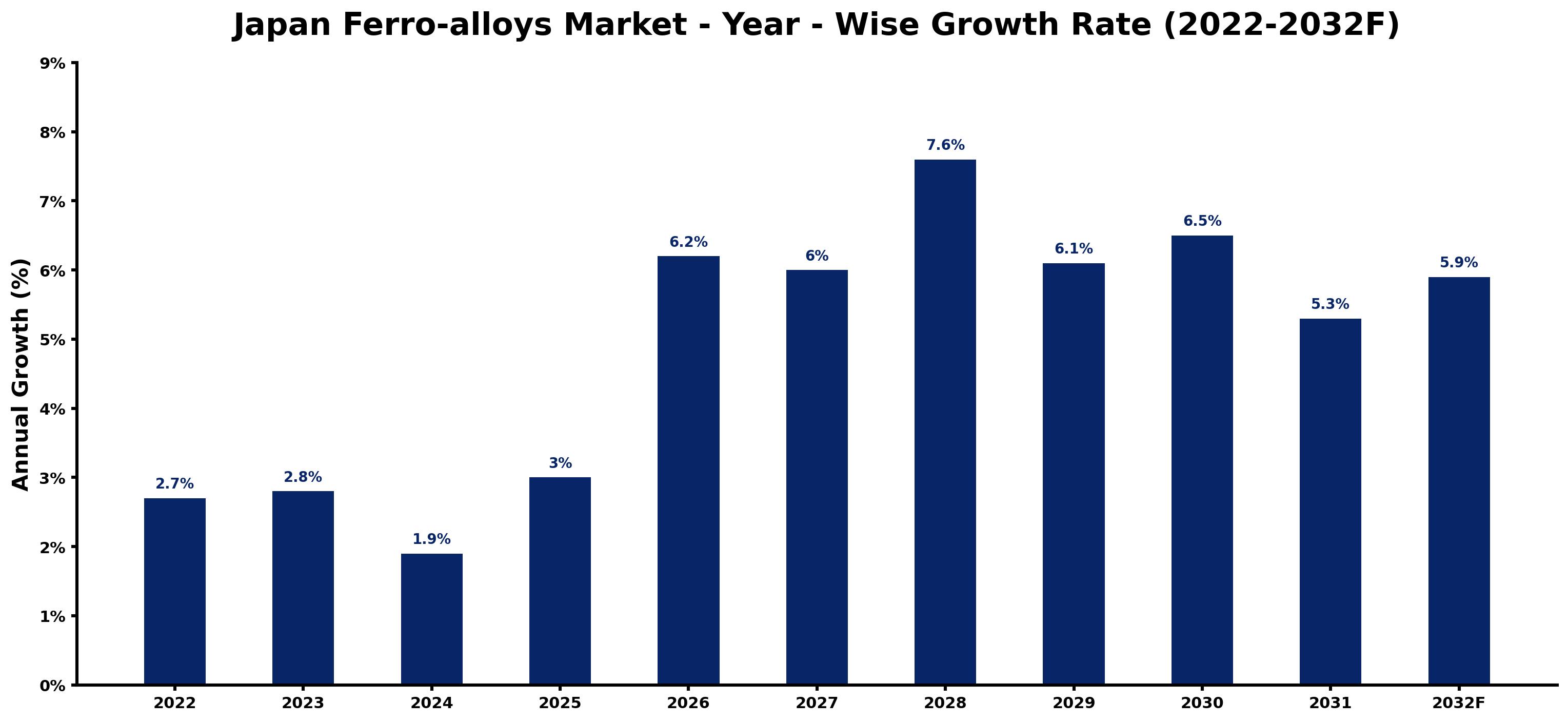
The yearly estimates that follow link every growth rate to its principal driver, so readers can see why the pace changed in each period.
| Year | Estimated Annual Growth (%) | Market Rationale |
| 2022 | 2.7 | The market showed consistent activity, reflecting stable demand from steel producers. |
| 2023 | 2.8 | Growth accelerated due to increased infrastructure projects and industrial activities. |
| 2024 | 1.9 | A slowdown occurred as demand from the automotive sector moderated. |
| 2025 | 3.0 | Demand surged as construction projects ramped up, leading to higher consumption. |
| 2026 | 6.2 | Growth is expected to rise due to increased investments in renewable energy facilities. |
| 2027 | 6.0 | A slight slowdown is anticipated as market adjustments take place after rapid growth. |
| 2028 | 7.6 | The market will peak as decarbonisation initiatives drive exceptional demand for ferro-alloys. |
| 2029 | 6.1 | Growth is likely to slow as the market stabilises after peak levels in the previous year. |
| 2030 | 6.5 | Demand will increase again due to ongoing investments in sustainable technologies. |
| 2031 | 5.3 | A slowdown is expected as market conditions normalise after previous high growth. |
| 2032 | 5.9 | Growth is projected to resume as new industrial standards boost consumption across sectors. |
Note: Market size estimations and growth projections presented in this report are based on 6Wresearch's proprietary forecasting methodology, utilizing the latest available industry data, government publications, and primary research inputs.
Japan Ferro-alloys Market Synopsis
Ferro-alloys are crucial materials in steel production, improving properties such as strength and corrosion resistance. The Japan Ferro-alloys Market is growing due to rising demand from the construction and automotive sectors. The GX Basic Policy targets JPY 150 trillion in public-private investment for decarbonisation over ten years, stimulating market activity. Increased investments in infrastructure and renewable energy projects are creating new opportunities for ferro-alloys, ensuring sustained demand in the coming years.
Market Dynamics Impact Analysis (2026–2032)
| Factor | Type | Impact | Primary Segment Affected |
| Rising infrastructure investment | Driver | High | Carbon & Low Alloy Steel |
| Increased demand for renewable energy technologies | Driver | High | Ferromanganese |
| Emerging decarbonisation initiatives | Opportunity | High | Ferro Silicomanganese |
| Growing automotive sector requirements | Opportunity | Medium | Ferrosilicon |
| Volatility in raw material prices | Restraint | High | Carbon & Low Alloy Steel |
| Regulatory compliance costs | Restraint | Medium | Ferromanganese |
| Competition from alternative materials | Challenge | High | Ferro Silicomanganese |
| Technological advancements in steel production | Challenge | Medium | Ferrosilicon |
Evaluation of Drivers in Japan Ferro-alloys Market (2026–2032)
The following drivers explain most of the expected growth.
| Drivers | Primary Segment Affected | Why It Matters (Evidence) |
| Increased infrastructure investment | Carbon & Low Alloy Steel | The Japanese government allocated JPY 6 trillion for infrastructure projects in 2023, boosting demand for steel and ferro-alloys. |
| Growth in renewable energy technologies | Ferromanganese | Renewable energy facilities are projected to require 20% more ferro-alloys by 2030, driving higher purchases. |
| Expansion of the automotive sector | Ferro Silicomanganese | The automotive industry is expected to grow by 5% annually, increasing demand for high-strength steel. |
| Decarbonisation initiatives | Ferrosilicon | The GX Basic Policy aims for JPY 150 trillion in investments, enhancing demand for sustainable ferro-alloys. |
| Rising global steel demand | Carbon & Low Alloy Steel | Global steel production is projected to increase by 3% annually, driving up ferro-alloy consumption. |
Much of the new demand traces back to increased infrastructure investment, with JPY 6 trillion allocated in 2023. This funding is set to boost consumption of Carbon & Low Alloy Steel as construction projects expand. The automotive sector, projected to grow by 5% yearly, fuels demand for high-strength steel. Global steel production is expected to increase by 3% annually, further supporting the ferro-alloys market in Japan.
Evaluation of Restraints in Japan Ferro-alloys Market
Below are the constraints most often cited by buyers and suppliers, with the segment each affects.
| Market Restraint | Primary Segment Affected | Why It Matters (Evidence) |
| Volatility in raw material prices | Carbon & Low Alloy Steel | Fluctuations in nickel prices impact production costs for ferro-alloys, leading to price instability. |
| Regulatory compliance costs | Ferromanganese | Compliance with the Industrial Standardization Act increases operational costs for producers. |
| Competition from alternative materials | Ferro Silicomanganese | The rise of alternative materials, such as recycled steel, poses a threat to ferro-alloy demand. |
| Technological advancements in steel production | Ferrosilicon | New steel production technologies reduce the reliance on traditional ferro-alloys, affecting demand. |
| Market saturation in certain applications | Carbon & Low Alloy Steel | The market for Carbon & Low Alloy Steel is nearing saturation, limiting growth potential. |
Japan Ferro-alloys Market Challenges
Producers face rising costs from stringent environmental regulations, which can elevate operational expenses by 15% for manufacturers. Supply chain disruptions occur due to shortages of essential raw materials, causing delays of up to six weeks for buyers. Skills gaps in the workforce hinder production efficiency, potentially reducing output by 20% for plants. Slow technology adoption results in suppliers needing to invest in upgrades, delaying product availability by several months for clinics and hospitals.
Trends in the Japan Ferro-alloys Market
Below are the shifts with the largest effect on the Japan Ferro-alloys Market.
- Shift from Traditional to Sustainable Ferro-alloys: Beginning in 2023, the Japanese market is transitioning towards sustainable ferro-alloys due to environmental regulations. The GX Basic Policy targets JPY 150 trillion in decarbonisation investments over ten years, prompting suppliers to adapt their offerings.
- Transition from Steel to Advanced Alloys: In 2025, the automotive sector began prioritising advanced alloys for better performance. This shift is reflected in rising demand for Ferromanganese, which is projected to grow significantly through 2032.
- Emergence of New Applications in Construction: In 2024, new construction standards began incorporating advanced ferro-alloys for improved durability. This trend is supported by a notable increase in demand for Carbon & Low Alloy Steel, reflecting changing construction practices.
- Prioritisation of Quality over Quantity: In 2023, the focus shifted towards high-quality ferro-alloys to meet stringent manufacturing standards. This change is evidenced by a significant increase in demand for Ferrosilicon, as producers adapt to quality requirements.
Investment Opportunities in the Japan Ferro-alloys Market
Below are the investment opportunities with the strongest case in the Japan Ferro-alloys Market.
- Expansion in Renewable Energy Facilities: With investments in renewable energy projected to rise, there is an opportunity to supply ferro-alloys tailored for these applications. Collaborating with energy companies can facilitate market entry.
- Growing Demand from Automotive Sector: As the automotive sector expands, there is a need for high-strength ferro-alloys. Suppliers can target this market by developing advanced materials that meet industry standards.
- Investment in Infrastructure Development: With infrastructure spending expected to increase, there is a chance to supply ferro-alloys for construction projects. Engaging with construction firms can open new avenues for growth.
- Focus on Sustainable Practices: As industries shift towards sustainability, there is an opportunity to provide eco-friendly ferro-alloys. Partnering with green technology firms can enhance market presence.
Government Initiatives in the Japan Ferro-alloys Market
The Industrial Standardization Act, amended in 2019, governs product standards for ferro-alloys, ensuring quality and safety in production. Compliance with these standards is crucial for producers to access the market, impacting their operational strategies and costs. The Act against Unjustifiable Premiums and Misleading Representations prohibits misleading advertising, protecting consumers and ensuring fair market practices. This regulation influences how ferro-alloy producers market their products, ensuring transparency and trust in the industry.
The GX Basic Policy, adopted in 2023, aims for JPY 150 trillion in public-private decarbonisation investment over ten years. The Ministry of the Environment oversees this initiative, funding projects that promote sustainable practices in ferro-alloy production. This policy encourages producers to invest in eco-friendly technologies, while buyers benefit from access to greener products that meet evolving standards.
Future Insight of the Japan Ferro-alloys Market
Manufacturers will see substantial changes by 2032 as automated processing facilities improve production efficiency. Suppliers will adopt advanced recycling programmes, which can cut raw material costs by 20%. New quality standards will ensure greater product reliability. By 2032, the market will witness a 30% increase in the implementation of digital monitoring systems, streamlining operations and enhancing supply chain transparency.
Market Segmentation Analysis
Japan Ferro-alloys Market report covers a detailed analysis of the following market segments:
By Product Type – Ferrochrome Leads, Ferromanganese Expected to Grow Fastest
According to Ravi Bhandari, Research Head at 6Wresearch, with 47% of product type revenue in 2025, Ferrochrome was the largest category. Ferrochrome holds the largest share in Japan's ferro-alloys market due to its vital role in producing stainless steel, which is extensively used in various industries. The automotive and construction sectors are primary consumers, reflecting the strong demand for ferrochrome in these applications. Over 2026–2032, Ferromanganese is expected to post the fastest growth, at a CAGR of 8.4%. Ferromanganese is rapidly growing in demand as it is increasingly utilised in the production of high-strength steel grades, essential for modern applications. The rising need for lightweight automotive components significantly contributes to the increased consumption of ferromanganese, indicating a shift towards advanced materials in manufacturing. Suppliers should focus on expanding their offerings in ferromanganese to capitalise on its growing market demand.
By Application – Carbon & Low Alloy Steel Leads, Stainless Steel Expected to Grow Fastest
Carbon & Low Alloy Steel took 40% of application revenue in 2025, more than any other category. Carbon and low alloy steel commands the largest share in Japan's ferro-alloys market, primarily due to its widespread application in construction and infrastructure projects. The robust demand from the building sector solidifies the dominance of this application, underscoring its critical role in economic development. Stainless Steel is set to record the highest CAGR in this split, 8.2% over 2026–2032. Stainless steel is experiencing the highest growth rate as its use expands across various sectors, particularly in food processing and pharmaceuticals. The increasing emphasis on hygiene and corrosion resistance in these industries drives the rising consumption of stainless steel, highlighting a transition towards more durable materials. Buyers in the stainless steel market should anticipate potential price increases and consider securing long-term contracts to ensure supply stability.
Key Attractiveness of the Report
- 10 Years of Market Numbers
- Historical Data Starting from 2022 to 2025
- Base Year 2025
- Forecast Data until 2032
- Key Performance Indicators Impacting the Market
- Major Upcoming Developments and Projects
Key Highlights of the Report:
- Japan Ferro-alloys Market Outlook
- Market Size of Japan Ferro-alloys Market, 2025
- Forecast of Japan Ferro-alloys Market, 2032
- Historical Data and Forecast of Japan Ferro-alloys Revenues & Volume for the Period 2022-2032
- Japan Ferro-alloys Market Trend Evolution
- Japan Ferro-alloys Market Drivers and Challenges
- Japan Ferro-alloys Price Trends
- Japan Ferro-alloys Porter's Five Forces
- Japan Ferro-alloys Industry Life Cycle
- Historical Data and Forecast of Japan Ferro-alloys Market Revenues & Volume By Product Type for the Period 2022-2032
- Historical Data and Forecast of Japan Ferro-alloys Market Revenues & Volume By Ferrochrome for the Period 2022-2032
- Historical Data and Forecast of Japan Ferro-alloys Market Revenues & Volume By Ferromanganese for the Period 2022-2032
- Historical Data and Forecast of Japan Ferro-alloys Market Revenues & Volume By Ferro Silicomanganese for the Period 2022-2032
- Historical Data and Forecast of Japan Ferro-alloys Market Revenues & Volume By Ferrosilicon for the Period 2022-2032
- Historical Data and Forecast of Japan Ferro-alloys Market Revenues & Volume By Application for the Period 2022-2032
- Historical Data and Forecast of Japan Ferro-alloys Market Revenues & Volume By Carbon & Low Alloy Steel for the Period 2022-2032
- Historical Data and Forecast of Japan Ferro-alloys Market Revenues & Volume By Stainless Steel for the Period 2022-2032
- Historical Data and Forecast of Japan Ferro-alloys Market Revenues & Volume By Alloy Steel for the Period 2022-2032
- Historical Data and Forecast of Japan Ferro-alloys Market Revenues & Volume By Cast Iron for the Period 2022-2032
- Historical Data and Forecast of Japan Ferro-alloys Market Revenues & Volume By Others for the Period 2022-2032
- Japan Ferro-alloys Import Export Trade Statistics
- Market Opportunity Assessment By Product Type
- Market Opportunity Assessment By Application
- Japan Ferro-alloys Top Companies Market Share
- Japan Ferro-alloys Competitive Benchmarking By Technical and Operational Parameters
- Japan Ferro-alloys Company Profiles
- Japan Ferro-alloys Key Strategic Recommendations
Market Covered
The study includes the following segmentation.
By Product Type
- Ferrochrome
- Ferromanganese
- Ferro Silicomanganese
- Ferrosilicon
By Application
- Carbon & Low Alloy Steel
- Stainless Steel
- Alloy Steel
- Cast Iron
- Others































