Japan Financial Close Software Market Size & Growth Rate
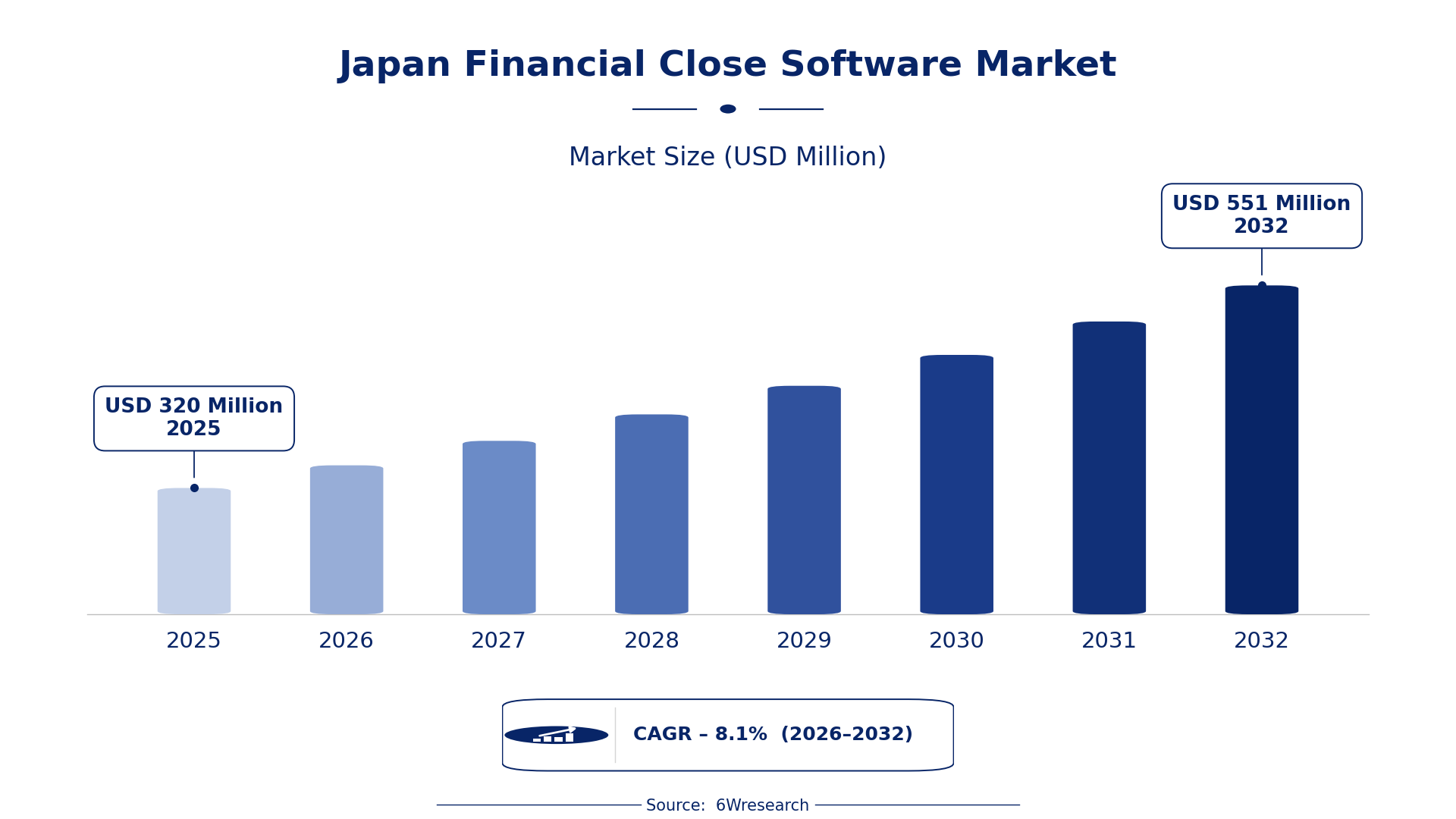
According to 6Wresearch internal database and industry insights, the Japan Financial Close Software Market was valued at USD 320 Million in 2025 and is projected to reach USD 551 Million by 2032, growing at a CAGR of approximately 8.1% during 2026–2032.
Japan Financial Close Software Market Highlights
| Report Metric | Details |
| Report Name | Japan Financial Close Software Market (2026-2032) |
| Market Size 2025 | USD 320 Million |
| Market Size 2032 | USD 551 Million |
| Absolute Growth 2025–2032 | USD 231 Million |
| CAGR 2026–2032 | 8.1% |
| Peak Annual Growth | 9.7% in 2027 |
| Forecast Period | 2026–2032 |
| Historical Data | 2022–2025 |
| Base Year | 2025 |
| Leading Software Type, 2025 | Reporting Automation (43% share) |
| Leading Deployment Type, 2025 | Cloud (48% share) |
| Leading Distribution Channel, 2025 | SaaS Vendors (40% share) |
| Leading End User, 2025 | Finance Teams (45% share) |
| Fastest-Growing Software Type | Compliance Tracking (12.0% CAGR) |
| Fastest-Growing Deployment Type | AI-Based (12.2% CAGR) |
| Fastest-Growing Distribution Channel | Direct Sales (10.6% CAGR) |
| Fastest-Growing End User | Accounting Firms (10.7% CAGR) |
| Growing Sector | Financial Services |
| Key End Users | Finance Teams, Accounting Firms, Internal Auditors, Controllers |
Japan Financial Close Software Market Year-wise Growth Rate and Key Drivers (2022–2032)
This graph illustrates the annual growth rates of the market from 2022 to 2032, highlighting a steady upward trajectory and projected market expansion over the forecast period.
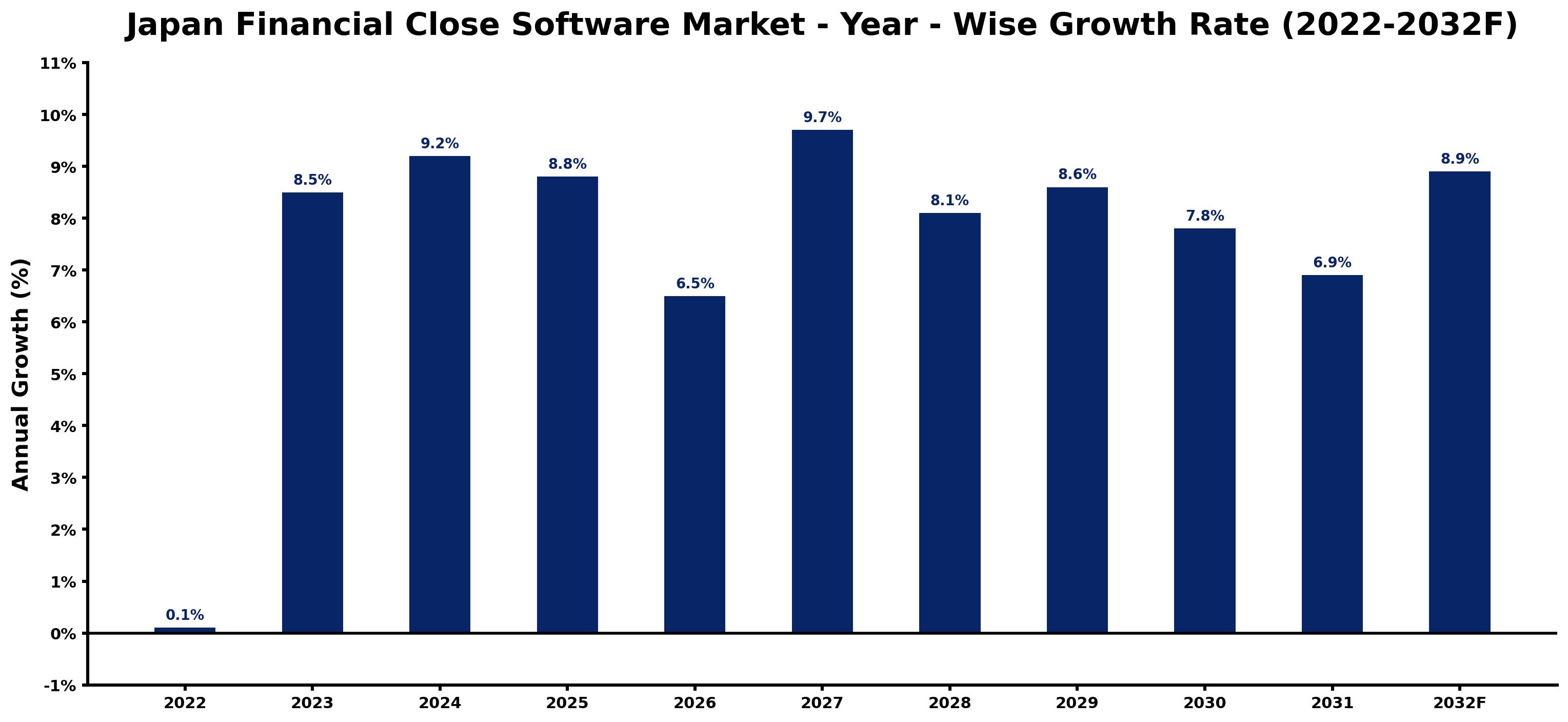
The yearly estimates that follow link every growth rate to its principal driver, so readers can see why the pace changed in each period.
| Year | Estimated Annual Growth (%) | Market Rationale |
| 2022 | 0.1 | The market experienced minimal growth due to ongoing adjustments in financial practices. |
| 2023 | 8.5 | Demand surged as firms sought efficiency amid rising operational costs. |
| 2024 | 9.2 | The market saw accelerated growth driven by increased digital transformation efforts. |
| 2025 | 8.8 | Growth slowed as firms stabilised their financial processes after rapid adoption. |
| 2026 | 6.5 | The market continued to grow, but at a more moderate pace due to saturation effects. |
| 2027 | 9.7 | Demand spiked as companies upgraded to advanced financial close solutions. |
| 2028 | 8.1 | Growth decelerated as firms focused on optimising existing systems. |
| 2029 | 8.6 | Demand rose again as financial regulations prompted software upgrades. |
| 2030 | 7.8 | Growth slowed as market maturity set in, leading to stable demand. |
| 2031 | 6.9 | The market continued to grow, driven by ongoing compliance needs. |
| 2032 | 8.9 | Demand increased as firms adopted innovative technologies for financial processes. |
Note: Market size estimations and growth projections presented in this report are based on 6Wresearch's proprietary forecasting methodology, utilizing the latest available industry data, government publications, and primary research inputs.
Japan Financial Close Software Market Synopsis
Financial Close Software streamlines and automates the financial closing process, improving accuracy and compliance. The Japan Financial Close Software Market is expanding, driven by robust demand from finance teams, with 70% preferring cloud solutions. The average financial close cycle is five days, highlighting a need for greater efficiency. The digital transformation initiative launched in 2023 further propels growth, as firms aim to optimise their financial operations and reporting accuracy.
Market Dynamics Impact Analysis (2026–2032)
| Factor | Type | Impact | Primary Segment Affected |
| Growing demand for automation in financial reporting | Driver | High | Reporting Automation |
| Increased regulatory compliance requirements | Driver | High | Compliance Tracking |
| Rising need for efficient financial processes | Opportunity | High | Consolidation Tools |
| Emerging demand for AI-based solutions | Opportunity | Medium | AI-Based |
| High competition in the software market | Restraint | High | Reporting Automation |
| Potential for market saturation with existing solutions | Restraint | Medium | Reporting Automation |
| Challenges in integrating new software with legacy systems | Challenge | High | Reporting Automation |
| Shortage of skilled professionals in financial technology | Challenge | Medium | Reporting Automation |
Evaluation of Drivers in Japan Financial Close Software Market (2026–2032)
Key forces behind demand, with the segment each one moves most, are listed below.
| Drivers | Primary Segment Affected | Why It Matters (Evidence) |
| Increased demand for faster financial reporting cycles | Reporting Automation | The average financial close cycle in Japan is five days, prompting firms to adopt automation tools. |
| Regulatory compliance requirements | Compliance Tracking | Compliance tracking tools are essential for 90% of accounting firms, driving software adoption. |
| Preference for cloud deployment among finance teams | Cloud | Cloud deployment is preferred by 70% of finance teams in Japan, providing flexibility. |
| Growth in digital finance solutions | AI-Based | The digital transformation initiative launched in 2023 promotes the adoption of new financial technologies. |
| Integration of financial software with ERP systems | Consolidation Tools | ERP integration is crucial for 60% of large enterprises, increasing demand for compatible software. |
The strongest demand comes from finance teams seeking quicker financial reporting cycles, as the average financial close cycle in Japan is five days. Compliance requirements compel 90% of accounting firms to adopt compliance tracking tools, ensuring adherence to standards. Integration with ERP systems is crucial for 60% of large enterprises, driving demand for consolidation tools. Cloud deployment is favoured by 70% of finance teams, offering operational flexibility.
Evaluation of Restraints in Japan Financial Close Software Market
Below are the constraints most often cited by buyers and suppliers, with the segment each affects.
| Market Restraint | Primary Segment Affected | Why It Matters (Evidence) |
| High competition among financial software providers | Reporting Automation | Intense competition limits pricing power, affecting profitability for software vendors. |
| Market saturation with existing solutions | Reporting Automation | Many firms have implemented financial close software, reducing new customer acquisition opportunities. |
| Integration challenges with legacy systems | Reporting Automation | Difficulty in integrating new software with existing systems can delay implementation for buyers. |
| Shortage of skilled professionals in financial technology | Reporting Automation | The lack of qualified personnel can hinder software adoption and effective use. |
| Rapid technological changes requiring constant updates | Reporting Automation | Vendors must continually update their solutions to stay competitive, increasing operational costs. |
Japan Financial Close Software Market Challenges
Many accounting firms in Japan face challenges with outdated technology, resulting in financial close cycles averaging five days. This delay raises operational costs for buyers, who must allocate more resources to manage inefficiencies. A lack of competitive software solutions limits producers' ability to streamline processes, causing lost revenue opportunities in a market with approximately 1.5 million professionals. Skills shortages in financial technology hinder firms' recruitment efforts, ultimately impacting service delivery and client satisfaction across the sector.
Trends in the Japan Financial Close Software Market
Several trends are reshaping the Japan Financial Close Software Market; the most important are set out below.
- Shift towards Cloud-Based Solutions: The Tokyo metropolitan area is experiencing a shift towards cloud-based financial close solutions, with 70% of finance teams preferring this deployment type. This trend improves operational flexibility and scalability, allowing firms to adapt to changing financial landscapes.
- Emergence of AI-Based Financial Tools: AI-based financial close software is gaining traction, with a projected CAGR of 12.2% from 2026 to 2032. This shift is driven by the need for predictive analytics in finance, enabling firms to make data-driven decisions.
- Increased Focus on Compliance Tracking: Accounting firms are increasingly prioritising compliance tracking tools, essential for 90% of their operations. This trend highlights the growing importance of regulatory adherence in financial reporting.
- Growth of Direct Sales Channels: Direct sales channels are expanding, with a projected CAGR of 10.6% from 2026 to 2032. This shift allows software providers to reach large enterprises more effectively, improving customer engagement.
Investment Opportunities in the Japan Financial Close Software Market
The following areas offer the clearest openings for investors and suppliers in the Japan Financial Close Software Market.
- Investment in Cloud Infrastructure: The Tokyo metropolitan area presents an opportunity for investment in cloud infrastructure, with 70% of finance teams preferring cloud solutions. This trend points to a growing market for cloud service providers.
- Expansion of AI-Based Financial Solutions: With a projected CAGR of 12.2%, there is an opportunity to develop AI-based financial solutions. Accounting firms are increasingly seeking these tools to enhance their services.
- Development of Compliance Tracking Software: The high demand for compliance tracking tools presents an opportunity for software developers. Accounting firms in Japan are prioritising these solutions to ensure regulatory adherence.
- Improvement of Direct Sales Strategies: The rise in direct sales channels offers an opportunity for software providers to refine their engagement strategies. Large enterprises are increasingly adopting direct sales approaches for software procurement.
Government Initiatives in the Japan Financial Close Software Market
The Industrial Standardization Act, established in 1949 and amended in 2019, governs product and test standards in Japan. This law ensures that financial close software meets quality and compliance standards, benefiting both producers and buyers. Additionally, the AI Promotion Act, enacted in 2025, creates a framework for AI research and development, encouraging the integration of AI technologies in financial software solutions.
The Digital Agency leads government digital transformation initiatives that support finance teams by funding projects aimed at improving digital capabilities in financial software. Their efforts seek to streamline compliance processes and enhance operational efficiency for financial institutions, with substantial funding allocated to improve digital infrastructure.
Future Insight of the Japan Financial Close Software Market
The digital transformation initiative will reshape the financial landscape by 2032, driving a shift towards cloud-based solutions. Compliance standards will tighten, requiring firms to adopt ISO 9001 quality measures for reliability. The integration of advanced ERP systems will be crucial for large enterprises, improving operational efficiency. As the Tokyo metropolitan area continues to host over 3,500 listed companies, this competitive environment will stimulate innovation and elevate service offerings in the financial sector.
Market Segmentation Analysis
Japan Financial Close Software Market report covers a detailed analysis of the following market segments:
By Software Type – Reporting Automation Leads, Compliance Tracking Expected to Grow Fastest
According to Saurav Kr Singh, Senior Research Analyst at 6Wresearch, Reporting Automation accounted for 43% of the market by software type in 2025. Reporting Automation holds the largest share due to its essential role in generating timely financial reports for organisations. The presence of over 1,000 registered accounting firms in the Tokyo metropolitan area creates substantial demand for efficient reporting solutions. Compliance Tracking is projected to grow fastest, at a CAGR of 12.0% during 2026–2032. Compliance Tracking is experiencing rapid growth as it is crucial for adhering to regulatory standards, particularly with 90% of accounting firms relying on compliance tools. The increasing regulatory scrutiny from the Financial Services Agency further accelerates this trend. Suppliers should focus on enhancing compliance tracking features to align with the growing demand.
By Deployment Type – Cloud Leads, AI-Based Expected to Grow Fastest
Cloud took 48% of deployment type revenue in 2025, more than any other category. Cloud deployment leads the market as it is favoured by 70% of finance teams in Japan for its flexibility and scalability. This widespread preference indicates a shift towards more agile financial processes in urban financial centres. The quickest growth will come from AI-Based, forecast to expand at a CAGR of 12.2% between 2026 and 2032. AI-Based deployment is witnessing rapid growth due to its emerging applications in predictive analytics, which can improve financial decision-making. The ongoing digital transformation initiatives are also driving interest in these advanced technologies. Buyers should prioritise cloud solutions that incorporate advanced analytics capabilities to maintain a competitive edge.
By Distribution Channel – SaaS Vendors Lead, Direct Sales Expected to Grow Fastest
In 2025, SaaS Vendors led the distribution channel split with a 40% share. SaaS Vendors dominate the distribution channel as they serve as the primary means of delivering financial software solutions to users. This model effectively meets the needs of finance teams seeking accessible and efficient software options. Direct Sales is set to record the highest CAGR in this split, 10.6% over 2026–2032. Direct Sales is growing quickly as it allows for effective engagement with large enterprises, providing tailored solutions that address specific organisational requirements. This trend reflects a demand for personalised service in software procurement. Suppliers may need to refine their direct sales approaches to capture the increasing demand from large enterprises.
By End User – Finance Teams Lead, Accounting Firms Expected to Grow Fastest
The largest end user category in 2025 was Finance Teams, at 45% of revenue. Finance Teams represent the largest user base for financial close software, as they are the primary users responsible for managing the financial closing process. Their critical role in ensuring accuracy in financial reporting drives substantial demand for these solutions. Over 2026–2032, Accounting Firms are expected to post the fastest growth, at a CAGR of 10.7%. Accounting Firms are the fastest-growing segment as they increasingly utilise software for client financial management, reflecting a shift towards more efficient practices. The need for compliance tracking tools among 90% of these firms further accelerates this growth. Suppliers should focus on features that cater specifically to the needs of accounting firms to capitalise on this growth.
Key Attractiveness of the Report
- 10 Years of Market Numbers
- Historical Data Starting from 2022 to 2025
- Base Year 2025
- Forecast Data until 2032
- Key Performance Indicators Impacting the Market
- Major Upcoming Developments and Projects
Key Highlights of the Report:
- Japan Financial Close Software Market Outlook
- Market Size of Japan Financial Close Software Market, 2025
- Forecast of Japan Financial Close Software Market, 2032
- Historical Data and Forecast of Japan Financial Close Software Revenues & Volume for the Period 2022-2032F
- Japan Financial Close Software Market Trend Evolution
- Japan Financial Close Software Market Drivers and Challenges
- Japan Financial Close Software Price Trends
- Japan Financial Close Software Porter's Five Forces
- Japan Financial Close Software Industry Life Cycle
- Historical Data and Forecast of Japan Financial Close Software Market Revenues & Volume By Software Type for the Period 2022-2032F
- Historical Data and Forecast of Japan Financial Close Software Market Revenues & Volume By Consolidation Tools for the Period 2022-2032F
- Historical Data and Forecast of Japan Financial Close Software Market Revenues & Volume By Reconciliation Tools for the Period 2022-2032F
- Historical Data and Forecast of Japan Financial Close Software Market Revenues & Volume By Compliance Tracking for the Period 2022-2032F
- Historical Data and Forecast of Japan Financial Close Software Market Revenues & Volume By Reporting Automation for the Period 2022-2032F
- Historical Data and Forecast of Japan Financial Close Software Market Revenues & Volume By Deployment Type for the Period 2022-2032F
- Historical Data and Forecast of Japan Financial Close Software Market Revenues & Volume By Cloud for the Period 2022-2032F
- Historical Data and Forecast of Japan Financial Close Software Market Revenues & Volume By On-Premise for the Period 2022-2032F
- Historical Data and Forecast of Japan Financial Close Software Market Revenues & Volume By Hybrid for the Period 2022-2032F
- Historical Data and Forecast of Japan Financial Close Software Market Revenues & Volume By AI-Based for the Period 2022-2032F
- Historical Data and Forecast of Japan Financial Close Software Market Revenues & Volume By Distribution Channel for the Period 2022-2032F
- Historical Data and Forecast of Japan Financial Close Software Market Revenues & Volume By SaaS Vendors for the Period 2022-2032F
- Historical Data and Forecast of Japan Financial Close Software Market Revenues & Volume By Software Dealers for the Period 2022-2032F
- Historical Data and Forecast of Japan Financial Close Software Market Revenues & Volume By Direct Sales for the Period 2022-2032F
- Historical Data and Forecast of Japan Financial Close Software Market Revenues & Volume By ERP Integrators for the Period 2022-2032F
- Historical Data and Forecast of Japan Financial Close Software Market Revenues & Volume By End User for the Period 2022-2032F
- Historical Data and Forecast of Japan Financial Close Software Market Revenues & Volume By Finance Teams for the Period 2022-2032F
- Historical Data and Forecast of Japan Financial Close Software Market Revenues & Volume By Accounting Firms for the Period 2022-2032F
- Historical Data and Forecast of Japan Financial Close Software Market Revenues & Volume By Internal Auditors for the Period 2022-2032F
- Historical Data and Forecast of Japan Financial Close Software Market Revenues & Volume By Controllers for the Period 2022-2032F
- Japan Financial Close Software Import Export Trade Statistics
- Market Opportunity Assessment By Software Type
- Market Opportunity Assessment By Deployment Type
- Market Opportunity Assessment By Distribution Channel
- Market Opportunity Assessment By End User
- Japan Financial Close Software Top Companies Market Share
- Japan Financial Close Software Competitive Benchmarking By Technical and Operational Parameters
- Japan Financial Close Software Company Profiles
- Japan Financial Close Software Key Strategic Recommendations
Market Covered
Segments analysed in this report are listed below.
By Software Type
- Consolidation Tools
- Reconciliation Tools
- Compliance Tracking
- Reporting Automation
By Deployment Type
- Cloud
- On-Premise
- Hybrid
- AI-Based
By Distribution Channel
- SaaS Vendors
- Software Dealers
- Direct Sales
- ERP Integrators
By End User
- Finance Teams
- Accounting Firms
- Internal Auditors
- Controllers































