Japan Financial Cybersecurity Market Size & Growth Rate
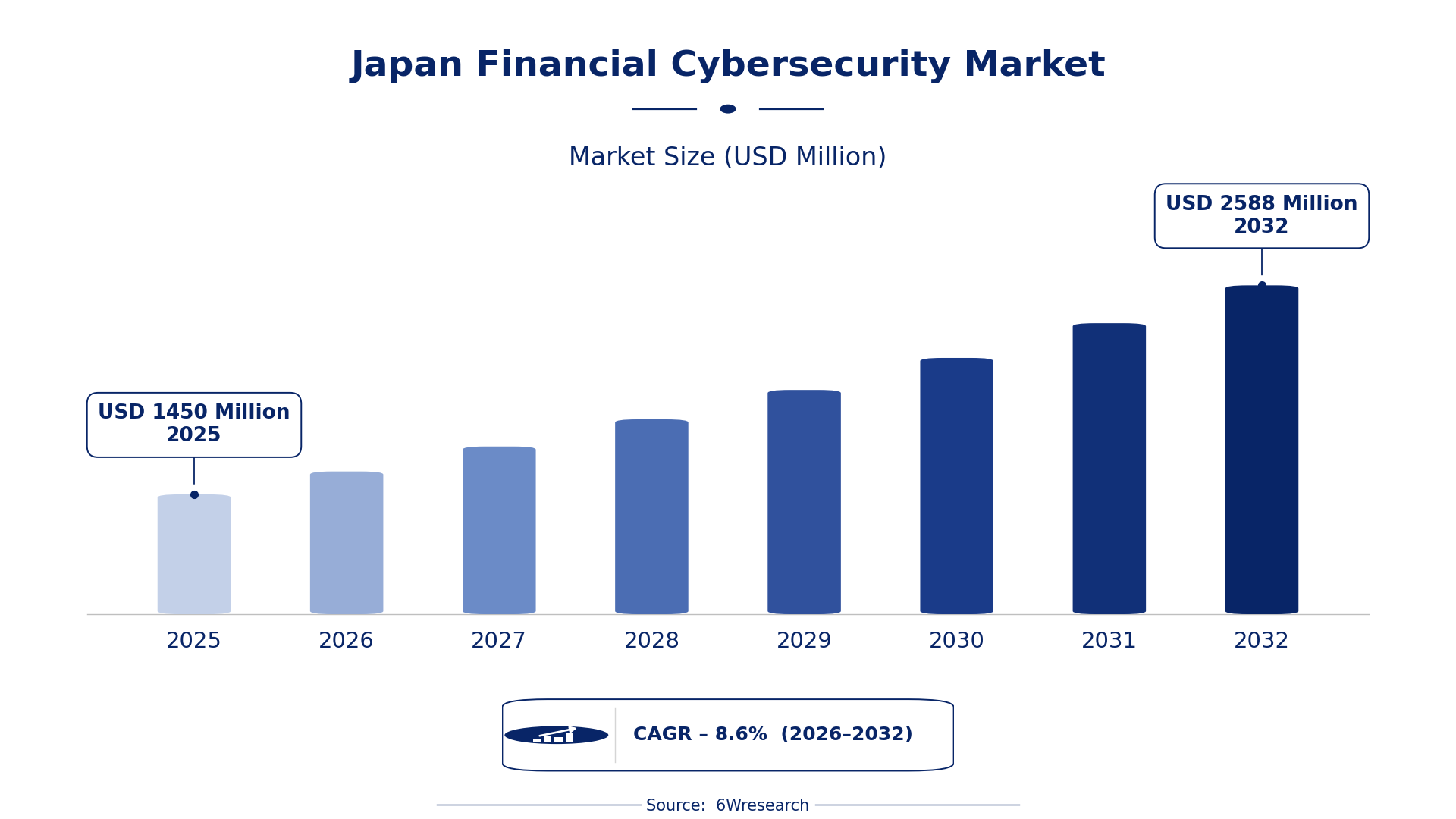
According to 6Wresearch internal database and industry insights, the Japan Financial Cybersecurity Market was valued at USD 1,450 Million in 2025 and is projected to reach USD 2,588 Million by 2032, growing at a CAGR of approximately 8.6% during 2026–2032.
Japan Financial Cybersecurity Market Highlights
| Report Metric | Details |
| Report Name | Japan Financial Cybersecurity Market (2026-2032) |
| Market Size 2025 | USD 1,450 Million |
| Market Size 2032 | USD 2,588 Million |
| Absolute Growth 2025–2032 | USD 1,138 Million |
| CAGR 2026–2032 | 8.6% |
| Peak Annual Growth | 10.6% in 2026 |
| Forecast Period | 2026–2032 |
| Historical Data | 2022–2025 |
| Base Year | 2025 |
| Leading Security Type, 2025 | Network Security (45% share) |
| Leading Threat Type, 2025 | Malware (38% share) |
| Leading Distribution Channel, 2025 | Cybersecurity Firms (43% share) |
| Leading End User, 2025 | Online Banks (36% share) |
| Fastest-Growing Security Type | Cloud Security (12.1% CAGR) |
| Fastest-Growing Threat Type | Data Theft (12.2% CAGR) |
| Fastest-Growing Distribution Channel | SaaS Marketplaces (10.9% CAGR) |
| Fastest-Growing End User | Digital Wallets (11.2% CAGR) |
| Growing Sector | Financial Services |
| Key End Users | Online Banks, Payment Apps, Digital Wallets, Trading Platforms |
Japan Financial Cybersecurity Market Year-wise Growth Rate and Key Drivers (2022–2032)
This graph illustrates the annual growth rates of the market from 2022 to 2032, highlighting a steady upward trajectory and projected market expansion over the forecast period.
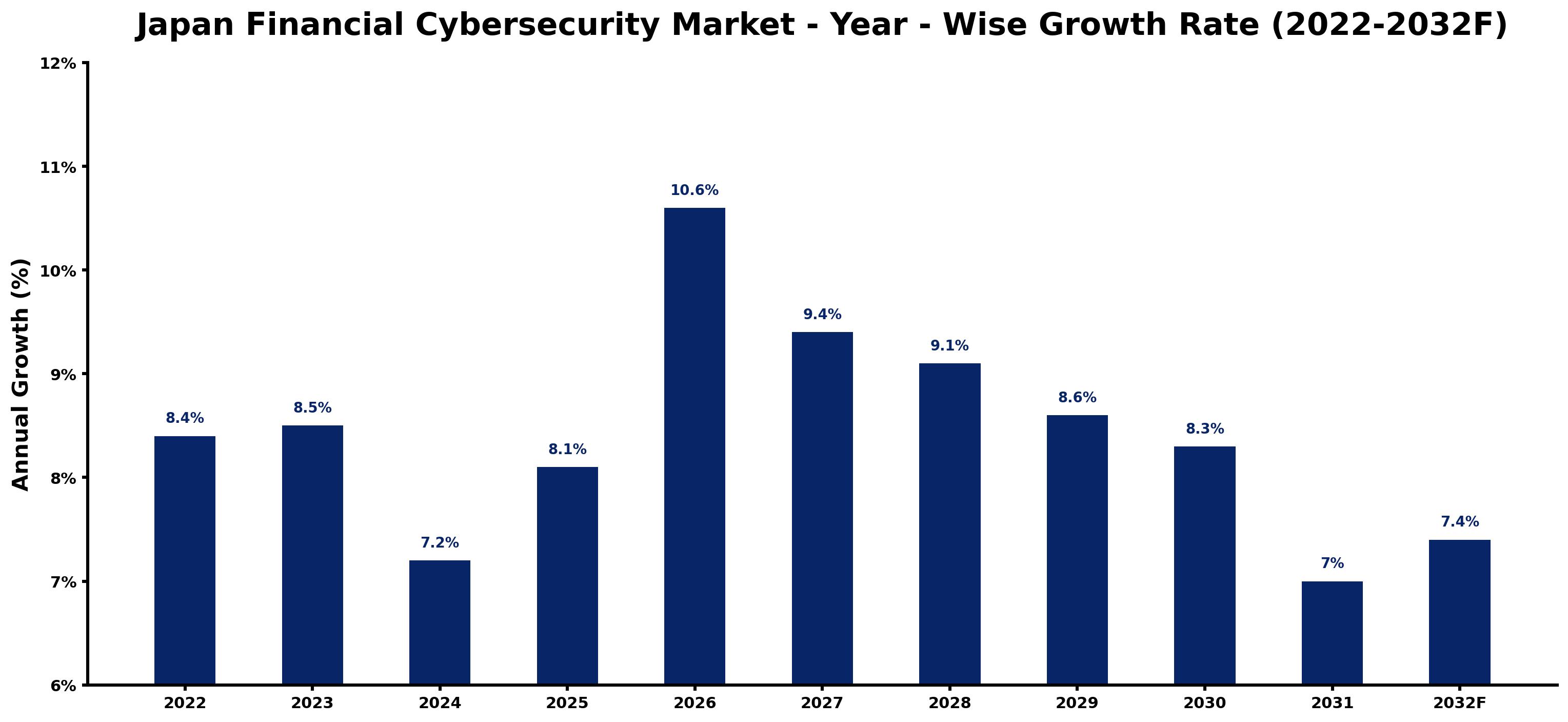
Each row of the following table gives one year's estimated growth and the event or demand shift that explains it.
| Year | Estimated Annual Growth (%) | Market Rationale |
| 2022 | 8.4 | Demand for financial cybersecurity increased due to rising online banking usage. |
| 2023 | 8.5 | Growth accelerated as the digital payment market expanded. |
| 2024 | 7.2 | A slowdown occurred as cybersecurity investments stabilised after high growth. |
| 2025 | 8.1 | Demand rose again as online banking users surpassed 30 million. |
| 2026 | 10.6 | The market peaked with heightened focus on compliance and security standards. |
| 2027 | 9.4 | Growth slowed as the market matured and competition intensified. |
| 2028 | 9.1 | A further slowdown was noted as firms consolidated their cybersecurity measures. |
| 2029 | 8.6 | Demand remained strong but growth rates continued to slow slightly. |
| 2030 | 8.3 | Market growth decelerated as firms focused on existing cybersecurity frameworks. |
| 2031 | 7.0 | A slowdown was observed as the market adjusted to regulatory changes. |
| 2032 | 7.4 | Growth picked up slightly as new cybersecurity initiatives were launched. |
Note: Market size estimations and growth projections presented in this report are based on 6Wresearch's proprietary forecasting methodology, utilizing the latest available industry data, government publications, and primary research inputs.
Japan Financial Cybersecurity Market Synopsis
Financial cybersecurity includes technologies and practices aimed at safeguarding financial data and transactions from cyber threats. The Japan Financial Cybersecurity Market is expanding due to the financial services sector, which exceeds 100 trillion yen, alongside a growing base of online banking users, now over 30 million. Compliance with strict regulations and the rise of digital payment solutions, expected to hit 10 trillion yen by 2025, are key drivers of this demand.
Market Dynamics Impact Analysis (2026–2032)
| Factor | Type | Impact | Primary Segment Affected |
| The increasing number of online banking users drives demand for robust cybersecurity solutions, ensuring financial data protection. | Driver | High | Endpoint Security |
| The digital payment market's projected growth to 10 trillion yen by 2025 necessitates enhanced security measures across platforms. | Driver | High | Cloud Security |
| The need for compliance with ISO/IEC 27001 standards creates opportunities for cybersecurity firms to offer certification services. | Opportunity | High | Cybersecurity Firms |
| The growing demand for digital wallets presents an opportunity for suppliers to develop tailored security solutions. | Opportunity | Medium | Digital Wallets |
| Competition among financial institutions leads to inflated costs for cybersecurity solutions, impacting budget allocations. | Restraint | High | Cybersecurity Firms |
| Supply chain constraints due to a limited number of domestic cybersecurity providers delay necessary security implementations. | Restraint | Medium | Endpoint Security |
| Skills shortages in cybersecurity talent hinder the ability of firms to implement effective security measures, delaying project timelines. | Challenge | High | Cybersecurity Firms |
| Integration challenges with existing systems complicate the adoption of advanced cybersecurity technologies, exposing institutions to risks. | Challenge | Medium | Cloud Security |
Evaluation of Drivers in Japan Financial Cybersecurity Market (2026–2032)
Below are the drivers that matter most for revenue growth, with supporting evidence.
| Drivers | Primary Segment Affected | Why It Matters (Evidence) |
| Rising number of online banking users increases demand for cybersecurity solutions. | Online Banks | The number of online banking users in Japan exceeds 30 million, prompting banks to invest in security. |
| Expansion of the digital payment market drives investment in cybersecurity. | Payment Apps | Japan's digital payment market is projected to reach 10 trillion yen by 2025, necessitating security. |
| Compliance with regulatory standards boosts demand for cybersecurity services. | Cybersecurity Firms | The Financial Services Agency oversees stringent regulations that require financial institutions to enhance security. |
| Increased cyber threats lead to higher investments in security technologies. | Endpoint Security | Firms must invest constantly to keep pace with new types of cyber attacks. |
| Growing awareness of cybersecurity risks among consumers drives security investments. | Digital Wallets | As consumers become more aware of data theft risks, demand for security measures increases. |
Volumes grow on the back of the increasing number of online banking users, which exceeds 30 million, leading banks to invest in their cybersecurity measures. The digital payment market, projected to reach 10 trillion yen by 2025, necessitates security solutions, prompting payment app developers to invest heavily in cybersecurity. Continuous adaptation to evolving threats drives demand for endpoint security solutions. Consumer awareness of cybersecurity risks accelerates investments in protective measures across digital wallets and online banking platforms.
Evaluation of Restraints in Japan Financial Cybersecurity Market
Several factors work against faster growth; the main ones are summarised below.
| Market Restraint | Primary Segment Affected | Why It Matters (Evidence) |
| Regulatory compliance costs can strain budgets of financial institutions. | Online Banks | Compliance with regulations from the Financial Services Agency requires significant investment in cybersecurity. |
| Limited awareness of cybersecurity threats among users can lead to vulnerabilities. | Digital Wallets | Consumers' lack of understanding of potential risks can result in inadequate security measures. |
| Talent shortages in cybersecurity expertise hinder firms' ability to respond to threats. | Cybersecurity Firms | The demand for skilled professionals exceeds supply, delaying security implementations. |
| Rapidly evolving cyber threats require continuous updates to security measures. | Endpoint Security | Firms must invest constantly to keep pace with new types of cyber attacks. |
| High costs of advanced security technologies can deter smaller firms from investing. | Payment Apps | Smaller payment app developers may struggle to allocate funds for necessary cybersecurity investments. |
Japan Financial Cybersecurity Market Challenges
Buyers in Japan's financial services sector contend with fierce competition, as over 100 trillion yen in assets attracts numerous firms, driving up the costs of cybersecurity solutions. Supply chain issues arise from dependence on a limited number of domestic cybersecurity providers, delaying critical protections for over 30 million online banking users. Skills shortages result from the rapid evolution of cyber threats, complicating recruitment and potentially extending project timelines by six months. Technology integration challenges persist, as many institutions struggle to implement advanced cybersecurity measures, leaving them exposed to data breaches.
Trends in the Japan Financial Cybersecurity Market
The trends below show where the Japan Financial Cybersecurity Market is heading.
- Shift from Traditional to Cloud-Based Security Solutions: The Tokyo Metropolitan Area is witnessing a shift towards cloud-based cybersecurity solutions as firms seek greater flexibility and scalability. This trend is reflected in the cloud security segment, which is growing at a CAGR of 12.1% through 2032.
- Transition from Reactive to Proactive Cybersecurity Measures: Since 2023, financial institutions have begun to prioritise proactive cybersecurity measures to avert breaches. This shift is marked by the rising adoption of ISO/IEC 27001 standards among firms.
- Emergence of AI-Driven Cybersecurity Solutions: The AI Promotion Act, established in 2025, is catalysing the development of AI-driven cybersecurity solutions. This trend enhances threat detection capabilities across the financial sector.
- Increased Collaboration Among Cybersecurity Firms: The Cybersecurity Strategy Council, founded in 2020, encourages collaboration among cybersecurity firms to exchange best practices. This initiative strengthens security frameworks throughout the industry.
Investment Opportunities in the Japan Financial Cybersecurity Market
The openings below show where demand in the Japan Financial Cybersecurity Market is visible and how suppliers can enter.
- Investment in Advanced Endpoint Security Solutions: With the endpoint security segment expanding rapidly, there is a chance to provide advanced solutions. Cybersecurity firms are looking for technologies to protect devices from threats, especially as the number of online banking users continues to rise.
- Supply of Cloud Security Services: As cloud security experiences rapid growth, firms can invest in tailored cloud security services. Online banks particularly require these solutions to safeguard their operations.
- Development of AI-Powered Cybersecurity Tools: The demand for AI-driven tools is on the rise, creating an opportunity for investment in this area. Cybersecurity firms can leverage the AI Promotion Act to improve their offerings and meet market demands.
- Expansion of Cybersecurity Training Programs: With talent shortages in cybersecurity, there is an urgent need for training programs. Educational institutions and training providers can partner with cybersecurity firms to create courses that address skills gaps.
Government Initiatives in the Japan Financial Cybersecurity Market
In 2023, the government introduced a cybersecurity strategy targeting financial institutions, strengthening existing regulations. This strategy builds on the Cybersecurity Management Guidelines updated in 2022, which addressed emerging threats and established clearer compliance requirements for financial firms.
The Digital Agency supports financial institutions in executing the cybersecurity strategy by providing funding and resources. This agency oversees the allocation of 5 billion yen for cybersecurity initiatives in finance, assisting firms in enhancing their security measures and meeting regulatory standards.
Future Insight of the Japan Financial Cybersecurity Market
Investment in new cybersecurity initiatives will rise sharply by 2032, driven by government funding for cybersecurity projects in finance. Compliance with ISO/IEC 27001 will become standard practice, ensuring financial institutions adopt strong security measures. The Cybersecurity Management Guidelines will aid adaptation to new threats, promoting collaboration across sectors. Advances in threat intelligence will enable suppliers to create more effective solutions, ultimately bolstering the security of financial transactions and data for buyers.
Market Segmentation Analysis
Japan Financial Cybersecurity Market report covers a detailed analysis of the following market segments:
By Security Type – Network Security Leads, Cloud Security Expected to Grow Fastest
According to Saurav Kr Singh, Senior Research Analyst at 6Wresearch, with 45% of security type revenue in 2025, Network Security was the largest category. Network security is essential for safeguarding communication channels in financial transactions, making it a priority for financial institutions. The concentration of cybersecurity firms in the Tokyo Metropolitan Area facilitates the widespread implementation of network security solutions. Cloud Security is projected to grow fastest, at a CAGR of 12.1% during 2026–2032. The growing adoption of cloud services in the financial sector is significantly increasing the demand for cloud security, as institutions aim to protect their cloud-based operations. The projected growth of Japan's digital payment market to 10 trillion yen by 2025 will further drive this demand. Suppliers should focus on enhancing their cloud security offerings to meet the evolving needs of financial institutions.
By Threat Type – Malware Leads, Data Theft Expected to Grow Fastest
Malware accounted for 38% of the market by threat type in 2025. Malware continues to be a dominant threat to financial systems, which drives its leading position in the market. The extensive use of online banking by over 30 million users in Japan amplifies the necessity for effective malware protection. Data Theft is set to record the highest CAGR in this split, 12.2% over 2026–2032. Data theft is becoming a more pressing concern as financial institutions face increasing risks of sensitive information being unlawfully acquired. The launch of the government's cybersecurity strategy in 2023 highlights the urgent need to combat this threat. Buyers must focus on solutions that specifically address the risks associated with data theft to protect their sensitive information.
By Distribution Channel – Cybersecurity Firms Lead, SaaS Marketplaces Expected to Grow Fastest
Cybersecurity Firms held 43% of the Japan Financial Cybersecurity Market by distribution channel in 2025. Cybersecurity firms are crucial in providing specialised security services tailored to the financial sector, securing the largest share in this distribution channel. Their expertise is vital as financial institutions comply with the stringent cybersecurity regulations set by the Financial Services Agency. Over 2026–2032, SaaS Marketplaces are expected to post the fastest growth, at a CAGR of 10.9%. SaaS marketplaces are rapidly emerging as preferred platforms for distributing cybersecurity applications, catering to the increasing demand for flexible solutions. The government's allocation of 5 billion yen for cybersecurity initiatives in finance is expected to bolster this growth. Suppliers should consider forming partnerships with SaaS marketplaces to expand their reach in the financial cybersecurity market.
By End User – Online Banks Lead, Digital Wallets Expected to Grow Fastest
The largest end user category in 2025 was Online Banks, at 36% of revenue. Online banks are the primary beneficiaries of financial cybersecurity solutions, necessitating robust protection for their operations. Their substantial role in Japan's financial services sector, valued at over 100 trillion yen, underscores their reliance on effective cybersecurity measures. The quickest growth will come from Digital Wallets, forecast to expand at a CAGR of 11.2% between 2026 and 2032. Digital wallets are experiencing rapid growth as consumers increasingly adopt cashless payment methods, thereby driving the need for enhanced security. The rise in digital payment transactions is a significant factor contributing to this segment's swift expansion. Suppliers must tailor their offerings to meet the specific security needs of digital wallet providers.
Key Attractiveness of the Report
- 10 Years of Market Numbers
- Historical Data Starting from 2022 to 2025
- Base Year 2025
- Forecast Data until 2032
- Key Performance Indicators Impacting the Market
- Major Upcoming Developments and Projects
Key Highlights of the Report:
- Japan Financial Cybersecurity Market Outlook
- Market Size of Japan Financial Cybersecurity Market, 2025
- Forecast of Japan Financial Cybersecurity Market, 2032
- Historical Data and Forecast of Japan Financial Cybersecurity Revenues & Volume for the Period 2022-2032F
- Japan Financial Cybersecurity Market Trend Evolution
- Japan Financial Cybersecurity Market Drivers and Challenges
- Japan Financial Cybersecurity Price Trends
- Japan Financial Cybersecurity Porter's Five Forces
- Japan Financial Cybersecurity Industry Life Cycle
- Historical Data and Forecast of Japan Financial Cybersecurity Market Revenues & Volume By Security Type for the Period 2022-2032F
- Historical Data and Forecast of Japan Financial Cybersecurity Market Revenues & Volume By Endpoint Security for the Period 2022-2032F
- Historical Data and Forecast of Japan Financial Cybersecurity Market Revenues & Volume By Network Security for the Period 2022-2032F
- Historical Data and Forecast of Japan Financial Cybersecurity Market Revenues & Volume By Identity Management for the Period 2022-2032F
- Historical Data and Forecast of Japan Financial Cybersecurity Market Revenues & Volume By Cloud Security for the Period 2022-2032F
- Historical Data and Forecast of Japan Financial Cybersecurity Market Revenues & Volume By Threat Type for the Period 2022-2032F
- Historical Data and Forecast of Japan Financial Cybersecurity Market Revenues & Volume By Malware for the Period 2022-2032F
- Historical Data and Forecast of Japan Financial Cybersecurity Market Revenues & Volume By Intrusion for the Period 2022-2032F
- Historical Data and Forecast of Japan Financial Cybersecurity Market Revenues & Volume By Phishing for the Period 2022-2032F
- Historical Data and Forecast of Japan Financial Cybersecurity Market Revenues & Volume By Data Theft for the Period 2022-2032F
- Historical Data and Forecast of Japan Financial Cybersecurity Market Revenues & Volume By Distribution Channel for the Period 2022-2032F
- Historical Data and Forecast of Japan Financial Cybersecurity Market Revenues & Volume By Cybersecurity Firms for the Period 2022-2032F
- Historical Data and Forecast of Japan Financial Cybersecurity Market Revenues & Volume By Direct Sales for the Period 2022-2032F
- Historical Data and Forecast of Japan Financial Cybersecurity Market Revenues & Volume By Software Vendors for the Period 2022-2032F
- Historical Data and Forecast of Japan Financial Cybersecurity Market Revenues & Volume By SaaS Marketplaces for the Period 2022-2032F
- Historical Data and Forecast of Japan Financial Cybersecurity Market Revenues & Volume By End User for the Period 2022-2032F
- Historical Data and Forecast of Japan Financial Cybersecurity Market Revenues & Volume By Online Banks for the Period 2022-2032F
- Historical Data and Forecast of Japan Financial Cybersecurity Market Revenues & Volume By Trading Platforms for the Period 2022-2032F
- Historical Data and Forecast of Japan Financial Cybersecurity Market Revenues & Volume By Payment Apps for the Period 2022-2032F
- Historical Data and Forecast of Japan Financial Cybersecurity Market Revenues & Volume By Digital Wallets for the Period 2022-2032F
- Japan Financial Cybersecurity Import Export Trade Statistics
- Market Opportunity Assessment By Security Type
- Market Opportunity Assessment By Threat Type
- Market Opportunity Assessment By Distribution Channel
- Market Opportunity Assessment By End User
- Japan Financial Cybersecurity Top Companies Market Share
- Japan Financial Cybersecurity Competitive Benchmarking By Technical and Operational Parameters
- Japan Financial Cybersecurity Company Profiles
- Japan Financial Cybersecurity Key Strategic Recommendations
Market Covered
This report examines the market across the segments below.
By Security Type
- Endpoint Security
- Network Security
- Identity Management
- Cloud Security
By Threat Type
- Malware
- Intrusion
- Phishing
- Data Theft
By Distribution Channel
- Cybersecurity Firms
- Direct Sales
- Software Vendors
- SaaS Marketplaces
By End User
- Online Banks
- Trading Platforms
- Payment Apps
- Digital Wallets































