Japan Financial Data Aggregation Market Size & Growth Rate
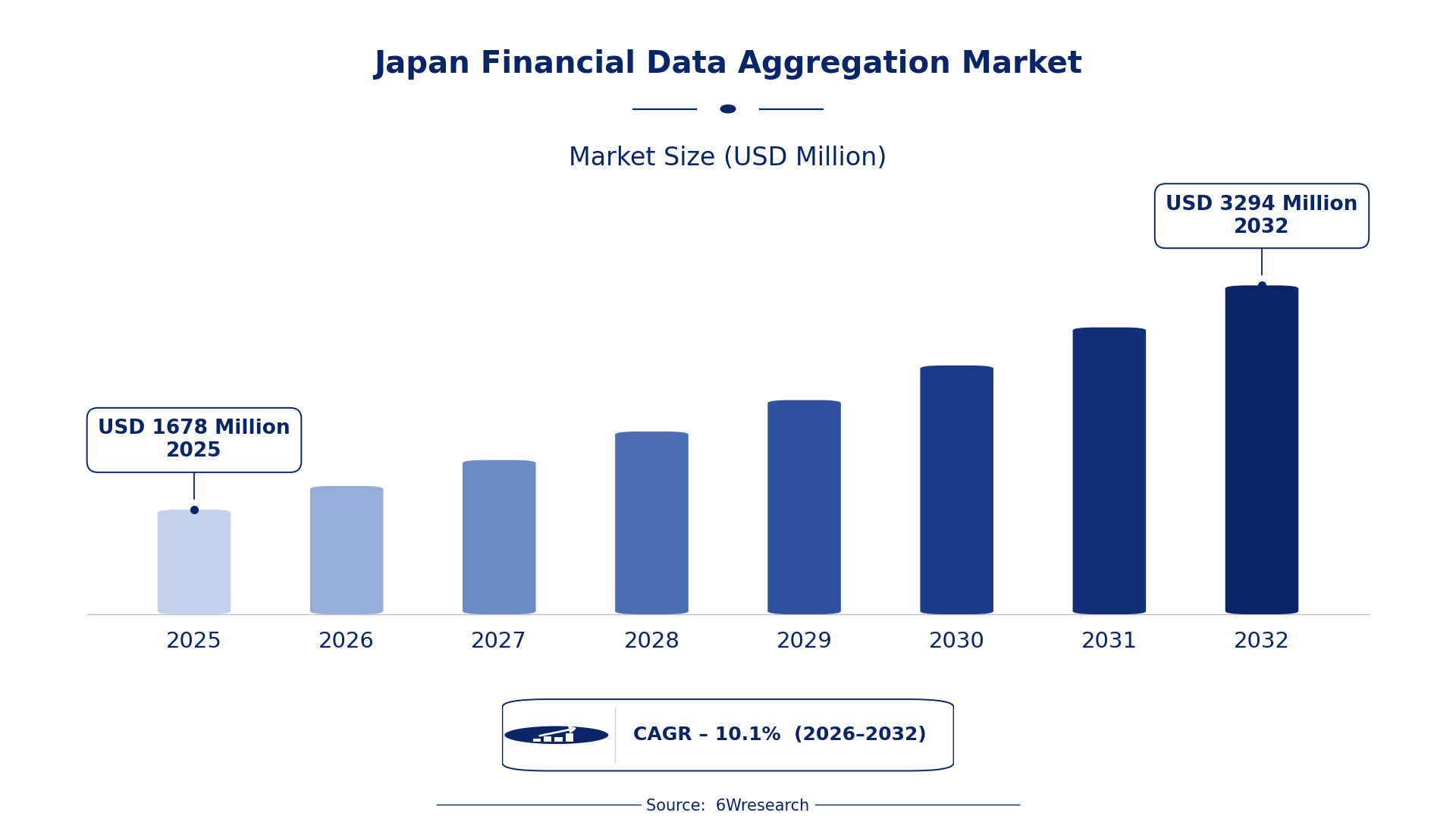
According to 6Wresearch internal database and industry insights, the Japan Financial Data Aggregation Market was valued at USD 1,678 Million in 2025 and is projected to reach USD 3,294 Million by 2032, growing at a CAGR of approximately 10.1% during 2026–2032.
Japan Financial Data Aggregation Market Highlights
| Report Metric | Details |
| Report Name | Japan Financial Data Aggregation Market (2026-2032) |
| Market Size 2025 | USD 1,678 Million |
| Market Size 2032 | USD 3,294 Million |
| Absolute Growth 2025–2032 | USD 1,616 Million |
| CAGR 2026–2032 | 10.1% |
| Peak Annual Growth | 11.1% in 2028 |
| Forecast Period | 2026–2032 |
| Historical Data | 2022–2025 |
| Base Year | 2025 |
| Leading Aggregation Type, 2025 | API-based Aggregators (45% share) |
| Leading Data Source, 2025 | Bank Feeds (39% share) |
| Leading Distribution Channel, 2025 | FinTech Firms (53% share) |
| Leading End User, 2025 | Personal Finance Apps (44% share) |
| Fastest-Growing Aggregation Type | Platform Aggregators (13.6% CAGR) |
| Fastest-Growing Distribution Channel | SaaS Tools (13.0% CAGR) |
| Fastest-Growing End User | Robo-Advisors (12.6% CAGR) |
| Growing Sector | Robo-Advisors |
| Key End Users | Personal Finance Apps, Robo-Advisors, Financial Analysts, Core Banking Providers |
Japan Financial Data Aggregation Market Year-wise Growth Rate and Key Drivers (2022–2032)
This graph illustrates the annual growth rates of the market from 2022 to 2032, highlighting a steady upward trajectory and projected market expansion over the forecast period.
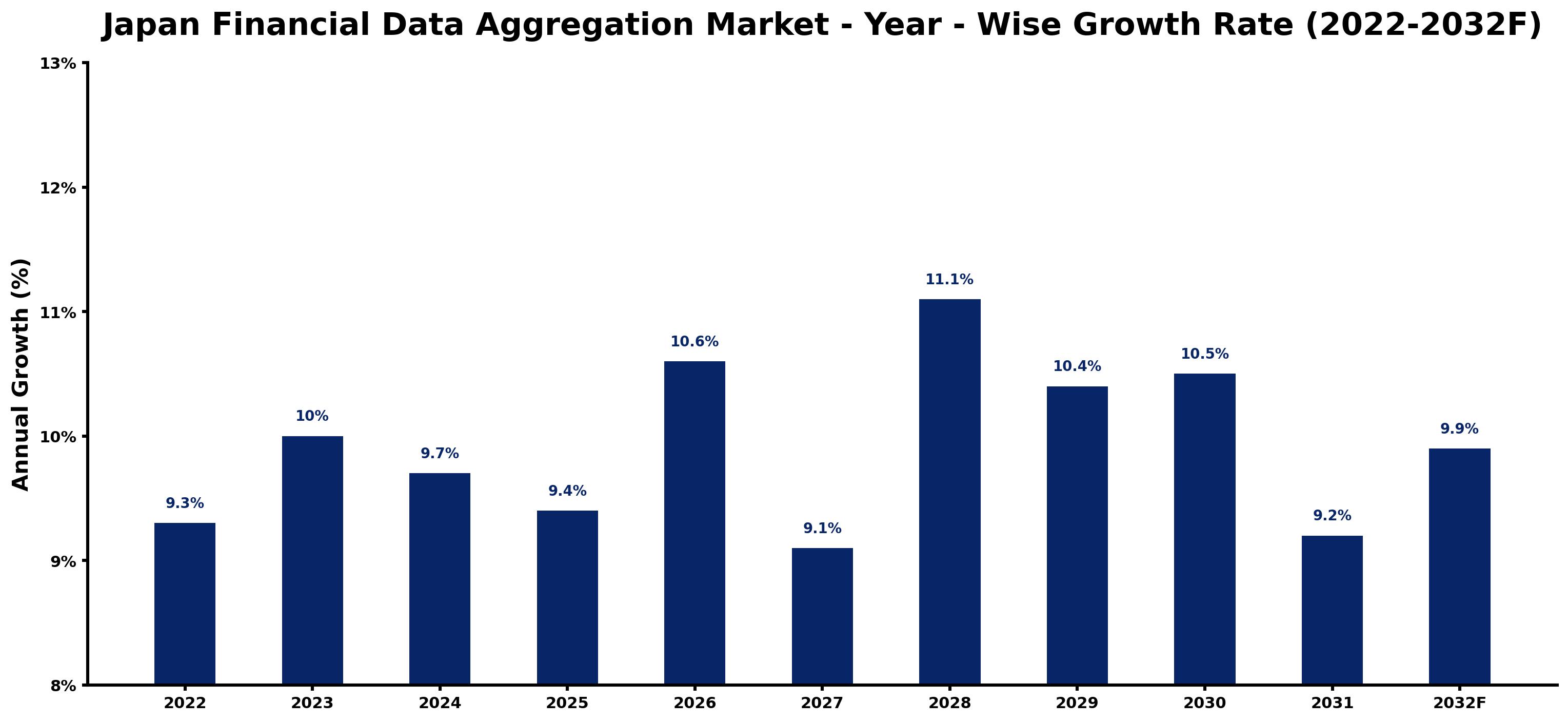
Below, each year's estimated growth is shown next to the factor that most influenced it.
| Year | Estimated Annual Growth (%) | Market Rationale |
| 2022 | 9.3 | The market experienced steady growth, driven by the rising adoption of digital finance solutions. |
| 2023 | 10.0 | Growth accelerated as more users engaged with personal finance applications and investment tools. |
| 2024 | 9.7 | A slight slowdown occurred as the market adjusted to previous rapid expansions and user saturation. |
| 2025 | 9.4 | Continued growth was observed, supported by increasing investments in FinTech innovations and services. |
| 2026 | 10.6 | Growth is expected to pick up again as API-based aggregators gain traction among financial service providers. |
| 2027 | 9.1 | The market will see a slowdown as competition intensifies and user acquisition costs rise. |
| 2028 | 11.1 | A peak in growth is projected, driven by heightened demand for real-time data solutions. |
| 2029 | 10.4 | The market is expected to experience a slowdown as growth stabilises after reaching a peak. |
| 2030 | 10.5 | Growth will resume as new FinTech solutions emerge, improving user engagement and service offerings. |
| 2031 | 9.2 | A slowdown is projected as the market matures and consolidation among providers occurs. |
| 2032 | 9.9 | Growth is expected to accelerate again, driven by increased investment in digital finance and data accessibility. |
Note: Market size estimations and growth projections presented in this report are based on 6Wresearch's proprietary forecasting methodology, utilizing the latest available industry data, government publications, and primary research inputs.
Japan Financial Data Aggregation Market Synopsis
Financial data aggregation consolidates financial information from diverse sources to provide valuable insights for decision-making. The Japan Financial Data Aggregation Market is expanding due to the robust financial services sector, valued at approximately 1,000 trillion JPY, and the increasing usage of personal finance apps, which surpassed 10 million active users in 2023. Investment in FinTech reached 300 billion JPY in 2023, driving the demand for effective data aggregation solutions.
Market Dynamics Impact Analysis (2026–2032)
| Factor | Type | Impact | Primary Segment Affected |
| Increasing adoption of API-based aggregators among FinTech firms | Driver | High | API-based Aggregators |
| The rise of personal finance applications requiring real-time data | Driver | High | Bank Feeds |
| Growing demand for integrated financial solutions | Opportunity | High | Platform Aggregators |
| Expansion of the FinTech sector creating new data needs | Opportunity | High | FinTech Firms |
| Challenges in integrating legacy systems with modern solutions | Restraint | Medium | Legacy System Integrators |
| Compliance requirements under the Financial Instruments and Exchange Act | Restraint | High | API-based Aggregators |
| High competition among data aggregation providers | Challenge | Medium | SaaS Tools |
| Rapid technological advancements necessitating constant updates | Challenge | High | Platform Aggregators |
Evaluation of Drivers in Japan Financial Data Aggregation Market (2026–2032)
The following drivers explain most of the expected growth.
| Drivers | Primary Segment Affected | Why It Matters (Evidence) |
| Increased investment in FinTech solutions | FinTech Firms | Investment in FinTech reached 300 billion JPY in 2023, driving demand for data aggregation services. |
| Growing user base of personal finance apps | Personal Finance Apps | Over 10 million active users in Japan are utilising aggregated data for improved financial management. |
| Adoption of API-based solutions for real-time data access | API-based Aggregators | The adoption rate of API-based aggregators among FinTech firms is over 60%, facilitating faster data integration. |
| Need for compliance with financial regulations | Bank Feeds | Financial data aggregation is essential for compliance with the Financial Instruments and Exchange Act. |
| Demand for timely investment analysis | Investment Data | Investment data sources are vital for over 500,000 financial analysts in Japan. |
Most of the extra volume comes from increased investment in FinTech solutions, which reached 300 billion JPY in 2023, driving demand for data aggregation services. The user base of personal finance apps has grown to over 10 million active users, improving financial management through aggregated data. Adoption of API-based solutions is substantial, with over 60% of FinTech firms utilising these for real-time data access. Investment data sources are important for over 500,000 financial analysts, ensuring timely and accurate analysis for informed decision-making.
Evaluation of Restraints in Japan Financial Data Aggregation Market
The table below lists the restraints and the evidence behind each.
| Market Restraint | Primary Segment Affected | Why It Matters (Evidence) |
| Integration challenges with legacy systems | Legacy System Integrators | Many providers struggle to integrate modern aggregation solutions with outdated legacy systems, limiting efficiency. |
| Regulatory compliance costs | API-based Aggregators | Compliance with the Financial Instruments and Exchange Act incurs substantial costs for aggregation service providers. |
| Market saturation affecting user acquisition | Personal Finance Apps | With over 10 million active users, acquiring new users has become increasingly competitive and costly. |
| Dependence on third-party data sources | Market Feeds | Reliance on external data sources can lead to inconsistencies and delays in data availability. |
| Technological obsolescence risks | SaaS Tools | Rapid advancements in technology can render existing solutions obsolete, requiring constant updates. |
Japan Financial Data Aggregation Market Challenges
Japan's financial services sector faces limited access to diverse data sources, forcing buyers to delay investment decisions and potentially miss out on opportunities worth millions. Supply chain disruptions arise as over 70% of core banking providers are integrating modern aggregation solutions, leading to inconsistent data feeds that hinder over 500,000 financial analysts. Regulatory hurdles from the Financial Services Agency impose compliance costs on firms, which can reach up to 300 billion JPY, reducing their operational efficiency. Technology gaps persist, as the adoption rate of API-based aggregators among FinTech firms exceeds 60%, leaving many reliant on outdated systems that impede progress.
Trends in the Japan Financial Data Aggregation Market
Four trends stand out in the Japan Financial Data Aggregation Market.
- Shift from Legacy Systems to API-based Solutions: Since 2023, financial institutions have increasingly adopted API-based solutions for data aggregation. This shift has improved efficiency and data accuracy, with over 60% of FinTech firms now utilising APIs.
- Rise of Personal Finance Apps: The number of active personal finance app users in Japan surpassed 10 million in 2023, indicating a growing trend towards digital financial management. This trend is driving demand for effective data aggregation solutions.
- Increased Focus on Compliance Standards: The Financial Data Exchange Standard has gained traction among major financial institutions since 2023, ensuring secure and compliant data sharing practices. This focus on compliance is reshaping data aggregation strategies.
- Expansion of Robo-Advisors: The number of robo-advisors operating in Japan exceeded 1,000 in 2023, highlighting a trend towards automated investment strategies. This growth necessitates real-time data aggregation for effective portfolio management.
Investment Opportunities in the Japan Financial Data Aggregation Market
The following areas offer the clearest openings for investors and suppliers in the Japan Financial Data Aggregation Market.
- Timing for Investment in API Solutions: With the adoption rate of API-based aggregators exceeding 60%, now is the time to invest in API solutions for financial data aggregation. FinTech firms are actively seeking efficient data integration methods.
- Growing Demand from Personal Finance Apps: The surge in active users of personal finance apps, exceeding 10 million, presents an opportunity to supply tailored aggregation solutions. Collaborating with app developers can improve service offerings.
- Investment in Compliance Solutions: As financial regulations tighten, there is a pressing need for compliance solutions. Financial institutions are looking for partners to help them meet these standards effectively.
- Expansion of Robo-Advisors: The increasing number of robo-advisors operating in Japan indicates a demand for real-time data aggregation services. Suppliers can focus on providing solutions that cater to this growing segment.
Government Initiatives in the Japan Financial Data Aggregation Market
The AI Promotion Act (2025) introduces a framework for AI research and development, improving the regulatory environment for financial data aggregation. This act complements existing regulations, ensuring that financial institutions can innovate while adhering to compliance standards. The government allocated 50 billion JPY for digital finance innovation, supporting projects that enhance data accessibility.
The Digital Agency, established in September 2021, leads government digital transformation efforts, including initiatives to improve data accessibility. This agency supports projects that enhance the integration of financial data aggregation solutions across various sectors, ensuring compliance with established standards.
Future Insight of the Japan Financial Data Aggregation Market
The launch of a digital finance strategy will enhance access to financial information for the sector, benefiting both buyers and suppliers. By 2032, the Financial Data Exchange Standard will be widely adopted, enabling improved data sharing among institutions. Investment in FinTech initiatives is projected to exceed 50 billion JPY, driving innovation in aggregation technologies. The growing number of over 200 tools available will increase competition, leading to superior services for users managing their finances.
Market Segmentation Analysis
Japan Financial Data Aggregation Market report covers a detailed analysis of the following market segments:
By Aggregation Type – API-based Aggregators Lead, Platform Aggregators Expected to Grow Fastest
According to Saurav Kr Singh, Senior Research Analyst at 6Wresearch, API-based Aggregators held 45% of the Japan Financial Data Aggregation Market by aggregation type in 2025. API-based aggregators hold the largest share as they are essential for real-time data access among FinTech firms, which are increasingly reliant on such solutions. The adoption rate exceeding 60% among these firms illustrates their critical role in the financial data aggregation market. Platform Aggregators are set to record the highest CAGR in this split, 13.6% over 2026–2032. Platform aggregators are experiencing rapid growth due to their ability to offer comprehensive data management solutions that cater to diverse user needs. The availability of over 200 SaaS tools in Japan facilitates this expansion by providing various options for users. Suppliers must enhance their platform capabilities to meet the growing demand for comprehensive data management solutions.
By Data Source – Bank Feeds Lead and Record the Fastest Growth
In 2025, Bank Feeds led the data source split with a 39% share. Bank feeds are the dominant source as they are indispensable for personal finance and investment platforms, serving over 10 million active users in Japan. Their vital contribution to financial data aggregation ensures their continued leadership in this market. The same category are also set to grow fastest, at a CAGR of 14.1% during 2026–2032. The growth of bank feeds is propelled by their essential support for over 1,000 robo-advisors, which depend on accurate data for their automated investment strategies. This strong link between bank feeds and robo-advisors underscores their position as the fastest-growing segment. Buyers should focus on enhancing the integration of bank feeds to improve their financial data aggregation capabilities.
By Distribution Channel – FinTech Firms Lead, SaaS Tools Expected to Grow Fastest
The largest distribution channel category in 2025 was FinTech Firms, at 53% of revenue. FinTech firms are the leading distribution channel as they are the primary users of aggregation services, driving advancements in financial data management. Their substantial investment in technology solutions keeps them at the forefront of this market. SaaS Tools are projected to grow fastest, at a CAGR of 13.0% during 2026–2032. SaaS tools are rapidly gaining popularity due to their ability to provide scalable solutions that cater to the diverse requirements of users in the financial sector. The flexibility and accessibility of these tools are key factors in their accelerated growth. Suppliers must adapt their offerings to include scalable SaaS solutions to meet the changing demands of FinTech firms.
By End User – Personal Finance Apps Lead, Robo-Advisors Expected to Grow Fastest
With 44% of end user revenue in 2025, Personal Finance Apps was the largest category. Personal finance apps lead this segment as they rely heavily on aggregated data to provide insights to over 10 million active users. This dependence on data aggregation for user engagement solidifies their prominent position in the market. Over 2026–2032, Robo-Advisors are expected to post the fastest growth, at a CAGR of 12.6%. Robo-advisors are the fastest-growing end user group, utilising aggregated data to automate investment strategies for a growing user base. Their increasing adoption reflects a shift towards data-driven investment solutions within the financial sector. Providers should tailor their solutions to meet the specific requirements of robo-advisors to leverage this growth opportunity.
Key Attractiveness of the Report
- 10 Years of Market Numbers
- Historical Data Starting from 2022 to 2025
- Base Year 2025
- Forecast Data until 2032
- Key Performance Indicators Impacting the Market
- Major Upcoming Developments and Projects
Key Highlights of the Report:
- Japan Financial Data Aggregation Market Outlook
- Market Size of Japan Financial Data Aggregation Market, 2025
- Forecast of Japan Financial Data Aggregation Market, 2032
- Historical Data and Forecast of Japan Financial Data Aggregation Revenues & Volume for the Period 2022-2032F
- Japan Financial Data Aggregation Market Trend Evolution
- Japan Financial Data Aggregation Market Drivers and Challenges
- Japan Financial Data Aggregation Price Trends
- Japan Financial Data Aggregation Porter's Five Forces
- Japan Financial Data Aggregation Industry Life Cycle
- Historical Data and Forecast of Japan Financial Data Aggregation Market Revenues & Volume By Aggregation Type for the Period 2022-2032F
- Historical Data and Forecast of Japan Financial Data Aggregation Market Revenues & Volume By API-based Aggregators for the Period 2022-2032F
- Historical Data and Forecast of Japan Financial Data Aggregation Market Revenues & Volume By Platform Aggregators for the Period 2022-2032F
- Historical Data and Forecast of Japan Financial Data Aggregation Market Revenues & Volume By Real-time Aggregation for the Period 2022-2032F
- Historical Data and Forecast of Japan Financial Data Aggregation Market Revenues & Volume By Legacy System Integrators for the Period 2022-2032F
- Historical Data and Forecast of Japan Financial Data Aggregation Market Revenues & Volume By Data Source for the Period 2022-2032F
- Historical Data and Forecast of Japan Financial Data Aggregation Market Revenues & Volume By Bank Feeds for the Period 2022-2032F
- Historical Data and Forecast of Japan Financial Data Aggregation Market Revenues & Volume By Investment Data for the Period 2022-2032F
- Historical Data and Forecast of Japan Financial Data Aggregation Market Revenues & Volume By Market Feeds for the Period 2022-2032F
- Historical Data and Forecast of Japan Financial Data Aggregation Market Revenues & Volume By Legacy Systems for the Period 2022-2032F
- Historical Data and Forecast of Japan Financial Data Aggregation Market Revenues & Volume By Distribution Channel for the Period 2022-2032F
- Historical Data and Forecast of Japan Financial Data Aggregation Market Revenues & Volume By FinTech Firms for the Period 2022-2032F
- Historical Data and Forecast of Japan Financial Data Aggregation Market Revenues & Volume By SaaS Tools for the Period 2022-2032F
- Historical Data and Forecast of Japan Financial Data Aggregation Market Revenues & Volume By Direct Licensing for the Period 2022-2032F
- Historical Data and Forecast of Japan Financial Data Aggregation Market Revenues & Volume By Enterprise Software for the Period 2022-2032F
- Historical Data and Forecast of Japan Financial Data Aggregation Market Revenues & Volume By End User for the Period 2022-2032F
- Historical Data and Forecast of Japan Financial Data Aggregation Market Revenues & Volume By Personal Finance Apps for the Period 2022-2032F
- Historical Data and Forecast of Japan Financial Data Aggregation Market Revenues & Volume By Robo-Advisors for the Period 2022-2032F
- Historical Data and Forecast of Japan Financial Data Aggregation Market Revenues & Volume By Financial Analysts for the Period 2022-2032F
- Historical Data and Forecast of Japan Financial Data Aggregation Market Revenues & Volume By Core Banking Providers for the Period 2022-2032F
- Japan Financial Data Aggregation Import Export Trade Statistics
- Market Opportunity Assessment By Aggregation Type
- Market Opportunity Assessment By Data Source
- Market Opportunity Assessment By Distribution Channel
- Market Opportunity Assessment By End User
- Japan Financial Data Aggregation Top Companies Market Share
- Japan Financial Data Aggregation Competitive Benchmarking By Technical and Operational Parameters
- Japan Financial Data Aggregation Company Profiles
- Japan Financial Data Aggregation Key Strategic Recommendations
Market Covered
Segments analysed in this report are listed below.
By Aggregation Type
- API-based Aggregators
- Platform Aggregators
- Real-time Aggregation
- Legacy System Integrators
By Data Source
- Bank Feeds
- Investment Data
- Market Feeds
- Legacy Systems
By Distribution Channel
- FinTech Firms
- SaaS Tools
- Direct Licensing
- Enterprise Software
By End User
- Personal Finance Apps
- Robo-Advisors
- Financial Analysts
- Core Banking Providers































