Japan Financial Data Analytics Market Size & Growth Rate
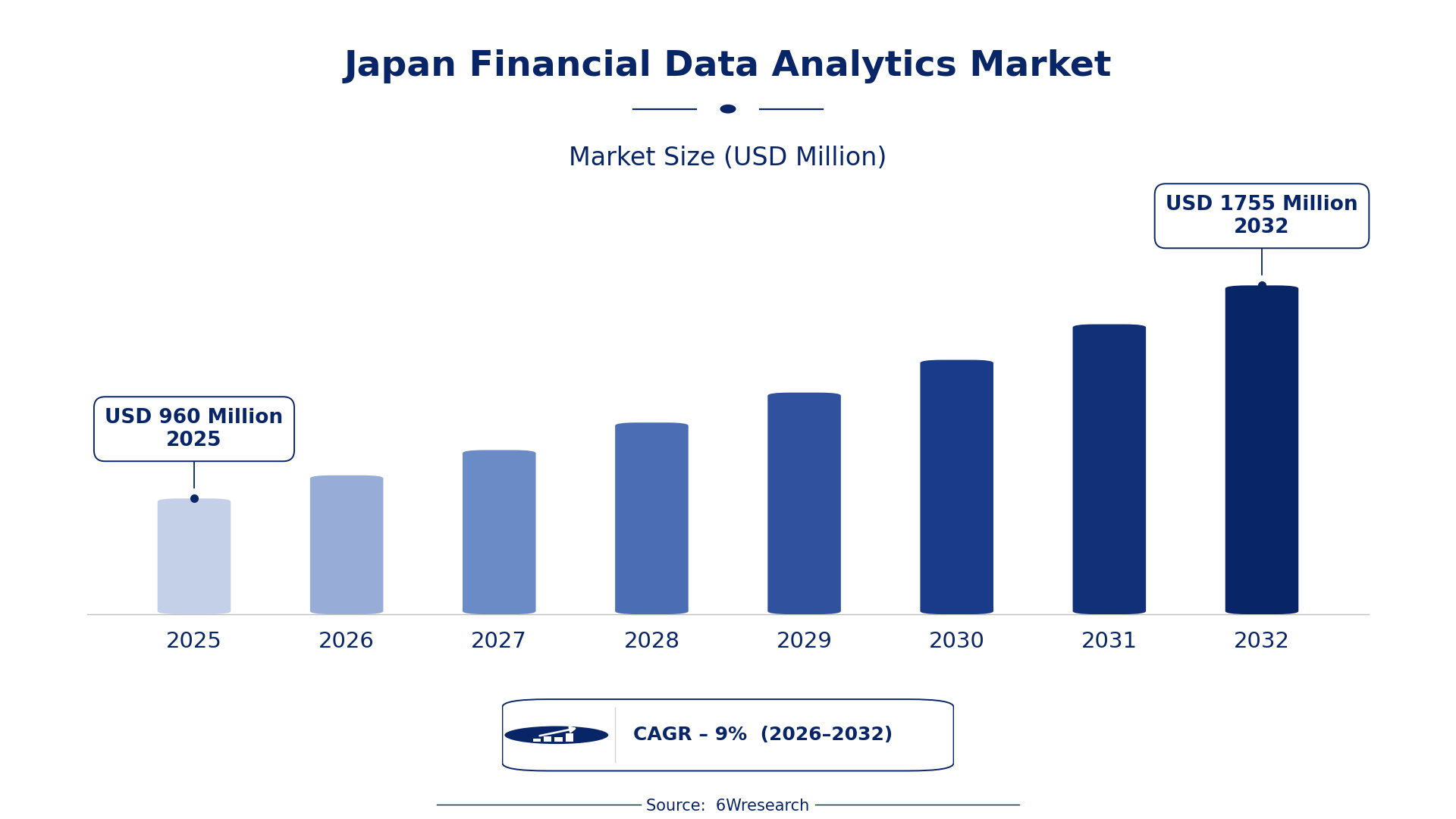
According to 6Wresearch internal database and industry insights, the Japan Financial Data Analytics Market was valued at USD 960 Million in 2025 and is projected to reach USD 1,755 Million by 2032, growing at a CAGR of approximately 9% during 2026–2032.
Japan Financial Data Analytics Market Highlights
| Report Metric | Details |
| Report Name | Japan Financial Data Analytics Market (2026-2032) |
| Market Size 2025 | USD 960 Million |
| Market Size 2032 | USD 1,755 Million |
| Absolute Growth 2025–2032 | USD 795 Million |
| CAGR 2026–2032 | 9% |
| Peak Annual Growth | 9.9% in 2030 |
| Forecast Period | 2026–2032 |
| Historical Data | 2022–2025 |
| Base Year | 2025 |
| Leading Analytics Type, 2025 | Portfolio Analytics (36% share) |
| Leading Use Case, 2025 | Asset Allocation (44% share) |
| Leading Distribution Channel, 2025 | Financial Software (36% share) |
| Leading End User, 2025 | Banks (37% share) |
| Fastest-Growing Analytics Type | ESG Analytics (12.5% CAGR) |
| Fastest-Growing Use Case | Responsible Investing (12.0% CAGR) |
| Fastest-Growing Distribution Channel | SaaS Platforms (11.9% CAGR) |
| Fastest-Growing End User | Investors (11.5% CAGR) |
| Growing Sector | Financial Services |
| Key End Users | Banks, Investors, Fund Managers, CFOs |
Japan Financial Data Analytics Market Year-wise Growth Rate and Key Drivers (2022–2032)
This graph illustrates the annual growth rates of the market from 2022 to 2032, highlighting a steady upward trajectory and projected market expansion over the forecast period.
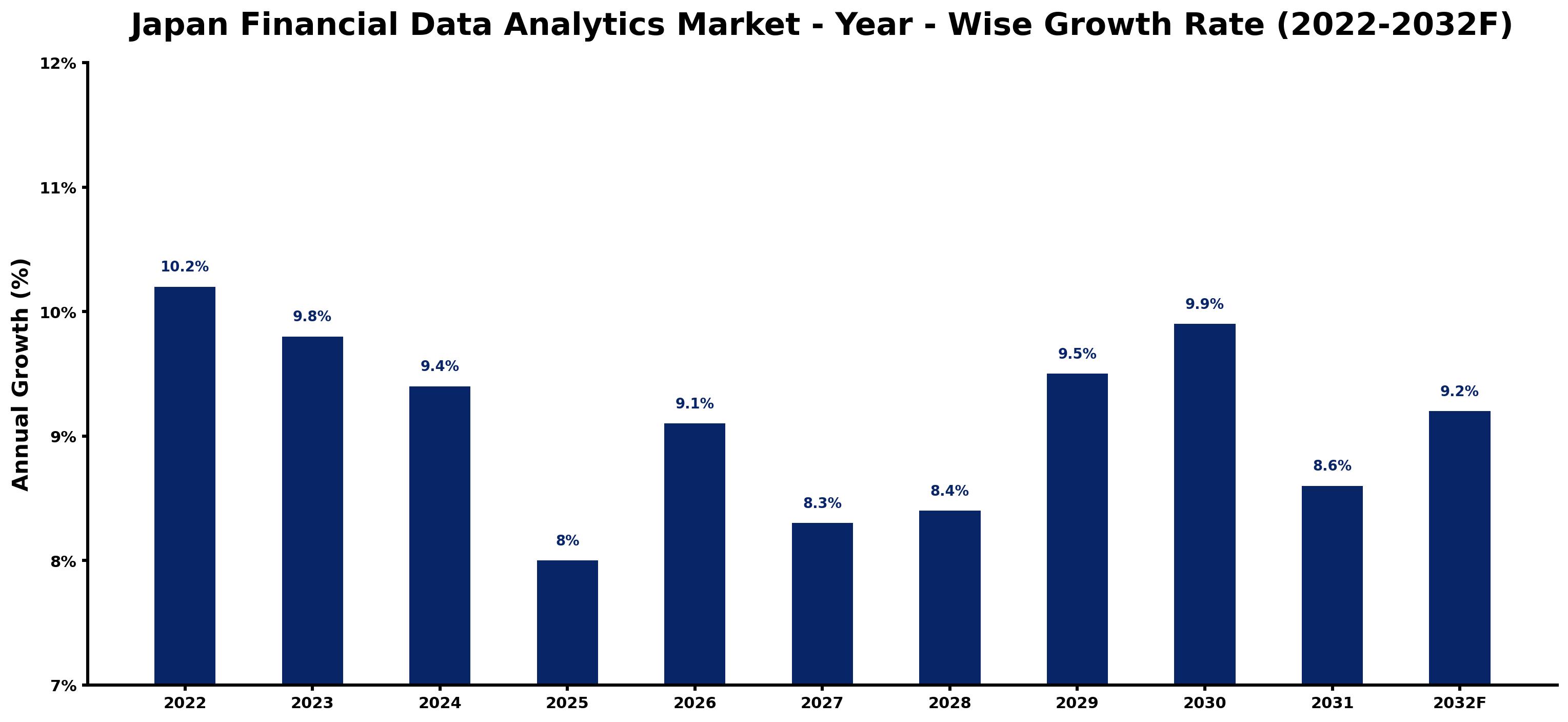
The following figures match every annual growth estimate with the main market development of that year, giving the reasoning behind each rise or slowdown.
| Year | Estimated Annual Growth (%) | Market Rationale |
| 2022 | 10.2 | The financial services sector was strong, driving high demand for analytics solutions. |
| 2023 | 9.8 | Growth slowed slightly as firms adjusted to market conditions and investment strategies. |
| 2024 | 9.4 | Demand continued but at a slower pace as firms adapted to analytics tools. |
| 2025 | 8.0 | The market experienced a further slowdown as firms prioritised cost management. |
| 2026 | 9.1 | Demand for advanced analytics is expected to rise as financial institutions seek improved risk management. |
| 2027 | 8.3 | Growth is projected to slow again as companies focus on consolidating their analytics capabilities. |
| 2028 | 8.4 | A resurgence in investment in analytics tools is expected to lead to a slight uptick in growth. |
| 2029 | 9.5 | Increased adoption of analytics for decision-making will drive higher growth rates. |
| 2030 | 9.9 | The market is projected to peak as financial institutions fully embrace analytics in operations. |
| 2031 | 8.6 | Growth is expected to moderate as the market stabilises after reaching its peak. |
| 2032 | 9.2 | A renewed focus on advanced analytics solutions is projected to boost growth. |
Note: Market size estimations and growth projections presented in this report are based on 6Wresearch's proprietary forecasting methodology, utilizing the latest available industry data, government publications, and primary research inputs.
Japan Financial Data Analytics Market Synopsis
Financial Data Analytics employs advanced techniques to interpret financial data, aiding in investment analysis, risk assessment, and performance measurement. The Japan Financial Data Analytics Market is growing due to rising demand from local financial institutions, with over 70% of banks using advanced analytics for risk management. This expansion is further fuelled by a 20% increase in fintech startups from 2021 to 2023 and continuous technological advancements in data processing.
Market Dynamics Impact Analysis (2026–2032)
| Factor | Type | Impact | Primary Segment Affected |
| Growing adoption of advanced analytics tools among financial institutions | Driver | High | Credit Risk Analytics |
| Increased focus on ESG factors in investment decisions | Driver | High | ESG Analytics |
| Rising demand for data-driven investment strategies | Opportunity | High | Asset Allocation |
| Expansion of fintech solutions in the market | Opportunity | High | Financial Software |
| High competition among financial institutions for analytics capabilities | Restraint | Medium | Portfolio Analytics |
| Challenges in data security and compliance regulations | Restraint | High | Revenue Forecasting |
| Limited availability of skilled data analysts in the market | Challenge | High | Data Science Firms |
| High costs associated with implementing advanced analytics solutions | Challenge | Medium | SaaS Platforms |
Evaluation of Drivers in Japan Financial Data Analytics Market (2026–2032)
The factors lifting demand, and the evidence behind each, are summarised below.
| Drivers | Primary Segment Affected | Why It Matters (Evidence) |
| Increased investment in risk management solutions | Credit Risk Analytics | Over 70% of banks in Japan use advanced analytics for risk management, leading to higher demand for these tools. |
| Growing emphasis on sustainable investing | ESG Analytics | The rise in responsible investing practices has led to increased adoption of ESG analytics in the financial sector. |
| Demand for optimised investment strategies | Asset Allocation | Financial institutions are increasingly utilising analytics for asset allocation, which is a key focus area for many firms. |
| Expansion of fintech startups | Financial Software | The 20% increase in fintech startups from 2021 to 2023 has driven demand for integrated analytics solutions. |
| Technological advancements in data processing | SaaS Platforms | The shift towards cloud-based solutions has improved the accessibility of analytics tools for financial institutions. |
Purchasing is picking up as the financial services sector values advanced analytics for risk management, with over 70% of banks employing these tools. The sector, worth approximately 200 trillion JPY, is increasingly investing in analytics to improve decision-making processes. The rise of fintech startups, which surged by 20% from 2021 to 2023, has stimulated demand for integrated financial software solutions. The need for optimised asset allocation strategies has led to a notable increase in analytics usage among financial institutions, driving the overall demand for financial data analytics solutions across Japan.
Evaluation of Restraints in Japan Financial Data Analytics Market
The following restraints limit how fast demand can grow.
| Market Restraint | Primary Segment Affected | Why It Matters (Evidence) |
| Intense competition among financial institutions | Portfolio Analytics | The high competition leads to price pressures, affecting profitability for analytics providers, with firms seeking cost-effective solutions. |
| Data security concerns related to financial information | Revenue Forecasting | Issues with data breaches have led to increased scrutiny and compliance costs for firms implementing analytics. |
| Shortage of skilled data analysts in the market | Data Science Firms | The average salary for data analysts in finance is around 6 million JPY, making it challenging to attract talent. |
| Regulatory compliance challenges in analytics implementation | Credit Risk Analytics | The Financial Services Agency's oversight requires strict adherence to regulations, complicating analytics adoption. |
| High implementation costs for advanced analytics solutions | SaaS Platforms | The initial investment required for cloud-based analytics systems can deter smaller firms from adoption. |
Japan Financial Data Analytics Market Challenges
Over 70% of banks in Japan use advanced analytics for risk management, yet a skills shortage in data analytics leads to project delays and increased costs for financial institutions. Regulatory requirements from the Financial Services Agency complicate operations, forcing institutions to allocate resources for compliance, which can inflate operational expenses. The growth of fintech startups, which rose by 20% from 2021 to 2023, intensifies competition, compelling traditional financial institutions to invest heavily in analytics and straining their budgets. Buyers face challenges as the average salary for data analysts in finance is around 6 million JPY annually, resulting in higher service costs and potential project delays.
Trends in the Japan Financial Data Analytics Market
Buyers and suppliers in the Japan Financial Data Analytics Market are adjusting to the following trends.
- Financial Institutions Increasingly Utilising Advanced Analytics: Financial institutions are adopting advanced analytics for risk management, with over 70% currently employing these tools. This trend reflects a growing recognition of the importance of data-driven decision-making in the financial sector.
- Rise in ESG Analytics for Sustainable Investing: The emphasis on sustainable investing has led to a rise in ESG analytics usage, growing in recent years. Financial institutions are prioritising these analytics to align investments with ethical standards.
- Surge in Fintech Startups in Japan: The number of fintech startups in Japan has increased by 20% from 2021 to 2023, indicating a shift towards innovative financial solutions. This growth is driving demand for integrated analytics services.
- Shift Towards Cloud-Based Analytics Solutions: Financial institutions are moving towards cloud-based analytics platforms, enhancing accessibility and scalability. This shift is evident as SaaS platforms are projected to experience strong growth.
Investment Opportunities in the Japan Financial Data Analytics Market
Below are the investment opportunities with the strongest case in the Japan Financial Data Analytics Market.
- Growing Need for Financial Data Analytics Solutions: There is a rising demand for advanced analytics solutions in the financial sector. Financial institutions are actively seeking partners to improve their analytics capabilities and meet evolving market demands.
- SaaS Platforms for Financial Analytics: With a projected growth of 11.9%, SaaS platforms represent a significant opportunity for suppliers. Financial institutions are increasingly adopting these solutions to streamline their operations.
- Investment in ESG Analytics: The rising demand for sustainable investing solutions presents a gap in the market. Financial firms are looking for analytics providers to support their ESG initiatives, particularly in urban areas.
- Data Science Services for Financial Institutions: The demand for data science services is increasing, with firms needing skilled analysts. Collaborating with local universities can facilitate entry into this market.
Government Initiatives in the Japan Financial Data Analytics Market
The AI Promotion Act, established in 2025, sets a national framework for AI research and development, encouraging financial institutions to adopt AI-driven analytics. This act ensures compliance with standards such as ISO 27001 for information security management, which is critical for the financial sector.
The Digital Agency, established in September 2021, leads government digital transformation efforts, including funding for fintech innovation. Financial institutions can utilise this support to improve their analytics capabilities, ensuring they meet compliance requirements set by the Financial Services Agency.
Future Insight of the Japan Financial Data Analytics Market
The shift in policy towards digital transformation will reshape the financial services sector by 2032, prompting increased use of advanced analytical techniques. Initiatives from the Tokyo Metropolitan Government will drive innovation, leading suppliers to develop tailored solutions for local financial institutions. The implementation of robust data security standards will address growing concerns about information management. With over 3,800 registered financial institutions in Japan, the demand for sophisticated analytical solutions will expand, creating new opportunities for both buyers and suppliers.
Market Segmentation Analysis
Japan Financial Data Analytics Market report covers a detailed analysis of the following market segments:
By Analytics Type – Portfolio Analytics Leads, ESG Analytics Expected to Grow Fastest
According to Saurav Kr Singh, Senior Research Analyst at 6Wresearch, Portfolio Analytics accounted for 36% of the market by analytics type in 2025. Portfolio Analytics commands the largest share due to its critical role in evaluating investment performance and managing associated risks. The extensive participation of over 3,800 registered financial institutions in Japan highlights the widespread adoption of this analytical approach. ESG Analytics is projected to grow fastest, at a CAGR of 12.5% during 2026–2032. The surge in ESG Analytics is propelled by the increasing prioritisation of sustainable investing, which is becoming essential for many investors. This shift is reflected in the growing allocation of funds towards environmentally and socially responsible initiatives, indicating a robust market trend. Suppliers should focus on enhancing their ESG analytics capabilities to align with the rising demand from financial institutions.
By Use Case – Asset Allocation Leads, Responsible Investing Expected to Grow Fastest
Asset Allocation took 44% of use case revenue in 2025, more than any other category. Asset Allocation is the leading use case due to its critical role in optimising investment strategies for various financial entities. Given the size of Japan's financial services sector, valued at approximately 200 trillion JPY, this use case is particularly relevant. Over 2026–2032, Responsible Investing is expected to post the fastest growth, at a CAGR of 12.0%. Responsible Investing is experiencing the fastest growth as more investors seek to align their investments with ethical standards, reflecting a shift in priorities. This trend is likely to persist as sustainability becomes increasingly important in investment decisions. Buyers will increasingly require tools that facilitate responsible investment strategies to align with ethical considerations.
By Distribution Channel – Financial Software Leads, SaaS Platforms Expected to Grow Fastest
The largest distribution channel category in 2025 was Financial Software, at 36% of revenue. Financial Software leads the market as it seamlessly integrates analytics into comprehensive financial management tools, making it indispensable for financial institutions. The fact that over 70% of banks in Japan employ advanced analytics for risk management underscores its importance in the sector. The quickest growth will come from SaaS Platforms, forecast to expand at a CAGR of 11.9% between 2026 and 2032. SaaS Platforms are experiencing rapid growth due to their provision of cloud-based analytics services that offer both flexibility and scalability. This trend is expected to continue as financial institutions increasingly adopt digital transformation strategies to optimise their operations. Suppliers must concentrate on developing SaaS solutions to address the shifting preferences of financial institutions towards cloud-based services.
By End User – Banks Lead, Investors Expected to Grow Fastest
Banks held 37% of the Japan Financial Data Analytics Market by end user in 2025. Banks are the predominant end user as they extensively utilise analytics for risk management and compliance, reflecting their pivotal role in the financial ecosystem. The regulatory framework established by the Financial Services Agency necessitates a strong reliance on analytical tools for operational success. Investors are set to record the highest CAGR in this split, 11.5% over 2026–2032. Investors represent the fastest-growing end user segment, motivated by the necessity for data analytics to guide their investment decisions. This growth indicates a wider trend towards data-driven strategies within the investment community, signalling a shift in market dynamics. Suppliers should customise their offerings to cater to the specific analytical requirements of investors, as their demand for data-driven insights continues to escalate.
Key Attractiveness of the Report
- 10 Years of Market Numbers
- Historical Data Starting from 2022 to 2025
- Base Year 2025
- Forecast Data until 2032
- Key Performance Indicators Impacting the Market
- Major Upcoming Developments and Projects
Key Highlights of the Report:
- Japan Financial Data Analytics Market Outlook
- Market Size of Japan Financial Data Analytics Market, 2025
- Forecast of Japan Financial Data Analytics Market, 2032
- Historical Data and Forecast of Japan Financial Data Analytics Revenues & Volume for the Period 2022-2032F
- Japan Financial Data Analytics Market Trend Evolution
- Japan Financial Data Analytics Market Drivers and Challenges
- Japan Financial Data Analytics Price Trends
- Japan Financial Data Analytics Porter's Five Forces
- Japan Financial Data Analytics Industry Life Cycle
- Historical Data and Forecast of Japan Financial Data Analytics Market Revenues & Volume By Analytics Type for the Period 2022-2032F
- Historical Data and Forecast of Japan Financial Data Analytics Market Revenues & Volume By Portfolio Analytics for the Period 2022-2032F
- Historical Data and Forecast of Japan Financial Data Analytics Market Revenues & Volume By Revenue Forecasting for the Period 2022-2032F
- Historical Data and Forecast of Japan Financial Data Analytics Market Revenues & Volume By Credit Risk Analytics for the Period 2022-2032F
- Historical Data and Forecast of Japan Financial Data Analytics Market Revenues & Volume By ESG Analytics for the Period 2022-2032F
- Historical Data and Forecast of Japan Financial Data Analytics Market Revenues & Volume By Use Case for the Period 2022-2032F
- Historical Data and Forecast of Japan Financial Data Analytics Market Revenues & Volume By Asset Allocation for the Period 2022-2032F
- Historical Data and Forecast of Japan Financial Data Analytics Market Revenues & Volume By Business Planning for the Period 2022-2032F
- Historical Data and Forecast of Japan Financial Data Analytics Market Revenues & Volume By Lending Decisions for the Period 2022-2032F
- Historical Data and Forecast of Japan Financial Data Analytics Market Revenues & Volume By Responsible Investing for the Period 2022-2032F
- Historical Data and Forecast of Japan Financial Data Analytics Market Revenues & Volume By Distribution Channel for the Period 2022-2032F
- Historical Data and Forecast of Japan Financial Data Analytics Market Revenues & Volume By Data Science Firms for the Period 2022-2032F
- Historical Data and Forecast of Japan Financial Data Analytics Market Revenues & Volume By Financial Software for the Period 2022-2032F
- Historical Data and Forecast of Japan Financial Data Analytics Market Revenues & Volume By SaaS Platforms for the Period 2022-2032F
- Historical Data and Forecast of Japan Financial Data Analytics Market Revenues & Volume By AI Vendors for the Period 2022-2032F
- Historical Data and Forecast of Japan Financial Data Analytics Market Revenues & Volume By End User for the Period 2022-2032F
- Historical Data and Forecast of Japan Financial Data Analytics Market Revenues & Volume By Fund Managers for the Period 2022-2032F
- Historical Data and Forecast of Japan Financial Data Analytics Market Revenues & Volume By CFOs for the Period 2022-2032F
- Historical Data and Forecast of Japan Financial Data Analytics Market Revenues & Volume By Banks for the Period 2022-2032F
- Historical Data and Forecast of Japan Financial Data Analytics Market Revenues & Volume By Investors for the Period 2022-2032F
- Japan Financial Data Analytics Import Export Trade Statistics
- Market Opportunity Assessment By Analytics Type
- Market Opportunity Assessment By Use Case
- Market Opportunity Assessment By Distribution Channel
- Market Opportunity Assessment By End User
- Japan Financial Data Analytics Top Companies Market Share
- Japan Financial Data Analytics Competitive Benchmarking By Technical and Operational Parameters
- Japan Financial Data Analytics Company Profiles
- Japan Financial Data Analytics Key Strategic Recommendations
Market Covered
Coverage by segment is as follows.
By Analytics Type
- Portfolio Analytics
- Revenue Forecasting
- Credit Risk Analytics
- ESG Analytics
By Use Case
- Asset Allocation
- Business Planning
- Lending Decisions
- Responsible Investing
By Distribution Channel
- Data Science Firms
- Financial Software
- SaaS Platforms
- AI Vendors
By End User
- Fund Managers
- CFOs
- Banks
- Investors































