Japan Financial Data Security Market Size & Growth Rate
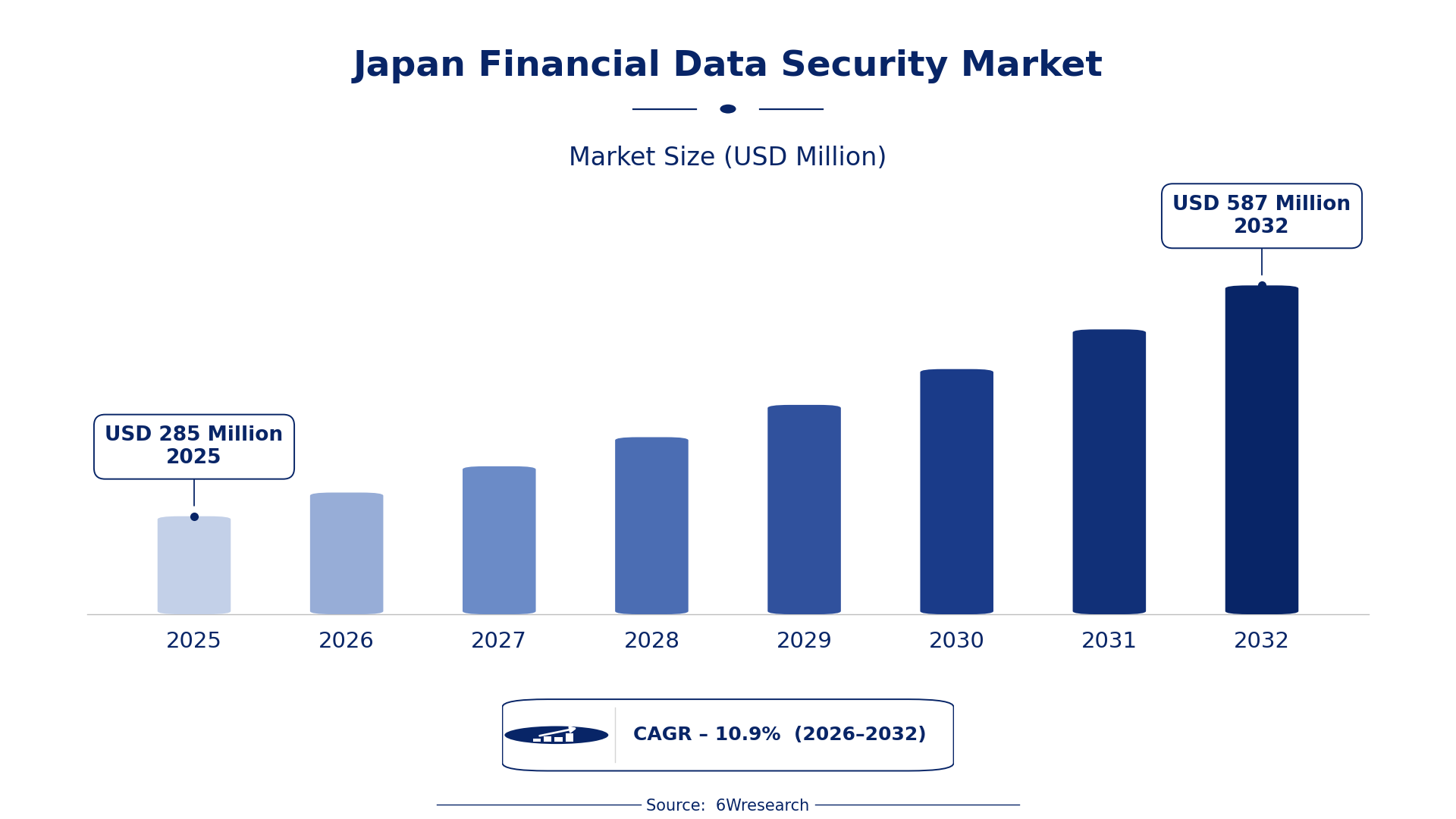
According to 6Wresearch internal database and industry insights, the Japan Financial Data Security Market was valued at USD 285 Million in 2025 and is projected to reach USD 587 Million by 2032, growing at a CAGR of approximately 10.9% during 2026–2032.
Japan Financial Data Security Market Highlights
| Report Metric | Details |
| Report Name | Japan Financial Data Security Market (2026-2032) |
| Market Size 2025 | USD 285 Million |
| Market Size 2032 | USD 587 Million |
| Absolute Growth 2025–2032 | USD 302 Million |
| CAGR 2026–2032 | 10.9% |
| Peak Annual Growth | 11.6% in 2032 |
| Forecast Period | 2026–2032 |
| Historical Data | 2022–2025 |
| Base Year | 2025 |
| Leading Security Type, 2025 | Data Encryption (41% share) |
| Leading Protection Layer, 2025 | User Authentication (34% share) |
| Leading Distribution Channel, 2025 | Cybersecurity Vendors (41% share) |
| Leading End User, 2025 | Banks (51% share) |
| Fastest-Growing Security Type | Tokenization (15.3% CAGR) |
| Fastest-Growing Protection Layer | Real-Time Monitoring (14.5% CAGR) |
| Fastest-Growing Distribution Channel | SaaS Solutions (14.3% CAGR) |
| Fastest-Growing End User | FinTech Platforms (14.6% CAGR) |
| Growing Sector | Financial Services |
| Key End Users | Banks, FinTech Platforms, Online Lenders, Cybersecurity Vendors |
Japan Financial Data Security Market Year-wise Growth Rate and Key Drivers (2022–2032)
This graph illustrates the annual growth rates of the market from 2022 to 2032, highlighting a steady upward trajectory and projected market expansion over the forecast period.
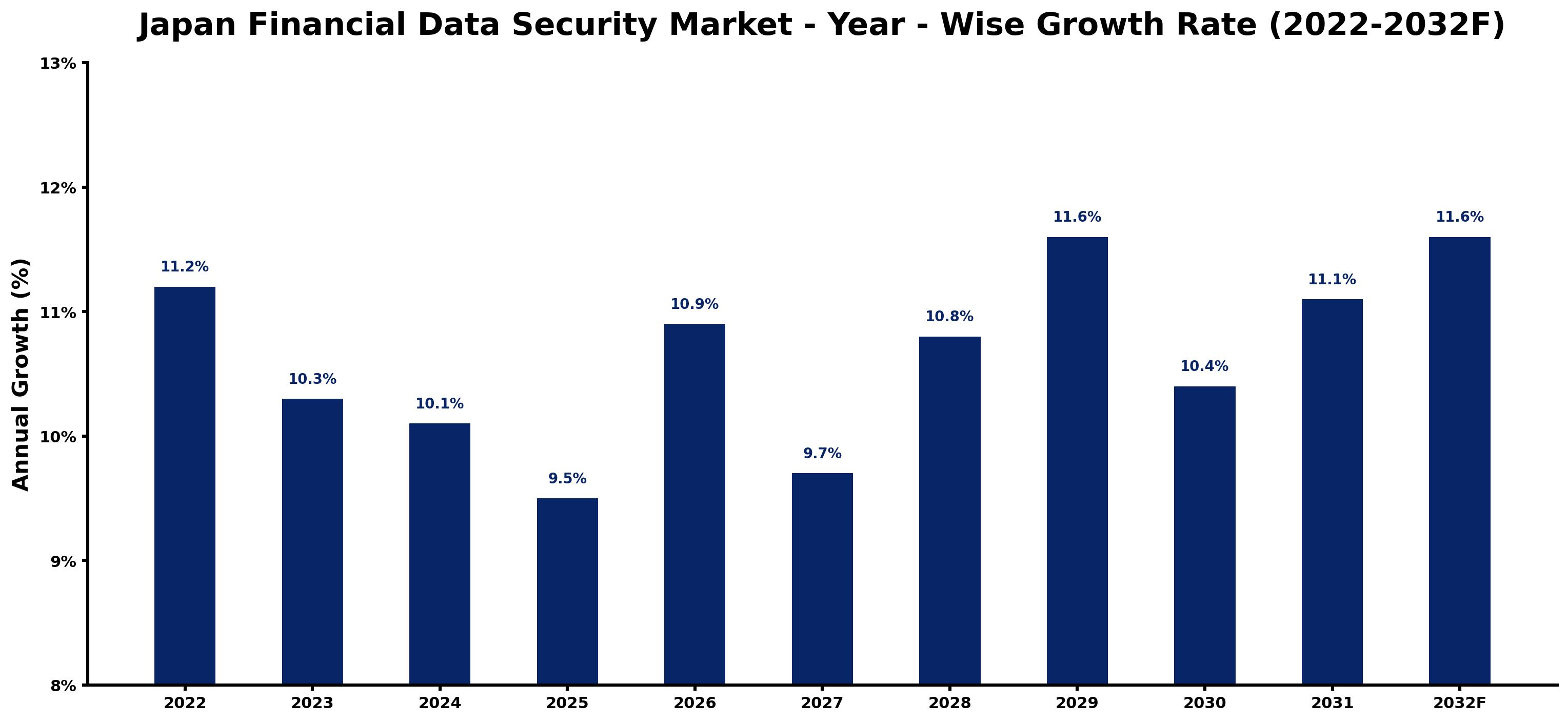
Year by year, the estimates below pair each growth rate with the development that shaped it.
| Year | Estimated Annual Growth (%) | Market Rationale |
| 2022 | 11.2 | The market experienced strong demand for financial data protection measures. |
| 2023 | 10.3 | Growth slowed due to increased competition among cybersecurity vendors. |
| 2024 | 10.1 | Market expansion continued but at a reduced pace as firms reassessed budgets. |
| 2025 | 9.5 | Growth decelerated as companies focused on compliance with new regulations. |
| 2026 | 10.9 | Demand surged as financial institutions invested in advanced security technologies. |
| 2027 | 9.7 | Growth slowed as market saturation began to impact new investments. |
| 2028 | 10.8 | Increased adoption of real-time monitoring solutions spurred market growth. |
| 2029 | 11.6 | Demand accelerated with the rise of fintech platforms requiring improved security. |
| 2030 | 10.4 | Growth slowed as companies consolidated their cybersecurity strategies. |
| 2031 | 11.1 | Investment in user authentication technologies increased, driving demand. |
| 2032 | 11.6 | The market peaked as financial institutions aimed for full compliance. |
Note: Market size estimations and growth projections presented in this report are based on 6Wresearch's proprietary forecasting methodology, utilizing the latest available industry data, government publications, and primary research inputs.
Japan Financial Data Security Market Synopsis
Financial Data Security encompasses technologies and practices that protect sensitive financial information from unauthorized access and breaches. The financial services sector in Japan, which includes over 1,200 banks and financial institutions, is experiencing growth driven by the increasing number of digital banking users and the implementation of international standards. The launch of a new cybersecurity strategy by the Financial Services Agency in 2023 and the growing fintech innovation in Tokyo are key contributors to this upward trend in security investments.
Market Dynamics Impact Analysis (2026–2032)
| Factor | Type | Impact | Primary Segment Affected |
| Rising digital banking users drive demand for enhanced security measures. | Driver | High | Data Encryption |
| The implementation of ISO/IEC 27001 standard increases compliance needs. | Driver | High | Access Control |
| The growing number of online lenders creates a need for secure processing. | Opportunity | High | Tokenization |
| The Japanese government allocated 5 billion yen for cybersecurity initiatives. | Opportunity | High | User Authentication |
| High annual cybersecurity spending by banks limits budget for new solutions. | Restraint | High | Data Encryption |
| Stricter penalties for data breaches increase operational costs for firms. | Restraint | High | Access Control |
| High costs of implementing comprehensive security measures deter smaller firms. | Challenge | Medium | Tokenization |
| Rapid technological changes require constant updates to security systems. | Challenge | Medium | User Authentication |
Evaluation of Drivers in Japan Financial Data Security Market (2026–2032)
The table below links each growth driver to the segment it affects and the evidence for it.
| Drivers | Primary Segment Affected | Why It Matters (Evidence) |
| Increase in digital banking users drives demand for data protection. | Data Encryption | In 2022, the number of mobile wallet users reached 60 million, increasing the need for data security. |
| Compliance with international standards necessitates access control measures. | Access Control | The financial sector's adherence to international standards boosts demand for security solutions. |
| The rise of online lenders necessitates secure transaction processing technologies. | Tokenization | The number of online lenders increased by 15% over the last five years, driving demand for security. |
| Government funding for cybersecurity initiatives boosts user authentication solutions. | User Authentication | The Japanese government allocated 5 billion yen for cybersecurity initiatives in 2023, increasing investments. |
| Growing fintech platforms require advanced security measures for customer data. | Real-Time Monitoring | Tokyo's fintech innovation hub is driving demand for real-time monitoring solutions. |
A wider customer base explains much of the growth, as the number of digital banking users in Japan reached 60 million in 2022, prompting banks to invest in data encryption technologies. Compliance with international standards has increased the need for access control measures, as financial institutions seek to meet security requirements. The rise of online lenders, which increased by 15% over five years, has created a demand for tokenization to secure transactions. Fintech innovation in Tokyo is driving demand for real-time monitoring technologies to protect sensitive information.
Evaluation of Restraints in Japan Financial Data Security Market
These restraints slow adoption and weigh on supplier margins.
| Market Restraint | Primary Segment Affected | Why It Matters (Evidence) |
| High annual cybersecurity spending limits budget for new solutions. | Data Encryption | Banks' average annual spending on cybersecurity is estimated at 1.2 trillion yen, constraining additional investments. |
| Stricter penalties for data breaches increase operational costs. | Access Control | The updated cybersecurity law in 2023 imposes higher penalties, raising compliance costs for firms. |
| Smaller firms struggle to implement security measures due to costs. | Tokenization | The financial sector's average cybersecurity spending creates barriers for smaller online lenders. |
| Rapid technological changes require constant updates to security systems. | User Authentication | The fast pace of innovation in cybersecurity tools necessitates ongoing investments. |
| Market saturation limits opportunities for new entrants. | Real-Time Monitoring | As more firms adopt monitoring solutions, competition intensifies, impacting growth. |
Japan Financial Data Security Market Challenges
Japan's revised cybersecurity law imposes stricter penalties for data breaches, forcing financial institutions to allocate considerable resources for compliance. This regulation arises from escalating cyber threats, costing banks around 1.2 trillion yen annually in cybersecurity expenditures. Buyers encounter challenges as the rapid increase in mobile wallet users, now at 60 million, strains existing security infrastructures. Supply issues emerge as fintech startups struggle to meet the elevated security standards, causing delays for consumers seeking secure online transactions. The 5 billion yen designated for cybersecurity initiatives may fall short of covering the rising costs of implementing robust security measures across the industry.
Trends in the Japan Financial Data Security Market
Below are the shifts with the largest effect on the Japan Financial Data Security Market.
- Launch of Cybersecurity Strategy: In 2023, the Financial Services Agency introduced a cybersecurity strategy to improve financial data protection. This initiative aims to strengthen compliance and security measures across the sector, benefiting banks and fintech platforms.
- Shift Towards Real-Time Monitoring: Financial institutions are increasingly adopting real-time monitoring technologies to detect threats immediately. This trend is evident in Tokyo, where fintech startups are focusing on developing advanced monitoring solutions.
- Growing Demand for Tokenization: Tokenization is becoming essential for securing payment information, especially among online lenders. The increase in online lending activity has driven this demand, with a 15% rise in lenders over five years.
- Expansion of Digital Banking: The number of digital banking users in Japan has surged, reaching 60 million in 2022. This growth is prompting banks to invest heavily in data encryption and access control measures.
Investment Opportunities in the Japan Financial Data Security Market
Several openings in the Japan Financial Data Security Market merit attention from investors.
- 5 Billion Yen Investment: The Japanese government's allocation of 5 billion yen for cybersecurity initiatives presents an opportunity for investment in security technologies. Cybersecurity vendors can partner with financial institutions to improve their offerings.
- Targeting Online Lenders: With the increase of online lenders, there is a growing need for secure processing solutions. Vendors can enter this market by forming joint ventures with fintech platforms.
- Rising Compliance Needs: As the Japanese government aims for full compliance with data protection regulations by 2025, there is a pressing need for advanced security solutions. Firms can capitalize on this by developing compliant technologies.
- Fintech Innovation in Tokyo: Tokyo's fintech innovation hub is creating opportunities for security technology providers. By collaborating with startups, firms can develop tailored solutions that meet the unique needs of this sector.
Government Initiatives in the Japan Financial Data Security Market
Japan's ISO/IEC 27001 standard for information security management has been a cornerstone of the approach to financial data security. This standard ensures that financial institutions adopt rigorous protocols to safeguard sensitive information. Additionally, the updated cybersecurity law in 2023 introduced stricter penalties for data breaches, compelling firms to invest in strong measures to avoid fines.
The Digital Agency, established in September 2021, plays a key role in leading government digital transformation efforts. It approves initiatives aimed at improving cybersecurity across financial institutions, ensuring compliance with international standards. In 2023, the agency funded various projects to strengthen data protection, reflecting the government's commitment to securing financial data.
Future Insight of the Japan Financial Data Security Market
The increasing number of digital banking users will drive demand for improved financial data security solutions by 2032, prompting suppliers to develop advanced technologies. The updated ISO/IEC 27001 standard will assist institutions in adopting best practices, ensuring adherence to international benchmarks. Tokyo's fintech hub will continue to thrive, encouraging partnerships that prioritise advancements in data protection. By 2025, achieving full compliance with data protection regulations will compel financial institutions to implement more stringent security protocols, ultimately enhancing consumer confidence in their transactions.
Market Segmentation Analysis
Japan Financial Data Security Market report covers a detailed analysis of the following market segments:
By Security Type – Data Encryption Leads, Tokenization Expected to Grow Fastest
According to Saurav Kr Singh, Senior Research Analyst at 6Wresearch, in 2025, Data Encryption led the security type split with a 41% share. Data Encryption holds a dominant position due to its necessity in safeguarding sensitive financial data across Japan's extensive network of over 1,200 banks and financial institutions. Its importance is underscored by the compliance requirements with the ISO/IEC 27001 standard, making it indispensable for security frameworks. Over 2026–2032, Tokenization is expected to post the fastest growth, at a CAGR of 15.3%. Tokenization is rapidly gaining traction as the number of mobile wallet users reached 60 million in 2022, highlighting the urgent need for securing payment information. This method effectively addresses rising fraud concerns in digital transactions, ensuring a secure environment for users. Suppliers should prioritise the development of tokenization solutions to align with the increasing demand for secure payment processes.
By Protection Layer – User Authentication Leads, Real-Time Monitoring Expected to Grow Fastest
User Authentication took 34% of protection layer revenue in 2025, more than any other category. User Authentication holds a substantial share as it is essential for verifying identities in a financial environment where security is crucial, especially after the recent updates to Japan's cybersecurity law. This method is widely adopted by banks and financial institutions to prevent unauthorised access to sensitive information. The quickest growth will come from Real-Time Monitoring, forecast to expand at a CAGR of 14.5% between 2026 and 2032. Real-Time Monitoring is experiencing rapid growth due to its necessity for immediate threat detection, which is vital in the fast-evolving digital financial landscape. The urgency for such capabilities is underscored by the cybersecurity strategy launched by the Financial Services Agency in 2023. Buyers need to prioritise investments in real-time monitoring systems to enhance their security frameworks against emerging threats.
By Distribution Channel – Cybersecurity Vendors Lead, SaaS Solutions Expected to Grow Fastest
With 41% of distribution channel revenue in 2025, Cybersecurity Vendors was the largest category. Cybersecurity Vendors are essential in providing tailored security solutions for Japan's financial sector, which is governed by stringent regulatory requirements. Their established expertise and market presence make them the preferred choice for financial data security. SaaS Solutions are set to record the highest CAGR in this split, 14.3% over 2026–2032. SaaS Solutions are increasingly favoured as they offer security as a service, providing flexibility and scalability that traditional models lack. This trend aligns with the broader digitalisation of financial services, driving demand for cloud-based security solutions. Suppliers should expand their SaaS offerings to meet the rising preference for adaptable security solutions.
By End User – Banks Lead, FinTech Platforms Expected to Grow Fastest
Banks accounted for 51% of the market by end user in 2025. Banks dominate the market as the primary users of security technologies, responsible for safeguarding extensive amounts of sensitive customer data and transactions. Their estimated annual cybersecurity expenditure of 1.2 trillion yen highlights the pressing need for robust security measures in the sector. FinTech Platforms are projected to grow fastest, at a CAGR of 14.6% during 2026–2032. FinTech Platforms are rapidly expanding and heavily rely on financial data security to build user trust. The increase in digital banking users further fuels the demand for tailored security solutions in this growing sector. Suppliers must tailor their offerings to meet the specific security needs of the rapidly growing FinTech Platforms.
Key Attractiveness of the Report
- 10 Years of Market Numbers
- Historical Data Starting from 2022 to 2025
- Base Year 2025
- Forecast Data until 2032
- Key Performance Indicators Impacting the Market
- Major Upcoming Developments and Projects
Key Highlights of the Report:
- Japan Financial Data Security Market Outlook
- Market Size of Japan Financial Data Security Market, 2025
- Forecast of Japan Financial Data Security Market, 2032
- Historical Data and Forecast of Japan Financial Data Security Revenues & Volume for the Period 2022-2032F
- Japan Financial Data Security Market Trend Evolution
- Japan Financial Data Security Market Drivers and Challenges
- Japan Financial Data Security Price Trends
- Japan Financial Data Security Porter's Five Forces
- Japan Financial Data Security Industry Life Cycle
- Historical Data and Forecast of Japan Financial Data Security Market Revenues & Volume By Security Type for the Period 2022-2032F
- Historical Data and Forecast of Japan Financial Data Security Market Revenues & Volume By Data Encryption for the Period 2022-2032F
- Historical Data and Forecast of Japan Financial Data Security Market Revenues & Volume By Access Control for the Period 2022-2032F
- Historical Data and Forecast of Japan Financial Data Security Market Revenues & Volume By Tokenization for the Period 2022-2032F
- Historical Data and Forecast of Japan Financial Data Security Market Revenues & Volume By Anomaly Detection for the Period 2022-2032F
- Historical Data and Forecast of Japan Financial Data Security Market Revenues & Volume By Protection Layer for the Period 2022-2032F
- Historical Data and Forecast of Japan Financial Data Security Market Revenues & Volume By Storage for the Period 2022-2032F
- Historical Data and Forecast of Japan Financial Data Security Market Revenues & Volume By User Authentication for the Period 2022-2032F
- Historical Data and Forecast of Japan Financial Data Security Market Revenues & Volume By Transaction Data for the Period 2022-2032F
- Historical Data and Forecast of Japan Financial Data Security Market Revenues & Volume By Real-Time Monitoring for the Period 2022-2032F
- Historical Data and Forecast of Japan Financial Data Security Market Revenues & Volume By Distribution Channel for the Period 2022-2032F
- Historical Data and Forecast of Japan Financial Data Security Market Revenues & Volume By Cybersecurity Vendors for the Period 2022-2032F
- Historical Data and Forecast of Japan Financial Data Security Market Revenues & Volume By Identity Providers for the Period 2022-2032F
- Historical Data and Forecast of Japan Financial Data Security Market Revenues & Volume By SaaS Solutions for the Period 2022-2032F
- Historical Data and Forecast of Japan Financial Data Security Market Revenues & Volume By AI Security Tools for the Period 2022-2032F
- Historical Data and Forecast of Japan Financial Data Security Market Revenues & Volume By End User for the Period 2022-2032F
- Historical Data and Forecast of Japan Financial Data Security Market Revenues & Volume By FinTech Platforms for the Period 2022-2032F
- Historical Data and Forecast of Japan Financial Data Security Market Revenues & Volume By Banks for the Period 2022-2032F
- Historical Data and Forecast of Japan Financial Data Security Market Revenues & Volume By Wallet Apps for the Period 2022-2032F
- Historical Data and Forecast of Japan Financial Data Security Market Revenues & Volume By Online Lenders for the Period 2022-2032F
- Japan Financial Data Security Import Export Trade Statistics
- Market Opportunity Assessment By Security Type
- Market Opportunity Assessment By Protection Layer
- Market Opportunity Assessment By Distribution Channel
- Market Opportunity Assessment By End User
- Japan Financial Data Security Top Companies Market Share
- Japan Financial Data Security Competitive Benchmarking By Technical and Operational Parameters
- Japan Financial Data Security Company Profiles
- Japan Financial Data Security Key Strategic Recommendations
Market Covered
Segments analysed in this report are listed below.
By Security Type
- Data Encryption
- Access Control
- Tokenization
- Anomaly Detection
By Protection Layer
- Storage
- User Authentication
- Transaction Data
- Real-Time Monitoring
By Distribution Channel
- Cybersecurity Vendors
- Identity Providers
- SaaS Solutions
- AI Security Tools
By End User
- FinTech Platforms
- Banks
- Wallet Apps
- Online Lenders































