Japan Financial Workflow Automation Market Size & Growth Rate
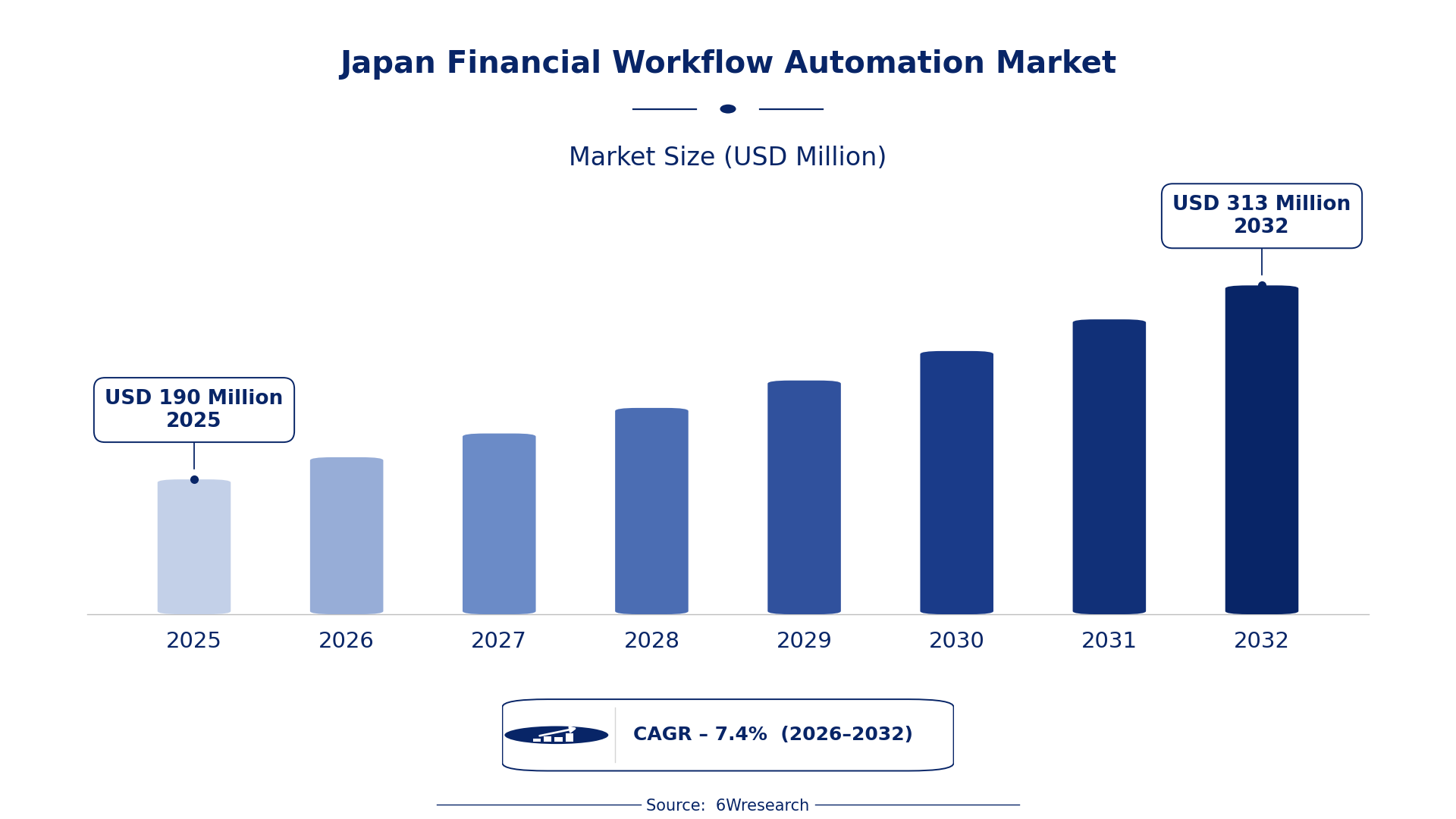
According to 6Wresearch internal database and industry insights, the Japan Financial Workflow Automation Market was valued at USD 190 Million in 2025 and is projected to reach USD 313 Million by 2032, growing at a CAGR of approximately 7.4% during 2026–2032.
Japan Financial Workflow Automation Market Highlights
| Report Metric | Details |
| Report Name | Japan Financial Workflow Automation Market (2026-2032) |
| Market Size 2025 | USD 190 Million |
| Market Size 2032 | USD 313 Million |
| Absolute Growth 2025–2032 | USD 123 Million |
| CAGR 2026–2032 | 7.4% |
| Peak Annual Growth | 8.2% in 2028 |
| Forecast Period | 2026–2032 |
| Historical Data | 2022–2025 |
| Base Year | 2025 |
| Leading Process Area, 2025 | Invoice Processing (36% share) |
| Leading Automation Type, 2025 | RPA (37% share) |
| Leading Distribution Channel, 2025 | BPO Vendors (46% share) |
| Leading End User, 2025 | Shared Service Centers (41% share) |
| Fastest-Growing Process Area | Expense Management (8.7% CAGR) |
| Fastest-Growing Automation Type | Cloud Workflow (11.1% CAGR) |
| Fastest-Growing Distribution Channel | SaaS Platforms (9.6% CAGR) |
| Fastest-Growing End User | CFO Offices (9.3% CAGR) |
| Growing Sector | Financial Services |
| Key End Users | CFO Offices, Shared Service Centers, Accounting Departments, Financial Controllers |
Japan Financial Workflow Automation Market Year-wise Growth Rate and Key Drivers (2022–2032)
This graph illustrates the annual growth rates of the market from 2022 to 2032, highlighting a steady upward trajectory and projected market expansion over the forecast period.
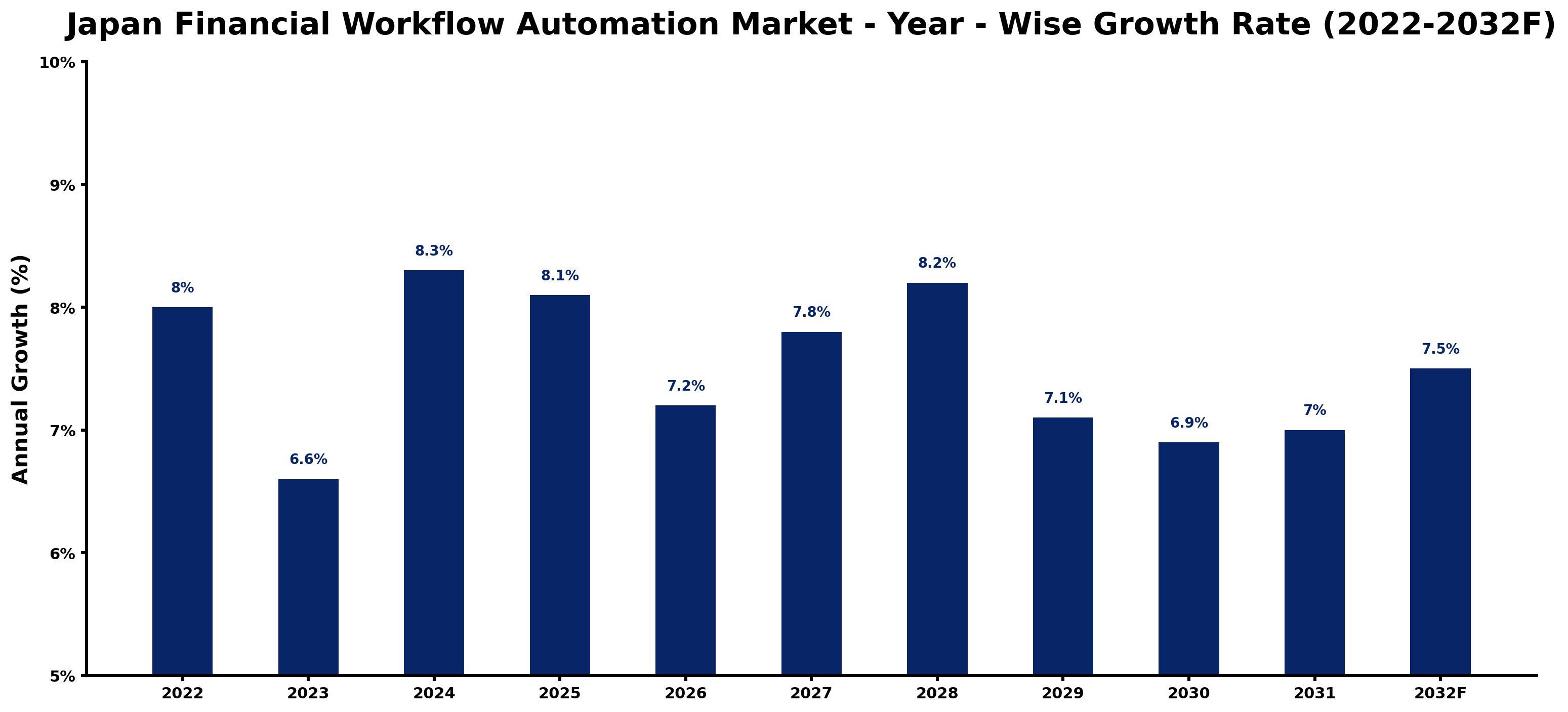
The yearly estimates that follow link every growth rate to its principal driver, so readers can see why the pace changed in each period.
| Year | Estimated Annual Growth (%) | Market Rationale |
| 2022 | 8.0 | The market experienced strong growth as financial institutions adopted automation tools. |
| 2023 | 6.6 | Growth slowed due to market saturation and cautious investment strategies. |
| 2024 | 8.3 | Demand surged as companies sought efficiency amidst rising operational costs. |
| 2025 | 8.1 | The market continued to grow, driven by increasing digital transformation initiatives. |
| 2026 | 7.2 | Growth is expected to slow as firms reassess their automation strategies and budgets. |
| 2027 | 7.8 | Demand is projected to increase as businesses recognise the long-term benefits of automation. |
| 2028 | 8.2 | Growth is expected to accelerate as new technologies gain traction in financial workflows. |
| 2029 | 7.1 | The market is projected to see a slowdown as competition intensifies and costs rise. |
| 2030 | 6.9 | Growth is expected to slow as firms focus on optimising existing automation solutions. |
| 2031 | 7.0 | Demand is projected to increase as companies invest in advanced automation technologies. |
| 2032 | 7.5 | The market is expected to grow steadily as financial institutions expand their automation capabilities. |
Note: Market size estimations and growth projections presented in this report are based on 6Wresearch's proprietary forecasting methodology, utilizing the latest available industry data, government publications, and primary research inputs.
Japan Financial Workflow Automation Market Synopsis
Financial Workflow Automation streamlines processes such as invoicing and compliance through software solutions integrating RPA and AI technologies. The Japan Financial Workflow Automation Market is growing, driven by the financial services sector, which employs over 1.5 million professionals. Increased investments in digital transformation, coupled with a 60% adoption rate of automation tools in CFO offices, are propelling demand. Shared Service Centers are expected to increase automation investments by 30% by 2025, indicating a strong future for these solutions.
Market Dynamics Impact Analysis (2026–2032)
| Factor | Type | Impact | Primary Segment Affected |
| Increasing adoption of RPA technologies to enhance efficiency in financial operations. | Driver | High | RPA |
| Growing demand for compliance reporting solutions due to stricter regulations. | Driver | High | Compliance Reporting |
| Emerging demand for AI-driven automation in accounting departments. | Opportunity | Medium | AI-Driven Automation |
| Investment in cloud workflow solutions to enable remote financial processes. | Opportunity | Medium | Cloud Workflow |
| Concerns over data security in financial automation solutions. | Restraint | High | Invoice Processing |
| High initial costs of implementing automation solutions. | Restraint | Medium | Invoice Processing |
| Limited availability of skilled personnel to manage automation tools. | Challenge | High | Invoice Processing |
| Rapid technological changes leading to obsolescence of existing solutions. | Challenge | Medium | Invoice Processing |
Evaluation of Drivers in Japan Financial Workflow Automation Market (2026–2032)
The factors lifting demand, and the evidence behind each, are summarised below.
| Drivers | Primary Segment Affected | Why It Matters (Evidence) |
| Increased efficiency in financial processes through RPA adoption. | RPA | The adoption rate of RPA technologies in financial services is approximately 60%. |
| Growing need for compliance solutions due to regulatory pressures. | Compliance Reporting | The Financial Services Agency oversees compliance regulations, increasing demand for reporting solutions. |
| Rising investments in digital transformation initiatives across financial institutions. | Cloud Workflow | Japan's financial services sector is investing heavily in digital tools, boosting automation. |
| Demand for effective expense management solutions to control costs. | Expense Management | Shared Service Centers are expected to increase automation investments by 30% by 2025. |
| Adoption of ISO 20022 standards to improve transaction efficiency. | Invoice Processing | The standardisation of financial transactions is driving automation tool adoption. |
Orders keep climbing as financial institutions increasingly adopt RPA technologies, with a 60% adoption rate in CFO offices. Investments in digital transformation are rising, with the financial services sector targeting around JPY 150 trillion over ten years. The growing need for effective expense management solutions is pushing firms to invest in advanced automation technologies. The increasing focus on efficiency is prompting firms to seek solutions that streamline financial processes.
Evaluation of Restraints in Japan Financial Workflow Automation Market
The following restraints limit how fast demand can grow.
| Market Restraint | Primary Segment Affected | Why It Matters (Evidence) |
| Concerns over data security in financial automation solutions. | Invoice Processing | Data breaches can lead to financial losses, causing hesitation in adoption. |
| High initial costs of implementing automation solutions. | Invoice Processing | Many firms face budget constraints, limiting their ability to invest in new technologies. |
| Limited availability of skilled personnel to manage automation tools. | Invoice Processing | A shortage of qualified professionals can delay implementation and reduce effectiveness. |
| Resistance to change within traditional financial institutions. | Invoice Processing | Cultural barriers can hinder the adoption of new technologies in established firms. |
| Rapid technological changes leading to obsolescence of existing solutions. | Invoice Processing | Firms may hesitate to invest due to fears of technology becoming outdated quickly. |
Japan Financial Workflow Automation Market Challenges
The average budget for financial automation projects in large enterprises is around ¥100 million, yet a skills shortage in automation technologies hampers project execution and delays timelines for buyers. Compliance regulations from the Financial Services Agency require constant updates, complicating implementation for suppliers and potentially extending project delivery by six months. Suppliers struggle to source advanced technology solutions, which can inflate costs and lead to deployment delays for buyers. The adoption of new standards complicates integration processes, resulting in additional costs that may reach ¥100 million for large enterprises.
Trends in the Japan Financial Workflow Automation Market
Several trends are reshaping the Japan Financial Workflow Automation Market; the most important are set out below.
- Launch of Digital Transformation Initiative: In 2023, the Japanese government initiated a digital transformation programme for financial services, aiming to improve efficiency and compliance. This initiative is expected to drive substantial investments in automation technologies, with an estimated budget of ¥100 million for large enterprises.
- Shift towards Cloud-Based Financial Solutions: Since 2026, there has been a notable shift towards cloud workflow solutions in financial services. Shared Service Centers are increasingly adopting these technologies, with a projected CAGR of 11.1%, enabling remote access and improving operational flexibility.
- Growing Adoption of ISO 20022 Standard: The adoption of ISO 20022 in financial transactions has been increasing since 2025, improving transaction efficiency. This standardisation is prompting financial institutions to invest in automation tools that comply with new requirements.
- Rise of AI-Driven Automation in Accounting: Accounting departments are increasingly embracing AI-driven automation solutions, with a 40% adoption rate. This trend reflects a growing need for predictive analytics to improve accuracy and compliance in financial reporting.
Investment Opportunities in the Japan Financial Workflow Automation Market
Investors looking at the Japan Financial Workflow Automation Market should consider the following areas.
- Investment in RPA Solutions: With a 60% adoption rate in CFO offices, there is a clear opportunity to supply RPA solutions. As firms seek efficiency, collaborating with Shared Service Centers can facilitate entry into this growing market.
- Supply of Compliance Reporting Tools: As regulatory pressures increase, the demand for compliance reporting tools is projected to rise. Investing in solutions that meet Financial Services Agency standards can open doors to new clients in the financial sector.
- Development of Cloud Workflow Platforms: The shift towards cloud-based financial solutions presents an opportunity to develop platforms. With the financial services sector targeting substantial investments, partnering with BPO vendors can enhance market entry.
- Expansion of Expense Management Solutions: Given the projected 30% increase in automation investments by Shared Service Centers, now is the time to supply advanced expense management solutions. This growing need highlights the potential for new partnerships in the sector.
Government Initiatives in the Japan Financial Workflow Automation Market
The AI Promotion Act, enacted in 2025, establishes a national framework for AI research and development, improving the capabilities of financial workflow automation. This law complements the New Robot Strategy from 2015, which aimed to expand automation across various sectors, including finance, thereby encouraging innovation in financial processes.
In 2023, the Japanese government allocated approximately ¥150 trillion for public and private decarbonisation investments over ten years. The Ministry of Economy, Trade and Industry oversees this initiative, which supports the adoption of automation technologies in financial services, ensuring compliance with environmental standards.
Future Insight of the Japan Financial Workflow Automation Market
CFO offices will increasingly adopt automation tools by 2032, driven by Japan's digital transformation initiative for financial services. The integration of new standards will streamline financial transactions, reducing processing times. With Japan targeting a 46% cut in greenhouse-gas emissions by 2030, suppliers will likely develop solutions that support sustainability efforts. As automation investments rise, operational efficiency will improve, benefiting both buyers and suppliers in the evolving market.
Market Segmentation Analysis
Japan Financial Workflow Automation Market report covers a detailed analysis of the following market segments:
By Process Area – Invoice Processing Leads, Expense Management Expected to Grow Fastest
According to Saurav Kr Singh, Senior Research Analyst at 6Wresearch, Invoice Processing accounted for 36% of the market by process area in 2025. Invoice processing commands the largest share due to its essential role in automating invoice handling, which enhances efficiency and accuracy in financial operations. The adoption rate of around 60% in CFO offices illustrates its critical importance in optimising financial workflows. The quickest growth will come from Expense Management, forecast to expand at a CAGR of 8.7% between 2026 and 2032. Expense management is experiencing rapid growth as businesses increasingly focus on effective expense tracking and management. The Japanese government's digital transformation initiative launched in 2023 further underscores the urgency for improved financial processes. Suppliers must refine their offerings for expense management to meet the rising demand from businesses.
By Automation Type – RPA Leads, Cloud Workflow Expected to Grow Fastest
With 37% of automation type revenue in 2025, RPA was the largest category. RPA maintains the largest share as it is extensively used for automating repetitive tasks, which is vital for streamlining financial operations. Its widespread application across various sectors ensures a strong installed base and ongoing investments in automation solutions. Over 2026–2032, Cloud Workflow is expected to post the fastest growth, at a CAGR of 11.1%. Cloud workflow is rapidly growing as it enables remote access to financial processes, a necessity in today’s work environment. The increasing demand for flexibility and efficiency in financial operations is propelling this segment's expansion. Buyers should consider investing in cloud workflow solutions to leverage benefits for remote financial management.
By Distribution Channel – BPO Vendors Lead, SaaS Platforms Expected to Grow Fastest
BPO Vendors took 46% of distribution channel revenue in 2025, more than any other category. BPO vendors lead the market as they are essential providers of outsourced financial services, catering to a wide range of organisations seeking operational efficiency. Their established expertise and strong relationships in financial processes reinforce their dominant position. SaaS Platforms are set to record the highest CAGR in this split, 9.6% over 2026–2032. SaaS platforms are gaining traction as a preferred delivery model for financial software, propelled by the growing need for scalable and accessible solutions. The shift towards cloud-based services significantly accelerates this segment's growth. Suppliers need to integrate SaaS solutions into their portfolios to remain competitive in the evolving market.
By End User – Shared Service Centers Lead, CFO Offices Expected to Grow Fastest
In 2025, Shared Service Centers led the end user split with a 41% share. Shared service centers represent the largest segment as they centralise financial operations, benefiting from economies of scale. Their strategic role in streamlining processes ensures a consistent demand for automation tools. CFO Offices are projected to grow fastest, at a CAGR of 9.3% during 2026–2032. CFO offices are experiencing the fastest growth as primary users of financial automation tools, reflecting a heightened focus on operational efficiency and cost management. Their central role in financial decision-making fuels this trend. Suppliers should customise their products to address the specific needs of CFO offices to capture this expanding market.
Key Attractiveness of the Report
- 10 Years of Market Numbers
- Historical Data Starting from 2022 to 2025
- Base Year 2025
- Forecast Data until 2032
- Key Performance Indicators Impacting the Market
- Major Upcoming Developments and Projects
Key Highlights of the Report:
- Japan Financial Workflow Automation Market Outlook
- Market Size of Japan Financial Workflow Automation Market, 2025
- Forecast of Japan Financial Workflow Automation Market, 2032
- Historical Data and Forecast of Japan Financial Workflow Automation Revenues & Volume for the Period 2022-2032F
- Japan Financial Workflow Automation Market Trend Evolution
- Japan Financial Workflow Automation Market Drivers and Challenges
- Japan Financial Workflow Automation Price Trends
- Japan Financial Workflow Automation Porter's Five Forces
- Japan Financial Workflow Automation Industry Life Cycle
- Historical Data and Forecast of Japan Financial Workflow Automation Market Revenues & Volume By Process Area for the Period 2022-2032F
- Historical Data and Forecast of Japan Financial Workflow Automation Market Revenues & Volume By Invoice Processing for the Period 2022-2032F
- Historical Data and Forecast of Japan Financial Workflow Automation Market Revenues & Volume By Expense Management for the Period 2022-2032F
- Historical Data and Forecast of Japan Financial Workflow Automation Market Revenues & Volume By Budget Approval for the Period 2022-2032F
- Historical Data and Forecast of Japan Financial Workflow Automation Market Revenues & Volume By Compliance Reporting for the Period 2022-2032F
- Historical Data and Forecast of Japan Financial Workflow Automation Market Revenues & Volume By Automation Type for the Period 2022-2032F
- Historical Data and Forecast of Japan Financial Workflow Automation Market Revenues & Volume By RPA for the Period 2022-2032F
- Historical Data and Forecast of Japan Financial Workflow Automation Market Revenues & Volume By Cloud Workflow for the Period 2022-2032F
- Historical Data and Forecast of Japan Financial Workflow Automation Market Revenues & Volume By AI-Driven Automation for the Period 2022-2032F
- Historical Data and Forecast of Japan Financial Workflow Automation Market Revenues & Volume By Rule-Based Engines for the Period 2022-2032F
- Historical Data and Forecast of Japan Financial Workflow Automation Market Revenues & Volume By Distribution Channel for the Period 2022-2032F
- Historical Data and Forecast of Japan Financial Workflow Automation Market Revenues & Volume By BPO Vendors for the Period 2022-2032F
- Historical Data and Forecast of Japan Financial Workflow Automation Market Revenues & Volume By SaaS Platforms for the Period 2022-2032F
- Historical Data and Forecast of Japan Financial Workflow Automation Market Revenues & Volume By Online Portals for the Period 2022-2032F
- Historical Data and Forecast of Japan Financial Workflow Automation Market Revenues & Volume By Software Integrators for the Period 2022-2032F
- Historical Data and Forecast of Japan Financial Workflow Automation Market Revenues & Volume By End User for the Period 2022-2032F
- Historical Data and Forecast of Japan Financial Workflow Automation Market Revenues & Volume By Shared Service Centers for the Period 2022-2032F
- Historical Data and Forecast of Japan Financial Workflow Automation Market Revenues & Volume By CFO Offices for the Period 2022-2032F
- Historical Data and Forecast of Japan Financial Workflow Automation Market Revenues & Volume By Accounting Departments for the Period 2022-2032F
- Historical Data and Forecast of Japan Financial Workflow Automation Market Revenues & Volume By Financial Controllers for the Period 2022-2032F
- Japan Financial Workflow Automation Import Export Trade Statistics
- Market Opportunity Assessment By Process Area
- Market Opportunity Assessment By Automation Type
- Market Opportunity Assessment By Distribution Channel
- Market Opportunity Assessment By End User
- Japan Financial Workflow Automation Top Companies Market Share
- Japan Financial Workflow Automation Competitive Benchmarking By Technical and Operational Parameters
- Japan Financial Workflow Automation Company Profiles
- Japan Financial Workflow Automation Key Strategic Recommendations
Market Covered
This report examines the market across the segments below.
By Process Area
- Invoice Processing
- Expense Management
- Budget Approval
- Compliance Reporting
By Automation Type
- RPA
- Cloud Workflow
- AI-Driven Automation
- Rule-Based Engines
By Distribution Channel
- BPO Vendors
- SaaS Platforms
- Online Portals
- Software Integrators
By End User
- Shared Service Centers
- CFO Offices
- Accounting Departments
- Financial Controllers































