Japan Fingerprint Recognition Market Size & Growth Rate
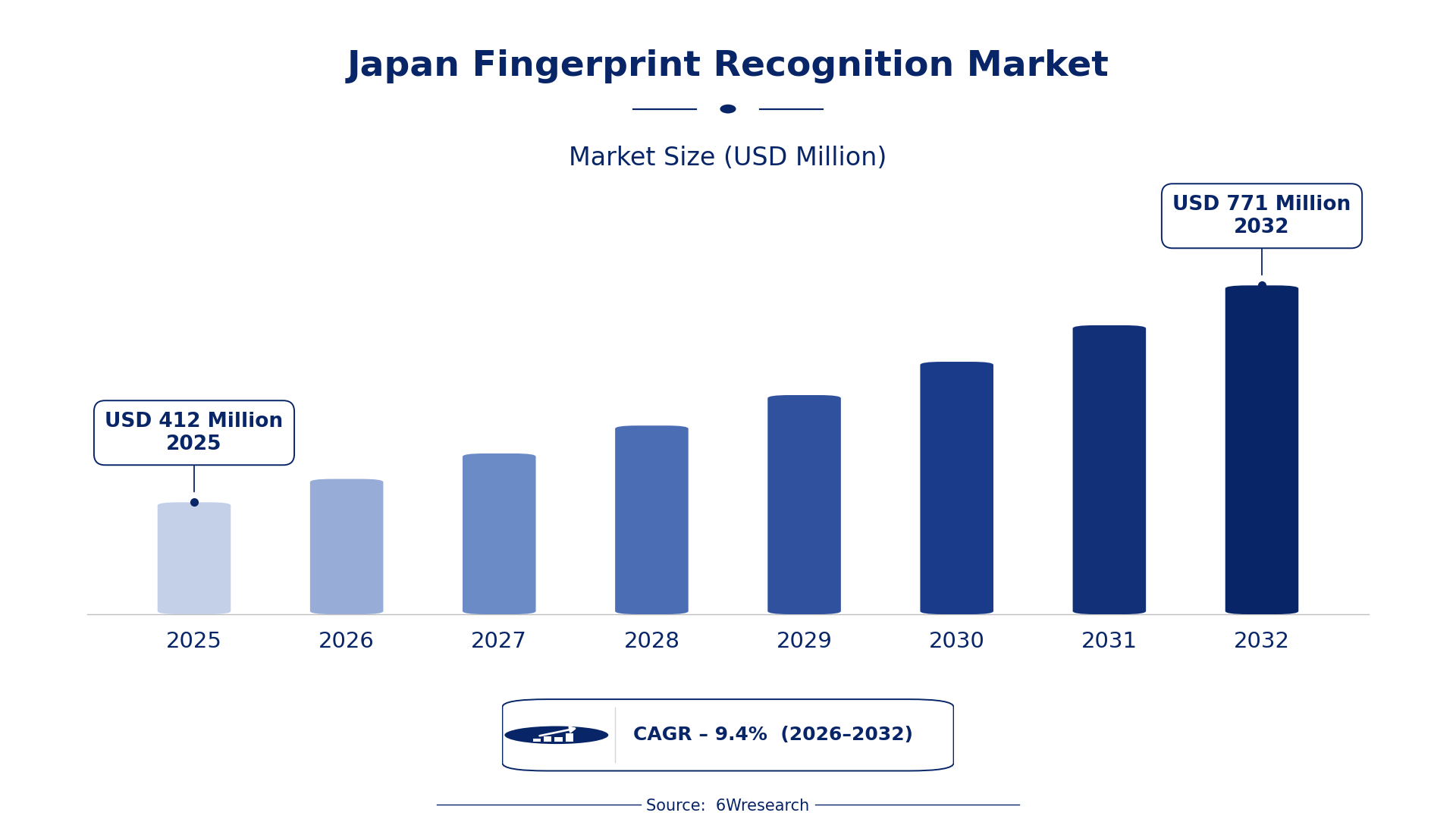
According to 6Wresearch internal database and industry insights, the Japan Fingerprint Recognition Market was valued at USD 412 Million in 2025 and is projected to reach USD 771 Million by 2032, growing at a CAGR of approximately 9.4% during 2026–2032.
Japan Fingerprint Recognition Market Highlights
| Report Metric | Details |
| Report Name | Japan Fingerprint Recognition Market (2026-2032) |
| Market Size 2025 | USD 412 Million |
| Market Size 2032 | USD 771 Million |
| Absolute Growth 2025–2032 | USD 359 Million |
| CAGR 2026–2032 | 9.4% |
| Peak Annual Growth | 10.1% in 2026 |
| Forecast Period | 2026–2032 |
| Historical Data | 2022–2025 |
| Base Year | 2025 |
| Leading Technology Type, 2025 | Optical Recognition (43% share) |
| Leading Application Area, 2025 | Mobile Devices (40% share) |
| Leading Distribution Channel, 2025 | Biometric OEMs (41% share) |
| Leading End User, 2025 | Smartphone Manufacturers (48% share) |
| Fastest-Growing Technology Type | Capacitive Sensing (13.2% CAGR) |
| Fastest-Growing Application Area | Access Control (11.0% CAGR) |
| Fastest-Growing Distribution Channel | System Integrators (11.5% CAGR) |
| Fastest-Growing End User | Corporate Security Teams (11.8% CAGR) |
| Growing Sector | Biometric Security |
| Key End Users | Smartphone Manufacturers, Corporate Security Teams, Financial Institutions, Government Agencies |
Japan Fingerprint Recognition Market Year-wise Growth Rate and Key Drivers (2022–2032)
This graph illustrates the annual growth rates of the market from 2022 to 2032, highlighting a steady upward trajectory and projected market expansion over the forecast period.
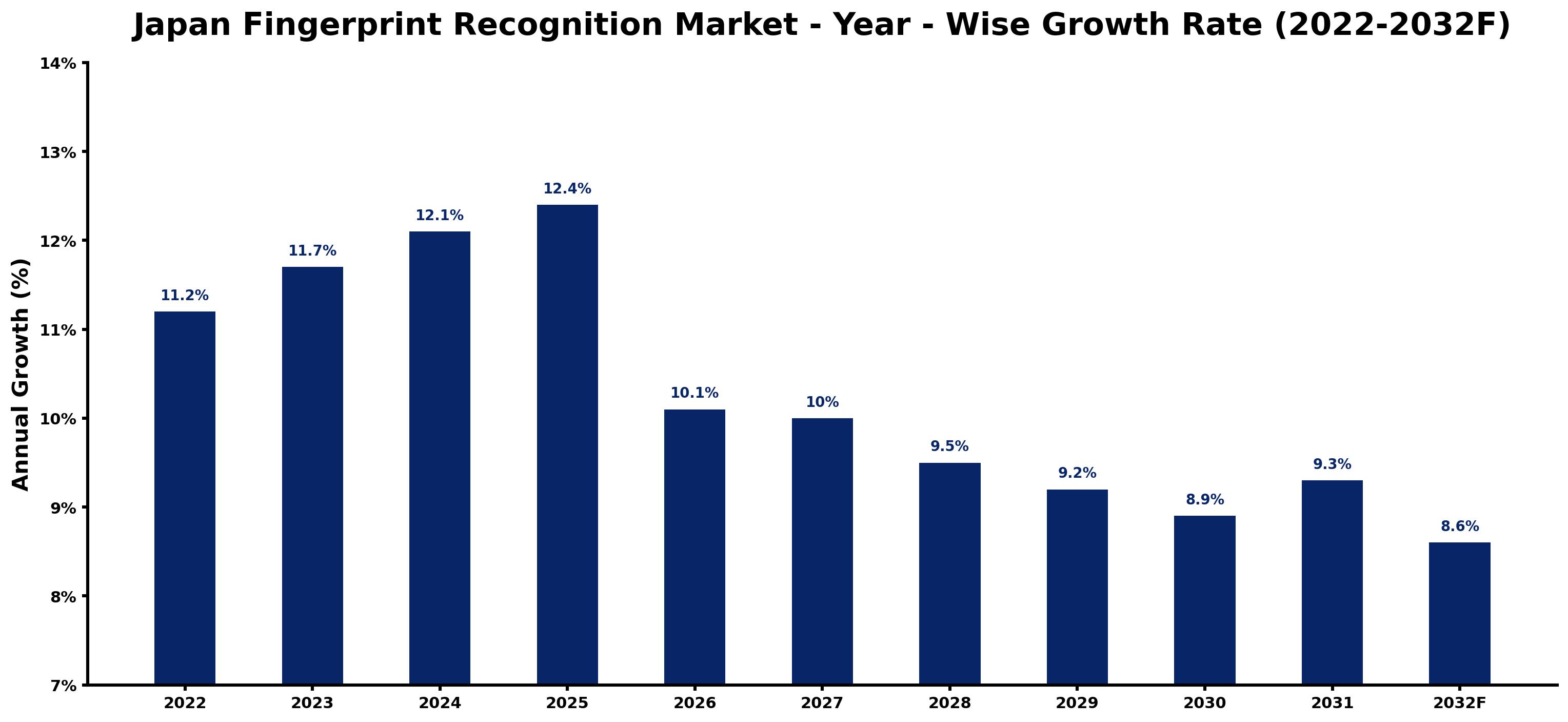
Below, each year's estimated growth is shown next to the factor that most influenced it.
| Year | Estimated Annual Growth (%) | Market Rationale |
| 2022 | 11.2 | The market exhibited steady growth due to rising smartphone penetration and security needs. |
| 2023 | 11.7 | Demand rose as fingerprint recognition became standard in new mobile devices and security systems. |
| 2024 | 12.1 | The introduction of new biometric standards further accelerated adoption across various sectors. |
| 2025 | 12.4 | Fingerprint recognition technology reached its historical peak as corporate security systems expanded rapidly. |
| 2026 | 10.1 | Growth is expected to slow as market saturation begins in mobile devices, yet demand will remain strong. |
| 2027 | 10.0 | The market will continue to grow, driven by advancements in fingerprint technology and applications. |
| 2028 | 9.5 | A slight slowdown is projected as competition intensifies among biometric technologies. |
| 2029 | 9.2 | Demand is expected to remain stable, supported by ongoing investments in security and access control. |
| 2030 | 8.9 | Growth will slow further as the market matures and new technologies emerge. |
| 2031 | 9.3 | An uptick in demand is projected as innovation in biometric solutions sparks renewed interest. |
| 2032 | 8.6 | The market is expected to stabilise as new applications and standards are adopted. |
Note: Market size estimations and growth projections presented in this report are based on 6Wresearch's proprietary forecasting methodology, utilizing the latest available industry data, government publications, and primary research inputs.
Japan Fingerprint Recognition Market Synopsis
Fingerprint recognition technology utilises unique patterns on fingertips for identification, primarily through sensors and software algorithms. Its main applications include securing mobile devices, access control systems, and banking applications. The Japan Fingerprint Recognition Market is expanding due to high smartphone penetration, with 78% of users in 2023, and rising demand from corporate security and financial institutions. The Tokyo metropolitan area serves as a key hub for biometric technology development, while the government promotes biometric standards to improve public safety.
Market Dynamics Impact Analysis (2026–2032)
| Factor | Type | Impact | Primary Segment Affected |
| High smartphone penetration drives demand for fingerprint recognition in mobile devices. | Driver | High | Mobile Devices |
| The rise in corporate security needs boosts fingerprint recognition in access control systems. | Driver | High | Access Control |
| Growing adoption of biometric technology in government ID systems presents new opportunities. | Opportunity | High | Government Agencies |
| The increasing number of mobile banking users creates demand for secure transaction methods. | Opportunity | High | Financial Institutions |
| Market saturation in mobile devices limits growth potential for new fingerprint technologies. | Restraint | High | Mobile Devices |
| High competition among biometric technologies may hinder market expansion. | Restraint | Medium | Biometric OEMs |
| Compliance with evolving biometric standards can increase operational costs for producers. | Challenge | High | System Integrators |
| Capacity constraints in production may delay the rollout of new fingerprint solutions. | Challenge | Medium | Hardware Vendors |
Evaluation of Drivers in Japan Fingerprint Recognition Market (2026–2032)
The following drivers explain most of the expected growth.
| Drivers | Primary Segment Affected | Why It Matters (Evidence) |
| High smartphone penetration rate | Mobile Devices | Japan's smartphone penetration reached 78% in 2023, leading to increased demand for fingerprint recognition in devices. |
| Expansion of corporate security systems | Access Control | Access control systems in corporate offices in Tokyo increased by 30% since 2022, driving fingerprint recognition adoption. |
| Rise in mobile banking users | Banking Apps | Japan's financial sector has over 100 million mobile banking users, creating a demand for secure biometric solutions. |
| Government initiatives promoting biometric standards | Government Agencies | The Ministry of Internal Affairs and Communications promotes biometric security standards, supporting market growth. |
| Integration of fingerprint sensors in high-end smartphones | Smartphone Manufacturers | Fingerprint sensors are integrated into 90% of new high-end smartphones in Japan, boosting market demand. |
The strongest pull on demand comes from the high smartphone penetration rate in Japan, which reached 78% in 2023, driving increased fingerprint recognition in mobile devices. Corporate security systems have expanded, particularly in Tokyo, with a 30% increase in access control systems since 2022, further boosting demand. The financial sector, with over 100 million mobile banking users, relies heavily on biometric solutions for secure transactions. Fingerprint sensors are integrated into 90% of new high-end smartphones, solidifying the technology's presence in consumer electronics.
Evaluation of Restraints in Japan Fingerprint Recognition Market
The main factors holding the market back are set out below.
| Market Restraint | Primary Segment Affected | Why It Matters (Evidence) |
| Market saturation limits growth potential for new fingerprint technologies. | Mobile Devices | As fingerprint recognition becomes standard in smartphones, the market faces saturation, limiting growth opportunities. |
| High competition among biometric technologies may hinder market expansion. | Biometric OEMs | Intense competition among biometric technologies can restrict market share for fingerprint recognition solutions. |
| Compliance with evolving biometric standards increases operational costs. | System Integrators | Producers must invest in compliance with new biometric standards, raising operational costs and affecting profitability. |
| Capacity constraints in production delay rollout of new solutions. | Hardware Vendors | Limited production capacity can slow the introduction of new fingerprint solutions to the market. |
| Consumer reluctance to adopt new biometric technologies affects growth. | Financial Institutions | Concerns over privacy and data security may deter consumers from fully embracing biometric solutions. |
Japan Fingerprint Recognition Market Challenges
Fingerprint recognition technology faces supply chain disruptions due to a limited number of component suppliers, which can delay smartphone manufacturers' production timelines by up to three months. Rising raw material costs, especially for silicon, have increased input prices by 15%, impacting producers' pricing strategies. Intense competition in the mobile device market forces suppliers to lower prices, reducing profit margins and limiting investment in advanced biometric features. Buyers experience longer wait times for secure devices, as over 60% of new smartphones now incorporate fingerprint recognition, resulting in delays in product availability.
Trends in the Japan Fingerprint Recognition Market
Several trends are reshaping the Japan Fingerprint Recognition Market; the most important are set out below.
- Shift in Biometric Technology Adoption in Tokyo: Tokyo is experiencing a move towards advanced biometric solutions, with access control systems increasing by 30% since 2022. This trend reflects the growing demand for improved security measures in corporate environments.
- Transition from Optical to Capacitive Sensing: The fingerprint recognition market is transitioning from optical to capacitive sensing technologies, driven by their superior accuracy. Capacitive sensing is projected to grow at a CAGR of 13.2% as smartphone manufacturers adopt this technology.
- Emergence of Biometric Standards: The establishment of the Japan Biometric Security Association in 2021 has led to the emergence of industry standards. This initiative aims to promote the adoption of biometric technology across various sectors, strengthening security protocols.
- Increased Integration in Financial Applications: Fingerprint recognition is becoming increasingly integrated into financial applications, with over 200 financial institutions adopting biometric security measures. This integration supports secure transactions for Japan's 100 million mobile banking users.
Investment Opportunities in the Japan Fingerprint Recognition Market
Investors looking at the Japan Fingerprint Recognition Market should consider the following areas.
- Expansion of Government ID Systems: The government aims to improve biometric security in ID systems, with 70% adoption projected by 2025. This presents opportunities for system integrators to supply fingerprint recognition solutions.
- Growth in Corporate Security Solutions: Corporate security teams in Japan are seeking advanced fingerprint recognition systems to secure premises. With a 30% increase in access control systems, suppliers can partner with local firms to meet this demand.
- Investment in Mobile Banking Security: Financial institutions are looking to invest in secure biometric solutions for mobile banking applications. Collaborating with tech providers can help meet the needs of over 100 million mobile banking users in Japan.
- Development of High-End Consumer Electronics: Smartphone manufacturers are increasingly integrating fingerprint sensors into their devices, with 90% adoption in new high-end models. Suppliers can enter this market through partnerships with OEMs to provide effective solutions.
Government Initiatives in the Japan Fingerprint Recognition Market
The Building Energy Efficiency Act, amended in 2022, mandates that all new buildings meet energy standards from April 2025, affecting producers of biometric technologies used in access control systems. Compliance with these standards will require investments in energy-efficient solutions that effectively integrate biometric systems.
Corporate security teams benefit from the Electrical Appliance and Material Safety Act, which regulates the safety of electrical appliances. This ensures that biometric devices used in security systems meet safety standards, increasing buyer confidence in adopting fingerprint recognition solutions.
Future Insight of the Japan Fingerprint Recognition Market
The government launched a biometric security initiative in 2023 to enhance public safety, paving the way for fingerprint recognition to be integrated into 70% of government ID systems by 2025. By 2032, advancements in sensor technology will lead to more compact devices, enabling suppliers to innovate effectively. The adoption of ISO/IEC 19794-2 standards will improve data exchange processes, benefiting buyers with streamlined operations. With over 15 million biometric devices expected in Japan by 2025, the market will present growth opportunities for suppliers.
Market Segmentation Analysis
Japan Fingerprint Recognition Market report covers a detailed analysis of the following market segments:
By Technology Type – Optical Recognition Leads, Capacitive Sensing Expected to Grow Fastest
According to Saurav Kr Singh, Senior Research Analyst at 6Wresearch, with 43% of technology type revenue in 2025, Optical Recognition was the largest category. Optical recognition technology holds the largest market share due to its widespread application in devices for user authentication. This technology is particularly prevalent in smartphones, where it serves a vast user base, ensuring security and ease of access. Capacitive Sensing is projected to grow fastest, at a CAGR of 13.2% during 2026–2032. Capacitive sensing is experiencing rapid growth as it is extensively implemented in smartphones for touch-based recognition, reflecting the 78% smartphone penetration rate in Japan. The integration of this technology into 90% of new high-end smartphones indicates a trend that will likely continue to expand. Suppliers should focus on advancing capacitive sensing technology to meet the rising demand from smartphone manufacturers.
By Application Area – Mobile Devices Lead, Access Control Expected to Grow Fastest
Mobile Devices took 40% of application area revenue in 2025, more than any other category. Mobile devices constitute the largest application area for fingerprint recognition, representing a substantial share of the market. With over 60% of new smartphones launched in Japan incorporating this technology, it plays a critical role in user authentication. The quickest growth will come from Access Control, forecast to expand at a CAGR of 11.0% between 2026 and 2032. Access control is the fastest-growing application area, propelled by a 30% increase in corporate office systems since 2022. This growth reflects a heightened emphasis on security measures within corporate and government sectors. Buyers in the security sector should invest in advanced access control solutions to effectively address increasing security requirements.
By Distribution Channel – Biometric OEMs Lead, System Integrators Expected to Grow Fastest
Biometric OEMs accounted for 41% of the market by distribution channel in 2025. Biometric OEMs dominate the distribution channel as they supply essential components for fingerprint systems across various applications. Their established relationships with manufacturers ensure a steady flow of technology into the market. Over 2026–2032, System Integrators are expected to post the fastest growth, at a CAGR of 11.5%. System integrators are the fastest-growing channel, as they implement fingerprint solutions across diverse sectors, responding to the increasing demand for integrated security systems. Their role is critical in adapting technology to specific user needs. Suppliers must collaborate closely with system integrators to effectively penetrate new market segments.
By End User – Smartphone Manufacturers Lead, Corporate Security Teams Expected to Grow Fastest
Smartphone Manufacturers held 48% of the Japan Fingerprint Recognition Market by end user in 2025. Smartphone manufacturers lead the end-user segment by integrating fingerprint sensors into their devices, catering to the high demand for secure mobile technology. This integration is essential for maintaining competitiveness in the smartphone market. Corporate Security Teams are set to record the highest CAGR in this split, 11.8% over 2026–2032. Corporate security teams are the fastest-growing end-user group, utilising fingerprint recognition for securing premises and data as security concerns escalate in corporate environments. This trend is likely to continue as businesses prioritise security measures. Suppliers should tailor their offerings to meet the specific security needs of corporate clients.
Key Attractiveness of the Report
- 10 Years of Market Numbers
- Historical Data Starting from 2022 to 2025
- Base Year 2025
- Forecast Data until 2032
- Key Performance Indicators Impacting the Market
- Major Upcoming Developments and Projects
Key Highlights of the Report:
- Japan Fingerprint Recognition Market Outlook
- Market Size of Japan Fingerprint Recognition Market, 2025
- Forecast of Japan Fingerprint Recognition Market, 2032
- Historical Data and Forecast of Japan Fingerprint Recognition Revenues & Volume for the Period 2022-2032F
- Japan Fingerprint Recognition Market Trend Evolution
- Japan Fingerprint Recognition Market Drivers and Challenges
- Japan Fingerprint Recognition Price Trends
- Japan Fingerprint Recognition Porter's Five Forces
- Japan Fingerprint Recognition Industry Life Cycle
- Historical Data and Forecast of Japan Fingerprint Recognition Market Revenues & Volume By Technology Type for the Period 2022-2032F
- Historical Data and Forecast of Japan Fingerprint Recognition Market Revenues & Volume By Optical Recognition for the Period 2022-2032F
- Historical Data and Forecast of Japan Fingerprint Recognition Market Revenues & Volume By Capacitive Sensing for the Period 2022-2032F
- Historical Data and Forecast of Japan Fingerprint Recognition Market Revenues & Volume By Ultrasonic Scanners for the Period 2022-2032F
- Historical Data and Forecast of Japan Fingerprint Recognition Market Revenues & Volume By Thermal Recognition for the Period 2022-2032F
- Historical Data and Forecast of Japan Fingerprint Recognition Market Revenues & Volume By Application Area for the Period 2022-2032F
- Historical Data and Forecast of Japan Fingerprint Recognition Market Revenues & Volume By Mobile Devices for the Period 2022-2032F
- Historical Data and Forecast of Japan Fingerprint Recognition Market Revenues & Volume By Access Control for the Period 2022-2032F
- Historical Data and Forecast of Japan Fingerprint Recognition Market Revenues & Volume By Banking Apps for the Period 2022-2032F
- Historical Data and Forecast of Japan Fingerprint Recognition Market Revenues & Volume By Law Enforcement for the Period 2022-2032F
- Historical Data and Forecast of Japan Fingerprint Recognition Market Revenues & Volume By Distribution Channel for the Period 2022-2032F
- Historical Data and Forecast of Japan Fingerprint Recognition Market Revenues & Volume By Biometric OEMs for the Period 2022-2032F
- Historical Data and Forecast of Japan Fingerprint Recognition Market Revenues & Volume By System Integrators for the Period 2022-2032F
- Historical Data and Forecast of Japan Fingerprint Recognition Market Revenues & Volume By Tech Providers for the Period 2022-2032F
- Historical Data and Forecast of Japan Fingerprint Recognition Market Revenues & Volume By Hardware Vendors for the Period 2022-2032F
- Historical Data and Forecast of Japan Fingerprint Recognition Market Revenues & Volume By End User for the Period 2022-2032F
- Historical Data and Forecast of Japan Fingerprint Recognition Market Revenues & Volume By Smartphone Manufacturers for the Period 2022-2032F
- Historical Data and Forecast of Japan Fingerprint Recognition Market Revenues & Volume By Corporate Security Teams for the Period 2022-2032F
- Historical Data and Forecast of Japan Fingerprint Recognition Market Revenues & Volume By Financial Institutions for the Period 2022-2032F
- Historical Data and Forecast of Japan Fingerprint Recognition Market Revenues & Volume By Government Agencies for the Period 2022-2032F
- Japan Fingerprint Recognition Import Export Trade Statistics
- Market Opportunity Assessment By Technology Type
- Market Opportunity Assessment By Application Area
- Market Opportunity Assessment By Distribution Channel
- Market Opportunity Assessment By End User
- Japan Fingerprint Recognition Top Companies Market Share
- Japan Fingerprint Recognition Competitive Benchmarking By Technical and Operational Parameters
- Japan Fingerprint Recognition Company Profiles
- Japan Fingerprint Recognition Key Strategic Recommendations
Market Covered
The report covers the following segments.
By Technology Type
- Optical Recognition
- Capacitive Sensing
- Ultrasonic Scanners
- Thermal Recognition
By Application Area
- Mobile Devices
- Access Control
- Banking Apps
- Law Enforcement
By Distribution Channel
- Biometric OEMs
- System Integrators
- Tech Providers
- Hardware Vendors
By End User
- Smartphone Manufacturers
- Corporate Security Teams
- Financial Institutions
- Government Agencies































