Japan Fintech API Market Size & Growth Rate
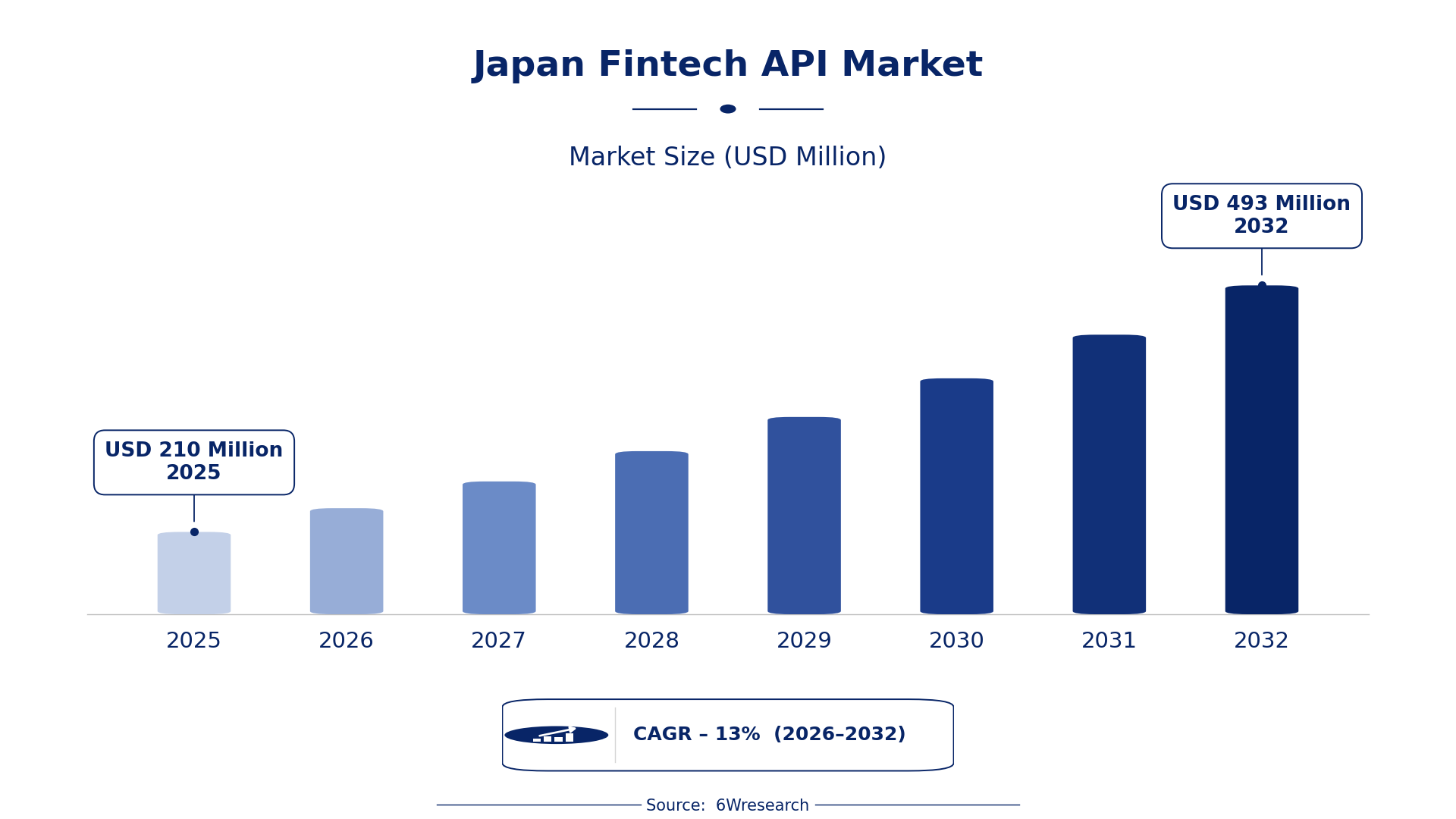
According to 6Wresearch internal database and industry insights, the Japan Fintech API Market was valued at USD 210 Million in 2025 and is projected to reach USD 493 Million by 2032, growing at a CAGR of approximately 13% during 2026–2032.
Japan Fintech API Market Highlights
| Report Metric | Details |
| Report Name | Japan Fintech API Market (2026-2032) |
| Market Size 2025 | USD 210 Million |
| Market Size 2032 | USD 493 Million |
| Absolute Growth 2025–2032 | USD 283 Million |
| CAGR 2026–2032 | 13% |
| Peak Annual Growth | 15.0% in 2026 |
| Forecast Period | 2026–2032 |
| Historical Data | 2022–2025 |
| Base Year | 2025 |
| Leading API Type, 2025 | Payment APIs (34% share) |
| Leading Use Case, 2025 | Digital Transactions (41% share) |
| Leading Distribution Channel, 2025 | API Marketplaces (35% share) |
| Leading End User, 2025 | FinTech Apps (54% share) |
| Fastest-Growing API Type | Identity APIs (17.4% CAGR) |
| Fastest-Growing Use Case | KYC/AML Verification (17.0% CAGR) |
| Fastest-Growing Distribution Channel | Cloud Providers (16.3% CAGR) |
| Fastest-Growing End User | Banking Apps (16.0% CAGR) |
| Growing Sector | Fintech applications |
| Key End Users | Banks, FinTech companies, InsurTech platforms, investment firms |
Japan Fintech API Market Year-wise Growth Rate and Key Drivers (2022–2032)
This graph illustrates the annual growth rates of the market from 2022 to 2032, highlighting a steady upward trajectory and projected market expansion over the forecast period.
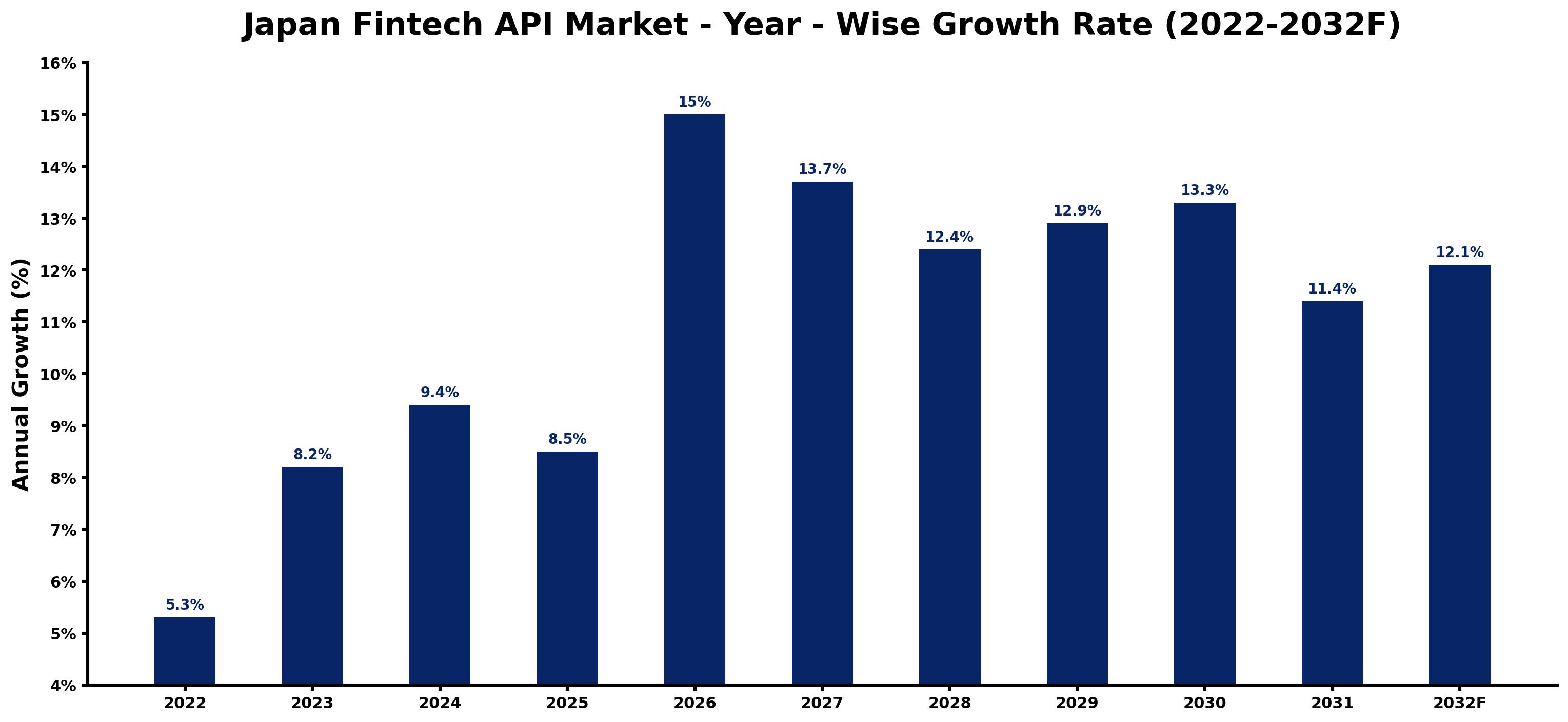
Year by year, the estimates below pair each growth rate with the development that shaped it.
| Year | Estimated Annual Growth (%) | Market Rationale |
| 2022 | 5.3 | The market showed steady activity, driven by increasing digital banking adoption. |
| 2023 | 8.2 | Growth accelerated as more fintech apps entered the market, expanding service offerings. |
| 2024 | 9.4 | The market continued to expand, supported by rising investments in API technology. |
| 2025 | 8.5 | Growth slowed slightly as the market matured and competition intensified. |
| 2026 | 15.0 | Demand surged as banks increased API investments to improve digital services. |
| 2027 | 13.7 | The market is expected to experience a slowdown, reflecting a more competitive environment. |
| 2028 | 12.4 | Growth is projected to decelerate as market saturation begins to impact new investments. |
| 2029 | 12.9 | Demand is expected to pick up again, driven by innovations in financial technology. |
| 2030 | 13.3 | The market will maintain growth as digital transaction volumes continue to rise. |
| 2031 | 11.4 | Growth is projected to slow as the market reaches a more stable phase of development. |
| 2032 | 12.1 | Demand is expected to increase as new fintech solutions emerge. |
Note: Market size estimations and growth projections presented in this report are based on 6Wresearch's proprietary forecasting methodology, utilizing the latest available industry data, government publications, and primary research inputs.
Japan Fintech API Market Synopsis
Fintech APIs are technology interfaces that enable financial institutions and developers to access financial data and services. Their primary applications include facilitating digital payments, ensuring compliance with regulations, and managing investment portfolios. The Japan Fintech API Market is expanding rapidly, driven by over 1,500 fintech apps and a 70% digital banking user rate. Investment from more than 80% of banks in API technology and the Digital Agency's 2023 strategy to improve digital finance are key growth factors. The Japan Fintech Association's initiatives in API standardization further support this expansion, improving interoperability and service delivery.
Market Dynamics Impact Analysis (2026–2032)
| Factor | Type | Impact | Primary Segment Affected |
| Increasing investment in API technology by banks | Driver | High | Payment APIs |
| Growing adoption of digital banking services | Driver | High | Digital Transactions |
| Expansion of API marketplaces | Opportunity | High | API Marketplaces |
| Rising demand for KYC/AML verification | Opportunity | High | Identity APIs |
| Regulatory compliance requirements for APIs | Restraint | Medium | Identity APIs |
| Market saturation limiting new entrants | Restraint | Medium | FinTech Apps |
| Competition among fintech firms for market share | Challenge | High | FinTech Apps |
| Technological integration challenges for legacy systems | Challenge | High | Banking Apps |
Evaluation of Drivers in Japan Fintech API Market (2026–2032)
These are the developments adding the most demand over the forecast period.
| Drivers | Primary Segment Affected | Why It Matters (Evidence) |
| Investment from banks in API technology | Payment APIs | Over 80% of banks in Japan are investing in API technology to enhance service offerings. |
| Growth of digital banking users | Digital Transactions | Around 70% of the population uses digital banking services, increasing transaction volumes. |
| Rise of fintech apps | FinTech Apps | The number of fintech apps in Japan surpassed 1,500, expanding service options. |
| Demand for KYC/AML compliance | Identity APIs | KYC regulations require identity verification for transactions over ¥100,000, driving API use. |
| Popularity of API marketplaces | API Marketplaces | Over 30 API marketplaces are operating in Japan, facilitating easier access to APIs. |
Buyers are adding capacity as banks invest heavily in API technology, with over 80% of them enhancing their digital services. The average population using digital banking services is around 70%, leading to increased transaction volumes and demand for Payment APIs. The fintech app market is thriving, with over 1,500 apps available, driving the need for effective integration. The rise of over 30 API marketplaces facilitates easier access to necessary services, encouraging innovation and competition among developers.
Evaluation of Restraints in Japan Fintech API Market
The table below lists the restraints and the evidence behind each.
| Market Restraint | Primary Segment Affected | Why It Matters (Evidence) |
| Regulatory compliance requirements | Identity APIs | KYC regulations mandate strict identity verification for transactions over ¥100,000, complicating API integration for developers. |
| Market saturation limiting growth opportunities | FinTech Apps | With over 1,500 fintech apps, competition is intensifying, making differentiation challenging for new entrants. |
| Integration issues with legacy systems | Banking Apps | Many banks struggle to connect modern APIs with outdated systems, delaying digital transformation efforts. |
| High development costs for API solutions | API Marketplaces | Developing and maintaining APIs can be costly, limiting investment in new solutions for developers. |
| Security concerns regarding API usage | Payment APIs | Increased cyber threats necessitate strong security measures, raising operational costs for providers. |
Japan Fintech API Market Challenges
A shortage of skilled developers hampers innovation, causing project delays of up to six months for financial institutions. Competition among over 1,500 fintech apps creates pricing pressures, forcing suppliers to reduce margins and limiting their ability to invest in new technologies. Regulatory hurdles arise as KYC regulations mandate identity verification for transactions over ¥100,000, increasing operational costs and causing service delays for buyers. Integration issues complicate API connectivity across platforms, leading to inefficiencies and operational costs that can exceed ¥1 million annually for firms struggling to streamline their systems.
Trends in the Japan Fintech API Market
Four trends stand out in the Japan Fintech API Market.
- Shift towards API Standardization: In 2023, the Japan Fintech Association promoted API standardization, improving interoperability among fintech solutions. This shift is important as over 80% of banks invest in API technology, streamlining processes.
- Rise of Cloud-Based Financial Services: Cloud computing adoption in the financial sector reached 50% in 2023, enabling scalable and flexible fintech solutions. This trend supports the growing demand for APIs, allowing easier access to financial services.
- Emergence of InsurTech Platforms: InsurTech platforms are increasingly integrating Insurance APIs, which are growing rapidly in Japan. This trend is evidenced by the rise in InsurTech startups, improving insurance service delivery.
- Growth of Digital Payment Solutions: The average transaction value for digital payments in Japan is around ¥5,000, reflecting a shift towards cashless transactions. This trend drives demand for Payment APIs as more consumers opt for digital solutions.
Investment Opportunities in the Japan Fintech API Market
Below are the investment opportunities with the strongest case in the Japan Fintech API Market.
- Partner with API Marketplaces: Forming partnerships with existing API marketplaces can facilitate entry into the market. With over 30 platforms operating, suppliers can reach a wider audience and improve service offerings.
- Supply Identity Verification Solutions: There is a growing need for identity verification solutions due to KYC regulations. Targeting financial institutions in Tokyo, where fintech innovation is concentrated, can yield high returns.
- Invest in Cloud-Based API Solutions: Investing in cloud-based API solutions is timely, as cloud adoption in finance reached 50% in 2023. Collaborating with banks in urban areas can provide a competitive edge.
- Develop InsurTech API Solutions: The rise of InsurTech platforms presents an opportunity to develop tailored API solutions. Focusing on regions with high InsurTech activity can drive growth.
Government Initiatives in the Japan Fintech API Market
The Financial Services Agency of Japan regulates fintech APIs under the Payment Services Act, ensuring compliance and security in digital transactions. In 2023, the agency issued guidelines for API security, which require financial institutions to implement stringent measures to protect user data. Additionally, the Japan Fintech Association promotes API standardization and innovation, enhancing interoperability among over 1,500 fintech apps. The government allocated ¥5 billion for fintech innovation in 2023, supporting projects that advance digital finance and improve service delivery.
The Digital Agency of Japan leads the government's digital transformation efforts, approving initiatives that enhance the fintech ecosystem. In 2023, it launched a strategy aimed at improving digital finance, which includes funding for startups and projects that integrate advanced technologies. The agency oversees the implementation of standards like ISO 20022, which aims to streamline financial messaging. By fostering collaboration between traditional banks and fintech firms, the agency aims to create a more competitive and innovative financial services market.
Future Insight of the Japan Fintech API Market
Buyers will see improved services as suppliers focus on API integration to simplify digital interactions. By 2032, the adoption of ISO 20022 will enhance transaction efficiency, benefiting both users and providers. The Digital Agency's strategy will encourage collaboration between fintech startups and traditional banks, creating a more dynamic market. Investment in fintech innovation will surge, driven by government support, leading to the development of advanced financial solutions that cater to evolving customer needs.
Market Segmentation Analysis
Japan Fintech API Market report covers a detailed analysis of the following market segments:
By API Type – Payment APIs Leads, Identity APIs Expected to Grow Fastest
According to Saurav Kr Singh, Senior Research Analyst at 6Wresearch, the largest api type category in 2025 was Payment APIs, at 34% of revenue. Payment APIs dominate the market as they are crucial for processing transactions, directly linking financial institutions with consumers. Their importance is highlighted by the fact that over 80% of banks in Japan are investing in API technology to enhance payment systems. The quickest growth will come from Identity APIs, forecast to expand at a CAGR of 17.4% between 2026 and 2032. Identity APIs are experiencing rapid growth due to stringent KYC regulations that require identity verification for transactions over ¥100,000. This regulatory framework compels financial institutions to prioritise the integration of these APIs to maintain compliance. Suppliers should focus on developing robust Identity API solutions to meet compliance needs, while buyers must seek reliable partners for seamless integration.
By Use Case – Digital Transactions Lead, KYC/AML Verification Expected to Grow Fastest
Digital Transactions accounted for 41% of the market by use case in 2025. Digital Transactions lead the market as they represent the core function of fintech applications, facilitating essential financial activities for users. With around 70% of the population using digital banking services, this segment is vital for the fintech ecosystem. Over 2026–2032, KYC/AML Verification is expected to post the fastest growth, at a CAGR of 17.0%. KYC/AML Verification is rapidly growing due to mandatory compliance requirements that enable financial institutions to effectively verify user identities. This necessity drives fintech companies to adopt these solutions swiftly to avoid regulatory penalties. Providers should prioritise KYC/AML solutions in their offerings, while users need to ensure their partners adhere to compliance standards.
By Distribution Channel – API Marketplaces Lead, Cloud Providers Expected to Grow Fastest
With 35% of distribution channel revenue in 2025, API Marketplaces was the largest category. API Marketplaces are the leading distribution channel as they serve as platforms for API distribution, connecting developers with vital financial services. The presence of over 30 platforms in Japan underscores their significance in the fintech sector. Cloud Providers are projected to grow fastest, at a CAGR of 16.3% during 2026–2032. Cloud Providers are witnessing the fastest growth as they offer essential support infrastructure for APIs, enabling scalability and flexibility for fintech applications. The adoption of cloud computing in the financial sector reached 50% in 2023, reflecting this trend. Vendors should enhance their cloud offerings, while clients must evaluate the reliability of cloud providers for API integration.
By End User – FinTech Apps Lead, Banking Apps Expected to Grow Fastest
FinTech Apps took 54% of end user revenue in 2025, more than any other category. FinTech Apps are the primary users of APIs, driving demand for seamless integration of various financial services. The surge in the number of fintech apps, which surpassed 1,500 in 2023, emphasises their pivotal role in the market. Banking Apps are set to record the highest CAGR in this split, 16.0% over 2026–2032. Banking Apps are growing rapidly as they integrate diverse financial services, catering to the needs of a tech-savvy consumer base. This trend is reinforced by the increasing average transaction value for digital payments, which is around ¥5,000. Developers should focus on creating user-friendly Banking Apps, while financial institutions must ensure they meet the evolving demands of their customers.
Key Attractiveness of the Report
- 10 Years of Market Numbers
- Historical Data Starting from 2022 to 2025
- Base Year 2025
- Forecast Data until 2032
- Key Performance Indicators Impacting the Market
- Major Upcoming Developments and Projects
Key Highlights of the Report:
- Japan Fintech API Market Outlook
- Market Size of Japan Fintech API Market, 2025
- Forecast of Japan Fintech API Market, 2032
- Historical Data and Forecast of Japan Fintech API Revenues & Volume for the Period 2022-2032F
- Japan Fintech API Market Trend Evolution
- Japan Fintech API Market Drivers and Challenges
- Japan Fintech API Price Trends
- Japan Fintech API Porter's Five Forces
- Japan Fintech API Industry Life Cycle
- Historical Data and Forecast of Japan Fintech API Market Revenues & Volume By API Type for the Period 2022-2032F
- Historical Data and Forecast of Japan Fintech API Market Revenues & Volume By Payment APIs for the Period 2022-2032F
- Historical Data and Forecast of Japan Fintech API Market Revenues & Volume By Identity APIs for the Period 2022-2032F
- Historical Data and Forecast of Japan Fintech API Market Revenues & Volume By Investment APIs for the Period 2022-2032F
- Historical Data and Forecast of Japan Fintech API Market Revenues & Volume By Insurance APIs for the Period 2022-2032F
- Historical Data and Forecast of Japan Fintech API Market Revenues & Volume By Use Case for the Period 2022-2032F
- Historical Data and Forecast of Japan Fintech API Market Revenues & Volume By Digital Transactions for the Period 2022-2032F
- Historical Data and Forecast of Japan Fintech API Market Revenues & Volume By KYC/AML Verification for the Period 2022-2032F
- Historical Data and Forecast of Japan Fintech API Market Revenues & Volume By Portfolio Management for the Period 2022-2032F
- Historical Data and Forecast of Japan Fintech API Market Revenues & Volume By Quote Comparison for the Period 2022-2032F
- Historical Data and Forecast of Japan Fintech API Market Revenues & Volume By Distribution Channel for the Period 2022-2032F
- Historical Data and Forecast of Japan Fintech API Market Revenues & Volume By API Marketplaces for the Period 2022-2032F
- Historical Data and Forecast of Japan Fintech API Market Revenues & Volume By Cloud Providers for the Period 2022-2032F
- Historical Data and Forecast of Japan Fintech API Market Revenues & Volume By SaaS Gateways for the Period 2022-2032F
- Historical Data and Forecast of Japan Fintech API Market Revenues & Volume By Direct Integrators for the Period 2022-2032F
- Historical Data and Forecast of Japan Fintech API Market Revenues & Volume By End User for the Period 2022-2032F
- Historical Data and Forecast of Japan Fintech API Market Revenues & Volume By FinTech Apps for the Period 2022-2032F
- Historical Data and Forecast of Japan Fintech API Market Revenues & Volume By Banking Apps for the Period 2022-2032F
- Historical Data and Forecast of Japan Fintech API Market Revenues & Volume By Robo-Advisors for the Period 2022-2032F
- Historical Data and Forecast of Japan Fintech API Market Revenues & Volume By InsurTech Platforms for the Period 2022-2032F
- Japan Fintech API Import Export Trade Statistics
- Market Opportunity Assessment By API Type
- Market Opportunity Assessment By Use Case
- Market Opportunity Assessment By Distribution Channel
- Market Opportunity Assessment By End User
- Japan Fintech API Top Companies Market Share
- Japan Fintech API Competitive Benchmarking By Technical and Operational Parameters
- Japan Fintech API Company Profiles
- Japan Fintech API Key Strategic Recommendations
Market Covered
This report examines the market across the segments below.
By API Type
- Payment APIs
- Identity APIs
- Investment APIs
- Insurance APIs
By Use Case
- Digital Transactions
- KYC/AML Verification
- Portfolio Management
- Quote Comparison
By Distribution Channel
- API Marketplaces
- Cloud Providers
- SaaS Gateways
- Direct Integrators
By End User
- FinTech Apps
- Banking Apps
- Robo-Advisors
- InsurTech Platforms































