Japan Fintech Automation Market Size & Growth Rate
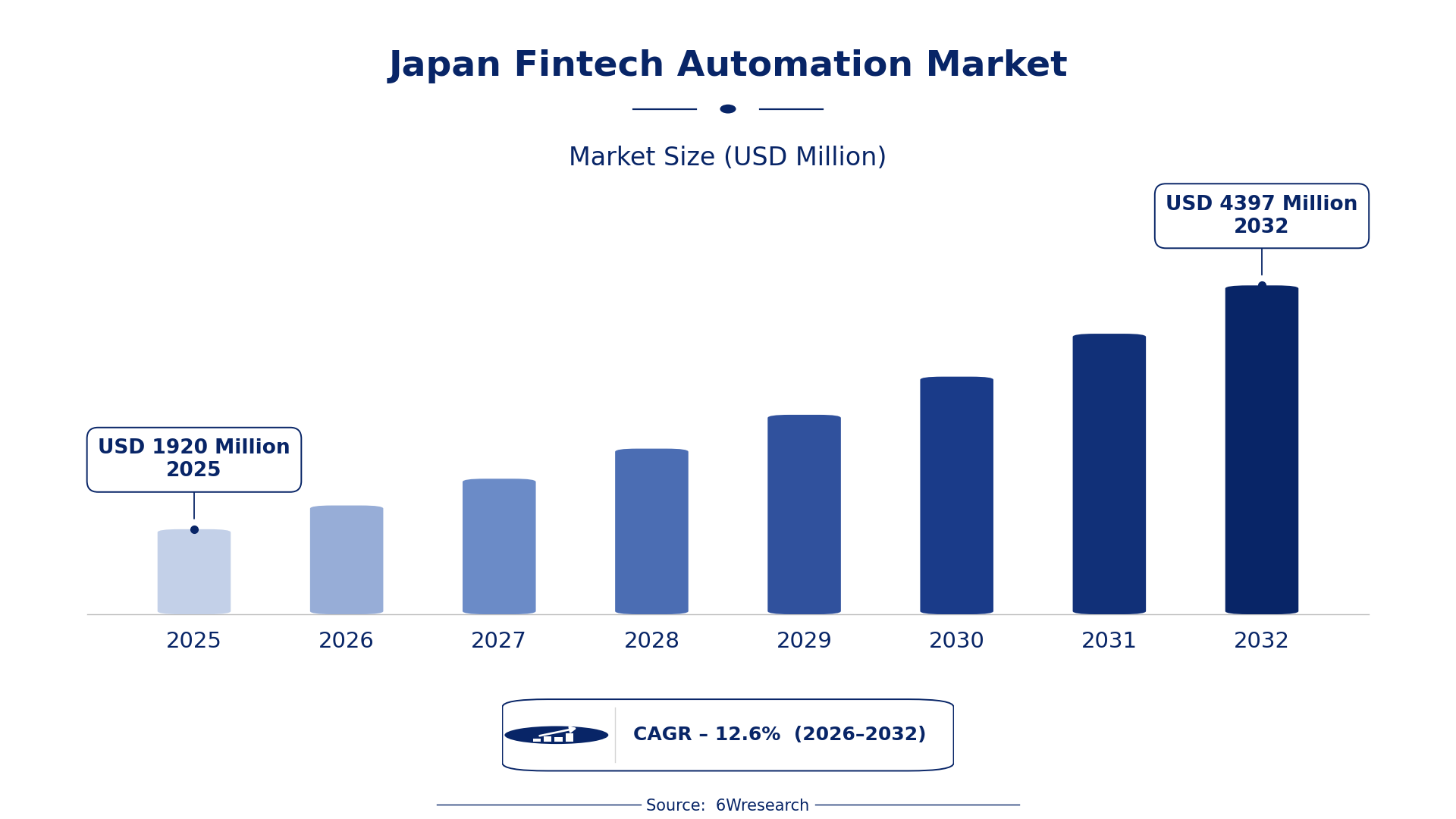
According to 6Wresearch internal database and industry insights, the Japan Fintech Automation Market was valued at USD 1,920 Million in 2025 and is projected to reach USD 4,397 Million by 2032, growing at a CAGR of approximately 12.6% during 2026–2032.
Japan Fintech Automation Market Highlights
| Report Metric | Details |
| Report Name | Japan Fintech Automation Market (2026-2032) |
| Market Size 2025 | USD 1,920 Million |
| Market Size 2032 | USD 4,397 Million |
| Absolute Growth 2025–2032 | USD 2,477 Million |
| CAGR 2026–2032 | 12.6% |
| Peak Annual Growth | 14.0% in 2028 |
| Forecast Period | 2026–2032 |
| Historical Data | 2022–2025 |
| Base Year | 2025 |
| Leading Automation Type, 2025 | Workflow Automation (50% share) |
| Leading Business Process, 2025 | Customer Onboarding (34% share) |
| Leading Distribution Channel, 2025 | SaaS Platforms (39% share) |
| Leading End User, 2025 | Digital Banks (42% share) |
| Fastest-Growing Automation Type | Chatbots (18.2% CAGR) |
| Fastest-Growing Business Process | Customer Support (17.3% CAGR) |
| Fastest-Growing Distribution Channel | Fintech Vendors (16.4% CAGR) |
| Fastest-Growing End User | Payment Providers (16.2% CAGR) |
| Growing Sector | Payment Providers |
| Key End Users | Digital Banks, Payment Providers, Investment Startups, Micro-Lending Firms |
Japan Fintech Automation Market Year-wise Growth Rate and Key Drivers (2022–2032)
This graph illustrates the annual growth rates of the market from 2022 to 2032, highlighting a steady upward trajectory and projected market expansion over the forecast period.
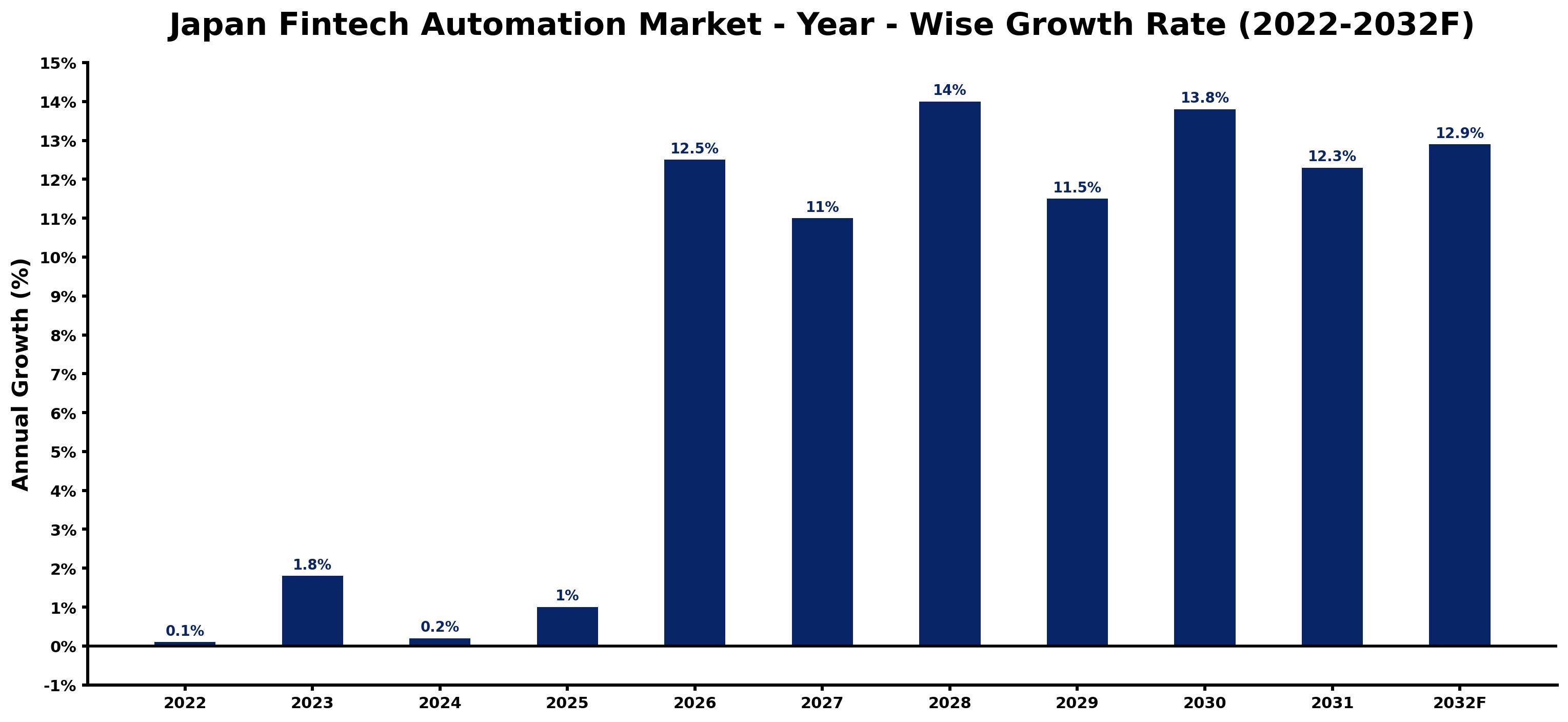
The table below sets out the estimated growth rate for each year and the main factor behind it.
| Year | Estimated Annual Growth (%) | Market Rationale |
| 2022 | 0.1 | The market showed minimal growth due to initial adoption phases and limited technological integration. |
| 2023 | 1.8 | Growth accelerated as more fintech startups entered the market, expanding service offerings. |
| 2024 | 0.2 | A slowdown occurred as market saturation began to affect growth rates, despite ongoing demand. |
| 2025 | 1.0 | Growth improved as digital banks expanded their services, attracting more users to automation. |
| 2026 | 12.5 | Investment in fintech automation is expected to surge, driven by the need for operational efficiency. |
| 2027 | 11.0 | Growth is projected to slow slightly as competition intensifies among existing fintech solutions. |
| 2028 | 14.0 | A peak in growth is expected as new solutions gain traction in the market. |
| 2029 | 11.5 | The market will experience a slowdown as new entrants face challenges in differentiation. |
| 2030 | 13.8 | Growth is projected to rebound as established players adopt advanced technologies to improve services. |
| 2031 | 12.3 | A slight slowdown will occur as market maturity begins to set in, stabilising growth rates. |
| 2032 | 12.9 | Demand is expected to rise as automation becomes integral to financial service delivery. |
Note: Market size estimations and growth projections presented in this report are based on 6Wresearch's proprietary forecasting methodology, utilizing the latest available industry data, government publications, and primary research inputs.
Japan Fintech Automation Market Synopsis
Fintech automation streamlines financial services through technology, improving customer experience and operational efficiency. The Japan Fintech Automation Market is expanding, driven by over 60 million internet users and a growing number of digital banks, which exceed 100 as of 2023. The fintech innovation strategy launched in 2023 aims to stimulate demand, as startups leverage automation to enhance service delivery and attract tech-savvy consumers.
Market Dynamics Impact Analysis (2026–2032)
| Factor | Type | Impact | Primary Segment Affected |
| Increased investment in automation technologies | Driver | High | Workflow Automation |
| Growing user base of digital banks | Driver | High | Digital Banks |
| Expansion of fintech startups | Opportunity | High | Fintech Vendors |
| Rising demand for operational efficiency | Opportunity | High | Loan Automation |
| High competition among fintech solutions | Restraint | Medium | Customer Support |
| Regulatory hurdles affecting new entrants | Restraint | Medium | Chatbots |
| High initial investment costs for automation systems | Challenge | High | Robo-Advisors |
| Rapid technological changes requiring constant updates | Challenge | Medium | SaaS Platforms |
Evaluation of Drivers in Japan Fintech Automation Market (2026–2032)
Demand rests on the following drivers, each shown with the segment it touches most.
| Drivers | Primary Segment Affected | Why It Matters (Evidence) |
| Increased funding for fintech automation solutions | Fintech Vendors | Investment startups in Japan have seen a 15% increase in adoption of robo-advisors, driving demand for automation solutions. |
| Expansion of digital banking services | Digital Banks | Japan has over 100 digital banks as of 2023, increasing competition and service offerings. |
| Growing internet user base | Loan Automation | The fintech sector is projected to grow, supported by over 60 million internet users. |
| Demand for improved customer service | Customer Support | The average response time for customer support chatbots in Japan is under 5 seconds, boosting user satisfaction. |
| Regulatory support for fintech innovation | Chatbots | The Financial Services Agency oversees fintech regulations, creating a conducive environment for growth. |
Spending rises because investment in fintech automation solutions is increasing, as evidenced by a 15% rise in robo-advisor adoption among investment startups. The presence of over 100 digital banks is driving competition, leading to better service offerings. With over 60 million internet users, demand for streamlined loan automation is growing, prompting financial institutions to adopt these solutions. The average response time for customer support chatbots is under 5 seconds, greatly improving customer satisfaction.
Evaluation of Restraints in Japan Fintech Automation Market
The main factors holding the market back are set out below.
| Market Restraint | Primary Segment Affected | Why It Matters (Evidence) |
| Intense competition among fintech solutions | Customer Support | High competition is limiting market share for individual solutions, making differentiation challenging for providers. |
| Regulatory compliance costs | Chatbots | Compliance with the JIS Q 15001 standard for personal information protection increases operational costs for chatbot providers. |
| High initial investment requirements | Robo-Advisors | The need for substantial upfront investment in technology deters some potential entrants from the market. |
| Rapid technological advancements | SaaS Platforms | Constant updates to technology require ongoing investment, straining resources for smaller firms. |
| Market saturation affecting growth rates | Workflow Automation | As more players enter the market, growth rates are stabilising, limiting opportunities for new entrants. |
Japan Fintech Automation Market Challenges
Producers face delays due to skill shortages in fintech automation, extending project timelines by up to six months for startups. Supply chain issues arise from reliance on a limited number of software vendors, causing service rollout delays that affect over 60 million potential users. Buyers encounter compliance challenges with the JIS Q 15001 standard, leading to increased operational costs estimated at JPY 5 million annually for fintech firms. Rising operational costs linked to Japan's increasing minimum wage threaten profit margins for producers, forcing them to raise service prices for consumers.
Trends in the Japan Fintech Automation Market
Buyers and suppliers in the Japan Fintech Automation Market are adjusting to the following trends.
- Shift from Traditional Banking to Digital Solutions: The fintech sector is increasingly moving towards digital solutions, with Tokyo hosting around 40% of fintech startups. This shift drives innovation and user engagement, as evidenced by a 10% increase in online lending solutions usage reported in 2023.
- Emergence of AI in Customer Support: In 2023, AI-driven chatbots are becoming standard in customer support, with response times averaging under 5 seconds. This trend improves user experience and operational efficiency, prompting financial institutions to invest in AI technologies.
- Growth of Automated Investment Services: Robo-advisors are gaining traction, with a 15% increase in adoption among investment startups in 2023. This trend reflects a growing preference for automated investment solutions among tech-savvy consumers in Japan.
- Expansion of Fintech Startups in Japan: The number of fintech startups in Japan is rising, supported by favourable policies and a tech-savvy population. In 2023, the FSA approved 20 new fintech licenses, promoting innovation and competition.
Investment Opportunities in the Japan Fintech Automation Market
The following opportunities in the Japan Fintech Automation Market pair current demand with a clear way in.
- Timing for Investment in Automation Solutions: With a growing number of digital banks, now is the ideal time to invest in automation solutions. The fintech sector is projected to grow, backed by over 60 million internet users in Japan.
- Need for Efficient Customer Onboarding Solutions: Digital banks require efficient customer onboarding solutions to improve user experience. The Tokyo Metropolitan Government's fintech support program can facilitate partnerships for technology providers.
- Entry into the Growing Chatbot Market: The demand for chatbots is surging, particularly among customer support sectors. Collaborating with fintech vendors can provide access to this expanding market.
- Investment in Loan Automation Technologies: Micro-lending firms are increasingly adopting loan automation solutions to enhance service delivery. Investing in this technology can yield substantial returns as demand continues to rise.
Government Initiatives in the Japan Fintech Automation Market
The 2023 fintech innovation strategy enhances existing frameworks by promoting collaboration among fintech firms and supporting startups. This strategy aims to improve the fintech sector, aligning with Japan's broader economic goals. The Financial Services Agency oversees these initiatives, ensuring regulatory compliance and encouraging innovation.
The Financial Services Agency (FSA) plays a key role in approving new fintech licenses and funding innovation initiatives. In 2023, the FSA approved 20 new fintech licenses, stimulating growth and encouraging startups to enter the market. Additionally, the Ministry of Economy, Trade and Industry supports various fintech development initiatives, further enhancing the sector's potential.
Future Insight of the Japan Fintech Automation Market
Japan's fintech sector will see a JPY 150 trillion investment pipeline over the next decade, stimulating demand for advanced solutions. By 2032, the adoption of technologies such as loan automation will enhance operational efficiency for buyers. The introduction of new fintech innovation strategies will promote collaboration among approximately 300 vendors, driving competitive offerings. As the population of tech-savvy users grows, the average response time for customer support will remain under five seconds, ensuring improved customer satisfaction.
Market Segmentation Analysis
Japan Fintech Automation Market report covers a detailed analysis of the following market segments:
By Automation Type – Workflow Automation Leads, Chatbots Expected to Grow Fastest
According to Saurav Kr Singh, Senior Research Analyst at 6Wresearch, Workflow Automation held 50% of the Japan Fintech Automation Market by automation type in 2025. Workflow automation holds the largest share due to its critical role in streamlining processes within financial institutions, particularly benefiting digital banks that require efficient operations. This foundational technology supports a wide range of banking services, ensuring its continued dominance in Japan's fintech market. The quickest growth will come from Chatbots, forecast to expand at a CAGR of 18.2% between 2026 and 2032. Chatbots are experiencing rapid growth as they significantly enhance customer interaction and support, evidenced by an impressive average response time of under 5 seconds. This efficiency in service delivery is likely to drive further adoption across various financial services. Suppliers should prioritise the development of advanced chatbot solutions to cater to the increasing demand for effective customer engagement.
By Business Process – Customer Onboarding Leads, Customer Support Expected to Grow Fastest
Customer Onboarding accounted for 34% of the market by business process in 2025. Customer onboarding leads the market as it is essential for efficiently integrating new clients into financial services, particularly for digital banks that rely on seamless processes. The focus on improving customer experience in fintech amplifies the need for effective onboarding solutions. Customer Support is projected to grow fastest, at a CAGR of 17.3% during 2026–2032. Customer support is the fastest-growing segment, as automated responses greatly enhance service delivery, meeting the demands of a rapidly expanding user base in Japan. The growing reliance on digital interactions is a key factor in this swift growth. Buyers must invest in robust customer support automation to maintain competitive service levels in an evolving market.
By Distribution Channel – SaaS Platforms Lead, Fintech Vendors Expected to Grow Fastest
The largest distribution channel category in 2025 was SaaS Platforms, at 39% of revenue. SaaS platforms dominate the distribution channel as they represent the primary delivery model for fintech solutions, offering scalable and flexible access to services. This model is particularly beneficial for startups aiming to minimise upfront costs while maximising service reach. Fintech Vendors are set to record the highest CAGR in this split, 16.4% over 2026–2032. Fintech vendors are experiencing the fastest growth as key providers of automation technology, driven by the increasing number of digital banks and startups seeking efficient solutions. Their role in the fintech ecosystem is becoming increasingly vital as demand escalates. Suppliers should strengthen partnerships with fintech vendors to enhance distribution capabilities and market reach.
By End User – Digital Banks Lead, Payment Providers Expected to Grow Fastest
Digital Banks took 42% of end user revenue in 2025, more than any other category. Digital banks capture the largest share as they extensively utilise automation for various banking services, catering to a tech-savvy population eager for efficient financial solutions. Their established presence in the market ensures sustained demand for automation technologies. Over 2026–2032, Payment Providers are expected to post the fastest growth, at a CAGR of 16.2%. Payment providers are the fastest-growing end user, as they increasingly adopt automation for transaction processing to enhance efficiency and customer satisfaction. The rise in digital transactions is a significant factor driving this growth. Buyers in the payment sector should invest in advanced automation technologies to maintain competitiveness in the rapidly changing fintech landscape.
Key Attractiveness of the Report
- 10 Years of Market Numbers
- Historical Data Starting from 2022 to 2025
- Base Year 2025
- Forecast Data until 2032
- Key Performance Indicators Impacting the Market
- Major Upcoming Developments and Projects
Key Highlights of the Report:
- Japan Fintech Automation Market Outlook
- Market Size of Japan Fintech Automation Market, 2025
- Forecast of Japan Fintech Automation Market, 2032
- Historical Data and Forecast of Japan Fintech Automation Revenues & Volume for the Period 2022-2032F
- Japan Fintech Automation Market Trend Evolution
- Japan Fintech Automation Market Drivers and Challenges
- Japan Fintech Automation Price Trends
- Japan Fintech Automation Porter's Five Forces
- Japan Fintech Automation Industry Life Cycle
- Historical Data and Forecast of Japan Fintech Automation Market Revenues & Volume By Automation Type for the Period 2022-2032F
- Historical Data and Forecast of Japan Fintech Automation Market Revenues & Volume By Workflow Automation for the Period 2022-2032F
- Historical Data and Forecast of Japan Fintech Automation Market Revenues & Volume By Chatbots for the Period 2022-2032F
- Historical Data and Forecast of Japan Fintech Automation Market Revenues & Volume By Robo-Advisors for the Period 2022-2032F
- Historical Data and Forecast of Japan Fintech Automation Market Revenues & Volume By Loan Automation for the Period 2022-2032F
- Historical Data and Forecast of Japan Fintech Automation Market Revenues & Volume By Business Process for the Period 2022-2032F
- Historical Data and Forecast of Japan Fintech Automation Market Revenues & Volume By Customer Onboarding for the Period 2022-2032F
- Historical Data and Forecast of Japan Fintech Automation Market Revenues & Volume By Customer Support for the Period 2022-2032F
- Historical Data and Forecast of Japan Fintech Automation Market Revenues & Volume By Wealth Management for the Period 2022-2032F
- Historical Data and Forecast of Japan Fintech Automation Market Revenues & Volume By Credit Assessment for the Period 2022-2032F
- Historical Data and Forecast of Japan Fintech Automation Market Revenues & Volume By Distribution Channel for the Period 2022-2032F
- Historical Data and Forecast of Japan Fintech Automation Market Revenues & Volume By SaaS Platforms for the Period 2022-2032F
- Historical Data and Forecast of Japan Fintech Automation Market Revenues & Volume By Fintech Vendors for the Period 2022-2032F
- Historical Data and Forecast of Japan Fintech Automation Market Revenues & Volume By App Integrators for the Period 2022-2032F
- Historical Data and Forecast of Japan Fintech Automation Market Revenues & Volume By Online Lending Solutions for the Period 2022-2032F
- Historical Data and Forecast of Japan Fintech Automation Market Revenues & Volume By End User for the Period 2022-2032F
- Historical Data and Forecast of Japan Fintech Automation Market Revenues & Volume By Digital Banks for the Period 2022-2032F
- Historical Data and Forecast of Japan Fintech Automation Market Revenues & Volume By Payment Providers for the Period 2022-2032F
- Historical Data and Forecast of Japan Fintech Automation Market Revenues & Volume By Investment Startups for the Period 2022-2032F
- Historical Data and Forecast of Japan Fintech Automation Market Revenues & Volume By Micro-Lending Firms for the Period 2022-2032F
- Japan Fintech Automation Import Export Trade Statistics
- Market Opportunity Assessment By Automation Type
- Market Opportunity Assessment By Business Process
- Market Opportunity Assessment By Distribution Channel
- Market Opportunity Assessment By End User
- Japan Fintech Automation Top Companies Market Share
- Japan Fintech Automation Competitive Benchmarking By Technical and Operational Parameters
- Japan Fintech Automation Company Profiles
- Japan Fintech Automation Key Strategic Recommendations
Market Covered
The following segment groups are covered in the report.
By Automation Type
- Workflow Automation
- Chatbots
- Robo-Advisors
- Loan Automation
By Business Process
- Customer Onboarding
- Customer Support
- Wealth Management
- Credit Assessment
By Distribution Channel
- SaaS Platforms
- Fintech Vendors
- App Integrators
- Online Lending Solutions
By End User
- Digital Banks
- Payment Providers
- Investment Startups
- Micro-Lending Firms































