Japan Fintech Hardware Market Size & Growth Rate
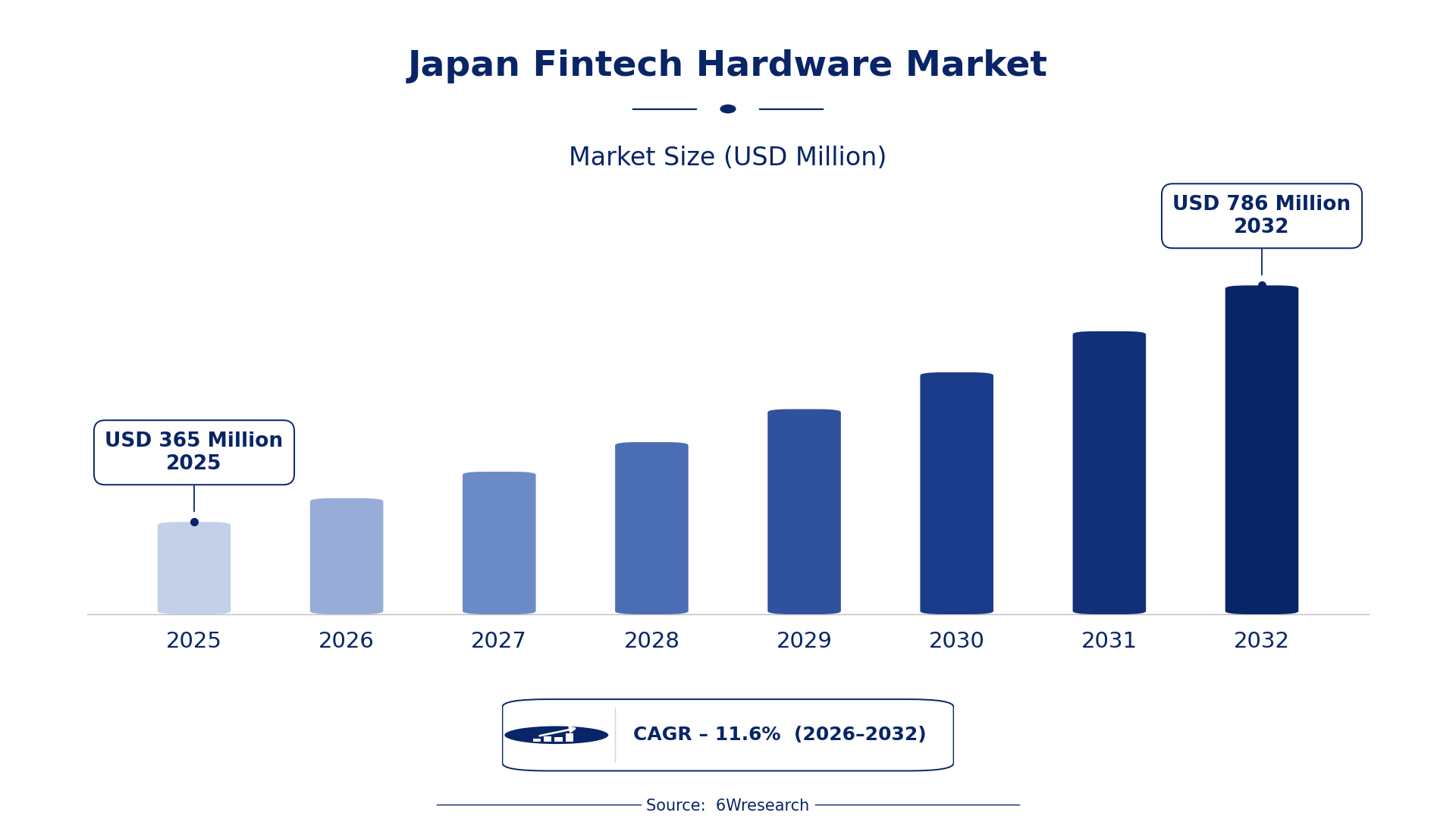
According to 6Wresearch internal database and industry insights, the Japan Fintech Hardware Market was valued at USD 365 Million in 2025 and is projected to reach USD 786 Million by 2032, growing at a CAGR of approximately 11.6% during 2026–2032.
Japan Fintech Hardware Market Highlights
| Report Metric | Details |
| Report Name | Japan Fintech Hardware Market (2026-2032) |
| Market Size 2025 | USD 365 Million |
| Market Size 2032 | USD 786 Million |
| Absolute Growth 2025–2032 | USD 421 Million |
| CAGR 2026–2032 | 11.6% |
| Peak Annual Growth | 14.3% in 2032 |
| Forecast Period | 2026–2032 |
| Historical Data | 2022–2025 |
| Base Year | 2025 |
| Leading Hardware Type, 2025 | POS Terminals (39% share) |
| Leading Application Area, 2025 | Retail Payments (42% share) |
| Leading Distribution Channel, 2025 | OEMs (44% share) |
| Leading End User, 2025 | Retailers (42% share) |
| Fastest-Growing Hardware Type | Biometric Devices (16.8% CAGR) |
| Fastest-Growing Application Area | Identity Verification (14.7% CAGR) |
| Fastest-Growing Distribution Channel | Online B2B (15.2% CAGR) |
| Fastest-Growing End User | Banks (15.1% CAGR) |
| Growing Sector | Retail Payments |
| Key End Users | Retailers, Banks, Fintech Startups, Financial Institutions |
Japan Fintech Hardware Market Year-wise Growth Rate and Key Drivers (2022–2032)
This graph illustrates the annual growth rates of the market from 2022 to 2032, highlighting a steady upward trajectory and projected market expansion over the forecast period.
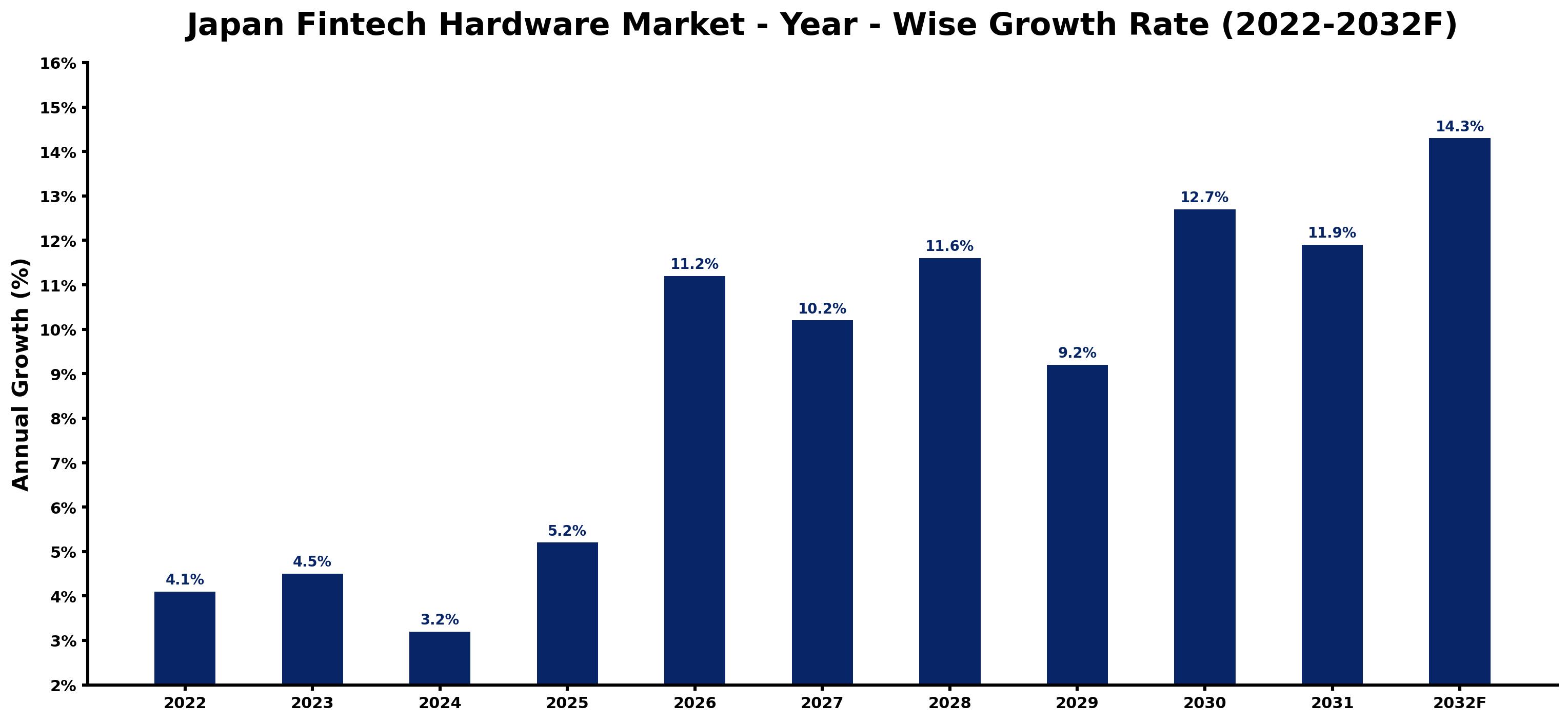
Year by year, the estimates below pair each growth rate with the development that shaped it.
| Year | Estimated Annual Growth (%) | Market Rationale |
| 2022 | 4.1 | The market showed steady demand, reflecting ongoing adoption of fintech solutions. |
| 2023 | 4.5 | Growth accelerated due to rising mobile payment users and fintech innovations. |
| 2024 | 3.2 | A slowdown occurred as the market adjusted to previous rapid expansion. |
| 2025 | 5.2 | Growth resumed, driven by increased retail payment transactions and technology adoption. |
| 2026 | 11.2 | Demand surged as biometric devices gained traction in ATMs and payment systems. |
| 2027 | 10.2 | A slight slowdown followed as the market stabilised after rapid growth. |
| 2028 | 11.6 | Growth picked up again, spurred by advancements in identity verification technology. |
| 2029 | 9.2 | The market experienced a slowdown, but demand remained strong overall. |
| 2030 | 12.7 | Growth accelerated as mobile payments became more integrated into retail. |
| 2031 | 11.9 | A slight slowdown occurred, reflecting market maturation and increased competition. |
| 2032 | 14.3 | The market peaked, driven by widespread adoption of cashless transactions. |
Note: Market size estimations and growth projections presented in this report are based on 6Wresearch's proprietary forecasting methodology, utilizing the latest available industry data, government publications, and primary research inputs.
Japan Fintech Hardware Market Synopsis
Fintech hardware includes devices that facilitate financial transactions and identity verification, such as POS terminals, biometric devices, card readers, and ATMs. The Japan Fintech Hardware Market is driven by a strong retail sector and over 126 million mobile payment users. The Tokyo region serves as a key hub for fintech innovation, with the government targeting 50% cashless transactions by 2025. This environment supports growth as technology adoption and investment in fintech solutions continue to rise.
Market Dynamics Impact Analysis (2026–2032)
| Factor | Type | Impact | Primary Segment Affected |
| Increase in mobile payment users | Driver | High | Mobile Payments |
| Integration of POS terminals with mobile solutions | Driver | High | POS Terminals |
| Growing demand for secure identity verification | Opportunity | High | Biometric Devices |
| Expansion of cashless transaction initiatives | Opportunity | High | Retail Payments |
| High costs of advanced technology implementation | Restraint | Medium | Card Readers |
| Regulatory compliance challenges for new entrants | Restraint | Medium | Fintech Startups |
| Rising competition from global fintech solutions | Challenge | High | Financial Institutions |
| Capacity constraints in hardware production | Challenge | Medium | ATMs |
Evaluation of Drivers in Japan Fintech Hardware Market (2026–2032)
The main growth drivers and the segments they affect most are set out below.
| Drivers | Primary Segment Affected | Why It Matters (Evidence) |
| Growing mobile payment adoption | Mobile Payments | Over 126 million users in Japan drive demand for mobile payment solutions, increasing hardware sales. |
| Integration of advanced technology in POS systems | POS Terminals | As POS terminals increasingly support mobile payments, retailers invest more in upgrading their systems. |
| Demand for biometric verification in financial services | Biometric Devices | The adoption rate of biometric verification reached 45% in 2023, boosting demand for related hardware. |
| Government initiatives promoting cashless transactions | Retail Payments | The target of 50% cashless transactions by 2025 encourages investment in fintech hardware. |
| Increased transaction values in mobile payments | Card Readers | The average transaction value of approximately ¥3,000 drives demand for efficient card readers. |
What keeps demand rising is the growing acceptance of mobile payments, with a substantial user base propelling hardware sales. Retailers are investing in POS terminals that accommodate mobile solutions, reflecting a change in consumer behaviour. Biometric verification adoption has reached 45%, driving demand for biometric devices in ATMs. The average transaction value for mobile payments is around ¥3,000, prompting retailers to upgrade their card readers.
Evaluation of Restraints in Japan Fintech Hardware Market
These restraints slow adoption and weigh on supplier margins.
| Market Restraint | Primary Segment Affected | Why It Matters (Evidence) |
| High costs associated with advanced technology implementation | Card Readers | The need for sophisticated technology increases costs, limiting adoption among smaller retailers. |
| Regulatory compliance challenges for new entrants | Fintech Startups | Navigating complex regulations can delay market entry for new fintech solutions. |
| Limited availability of skilled workforce for production | ATMs | A shortage of skilled labour affects the production capacity of advanced ATM systems. |
| Market saturation in certain hardware segments | POS Terminals | High competition among existing providers limits growth opportunities for new entrants. |
| Dependence on third-party suppliers for components | Biometric Devices | Supply chain disruptions can impact the availability of essential components for biometric devices. |
Japan Fintech Hardware Market Challenges
In Japan, the surge of new entrants in the fintech hardware market results in competitive pricing, which can erode profit margins for producers and lead to compromises on quality. A shortage of skilled professionals in advanced technology restricts suppliers' capacity to innovate, causing delays in product launches for buyers seeking cutting-edge solutions. Technology adoption varies widely between urban and rural areas, creating service gaps that frustrate end users who depend on seamless payment systems. Buyers encounter difficulties integrating new devices, as over 60% of transactions processed require compatibility with existing systems, risking transaction failures and customer dissatisfaction.
Trends in the Japan Fintech Hardware Market
Several trends are reshaping the Japan Fintech Hardware Market; the most important are set out below.
- Retailers Embracing Cashless Payments: Retailers are increasingly adopting cashless payment solutions to enhance customer experience. In 2023, over 60% of transactions processed through fintech hardware were retail payments, signalling a shift towards digital transactions.
- Rise of Biometric Verification in ATMs: Biometric devices are now featured in over 70% of new ATMs installed in Japan, improving security and user convenience. This trend highlights a growing emphasis on secure identity verification in financial transactions.
- Integration of POS Terminals with Mobile Payments: POS terminals are being integrated more frequently with mobile payment solutions, enabling quicker transactions. This integration is apparent as retailers upgrade their systems to cater to the expanding mobile payment user base.
- Government Initiatives Supporting Fintech Startups: The Japanese government initiated a programme in 2023 to subsidise fintech startups, encouraging innovation in the sector. This initiative aims to enhance the overall fintech environment and stimulate hardware demand.
Investment Opportunities in the Japan Fintech Hardware Market
The opportunities below stand out in the Japan Fintech Hardware Market for new entrants and existing suppliers.
- Gap in Biometric Device Adoption: With a 45% adoption rate for biometric verification, there is an opportunity to supply advanced biometric devices to financial institutions. Partnering with banks can facilitate entry into this growing market.
- Investment in Cashless Infrastructure: The government aims for 50% cashless transactions by 2025, creating a demand for supporting hardware. Collaborating with retailers can help meet this growing need for payment solutions.
- Expansion of Direct Sales Channels: Direct sales channels are becoming increasingly important for hardware distribution, with a growing emphasis on online sales. Engaging with hardware integrators can enhance market reach and efficiency.
- Emerging Demand from Fintech Startups: As fintech startups develop innovative solutions, there is a need for reliable hardware. Focusing on partnerships with startups can open new avenues for growth in the fintech hardware market.
Government Initiatives in the Japan Fintech Hardware Market
The 2023 programme to subsidise fintech startups promotes innovation, building on the existing framework established by the Financial Services Agency. This initiative aims to lower barriers for new entrants, encouraging the development of advanced fintech hardware solutions.
The Financial Services Agency regulates fintech hardware usage, ensuring compliance with standards like ISO/IEC 27001. This agency plays a crucial role in approving new technologies and ensuring they meet security requirements.
Future Insight of the Japan Fintech Hardware Market
By 2032, the rise of robust cybersecurity standards will transform the fintech hardware sector, boosting user confidence and driving higher adoption rates. The government's goal to achieve 50% cashless transactions by 2025 will stimulate demand for advanced payment solutions, prompting suppliers to innovate. Projections indicate that biometric verification will be incorporated in 70% of new installations, streamlining identity verification processes. The Tokyo region will continue to be a key innovation hub, attracting further investment and talent in fintech hardware development.
Market Segmentation Analysis
Japan Fintech Hardware Market report covers a detailed analysis of the following market segments:
By Hardware Type – POS Terminals Lead, Biometric Devices Expected to Grow Fastest
According to Saurav Kr Singh, Senior Research Analyst at 6Wresearch, POS Terminals held 39% of the Japan Fintech Hardware Market by hardware type in 2025. POS terminals hold the largest share due to their essential role in processing retail payments, which account for over 60% of all transactions. Their integration with mobile payment solutions further solidifies their significance in the retail sector. Biometric Devices are projected to grow fastest, at a CAGR of 16.8% during 2026–2032. Biometric devices are experiencing rapid growth as they are increasingly used in over 70% of new ATMs, enhancing security measures in financial transactions. This trend is likely to continue as the government aims to improve cybersecurity for fintech hardware by 2024. Suppliers should focus on advancing biometric technology to meet the rising security demands of the market.
By Application Area – Retail Payments Lead, Identity Verification Expected to Grow Fastest
With 42% of application area revenue in 2025, Retail Payments was the largest category. Retail payments dominate the application area as the primary function of fintech hardware, reflecting the high volume of transactions processed in this sector. The average transaction value of approximately ¥3,000 highlights the financial activity prevalent in retail environments. The quickest growth will come from Identity Verification, forecast to expand at a CAGR of 14.7% between 2026 and 2032. Identity verification is growing quickly due to its critical importance in securing transactions, with the adoption rate of biometric verification in financial services reaching 45% in 2023. This increasing emphasis on security is expected to drive further investments in identity verification technologies. Buyers must prioritise identity verification solutions to comply with escalating security standards.
By Distribution Channel – OEMs Lead, Online B2B Expected to Grow Fastest
OEMs took 44% of distribution channel revenue in 2025, more than any other category. OEMs lead the distribution channel as they supply essential components for hardware manufacturing, making them vital to the production ecosystem. Their established relationships within the industry ensure a dependable supply chain for market requirements. Over 2026–2032, Online B2B is expected to post the fastest growth, at a CAGR of 15.2%. Online B2B channels are rapidly expanding, facilitating hardware sales to businesses and meeting the growing demand for efficient procurement processes. This shift reflects broader trends towards digitalisation in supply chain operations. Suppliers should enhance their online strategies to capitalise on the increasing demand for B2B sales.
By End User – Retailers Lead, Banks Expected to Grow Fastest
The largest end user category in 2025 was Retailers, at 42% of revenue. Retailers are the primary end user group for fintech hardware, relying heavily on transaction processing solutions. Their need for efficient payment systems drives the demand for advanced hardware tailored to their operational requirements. Banks are set to record the highest CAGR in this split, 15.1% over 2026–2032. Banks are the fastest-growing end users of fintech hardware, particularly as they adopt new technologies for transaction processing. This trend indicates a significant shift towards more sophisticated banking solutions that improve service delivery. Suppliers should tailor their offerings to meet the changing needs of banks as they modernise their transaction processing capabilities.
Key Attractiveness of the Report
- 10 Years of Market Numbers
- Historical Data Starting from 2022 to 2025
- Base Year 2025
- Forecast Data until 2032
- Key Performance Indicators Impacting the Market
- Major Upcoming Developments and Projects
Key Highlights of the Report:
- Japan Fintech Hardware Market Outlook
- Market Size of Japan Fintech Hardware Market, 2025
- Forecast of Japan Fintech Hardware Market, 2032
- Historical Data and Forecast of Japan Fintech Hardware Revenues & Volume for the Period 2022-2032F
- Japan Fintech Hardware Market Trend Evolution
- Japan Fintech Hardware Market Drivers and Challenges
- Japan Fintech Hardware Price Trends
- Japan Fintech Hardware Porter's Five Forces
- Japan Fintech Hardware Industry Life Cycle
- Historical Data and Forecast of Japan Fintech Hardware Market Revenues & Volume By Hardware Type for the Period 2022-2032F
- Historical Data and Forecast of Japan Fintech Hardware Market Revenues & Volume By POS Terminals for the Period 2022-2032F
- Historical Data and Forecast of Japan Fintech Hardware Market Revenues & Volume By Biometric Devices for the Period 2022-2032F
- Historical Data and Forecast of Japan Fintech Hardware Market Revenues & Volume By Card Readers for the Period 2022-2032F
- Historical Data and Forecast of Japan Fintech Hardware Market Revenues & Volume By ATMs for the Period 2022-2032F
- Historical Data and Forecast of Japan Fintech Hardware Market Revenues & Volume By Application Area for the Period 2022-2032F
- Historical Data and Forecast of Japan Fintech Hardware Market Revenues & Volume By Retail Payments for the Period 2022-2032F
- Historical Data and Forecast of Japan Fintech Hardware Market Revenues & Volume By Identity Verification for the Period 2022-2032F
- Historical Data and Forecast of Japan Fintech Hardware Market Revenues & Volume By Mobile Payments for the Period 2022-2032F
- Historical Data and Forecast of Japan Fintech Hardware Market Revenues & Volume By Cash Withdrawal for the Period 2022-2032F
- Historical Data and Forecast of Japan Fintech Hardware Market Revenues & Volume By Distribution Channel for the Period 2022-2032F
- Historical Data and Forecast of Japan Fintech Hardware Market Revenues & Volume By OEMs for the Period 2022-2032F
- Historical Data and Forecast of Japan Fintech Hardware Market Revenues & Volume By Online B2B for the Period 2022-2032F
- Historical Data and Forecast of Japan Fintech Hardware Market Revenues & Volume By Hardware Integrators for the Period 2022-2032F
- Historical Data and Forecast of Japan Fintech Hardware Market Revenues & Volume By Direct Sales for the Period 2022-2032F
- Historical Data and Forecast of Japan Fintech Hardware Market Revenues & Volume By End User for the Period 2022-2032F
- Historical Data and Forecast of Japan Fintech Hardware Market Revenues & Volume By Retailers for the Period 2022-2032F
- Historical Data and Forecast of Japan Fintech Hardware Market Revenues & Volume By Banks for the Period 2022-2032F
- Historical Data and Forecast of Japan Fintech Hardware Market Revenues & Volume By Fintech Startups for the Period 2022-2032F
- Historical Data and Forecast of Japan Fintech Hardware Market Revenues & Volume By Financial Institutions for the Period 2022-2032F
- Japan Fintech Hardware Import Export Trade Statistics
- Market Opportunity Assessment By Hardware Type
- Market Opportunity Assessment By Application Area
- Market Opportunity Assessment By Distribution Channel
- Market Opportunity Assessment By End User
- Japan Fintech Hardware Top Companies Market Share
- Japan Fintech Hardware Competitive Benchmarking By Technical and Operational Parameters
- Japan Fintech Hardware Company Profiles
- Japan Fintech Hardware Key Strategic Recommendations
Market Covered
Coverage by segment is as follows.
By Hardware Type
- POS Terminals
- Biometric Devices
- Card Readers
- ATMs
By Application Area
- Retail Payments
- Identity Verification
- Mobile Payments
- Cash Withdrawal
By Distribution Channel
- OEMs
- Online B2B
- Hardware Integrators
- Direct Sales
By End User
- Retailers
- Banks
- Fintech Startups
- Financial Institutions































