Japan Fintech Platforms Market Size & Growth Rate
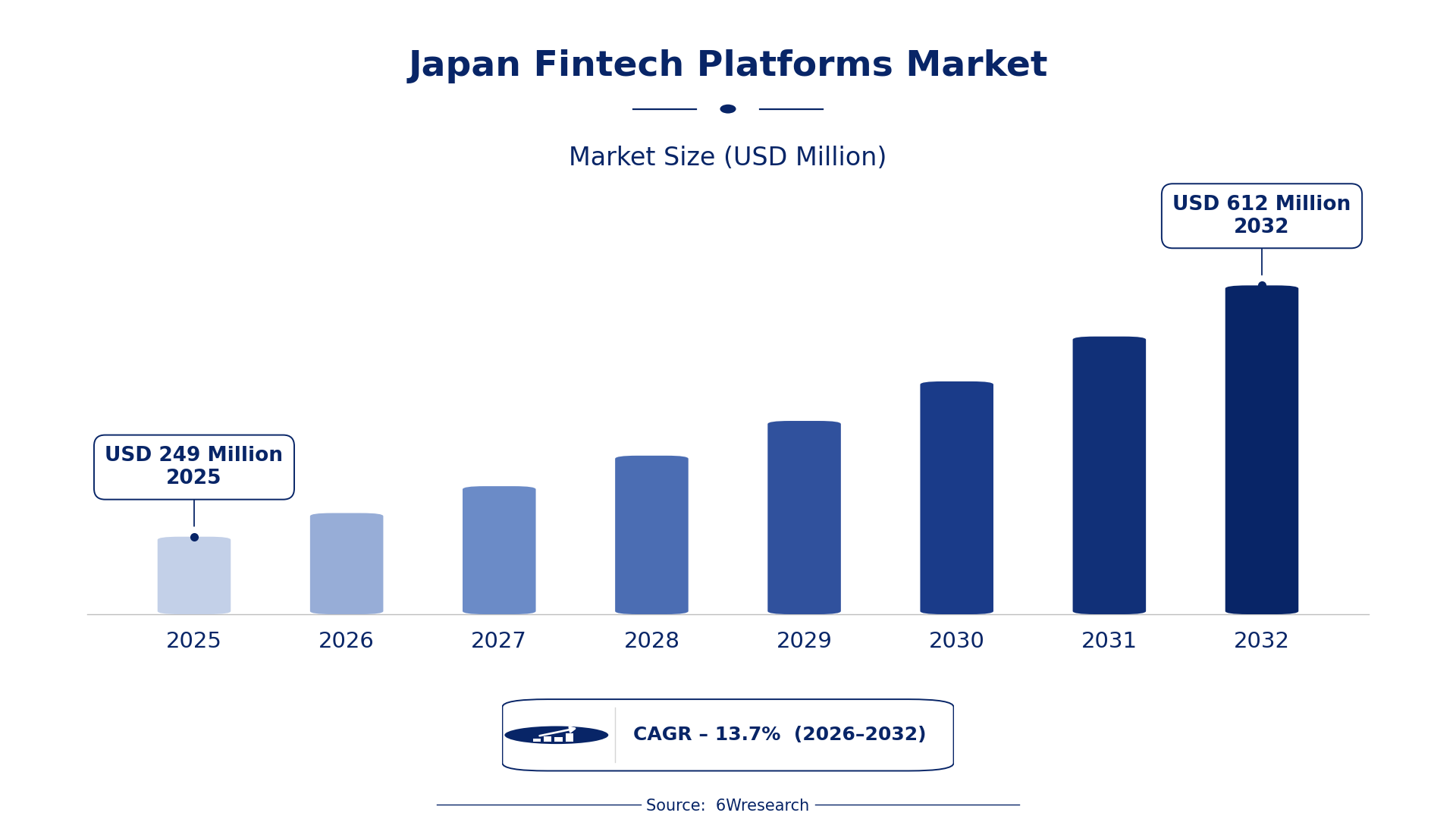
According to 6Wresearch internal database and industry insights, the Japan Fintech Platforms Market was valued at USD 249 Million in 2025 and is projected to reach USD 612 Million by 2032, growing at a CAGR of approximately 13.7% during 2026–2032.
Japan Fintech Platforms Market Highlights
| Report Metric | Details |
| Report Name | Japan Fintech Platforms Market (2026-2032) |
| Market Size 2025 | USD 249 Million |
| Market Size 2032 | USD 612 Million |
| Absolute Growth 2025–2032 | USD 363 Million |
| CAGR 2026–2032 | 13.7% |
| Peak Annual Growth | 14.9% in 2032 |
| Forecast Period | 2026–2032 |
| Historical Data | 2022–2025 |
| Base Year | 2025 |
| Leading Platform Type, 2025 | Digital Banking (53% share) |
| Leading Technology Used, 2025 | Cloud (40% share) |
| Leading Distribution Channel, 2025 | SaaS Providers (42% share) |
| Leading End User, 2025 | Challenger Banks (35% share) |
| Fastest-Growing Platform Type | Robo-Advisory (19.4% CAGR) |
| Fastest-Growing Technology Used | AI (19.6% CAGR) |
| Fastest-Growing Distribution Channel | Online Platforms (17.7% CAGR) |
| Fastest-Growing End User | Retail Investors (17.6% CAGR) |
| Growing Sector | Fintech Platforms |
| Key End Users | Retail Investors, Challenger Banks, InsurTech Companies, Digital Banks |
Japan Fintech Platforms Market Year-wise Growth Rate and Key Drivers (2022–2032)
This graph illustrates the annual growth rates of the market from 2022 to 2032, highlighting a steady upward trajectory and projected market expansion over the forecast period.
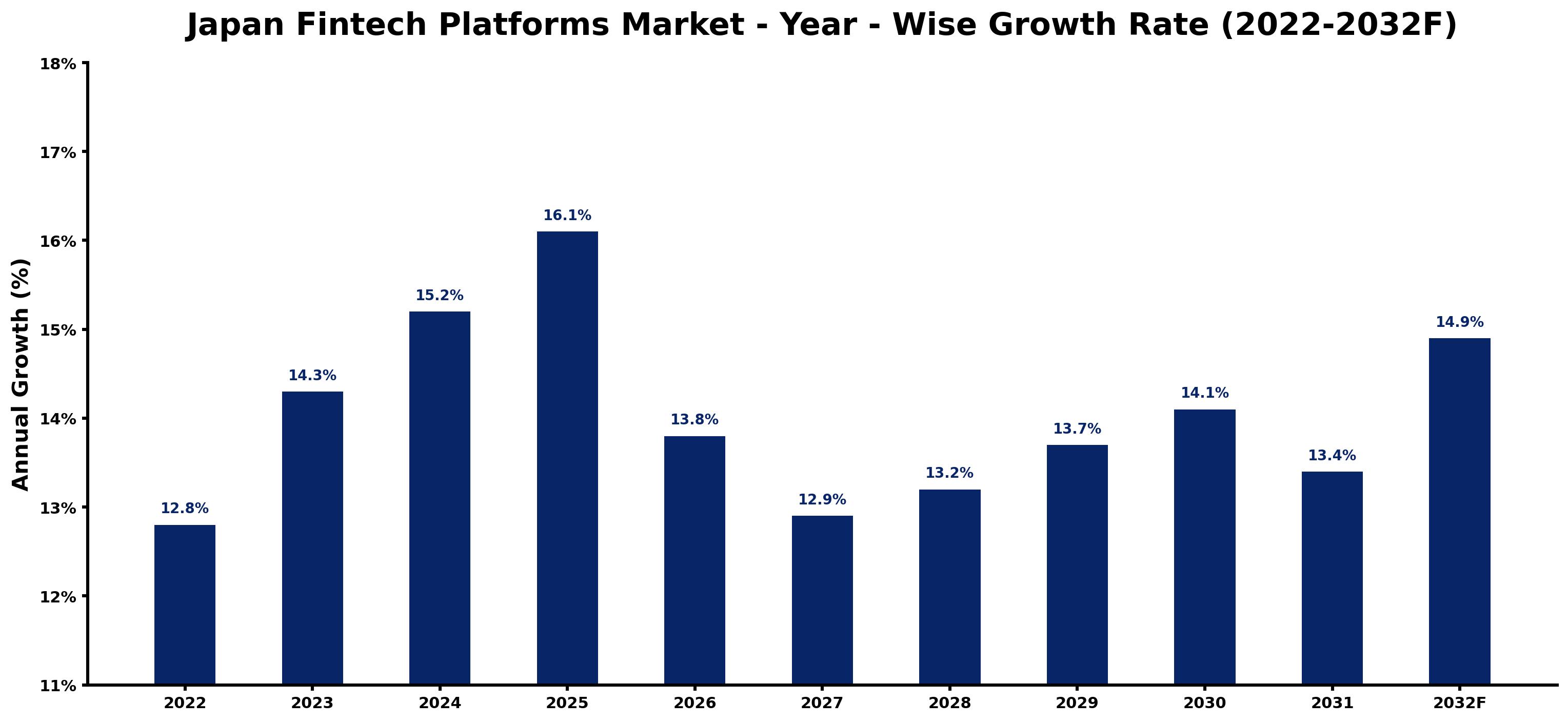
The table below sets out the estimated growth rate for each year and the main factor behind it.
| Year | Estimated Annual Growth (%) | Market Rationale |
| 2022 | 12.8 | Digital banking adoption reached 60% among adults, boosting fintech growth. |
| 2023 | 14.3 | The launch of a new regulatory sandbox for fintech innovations spurred investment. |
| 2024 | 15.2 | Increased AI adoption in customer service drove demand for fintech platforms. |
| 2025 | 16.1 | The fintech market peaked as over 200 startups emerged in Tokyo, enhancing competition. |
| 2026 | 13.8 | Growth is expected to slow as the market adjusts to regulatory changes and competition. |
| 2027 | 12.9 | Demand is projected to remain steady as digital banking services become more mainstream. |
| 2028 | 13.2 | AI technology adoption is expected to continue rising, improving customer experiences in fintech. |
| 2029 | 13.7 | Retail investors are expected to increasingly turn to robo-advisory services for investment management. |
| 2030 | 14.1 | Cloud technology is projected to remain essential, supporting the scalability of fintech operations. |
| 2031 | 13.4 | Growth is expected to slow as the market matures and competition intensifies. |
| 2032 | 14.9 | The introduction of new fintech regulations is expected to drive further innovation. |
Note: Market size estimations and growth projections presented in this report are based on 6Wresearch's proprietary forecasting methodology, utilizing the latest available industry data, government publications, and primary research inputs.
Japan Fintech Platforms Market Synopsis
Fintech platforms facilitate financial services through digital means, leveraging cloud computing, AI, and blockchain technologies. The market is projected to grow rapidly, driven by over 126 million internet users and a digital banking adoption rate of 60% among adults. Demand is rising from domestic users and international collaborations as traditional banking systems evolve to meet modern needs, supported by initiatives from the Japan Fintech Association and the Financial Services Agency.
Market Dynamics Impact Analysis (2026–2032)
| Factor | Type | Impact | Primary Segment Affected |
| Increased digital banking adoption drives demand for fintech solutions. | Driver | High | Digital Banking |
| The rise of AI technology enhances customer service capabilities in fintech. | Driver | High | AI |
| Growing interest in investment management creates opportunities for robo-advisory services. | Opportunity | High | Robo-Advisory |
| Investment in fintech initiatives is expanding, creating a need for cloud services. | Opportunity | High | Cloud |
| Regulatory compliance challenges can slow down fintech innovation. | Restraint | Medium | Digital Banking |
| High competition among startups may limit market share for new entrants. | Restraint | Medium | Digital Banking |
| Limited access to funding can hinder the growth of emerging fintech startups. | Challenge | High | Digital Banking |
| Rapid technological changes require continuous adaptation from existing platforms. | Challenge | Medium | API |
Evaluation of Drivers in Japan Fintech Platforms Market (2026–2032)
These are the developments adding the most demand over the forecast period.
| Drivers | Primary Segment Affected | Why It Matters (Evidence) |
| Digital banking adoption is increasing, leading to higher demand for fintech solutions. | Digital Banking | Digital banking adoption reached 60% among adults in 2023, prompting more users to seek fintech services. |
| AI technology enhances customer service, encouraging more users to engage with fintech platforms. | AI | With 40% of companies adopting AI by 2023, user experience in fintech improves, driving demand. |
| The growing number of retail investors is pushing demand for robo-advisory services. | Robo-Advisory | In 2023, 15% of retail investors used robo-advisory services, indicating a shift towards automated investment. |
| Cloud technology is essential for fintech operations, driving investment in cloud services. | Cloud | Over 70% of challenger banks utilise cloud technology, ensuring scalability and efficiency. |
| The regulatory environment is becoming more supportive of fintech innovations, encouraging investment. | Digital Banking | The launch of a regulatory sandbox in 2023 allows fintech startups to test innovations in a controlled environment. |
Behind the steady rise in orders sits the increasing digital banking adoption, which reached 60% among adults in 2023, prompting more users to engage with fintech solutions. The use of AI technology has been adopted by 40% of companies, improving customer service and driving demand for platforms. The number of retail investors using robo-advisory services rose to 15% in 2023, reflecting a shift towards automated investment management. Cloud technology is essential for fintech operations, with over 70% of challenger banks utilizing it to ensure operational efficiency.
Evaluation of Restraints in Japan Fintech Platforms Market
Several factors work against faster growth; the main ones are summarised below.
| Market Restraint | Primary Segment Affected | Why It Matters (Evidence) |
| Regulatory compliance can slow down innovation in fintech services. | Digital Banking | The Financial Services Agency's guidelines for digital asset management impose strict requirements on fintech companies. |
| High competition among startups can limit market entry for new players. | AI | With over 200 fintech startups in Tokyo, new entrants face challenges in gaining market share. |
| Limited access to funding can hinder the growth of emerging fintech startups. | Lending Platforms | The average transaction value in lending platforms is around 500,000 yen, which may deter smaller startups from entering. |
| Rapid technological changes require continuous adaptation from existing platforms. | API | As technology evolves, platforms must invest in upgrades to remain competitive, impacting profitability. |
| Consumer trust issues may affect the adoption of new fintech solutions. | Insurance Tech | Despite the growing market, some users remain hesitant to switch from traditional banking due to security concerns. |
Japan Fintech Platforms Market Challenges
Many fintech startups in Tokyo grapple with intense competition, as over 200 companies vie for market share, making it difficult for new entrants to establish themselves. Operational costs are rising; since 90% of fintech operations rely on cloud computing, producers face escalating expenses that can squeeze profit margins. Buyers encounter delays due to regulatory compliance; the Financial Services Agency's strict guidelines can postpone product launches, limiting service availability. The recent introduction of a regulatory sandbox creates uncertainty; startups must adapt to new rules, potentially extending their time to market for innovative solutions.
Trends in the Japan Fintech Platforms Market
The following changes are redrawing the Japan Fintech Platforms Market.
- Retail Investors Increasingly Utilising Digital Platforms: The average age of retail investors is now 40 years, indicating a younger demographic entering the market. This shift drives demand for user-friendly fintech solutions, with notable growth in platform usage.
- Rise of AI in Customer Service: The integration of AI technology in customer service is transforming fintech platforms. By 2023, 40% of companies adopted AI, improving user experiences and streamlining operations, which is key for attracting new customers.
- Shift Towards Cloud-Based Solutions: Fintech companies are increasingly adopting cloud technology for operations, with over 70% of challenger banks utilising cloud services. This trend supports scalability and flexibility, allowing firms to respond quickly to market demands.
- Expansion of Regulatory Sandboxes: The introduction of regulatory sandboxes in 2023 has encouraged innovation within the fintech sector. Startups can now test their solutions in a controlled environment, promoting a culture of experimentation and growth.
Investment Opportunities in the Japan Fintech Platforms Market
The following areas offer the clearest openings for investors and suppliers in the Japan Fintech Platforms Market.
- Tokyo as a Fintech Hub: With over 200 fintech startups, Tokyo creates opportunities for collaboration and investment, supported by a projected budget of 1 billion yen for fintech initiatives in 2024.
- Growing Demand for Robo-Advisory Services: With 15% of retail investors using robo-advisory services in 2023, there is a gap in the market for automated investment solutions. Firms can enter this space by developing user-friendly platforms tailored to younger investors.
- Investment in AI Technology: The increasing adoption of AI technology in customer service presents an opportunity. Companies can invest in AI solutions to improve user experiences and streamline operations, meeting the needs of tech-savvy consumers.
- Cloud Services for Fintech Operations: With over 70% of challenger banks utilising cloud technology, there is a strong demand for cloud services. Providers can partner with fintech firms to offer scalable solutions that support their growth.
Government Initiatives in the Japan Fintech Platforms Market
Japan's fintech framework is shaped by key laws, including the Financial Instruments and Exchange Act and the Payment Services Act, which provide guidelines for digital asset management and payment systems. The AI Promotion Act introduced in 2025 establishes a framework for AI research and development, promoting innovation in the fintech sector. These measures improve the operational environment for fintech platforms, ensuring compliance and supporting growth.
The Digital Agency oversees the implementation of fintech regulations and has established a regulatory sandbox to facilitate innovation. This sandbox allows startups to test their solutions in a controlled environment, promoting collaboration among fintech firms. Additionally, the Japan Fintech Association plays a crucial role in supporting fintech initiatives, ensuring that companies can navigate the regulatory landscape effectively.
Future Insight of the Japan Fintech Platforms Market
By 2032, the market will shift as digital banking adoption is projected to surpass 70%, transforming how buyers engage with financial services. The government's commitment of 1 billion yen for fintech initiatives will drive innovation, enabling suppliers to develop advanced platforms. Increased integration of AI in customer service is expected, with 80% of companies adopting this technology to improve user interactions. As robo-advisory services gain popularity, younger demographics will be drawn into the investment space, broadening market participation.
Market Segmentation Analysis
Japan Fintech Platforms Market report covers a detailed analysis of the following market segments:
By Platform Type – Digital Banking Leads, Robo-Advisory Expected to Grow Fastest
According to Saurav Kr Singh, Senior Research Analyst at 6Wresearch, Digital Banking accounted for 53% of the market by platform type in 2025. Digital banking holds the largest share as it provides essential banking services through digital channels, catering to a vast user base of over 126 million internet users in Japan. The 60% adoption rate among adults underscores its importance in modern financial services. Over 2026–2032, Robo-Advisory is expected to post the fastest growth, at a CAGR of 19.4%. Robo-advisory services are experiencing rapid growth due to their ability to automate investment advice, particularly appealing to younger retail investors entering the market. With 15% of retail investors using these services in 2023, this trend indicates a shift towards more technology-oriented investment solutions. Suppliers should enhance digital banking features to meet the rising demand for fintech solutions.
By Technology Used – Cloud Leads, AI Expected to Grow Fastest
With 40% of technology used revenue in 2025, Cloud was the largest category. Cloud technology leads the market as it supports 90% of fintech operations, providing the scalable infrastructure necessary for efficient service delivery. Its extensive adoption among fintech firms ensures operational flexibility and responsiveness to market needs. The quickest growth will come from AI, forecast to expand at a CAGR of 19.6% between 2026 and 2032. AI technology is advancing rapidly, with 40% of companies incorporating it for customer service and data analysis. This reflects the growing demand for personalised user experiences in the fintech sector, suggesting that AI will play a pivotal role in future developments. Buyers can anticipate enhanced service offerings as suppliers invest in AI to improve customer interactions.
By Distribution Channel – SaaS Providers Lead, Online Platforms Expected to Grow Fastest
The largest distribution channel category in 2025 was SaaS Providers, at 42% of revenue. SaaS providers dominate the distribution channel by supplying crucial software solutions to fintech companies, streamlining their operations and enhancing service delivery. This model ensures scalability and accessibility in a fast-paced fintech environment. Online Platforms are projected to grow fastest, at a CAGR of 17.7% during 2026–2032. Online platforms are the fastest-growing channel, serving as the main interface for users to access various fintech services. The convenience and user-friendliness of these platforms align with the expectations of a tech-savvy consumer base. Suppliers should focus on developing online platforms to capture the growing user engagement in fintech services.
By End User – Challenger Banks Lead, Retail Investors Expected to Grow Fastest
Challenger Banks took 35% of end user revenue in 2025, more than any other category. Challenger banks occupy the leading position in the end-user segment by offering alternative banking solutions that appeal to a tech-savvy demographic. Their popularity is reinforced by the increasing adoption of digital banking across Japan, indicating a shift in consumer preferences. Retail Investors are set to record the highest CAGR in this split, 17.6% over 2026–2032. Retail investors represent the fastest-growing end-user group, utilising platforms for personal investment management as they adapt to the changing financial landscape. The average age of retail investors at 40 signifies a trend towards younger individuals engaging with investment technologies. Suppliers must tailor their offerings to attract and retain retail investors who are increasingly utilising fintech platforms for their investment needs.
Key Attractiveness of the Report
- 10 Years of Market Numbers
- Historical Data Starting from 2022 to 2025
- Base Year 2025
- Forecast Data until 2032
- Key Performance Indicators Impacting the Market
- Major Upcoming Developments and Projects
Key Highlights of the Report:
- Japan Fintech Platforms Market Outlook
- Market Size of Japan Fintech Platforms Market, 2025
- Forecast of Japan Fintech Platforms Market, 2032
- Historical Data and Forecast of Japan Fintech Platforms Revenues & Volume for the Period 2022-2032F
- Japan Fintech Platforms Market Trend Evolution
- Japan Fintech Platforms Market Drivers and Challenges
- Japan Fintech Platforms Price Trends
- Japan Fintech Platforms Porter's Five Forces
- Japan Fintech Platforms Industry Life Cycle
- Historical Data and Forecast of Japan Fintech Platforms Market Revenues & Volume By Platform Type for the Period 2022-2032F
- Historical Data and Forecast of Japan Fintech Platforms Market Revenues & Volume By Digital Banking for the Period 2022-2032F
- Historical Data and Forecast of Japan Fintech Platforms Market Revenues & Volume By Robo-Advisory for the Period 2022-2032F
- Historical Data and Forecast of Japan Fintech Platforms Market Revenues & Volume By Lending Platforms for the Period 2022-2032F
- Historical Data and Forecast of Japan Fintech Platforms Market Revenues & Volume By Insurance Tech for the Period 2022-2032F
- Historical Data and Forecast of Japan Fintech Platforms Market Revenues & Volume By Technology Used for the Period 2022-2032F
- Historical Data and Forecast of Japan Fintech Platforms Market Revenues & Volume By Cloud for the Period 2022-2032F
- Historical Data and Forecast of Japan Fintech Platforms Market Revenues & Volume By AI for the Period 2022-2032F
- Historical Data and Forecast of Japan Fintech Platforms Market Revenues & Volume By API for the Period 2022-2032F
- Historical Data and Forecast of Japan Fintech Platforms Market Revenues & Volume By Blockchain for the Period 2022-2032F
- Historical Data and Forecast of Japan Fintech Platforms Market Revenues & Volume By Distribution Channel for the Period 2022-2032F
- Historical Data and Forecast of Japan Fintech Platforms Market Revenues & Volume By SaaS Providers for the Period 2022-2032F
- Historical Data and Forecast of Japan Fintech Platforms Market Revenues & Volume By Online Platforms for the Period 2022-2032F
- Historical Data and Forecast of Japan Fintech Platforms Market Revenues & Volume By Direct B2B for the Period 2022-2032F
- Historical Data and Forecast of Japan Fintech Platforms Market Revenues & Volume By Fintech Ecosystems for the Period 2022-2032F
- Historical Data and Forecast of Japan Fintech Platforms Market Revenues & Volume By End User for the Period 2022-2032F
- Historical Data and Forecast of Japan Fintech Platforms Market Revenues & Volume By Challenger Banks for the Period 2022-2032F
- Historical Data and Forecast of Japan Fintech Platforms Market Revenues & Volume By Retail Investors for the Period 2022-2032F
- Historical Data and Forecast of Japan Fintech Platforms Market Revenues & Volume By Credit Unions for the Period 2022-2032F
- Historical Data and Forecast of Japan Fintech Platforms Market Revenues & Volume By InsurTech Companies for the Period 2022-2032F
- Japan Fintech Platforms Import Export Trade Statistics
- Market Opportunity Assessment By Platform Type
- Market Opportunity Assessment By Technology Used
- Market Opportunity Assessment By Distribution Channel
- Market Opportunity Assessment By End User
- Japan Fintech Platforms Top Companies Market Share
- Japan Fintech Platforms Competitive Benchmarking By Technical and Operational Parameters
- Japan Fintech Platforms Company Profiles
- Japan Fintech Platforms Key Strategic Recommendations
Market Covered
This report examines the market across the segments below.
By Platform Type
- Digital Banking
- Robo-Advisory
- Lending Platforms
- Insurance Tech
By Technology Used
- Cloud
- AI
- API
- Blockchain
By Distribution Channel
- SaaS Providers
- Online Platforms
- Direct B2B
- Fintech Ecosystems
By End User
- Challenger Banks
- Retail Investors
- Credit Unions
- InsurTech Companies































