Japan FinTech Security Market Size & Growth Rate
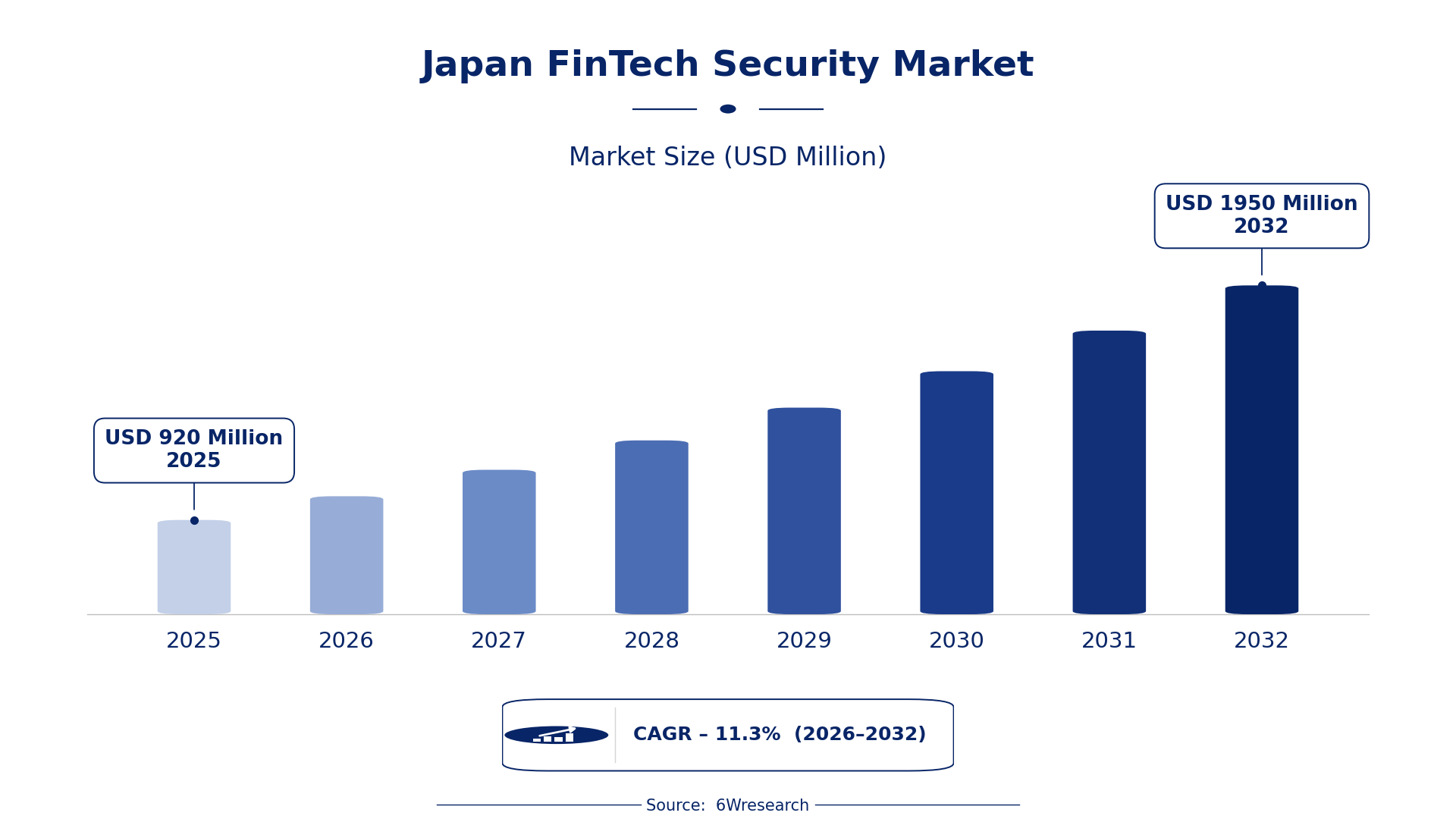
According to 6Wresearch internal database and industry insights, the Japan FinTech Security Market was valued at USD 920 Million in 2025 and is projected to reach USD 1,950 Million by 2032, growing at a CAGR of approximately 11.3% during 2026–2032.
Japan FinTech Security Market Highlights
| Report Metric | Details |
| Report Name | Japan FinTech Security Market (2026-2032) |
| Market Size 2025 | USD 920 Million |
| Market Size 2032 | USD 1,950 Million |
| Absolute Growth 2025–2032 | USD 1,030 Million |
| CAGR 2026–2032 | 11.3% |
| Peak Annual Growth | 12.7% in 2028 |
| Forecast Period | 2026–2032 |
| Historical Data | 2022–2025 |
| Base Year | 2025 |
| Leading Security Type, 2025 | Data Encryption (52% share) |
| Leading Threat Focus, 2025 | Phishing/Fraud (41% share) |
| Leading Distribution Channel, 2025 | Cybersecurity Vendors (41% share) |
| Leading End User, 2025 | FinTech Firms (42% share) |
| Fastest-Growing Security Type | Fraud Detection (15.8% CAGR) |
| Fastest-Growing Threat Focus | API Breach (14.9% CAGR) |
| Fastest-Growing Distribution Channel | SaaS Providers (14.6% CAGR) |
| Fastest-Growing End User | Digital Banks (14.7% CAGR) |
| Growing Sector | Digital Banks |
| Key End Users | FinTech Firms, Digital Banks, Payment Processors, Mobile Wallet Providers |
Japan FinTech Security Market Year-wise Growth Rate and Key Drivers (2022–2032)
This graph illustrates the annual growth rates of the market from 2022 to 2032, highlighting a steady upward trajectory and projected market expansion over the forecast period.
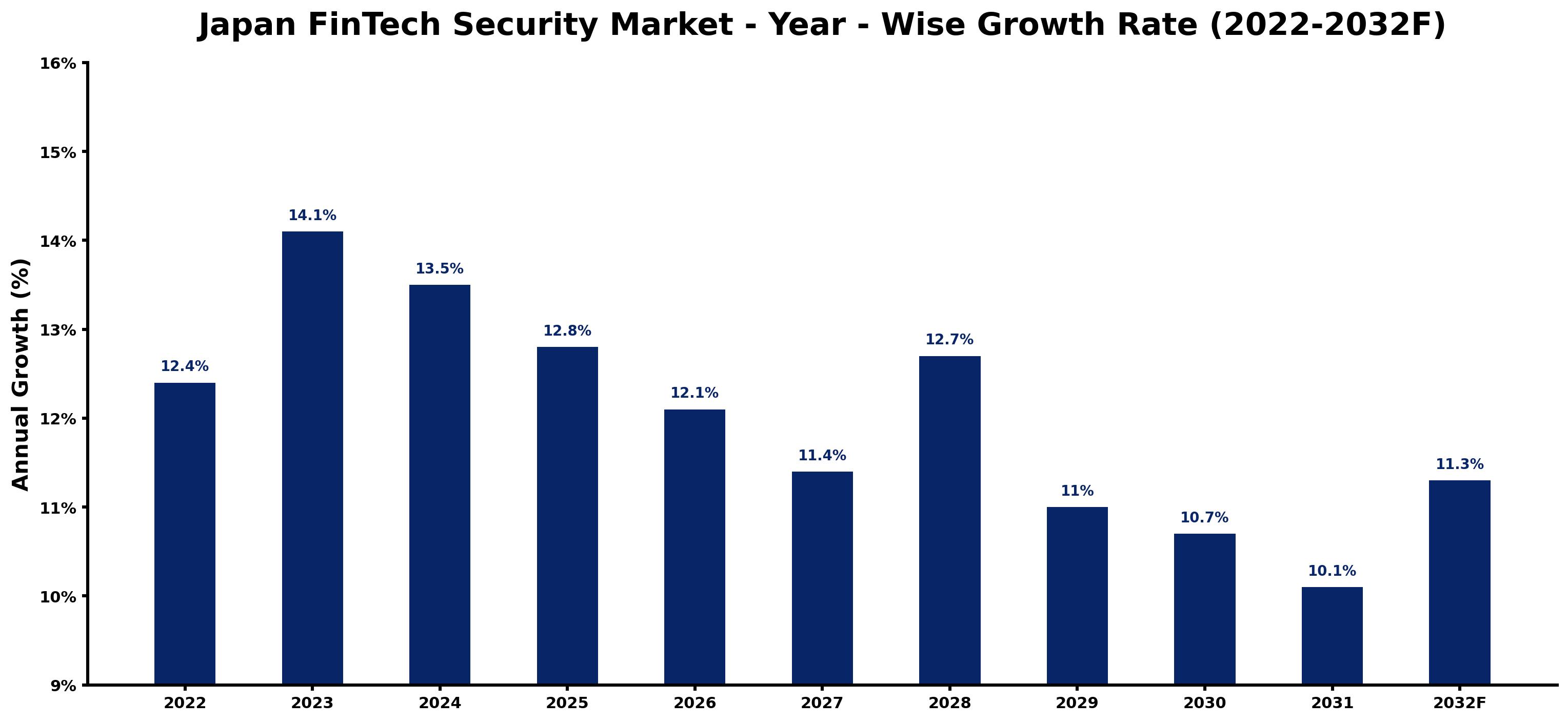
For each year, the table pairs the estimated growth rate with the leading influence on demand, showing how the drivers changed across the period.
| Year | Estimated Annual Growth (%) | Market Rationale |
| 2022 | 12.4 | The market experienced solid growth due to increased digital finance adoption. |
| 2023 | 14.1 | Demand surged as cybersecurity incidents rose, prompting greater investment in security solutions. |
| 2024 | 13.5 | Growth slowed as companies began to consolidate their cybersecurity strategies. |
| 2025 | 12.8 | The market continued to expand as digital wallets gained popularity among users. |
| 2026 | 12.1 | Demand growth is expected to decelerate as firms focus on improving existing security measures. |
| 2027 | 11.4 | The market will maintain growth as new technologies emerge to combat cyber threats. |
| 2028 | 12.7 | Demand is projected to accelerate again as regulatory pressures increase for stronger security frameworks. |
| 2029 | 11.0 | Growth is expected to slow as market saturation begins to impact new investments in security. |
| 2030 | 10.7 | The market will continue to grow, driven by ongoing advancements in cybersecurity technologies. |
| 2031 | 10.1 | Demand growth is projected to moderate as firms reassess their cybersecurity budgets and strategies. |
| 2032 | 11.3 | The market is expected to grow as new regulations and technologies drive further investments. |
Note: Market size estimations and growth projections presented in this report are based on 6Wresearch's proprietary forecasting methodology, utilizing the latest available industry data, government publications, and primary research inputs.
Japan FinTech Security Market Synopsis
FinTech Security encompasses technologies that protect financial transactions and sensitive data in Japan's digital finance sector. Demand in the Japan FinTech Security Market is rising, driven by the anticipated growth of digital wallets to over 100 million by 2024. Cybersecurity investments reached 300 billion JPY in 2023, propelled by a surge in cyber incidents and regulatory requirements, creating a vibrant market environment.
Market Dynamics Impact Analysis (2026–2032)
| Factor | Type | Impact | Primary Segment Affected |
| Increasing cyber incidents in the financial sector | Driver | High | Network Security |
| Growing digital wallet adoption | Driver | High | Identity Protection |
| Investment in cybersecurity solutions | Opportunity | High | Cybersecurity Vendors |
| Expansion of FinTech firms in urban areas | Opportunity | High | FinTech Firms |
| High costs of implementing advanced security measures | Restraint | Medium | Fraud Detection |
| Shortage of skilled cybersecurity professionals | Restraint | High | Data Encryption |
| Rapid technological changes in cybersecurity | Challenge | High | API Breach |
| Increasing competition among security providers | Challenge | Medium | Cloud Services |
Evaluation of Drivers in Japan FinTech Security Market (2026–2032)
Below are the drivers that matter most for revenue growth, with supporting evidence.
| Drivers | Primary Segment Affected | Why It Matters (Evidence) |
| Rise in cyber incidents | Network Security | The number of reported cyber incidents increased by 15% in 2022, prompting financial institutions to improve their security measures. |
| Digital wallet proliferation | Identity Protection | With over 100 million digital wallets expected by 2024, demand for identity protection solutions is rising sharply. |
| Investment in cybersecurity | Cybersecurity Vendors | Cybersecurity investment reached 300 billion JPY in 2023, driving demand for advanced security solutions. |
| Urban expansion of FinTech firms | FinTech Firms | Tokyo's status as a FinTech hub is resulting in increased demand for security solutions among local firms. |
| Regulatory compliance requirements | Fraud Detection | Stricter regulations compel financial institutions to invest in fraud detection technologies. |
Orders keep climbing as the number of cyber incidents reported in the financial sector rose by 15% in 2022, prompting institutions to invest more in network security. The proliferation of digital wallets, expected to exceed 100 million by 2024, drives demand for identity protection solutions among users. Investment in cybersecurity reached 300 billion JPY in 2023, resulting in increased orders for security solutions. Tokyo's growth as a FinTech hub is further increasing demand for security solutions among local firms. Stricter compliance requirements are pushing institutions to invest in fraud detection technologies, ensuring safer transactions.
Evaluation of Restraints in Japan FinTech Security Market
The key brakes on demand, and where they bite hardest, are shown below.
| Market Restraint | Primary Segment Affected | Why It Matters (Evidence) |
| High costs of advanced security measures | Fraud Detection | Implementing sophisticated fraud detection systems can be prohibitively expensive for smaller financial institutions. |
| Shortage of skilled cybersecurity professionals | Data Encryption | The lack of qualified professionals in cybersecurity limits the ability of firms to improve their data encryption practices. |
| Complexity of regulatory compliance | API Breach | Navigating complex regulations can hinder timely implementation of necessary security measures. |
| Market saturation among security providers | Cloud Services | An oversaturated market leads to price competition, affecting profitability for providers. |
| Rapid technological changes | Network Security | Keeping up with the fast-paced evolution of cybersecurity technology is challenging for many firms. |
Japan FinTech Security Market Challenges
High cybersecurity investment costs weigh heavily on producers, as the 300 billion JPY spent in 2023 strains budgets and limits their capacity for innovation. Importers are grappling with supply chain disruptions caused by a 15% rise in reported cyber incidents in 2022, delaying access to critical security technologies. Buyers face intense competition among digital wallet providers, with over 100 million expected by 2024, driving up prices and narrowing their choices. Regulatory compliance complicates operations for all stakeholders, as stringent guidelines from the Financial Services Agency inflate operational costs and create additional burdens.
Trends in the Japan FinTech Security Market
The trends below show where the Japan FinTech Security Market is heading.
- Shift from Traditional to Cloud-Based Security Solutions: Since 2021, many FinTech firms have shifted towards cloud-based security solutions, driven by the need for scalability. The Digital Agency's establishment has encouraged this transition, with investments in cybersecurity reaching 300 billion JPY in 2023.
- Increased Focus on Identity Verification: FinTech firms are prioritising identity verification processes to combat rising fraud rates. The implementation of ISO/IEC 27001 standards has become essential, with over 100 million digital wallets expected by 2024.
- AI Integration in Fraud Detection: Beginning in 2025, AI technologies are being integrated into fraud detection systems to improve efficiency. This trend is supported by the AI Promotion Act, which aims to promote AI development in Japan.
- Expansion of Cybersecurity Regulations: In 2020, the FinTech Innovation Hub was launched to support startups in navigating cybersecurity regulations. This initiative has led to increased compliance efforts among emerging FinTech firms.
Investment Opportunities in the Japan FinTech Security Market
The following areas offer the clearest openings for investors and suppliers in the Japan FinTech Security Market.
- Partnerships with Local Firms: Now is an opportune moment to invest in partnerships with local FinTech firms to deliver tailored security solutions. Tokyo's expanding FinTech sector presents a promising entry point.
- Investment in Fraud Detection Technologies: With rising cyber incidents, there is a critical need for advanced fraud detection technologies. Financial institutions in Tokyo are actively pursuing innovative solutions to strengthen their security frameworks.
- Development of Cloud Security Solutions: The shift towards cloud-based services creates opportunities for providers to offer scalable security solutions. Demand from FinTech firms in urban areas is driving this trend, making it a strategic priority.
- Certification Services for Compliance: As regulatory requirements tighten, there is an increasing need for certification services to ensure compliance. Initiatives from the Digital Agency are driving demand for such services among financial institutions.
Government Initiatives in the Japan FinTech Security Market
The Digital Agency, established in September 2021, spearheads government digital transformation efforts and sets common system standards. Its initiatives aim to bolster cybersecurity measures across various sectors, ensuring financial institutions comply with evolving regulations. The agency has approved numerous projects, improving the security framework for FinTech firms and promoting progress in the sector.
The Semiconductor and Digital Industry Strategy, introduced by METI in June 2021, includes measures to secure domestic semiconductor manufacturing. This strategy supports the development of secure technologies crucial for the FinTech sector, facilitating compliance and advancement, with funding allocated for multiple projects aimed at enhancing cybersecurity infrastructure.
Future Insight of the Japan FinTech Security Market
Investment in cybersecurity will rise, driving demand for advanced security solutions in the FinTech sector. By 2032, the FinTech Innovation Hub will enable collaboration between startups and established firms, promoting the development of new security technologies. Enhanced standards like ISO/IEC 27001 will gain traction, ensuring better protection for users. Initiatives from the Digital Agency will drive digital transformation, contributing to a more secure environment for financial transactions.
Market Segmentation Analysis
Japan FinTech Security Market report covers a detailed analysis of the following market segments:
By Security Type – Data Encryption Leads, Fraud Detection Expected to Grow Fastest
According to Saurav Kr Singh, Senior Research Analyst at 6Wresearch, the largest security type category in 2025 was Data Encryption, at 52% of revenue. Data encryption holds the largest share as it is essential for safeguarding sensitive financial data during transmission. The robust demand for encryption solutions is driven by the increasing number of digital wallets, projected to exceed 100 million by 2024. Over 2026–2032, Fraud Detection is expected to post the fastest growth, at a CAGR of 15.8%. Fraud detection is rapidly growing due to its critical role in identifying and preventing fraudulent activities in real-time. The 15% rise in cyber incidents reported in the financial sector in 2022 underscores the urgent need for effective fraud detection mechanisms. This trend indicates that suppliers must prioritise developing advanced fraud detection technologies to meet the escalating demands of the market.
By Threat Focus – Phishing/Fraud Leads, API Breach Expected to Grow Fastest
In 2025, Phishing/Fraud led the threat focus split with a 41% share. Phishing and fraud represent the leading threats as they are vital for protecting users from deceptive schemes that can lead to substantial financial losses. The sophistication of cyber threats necessitates robust solutions to effectively combat these risks. API Breach is set to record the highest CAGR in this split, 14.9% over 2026–2032. API breach is the fastest-growing threat focus area, crucial for securing APIs that connect financial services. As digital finance adoption continues to rise, the need for secure API management becomes increasingly critical. Suppliers should focus on enhancing API security measures to address the growing vulnerabilities in the FinTech ecosystem.
By Distribution Channel – Cybersecurity Vendors Lead, SaaS Providers Expected to Grow Fastest
Cybersecurity Vendors held 41% of the Japan FinTech Security Market by distribution channel in 2025. Cybersecurity vendors dominate this segment as they provide essential security solutions tailored for the FinTech sector. Their established presence and expertise in delivering comprehensive security measures are vital for maintaining trust in digital finance. SaaS Providers are projected to grow fastest, at a CAGR of 14.6% during 2026–2032. SaaS providers are experiencing the fastest growth due to their ability to offer scalable security solutions that meet the changing needs of financial services. The flexibility and accessibility of SaaS models make them particularly appealing to emerging FinTech firms. This shift suggests that suppliers should consider expanding their offerings through SaaS models to capture a larger share of the market.
By End User – FinTech Firms Lead, Digital Banks Expected to Grow Fastest
FinTech Firms took 42% of end user revenue in 2025, more than any other category. FinTech firms are the primary users of security solutions, requiring robust measures to protect their operations from cyber threats. The growth of the FinTech sector in Japan drives the demand for comprehensive security frameworks. The quickest growth will come from Digital Banks, forecast to expand at a CAGR of 14.7% between 2026 and 2032. Digital banks are the fastest-growing end users, necessitating strong security frameworks to operate safely in a competitive environment. As digital banking continues to expand, the urgency for effective security solutions will only increase. This trend indicates that suppliers should tailor their offerings to meet the specific security needs of digital banks to remain competitive.
Key Attractiveness of the Report
- 10 Years of Market Numbers
- Historical Data Starting from 2022 to 2025
- Base Year 2025
- Forecast Data until 2032
- Key Performance Indicators Impacting the Market
- Major Upcoming Developments and Projects
Key Highlights of the Report:
- Japan FinTech Security Market Outlook
- Market Size of Japan FinTech Security Market, 2025
- Forecast of Japan FinTech Security Market, 2032
- Historical Data and Forecast of Japan FinTech Security Revenues & Volume for the Period 2022-2032F
- Japan FinTech Security Market Trend Evolution
- Japan FinTech Security Market Drivers and Challenges
- Japan FinTech Security Price Trends
- Japan FinTech Security Porter's Five Forces
- Japan FinTech Security Industry Life Cycle
- Historical Data and Forecast of Japan FinTech Security Market Revenues & Volume By Security Type for the Period 2022-2032F
- Historical Data and Forecast of Japan FinTech Security Market Revenues & Volume By Identity Protection for the Period 2022-2032F
- Historical Data and Forecast of Japan FinTech Security Market Revenues & Volume By Data Encryption for the Period 2022-2032F
- Historical Data and Forecast of Japan FinTech Security Market Revenues & Volume By Network Security for the Period 2022-2032F
- Historical Data and Forecast of Japan FinTech Security Market Revenues & Volume By Fraud Detection for the Period 2022-2032F
- Historical Data and Forecast of Japan FinTech Security Market Revenues & Volume By Threat Focus for the Period 2022-2032F
- Historical Data and Forecast of Japan FinTech Security Market Revenues & Volume By Phishing/Fraud for the Period 2022-2032F
- Historical Data and Forecast of Japan FinTech Security Market Revenues & Volume By Transaction Data for the Period 2022-2032F
- Historical Data and Forecast of Japan FinTech Security Market Revenues & Volume By API Breach for the Period 2022-2032F
- Historical Data and Forecast of Japan FinTech Security Market Revenues & Volume By Behavior Monitoring for the Period 2022-2032F
- Historical Data and Forecast of Japan FinTech Security Market Revenues & Volume By Distribution Channel for the Period 2022-2032F
- Historical Data and Forecast of Japan FinTech Security Market Revenues & Volume By Cybersecurity Vendors for the Period 2022-2032F
- Historical Data and Forecast of Japan FinTech Security Market Revenues & Volume By SaaS Providers for the Period 2022-2032F
- Historical Data and Forecast of Japan FinTech Security Market Revenues & Volume By Cloud Services for the Period 2022-2032F
- Historical Data and Forecast of Japan FinTech Security Market Revenues & Volume By AI Integrators for the Period 2022-2032F
- Historical Data and Forecast of Japan FinTech Security Market Revenues & Volume By End User for the Period 2022-2032F
- Historical Data and Forecast of Japan FinTech Security Market Revenues & Volume By FinTech Firms for the Period 2022-2032F
- Historical Data and Forecast of Japan FinTech Security Market Revenues & Volume By Mobile Wallet Providers for the Period 2022-2032F
- Historical Data and Forecast of Japan FinTech Security Market Revenues & Volume By Digital Banks for the Period 2022-2032F
- Historical Data and Forecast of Japan FinTech Security Market Revenues & Volume By Payment Processors for the Period 2022-2032F
- Japan FinTech Security Import Export Trade Statistics
- Market Opportunity Assessment By Security Type
- Market Opportunity Assessment By Threat Focus
- Market Opportunity Assessment By Distribution Channel
- Market Opportunity Assessment By End User
- Japan FinTech Security Top Companies Market Share
- Japan FinTech Security Competitive Benchmarking By Technical and Operational Parameters
- Japan FinTech Security Company Profiles
- Japan FinTech Security Key Strategic Recommendations
Market Covered
Coverage by segment is as follows.
By Security Type
- Identity Protection
- Data Encryption
- Network Security
- Fraud Detection
By Threat Focus
- Phishing/Fraud
- Transaction Data
- API Breach
- Behavior Monitoring
By Distribution Channel
- Cybersecurity Vendors
- SaaS Providers
- Cloud Services
- AI Integrators
By End User
- FinTech Firms
- Mobile Wallet Providers
- Digital Banks
- Payment Processors































