Japan Fixed Income Investment Market Size & Growth Rate
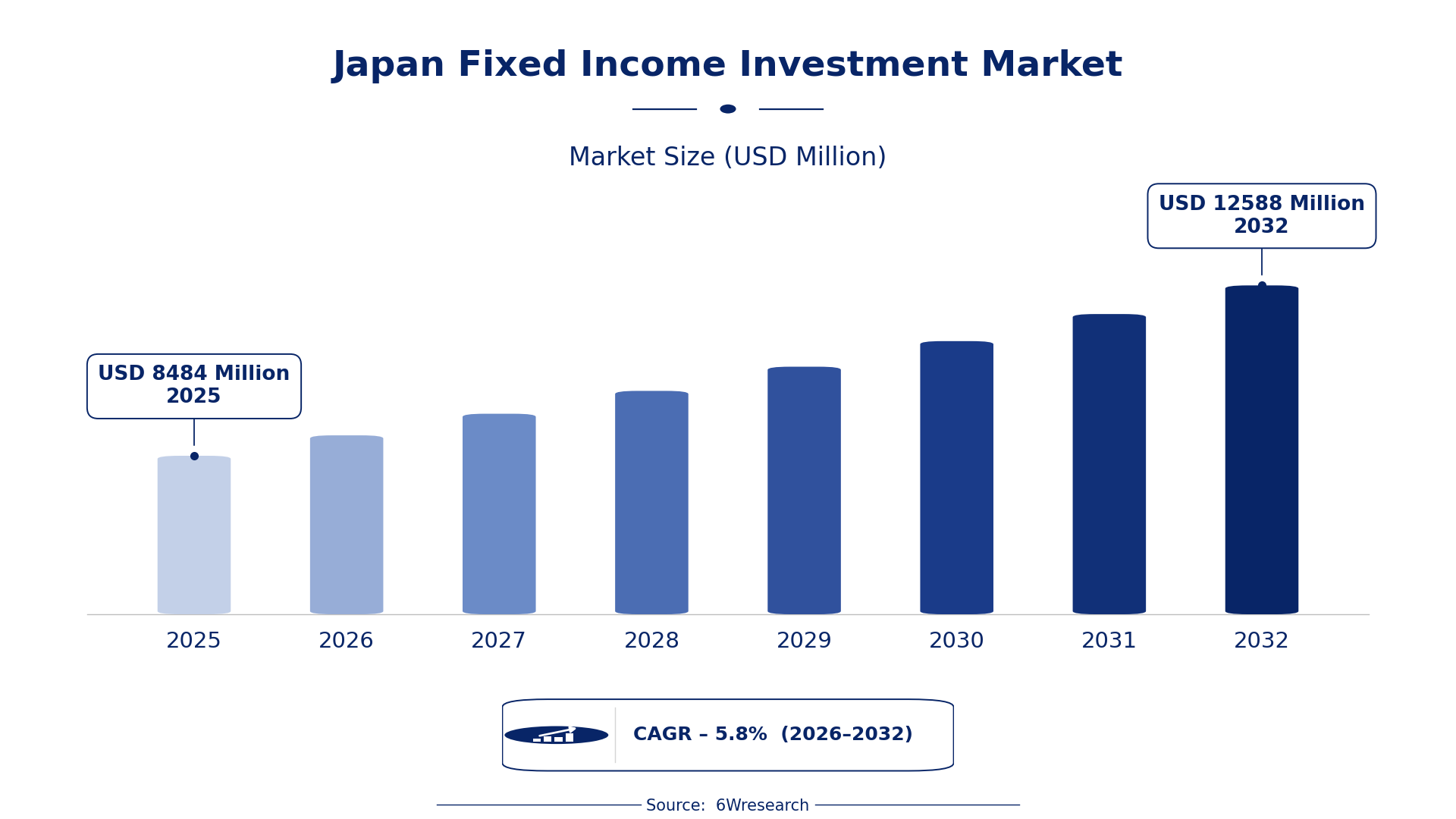
According to 6Wresearch internal database and industry insights, the Japan Fixed Income Investment Market was valued at USD 8,484 Million in 2025 and is projected to reach USD 12,588 Million by 2032, growing at a CAGR of approximately 5.8% during 2026–2032.
Japan Fixed Income Investment Market Highlights
| Report Metric | Details |
| Report Name | Japan Fixed Income Investment Market (2026-2032) |
| Market Size 2025 | USD 8,484 Million |
| Market Size 2032 | USD 12,588 Million |
| Absolute Growth 2025–2032 | USD 4,104 Million |
| CAGR 2026–2032 | 5.8% |
| Peak Annual Growth | 6.3% in 2032 |
| Forecast Period | 2026–2032 |
| Historical Data | 2022–2025 |
| Base Year | 2025 |
| Leading Investment Type, 2025 | Government Bonds (43% share) |
| Leading Risk Profile, 2025 | Low Risk (41% share) |
| Leading Distribution Channel, 2025 | Financial Advisors (42% share) |
| Leading End User, 2025 | Pension Funds (53% share) |
| Fastest-Growing Investment Type | Bond ETFs (8.0% CAGR) |
| Fastest-Growing Risk Profile | Moderate Risk (7.4% CAGR) |
| Fastest-Growing Distribution Channel | FinTech Platforms (7.5% CAGR) |
| Fastest-Growing End User | Retail Investors (7.6% CAGR) |
| Growing Sector | Fixed Income Investment |
| Key End Users | Pension Funds, Retail Investors, Conservative Investors |
Japan Fixed Income Investment Market Year-wise Growth Rate and Key Drivers (2022–2032)
This graph illustrates the annual growth rates of the market from 2022 to 2032, highlighting a steady upward trajectory and projected market expansion over the forecast period.
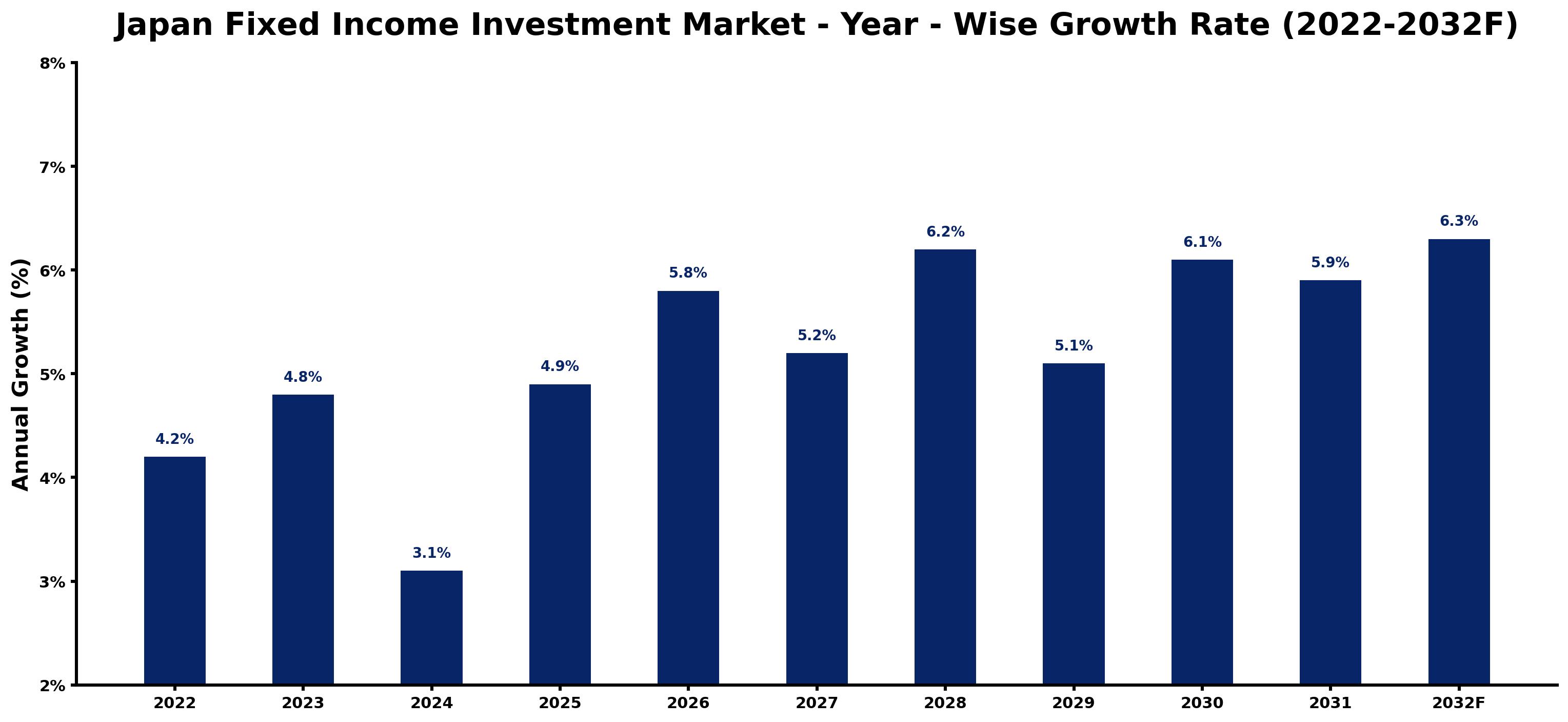
For each year, the table pairs the estimated growth rate with the leading influence on demand, showing how the drivers changed across the period.
| Year | Estimated Annual Growth (%) | Market Rationale |
| 2022 | 4.2 | Growth was driven by stable returns appealing to conservative investors. |
| 2023 | 4.8 | Demand increased due to rising interest in corporate bonds among retail investors. |
| 2024 | 3.1 | Growth slowed as investors shifted focus towards equities for higher returns. |
| 2025 | 4.9 | A resurgence in government bond issuance stimulated market activity. |
| 2026 | 5.8 | Increased investment from pension funds is expected to boost demand for low-risk options. |
| 2027 | 5.2 | A slight slowdown is projected as market saturation begins to affect growth. |
| 2028 | 6.2 | Demand is expected to surge with the introduction of new bond ETFs attracting retail investors. |
| 2029 | 5.1 | Growth is projected to slow as interest rates remain low, limiting bond appeal. |
| 2030 | 6.1 | A rise in municipal bond offerings will support market expansion. |
| 2031 | 5.9 | Investor interest in diversified risk profiles is expected to contribute to steady growth. |
| 2032 | 6.3 | The market is projected to peak as bond ETFs gain popularity among younger investors. |
Note: Market size estimations and growth projections presented in this report are based on 6Wresearch's proprietary forecasting methodology, utilizing the latest available industry data, government publications, and primary research inputs.
Japan Fixed Income Investment Market Synopsis
Fixed Income Investment encompasses government bonds, corporate bonds, municipal bonds, and bond ETFs, created through debt issuance by governments and corporations. The Japan Fixed Income Investment Market is growing, driven by strong demand from pension funds managing over ¥200 trillion in fixed income assets and retail investors seeking stable returns. The introduction of new bond ETFs and a growing interest in corporate bonds further fuel market expansion, with a projected growth rate of 5.8% from 2026 to 2032.
Market Dynamics Impact Analysis (2026–2032)
| Factor | Type | Impact | Primary Segment Affected |
| Strong demand for government bonds due to low-risk preference among investors. | Driver | High | Government Bonds |
| Increased issuance of corporate bonds by companies seeking capital. | Driver | High | Corporate Bonds |
| Growing interest in bond ETFs as a diversified investment option. | Opportunity | High | Bond ETFs |
| Emerging demand from retail investors seeking stable income sources. | Opportunity | High | Retail Investors |
| Low yields on government bonds limiting attractive investment options. | Restraint | Medium | Government Bonds |
| Market saturation in corporate bonds causing investor caution. | Restraint | Medium | Corporate Bonds |
| Negative interest rate policy affecting investor sentiment and returns. | Challenge | High | Government Bonds |
| Regulatory complexities in bond trading creating barriers for new entrants. | Challenge | Medium | Government Bonds |
Evaluation of Drivers in Japan Fixed Income Investment Market (2026–2032)
Key forces behind demand, with the segment each one moves most, are listed below.
| Drivers | Primary Segment Affected | Why It Matters (Evidence) |
| Increased government bond issuance to fund public projects. | Government Bonds | Japan's government bonds account for over 40% of the total fixed income market, attracting conservative investors. |
| Higher corporate bond yields appealing to risk-seeking investors. | Corporate Bonds | The Tokyo Stock Exchange lists more than 1,000 corporate bonds, stimulating interest among institutional investors. |
| Rising popularity of bond ETFs for diversified exposure. | Bond ETFs | Bond ETFs have seen a 25% increase in assets under management in 2023, attracting more retail investors. |
| Growing pension fund allocations to fixed income assets. | Pension Funds | Pension funds in Japan manage over ¥200 trillion in fixed income assets, driving demand for stable returns. |
| Increased retail investor participation through online platforms. | Retail Investors | Online brokers have seen a 30% increase in retail investor accounts in the last year, expanding market access. |
Most of the extra volume comes from the rising popularity of bond ETFs, which have seen a 25% increase in assets under management in 2023, appealing to retail investors seeking diversified exposure. The Tokyo Stock Exchange lists more than 1,000 corporate bonds, attracting institutional investors looking for higher yields. Online brokers have experienced a 30% increase in retail investor accounts, reflecting a broader trend towards conservative investment strategies among Japanese individuals.
Evaluation of Restraints in Japan Fixed Income Investment Market
Several factors work against faster growth; the main ones are summarised below.
| Market Restraint | Primary Segment Affected | Why It Matters (Evidence) |
| Low yields on government bonds limiting investor returns. | Government Bonds | The average yield on 10-year Japanese government bonds is around 0.1%, discouraging some investors. |
| Market saturation in corporate bonds leading to cautious investment. | Corporate Bonds | The number of registered financial advisors in Japan exceeds 50,000, indicating a competitive advisory environment. |
| Regulatory complexities in bond trading affecting market entry. | Corporate Bonds | The Japan Securities Dealers Association sets stringent standards for bond trading, complicating compliance. |
| Negative interest rate policy impacting investor sentiment. | Government Bonds | The Bank of Japan has maintained a negative interest rate policy since 2016, limiting attractive investment options. |
| Limited appeal of tax-exempt bonds among investors. | Tax-Exempt | Tax-exempt bonds have a minor appeal in specific cases, restricting their market growth. |
Japan Fixed Income Investment Market Challenges
Investment funds incur up to 15% higher costs due to a shortage of skilled financial analysts, delaying portfolio optimisation for buyers. Intense competition among issuers results in tighter spreads, which can reduce returns for investors and erode market confidence. Limited technology adoption affects 70% of firms, restricting operational efficiency and costing producers potential revenue growth. Supply chain disruptions in bond issuance processes can delay municipal bonds, impacting over 1,700 local governments' ability to fund essential public projects.
Trends in the Japan Fixed Income Investment Market
Buyers and suppliers in the Japan Fixed Income Investment Market are adjusting to the following trends.
- Shift towards Bond ETFs since 2023: The popularity of bond ETFs has surged, with a 25% increase in assets under management in 2023. This trend reflects a growing preference among retail investors for diversified investment options, increasing market participation.
- Emergence of Green Bonds in 2023: The Tokyo Metropolitan Government plans to issue green bonds for environmental projects, signalling a shift towards sustainable investment. This initiative aims to raise ¥300 billion, attracting environmentally-conscious investors.
- Increased Retail Investor Engagement since 2022: Retail investors have become more active in the fixed income market, with online brokers reporting a 30% increase in accounts last year. This trend indicates a growing interest in stable income sources among individual investors.
- Growing Demand for Corporate Bonds since 2022: Corporate bonds have gained traction, with the Tokyo Stock Exchange listing over 1,000 such instruments. This increase reflects a rising appetite for higher yields among institutional investors.
Investment Opportunities in the Japan Fixed Income Investment Market
The following areas offer the clearest openings for investors and suppliers in the Japan Fixed Income Investment Market.
- Gap in Low-Risk Investment Options: With 70% of conservative investors favouring low-risk bonds, there is an opportunity to supply more government bonds. Collaborating with financial advisors could improve market penetration.
- Timing for Investor Education Initiatives: The Japan Financial Services Agency launched a program to improve investor education in 2023, creating a timely opportunity for educational initiatives targeting retail investors. This could increase awareness and participation in fixed income products.
- Entry into Municipal Bond Market: The Tokyo Metropolitan Government's plan to issue ¥300 billion in municipal bonds presents an opportunity for investment banks to facilitate these offerings. Establishing partnerships with local governments could enhance access to this market.
- Supply of Diversified Risk Products: The demand for diversified risk profiles is growing, with moderate risk bonds projected to grow significantly. Targeting pension funds could lead to successful market entry.
Government Initiatives in the Japan Fixed Income Investment Market
The GX Basic Policy, adopted in 2023, aims for about JPY 150 trillion of public-private decarbonisation investment over 10 years, strengthening the regulatory framework for fixed income products. This policy complements the Industrial Standardization Act, which governs product standards, ensuring compliance and transparency in bond offerings.
The Japan Financial Services Agency oversees investor education programs, which help retail investors navigate the fixed income market. This initiative supports buyers by providing essential knowledge about bond investments, improving their decision-making capabilities.
Future Insight of the Japan Fixed Income Investment Market
Pension funds will increasingly invest in green bonds, with the Tokyo Metropolitan Government planning to issue ¥300 billion for environmental projects. The Financial Services Agency's new investor education programmes will improve market participation and understanding. By 2032, the average yield on 10-year Japanese government bonds is projected to remain around 0.1%, shaping conservative investment strategies. Upgraded trading platforms by the Japan Exchange Group will streamline transactions, benefiting both buyers and suppliers.
Market Segmentation Analysis
Japan Fixed Income Investment Market report covers a detailed analysis of the following market segments:
By Investment Type – Government Bonds Lead, Bond ETFs Expected to Grow Fastest
According to Saurav Kr Singh, Senior Research Analyst at 6Wresearch, Government Bonds took 43% of investment type revenue in 2025, more than any other category. Government bonds dominate Japan's fixed income market due to their reliability and essential role in financing public projects. They are particularly appealing to conservative investors, making up over 40% of the total market. Over 2026–2032, Bond ETFs are expected to post the fastest growth, at a CAGR of 8.0%. Bond ETFs are experiencing rapid growth as they offer diversified exposure to fixed income assets, evidenced by a 25% increase in assets under management in 2023. This trend reflects a growing preference for flexible investment options among a wider range of investors. Suppliers need to focus on enhancing their bond ETF offerings to meet the rising demand from investors.
By Risk Profile – Low Risk Leads, Moderate Risk Expected to Grow Fastest
With 41% of risk profile revenue in 2025, Low Risk was the largest category. Low-risk investments are favoured by around 70% of conservative investors in Japan, who prioritise capital preservation and stable returns. This strong preference reinforces the dominance of low-risk bonds in the market, appealing to a wide investor base. The quickest growth will come from Moderate Risk, forecast to expand at a CAGR of 7.4% between 2026 and 2032. Moderate-risk bonds are gaining popularity as they cater to investors seeking a balance between risk and return, indicating a shift in investment strategies. The growth of this segment is supported by the increasing number of financial advisors guiding clients towards these options. Buyers may find value in diversifying their portfolios to include moderate-risk options as they gain traction.
By Distribution Channel – Financial Advisors Lead, FinTech Platforms Expected to Grow Fastest
In 2025, Financial Advisors led the distribution channel split with a 42% share. Financial advisors play a vital role in the fixed income market, assisting investors in making informed decisions and selecting appropriate investment options. Their expertise is crucial for navigating the complexities of various financial instruments available. FinTech Platforms are projected to grow fastest, at a CAGR of 7.5% during 2026–2032. FinTech platforms are swiftly gaining popularity, providing modern tools and user-friendly interfaces for investment management that resonate with a younger, tech-savvy demographic. This shift indicates a move towards more accessible and efficient financial services for investors. Suppliers must adapt to the growing influence of FinTech platforms to effectively connect with a broader audience.
By End User – Pension Funds Lead, Retail Investors Expected to Grow Fastest
Pension Funds held 53% of the Japan Fixed Income Investment Market by end user in 2025. Pension funds are the predominant institutional investors in Japan, managing over ¥200 trillion in fixed income assets and significantly influencing market dynamics. Their large-scale investments create a consistent demand for various bond types, especially government bonds. Retail Investors are set to record the highest CAGR in this split, 7.6% over 2026–2032. Retail investors are increasingly entering the fixed income market, as shown by a 30% increase in accounts at online brokers. This trend highlights a shift towards more accessible investment opportunities for the general public, broadening the market's participant base. Suppliers should develop strategies aimed at attracting and retaining retail investors as their market presence expands.
Key Attractiveness of the Report
- 10 Years of Market Numbers
- Historical Data Starting from 2022 to 2025
- Base Year 2025
- Forecast Data until 2032
- Key Performance Indicators Impacting the Market
- Major Upcoming Developments and Projects
Key Highlights of the Report:
- Japan Fixed Income Investment Market Outlook
- Market Size of Japan Fixed Income Investment Market, 2025
- Forecast of Japan Fixed Income Investment Market, 2032
- Historical Data and Forecast of Japan Fixed Income Investment Revenues & Volume for the Period 2022-2032F
- Japan Fixed Income Investment Market Trend Evolution
- Japan Fixed Income Investment Market Drivers and Challenges
- Japan Fixed Income Investment Price Trends
- Japan Fixed Income Investment Porter's Five Forces
- Japan Fixed Income Investment Industry Life Cycle
- Historical Data and Forecast of Japan Fixed Income Investment Market Revenues & Volume By Investment Type for the Period 2022-2032F
- Historical Data and Forecast of Japan Fixed Income Investment Market Revenues & Volume By Government Bonds for the Period 2022-2032F
- Historical Data and Forecast of Japan Fixed Income Investment Market Revenues & Volume By Corporate Bonds for the Period 2022-2032F
- Historical Data and Forecast of Japan Fixed Income Investment Market Revenues & Volume By Municipal Bonds for the Period 2022-2032F
- Historical Data and Forecast of Japan Fixed Income Investment Market Revenues & Volume By Bond ETFs for the Period 2022-2032F
- Historical Data and Forecast of Japan Fixed Income Investment Market Revenues & Volume By Risk Profile for the Period 2022-2032F
- Historical Data and Forecast of Japan Fixed Income Investment Market Revenues & Volume By Low Risk for the Period 2022-2032F
- Historical Data and Forecast of Japan Fixed Income Investment Market Revenues & Volume By Moderate Risk for the Period 2022-2032F
- Historical Data and Forecast of Japan Fixed Income Investment Market Revenues & Volume By Tax-Exempt for the Period 2022-2032F
- Historical Data and Forecast of Japan Fixed Income Investment Market Revenues & Volume By Diversified Risk for the Period 2022-2032F
- Historical Data and Forecast of Japan Fixed Income Investment Market Revenues & Volume By Distribution Channel for the Period 2022-2032F
- Historical Data and Forecast of Japan Fixed Income Investment Market Revenues & Volume By Financial Advisors for the Period 2022-2032F
- Historical Data and Forecast of Japan Fixed Income Investment Market Revenues & Volume By Investment Banks for the Period 2022-2032F
- Historical Data and Forecast of Japan Fixed Income Investment Market Revenues & Volume By Online Brokers for the Period 2022-2032F
- Historical Data and Forecast of Japan Fixed Income Investment Market Revenues & Volume By FinTech Platforms for the Period 2022-2032F
- Historical Data and Forecast of Japan Fixed Income Investment Market Revenues & Volume By End User for the Period 2022-2032F
- Historical Data and Forecast of Japan Fixed Income Investment Market Revenues & Volume By Conservative Investors for the Period 2022-2032F
- Historical Data and Forecast of Japan Fixed Income Investment Market Revenues & Volume By Pension Funds for the Period 2022-2032F
- Historical Data and Forecast of Japan Fixed Income Investment Market Revenues & Volume By HNIs for the Period 2022-2032F
- Historical Data and Forecast of Japan Fixed Income Investment Market Revenues & Volume By Retail Investors for the Period 2022-2032F
- Japan Fixed Income Investment Import Export Trade Statistics
- Market Opportunity Assessment By Investment Type
- Market Opportunity Assessment By Risk Profile
- Market Opportunity Assessment By Distribution Channel
- Market Opportunity Assessment By End User
- Japan Fixed Income Investment Top Companies Market Share
- Japan Fixed Income Investment Competitive Benchmarking By Technical and Operational Parameters
- Japan Fixed Income Investment Company Profiles
- Japan Fixed Income Investment Key Strategic Recommendations
Market Covered
The report covers the following segments.
By Investment Type
- Government Bonds
- Corporate Bonds
- Municipal Bonds
- Bond ETFs
By Risk Profile
- Low Risk
- Moderate Risk
- Tax-Exempt
- Diversified Risk
By Distribution Channel
- Financial Advisors
- Investment Banks
- Online Brokers
- FinTech Platforms
By End User
- Conservative Investors
- Pension Funds
- HNIs
- Retail Investors































