Japan Fleet Management Telematics Market Size & Growth Rate
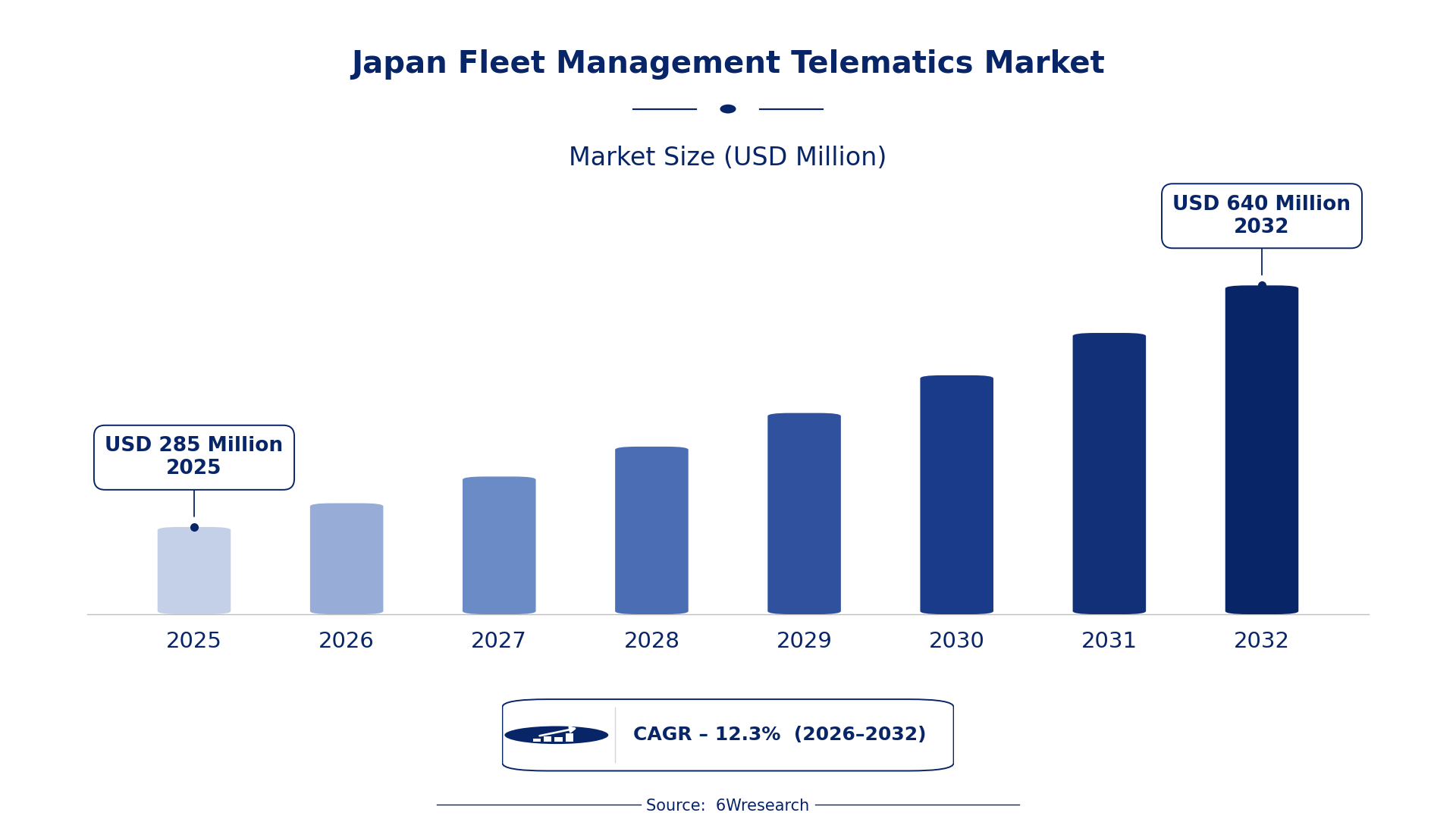
According to 6Wresearch internal database and industry insights, the Japan Fleet Management Telematics Market was valued at USD 285 Million in 2025 and is projected to reach USD 640 Million by 2032, growing at a CAGR of approximately 12.3% during 2026–2032.
Japan Fleet Management Telematics Market Highlights
| Report Metric | Details |
| Report Name | Japan Fleet Management Telematics Market (2026-2032) |
| Market Size 2025 | USD 285 Million |
| Market Size 2032 | USD 640 Million |
| Absolute Growth 2025–2032 | USD 355 Million |
| CAGR 2026–2032 | 12.3% |
| Peak Annual Growth | 13.9% in 2032 |
| Forecast Period | 2026–2032 |
| Historical Data | 2022–2025 |
| Base Year | 2025 |
| Leading Technology Type, 2025 | GPS Telematics (40% share) |
| Leading Application, 2025 | Real-Time Location (40% share) |
| Leading Communication Type, 2025 | Cellular (36% share) |
| Leading End User, 2025 | Vehicle Leasing Firms (38% share) |
| Fastest-Growing Technology Type | CAN Bus Integration (17.8% CAGR) |
| Fastest-Growing Application | Vehicle Diagnostics (16.3% CAGR) |
| Fastest-Growing Communication Type | Satellite (17.9% CAGR) |
| Fastest-Growing End User | Commercial Fleets (15.7% CAGR) |
| Growing Sector | Logistics and Transportation |
| Key End Users | Logistics Firms, Vehicle Leasing Firms, Commercial Fleets, Transportation Providers |
Japan Fleet Management Telematics Market Year-wise Growth Rate and Key Drivers (2022–2032)
This graph illustrates the annual growth rates of the market from 2022 to 2032, highlighting a steady upward trajectory and projected market expansion over the forecast period.
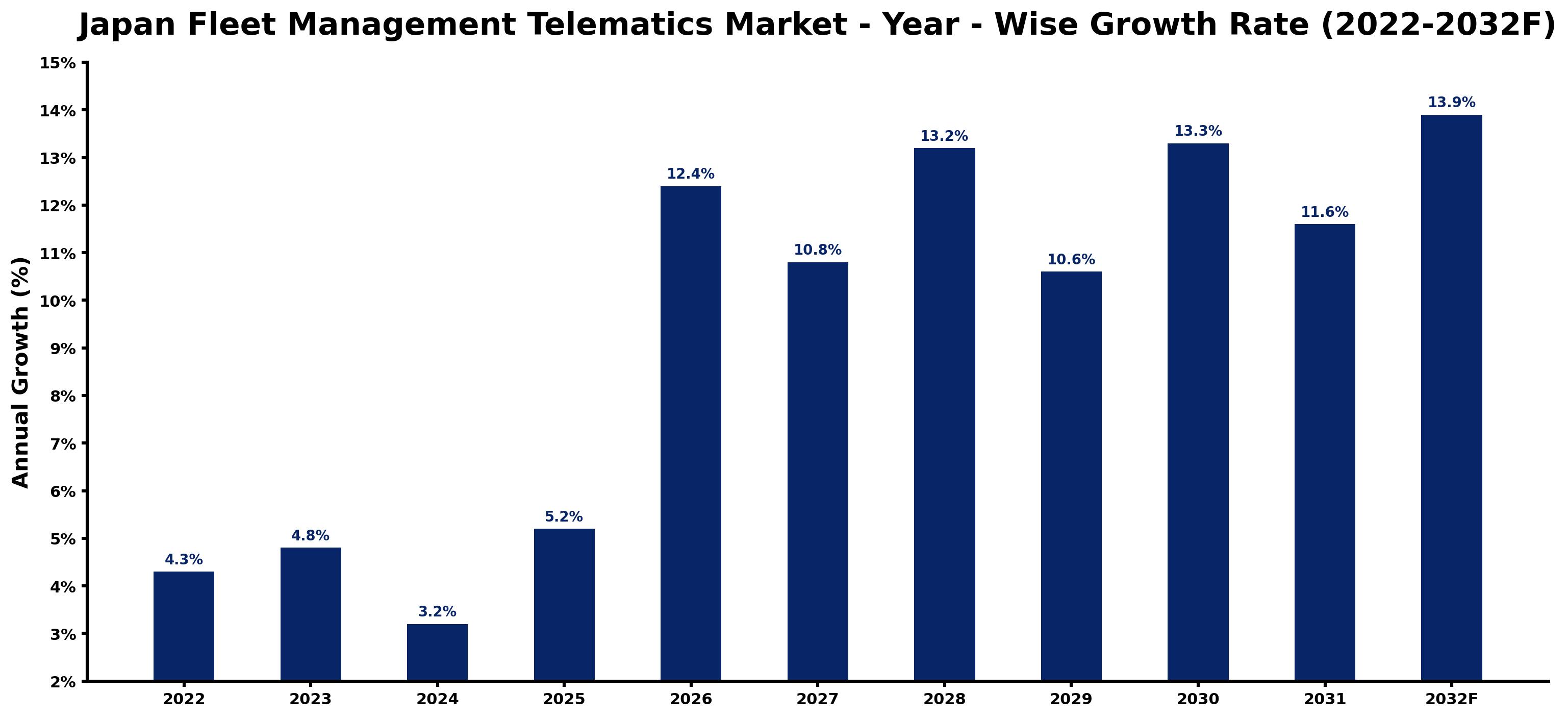
The table below sets out the estimated growth rate for each year and the main factor behind it.
| Year | Estimated Annual Growth (%) | Market Rationale |
| 2022 | 4.3 | The market experienced steady growth due to increased adoption of telematics solutions. |
| 2023 | 4.8 | Demand rose further as logistics firms expanded their operations and sought efficiency. |
| 2024 | 3.2 | Growth slowed as some firms delayed investments in new technologies amid market adjustments. |
| 2025 | 5.2 | The market grew faster as more vehicles integrated telematics for operational improvements. |
| 2026 | 12.4 | Demand surged as the logistics sector increasingly adopted advanced telematics systems. |
| 2027 | 10.8 | Growth slowed slightly as firms focused on optimising existing telematics investments. |
| 2028 | 13.2 | The market rebounded with faster growth driven by new technology integrations. |
| 2029 | 10.6 | Growth decelerated as market saturation began to impact new telematics deployments. |
| 2030 | 13.3 | Demand increased again as firms sought to improve safety and efficiency through telematics. |
| 2031 | 11.6 | Growth slowed as the market matured and competitive pressures intensified. |
| 2032 | 13.9 | The market peaked with strong investments in telematics for fleet optimisation. |
Note: Market size estimations and growth projections presented in this report are based on 6Wresearch's proprietary forecasting methodology, utilizing the latest available industry data, government publications, and primary research inputs.
Japan Fleet Management Telematics Market Synopsis
Fleet Management Telematics utilises GPS and onboard diagnostics to monitor vehicle performance and location, optimising operations and improving safety. The Japan Fleet Management Telematics Market is expanding, driven by logistics and transportation sectors employing over 1.5 million people. The integration of telematics solutions into new commercial vehicles is projected to reach 1.5 million units by 2025, fuelling demand. Real-time location services are critical for 85% of logistics operations in urban areas, improving operational efficiency.
Market Dynamics Impact Analysis (2026–2032)
| Factor | Type | Impact | Primary Segment Affected |
| Growing demand for operational efficiency | Driver | High | Logistics Firms |
| Increased integration of telematics in new vehicles | Driver | High | Commercial Fleets |
| Expansion of logistics hubs in urban areas | Opportunity | High | Transportation Providers |
| Rising need for compliance with safety standards | Opportunity | Medium | Vehicle Leasing Firms |
| High costs of telematics implementation | Restraint | High | Commercial Fleets |
| Challenges in data privacy regulations | Restraint | Medium | Logistics Firms |
| Limited skilled workforce for telematics support | Challenge | High | Transportation Providers |
| Dependence on technology for fleet operations | Challenge | Medium | Vehicle Leasing Firms |
Evaluation of Drivers in Japan Fleet Management Telematics Market (2026–2032)
The factors lifting demand, and the evidence behind each, are summarised below.
| Drivers | Primary Segment Affected | Why It Matters (Evidence) |
| Increased operational efficiency through telematics | Logistics Firms | Logistics firms are adopting telematics to achieve a 15% reduction in operational costs. |
| Integration of telematics in new commercial vehicles | Commercial Fleets | Over 70% of new commercial vehicles sold in Japan are equipped with telematics, driving fleet management improvements. |
| Real-time location services for logistics | Transportation Providers | 85% of logistics operations in urban areas rely on real-time location services for efficient routing. |
| Growing workforce in the logistics sector | Logistics Firms | The logistics industry employs over 1.5 million people, increasing demand for fleet management solutions. |
| Compliance with safety standards | Vehicle Leasing Firms | Telematics systems are increasingly required to comply with JIS standards for safety and performance. |
Purchasing is picking up as logistics firms increasingly adopt telematics solutions to optimise their operations. The average age of commercial vehicles in Japan is around 10 years, driving demand for diagnostics and performance monitoring. In urban areas, real-time location services are critical for 85% of logistics operations, enhancing efficiency. Telematics devices are integrated into over 70% of new commercial vehicles sold, reflecting a shift towards advanced fleet management. Compliance with safety standards further boosts demand, as firms seek to improve operational safety and efficiency.
Evaluation of Restraints in Japan Fleet Management Telematics Market
These restraints slow adoption and weigh on supplier margins.
| Market Restraint | Primary Segment Affected | Why It Matters (Evidence) |
| High costs associated with telematics implementation | Commercial Fleets | The average cost savings from telematics implementation is estimated at 15%, making initial investments substantial. |
| Data privacy regulations affecting telematics usage | Logistics Firms | Compliance with privacy regulations can delay the deployment of telematics systems in logistics operations. |
| Limited availability of skilled workforce for telematics support | Transportation Providers | The shortage of skilled technicians hampers the effective implementation of telematics solutions. |
| Market saturation impacting new deployments | Vehicle Leasing Firms | As telematics becomes standard, the growth rate of new installations is slowing due to market maturity. |
| Dependence on technology for fleet operations | Commercial Fleets | Reliance on telematics systems can lead to vulnerabilities if technology fails or is compromised. |
Japan Fleet Management Telematics Market Challenges
Many logistics firms in Tokyo face challenges with outdated vehicles, as the average age of commercial vehicles is around 10 years, resulting in increased maintenance costs of approximately 15% for buyers. Supply chain delays stem from reliance on imported telematics solutions, raising costs and extending implementation timelines for suppliers. Compliance with JIS standards for safety and performance pressures producers to invest heavily, potentially delaying product launches. Skills shortages in telematics technology impede progress, as the logistics industry employs over 1.5 million people, yet many lack the necessary training to effectively utilise these systems.
Trends in the Japan Fleet Management Telematics Market
These developments are changing demand patterns in the Japan Fleet Management Telematics Market.
- Shift from Basic to Advanced Telematics Solutions: Logistics firms are transitioning towards advanced telematics systems that integrate IoT technology, improving data analysis capabilities. In 2023, the average response time for fleet incidents improved by 20% due to these advancements.
- Increase in Real-Time Location Services Adoption: Transportation providers are increasingly adopting real-time location services, as 85% of logistics operations in urban areas depend on them for efficiency. This trend is particularly noticeable in the Tokyo region, where logistics firms are concentrated.
- Growing Use of Dashcams in Fleet Management: The use of dashcams is rising, with a 25% increase in installations in 2023. This trend reflects a broader focus on safety and incident recording within fleet operations.
- Transition to Compliance with JIS Standards: The industry is prioritising compliance with JIS standards for safety and performance in telematics systems. This shift is driven by the need for improved safety measures in fleet management.
Investment Opportunities in the Japan Fleet Management Telematics Market
The following opportunities in the Japan Fleet Management Telematics Market pair current demand with a clear way in.
- Urban Logistics Hubs Expansion: The Tokyo region is expanding its logistics hubs, creating an opportunity for telematics solutions. With over 1.5 million people employed in logistics, firms can collaborate with local providers to enhance operations.
- Investment in Smart Transportation Initiatives: With ¥3 billion allocated for smart transportation initiatives in 2023, there is a strong opportunity for telematics providers. Collaborating with government agencies can facilitate entry into this growing market.
- Growing Demand for Vehicle Diagnostics: The average age of commercial vehicles in Japan is around 10 years, indicating a need for diagnostics solutions. Vehicle leasing firms can invest in telematics to improve fleet management and maintenance.
- Rising Need for Safety Monitoring Solutions: As safety becomes a priority, the demand for telematics solutions that include safety monitoring is increasing. Logistics firms can explore partnerships to improve safety measures.
Government Initiatives in the Japan Fleet Management Telematics Market
The Semiconductor and Digital Industry Strategy, established in June 2021, aims to secure domestic semiconductor manufacturing, impacting telematics producers by ensuring a stable supply of components. The Economic Security Promotion Act of 2022 further supports supply-chain resilience for critical products, including telematics systems, improving operational reliability across the sector.
The Ministry of Land, Infrastructure, Transport and Tourism promotes telematics for safer driving, approving initiatives that enhance vehicle safety. In 2023, the government allocated ¥3 billion for smart transportation initiatives, funding projects that integrate telematics into fleet management systems.
Future Insight of the Japan Fleet Management Telematics Market
The integration of IoT technology will transform fleet management by 2032, improving real-time data analytics and operational efficiency for buyers. Government funding in smart transportation initiatives will drive innovation and elevate safety standards across the industry. Telematics will be standard in 60% of new commercial vehicles sold, streamlining operations for suppliers. The average response time for fleet incidents is expected to improve by an additional 20%, reducing operational disruptions.
Market Segmentation Analysis
Japan Fleet Management Telematics Market report covers a detailed analysis of the following market segments:
By Technology Type – GPS Telematics Lead, CAN Bus Integration Expected to Grow Fastest
According to Saurav Kr Singh, Senior Research Analyst at 6Wresearch, the largest technology type category in 2025 was GPS Telematics, at 40% of revenue. GPS Telematics holds the largest share in the market as it is the primary technology for tracking and managing fleets, essential for logistics operations. Its widespread implementation within the Tokyo region, which hosts numerous logistics firms, ensures optimal fleet performance and management. The quickest growth will come from CAN Bus Integration, forecast to expand at a CAGR of 17.8% between 2026 and 2032. CAN Bus Integration is experiencing rapid growth due to its critical role in providing vehicle diagnostics and performance data, which are vital for operational efficiency. The increasing average age of commercial vehicles, around 10 years, drives the demand for such diagnostic solutions, further solidifying its position. Suppliers must focus on advancing GPS and CAN Bus technologies to meet the changing needs of fleet operators.
By Application – Real-Time Location Leads, Vehicle Diagnostics Expected to Grow Fastest
Real-Time Location held 40% of the Japan Fleet Management Telematics Market by application in 2025. Real-Time Location is the leading application because it is vital for fleet management and route optimisation, directly impacting operational efficiency. The reliance of 85% of logistics operations in urban areas on real-time location services highlights its essential role in the industry. Vehicle Diagnostics are projected to grow fastest, at a CAGR of 16.3% during 2026–2032. Vehicle Diagnostics is the fastest-growing application, spurred by the rising demand for maintenance and operational efficiency among fleets. The estimated 15% average cost savings from telematics implementation underscores the financial benefits of prioritising diagnostics. Buyers should consider investing in advanced telematics solutions that improve both real-time location and diagnostics functionalities.
By Communication Type – Cellular Leads, Satellite Expected to Grow Fastest
In 2025, Cellular led the communication type split with a 36% share. Cellular is the main communication method for data transmission, providing reliable connectivity for telematics systems across Japan. Its extensive adoption among logistics firms supports efficient fleet management operations, making it a critical component of the market. Satellite is set to record the highest CAGR in this split, 17.9% over 2026–2032. Satellite communication is rapidly expanding, particularly in remote areas where cellular coverage is limited. This growth is essential for fleets operating in less accessible regions to effectively leverage telematics solutions. Suppliers need to enhance their satellite communication capabilities to cater to the needs of fleets in remote locations.
By End User – Vehicle Leasing Firms Lead, Commercial Fleets Expected to Grow Fastest
With 38% of end user revenue in 2025, Vehicle Leasing Firms was the largest category. Vehicle Leasing Firms represent the largest end user group, as they are key users of telematics for effective fleet management. Their significant presence in the market arises from the necessity to optimise operations and reduce costs. Over 2026–2032, Commercial Fleets are expected to post the fastest growth, at a CAGR of 15.7%. Commercial Fleets are the fastest-growing end user segment, increasingly adopting telematics to improve operational efficiency. With an average fleet size of approximately 50 vehicles, there is a substantial market for telematics solutions. Suppliers should tailor their offerings to meet the specific needs of vehicle leasing firms and commercial fleets.
Key Attractiveness of the Report
- 10 Years of Market Numbers
- Historical Data Starting from 2022 to 2025
- Base Year 2025
- Forecast Data until 2032
- Key Performance Indicators Impacting the Market
- Major Upcoming Developments and Projects
Key Highlights of the Report:
- Japan Fleet Management Telematics Market Outlook
- Market Size of Japan Fleet Management Telematics Market, 2025
- Forecast of Japan Fleet Management Telematics Market, 2032
- Historical Data and Forecast of Japan Fleet Management Telematics Revenues & Volume for the Period 2022-2032F
- Japan Fleet Management Telematics Market Trend Evolution
- Japan Fleet Management Telematics Market Drivers and Challenges
- Japan Fleet Management Telematics Price Trends
- Japan Fleet Management Telematics Porter's Five Forces
- Japan Fleet Management Telematics Industry Life Cycle
- Historical Data and Forecast of Japan Fleet Management Telematics Market Revenues & Volume By Technology Type for the Period 2022-2032F
- Historical Data and Forecast of Japan Fleet Management Telematics Market Revenues & Volume By GPS Telematics for the Period 2022-2032F
- Historical Data and Forecast of Japan Fleet Management Telematics Market Revenues & Volume By CAN Bus Integration for the Period 2022-2032F
- Historical Data and Forecast of Japan Fleet Management Telematics Market Revenues & Volume By Sensors & Actuators for the Period 2022-2032F
- Historical Data and Forecast of Japan Fleet Management Telematics Market Revenues & Volume By Dashcams for the Period 2022-2032F
- Historical Data and Forecast of Japan Fleet Management Telematics Market Revenues & Volume By Application for the Period 2022-2032F
- Historical Data and Forecast of Japan Fleet Management Telematics Market Revenues & Volume By Real-Time Location for the Period 2022-2032F
- Historical Data and Forecast of Japan Fleet Management Telematics Market Revenues & Volume By Vehicle Diagnostics for the Period 2022-2032F
- Historical Data and Forecast of Japan Fleet Management Telematics Market Revenues & Volume By Load Monitoring for the Period 2022-2032F
- Historical Data and Forecast of Japan Fleet Management Telematics Market Revenues & Volume By Safety Monitoring for the Period 2022-2032F
- Historical Data and Forecast of Japan Fleet Management Telematics Market Revenues & Volume By Communication Type for the Period 2022-2032F
- Historical Data and Forecast of Japan Fleet Management Telematics Market Revenues & Volume By Cellular for the Period 2022-2032F
- Historical Data and Forecast of Japan Fleet Management Telematics Market Revenues & Volume By Satellite for the Period 2022-2032F
- Historical Data and Forecast of Japan Fleet Management Telematics Market Revenues & Volume By IoT for the Period 2022-2032F
- Historical Data and Forecast of Japan Fleet Management Telematics Market Revenues & Volume By Hybrid for the Period 2022-2032F
- Historical Data and Forecast of Japan Fleet Management Telematics Market Revenues & Volume By End User for the Period 2022-2032F
- Historical Data and Forecast of Japan Fleet Management Telematics Market Revenues & Volume By Vehicle Leasing Firms for the Period 2022-2032F
- Historical Data and Forecast of Japan Fleet Management Telematics Market Revenues & Volume By Commercial Fleets for the Period 2022-2032F
- Historical Data and Forecast of Japan Fleet Management Telematics Market Revenues & Volume By Transportation Providers for the Period 2022-2032F
- Historical Data and Forecast of Japan Fleet Management Telematics Market Revenues & Volume By Logistics Firms for the Period 2022-2032F
- Japan Fleet Management Telematics Import Export Trade Statistics
- Market Opportunity Assessment By Technology Type
- Market Opportunity Assessment By Application
- Market Opportunity Assessment By Communication Type
- Market Opportunity Assessment By End User
- Japan Fleet Management Telematics Top Companies Market Share
- Japan Fleet Management Telematics Competitive Benchmarking By Technical and Operational Parameters
- Japan Fleet Management Telematics Company Profiles
- Japan Fleet Management Telematics Key Strategic Recommendations
Market Covered
The report covers the following segments.
By Technology Type
- GPS Telematics
- CAN Bus Integration
- Sensors & Actuators
- Dashcams
By Application
- Real-Time Location
- Vehicle Diagnostics
- Load Monitoring
- Safety Monitoring
By Communication Type
- Cellular
- Satellite
- IoT
- Hybrid
By End User
- Vehicle Leasing Firms
- Commercial Fleets
- Transportation Providers
- Logistics Firms































