Japan Floor Safety Additives Market Size & Growth Rate
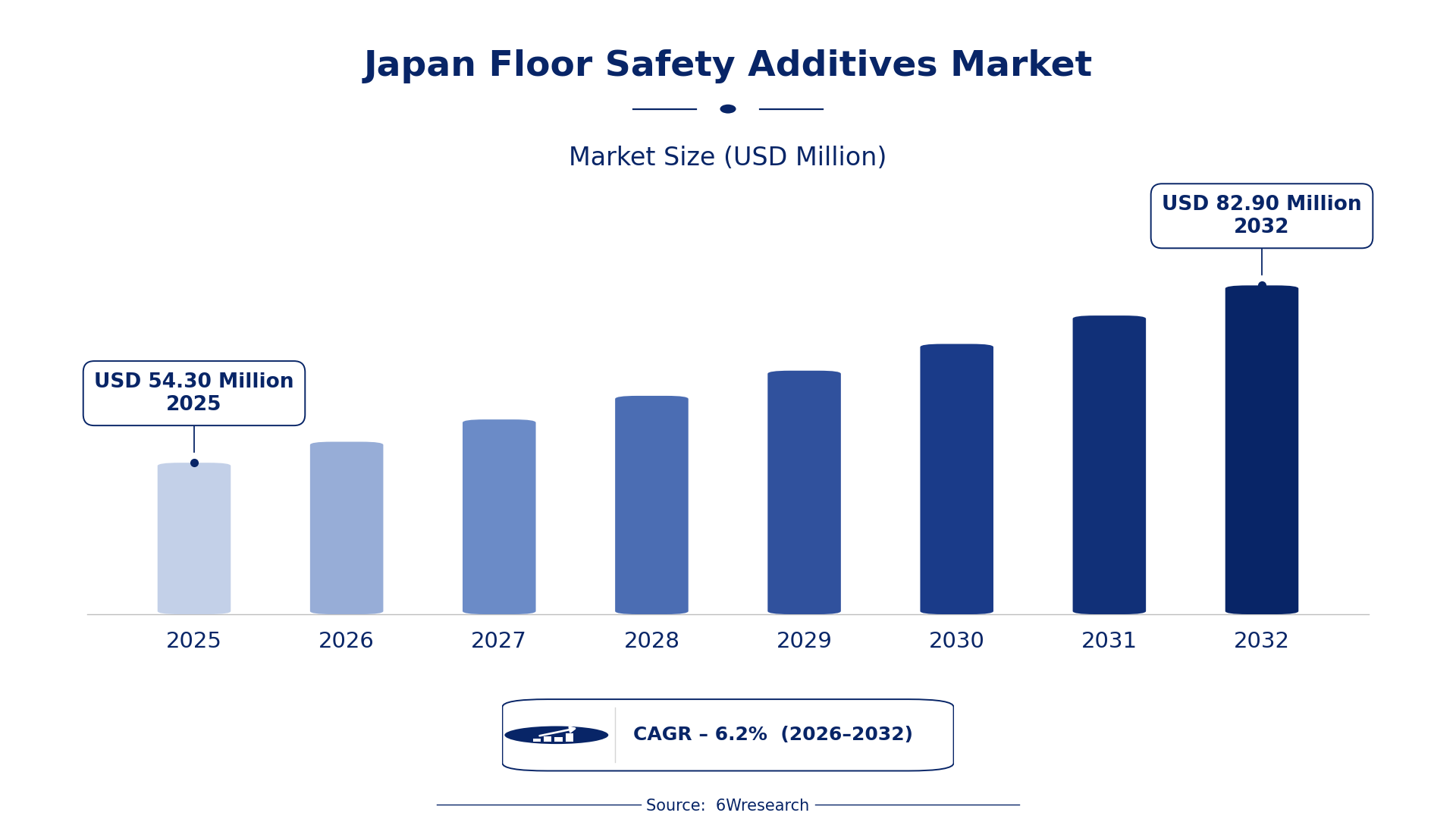
According to 6Wresearch internal database and industry insights, the Japan Floor Safety Additives Market was valued at USD 54.30 Million in 2025 and is projected to reach USD 82.90 Million by 2032, growing at a CAGR of approximately 6.2% during 2026–2032.
Japan Floor Safety Additives Market Highlights
| Report Metric | Details |
| Report Name | Japan Floor Safety Additives Market (2026-2032) |
| Market Size 2025 | USD 54.30 Million |
| Market Size 2032 | USD 82.90 Million |
| Absolute Growth 2025–2032 | USD 28.60 Million |
| CAGR 2026–2032 | 6.2% |
| Peak Annual Growth | 7.9% in 2027 |
| Forecast Period | 2026–2032 |
| Historical Data | 2022–2025 |
| Base Year | 2025 |
| Leading Additive Type, 2025 | Anti‑Slip Grit Additive (42% share) |
| Leading Application Area, 2025 | Coats & Sealers (45% share) |
| Leading Distribution Channel, 2025 | Distributors (55% share) |
| Leading End User, 2025 | Industrial & Commercial Flooring (35% share) |
| Fastest-Growing Additive Type | Anti‑Skid Flooring Compound (8.3% CAGR) |
| Fastest-Growing Application Area | Concrete (7.5% CAGR) |
| Fastest-Growing Distribution Channel | OEMs (7.9% CAGR) |
| Fastest-Growing End User | Public Infrastructure Projects (8.0% CAGR) |
| Growing Sector | public infrastructure projects |
| Key End Users | facility maintenance companies, construction firms, industrial suppliers, distributors |
Japan Floor Safety Additives Market Year-wise Growth Rate and Key Drivers (2022–2032)
This graph illustrates the annual growth rates of the market from 2022 to 2032, highlighting a steady upward trajectory and projected market expansion over the forecast period.
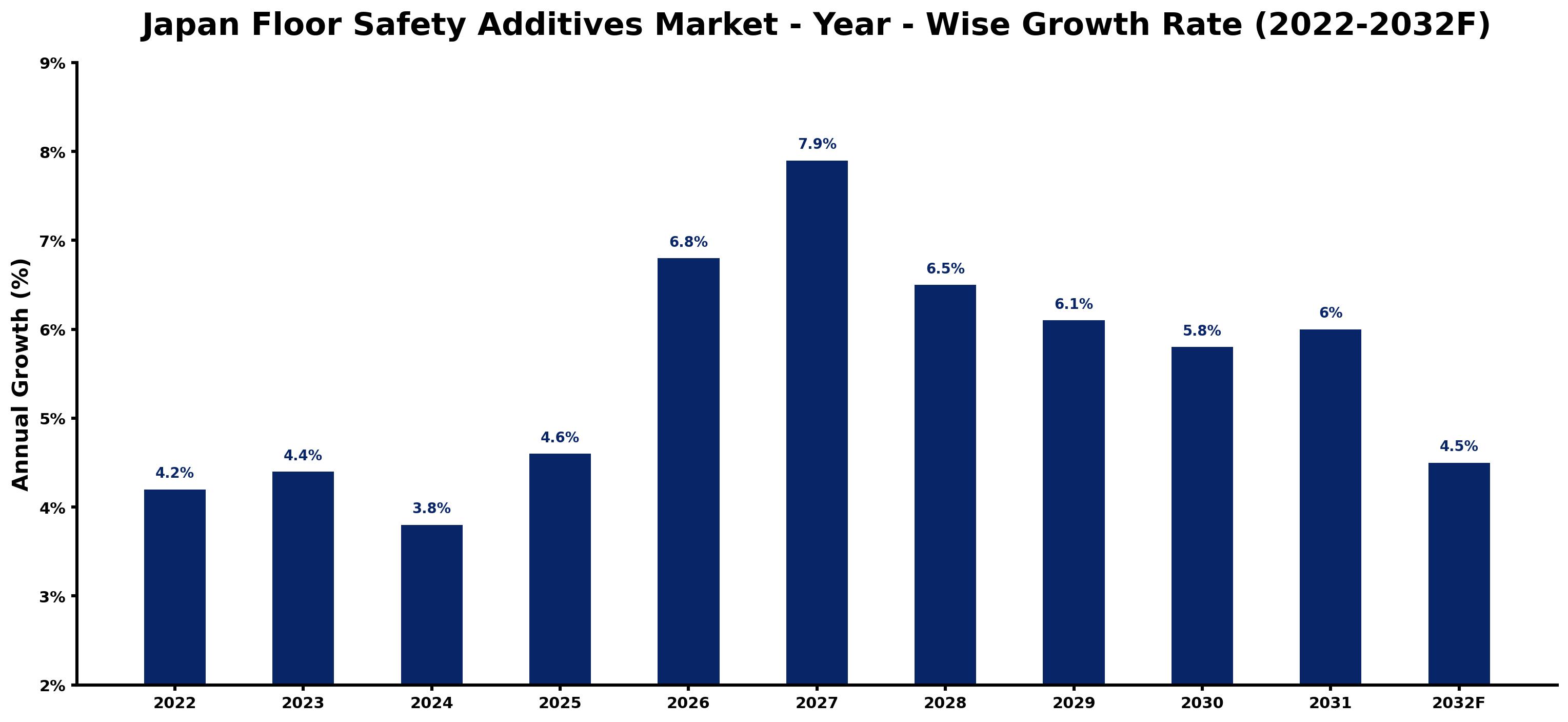
The table below sets out the estimated growth rate for each year and the main factor behind it.
| Year | Estimated Annual Growth (%) | Market Rationale |
| 2022 | 4.2 | The market experienced steady growth due to ongoing infrastructure projects. |
| 2023 | 4.4 | Demand for safety additives increased as awareness of workplace safety rose. |
| 2024 | 3.8 | Growth slowed as some construction projects faced delays. |
| 2025 | 4.6 | Investment in safety measures surged, driving higher demand for additives. |
| 2026 | 6.8 | The market is expected to accelerate as new regulations mandate slip-resistant materials. |
| 2027 | 7.9 | Peak growth will be achieved as public infrastructure projects expand. |
| 2028 | 6.5 | Growth is projected to slow as the market stabilises after rapid expansion. |
| 2029 | 6.1 | Demand will continue to grow, albeit at a slower rate than previous years. |
| 2030 | 5.8 | The market growth rate is expected to decrease as saturation in some sectors occurs. |
| 2031 | 6.0 | A renewed focus on safety standards will lead to increased purchasing activity. |
| 2032 | 4.5 | The market is projected to stabilise as growth normalises after peak levels. |
Note: Market size estimations and growth projections presented in this report are based on 6Wresearch's proprietary forecasting methodology, utilizing the latest available industry data, government publications, and primary research inputs.
Japan Floor Safety Additives Market Synopsis
Floor safety additives are chemical compounds that improve slip resistance on various surfaces, made from materials like grit and resins. The Japan Floor Safety Additives Market is growing due to investments in public infrastructure, projected to exceed 10 trillion yen in 2023, and increasing regulations that drive demand from construction and facility maintenance sectors.
Market Dynamics Impact Analysis (2026–2032)
| Factor | Type | Impact | Primary Segment Affected |
| Increasing safety regulations in construction | Driver | High | Anti‑Slip Grit Additive |
| Growing awareness of workplace safety | Driver | High | Anti‑Slip Grit Additive |
| Rising investment in public infrastructure | Opportunity | High | Public Infrastructure Projects |
| Expansion of commercial flooring applications | Opportunity | Medium | Industrial & Commercial Flooring |
| High competition among suppliers | Restraint | Medium | Distributors |
| Potential supply chain disruptions | Restraint | High | OEMs |
| Regulatory compliance costs for manufacturers | Challenge | High | Facility Maintenance Companies |
| Fluctuating raw material prices | Challenge | Medium | Industrial Suppliers |
Evaluation of Drivers in Japan Floor Safety Additives Market (2026–2032)
The main growth drivers and the segments they affect most are set out below.
| Drivers | Primary Segment Affected | Why It Matters (Evidence) |
| Increased investment in safety measures | Anti‑Slip Grit Additive | The construction industry is projected to invest heavily in safety measures, with spending exceeding 10 trillion yen in 2023. |
| Rising safety awareness among facility managers | Facility Maintenance Companies | Facility maintenance companies are adopting safety additives to comply with stringent standards, reflecting a shift towards prioritising workplace safety. |
| Implementation of stricter safety standards | Public Infrastructure Projects | The Japanese government has set safety standards for public infrastructure, driving demand for slip-resistant flooring materials. |
| Growth in airport and transit facility projects | Airport & Transit Facilities | Anti-slip additives are commonly used in airports to improve safety in high-traffic areas. |
| Expansion of commercial flooring applications | Industrial & Commercial Flooring | The use of anti-skid flooring compounds is growing in commercial settings due to increased safety awareness. |
The strongest pull on demand comes from increased investment in safety measures, with the construction industry projected to spend over 10 trillion yen in 2023 on public infrastructure projects. Facility maintenance companies are adopting safety additives to comply with stringent standards, reflecting a shift towards prioritising workplace safety. Stricter safety requirements have driven demand, particularly for anti-slip materials in public infrastructure. Airports also represent a key market, utilising anti-slip additives to ensure safety in high-traffic areas. As commercial flooring applications expand, the demand for anti-skid flooring compounds continues to rise, driven by heightened safety awareness among facility managers.
Evaluation of Restraints in Japan Floor Safety Additives Market
Several factors work against faster growth; the main ones are summarised below.
| Market Restraint | Primary Segment Affected | Why It Matters (Evidence) |
| High competition among suppliers | Distributors | Intense competition among distributors can lead to price wars, affecting profitability for suppliers in the market. |
| Potential supply chain disruptions | OEMs | Supply chain issues can delay the availability of safety additives, impacting production timelines for OEMs. |
| Regulatory compliance costs for manufacturers | Facility Maintenance Companies | Manufacturers face high costs to comply with safety regulations, which can limit their ability to invest in product development. |
| Fluctuating raw material prices | Industrial Suppliers | Volatility in raw material prices can increase production costs, affecting pricing strategies for industrial suppliers. |
| Limited awareness among smaller businesses | Public Infrastructure Projects | Smaller companies may lack awareness of safety additive benefits, leading to lower adoption rates in public projects. |
Japan Floor Safety Additives Market Challenges
High competition from lower-cost alternatives pressures local producers, forcing them to reduce prices and eroding profit margins. Rising raw material costs can inflate production expenses, leading to project delays for construction firms, which may miss critical deadlines. Rapid technological changes necessitate continuous investment, straining budgets for smaller suppliers and limiting their ability to compete effectively. Stringent regulations from the Ministry of Land, Infrastructure, Transport and Tourism can prolong product approval processes, causing delays of up to six months for manufacturers aiming to enter new market segments.
Trends in the Japan Floor Safety Additives Market
The trends below show where the Japan Floor Safety Additives Market is heading.
- Shift in Focus to Safety Standards: Facility maintenance companies are prioritising safety, as new regulations mandate slip-resistant materials. In 2023, public infrastructure projects are expected to exceed 10 trillion yen, reflecting this shift.
- Growth in Airport Safety Measures: Airports are improving safety protocols by integrating anti-slip additives into flooring solutions. This trend is clear as anti-slip additives are commonly used in airports, enhancing safety in high-traffic areas.
- Rising Demand for Anti-Skid Flooring: The use of anti-skid flooring compounds is growing in commercial settings, driven by increased safety awareness. This trend is supported by the ongoing expansion of commercial flooring applications.
- Expansion of Regulations for Public Infrastructure: New regulations are being introduced to ensure safety in public spaces, including flooring materials. The Tokyo Metropolitan Government has launched initiatives to improve safety in public spaces, including flooring.
Investment Opportunities in the Japan Floor Safety Additives Market
Several openings in the Japan Floor Safety Additives Market merit attention from investors.
- Investment in Public Infrastructure: With public infrastructure projects expected to exceed 10 trillion yen in 2023, there is an opportunity to supply safety additives to public sector projects. Collaborating with facility maintenance companies can facilitate market entry.
- Growing Commercial Flooring Market: The commercial flooring market is expanding, creating opportunities for suppliers of anti-skid flooring compounds. Engaging with distributors can improve market penetration in this sector.
- Increased Adoption of Safety Additives in Airports: Airports are increasingly adopting safety additives to improve passenger safety, presenting an opportunity for suppliers. Forming partnerships with airport facility managers can aid in market access.
- Regulatory Compliance Solutions: As regulations tighten, there is a need for compliance-focused safety additives. Suppliers can enter the market by aligning with regulatory bodies to ensure product approval.
Government Initiatives in the Japan Floor Safety Additives Market
The Chemical Substances Control Law requires manufacturers to evaluate and control chemical substances used in floor safety additives, ensuring compliance with safety standards. This law complements the Industrial Safety and Health Act, which sets employer duties for hazardous substances, ensuring safety in the production process.
Facility maintenance companies utilise the Building Energy Efficiency Act to ensure that new buildings meet energy standards, which includes the use of slip-resistant materials. The Ministry of Land, Infrastructure, Transport and Tourism oversees these regulations, ensuring compliance and safety in public infrastructure projects.
Future Insight of the Japan Floor Safety Additives Market
Buyers in the construction industry will prioritise advanced floor safety additives to comply with JIS standards by 2032, enhancing safety in flooring applications. Public infrastructure investments are projected to exceed 10 trillion yen, driving demand for slip-resistant materials. The Tokyo Metropolitan Government's safety initiatives will encourage suppliers to innovate and improve product offerings. As awareness of slip risks increases, commercial spaces will focus on anti-slip flooring solutions, creating a broader market for these additives.
Market Segmentation Analysis
Japan Floor Safety Additives Market report covers a detailed analysis of the following market segments:
By Additive Type – Anti‑Slip Grit Additive Leads, Anti‑Skid Flooring Compound Expected to Grow Fastest
According to Hittika Dhall, Research Associate at 6Wresearch, the largest additive type category in 2025 was Anti‑Slip Grit Additive, at 42% of revenue. The Anti-Slip Grit Additive holds the largest share as it is crucial for enhancing traction in environments like airports where safety is paramount. Its widespread use among facility managers highlights its importance in preventing accidents in high-traffic areas. Anti‑Skid Flooring Compound is projected to grow fastest, at a CAGR of 8.3% during 2026–2032. The Anti-Skid Flooring Compound is seeing rapid growth due to its adoption in commercial flooring applications that prioritise safety. Increased awareness around slip resistance in newly constructed spaces is fuelling this trend. Suppliers should focus on promoting these additives to meet the rising demand for safety in various environments.
By Application Area – Coats & Sealers Lead, Concrete Expected to Grow Fastest
In 2025, Coats & Sealers led the application area split with a 45% share. Coats & Sealers dominate the market as they are extensively used for surface protection in industrial settings. Their effectiveness in enhancing slip resistance makes them a preferred choice for buyers seeking reliable safety solutions. Concrete is set to record the highest CAGR in this split, 7.5% over 2026–2032. Concrete is witnessing the fastest growth as it is increasingly combined with safety additives to ensure slip resistance in new constructions. The emphasis on safer public infrastructure is a driving force behind this trend. Buyers should consider investing in advanced coating solutions to comply with stringent safety regulations.
By Distribution Channel – Distributors Lead, OEMs Expected to Grow Fastest
Distributors accounted for 55% of the market by distribution channel in 2025. Distributors capture the largest market share by supplying safety additives across diverse sectors, ensuring that products are accessible to a broad range of end users. Their established networks enable timely delivery, meeting the demands of the market efficiently. The quickest growth will come from OEMs, forecast to expand at a CAGR of 7.9% between 2026 and 2032. OEMs are rapidly gaining ground as they integrate safety additives directly into flooring products, reflecting a shift towards comprehensive safety solutions in manufacturing. This trend is becoming increasingly standard within the industry. Suppliers must enhance collaborations with OEMs to leverage this growing trend in product integration.
By End User – Industrial & Commercial Flooring Leads, Public Infrastructure Projects Expected to Grow Fastest
Industrial & Commercial Flooring took 35% of end user revenue in 2025, more than any other category. Industrial & Commercial Flooring is the largest segment, driven by the critical need for enhanced safety in workplaces. The continuous expansion of this sector guarantees a consistent demand for safety additives. Over 2026–2032, Public Infrastructure Projects are expected to post the fastest growth, at a CAGR of 8.0%. Public Infrastructure Projects are the fastest-growing segment, with a strong focus on safety in the development of public spaces. Government initiatives aimed at improving safety standards significantly contribute to this growth. Investing in safety solutions for public infrastructure will be vital for suppliers looking to capture this expanding market.
Key Attractiveness of the Report
- 10 Years of Market Numbers
- Historical Data Starting from 2022 to 2025
- Base Year 2025
- Forecast Data until 2032
- Key Performance Indicators Impacting the Market
- Major Upcoming Developments and Projects
Key Highlights of the Report:
- Japan Floor Safety Additives Market Outlook
- Market Size of Japan Floor Safety Additives Market, 2025
- Forecast of Japan Floor Safety Additives Market, 2032
- Historical Data and Forecast of Japan Floor Safety Additives Revenues & Volume for the Period 2022-2032F
- Japan Floor Safety Additives Market Trend Evolution
- Japan Floor Safety Additives Market Drivers and Challenges
- Japan Floor Safety Additives Price Trends
- Japan Floor Safety Additives Porter's Five Forces
- Japan Floor Safety Additives Industry Life Cycle
- Historical Data and Forecast of Japan Floor Safety Additives Market Revenues & Volume By Additive Type for the Period 2022-2032F
- Historical Data and Forecast of Japan Floor Safety Additives Market Revenues & Volume By Anti Slip Grit Additive for the Period 2022-2032F
- Historical Data and Forecast of Japan Floor Safety Additives Market Revenues & Volume By Anti Skid Flooring Compound for the Period 2022-2032F
- Historical Data and Forecast of Japan Floor Safety Additives Market Revenues & Volume By UV Curing Safety Additives for the Period 2022-2032F
- Historical Data and Forecast of Japan Floor Safety Additives Market Revenues & Volume By Plastic Bead Additives for the Period 2022-2032F
- Historical Data and Forecast of Japan Floor Safety Additives Market Revenues & Volume By Application Area for the Period 2022-2032F
- Historical Data and Forecast of Japan Floor Safety Additives Market Revenues & Volume By Coats & Sealers for the Period 2022-2032F
- Historical Data and Forecast of Japan Floor Safety Additives Market Revenues & Volume By Concrete for the Period 2022-2032F
- Historical Data and Forecast of Japan Floor Safety Additives Market Revenues & Volume By Resins & Coatings for the Period 2022-2032F
- Historical Data and Forecast of Japan Floor Safety Additives Market Revenues & Volume By Paints & Varnishes for the Period 2022-2032F
- Historical Data and Forecast of Japan Floor Safety Additives Market Revenues & Volume By Distribution Channel for the Period 2022-2032F
- Historical Data and Forecast of Japan Floor Safety Additives Market Revenues & Volume By Distributors for the Period 2022-2032F
- Historical Data and Forecast of Japan Floor Safety Additives Market Revenues & Volume By OEMs for the Period 2022-2032F
- Historical Data and Forecast of Japan Floor Safety Additives Market Revenues & Volume By Industrial Suppliers for the Period 2022-2032F
- Historical Data and Forecast of Japan Floor Safety Additives Market Revenues & Volume By Online Platforms for the Period 2022-2032F
- Historical Data and Forecast of Japan Floor Safety Additives Market Revenues & Volume By End User for the Period 2022-2032F
- Historical Data and Forecast of Japan Floor Safety Additives Market Revenues & Volume By Industrial & Commercial Flooring for the Period 2022-2032F
- Historical Data and Forecast of Japan Floor Safety Additives Market Revenues & Volume By Public Infrastructure Projects for the Period 2022-2032F
- Historical Data and Forecast of Japan Floor Safety Additives Market Revenues & Volume By Airport & Transit Facilities for the Period 2022-2032F
- Historical Data and Forecast of Japan Floor Safety Additives Market Revenues & Volume By Facility Maintenance Companies for the Period 2022-2032F
- Japan Floor Safety Additives Import Export Trade Statistics
- Market Opportunity Assessment By Additive Type
- Market Opportunity Assessment By Application Area
- Market Opportunity Assessment By Distribution Channel
- Market Opportunity Assessment By End User
- Japan Floor Safety Additives Top Companies Market Share
- Japan Floor Safety Additives Competitive Benchmarking By Technical and Operational Parameters
- Japan Floor Safety Additives Company Profiles
- Japan Floor Safety Additives Key Strategic Recommendations
Market Covered
The study includes the following segmentation.
By Additive Type
- Anti‑Slip Grit Additive
- Anti‑Skid Flooring Compound
- UV‑Curing Safety Additives
- Plastic Bead Additives
By Application Area
- Coats & Sealers
- Concrete
- Resins & Coatings
- Paints & Varnishes
By Distribution Channel
- Distributors
- OEMs
- Industrial Suppliers
- Online Platforms
By End User
- Industrial & Commercial Flooring
- Public Infrastructure Projects
- Airport & Transit Facilities
- Facility Maintenance Companies































