Japan Foam Glass Market Size & Growth Rate
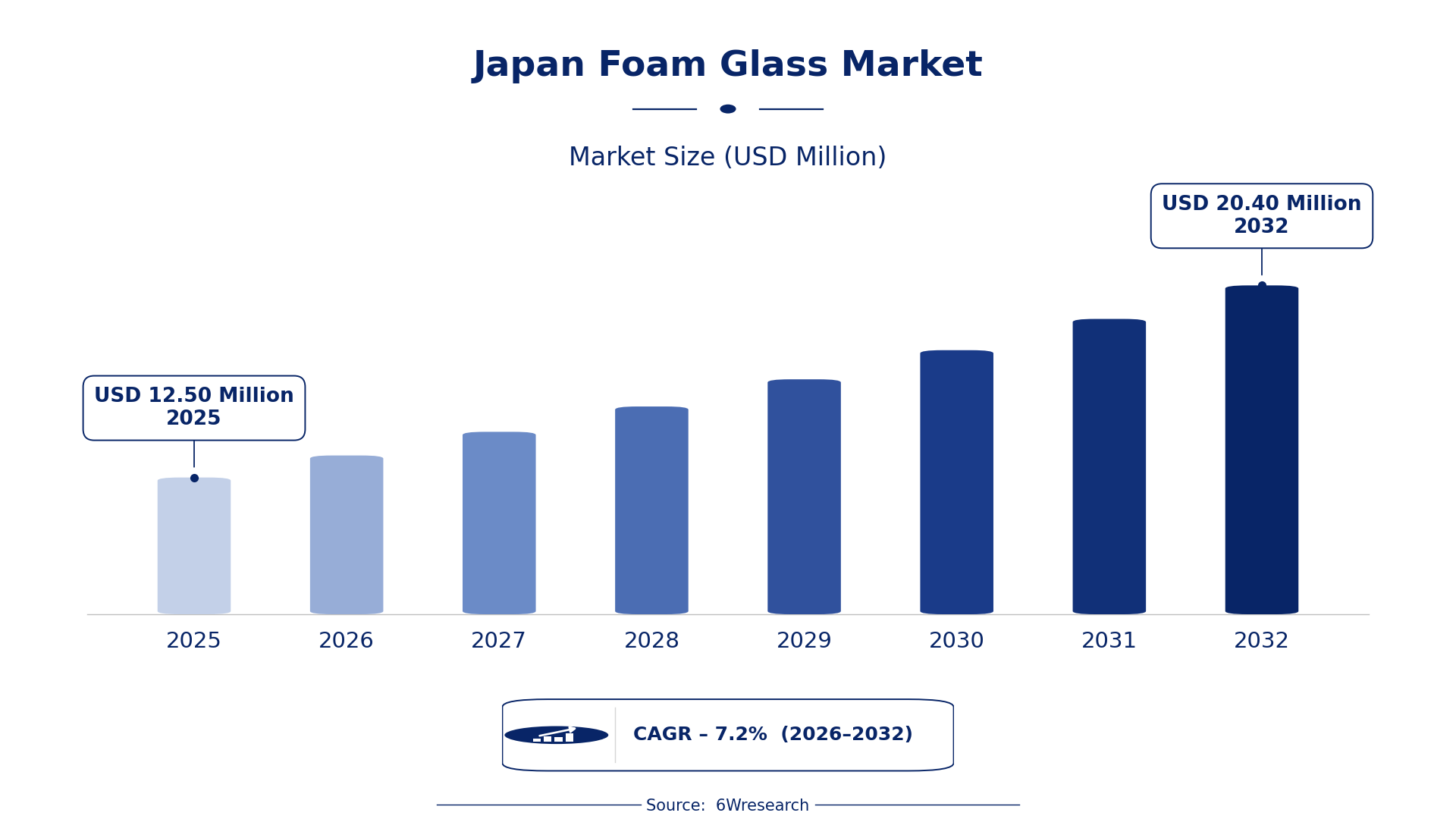
According to 6Wresearch internal database and industry insights, the Japan Foam Glass Market was valued at USD 12.50 Million in 2025 and is projected to reach USD 20.40 Million by 2032, growing at a CAGR of approximately 7.2% during 2026–2032.
Japan Foam Glass Market Highlights
| Report Metric | Details |
| Report Name | Japan Foam Glass Market (2026-2032) |
| Market Size 2025 | USD 12.50 Million |
| Market Size 2032 | USD 20.40 Million |
| Absolute Growth 2025–2032 | USD 7.90 Million |
| CAGR 2026–2032 | 7.2% |
| Peak Annual Growth | 8.0% in 2030 |
| Forecast Period | 2026–2032 |
| Historical Data | 2022–2025 |
| Base Year | 2025 |
| Leading Type, 2025 | open cell (68% share) |
| Leading Process, 2025 | Physical (58% share) |
| Leading Application, 2025 | Building & Industrial Insulation (55% share) |
| Fastest-Growing Type | Closed Cell (9.5% CAGR) |
| Fastest-Growing Process | Chemical (10.0% CAGR) |
| Fastest-Growing Application | Chemical Processing Systems (9.2% CAGR) |
| Growing Sector | Chemical Processing Systems |
| Key End Users | Building & Industrial Insulation, Chemical Processing Systems |
Japan Foam Glass Market Year-wise Growth Rate and Key Drivers (2022–2032)
This graph illustrates the annual growth rates of the market from 2022 to 2032, highlighting a steady upward trajectory and projected market expansion over the forecast period.
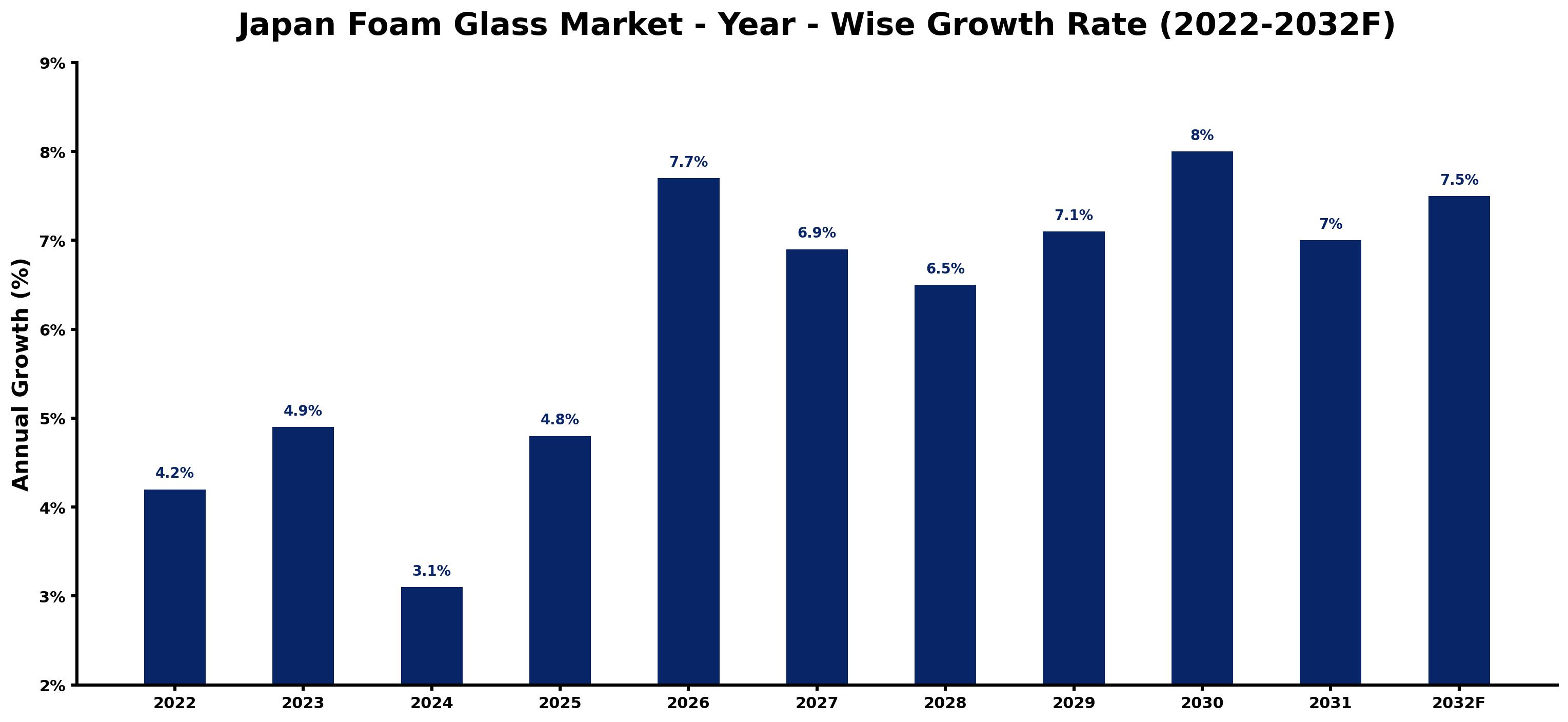
The yearly estimates that follow link every growth rate to its principal driver, so readers can see why the pace changed in each period.
| Year | Estimated Annual Growth (%) | Market Rationale |
| 2022 | 4.2 | The construction sector was valued at approximately 50 trillion yen, driving early demand. |
| 2023 | 4.9 | Foam glass saw increased adoption in new commercial building projects, boosting growth. |
| 2024 | 3.1 | Demand growth slowed as construction activity stabilised after a previous surge. |
| 2025 | 4.8 | The market rebounded with renewed investments in energy-efficient building materials. |
| 2026 | 7.7 | Rising awareness of sustainability is expected to increase foam glass usage in construction. |
| 2027 | 6.9 | Growth slowed as the market adjusted to previous high levels of demand. |
| 2028 | 6.5 | The market continued to stabilise as new projects were planned and initiated. |
| 2029 | 7.1 | Demand accelerated again due to a focus on energy-efficient designs in buildings. |
| 2030 | 8.0 | Foam glass demand peaked as the market embraced effective insulation solutions. |
| 2031 | 7.0 | Growth slowed as the market began to mature and competition intensified. |
| 2032 | 7.5 | Rising investments in sustainable materials will drive demand for foam glass. |
Note: Market size estimations and growth projections presented in this report are based on 6Wresearch's proprietary forecasting methodology, utilizing the latest available industry data, government publications, and primary research inputs.
Japan Foam Glass Market Synopsis
Foam glass is a lightweight, rigid material made from recycled glass, primarily used for thermal insulation in buildings and industrial applications. The Japan Foam Glass Market is expanding due to the construction sector, particularly in urban areas where over 30% of new commercial projects utilise foam glass. The ongoing push for energy-efficient building materials, supported by the 2023 program promoting sustainable materials, fuels demand. As the market matures, the focus on effective insulation solutions is expected to sustain growth.
Market Dynamics Impact Analysis (2026–2032)
| Factor | Type | Impact | Primary Segment Affected |
| Growing construction sector in urban areas | Driver | High | Building & Industrial Insulation |
| Increased focus on energy efficiency in buildings | Driver | High | Building & Industrial Insulation |
| Rising demand for sustainable materials | Opportunity | High | Building & Industrial Insulation |
| Expansion of recycling initiatives for glass waste | Opportunity | Medium | Building & Industrial Insulation |
| Competition from alternative insulation materials | Restraint | High | Building & Industrial Insulation |
| High production costs associated with foam glass | Restraint | Medium | Building & Industrial Insulation |
| Limited awareness of foam glass benefits | Challenge | High | Building & Industrial Insulation |
| Dependence on construction sector performance | Challenge | Medium | Building & Industrial Insulation |
Evaluation of Drivers in Japan Foam Glass Market (2026–2032)
Key forces behind demand, with the segment each one moves most, are listed below.
| Drivers | Primary Segment Affected | Why It Matters (Evidence) |
| Increased urban construction projects | Building & Industrial Insulation | Over 30% of new commercial building projects in urban areas utilise foam glass, driving demand. |
| Sustainability initiatives | Building & Industrial Insulation | Recycling initiatives from the Ministry of the Environment are projected to boost foam glass production. |
| Energy efficiency regulations | Building & Industrial Insulation | The Building Energy Efficiency Act mandates energy standards, resulting in greater adoption of foam glass. |
| Long lifespan of foam glass insulation | Building & Industrial Insulation | Foam glass insulation has an estimated lifespan of over 50 years, appealing to buyers seeking durability. |
| Fire resistance standards | Building & Industrial Insulation | Foam glass meets JIS A 9511 standards, making it a preferred choice for safety-conscious buyers. |
The strongest pull on demand comes from the increased number of urban construction projects, where over 30% of new commercial buildings utilise foam glass for insulation. Sustainability efforts are driving foam glass production as recycling becomes more prevalent. The material's longevity of over 50 years makes it attractive to buyers seeking durable solutions. Its fire resistance, compliant with JIS A 9511 standards, positions foam glass as a safe choice in construction.
Evaluation of Restraints in Japan Foam Glass Market
The following restraints limit how fast demand can grow.
| Market Restraint | Primary Segment Affected | Why It Matters (Evidence) |
| Competition from alternative insulation materials | Building & Industrial Insulation | The presence of cheaper alternatives limits foam glass's market share in insulation, reducing buyer interest. |
| High production costs associated with foam glass | Building & Industrial Insulation | Production costs are elevated due to the recycling and processing of glass, impacting pricing competitiveness. |
| Limited awareness of foam glass benefits | Building & Industrial Insulation | Many buyers lack knowledge of foam glass's advantages, which hinders its market penetration. |
| Dependence on construction sector performance | Building & Industrial Insulation | Fluctuations in the construction sector directly affect foam glass demand, resulting in unpredictable sales. |
| Regulatory compliance costs | Building & Industrial Insulation | Adhering to stringent regulations increases operational costs for foam glass producers, affecting profitability. |
Japan Foam Glass Market Challenges
In 2022, the construction sector in Japan was valued at approximately 50 trillion yen, but rising material costs have inflated project budgets, delaying completion for contractors. Supply chain disruptions have resulted in inconsistent availability of foam glass, forcing producers to extend lead times, which impacts project timelines for builders. Many manufacturers struggle with outdated production techniques, limiting efficiency and increasing operational costs. Buyers face challenges in sourcing sustainable materials, as the recent program promoting sustainable building materials has intensified competition for foam glass, driving prices higher and increasing procurement costs by up to 15%.
Trends in the Japan Foam Glass Market
Below are the shifts with the largest effect on the Japan Foam Glass Market.
- Shift towards Sustainable Building Materials: The focus on sustainable building materials is growing, with the 2023 program promoting foam glass. Urban areas are increasingly incorporating foam glass for insulation, reflecting a shift towards eco-friendly construction practices.
- Increased Adoption of Energy-Efficient Designs: Building designers are prioritising energy-efficient solutions, with foam glass increasingly featured in new projects. The construction sector's value of approximately 50 trillion yen highlights the growing trend towards energy-efficient materials.
- Expansion of Recycling Initiatives: Support for recycling initiatives is leading to increased foam glass production. In 2023, these efforts are expected to boost the use of recycled materials in construction, promoting sustainability.
- Focus on Fire Safety Standards: Fire safety is becoming a priority in construction, driving demand for materials like foam glass. Foam glass is increasingly specified in projects requiring high safety compliance, meeting JIS A 9511 standards.
Investment Opportunities in the Japan Foam Glass Market
Investors looking at the Japan Foam Glass Market should consider the following areas.
- Investment in Urban Insulation Projects: Urban areas are increasingly investing in insulation projects, with foam glass being a key material. The Tokyo metropolitan area is a prime market, with substantial demand for energy-efficient solutions.
- Collaboration with Construction Firms: Construction firms are seeking sustainable materials, creating opportunities for foam glass suppliers. Partnering with local builders in urban regions will facilitate market entry and growth.
- Expansion of Recycling Facilities: The need for recycling facilities is rising as sustainability becomes a priority. Establishing partnerships with local recycling centres can enhance foam glass production capabilities.
- Focus on Energy-Efficient Building Codes: New energy-efficient building codes are being introduced, creating demand for insulation materials. Suppliers should align with these codes to capture market opportunities.
Government Initiatives in the Japan Foam Glass Market
The Building Energy Efficiency Act (2015, amended 2022) requires all new buildings to meet energy standards from April 2025. This law compels producers to ensure their insulation materials, including foam glass, comply with these standards, enhancing market competitiveness. The PRTR Law (1999) mandates businesses to report releases and transfers of designated chemical substances, ensuring that foam glass production adheres to environmental safety regulations, which benefits buyers seeking compliant materials.
The Ministry of the Environment oversees recycling initiatives that support glass waste recycling in foam glass production. This scheme encourages producers to invest in sustainable practices, ensuring that buyers can access eco-friendly insulation solutions. The Japan Society of Civil Engineers promotes the use of innovative insulation materials, including foam glass, which aligns with industry standards and enhances market acceptance.
Future Insight of the Japan Foam Glass Market
The investment pipeline for sustainable building materials will expand significantly, driven by government initiatives and environmental standards. Urban expansion will create greater demand for foam glass as more projects incorporate energy-efficient designs. Emerging production technologies will improve quality while reducing costs for insulation materials. As foam glass insulation becomes a standard in over 30% of new commercial building projects, buyers will benefit from better availability and suppliers will find expanded market opportunities.
Market Segmentation Analysis
Japan Foam Glass Market report covers a detailed analysis of the following market segments:
By Type – open cell Leads, Closed Cell Expected to Grow Fastest
According to Sachin Kumar Rai, Senior Research Analyst at 6Wresearch, open cell accounted for 68% of the market by type in 2025. Open cell foam glass commands the largest share owing to its prevalent use in insulation across various applications, especially in urban construction. In the Tokyo metropolitan area, it is utilised in over 30% of new commercial building projects for effective thermal insulation. Closed Cell is set to record the highest CAGR in this split, 9.5% over 2026–2032. Closed cell foam glass is experiencing rapid growth as it offers superior insulation and moisture resistance, making it the preferred choice in energy-efficient designs. The recent initiative promoting sustainable building materials has significantly boosted its adoption in the construction sector. Suppliers must prioritise their offerings in closed cell foam glass to align with the increasing demand for energy-efficient solutions.
By Process – Physical Leads, Chemical Expected to Grow Fastest
In 2025, Physical led the process split with a 58% share. The physical process for producing foam glass leads the market as it is extensively utilised in manufacturing insulation materials that meet Japan Industrial Standards. This method guarantees the production of high-quality foam glass suitable for diverse applications in the construction industry. Chemical is projected to grow fastest, at a CAGR of 10.0% during 2026–2032. The chemical process is gaining momentum due to its specific applications in chemical processing systems that require enhanced insulation and resistance. As industries pursue more efficient solutions, this process is becoming increasingly vital. Buyers in the chemical sector should consider suppliers that employ the chemical process to fulfil their insulation requirements.
By Application – Building & Industrial Insulation Leads, Chemical Processing Systems Expected to Grow Fastest
Building & Industrial Insulation took 55% of application revenue in 2025, more than any other category. Building and industrial insulation is the leading application for foam glass, driven by its widespread use in Japan's construction sector valued at approximately 50 trillion yen. This segment benefits from strong demand in urban areas, particularly for new commercial building projects. Over 2026–2032, Chemical Processing Systems are expected to post the fastest growth, at a CAGR of 9.2%. Chemical processing systems are the fastest-growing application as industries look for insulation materials that can withstand harsh conditions while providing chemical resistance. This trend aligns with the increasing focus on sustainability in industrial practices. Suppliers should consider expanding their product lines to cater to the growing needs of the chemical processing sector.
Key Attractiveness of the Report
- 10 Years of Market Numbers
- Historical Data Starting from 2022 to 2025
- Base Year 2025
- Forecast Data until 2032
- Key Performance Indicators Impacting the Market
- Major Upcoming Developments and Projects
Key Highlights of the Report:
- Japan Foam Glass Market Outlook
- Market Size of Japan Foam Glass Market, 2025
- Forecast of Japan Foam Glass Market, 2032
- Historical Data and Forecast of Japan Foam Glass Revenues & Volume for the Period 2022-2032
- Japan Foam Glass Market Trend Evolution
- Japan Foam Glass Market Drivers and Challenges
- Japan Foam Glass Price Trends
- Japan Foam Glass Porter's Five Forces
- Japan Foam Glass Industry Life Cycle
- Historical Data and Forecast of Japan Foam Glass Market Revenues & Volume By Type for the Period 2022-2032
- Historical Data and Forecast of Japan Foam Glass Market Revenues & Volume By open cell for the Period 2022-2032
- Historical Data and Forecast of Japan Foam Glass Market Revenues & Volume By Closed Cell for the Period 2022-2032
- Historical Data and Forecast of Japan Foam Glass Market Revenues & Volume By Process for the Period 2022-2032
- Historical Data and Forecast of Japan Foam Glass Market Revenues & Volume By Physical for the Period 2022-2032
- Historical Data and Forecast of Japan Foam Glass Market Revenues & Volume By Chemical for the Period 2022-2032
- Historical Data and Forecast of Japan Foam Glass Market Revenues & Volume By Application for the Period 2022-2032
- Historical Data and Forecast of Japan Foam Glass Market Revenues & Volume By Building & Industrial Insulation for the Period 2022-2032
- Historical Data and Forecast of Japan Foam Glass Market Revenues & Volume By Chemical Processing Systems for the Period 2022-2032
- Japan Foam Glass Import Export Trade Statistics
- Market Opportunity Assessment By Type
- Market Opportunity Assessment By Process
- Market Opportunity Assessment By Application
- Japan Foam Glass Top Companies Market Share
- Japan Foam Glass Competitive Benchmarking By Technical and Operational Parameters
- Japan Foam Glass Company Profiles
- Japan Foam Glass Key Strategic Recommendations
Market Covered
This report examines the market across the segments below.
By Type
- open cell
- Closed Cell
By Process
- Physical
- Chemical
By Application
- Building & Industrial Insulation
- Chemical Processing Systems































