Japan Functional Workwear Apparel Market Size & Growth Rate
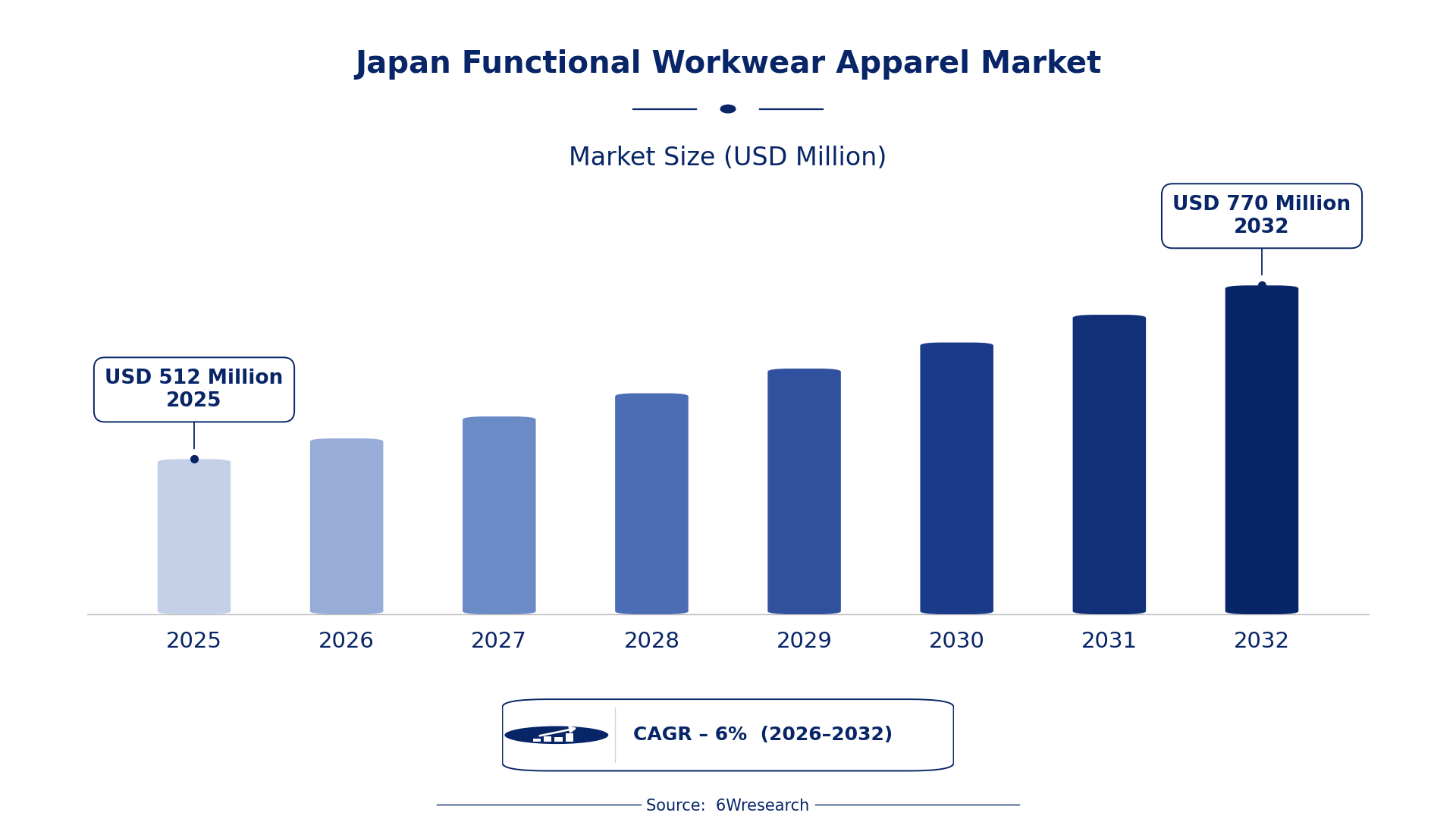
According to 6Wresearch internal database and industry insights, the Japan Functional Workwear Apparel Market was valued at USD 512 Million in 2025 and is projected to reach USD 770 Million by 2032, growing at a CAGR of approximately 6% during 2026–2032.
Japan Functional Workwear Apparel Market Highlights
| Report Metric | Details |
| Report Name | Japan Functional Workwear Apparel Market (2026-2032) |
| Market Size 2025 | USD 512 Million |
| Market Size 2032 | USD 770 Million |
| Absolute Growth 2025–2032 | USD 258 Million |
| CAGR 2026–2032 | 6% |
| Peak Annual Growth | 7.6% in 2026 |
| Forecast Period | 2026–2032 |
| Historical Data | 2022–2025 |
| Base Year | 2025 |
| Leading Type, 2025 | Trousers (44% share) |
| Leading Gender, 2025 | Male (66% share) |
| Leading Material, 2025 | Polyester (45% share) |
| Leading End-use Industry, 2025 | Manufacturing (35% share) |
| Leading Distribution Channel, 2025 | Offline (69% share) |
| Fastest-Growing Type | Jackets (8.6% CAGR) |
| Fastest-Growing Gender | Female (7.2% CAGR) |
| Fastest-Growing Material | Cotton Blend (8.2% CAGR) |
| Fastest-Growing End-use Industry | Healthcare (7.8% CAGR) |
| Fastest-Growing Distribution Channel | Online (7.6% CAGR) |
| Growing Sector | Healthcare |
| Key End Users | Manufacturers, Construction Firms, Healthcare Providers, Retailers |
Japan Functional Workwear Apparel Market Year-wise Growth Rate and Key Drivers (2022–2032)
This graph illustrates the annual growth rates of the market from 2022 to 2032, highlighting a steady upward trajectory and projected market expansion over the forecast period.
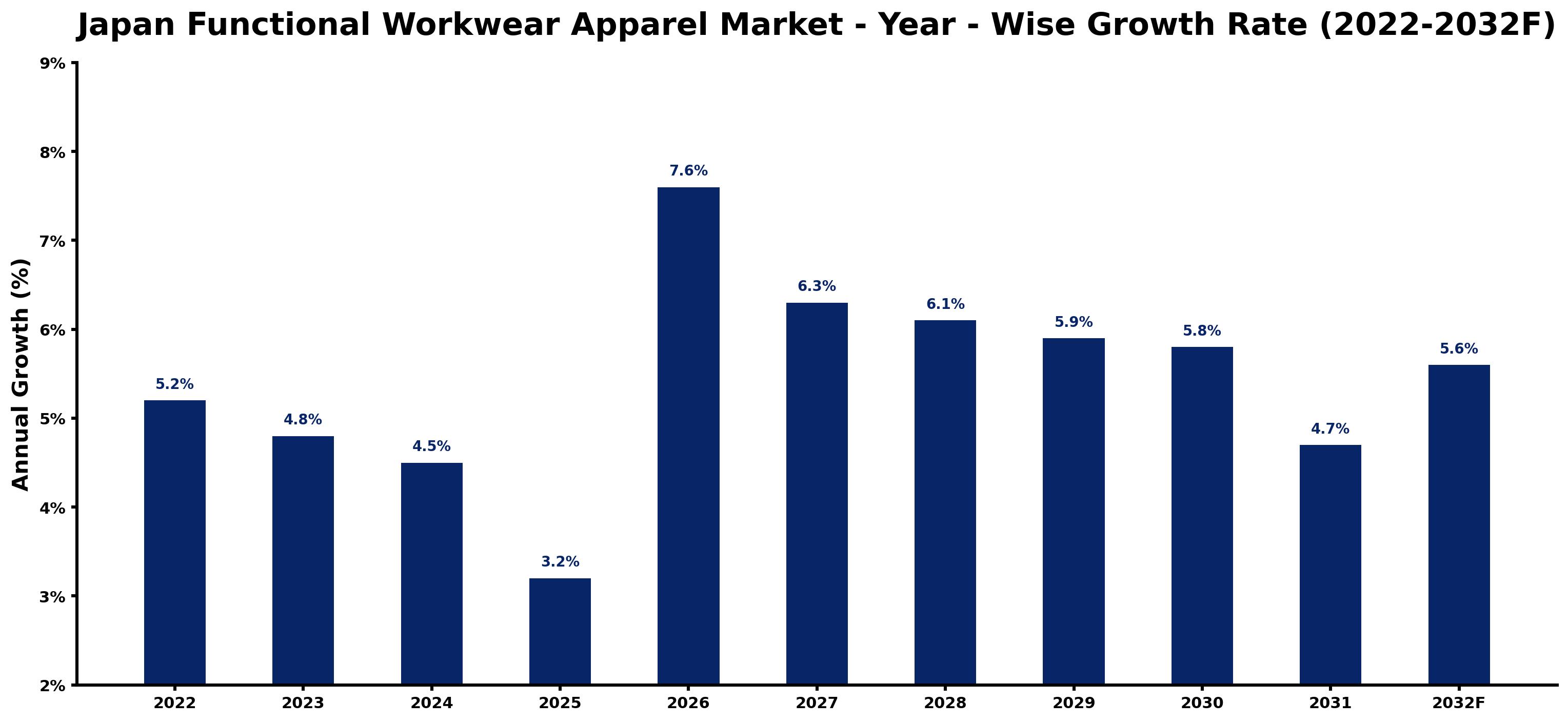
Below, each year's estimated growth is shown next to the factor that most influenced it.
| Year | Estimated Annual Growth (%) | Market Rationale |
| 2022 | 5.2 | The market experienced strong demand from key sectors like manufacturing and construction. |
| 2023 | 4.8 | Growth slowed due to market saturation and fewer new entrants in the workwear sector. |
| 2024 | 4.5 | Demand remained steady, with competition intensifying among existing players. |
| 2025 | 3.2 | Growth continued to decelerate as the market adjusted to previous expansions. |
| 2026 | 7.6 | The market is expected to rebound sharply, driven by increased safety regulations in construction. |
| 2027 | 6.3 | Growth will slow as the market stabilises after the previous surge in demand. |
| 2028 | 6.1 | Demand is projected to continue moderating, reflecting a more mature market environment. |
| 2029 | 5.9 | The market will experience slight growth as manufacturers adapt to changing consumer preferences. |
| 2030 | 5.8 | Growth will slow further due to challenges from rising material costs. |
| 2031 | 4.7 | The market will continue to grow, albeit at a slower pace, due to stable demand. |
| 2032 | 5.6 | Growth is expected to pick up again, driven by innovations in sustainable workwear materials. |
Note: Market size estimations and growth projections presented in this report are based on 6Wresearch's proprietary forecasting methodology, utilizing the latest available industry data, government publications, and primary research inputs.
Japan Functional Workwear Apparel Market Synopsis
Functional workwear apparel is engineered for durability and protection, primarily made from high-performance fabrics like polyester and cotton blends. The Japan Functional Workwear Apparel Market is growing due to strong demand from the manufacturing and construction sectors, which employ millions of workers needing functional apparel. This growth is driven by safety regulations and an increased focus on workplace safety standards, with substantial investments expected in sustainable materials and advancements in design.
Market Dynamics Impact Analysis (2026–2032)
| Factor | Type | Impact | Primary Segment Affected |
| Rising safety regulations in the construction sector | Driver | High | Jackets |
| Growing focus on workplace safety and hygiene | Driver | High | Healthcare |
| Increased demand for sustainable materials | Opportunity | Medium | Cotton Blend |
| Expansion of online sales channels | Opportunity | Medium | Online |
| High competition among established brands | Restraint | High | Trousers |
| Fluctuations in raw material prices | Restraint | Medium | Polyester |
| Limited supply chain capacity for high-performance fabrics | Challenge | High | Bib Overalls |
| Aging workforce impacting design requirements | Challenge | Medium | Shirts |
Evaluation of Drivers in Japan Functional Workwear Apparel Market (2026–2032)
The factors lifting demand, and the evidence behind each, are summarised below.
| Drivers | Primary Segment Affected | Why It Matters (Evidence) |
| Increased safety regulations | Jackets | The construction sector's growth has led to stricter safety regulations, increasing demand for protective jackets, with the sector investing 1 trillion JPY by 2025. |
| Growing workforce in manufacturing | Trousers | The manufacturing sector employs over 10 million workers, driving demand for durable trousers that meet safety standards. |
| Demand for eco-friendly materials | Cotton Blend | The trend towards sustainable workwear materials is influenced by the Tokyo Metropolitan Government's programs promoting eco-friendly options. |
| Expansion of healthcare sector | Healthcare | The healthcare industry is expected to grow, increasing the need for functional workwear to ensure hygiene and safety. |
| Rise in online sales | Online | Online sales of workwear surged by 25% last year, reflecting changing consumer purchasing habits. |
The manufacturing sector employs over 10 million workers, driving demand for durable trousers that meet safety standards. The healthcare sector's expansion will increase the need for functional workwear to ensure hygiene and safety. Online sales of workwear surged by 25% last year, reflecting changing consumer habits.
Evaluation of Restraints in Japan Functional Workwear Apparel Market
The following restraints limit how fast demand can grow.
| Market Restraint | Primary Segment Affected | Why It Matters (Evidence) |
| High competition among established brands | Trousers | Intense competition limits pricing power, affecting profitability for manufacturers in the trousers segment. |
| Fluctuations in raw material prices | Polyester | Rising costs of polyester impact production budgets, forcing manufacturers to adjust pricing strategies. |
| Limited supply chain capacity for high-performance fabrics | Bib Overalls | Supply chain constraints hinder timely delivery of high-performance fabrics, affecting production schedules. |
| Aging workforce impacting design requirements | Shirts | An aging workforce necessitates specific design adaptations, complicating product development for manufacturers. |
| Market saturation in certain segments | Jackets | Market saturation leads to reduced growth potential for jacket manufacturers, limiting new entrants. |
Japan Functional Workwear Apparel Market Challenges
Rising material costs can push the average price of a functional workwear jacket to around 8,000 JPY, straining buyers' budgets. Slow technology adoption in some manufacturing sectors delays production timelines for suppliers, extending lead times by up to three weeks. Buyers face competition from imported workwear that often offers lower prices, forcing local manufacturers to cut margins by 10% to remain competitive. Ongoing investments in compliance with safety standards, such as ISO 20471, consume resources for producers that could otherwise support product development.
Trends in the Japan Functional Workwear Apparel Market
Four trends stand out in the Japan Functional Workwear Apparel Market.
- Increase in Online Sales: Online sales of functional workwear surged by 25% over the past year, reflecting changing consumer purchasing habits. This shift is important for suppliers aiming to expand their market reach.
- Shift Towards Eco-Friendly Materials: The trend towards sustainable workwear materials is gaining traction, influenced by initiatives from the Tokyo Metropolitan Government. This shift is likely to influence purchasing decisions among environmentally conscious consumers.
- Growing Demand for Women's Workwear: The demand for women's workwear is projected to grow by 20% by 2026, driven by increasing female participation in the workforce. This trend presents new opportunities for manufacturers looking to diversify their product lines.
- Adoption of Safety Standards: ISO 20471, a standard for high visibility clothing, is increasingly adopted in the workwear sector. Compliance with this standard is essential for manufacturers aiming to meet industry requirements.
Investment Opportunities in the Japan Functional Workwear Apparel Market
Investors looking at the Japan Functional Workwear Apparel Market should consider the following areas.
- Supply of Eco-Friendly Materials: A demand for sustainable materials, particularly cotton blends, is rising as the Tokyo Metropolitan Government promotes eco-friendly initiatives. Suppliers can enter this market by partnering with local manufacturers.
- Expansion in the Healthcare Sector: The healthcare sector is expanding, increasing the need for functional workwear. Suppliers can target hospitals and clinics, which are investing in safety improvements and compliance with health regulations.
- Investment in Online Retail Platforms: With online sales increasing, there is an opportunity to invest in e-commerce platforms. This is particularly relevant for suppliers targeting younger consumers who prefer online shopping.
- Focus on Safety Gear for Construction: The construction industry is set to invest 1 trillion JPY in safety improvements by 2025. Suppliers can capitalise on this by providing innovative safety gear tailored to construction needs.
Government Initiatives in the Japan Functional Workwear Apparel Market
The Building Energy Efficiency Act, amended in 2022, mandates that all new buildings comply with energy standards from April 2025, impacting workwear producers by necessitating adherence to safety regulations. The Ministry of Health, Labour and Welfare promotes safety standards for workwear, ensuring that products meet specific quality benchmarks.
The Ministry of Health, Labour and Welfare oversees the implementation of safety standards for workwear, funding initiatives that improve workplace safety. This includes programs that support manufacturers in meeting JIS standards, ensuring that workwear products are certified for quality and safety.
Future Insight of the Japan Functional Workwear Apparel Market
Investment in safety improvements will reach 1 trillion JPY by 2025, generating strong demand for functional workwear. By 2032, innovations in eco-friendly materials will transform product offerings, attracting environmentally conscious buyers. The anticipated 20% growth in women's workwear by 2026 will encourage suppliers to expand their product lines. Increased government safety initiatives will further raise the demand for compliant apparel, compelling producers to align with stricter industry standards.
Market Segmentation Analysis
Japan Functional Workwear Apparel Market report covers a detailed analysis of the following market segments:
By Type – Trousers Lead, Jackets Expected to Grow Fastest
According to Bhawna Singh, Assistant Manager at 6Wresearch, Trousers held 44% of the Japan Functional Workwear Apparel Market by type in 2025. Trousers hold the largest market share as they are essential for ensuring safety and comfort in various work environments, especially in manufacturing where safety regulations are strict. Their critical role in facilitating worker mobility further reinforces their market dominance. Jackets are projected to grow fastest, at a CAGR of 8.6% during 2026–2032. Jackets are witnessing rapid growth due to their protective features against weather and hazards, which are increasingly vital for outdoor workers. As safety standards evolve, the demand for jackets will likely continue to rise, widening their market lead. Suppliers should focus on developing jackets to meet the growing emphasis on worker safety.
By Gender – Male Leads, Female Expected to Grow Fastest
In 2025, Male led the gender split with a 66% share. The male segment leads the market, reflecting the larger share of male workers in industries that require functional workwear, particularly in manufacturing and construction. This established presence ensures sustained demand for male-oriented workwear products. The quickest growth will come from Female, forecast to expand at a CAGR of 7.2% between 2026 and 2032. The female segment is growing quickly as more women enter the workforce and require functional apparel tailored to their specific needs. This trend is supported by a heightened awareness of workplace safety and the need for suitable workwear for women. Suppliers need to adapt their product offerings to better serve the emerging female workforce.
By Material – Polyester Leads, Cotton Blend Expected to Grow Fastest
Polyester accounted for 45% of the market by material in 2025. Polyester leads the market as it is extensively used in functional workwear, valued for its durability and moisture-wicking properties. This makes it particularly suitable for demanding environments like manufacturing, where performance is paramount. Over 2026–2032, Cotton Blend is expected to post the fastest growth, at a CAGR of 8.2%. Cotton blends are gaining traction as they offer comfort and breathability, appealing to users in sectors such as healthcare. The rising demand for comfortable workwear is significantly driving this segment's growth. Manufacturers should consider expanding their product lines to include more cotton blend options to meet changing consumer preferences.
By End-use Industry – Manufacturing Leads, Healthcare Expected to Grow Fastest
The largest end-use industry category in 2025 was Manufacturing, at 35% of revenue. The manufacturing sector is the largest consumer of functional workwear, employing over 10 million workers who require durable apparel for safety and efficiency. This substantial workforce drives continuous demand across various workwear categories. Healthcare is set to record the highest CAGR in this split, 7.8% over 2026–2032. The healthcare industry is rapidly increasing its demand for functional workwear, driven by stringent hygiene and safety requirements in medical environments. As health and safety concerns grow, this segment's expansion is expected to accelerate. Suppliers should focus on the healthcare sector to align their product development with rising safety standards.
By Distribution Channel – Offline Leads, Online Expected to Grow Fastest
Offline took 69% of distribution channel revenue in 2025, more than any other category. The offline channel remains the primary sales avenue, allowing customers to physically assess workwear products before purchasing. This is particularly crucial in sectors where fit and comfort are essential for workers. Online is projected to grow fastest, at a CAGR of 7.6% during 2026–2032. Online sales are increasing rapidly, with a notable 25% rise in the past year, reflecting a shift towards convenience and digital shopping preferences among consumers. This trend signifies a substantial change in purchasing behaviour for workwear. Retailers should enhance their online strategies to capitalise on the growing e-commerce trend in the workwear market.
Key Attractiveness of the Report
- 10 Years of Market Numbers
- Historical Data Starting from 2022 to 2025
- Base Year 2025
- Forecast Data until 2032
- Key Performance Indicators Impacting the Market
- Major Upcoming Developments and Projects
Key Highlights of the Report:
- Japan Functional Workwear Apparel Market Outlook
- Market Size of Japan Functional Workwear Apparel Market, 2025
- Forecast of Japan Functional Workwear Apparel Market, 2032
- Historical Data and Forecast of Japan Functional Workwear Apparel Revenues & Volume for the Period 2022-2032
- Japan Functional Workwear Apparel Market Trend Evolution
- Japan Functional Workwear Apparel Market Drivers and Challenges
- Japan Functional Workwear Apparel Price Trends
- Japan Functional Workwear Apparel Porter's Five Forces
- Japan Functional Workwear Apparel Industry Life Cycle
- Historical Data and Forecast of Japan Functional Workwear Apparel Market Revenues & Volume By Type for the Period 2022-2032
- Historical Data and Forecast of Japan Functional Workwear Apparel Market Revenues & Volume By Trousers for the Period 2022-2032
- Historical Data and Forecast of Japan Functional Workwear Apparel Market Revenues & Volume By Bib Overalls for the Period 2022-2032
- Historical Data and Forecast of Japan Functional Workwear Apparel Market Revenues & Volume By Shirts for the Period 2022-2032
- Historical Data and Forecast of Japan Functional Workwear Apparel Market Revenues & Volume By Jackets for the Period 2022-2032
- Historical Data and Forecast of Japan Functional Workwear Apparel Market Revenues & Volume By Sweatshirts for the Period 2022-2032
- Historical Data and Forecast of Japan Functional Workwear Apparel Market Revenues & Volume By T-Shirts for the Period 2022-2032
- Historical Data and Forecast of Japan Functional Workwear Apparel Market Revenues & Volume By Others (Shorts, etc.) for the Period 2022-2032
- Historical Data and Forecast of Japan Functional Workwear Apparel Market Revenues & Volume By Gender for the Period 2022-2032
- Historical Data and Forecast of Japan Functional Workwear Apparel Market Revenues & Volume By Male for the Period 2022-2032
- Historical Data and Forecast of Japan Functional Workwear Apparel Market Revenues & Volume By Female for the Period 2022-2032
- Historical Data and Forecast of Japan Functional Workwear Apparel Market Revenues & Volume By Material for the Period 2022-2032
- Historical Data and Forecast of Japan Functional Workwear Apparel Market Revenues & Volume By Cotton Blend for the Period 2022-2032
- Historical Data and Forecast of Japan Functional Workwear Apparel Market Revenues & Volume By Polyester for the Period 2022-2032
- Historical Data and Forecast of Japan Functional Workwear Apparel Market Revenues & Volume By Cotton for the Period 2022-2032
- Historical Data and Forecast of Japan Functional Workwear Apparel Market Revenues & Volume By Elastane for the Period 2022-2032
- Historical Data and Forecast of Japan Functional Workwear Apparel Market Revenues & Volume By Nylon for the Period 2022-2032
- Historical Data and Forecast of Japan Functional Workwear Apparel Market Revenues & Volume By Others (Denim etc.) for the Period 2022-2032
- Historical Data and Forecast of Japan Functional Workwear Apparel Market Revenues & Volume By End-use Industry for the Period 2022-2032
- Historical Data and Forecast of Japan Functional Workwear Apparel Market Revenues & Volume By Manufacturing for the Period 2022-2032
- Historical Data and Forecast of Japan Functional Workwear Apparel Market Revenues & Volume By Construction for the Period 2022-2032
- Historical Data and Forecast of Japan Functional Workwear Apparel Market Revenues & Volume By Healthcare for the Period 2022-2032
- Historical Data and Forecast of Japan Functional Workwear Apparel Market Revenues & Volume By Defense for the Period 2022-2032
- Historical Data and Forecast of Japan Functional Workwear Apparel Market Revenues & Volume By Sports for the Period 2022-2032
- Historical Data and Forecast of Japan Functional Workwear Apparel Market Revenues & Volume By Others (Mining, etc.) for the Period 2022-2032
- Historical Data and Forecast of Japan Functional Workwear Apparel Market Revenues & Volume By Distribution Channel for the Period 2022-2032
- Historical Data and Forecast of Japan Functional Workwear Apparel Market Revenues & Volume By Online for the Period 2022-2032
- Historical Data and Forecast of Japan Functional Workwear Apparel Market Revenues & Volume By Offline for the Period 2022-2032
- Japan Functional Workwear Apparel Import Export Trade Statistics
- Market Opportunity Assessment By Type
- Market Opportunity Assessment By Gender
- Market Opportunity Assessment By Material
- Market Opportunity Assessment By End-use Industry
- Market Opportunity Assessment By Distribution Channel
- Japan Functional Workwear Apparel Top Companies Market Share
- Japan Functional Workwear Apparel Competitive Benchmarking By Technical and Operational Parameters
- Japan Functional Workwear Apparel Company Profiles
- Japan Functional Workwear Apparel Key Strategic Recommendations
Market Covered
The study includes the following segmentation.
By Type
- Trousers
- Bib Overalls
- Shirts
- Jackets
- Sweatshirts
- T-Shirts
- Others (Shorts, etc.)
By Gender
- Male
- Female
By Material
- Cotton Blend
- Polyester
- Cotton
- Elastane
- Nylon
- Others (Denim etc.)
By End-use Industry
- Manufacturing
- Construction
- Healthcare
- Defense
- Sports
- Others (Mining, etc.)
By Distribution Channel
- Online
- Offline






































