Japan Gas turbine Market Size & Growth Rate
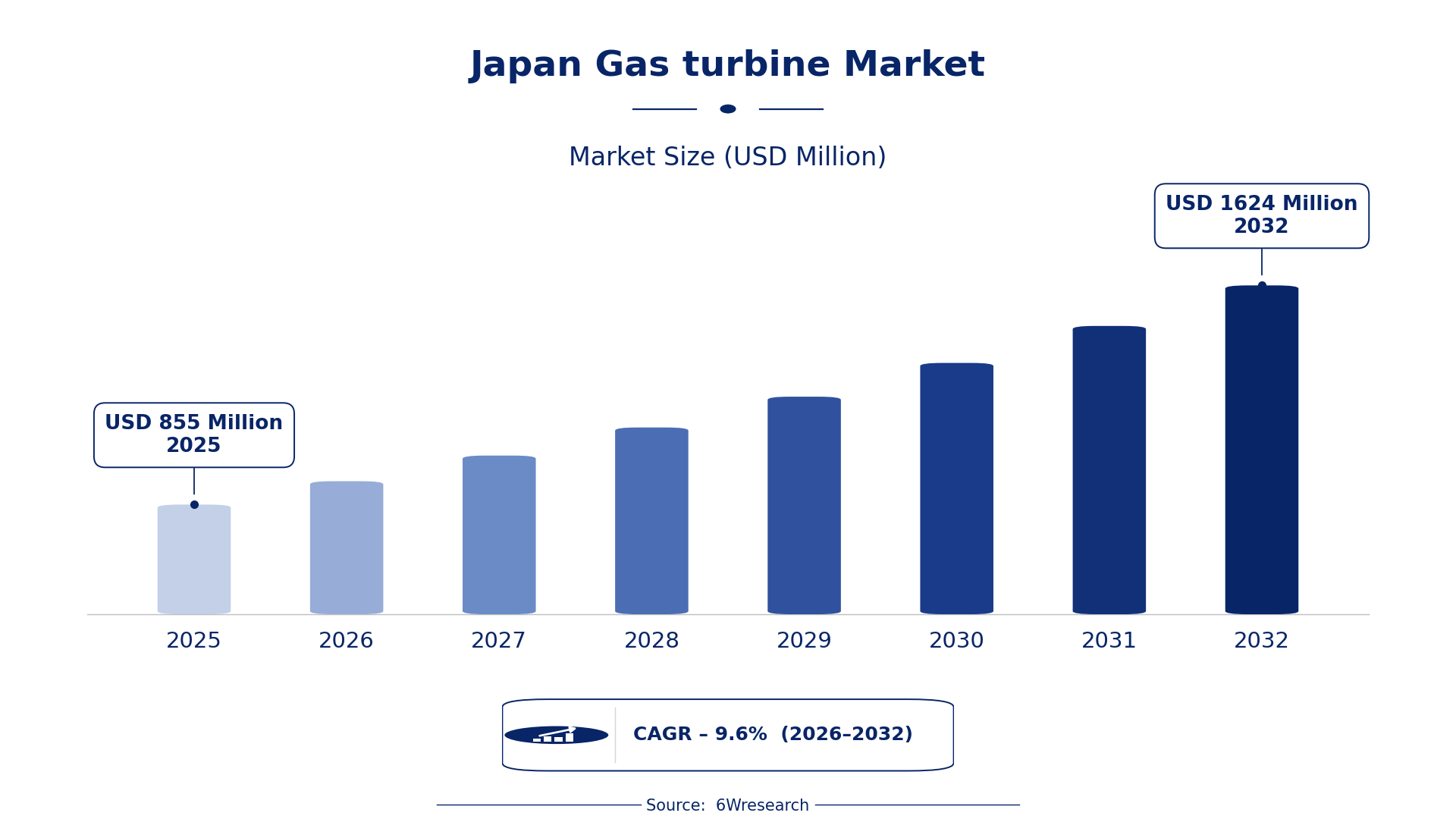
According to 6Wresearch internal database and industry insights, the Japan Gas turbine Market was valued at USD 855 Million in 2025 and is projected to reach USD 1,624 Million by 2032, growing at a CAGR of approximately 9.6% during 2026–2032.
Japan Gas turbine Market Highlights
| Report Metric | Details |
| Report Name | Japan Gas turbine Market (2026-2032) |
| Market Size 2025 | USD 855 Million |
| Market Size 2032 | USD 1,624 Million |
| Absolute Growth 2025–2032 | USD 769 Million |
| CAGR 2026–2032 | 9.6% |
| Peak Annual Growth | 11.0% in 2028 |
| Forecast Period | 2026–2032 |
| Historical Data | 2022–2025 |
| Base Year | 2025 |
| Leading Technology, 2025 | Combined Cycle (56% share) |
| Leading Application, 2025 | Power Generation (52% share) |
| Leading Design Type, 2025 | Heavy Duty (58% share) |
| Leading Capacity, 2025 | >200 MW (62% share) |
| Fastest-Growing Application | Oil & Gas (13.2% CAGR) |
| Fastest-Growing Design Type | Aeroderivative (12.9% CAGR) |
| Fastest-Growing Capacity | ?200 MW (10.8% CAGR) |
| Growing Sector | Power Generation |
| Key End Users | Power utilities, industrial users, oil and gas sector |
Japan Gas turbine Market Year-wise Growth Rate and Key Drivers (2022–2032)
This graph illustrates the annual growth rates of the market from 2022 to 2032, highlighting a steady upward trajectory and projected market expansion over the forecast period.
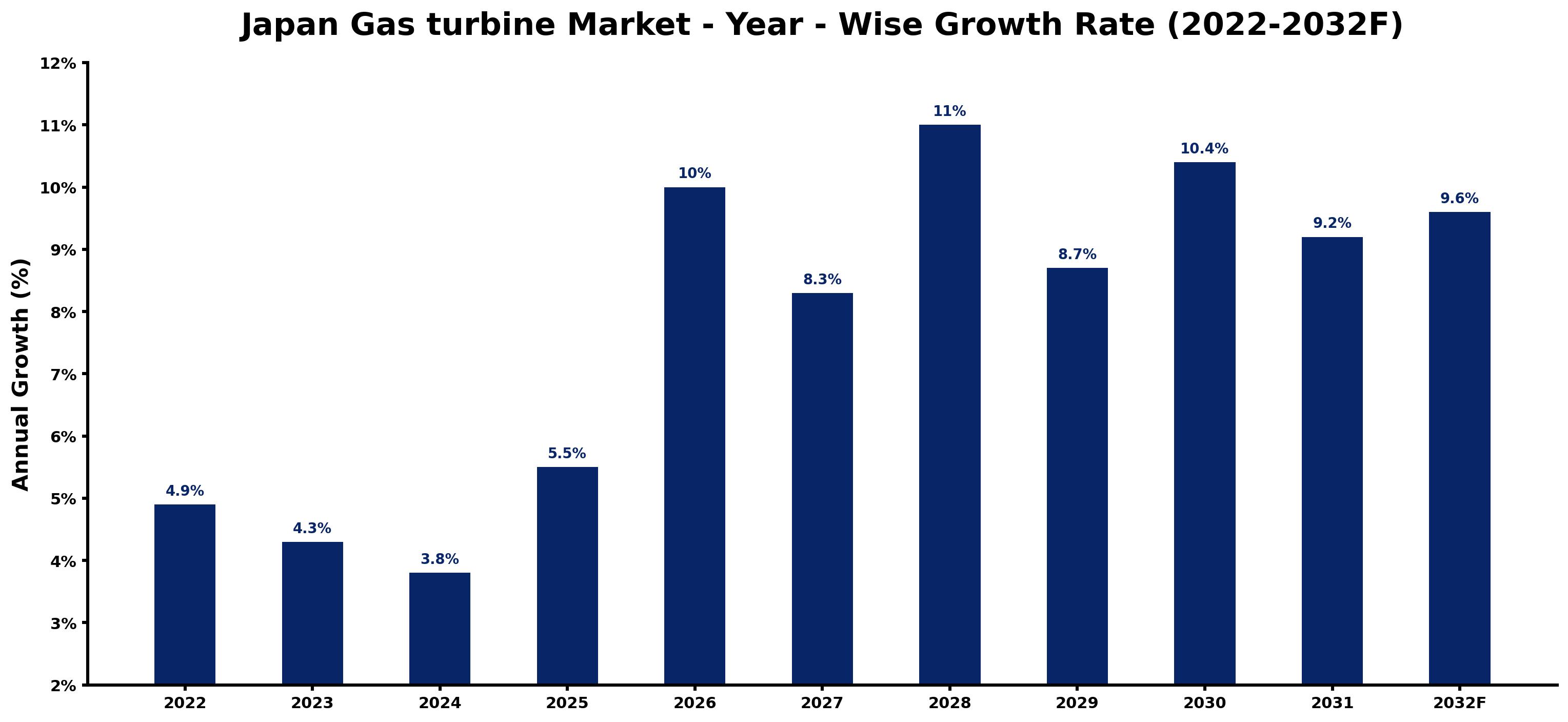
The yearly estimates that follow link every growth rate to its principal driver, so readers can see why the pace changed in each period.
| Year | Estimated Annual Growth (%) | Market Rationale |
| 2022 | 4.9 | The market experienced steady growth due to energy demand and infrastructure investments. |
| 2023 | 4.3 | Growth slowed as the market adjusted to higher energy prices and supply chain disruptions. |
| 2024 | 3.8 | Market expansion continued but at a slower pace due to rising operational costs. |
| 2025 | 5.5 | Growth accelerated as investments in new power generation technologies increased. |
| 2026 | 10.0 | Demand is expected to surge with the introduction of new gas turbine projects and efficiency upgrades. |
| 2027 | 8.3 | Growth will slow slightly as market saturation begins to affect new installations. |
| 2028 | 11.0 | The market is projected to peak with substantial investments in large-scale power generation facilities. |
| 2029 | 8.7 | Growth is expected to moderate as the market stabilises after the peak investment phase. |
| 2030 | 10.4 | Demand will increase again as new efficiency standards prompt upgrades. |
| 2031 | 9.2 | Growth is projected to slow as the market adjusts to the new regulatory environment. |
| 2032 | 9.6 | The market is expected to maintain strong growth with ongoing technological advancements. |
Note: Market size estimations and growth projections presented in this report are based on 6Wresearch's proprietary forecasting methodology, utilizing the latest available industry data, government publications, and primary research inputs.
Japan Gas turbine Market Synopsis
Gas turbines are advanced combustion engines primarily used for power generation and mechanical drive applications. They play a critical role in electricity generation in power plants and propulsion in aviation. The Japan Gas Turbine Market is expanding, driven by rising energy demand from a population of approximately 126 million and significant investments in new technology. The installed gas turbine capacity reached 60 GW in 2022, and the government targets a 46% reduction in greenhouse gas emissions by 2030, further stimulating demand for efficient gas turbine solutions.
Market Dynamics Impact Analysis (2026–2032)
| Factor | Type | Impact | Primary Segment Affected |
| Rising energy demand from power utilities | Driver | High | Power Generation |
| Investment in new gas turbine technology | Driver | High | Combined Cycle |
| Growing focus on emissions reduction | Opportunity | High | Oil & Gas |
| Expansion of gas turbine manufacturing hubs | Opportunity | Medium | Heavy Duty |
| High initial investment costs for new technology | Restraint | High | Combined Cycle |
| Limited availability of skilled workforce | Restraint | Medium | Aeroderivative |
| Supply chain disruptions affecting production timelines | Challenge | High | Open Cycle |
| Increased competition from alternative energy sources | Challenge | Medium | Power Generation |
Evaluation of Drivers in Japan Gas turbine Market (2026–2032)
Below are the drivers that matter most for revenue growth, with supporting evidence.
| Drivers | Primary Segment Affected | Why It Matters (Evidence) |
| Increased investment in renewable energy integration | Combined Cycle | This integration improves overall system efficiency, prompting utilities to purchase more gas turbines for hybrid systems. |
| Government incentives for cleaner energy solutions | Power Generation | Subsidies for low-emission technologies encourage utilities to invest in gas turbine upgrades. |
| Technological advancements improving efficiency | Heavy Duty | New designs enable higher output and lower emissions, attracting industrial users to upgrade their systems. |
| Rising electricity demand due to population growth | Oil & Gas | The growing population drives the need for reliable power generation, increasing gas turbine purchases. |
| Investment in infrastructure projects across Japan | Open Cycle | Infrastructure expansions necessitate flexible power solutions, boosting demand for quick-start gas turbines. |
The strongest pull on demand comes from increased investment in renewable energy integration, which improves system efficiency and encourages utilities to purchase more gas turbines for hybrid systems. Technological advancements in efficiency attract industrial users, with new designs enabling higher output and lower emissions. The growing population drives the need for reliable power generation, further increasing gas turbine purchases. Infrastructure projects necessitate flexible power solutions, boosting demand for quick-start gas turbines.
Evaluation of Restraints in Japan Gas turbine Market
The table below lists the restraints and the evidence behind each.
| Market Restraint | Primary Segment Affected | Why It Matters (Evidence) |
| High initial investment costs for new technology | Combined Cycle | The substantial upfront costs deter some utilities from upgrading their gas turbine systems. |
| Limited availability of skilled workforce | Aeroderivative | A shortage of qualified technicians hampers the installation and maintenance of advanced gas turbines. |
| Supply chain disruptions affecting production timelines | Open Cycle | Delays in component delivery extend project timelines, impacting overall market growth. |
| Increased competition from alternative energy sources | Power Generation | The rise of renewables poses a challenge to gas turbine market share in electricity generation. |
| Regulatory compliance costs for emissions standards | Heavy Duty | Meeting stringent emissions regulations increases operational costs for gas turbine operators. |
Japan Gas turbine Market Challenges
Japan's gas turbine sector faces a skills shortage, with many technicians lacking expertise in advanced turbine technology due to an aging workforce and insufficient training programs. This gap delays project timelines for manufacturers, hindering their ability to meet rising demand from power utilities. Buyers encounter increased costs, as prices for gas turbines have risen by up to 15% due to heightened energy needs. High technology investment costs can reach billions, straining budgets for energy companies and limiting their capacity to upgrade. Competition from international markets pressures local producers, risking market share and profitability for Japanese manufacturers.
Trends in the Japan Gas turbine Market
The shifts below are changing how Japan Gas turbine Market products are bought and supplied.
- Shift towards Hybrid Power Systems: Japan is increasingly adopting hybrid power systems that integrate gas turbines with renewable energy sources. The Tokyo Electric Power Company has implemented several projects, resulting in a 25% increase in overall efficiency.
- Increase in Gas Turbine Efficiency Standards: The government aims to boost gas turbine efficiency by 10% by 2025, prompting manufacturers to innovate. This shift aligns with Japan's commitment to reducing greenhouse gas emissions.
- Growth of Gas Turbine Manufacturing in Kansai: The Kansai region is becoming a major hub for gas turbine manufacturing, with a 30% increase in production capacity over the past five years, attracting investments from various sectors.
- Rising Demand for Combined Cycle Plants: There is a notable increase in demand for combined cycle plants, driven by their efficiency. In 2022, Japan's installed capacity reached 60 GW, with combined cycle plants accounting for a significant share.
Investment Opportunities in the Japan Gas turbine Market
Investors looking at the Japan Gas turbine Market should consider the following areas.
- Kansai Region Expansion: The Kansai region is expanding its gas turbine manufacturing capabilities, with a 30% increase in production capacity. This presents opportunities for suppliers to enter the market and partner with local manufacturers.
- Investment in Upgrading Technology: With the government targeting a 10% increase in efficiency by 2025, there is a gap in upgrading existing gas turbine technology. Power utilities are seeking suppliers for advanced systems.
- Growing Oil & Gas Sector Demand: The oil and gas sector is heavily reliant on gas turbines for efficiency, with a projected growth of 13.2% in the segment. Suppliers can focus on providing tailored solutions for this sector.
- Subsidy Program for Technology Upgrades: In 2023, Japan launched a subsidy program for upgrading gas turbine technology, offering financial support to power utilities. This creates opportunities for companies to provide innovative solutions.
Government Initiatives in the Japan Gas turbine Market
The Industrial Standardization Act, enacted in 1949 and amended in 2019, governs product standards for gas turbines, ensuring safety and performance. The Hydrogen Society Promotion Act, introduced in 2024, supports low-carbon hydrogen supply chains, promoting the use of gas turbines in cleaner energy applications.
In 2023, the government allocated JPY 150 trillion for public-private decarbonisation investment over ten years, administered by the Ministry of Economy, Trade and Industry. This funding aims to improve gas turbine efficiency and support the transition to low-carbon energy sources.
Future Insight of the Japan Gas turbine Market
New combined cycle plants are expected to come online by 2032, utilising advanced gas turbine technology to help Japan achieve its emissions reduction targets. The government’s subsidy program for upgrading technology will encourage suppliers to innovate, improving efficiency by 10% by 2025. Standards like JIS B 8400 will drive performance improvements, benefiting buyers with more reliable energy sources. As demand from Japan's 126 million population grows, the focus on lower emissions will create opportunities for suppliers to expand their offerings.
Market Segmentation Analysis
Japan Gas turbine Market report covers a detailed analysis of the following market segments:
By Technology – Combined Cycle Leads and Records the Fastest Growth
According to Bhawna Singh, Assistant Manager at 6Wresearch, Combined Cycle held 56% of the Japan Gas turbine Market by technology in 2025. Combined cycle technology holds the largest share due to its efficiency in utilising waste heat for additional power generation. The Tokyo Electric Power Company's combined cycle plants exemplify this technology's widespread adoption in Japan's energy sector. The same category is also set to grow fastest, at a CAGR of 11.1% during 2026–2032. The combined cycle segment is also the fastest growing, with government initiatives aiming for a 10% increase in gas turbine efficiency by 2025. This focus on efficiency will likely widen the lead of combined cycle technology in the market. Suppliers should prioritise advancements in combined cycle technology to meet the growing demand for efficient power generation solutions.
By Application – Power Generation Leads, Oil & Gas Expected to Grow Fastest
Power Generation took 52% of application revenue in 2025, more than any other category. Power generation is the leading application for gas turbines, primarily due to their critical role in electricity generation across various facilities. Japan's installed gas turbine capacity reached 60 GW in 2022, highlighting the importance of this segment for energy demands. The quickest growth will come from Oil & Gas, forecast to expand at a CAGR of 13.2% between 2026 and 2032. The oil and gas application is experiencing rapid growth, driven by the sector's reliance on gas turbines for mechanical drive and power generation in extraction and processing. This trend indicates a rising need for efficient solutions within the industry. Buyers in the oil and gas sector should consider investing in advanced gas turbine technologies to improve operational efficiency and meet energy demands.
By Design Type – Heavy Duty Leads, Aeroderivative Expected to Grow Fastest
Heavy Duty accounted for 58% of the market by design type in 2025. Heavy duty gas turbines dominate the market as they are specifically designed for continuous operation in large-scale power plants. This design is essential for meeting the substantial energy requirements of Japan's power generation infrastructure. Over 2026–2032, Aeroderivative is expected to post the fastest growth, at a CAGR of 12.9%. Aeroderivative gas turbines are the fastest growing design type, increasingly utilised in smaller, more flexible applications such as peaking power plants. This shift towards flexibility reflects the changing energy landscape in Japan. Suppliers should focus on developing aeroderivative models to cater to the growing demand for flexible power generation solutions.
By Capacity – >200 MW Leads, ?200 MW Expected to Grow Fastest
With 62% of capacity revenue in 2025, >200 MW was the largest category. The >200 MW capacity gas turbines lead the market, preferred for large-scale power generation facilities that require substantial output. This preference aligns with Japan's energy strategy, focusing on maximising efficiency and output. ?200 MW is projected to grow fastest, at a CAGR of 10.8% during 2026–2032. The ?200 MW capacity segment is witnessing the fastest growth, as it is well-suited for mid-sized power generation projects that are increasingly in demand. This trend highlights a shift towards more adaptable energy solutions. Buyers should evaluate their capacity needs carefully to ensure they invest in the right turbine size for their specific energy projects.
Key Attractiveness of the Report
- 10 Years of Market Numbers
- Historical Data Starting from 2022 to 2025
- Base Year 2025
- Forecast Data until 2032
- Key Performance Indicators Impacting the Market
- Major Upcoming Developments and Projects
Key Highlights of the Report:
- Japan Gas turbine Market Outlook
- Market Size of Japan Gas turbine Market, 2025
- Forecast of Japan Gas turbine Market, 2032
- Historical Data and Forecast of Japan Gas turbine Revenues & Volume for the Period 2022-2032
- Japan Gas turbine Market Trend Evolution
- Japan Gas turbine Market Drivers and Challenges
- Japan Gas turbine Price Trends
- Japan Gas turbine Porter's Five Forces
- Japan Gas turbine Industry Life Cycle
- Historical Data and Forecast of Japan Gas turbine Market Revenues & Volume By Technology for the Period 2022-2032
- Historical Data and Forecast of Japan Gas turbine Market Revenues & Volume By Open Cycle for the Period 2022-2032
- Historical Data and Forecast of Japan Gas turbine Market Revenues & Volume By Combined Cycle for the Period 2022-2032
- Historical Data and Forecast of Japan Gas turbine Market Revenues & Volume By Application for the Period 2022-2032
- Historical Data and Forecast of Japan Gas turbine Market Revenues & Volume By Power Generation for the Period 2022-2032
- Historical Data and Forecast of Japan Gas turbine Market Revenues & Volume By Oil & Gas for the Period 2022-2032
- Historical Data and Forecast of Japan Gas turbine Market Revenues & Volume By Other for the Period 2022-2032
- Historical Data and Forecast of Japan Gas turbine Market Revenues & Volume By Design Type for the Period 2022-2032
- Historical Data and Forecast of Japan Gas turbine Market Revenues & Volume By Heavy Duty for the Period 2022-2032
- Historical Data and Forecast of Japan Gas turbine Market Revenues & Volume By Aeroderivative for the Period 2022-2032
- Historical Data and Forecast of Japan Gas turbine Market Revenues & Volume By Capacity for the Period 2022-2032
- Historical Data and Forecast of Japan Gas turbine Market Revenues & Volume By 200 MW for the Period 2022-2032
- Historical Data and Forecast of Japan Gas turbine Market Revenues & Volume By >200 MW for the Period 2022-2032
- Japan Gas turbine Import Export Trade Statistics
- Market Opportunity Assessment By Technology
- Market Opportunity Assessment By Application
- Market Opportunity Assessment By Design Type
- Market Opportunity Assessment By Capacity
- Japan Gas turbine Top Companies Market Share
- Japan Gas turbine Competitive Benchmarking By Technical and Operational Parameters
- Japan Gas turbine Company Profiles
- Japan Gas turbine Key Strategic Recommendations
Market Covered
This report examines the market across the segments below.
By Technology
- Open Cycle
- Combined Cycle
By Application
- Power Generation
- Oil & Gas
- Other
By Design Type
- Heavy Duty
- Aeroderivative
By Capacity
- ?200 MW
- >200 MW































