Japan Generative Artificial Intelligence Market Size & Growth Rate
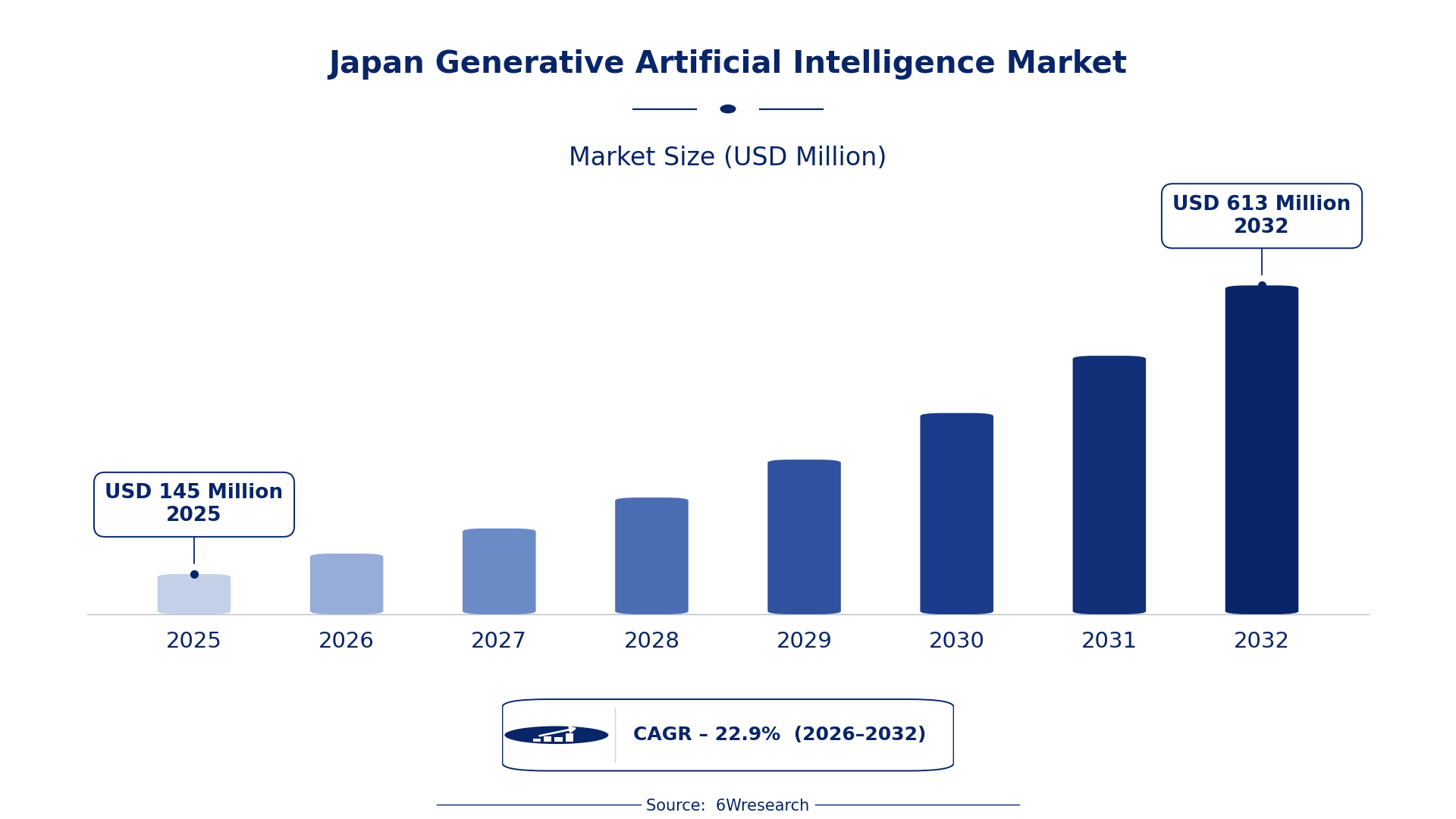
According to 6Wresearch internal database and industry insights, the Japan Generative Artificial Intelligence Market was valued at USD 145 Million in 2025 and is projected to reach USD 613 Million by 2032, growing at a CAGR of approximately 22.9% during 2026–2032.
Japan Generative Artificial Intelligence Market Highlights
| Report Metric | Details |
| Report Name | Japan Generative Artificial Intelligence Market (2026-2032) |
| Market Size 2025 | USD 145 Million |
| Market Size 2032 | USD 613 Million |
| Absolute Growth 2025–2032 | USD 468 Million |
| CAGR 2026–2032 | 22.9% |
| Peak Annual Growth | 27.5% in 2026 |
| Forecast Period | 2026–2032 |
| Historical Data | 2022–2025 |
| Base Year | 2025 |
| Leading Offering Type, 2025 | Image (35% share) |
| Leading Technology Type, 2025 | Autoencoders (47% share) |
| Leading Application, 2025 | Healthcare (46% share) |
| Fastest-Growing Offering Type | Video (25.1% CAGR) |
| Fastest-Growing Technology Type | Generative Adversarial Networks (24.1% CAGR) |
| Fastest-Growing Application | Generative Intelligence (25.2% CAGR) |
| Growing Sector | Media and Entertainment |
| Key End Users | Healthcare providers, media companies, technology firms |
Japan Generative Artificial Intelligence Market Year-wise Growth Rate and Key Drivers (2022–2032)
This graph illustrates the annual growth rates of the market from 2022 to 2032, highlighting a steady upward trajectory and projected market expansion over the forecast period.
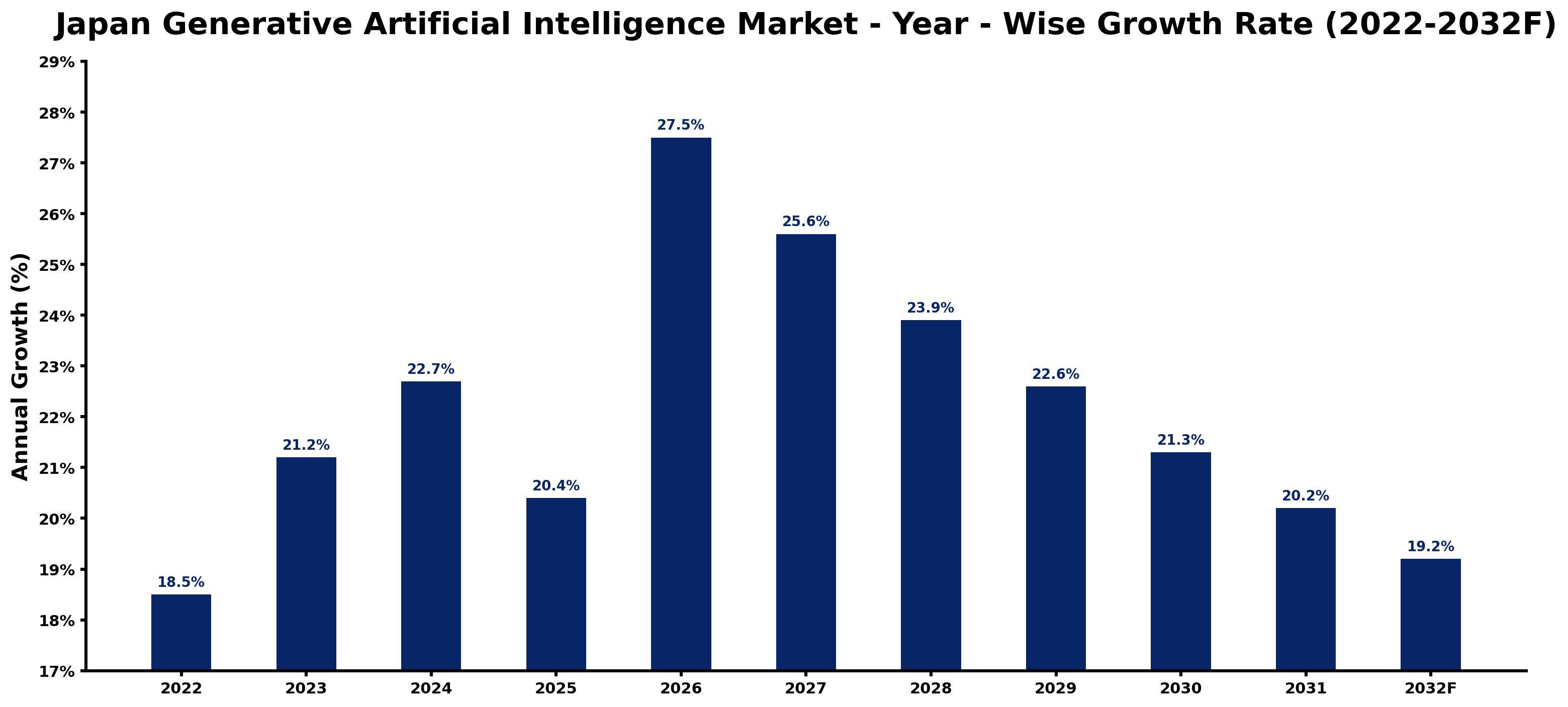
The following figures match every annual growth estimate with the main market development of that year, giving the reasoning behind each rise or slowdown.
| Year | Estimated Annual Growth (%) | Market Rationale |
| 2022 | 18.5 | The market showed strong activity with increasing interest in AI technologies. |
| 2023 | 21.2 | Growth accelerated as more sectors adopted AI solutions for efficiency. |
| 2024 | 22.7 | Demand continued to rise, driven by advancements in generative models. |
| 2025 | 20.4 | Growth moderated as the market adjusted to rapid technological changes. |
| 2026 | 27.5 | The market is expected to peak due to heightened investments in AI capabilities. |
| 2027 | 25.6 | Demand is projected to slow slightly as the market stabilises after rapid growth. |
| 2028 | 23.9 | Growth will continue to decelerate as the market matures and competition intensifies. |
| 2029 | 22.6 | The market will maintain positive growth, though at a slower pace than before. |
| 2030 | 21.3 | Growth is expected to remain steady as industries integrate AI into their operations. |
| 2031 | 20.2 | The market will continue to grow, but at a declining rate as saturation approaches. |
| 2032 | 19.2 | Growth is projected to slow further as the market reaches a more mature phase. |
Note: Market size estimations and growth projections presented in this report are based on 6Wresearch's proprietary forecasting methodology, utilizing the latest available industry data, government publications, and primary research inputs.
Japan Generative Artificial Intelligence Market Synopsis
Generative Artificial Intelligence is a subset of AI that creates content like images, videos, and text using advanced algorithms. The Japan Generative Artificial Intelligence Market is valued at approximately 1 trillion JPY in 2023, reflecting strong demand across various sectors. Key growth drivers include increased adoption in media and entertainment, investments in AI research, and a thriving technology sector, particularly in Tokyo, which hosts numerous startups and research institutions.
Market Dynamics Impact Analysis (2026–2032)
| Factor | Type | Impact | Primary Segment Affected |
| Increased adoption of AI technologies in media and entertainment. | Driver | High | Media and Entertainment |
| Growing investment in AI research and development. | Driver | High | Generative Intelligence |
| Expansion of AI applications in healthcare. | Opportunity | High | Healthcare |
| Rising demand for content generation tools in various sectors. | Opportunity | High | Image |
| Challenges in data security and privacy regulations. | Restraint | High | Generative Adversarial Networks |
| Limited understanding of GAI among potential users. | Restraint | Medium | Video |
| Shortage of skilled professionals in AI development. | Challenge | High | Autoencoders |
| High costs associated with implementing AI solutions. | Challenge | Medium | Speech |
Evaluation of Drivers in Japan Generative Artificial Intelligence Market (2026–2032)
The main growth drivers and the segments they affect most are set out below.
| Drivers | Primary Segment Affected | Why It Matters (Evidence) |
| Increased content creation demand in media and entertainment. | Image | The media sector generated over 2 trillion JPY in 2022, driving demand for GAI solutions. |
| Growing adoption of AI technologies in healthcare. | Healthcare | Over 30% of hospitals in Japan implemented AI solutions, boosting demand for GAI. |
| Rising investments in AI research and development. | Generative Intelligence | The government allocated 10 billion JPY for AI R&D in 2023, expanding market capabilities. |
| Expansion of AI-related patents filed in Japan. | Video | In 2023, over 5,000 AI-related patents were filed, indicating innovation and demand. |
| Increasing user experience through AI applications. | Generative Adversarial Networks | Generative models are essential for creating realistic content, driving market growth. |
Purchasing is picking up as demand for AI-generated content in media and entertainment grows, with the sector generating over 2 trillion JPY in 2022. The allocation of 10 billion JPY for AI research and development in 2023 is expected to expand capabilities. The filing of over 5,000 AI-related patents in 2023 reflects rising innovation. These factors drive demand for generative artificial intelligence across various applications.
Evaluation of Restraints in Japan Generative Artificial Intelligence Market
Below are the constraints most often cited by buyers and suppliers, with the segment each affects.
| Market Restraint | Primary Segment Affected | Why It Matters (Evidence) |
| Data security and privacy regulations limit AI application. | Generative Adversarial Networks | Compliance with ISO/IEC 27001 standards raises operational costs for developers. |
| Limited understanding of GAI among potential users hampers adoption. | Video | Many businesses lack knowledge about effectively implementing AI solutions. |
| High costs associated with AI implementation deter investment. | Speech | The initial investment for AI technologies can be prohibitive for smaller firms. |
| Shortage of skilled professionals in AI development affects growth. | Autoencoders | The demand for AI talent exceeds supply, causing project delays. |
| Regulatory hurdles slow down the approval process for AI solutions. | Healthcare | Compliance with the Clinical Trials Act can extend product development timelines. |
Japan Generative Artificial Intelligence Market Challenges
Buyers in Japan's generative artificial intelligence market face high costs due to a lack of local expertise, which can delay project completions by up to six months. Competition intensifies as many producers rely on outdated algorithms, resulting in products that do not meet consumer expectations and leading to potential revenue losses. Skills shortages persist, with over 30% of hospitals unable to effectively implement AI solutions, increasing operational expenses for healthcare providers. Supply chain issues arise from reliance on imported AI components, causing delays in product availability and forcing buyers to seek alternative solutions.
Trends in the Japan Generative Artificial Intelligence Market
These developments are changing demand patterns in the Japan Generative Artificial Intelligence Market.
- Tokyo's AI Startup Scene Thriving: The Tokyo Metropolitan Government has initiated programs to support AI startups with funding and resources, attracting over 10 billion JPY in investments in 2023. This influx of capital is driving innovation and talent development in the city.
- Healthcare Sector Adopting AI Solutions: The healthcare sector is increasingly integrating AI technologies, with over 30% of hospitals implementing AI solutions. This trend is reshaping patient care and operational efficiency, indicating a growing market for AI applications.
- Shift Towards Generative Models for Content Creation: Generative models are gaining preference for content generation in media and entertainment. In 2022, the industry generated over 2 trillion JPY, reflecting this shift and the demand for advanced AI tools.
- Surge in AI Patent Filings in Japan: The number of AI-related patents filed in Japan reached over 5,000 in 2023. This surge indicates a strong focus on innovation and competitive advantage in the AI sector, driving further development.
Investment Opportunities in the Japan Generative Artificial Intelligence Market
Several openings in the Japan Generative Artificial Intelligence Market merit attention from investors.
- Investment in AI Research Facilities in Tokyo: Tokyo's vibrant startup environment presents opportunities for investment in AI research facilities. The government allocated 10 billion JPY for AI R&D in 2023, encouraging partnerships with local startups.
- Growing Demand for AI in Healthcare: With over 30% of hospitals adopting AI solutions, there is a strong opportunity to supply AI technologies tailored for healthcare applications. Collaborating with medical institutions can facilitate market entry.
- Expansion of AI Applications in Media: The media and entertainment industry generated over 2 trillion JPY in 2022, highlighting the demand for AI-driven content creation tools. Suppliers can enter this market by developing innovative solutions.
- Development of AI Standards and Protocols: Establishing AI standards is important for market growth. Engaging with the Japan Artificial Intelligence Association can facilitate compliance and enhance credibility.
Government Initiatives in the Japan Generative Artificial Intelligence Market
The Next-Generation Medical Infrastructure Act promotes AI use in healthcare by allowing certified bodies to anonymise medical data for research. This measure supports innovation by enabling data-driven insights for product development, benefiting both producers and buyers. The government allocated 10 billion JPY for AI research in 2023, strengthening the capabilities of the sector.
The PMDA ensures compliance with safety standards for pharmaceuticals and medical devices, which helps buyers trust the quality of AI solutions in healthcare applications. This regulatory framework includes monitoring and approving AI technologies, supporting market growth.
Future Insight of the Japan Generative Artificial Intelligence Market
By 2032, Japan's generative artificial intelligence sector will undergo substantial changes driven by the AI Strategy 2023, which encourages local innovation. The government’s allocation of 10 billion JPY for AI research will strengthen capabilities across multiple sectors. As AI-related patents filed in Japan exceed 5,000, buyers will benefit from a wider range of advanced solutions. Programs supporting AI startups will create a vibrant environment, enabling suppliers to develop applications tailored to specific industry needs.
Market Segmentation Analysis
Japan Generative Artificial Intelligence Market report covers a detailed analysis of the following market segments:
By Offering Type – Image Leads, Video Expected to Grow Fastest
According to Dhaval Chaurasia, Assistant Manager at 6Wresearch, in 2025, Image led the offering type split with a 35% share. Image holds the largest share due to its extensive application in content generation across various industries, particularly in media and advertising. The media sector in Japan, generating over 2 trillion JPY, heavily relies on image generation for marketing and promotional content. The quickest growth will come from Video, forecast to expand at a CAGR of 25.1% between 2026 and 2032. Video is experiencing rapid growth as the demand for dynamic content increases, particularly in the media and entertainment industry. The rise of video streaming platforms and social media has led to a surge in video content creation, driving this segment's expansion. Suppliers should focus on enhancing video generation capabilities to meet the growing demand from content creators.
By Technology Type – Autoencoders Lead, Generative Adversarial Networks Expected to Grow Fastest
Autoencoders held 47% of the Japan Generative Artificial Intelligence Market by technology type in 2025. Autoencoders dominate the market as they are widely used for data processing tasks, making them essential in various applications. Their role in optimising data handling is critical for sectors such as healthcare and finance. Generative Adversarial Networks are set to record the highest CAGR in this split, 24.1% over 2026–2032. Generative Adversarial Networks are growing quickly due to their ability to create highly realistic images and videos, which are increasingly sought after in creative industries. This technology's effectiveness in producing high-quality content is attracting significant investment and interest. Buyers should consider investing in Generative Adversarial Networks to stay competitive in content creation and visual media.
By Application – Healthcare Leads, Generative Intelligence Expected to Grow Fastest
With 46% of application revenue in 2025, Healthcare was the largest category. Healthcare is the leading application area as over 30% of hospitals in Japan are adopting AI solutions for data analysis and predictive modelling. The sector's focus on improving patient outcomes through technology drives substantial investment in AI applications. Over 2026–2032, Generative Intelligence is expected to post the fastest growth, at a CAGR of 25.2%. Generative Intelligence is rapidly growing as it encompasses a wide range of applications across various sectors, reflecting the increasing integration of AI in everyday business processes. This broad applicability is attracting diverse investments and innovations. Suppliers must diversify their offerings to cater to the expanding applications of Generative Intelligence across multiple industries.
Key Attractiveness of the Report
- 10 Years of Market Numbers
- Historical Data Starting from 2022 to 2025
- Base Year 2025
- Forecast Data until 2032
- Key Performance Indicators Impacting the Market
- Major Upcoming Developments and Projects
Key Highlights of the Report:
- Japan Generative Artificial Intelligence Market Outlook
- Market Size of Japan Generative Artificial Intelligence Market, 2025
- Forecast of Japan Generative Artificial Intelligence Market, 2032
- Historical Data and Forecast of Japan Generative Artificial Intelligence Revenues & Volume for the Period 2022-2032
- Japan Generative Artificial Intelligence Market Trend Evolution
- Japan Generative Artificial Intelligence Market Drivers and Challenges
- Japan Generative Artificial Intelligence Price Trends
- Japan Generative Artificial Intelligence Porter's Five Forces
- Japan Generative Artificial Intelligence Industry Life Cycle
- Historical Data and Forecast of Japan Generative Artificial Intelligence Market Revenues & Volume By Offering Type for the Period 2022-2032
- Historical Data and Forecast of Japan Generative Artificial Intelligence Market Revenues & Volume By Image for the Period 2022-2032
- Historical Data and Forecast of Japan Generative Artificial Intelligence Market Revenues & Volume By Video for the Period 2022-2032
- Historical Data and Forecast of Japan Generative Artificial Intelligence Market Revenues & Volume By Speech for the Period 2022-2032
- Historical Data and Forecast of Japan Generative Artificial Intelligence Market Revenues & Volume By Others for the Period 2022-2032
- Historical Data and Forecast of Japan Generative Artificial Intelligence Market Revenues & Volume By Technology Type for the Period 2022-2032
- Historical Data and Forecast of Japan Generative Artificial Intelligence Market Revenues & Volume By Autoencoders for the Period 2022-2032
- Historical Data and Forecast of Japan Generative Artificial Intelligence Market Revenues & Volume By Generative Adversarial Networks for the Period 2022-2032
- Historical Data and Forecast of Japan Generative Artificial Intelligence Market Revenues & Volume By Others for the Period 2022-2032
- Historical Data and Forecast of Japan Generative Artificial Intelligence Market Revenues & Volume By Application for the Period 2022-2032
- Historical Data and Forecast of Japan Generative Artificial Intelligence Market Revenues & Volume By Healthcare for the Period 2022-2032
- Historical Data and Forecast of Japan Generative Artificial Intelligence Market Revenues & Volume By Generative Intelligence for the Period 2022-2032
- Historical Data and Forecast of Japan Generative Artificial Intelligence Market Revenues & Volume By Media and Entertainment for the Period 2022-2032
- Historical Data and Forecast of Japan Generative Artificial Intelligence Market Revenues & Volume By Others for the Period 2022-2032
- Japan Generative Artificial Intelligence Import Export Trade Statistics
- Market Opportunity Assessment By Offering Type
- Market Opportunity Assessment By Technology Type
- Market Opportunity Assessment By Application
- Japan Generative Artificial Intelligence Top Companies Market Share
- Japan Generative Artificial Intelligence Competitive Benchmarking By Technical and Operational Parameters
- Japan Generative Artificial Intelligence Company Profiles
- Japan Generative Artificial Intelligence Key Strategic Recommendations
Market Covered
This report examines the market across the segments below.
By Offering Type
- Image
- Video
- Speech
- Others
By Technology Type
- Autoencoders
- Generative Adversarial Networks
- Others
By Application
- Healthcare
- Generative Intelligence
- Media and Entertainment
- Others































