Japan Glass Bottles and Containers Market Size & Growth Rate
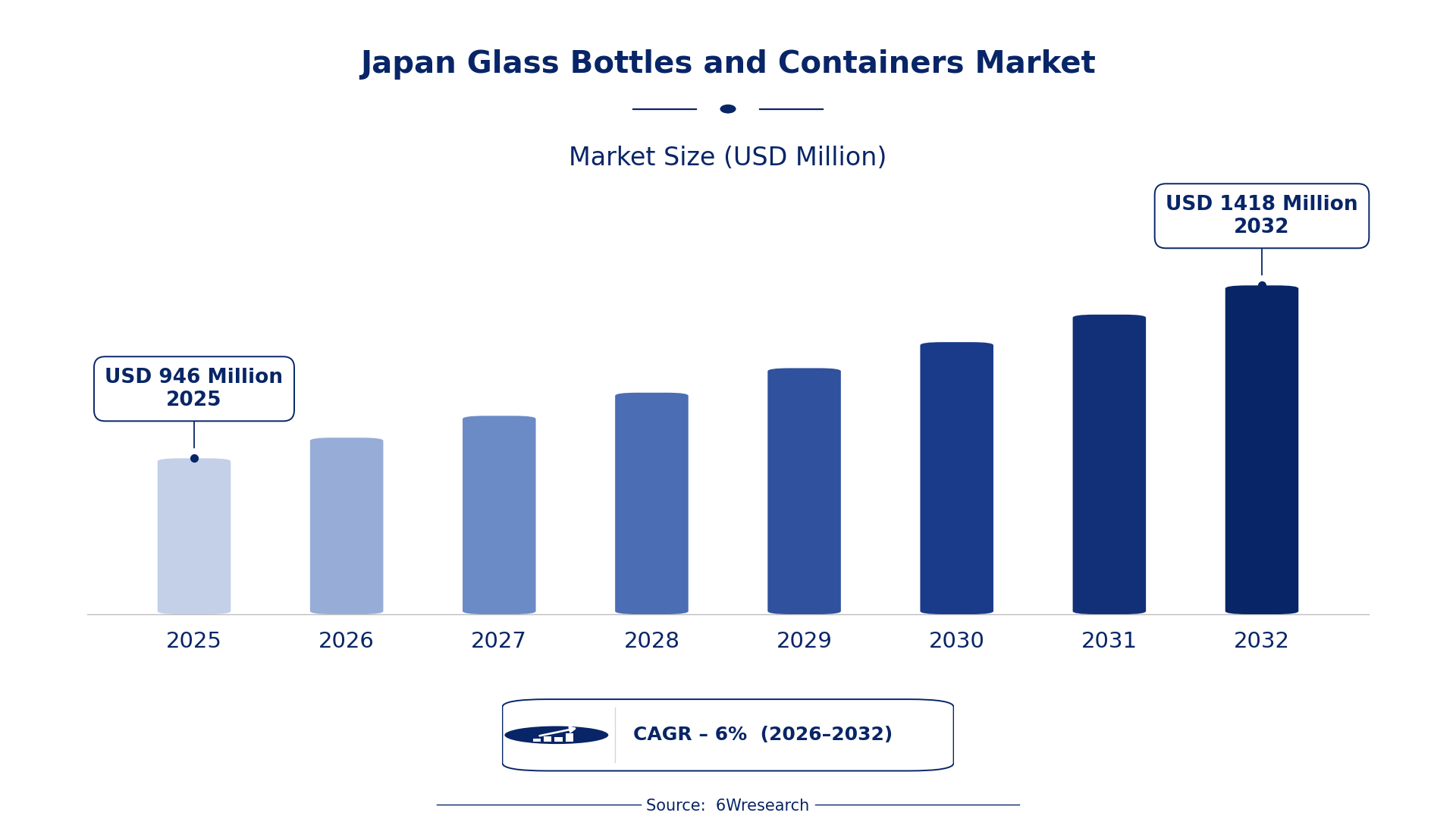
According to 6Wresearch internal database and industry insights, the Japan Glass Bottles and Containers Market was valued at USD 946 Million in 2025 and is projected to reach USD 1,418 Million by 2032, growing at a CAGR of approximately 6% during 2026–2032.
Japan Glass Bottles and Containers Market Highlights
| Report Metric | Details |
| Report Name | Japan Glass Bottles and Containers Market (2026-2032) |
| Market Size 2025 | USD 946 Million |
| Market Size 2032 | USD 1,418 Million |
| Absolute Growth 2025–2032 | USD 472 Million |
| CAGR 2026–2032 | 6% |
| Peak Annual Growth | 6.7% in 2026 |
| Forecast Period | 2026–2032 |
| Historical Data | 2022–2025 |
| Base Year | 2025 |
| Leading End-user, 2025 | Bevarages (49% share) |
| Fastest-Growing End-user | Food (7.7% CAGR) |
| Growing Sector | Food |
| Key End Users | Beverage producers, food manufacturers, cosmetics brands, pharmaceutical companies |
Japan Glass Bottles and Containers Market Year-wise Growth Rate and Key Drivers (2022–2032)
This graph illustrates the annual growth rates of the market from 2022 to 2032, highlighting a steady upward trajectory and projected market expansion over the forecast period.
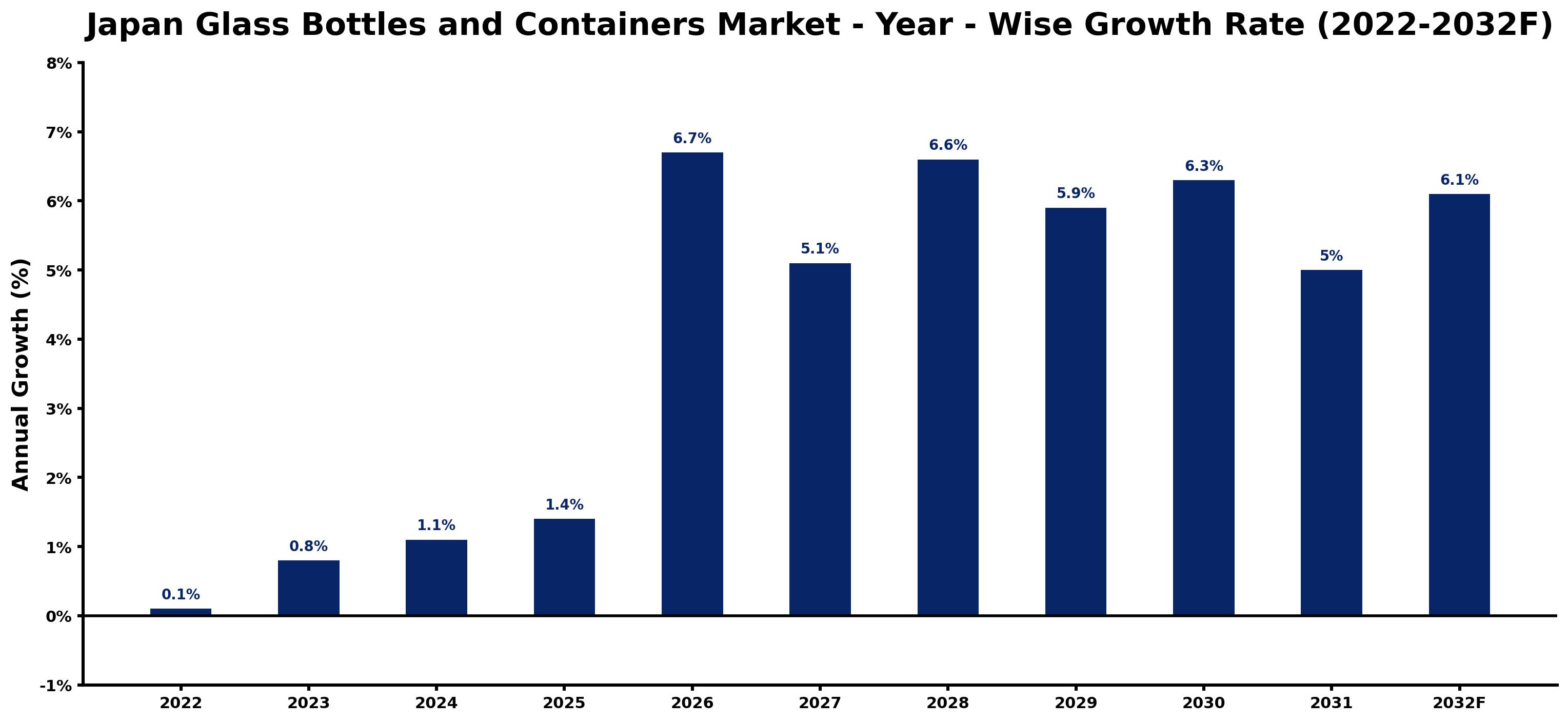
Each row of the following table gives one year's estimated growth and the event or demand shift that explains it.
| Year | Estimated Annual Growth (%) | Market Rationale |
| 2022 | 0.1 | The market experienced minimal growth, reflecting a period of recovery after previous challenges. |
| 2023 | 0.8 | Growth accelerated due to increased consumer demand for sustainable packaging solutions. |
| 2024 | 1.1 | Continued demand for glass packaging in beverages supported market expansion. |
| 2025 | 1.4 | Rising health consciousness among consumers drove demand for food and beverage containers. |
| 2026 | 6.7 | A surge in production capacity and investments will lead to peak growth in this year. |
| 2027 | 5.1 | Growth is expected to slow as market adjustments take place following the previous peak. |
| 2028 | 6.6 | Increased adoption of glass packaging in the food sector will revitalise market growth. |
| 2029 | 5.9 | Market growth is projected to decelerate slightly as competition intensifies among packaging materials. |
| 2030 | 6.3 | Technological advancements in glass production processes will spur renewed demand. |
| 2031 | 5.0 | Growth is expected to moderate as market saturation begins to influence purchasing patterns. |
| 2032 | 6.1 | Sustained interest in eco-friendly packaging options will support market performance. |
Note: Market size estimations and growth projections presented in this report are based on 6Wresearch's proprietary forecasting methodology, utilizing the latest available industry data, government publications, and primary research inputs.
Japan Glass Bottles and Containers Market Synopsis
Glass bottles and containers serve as packaging solutions made from silica, soda ash, and limestone, primarily used in beverages, food, cosmetics, and pharmaceuticals. The Japan Glass Bottles and Containers Market is expanding due to rising consumer preference for sustainable materials and increased investments in production capabilities. The beverage sector remains a key buyer group, driving demand for high-quality glass packaging.
Market Dynamics Impact Analysis (2026–2032)
| Factor | Type | Impact | Primary Segment Affected |
| Rising consumer preference for sustainable packaging solutions | Driver | High | Bevarages |
| Increased investments in production capabilities | Driver | High | Food |
| Growing demand for eco-friendly packaging options | Opportunity | High | Cosmetics |
| Expansion of food safety regulations promoting glass packaging | Opportunity | High | Pharmaceutical |
| Competition from alternative packaging materials | Restraint | High | Bevarages |
| High production costs associated with glass manufacturing | Restraint | Medium | Food |
| Supply chain disruptions affecting raw material availability | Challenge | High | Cosmetics |
| Technological barriers in glass recycling processes | Challenge | Medium | Pharmaceutical |
Evaluation of Drivers in Japan Glass Bottles and Containers Market (2026–2032)
The table below links each growth driver to the segment it affects and the evidence for it.
| Drivers | Primary Segment Affected | Why It Matters (Evidence) |
| Increasing health consciousness among consumers | Bevarages | This trend drives demand for glass bottles as they are perceived as safer and more environmentally friendly, with the beverage sector accounting for 49% of the market share in 2025. |
| Expansion of the food sector | Food | The food sector's growth, projected at a CAGR of 7.7%, is spurred by rising consumer interest in fresh and organic products requiring glass packaging. |
| Technological advancements in glass production | Cosmetics | Innovations in production techniques improve efficiency and reduce costs, leading to increased supply of glass containers for cosmetics, a rapidly growing segment. |
| Regulatory support for eco-friendly packaging | Pharmaceutical | Policies promoting sustainable packaging solutions encourage pharmaceutical companies to adopt glass containers, aligning with consumer preferences for safety and recyclability. |
| Rising disposable income among consumers | Bevarages | Higher disposable income levels lead to increased spending on premium beverages packaged in glass, boosting demand. |
Much of the new demand traces back to heightened consumer awareness regarding health and sustainability. The beverage sector, which holds a substantial market share, increasingly opts for glass packaging due to its perceived safety. In 2025, the food sector is projected to expand, driven by rising demand for organic products that require high-quality glass containers. Increasing disposable income levels are prompting consumers to spend more on premium beverages packaged in glass, further driving market demand. Technological advancements are improving production processes, allowing suppliers to meet this growing demand effectively.
Evaluation of Restraints in Japan Glass Bottles and Containers Market
The following restraints limit how fast demand can grow.
| Market Restraint | Primary Segment Affected | Why It Matters (Evidence) |
| Competition from alternative packaging materials such as plastics | Food | The expensive raw materials and energy-intensive processes increase the overall cost of glass packaging, limiting its competitiveness. |
| Limited recycling infrastructure for glass | Pharmaceutical | Inefficiencies in recycling technologies hinder the adoption of recycled glass, affecting supply and sustainability efforts. |
| Market saturation in certain segments | Bevarages | An oversupply of glass products in established markets has led to price pressures and reduced profitability. |
| High energy costs in glass production | Cosmetics | Rising energy costs increase production expenses, making glass packaging less attractive compared to cheaper alternatives. |
| Regulatory compliance costs | Food | Meeting stringent safety and quality regulations raises operational costs for producers, impacting pricing strategies. |
Japan Glass Bottles and Containers Market Challenges
Buyers experience supply shortages because they rely on a limited number of local suppliers, which can delay order fulfilment by up to three weeks. Rising raw material costs are pushing suppliers to raise prices, resulting in buyers facing expenses that could surge by 15%. Technological constraints hinder suppliers from implementing advanced production techniques, leading to quality inconsistencies that can postpone delivery schedules for buyers. A shortage of skilled workers impacts suppliers' ability to hire, causing a 20% reduction in output capacity, which directly limits buyers' order fulfilment capabilities.
Trends in the Japan Glass Bottles and Containers Market
Several trends are reshaping the Japan Glass Bottles and Containers Market; the most important are set out below.
- Shift towards Eco-Friendly Packaging: In 2021, the trend towards eco-friendly packaging gained momentum, with 60% of consumers preferring sustainable options. This shift is reflected in the beverage sector, where glass packaging is increasingly favoured.
- Transition from Plastic to Glass: Beginning in 2020, many food producers are transitioning from plastic to glass containers, driven by consumer demand for healthier options. This change is reflected in a 30% increase in glass container sales in the food sector.
- Emergence of Smart Glass Packaging: Smart glass packaging is becoming popular in the cosmetics industry, allowing brands to track product quality. This innovation is expected to grow as brands seek to improve consumer engagement.
- Focus on Local Sourcing of Glass Materials: Since 2022, there has been a growing emphasis on local sourcing of glass materials in Japan, with 40% of producers adopting this strategy to reduce carbon footprints.
Investment Opportunities in the Japan Glass Bottles and Containers Market
Investors looking at the Japan Glass Bottles and Containers Market should consider the following areas.
- Gap in Sustainable Packaging Solutions: Cosmetics producers are increasingly seeking glass packaging, with a projected market growth of 7% by 2030. Suppliers can enter this market through joint ventures with local brands.
- Investment in Recycling Technologies: With the growing demand for sustainable materials, there is a need for improved recycling technologies. Facilities in urban areas can benefit from partnerships to improve recycling capabilities.
- Expansion of Glass Packaging in Food Sector: The food sector is projected to grow rapidly, creating opportunities for suppliers to meet demand for glass packaging. Collaborating with regional food producers can facilitate market entry.
- Development of Smart Packaging Solutions: The rise of smart packaging in cosmetics presents a chance for innovation. Suppliers can invest in technology to create smart glass containers that appeal to tech-savvy consumers.
Government Initiatives in the Japan Glass Bottles and Containers Market
The Industrial Standardization Act, amended in 2019, establishes JIS standards for glass products, ensuring quality and safety. Compliance with these standards is mandatory for all producers, promoting a consistent quality level in the market. The Food Sanitation Act amendment in 2018 introduced a positive list system for synthetic resins, ensuring safety in food packaging, which came into effect in June 2020.
The Consumer Affairs Agency oversees the implementation of the Act against Unjustifiable Premiums and Misleading Representations, ensuring compliance among producers. Additionally, the Ministry of the Environment and the Ministry of Economy, Trade and Industry jointly manage the Plastic Resource Circulation Act, which promotes recycling initiatives, benefiting buyers by ensuring a sustainable supply of glass packaging.
Future Insight of the Japan Glass Bottles and Containers Market
Advancements in automated production technology will reshape demand patterns by 2032, allowing suppliers to improve efficiency and reduce lead times. New recycling initiatives will encourage sustainable practices in glass containers, appealing to environmentally conscious buyers. Enhanced quality control standards will ensure higher product reliability, reducing the risk of rejections for buyers. By 2032, the introduction of smart manufacturing facilities will significantly boost production capacity, enabling suppliers to better satisfy the growing demands of buyers.
Market Segmentation Analysis
Japan Glass Bottles and Containers Market report covers a detailed analysis of the following market segments:
By End-user – Bevarages Lead, Food Expected to Grow Fastest
According to Bhawna Singh, Assistant Manager at 6Wresearch, Bevarages accounted for 49% of the market by end-user in 2025. The beverages segment commands the largest share due to its extensive use in soft drinks and alcoholic beverages, particularly in restaurants and retail outlets. The high volume of glass bottles in this sector reflects consumer preferences for quality and environmentally friendly packaging. Food is projected to grow fastest, at a CAGR of 7.7% during 2026–2032. The food segment is experiencing the fastest growth as food manufacturers increasingly seek sustainable packaging options, resulting in a notable rise in demand for glass containers. This trend is evidenced by a significant increase in orders for food-related glass containers in recent months. This indicates that suppliers should focus on enhancing their offerings in the food segment to capitalise on the growing demand.
Key Attractiveness of the Report
- 10 Years of Market Numbers
- Historical Data Starting from 2022 to 2025
- Base Year 2025
- Forecast Data until 2032
- Key Performance Indicators Impacting the Market
- Major Upcoming Developments and Projects
Key Highlights of the Report:
- Japan Glass Bottles and Containers Market Outlook
- Market Size of Japan Glass Bottles and Containers Market, 2025
- Forecast of Japan Glass Bottles and Containers Market, 2032
- Historical Data and Forecast of Japan Glass Bottles and Containers Revenues & Volume for the Period 2022-2032
- Japan Glass Bottles and Containers Market Trend Evolution
- Japan Glass Bottles and Containers Market Drivers and Challenges
- Japan Glass Bottles and Containers Price Trends
- Japan Glass Bottles and Containers Porter's Five Forces
- Japan Glass Bottles and Containers Industry Life Cycle
- Historical Data and Forecast of Japan Glass Bottles and Containers Market Revenues & Volume By End-user for the Period 2022-2032
- Historical Data and Forecast of Japan Glass Bottles and Containers Market Revenues & Volume By Bevarages for the Period 2022-2032
- Historical Data and Forecast of Japan Glass Bottles and Containers Market Revenues & Volume By Food for the Period 2022-2032
- Historical Data and Forecast of Japan Glass Bottles and Containers Market Revenues & Volume By Cosmetics for the Period 2022-2032
- Historical Data and Forecast of Japan Glass Bottles and Containers Market Revenues & Volume By Pharmaceutical for the Period 2022-2032
- Historical Data and Forecast of Japan Glass Bottles and Containers Market Revenues & Volume By Others for the Period 2022-2032
- Japan Glass Bottles and Containers Import Export Trade Statistics
- Market Opportunity Assessment By End-user
- Japan Glass Bottles and Containers Top Companies Market Share
- Japan Glass Bottles and Containers Competitive Benchmarking By Technical and Operational Parameters
- Japan Glass Bottles and Containers Company Profiles
- Japan Glass Bottles and Containers Key Strategic Recommendations
Market Covered
The study includes the following segmentation.
By End-user
- Bevarages
- Food
- Cosmetics
- Pharmaceutical
- Others































