Japan Glass Fibre Yarn Market Size & Growth Rate
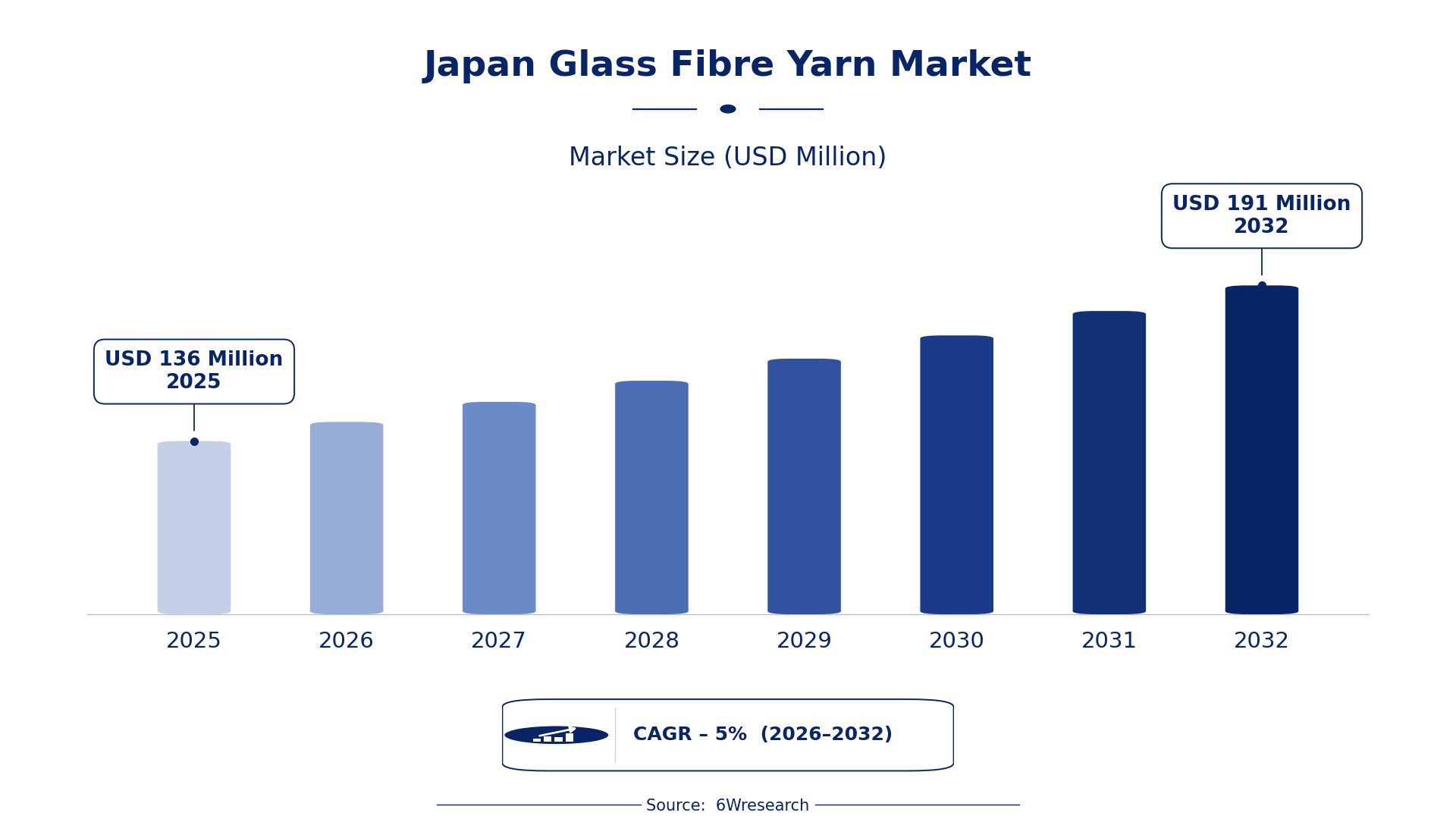
According to 6Wresearch internal database and industry insights, the Japan Glass Fibre Yarn Market was valued at USD 136 Million in 2025 and is projected to reach USD 191 Million by 2032, growing at a CAGR of approximately 5% during 2026–2032.
Japan Glass Fibre Yarn Market Highlights
| Report Metric | Details |
| Report Name | Japan Glass Fibre Yarn Market (2026-2032) |
| Market Size 2025 | USD 136 Million |
| Market Size 2032 | USD 191 Million |
| Absolute Growth 2025–2032 | USD 55 Million |
| CAGR 2026–2032 | 5% |
| Peak Annual Growth | 6.0% in 2028 |
| Forecast Period | 2026–2032 |
| Historical Data | 2022–2025 |
| Base Year | 2025 |
| Leading Product Type, 2025 | Single Yarns (43% share) |
| Leading Application, 2025 | Printed Circuit Board (38% share) |
| Leading End-use Industries, 2025 | Aerospace Industry (41% share) |
| Fastest-Growing Product Type | Multi-end Yarn (7.0% CAGR) |
| Fastest-Growing Application | Glass Fibre Wall Coverings (6.9% CAGR) |
| Fastest-Growing End-use Industries | Automotive Industry (6.8% CAGR) |
| Growing Sector | Aerospace Industry |
| Key End Users | Aerospace manufacturers, automotive suppliers, construction companies, electrical component manufacturers |
Japan Glass Fibre Yarn Market Year-wise Growth Rate and Key Drivers (2022–2032)
This graph illustrates the annual growth rates of the market from 2022 to 2032, highlighting a steady upward trajectory and projected market expansion over the forecast period.
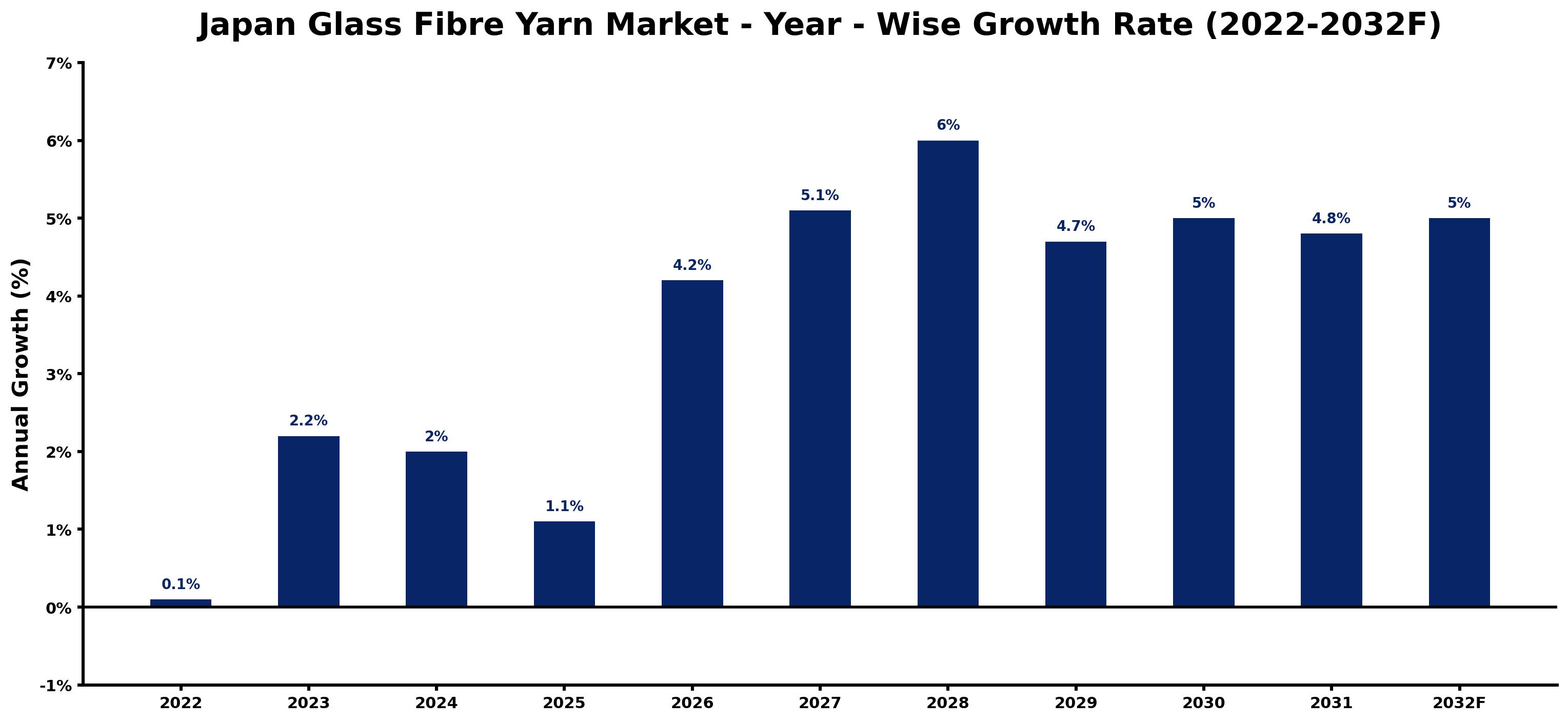
Year by year, the estimates below pair each growth rate with the development that shaped it.
| Year | Estimated Annual Growth (%) | Market Rationale |
| 2022 | 0.1 | The market showed cautious demand from key sectors, reflecting ongoing production capabilities. |
| 2023 | 2.2 | Demand from the aerospace industry increased, boosting growth compared to the previous year. |
| 2024 | 2.0 | The growth rate slowed as the automotive sector faced temporary production challenges. |
| 2025 | 1.1 | A slowdown in growth was noted as the construction industry adjusted its material sourcing strategies. |
| 2026 | 4.2 | A resurgence in demand from the aerospace sector spurred a faster growth rate. |
| 2027 | 5.1 | Increased automotive production and safety standards drove higher demand for glass fibre yarn. |
| 2028 | 6.0 | The market peaked as the construction industry expanded, requiring more reinforcement materials. |
| 2029 | 4.7 | A slight slowdown occurred as the market stabilised after reaching peak demand levels. |
| 2030 | 5.0 | Growth accelerated again due to rising investments in infrastructure projects. |
| 2031 | 4.8 | A moderation in growth was observed as the market adjusted to new supply chain conditions. |
| 2032 | 5.0 | Demand is projected to rise steadily as the automotive industry continues to innovate. |
Note: Market size estimations and growth projections presented in this report are based on 6Wresearch's proprietary forecasting methodology, utilizing the latest available industry data, government publications, and primary research inputs.
Japan Glass Fibre Yarn Market Synopsis
Glass fibre yarn is a composite material made from fine strands of glass fibres, primarily used for reinforcement in various applications such as aerospace, automotive, and construction. The Japan Glass Fibre Yarn Market is growing due to increased orders from the aerospace and automotive sectors, alongside a projected 15% rise in usage within the construction industry by 2025. Key regions like Tokyo and Aichi play a central role in production, while the Ministry of Economy, Trade and Industry promotes advanced materials, further stimulating market activity.
Market Dynamics Impact Analysis (2026–2032)
| Factor | Type | Impact | Primary Segment Affected |
| Rising aerospace demand for lightweight materials | Driver | High | Aerospace Industry |
| Growing automotive safety regulations | Driver | High | Automotive Industry |
| Expanding construction projects requiring reinforcement materials | Opportunity | High | Construction Industry |
| Increasing popularity of glass fibre wall coverings in urban projects | Opportunity | Medium | Glass Fibre Wall Coverings |
| Fluctuating raw material prices affecting production costs | Restraint | High | Single Yarns |
| Competition from alternative reinforcement materials | Restraint | Medium | Multi-end Yarn |
| Supply chain disruptions impacting timely delivery | Challenge | High | Coated Glass Yarn |
| Technological advancements requiring continuous investment | Challenge | Medium | Textile Glass Yarn |
Evaluation of Drivers in Japan Glass Fibre Yarn Market (2026–2032)
Key forces behind demand, with the segment each one moves most, are listed below.
| Drivers | Primary Segment Affected | Why It Matters (Evidence) |
| Increased production of lightweight aircraft components | Aerospace Industry | The aerospace industry is projected to grow, leading to higher demand for glass fibre yarn to improve structural integrity. |
| Growing focus on safety components in vehicles | Automotive Industry | The automotive sector is a major consumer, particularly for parts requiring high strength and safety features. |
| Expansion of infrastructure projects in urban areas | Construction Industry | The construction sector is anticipated to drive a 15% increase in glass fibre yarn usage by 2025. |
| Rising applications for electrical insulation | Electrical Industry | The electrical industry is increasingly utilising glass fibre yarn for circuit boards and insulation. |
| Popularity of decorative wall coverings in residential projects | Glass Fibre Wall Coverings | Glass fibre wall coverings are gaining traction in urban residential projects, boosting demand. |
Behind the steady rise in orders is increased production of lightweight aircraft components, as the aerospace sector is expected to expand, creating higher demand for glass fibre yarn. The automotive sector, a major consumer, is concentrating on safety components, which further drives orders. Infrastructure projects in urban areas are likely to boost glass fibre yarn usage by 15% by 2025. The electrical industry is increasing its use of glass fibre yarn for circuit boards and insulation. The popularity of decorative wall coverings in residential projects is also contributing to demand, as urban developments seek durable materials.
Evaluation of Restraints in Japan Glass Fibre Yarn Market
The table below lists the restraints and the evidence behind each.
| Market Restraint | Primary Segment Affected | Why It Matters (Evidence) |
| Fluctuating raw material prices affecting production costs | Single Yarns | Rising costs of raw materials impact the profitability of producers, resulting in potential price increases for buyers. |
| Competition from alternative reinforcement materials | Multi-end Yarn | The presence of alternative materials may restrict market share for glass fibre yarn in certain applications. |
| Supply chain disruptions impacting timely delivery | Coated Glass Yarn | Delays in the supply chain can hinder production schedules, affecting availability for buyers. |
| Technological advancements requiring continuous investment | Textile Glass Yarn | Producers must invest in new technologies to remain competitive, which can strain financial resources. |
| Market saturation in certain applications limiting growth | Printed Circuit Board | The electrical industry’s reliance on established materials may slow the adoption of glass fibre yarn. |
Japan Glass Fibre Yarn Market Challenges
Urban residential projects in Japan's construction industry are facing rising material costs as a 15% increase in glass fibre yarn usage by 2025 strains budgets for buyers. Producers in Tokyo and Aichi are encountering production delays, affecting the timely delivery of 10,000 tons produced in 2022, which disrupts supply chains for buyers. Importers are dealing with outdated manufacturing technology, causing inefficiencies that delay meeting the annual demand of 30,000 tons, forcing buyers to wait longer for essential materials. Increasing raw material prices are inflating production costs for producers, leading to higher prices for buyers and potential project cancellations.
Trends in the Japan Glass Fibre Yarn Market
Four trends stand out in the Japan Glass Fibre Yarn Market.
- Rise of Glass Fibre Wall Coverings: The popularity of glass fibre wall coverings is increasing, particularly in urban residential projects, with a projected growth rate of 6.9% through 2032. This trend reflects a shift towards durable and aesthetically pleasing materials in construction.
- Shift towards Lightweight Materials in Aerospace: The aerospace industry is increasingly adopting lightweight materials, with glass fibre yarn becoming essential for aircraft components. This shift is motivated by the need for fuel efficiency and performance improvements.
- Growing Demand for Electrical Insulation: The electrical industry is prioritising glass fibre yarn for circuit boards and insulation, reflecting a rising need for reliable and durable materials in electronics manufacturing, particularly as the market expands.
- Increased Focus on Safety in Automotive: The automotive sector is emphasising safety through the use of glass fibre yarn in vehicle parts, aligning with stricter regulations and consumer expectations for safety features.
Investment Opportunities in the Japan Glass Fibre Yarn Market
Several openings in the Japan Glass Fibre Yarn Market merit attention from investors.
- Projected 15% Increase in Construction Usage: With a projected 15% increase in glass fibre yarn usage by 2025, suppliers should target the construction industry, particularly in urban areas, to meet the growing need for reinforcement materials.
- Growing Urban Residential Projects: Urban residential projects are increasingly adopting glass fibre wall coverings, creating opportunities for suppliers to enter this market segment with new designs and products.
- Expansion of Aerospace Manufacturing: The expanding aerospace sector presents opportunities for suppliers of glass fibre yarn, particularly in regions like Tokyo and Aichi, where production is concentrated.
- Rising Electrical Applications: The electrical industry’s increasing reliance on glass fibre yarn for circuit boards offers suppliers a chance to cater to this growing need, particularly in technology hubs.
Government Initiatives in the Japan Glass Fibre Yarn Market
The Electrical Appliance and Material Safety Act (1961; METI) regulates the safety of electrical materials in Japan, ensuring that products meet strict safety standards. This act impacts producers of glass fibre yarn used in electrical applications, requiring compliance with safety regulations to access the market. Additionally, the act mandates regular inspections and certifications to maintain quality, benefiting both producers and consumers.
The Ministry of Economy, Trade and Industry supports the use of advanced materials like glass fibre in manufacturing through various initiatives. This includes funding for research and development projects aimed at improving production techniques and product quality, benefiting producers and buyers in the glass fibre yarn market. The ministry allocated ¥1 billion for such initiatives in 2022, promoting innovation and efficiency.
Future Insight of the Japan Glass Fibre Yarn Market
A policy-driven shift towards advanced materials will drive the adoption of modern manufacturing techniques, improving production efficiency. The construction sector will increasingly rely on glass fibre yarn for durable materials, reflecting urbanisation trends. Government initiatives will promote research and development, facilitating technological advancements within the industry. As the aerospace sector expands, demand for glass fibre yarn is expected to rise, contributing to a projected 20% increase in usage by 2032.
Market Segmentation Analysis
Japan Glass Fibre Yarn Market report covers a detailed analysis of the following market segments:
By Product Type – Single Yarns Lead, Multi-end Yarn Expected to Grow Fastest
According to Ravi Bhandari, Research Head at 6Wresearch, the largest product type category in 2025 was Single Yarns, at 43% of revenue. Single Yarns hold the largest market share as they are extensively used for reinforcement in various applications, particularly within the aerospace sector where high tensile strength is crucial. Their established presence in key regions such as Tokyo and Aichi further solidifies their leading position. The quickest growth will come from Multi-end Yarn, forecast to expand at a CAGR of 7.0% between 2026 and 2032. Multi-end Yarn is experiencing rapid growth due to its increasing adoption in large-scale applications that require enhanced strength. The anticipated 15% rise in glass fibre yarn usage within the construction industry by 2025 is a significant factor driving this trend. Suppliers should consider expanding their product lines to include multi-end yarn to meet the increasing demand in large-scale applications.
By Application – Printed Circuit Board Leads, Glass Fibre Wall Coverings Expected to Grow Fastest
Printed Circuit Board took 38% of application revenue in 2025, more than any other category. Printed Circuit Boards are the leading application as they are essential for ensuring reliable electrical connections in various electronic devices. This application is particularly critical in Japan's robust electronics sector, which consistently drives demand for high-quality materials. Glass Fibre Wall Coverings are set to record the highest CAGR in this split, 6.9% over 2026–2032. Glass Fibre Wall Coverings are witnessing rapid growth, particularly in urban residential projects where both aesthetics and durability are highly sought after. The shift towards modern interior design trends is a key factor contributing to this increase. Buyers in the construction sector should explore the integration of glass fibre wall coverings to align with contemporary design trends.
By End-use Industries – Aerospace Industry Leads, Automotive Industry Expected to Grow Fastest
Aerospace Industry accounted for 41% of the market by end-use industries in 2025. The Aerospace Industry leads the market as it relies on glass fibre yarn for lightweight and strong components that are vital for aircraft performance and safety. The growth of this industry is further supported by Japan's expanding aerospace sector, which is investing in advanced materials. Automotive Industry is projected to grow fastest, at a CAGR of 6.8% during 2026–2032. The Automotive Industry is growing rapidly due to the rising demand for glass fibre yarn in safety components, which are essential for enhancing vehicle performance. The industry's focus on improving safety standards is a primary driver of this growth. Suppliers should seek to establish partnerships with automotive manufacturers to capitalise on the increasing need for safety components.
Key Attractiveness of the Report
- 10 Years of Market Numbers
- Historical Data Starting from 2022 to 2025
- Base Year 2025
- Forecast Data until 2032
- Key Performance Indicators Impacting the Market
- Major Upcoming Developments and Projects
Key Highlights of the Report:
- Japan Glass Fibre Yarn Market Outlook
- Market Size of Japan Glass Fibre Yarn Market, 2025
- Forecast of Japan Glass Fibre Yarn Market, 2032
- Historical Data and Forecast of Japan Glass Fibre Yarn Revenues & Volume for the Period 2022-2032
- Japan Glass Fibre Yarn Market Trend Evolution
- Japan Glass Fibre Yarn Market Drivers and Challenges
- Japan Glass Fibre Yarn Price Trends
- Japan Glass Fibre Yarn Porter's Five Forces
- Japan Glass Fibre Yarn Industry Life Cycle
- Historical Data and Forecast of Japan Glass Fibre Yarn Market Revenues & Volume By Product Type for the Period 2022-2032
- Historical Data and Forecast of Japan Glass Fibre Yarn Market Revenues & Volume By Single Yarns for the Period 2022-2032
- Historical Data and Forecast of Japan Glass Fibre Yarn Market Revenues & Volume By Multi-end Yarn for the Period 2022-2032
- Historical Data and Forecast of Japan Glass Fibre Yarn Market Revenues & Volume By Coated Glass Yarn for the Period 2022-2032
- Historical Data and Forecast of Japan Glass Fibre Yarn Market Revenues & Volume By Textile Glass Yarn for the Period 2022-2032
- Historical Data and Forecast of Japan Glass Fibre Yarn Market Revenues & Volume By Application for the Period 2022-2032
- Historical Data and Forecast of Japan Glass Fibre Yarn Market Revenues & Volume By Printed Circuit Board for the Period 2022-2032
- Historical Data and Forecast of Japan Glass Fibre Yarn Market Revenues & Volume By Glass Fibre Wall Coverings for the Period 2022-2032
- Historical Data and Forecast of Japan Glass Fibre Yarn Market Revenues & Volume By Electrical And Thermal Insulation for the Period 2022-2032
- Historical Data and Forecast of Japan Glass Fibre Yarn Market Revenues & Volume By Grinding Wheel Reinforcements for the Period 2022-2032
- Historical Data and Forecast of Japan Glass Fibre Yarn Market Revenues & Volume By End-use Industries for the Period 2022-2032
- Historical Data and Forecast of Japan Glass Fibre Yarn Market Revenues & Volume By Aerospace Industry for the Period 2022-2032
- Historical Data and Forecast of Japan Glass Fibre Yarn Market Revenues & Volume By Automotive Industry for the Period 2022-2032
- Historical Data and Forecast of Japan Glass Fibre Yarn Market Revenues & Volume By Construction Industry for the Period 2022-2032
- Historical Data and Forecast of Japan Glass Fibre Yarn Market Revenues & Volume By Electrical Industry for the Period 2022-2032
- Japan Glass Fibre Yarn Import Export Trade Statistics
- Market Opportunity Assessment By Product Type
- Market Opportunity Assessment By Application
- Market Opportunity Assessment By End-use Industries
- Japan Glass Fibre Yarn Top Companies Market Share
- Japan Glass Fibre Yarn Competitive Benchmarking By Technical and Operational Parameters
- Japan Glass Fibre Yarn Company Profiles
- Japan Glass Fibre Yarn Key Strategic Recommendations
Market Covered
The report covers the following segments.
By Product Type
- Single Yarns
- Multi-end Yarn
- Coated Glass Yarn
- Textile Glass Yarn
By Application
- Printed Circuit Board
- Glass Fibre Wall Coverings
- Electrical And Thermal Insulation
- Grinding Wheel Reinforcements
By End-use Industries
- Aerospace Industry
- Automotive Industry
- Construction Industry
- Electrical Industry































