Japan Gluten Free Prepared Foods Market Size & Growth Rate
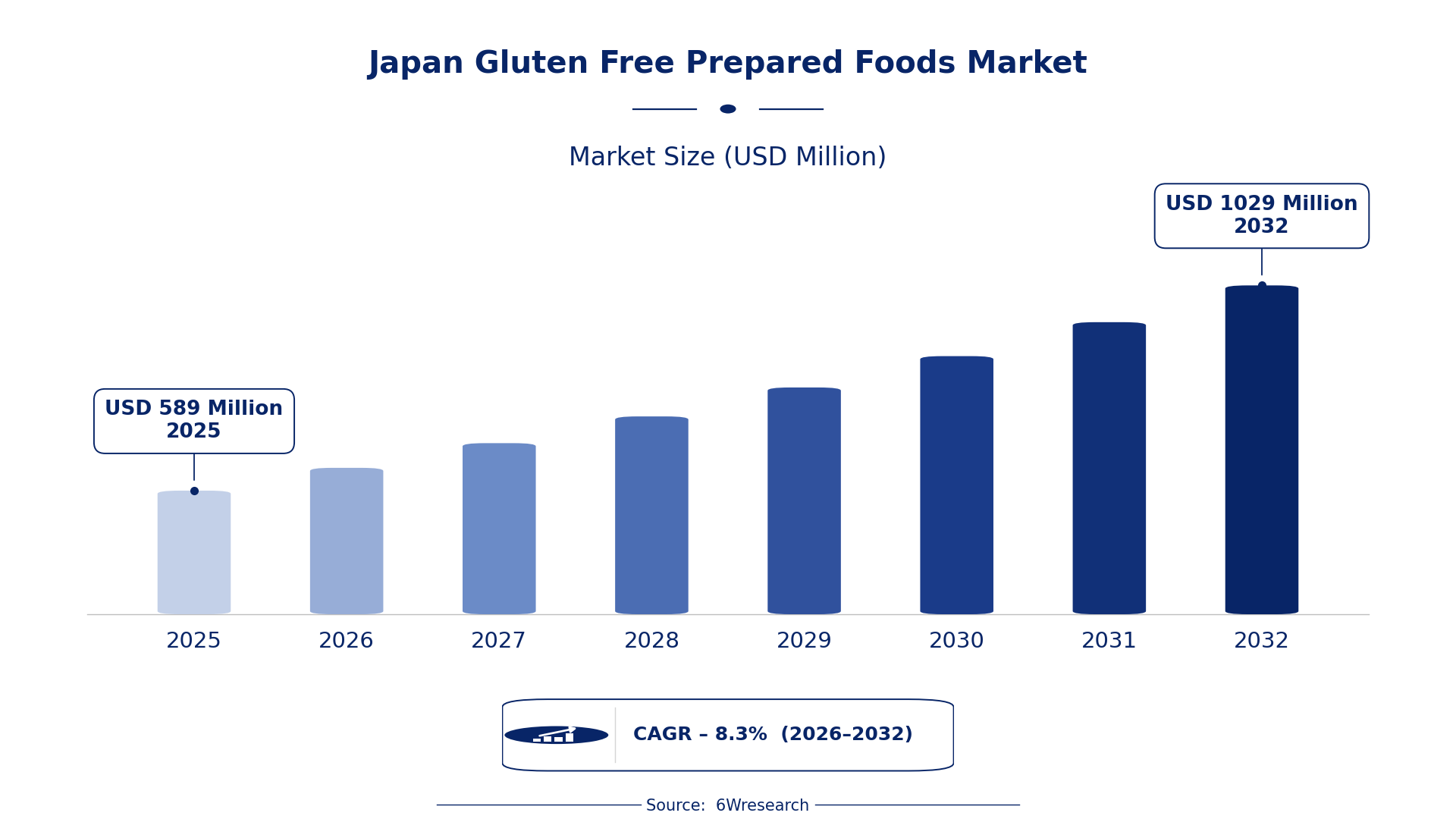
According to 6Wresearch internal database and industry insights, the Japan Gluten Free Prepared Foods Market was valued at USD 589 Million in 2025 and is projected to reach USD 1,029 Million by 2032, growing at a CAGR of approximately 8.3% during 2026–2032.
Japan Gluten Free Prepared Foods Market Highlights
| Report Metric | Details |
| Report Name | Japan Gluten Free Prepared Foods Market (2026-2032) |
| Market Size 2025 | USD 589 Million |
| Market Size 2032 | USD 1,029 Million |
| Absolute Growth 2025–2032 | USD 440 Million |
| CAGR 2026–2032 | 8.3% |
| Peak Annual Growth | 9.6% in 2032 |
| Forecast Period | 2026–2032 |
| Historical Data | 2022–2025 |
| Base Year | 2025 |
| Leading Product Type, 2025 | Baked Goods (28% share) |
| Leading Distribution Channel, 2025 | Supermarkets/Hypermarkets (39% share) |
| Fastest-Growing Product Type | Dairy Products (12.0% CAGR) |
| Fastest-Growing Distribution Channel | Convenience Stores (10.7% CAGR) |
| Growing Sector | health-focused dining |
| Key End Users | health-conscious consumers, restaurants, online retailers, supermarkets |
Japan Gluten Free Prepared Foods Market Year-wise Growth Rate and Key Drivers (2022–2032)
This graph illustrates the annual growth rates of the market from 2022 to 2032, highlighting a steady upward trajectory and projected market expansion over the forecast period.
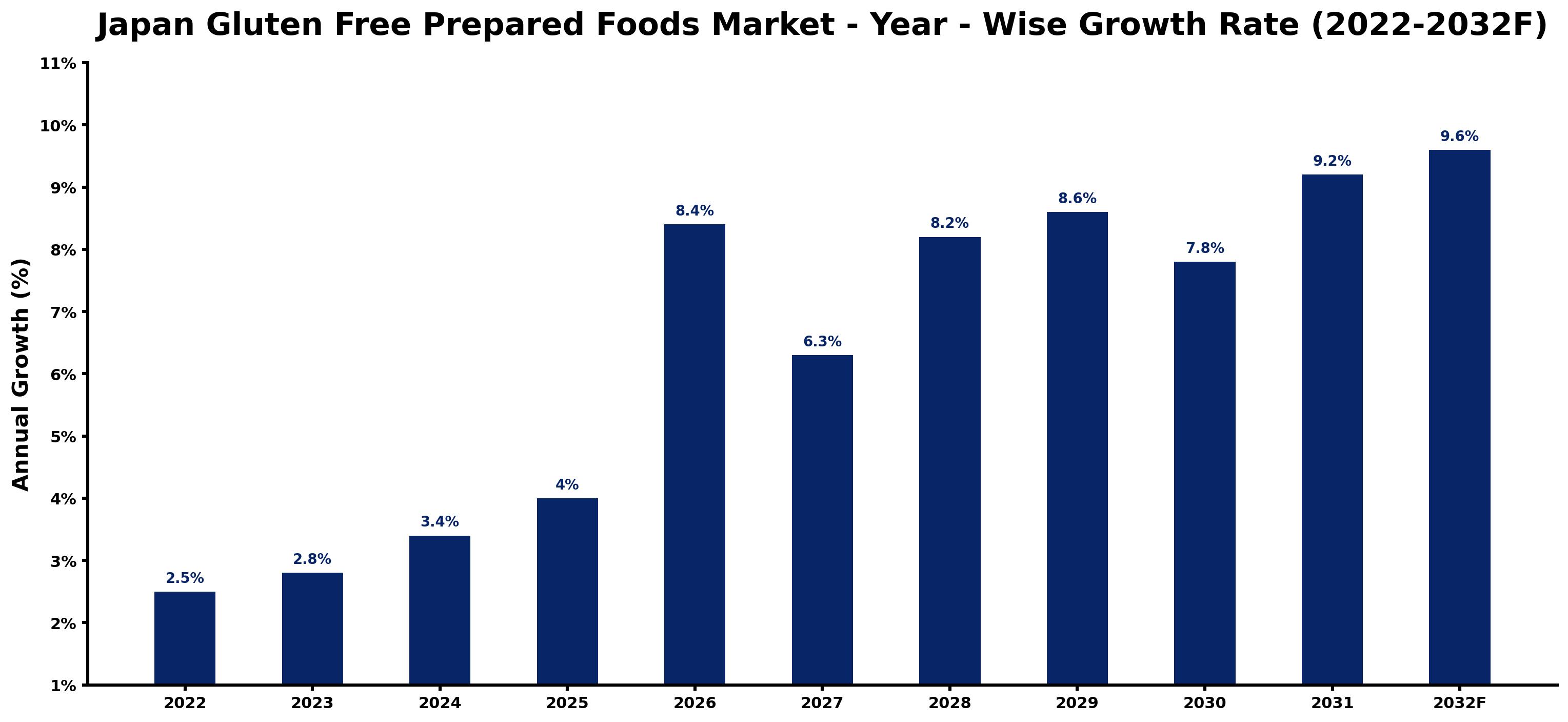
Below, each year's estimated growth is shown next to the factor that most influenced it.
| Year | Estimated Annual Growth (%) | Market Rationale |
| 2022 | 2.5 | The market showed steady growth as awareness of gluten intolerance increased among consumers. |
| 2023 | 2.8 | Growth accelerated due to rising health consciousness and demand for gluten-free options. |
| 2024 | 3.4 | The introduction of new gluten-free products contributed to faster market expansion. |
| 2025 | 4.0 | Consumer preferences shifted towards gluten-free baked goods, driving sales higher. |
| 2026 | 8.4 | Investment in gluten-free food production facilities is expected to boost supply significantly. |
| 2027 | 6.3 | Growth slows as the market begins to stabilise after rapid expansion in previous years. |
| 2028 | 8.2 | Increased availability of gluten-free options in restaurants spurs renewed consumer interest. |
| 2029 | 8.6 | The trend of health-focused dining continues to elevate gluten-free food demand. |
| 2030 | 7.8 | Market growth slows as competition intensifies among gluten-free product suppliers. |
| 2031 | 9.2 | The introduction of innovative gluten-free products drives renewed consumer interest. |
| 2032 | 9.6 | The market peaks as health trends solidify gluten-free diets among consumers. |
Note: Market size estimations and growth projections presented in this report are based on 6Wresearch's proprietary forecasting methodology, utilizing the latest available industry data, government publications, and primary research inputs.
Japan Gluten Free Prepared Foods Market Synopsis
Gluten Free Prepared Foods cater to individuals with celiac disease or gluten sensitivity, using alternative grains like rice and quinoa. The market in Japan is expanding rapidly, driven by a growing population of health-conscious consumers and increased availability of gluten-free options in supermarkets and restaurants. Valued at approximately 50 billion JPY in 2022, the gluten-free food market is projected to grow at a rate of 8.3% from 2026 to 2032, reflecting strong demand from both domestic consumers and health-focused establishments.
Market Dynamics Impact Analysis (2026–2032)
| Factor | Type | Impact | Primary Segment Affected |
| Rising health consciousness among consumers | Driver | High | Baked Goods |
| Increased product variety and availability | Driver | High | Dairy Products |
| Growing demand for gluten-free options in restaurants | Opportunity | High | Confectionery Products |
| Expansion of online retail channels for gluten-free foods | Opportunity | Medium | Other Product Types |
| High production costs for gluten-free foods | Restraint | High | Baked Goods |
| Limited consumer awareness about gluten-free labeling | Restraint | Medium | Dairy Products |
| Intense competition among gluten-free product suppliers | Challenge | High | Confectionery Products |
| Supply chain disruptions affecting ingredient sourcing | Challenge | Medium | Other Product Types |
Evaluation of Drivers in Japan Gluten Free Prepared Foods Market (2026–2032)
The factors lifting demand, and the evidence behind each, are summarised below.
| Drivers | Primary Segment Affected | Why It Matters (Evidence) |
| Increased health awareness | Baked Goods | The population of individuals with gluten intolerance in Japan is estimated at 1 million, driving demand for safe dietary options. |
| Expansion of gluten-free product types | Dairy Products | The number of gluten-free product types has increased by 30% since 2020, attracting more health-focused consumers. |
| Support from health-focused restaurants | Confectionery Products | Health-focused restaurants are increasingly offering gluten-free menu options, leading to higher sales of gluten-free snacks. |
| Growth of online retail for gluten-free foods | Other Product Types | Online retail for gluten-free foods has grown by 25% in the last year, providing greater access to consumers. |
| Government support for gluten-free initiatives | Baked Goods | Subsidies for gluten-free food production from the Japanese government facilitate market growth by encouraging manufacturers to innovate. |
Behind the steady rise in orders sits the increasing health awareness among consumers, with approximately 1 million individuals in Japan estimated to have gluten intolerance. The number of gluten-free product types has surged by 30% since 2020, attracting a diverse range of health-conscious buyers. Health-focused restaurants now offer gluten-free menu options, contributing to rising demand for gluten-free snacks. The online retail channel has expanded, growing by 25% in the last year, which improves accessibility for consumers.
Evaluation of Restraints in Japan Gluten Free Prepared Foods Market
The key brakes on demand, and where they bite hardest, are shown below.
| Market Restraint | Primary Segment Affected | Why It Matters (Evidence) |
| High production costs for gluten-free foods | Baked Goods | The national weighted-average minimum wage rose to JPY 1,055 per hour in October 2024, increasing operational costs for producers. |
| Limited consumer awareness about gluten-free labeling | Dairy Products | An estimated 70% of consumers remain unaware of gluten-free labeling guidelines, impacting their purchasing decisions. |
| Supply chain disruptions affecting ingredient sourcing | Confectionery Products | Producers have faced challenges in sourcing gluten-free ingredients consistently due to supply chain issues. |
| Competition from traditional gluten-containing products | Other Product Types | Traditional products often dominate the market, making it difficult for gluten-free alternatives to gain traction. |
| Regulatory compliance costs for gluten-free certification | Baked Goods | Producers must invest in compliance with JIS guidelines for gluten-free labeling, adding to their expenses. |
Japan Gluten Free Prepared Foods Market Challenges
Buyers struggle with limited availability of gluten-free ingredients, which delays menu development for health-focused restaurants. Producers encounter technological barriers in scaling production, resulting in longer lead times for product launches, impacting market responsiveness. Confusion over gluten-free labeling regulations creates compliance challenges for suppliers, risking mislabeling that undermines consumer confidence. Rising production costs, driven by the national minimum wage increase to JPY 1,055 per hour, squeeze profit margins for suppliers, forcing them to raise prices for buyers and potentially reducing market access.
Trends in the Japan Gluten Free Prepared Foods Market
Below are the shifts with the largest effect on the Japan Gluten Free Prepared Foods Market.
- Shift towards Health-Focused Dining: In 2023, health-focused restaurants began prominently featuring gluten-free options on their menus. This shift has led to a 30% increase in gluten-free meal offerings, catering to the 1 million individuals with gluten intolerance in Japan.
- Transition from Traditional to Gluten-Free Products: Since 2020, the number of gluten-free product types has increased by 30%, reflecting a shift in consumer preferences. This change has prompted manufacturers to innovate and diversify their product lines to meet demand.
- Emergence of Online Retail Channels: The rise of online retail for gluten-free foods has been notable, with a 25% growth in 2023. This trend allows consumers greater access to gluten-free products, particularly in urban areas like Tokyo and Osaka.
- Increased Awareness through Certification Programs: The Japan Gluten-Free Association has raised awareness of gluten-free foods since its establishment. This initiative has led to more producers seeking certification, contributing to a more informed consumer base.
Investment Opportunities in the Japan Gluten Free Prepared Foods Market
Where to invest in the Japan Gluten Free Prepared Foods Market: the main openings are set out below.
- Timing for Investment in Gluten-Free Production: With the gluten-free food market valued at approximately 50 billion JPY in 2022, now is an opportune time to invest in production facilities. Health-focused restaurants in urban areas are increasingly seeking gluten-free options.
- Supply of Unique Gluten-Free Ingredients: The demand for gluten-free foods presents an opportunity to supply unique ingredients. Producers in Tokyo can collaborate with local suppliers to create distinctive gluten-free offerings.
- Expansion of Online Gluten-Free Retail: The online retail channel for gluten-free foods has grown by 25% in the last year, indicating a strong opportunity for e-commerce platforms. Partnering with local delivery services can enhance market reach.
- Development of Gluten-Free Snack Products: The increasing popularity of gluten-free snacks offers a chance to develop new product lines. Convenience stores in Osaka are expanding their gluten-free snack selections to cater to consumer preferences.
Government Initiatives in the Japan Gluten Free Prepared Foods Market
The Food Sanitation Act amendment of 2018 introduced a positive list system for food utensils, containers, and packaging, which is crucial for gluten-free food producers. This regulation ensures that only safe materials are used, enhancing consumer confidence in gluten-free products. Additionally, the Food Recycling Law mandates food businesses to reduce waste, indirectly benefiting gluten-free food producers by promoting sustainable practices in the industry. These measures support the integrity and safety of gluten-free prepared foods in the market.
The Ministry of Health oversees the implementation of various initiatives that support gluten-free food production. This agency funds programmes aimed at improving production capabilities and enhancing the certification process for gluten-free products. In 2023, the Ministry launched a specific programme to boost gluten-free food production, which is expected to increase the availability of certified options in the market. By providing financial support and resources, the Ministry plays a key role in ensuring that gluten-free products meet safety and quality standards.
Future Insight of the Japan Gluten Free Prepared Foods Market
Health-focused restaurants will increasingly offer gluten-free options as consumer awareness rises. By 2032, online retail for gluten-free foods is projected to grow significantly, with sales expected to reach approximately 62.5 billion JPY. The Ministry of Health's programme will enhance production capabilities, ensuring a steady supply of certified gluten-free products. As the population ages, with 29.3% aged 65 or older, there will be a stronger focus on nutritious offerings tailored to health-conscious consumers.
Market Segmentation Analysis
Japan Gluten Free Prepared Foods Market report covers a detailed analysis of the following market segments:
By Product Type – Baked Goods Lead, Dairy Products Expected to Grow Fastest
According to Dhaval Chaurasia, Assistant Manager at 6Wresearch, Baked Goods accounted for 28% of the market by product type in 2025. Baked goods hold the largest share as they are essential for individuals with gluten sensitivity, providing necessary dietary options. Their prominence is highlighted by the significant consumption rates among those with gluten intolerance, particularly in urban areas like Tokyo. Dairy Products are set to record the highest CAGR in this split, 12.0% over 2026–2032. Dairy products are experiencing rapid growth due to their increasing use in gluten-free recipes, catering to the rising demand for varied meal choices. The 30% increase in gluten-free product types since 2020 indicates a trend towards incorporating dairy into gluten-free diets. Suppliers should focus on expanding their baked goods offerings while also exploring dairy product innovations to meet evolving consumer preferences.
By Distribution Channel – Supermarkets/Hypermarkets Lead, Convenience Stores Expected to Grow Fastest
Supermarkets/Hypermarkets held 39% of the Japan Gluten Free Prepared Foods Market by distribution channel in 2025. Supermarkets and hypermarkets dominate the distribution of gluten-free foods, representing 60% of total sales, as they provide a wide variety and easy access for consumers. This channel is crucial for serving the large population of gluten-sensitive individuals who rely on these retail formats for their dietary needs. Over 2026–2032, Convenience Stores are expected to post the fastest growth, at a CAGR of 10.7%. Convenience stores are rapidly growing as they cater to the demand for gluten-free snacks and meals, appealing to health-conscious consumers seeking quick and accessible options. The increase in sales through convenience stores reflects changing shopping habits, with more consumers looking for gluten-free choices on-the-go. Retailers should strengthen their presence in convenience stores to effectively connect with the increasing number of health-focused consumers seeking gluten-free products.
Key Attractiveness of the Report
- 10 Years of Market Numbers
- Historical Data Starting from 2022 to 2025
- Base Year 2025
- Forecast Data until 2032
- Key Performance Indicators Impacting the Market
- Major Upcoming Developments and Projects
Key Highlights of the Report:
- Japan Gluten Free Prepared Foods Market Outlook
- Market Size of Japan Gluten Free Prepared Foods Market, 2025
- Forecast of Japan Gluten Free Prepared Foods Market, 2032
- Historical Data and Forecast of Japan Gluten Free Prepared Foods Revenues & Volume for the Period 2022-2032
- Japan Gluten Free Prepared Foods Market Trend Evolution
- Japan Gluten Free Prepared Foods Market Drivers and Challenges
- Japan Gluten Free Prepared Foods Price Trends
- Japan Gluten Free Prepared Foods Porter's Five Forces
- Japan Gluten Free Prepared Foods Industry Life Cycle
- Historical Data and Forecast of Japan Gluten Free Prepared Foods Market Revenues & Volume By Product Type for the Period 2022-2032
- Historical Data and Forecast of Japan Gluten Free Prepared Foods Market Revenues & Volume By Baked Goods for the Period 2022-2032
- Historical Data and Forecast of Japan Gluten Free Prepared Foods Market Revenues & Volume By Dairy Products for the Period 2022-2032
- Historical Data and Forecast of Japan Gluten Free Prepared Foods Market Revenues & Volume By Confectionery Products for the Period 2022-2032
- Historical Data and Forecast of Japan Gluten Free Prepared Foods Market Revenues & Volume By Sauces for the Period 2022-2032
- Historical Data and Forecast of Japan Gluten Free Prepared Foods Market Revenues & Volume By Dressings for the Period 2022-2032
- Historical Data and Forecast of Japan Gluten Free Prepared Foods Market Revenues & Volume By Seasonings for the Period 2022-2032
- Historical Data and Forecast of Japan Gluten Free Prepared Foods Market Revenues & Volume By Other Product Types for the Period 2022-2032
- Historical Data and Forecast of Japan Gluten Free Prepared Foods Market Revenues & Volume By Distribution Channel for the Period 2022-2032
- Historical Data and Forecast of Japan Gluten Free Prepared Foods Market Revenues & Volume By Supermarkets/Hypermarkets for the Period 2022-2032
- Historical Data and Forecast of Japan Gluten Free Prepared Foods Market Revenues & Volume By Convenience Stores for the Period 2022-2032
- Historical Data and Forecast of Japan Gluten Free Prepared Foods Market Revenues & Volume By Online Retail Stores for the Period 2022-2032
- Historical Data and Forecast of Japan Gluten Free Prepared Foods Market Revenues & Volume By Other Distribution Channels for the Period 2022-2032
- Japan Gluten Free Prepared Foods Import Export Trade Statistics
- Market Opportunity Assessment By Product Type
- Market Opportunity Assessment By Distribution Channel
- Japan Gluten Free Prepared Foods Top Companies Market Share
- Japan Gluten Free Prepared Foods Competitive Benchmarking By Technical and Operational Parameters
- Japan Gluten Free Prepared Foods Company Profiles
- Japan Gluten Free Prepared Foods Key Strategic Recommendations
Market Covered
This report examines the market across the segments below.
By Product Type
- Baked Goods
- Dairy Products
- Confectionery Products
- Sauces
- Dressings
- Seasonings
- Other Product Types
By Distribution Channel
- Supermarkets/Hypermarkets
- Convenience Stores
- Online Retail Stores
- Other Distribution Channels































