Japan Ground Penetrating Radar Market Size & Growth Rate
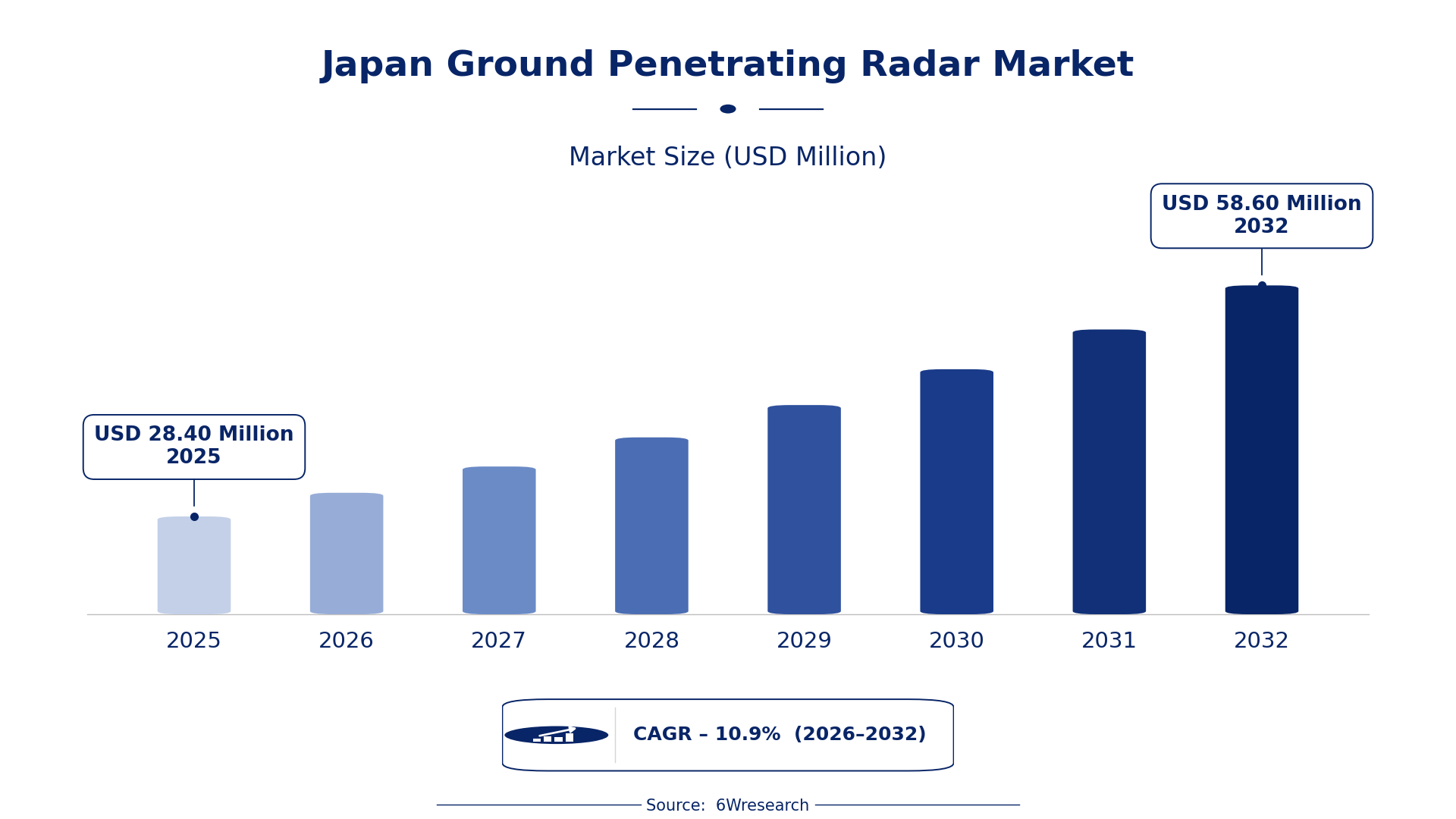
According to 6Wresearch internal database and industry insights, the Japan Ground Penetrating Radar Market was valued at USD 28.40 Million in 2025 and is projected to reach USD 58.60 Million by 2032, growing at a CAGR of approximately 10.9% during 2026–2032.
Japan Ground Penetrating Radar Market Highlights
| Report Metric | Details |
| Report Name | Japan Ground Penetrating Radar Market (2026-2032) |
| Market Size 2025 | USD 28.40 Million |
| Market Size 2032 | USD 58.60 Million |
| Absolute Growth 2025–2032 | USD 30.20 Million |
| CAGR 2026–2032 | 10.9% |
| Peak Annual Growth | 11.6% in 2027 |
| Forecast Period | 2026–2032 |
| Historical Data | 2022–2025 |
| Base Year | 2025 |
| Leading Offering, 2025 | Equipment (54% share) |
| Leading Type, 2025 | Handheld (55% share) |
| Leading Application, 2025 | Utility Detection (48% share) |
| Fastest-Growing Offering | Services (14.4% CAGR) |
| Fastest-Growing Type | Cart-based (14.7% CAGR) |
| Fastest-Growing Application | Concrete Investigation (14.2% CAGR) |
| Growing Sector | Construction and Civil Engineering |
| Key End Users | Construction firms, civil engineering companies, local governments, utility service providers |
Japan Ground Penetrating Radar Market Year-wise Growth Rate and Key Drivers (2022–2032)
This graph illustrates the annual growth rates of the market from 2022 to 2032, highlighting a steady upward trajectory and projected market expansion over the forecast period.
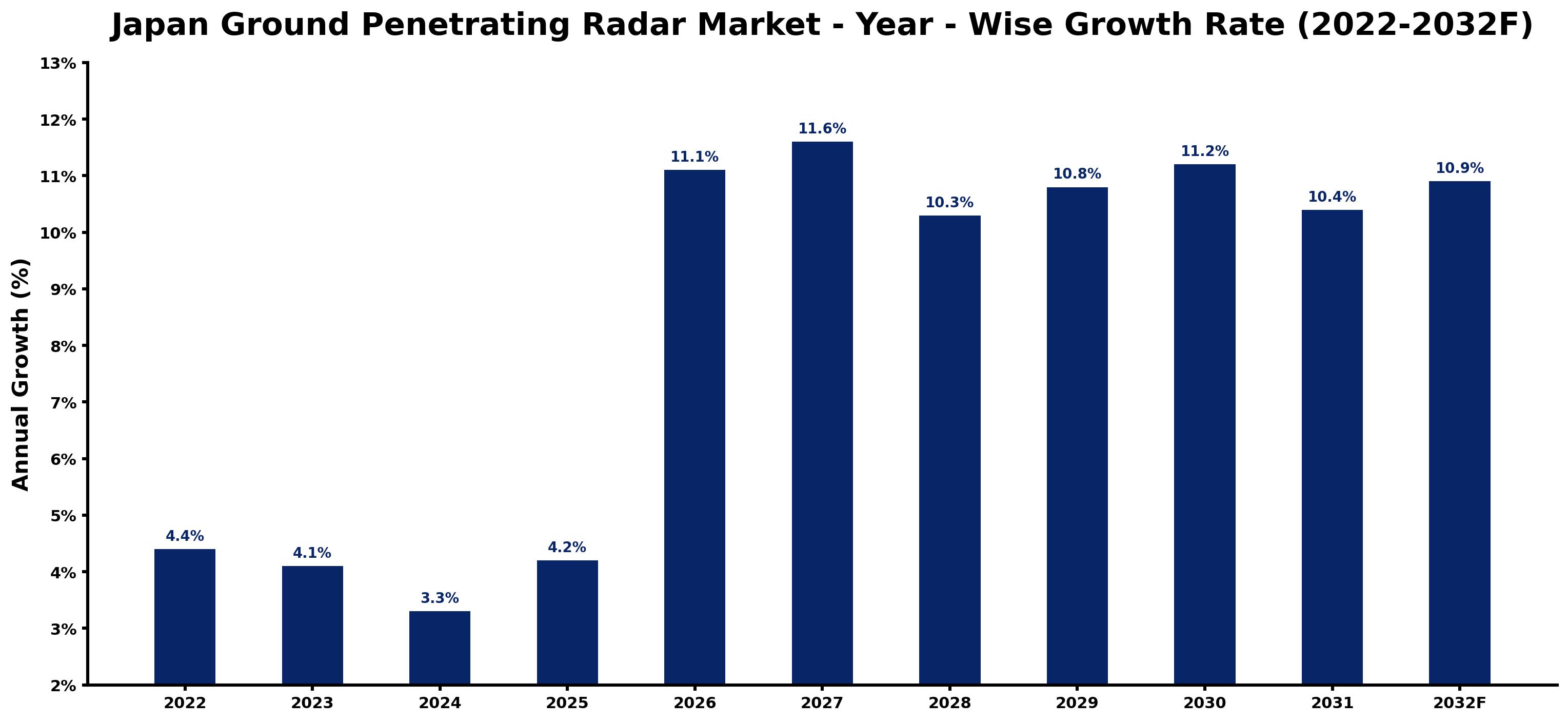
Each row of the following table gives one year's estimated growth and the event or demand shift that explains it.
| Year | Estimated Annual Growth (%) | Market Rationale |
| 2022 | 4.4 | Demand remained stable, supported by ongoing projects in construction and civil engineering. |
| 2023 | 4.1 | Growth slowed as the market adjusted to previous high activity levels and urban infrastructure challenges. |
| 2024 | 3.3 | A further slowdown occurred due to cautious spending amid economic uncertainties in the construction sector. |
| 2025 | 4.2 | Increased investments in infrastructure revitalisation led to a recovery in demand for GPR services. |
| 2026 | 11.1 | Growth is expected to accelerate as urban development projects expand, driving higher utility detection needs. |
| 2027 | 11.6 | The peak growth year will see heightened adoption of GPR technology in various sectors, including construction. |
| 2028 | 10.3 | Growth is projected to slow slightly as the market begins to normalise after rapid expansion in previous years. |
| 2029 | 10.8 | Demand is expected to increase again, driven by ongoing infrastructure projects and a focus on utility management. |
| 2030 | 11.2 | Continued investment in urban infrastructure is projected to sustain growth in GPR applications. |
| 2031 | 10.4 | Growth will moderate as the market stabilises, reflecting a balance between supply and demand. |
| 2032 | 10.9 | Demand is projected to rise further as aging infrastructure necessitates more concrete investigations. |
Note: Market size estimations and growth projections presented in this report are based on 6Wresearch's proprietary forecasting methodology, utilizing the latest available industry data, government publications, and primary research inputs.
Japan Ground Penetrating Radar Market Synopsis
Ground Penetrating Radar is a non-destructive geophysical method that uses radar pulses for subsurface imaging, essential for utility detection, concrete investigation, and archaeological surveys. The Japan Ground Penetrating Radar Market is expanding due to rising demand from the construction and civil engineering sectors, particularly in urban areas like Tokyo, where the average population density is approximately 6,000 people per square kilometer. Initiatives such as the Ministry of Land, Infrastructure, Transport and Tourism's programme for subsurface utility management are driving growth, alongside the promotion of GPR by the Japan Society of Civil Engineers.
Market Dynamics Impact Analysis (2026–2032)
| Factor | Type | Impact | Primary Segment Affected |
| Rising urban infrastructure projects | Driver | High | Utility Detection |
| Increased adoption of GPR in disaster response strategies | Driver | High | Concrete Investigation |
| Growing need for utility detection in dense urban areas | Opportunity | High | Utility Detection |
| Demand for concrete investigation due to aging infrastructure | Opportunity | High | Concrete Investigation |
| High initial investment costs for GPR equipment | Restraint | Medium | Equipment |
| Limited awareness of GPR benefits among potential users | Restraint | Medium | Services |
| Supply chain disruptions affecting equipment availability | Challenge | High | Equipment |
| Competition from alternative subsurface imaging technologies | Challenge | Medium | Services |
Evaluation of Drivers in Japan Ground Penetrating Radar Market (2026–2032)
The table below links each growth driver to the segment it affects and the evidence for it.
| Drivers | Primary Segment Affected | Why It Matters (Evidence) |
| Investment in urban infrastructure projects | Utility Detection | The Tokyo metropolitan area has a high demand for GPR services due to dense infrastructure, resulting in increased purchases of GPR equipment. |
| Integration of GPR in disaster response strategies | Concrete Investigation | Local governments are adopting GPR technology for assessing structural integrity in disaster-prone areas, boosting demand. |
| Growing awareness of GPR's non-destructive capabilities | Services | Training programs for operators are increasing service offerings and expertise in GPR operation, enhancing market growth. |
| Rising population density in urban areas | Utility Detection | The average population density in Tokyo necessitates effective utility detection before excavation, driving demand for GPR. |
| Support from industry associations | Concrete Investigation | The Japan Society of Civil Engineers promotes GPR use, encouraging construction firms to invest in this technology. |
Spending rises because urban infrastructure projects increasingly prioritise utility detection, with high demand for GPR services in metropolitan areas. In 2023, GPR was utilised in over 50% of concrete inspection projects in major cities, reflecting the growing awareness of its non-destructive capabilities. The average population density in Tokyo, approximately 6,000 people per square kilometer, drives the need for effective utility management. Local governments are integrating GPR technology into disaster response strategies, further boosting demand.
Evaluation of Restraints in Japan Ground Penetrating Radar Market
These restraints slow adoption and weigh on supplier margins.
| Market Restraint | Primary Segment Affected | Why It Matters (Evidence) |
| High initial investment costs for GPR equipment | Equipment | The large financial outlay required for GPR equipment limits access for smaller firms, affecting overall market growth. |
| Limited awareness of GPR benefits among potential users | Services | Many potential customers lack knowledge of GPR advantages, hindering wider adoption and service expansion. |
| Supply chain disruptions affecting equipment availability | Equipment | Global supply chain issues have caused delays in GPR equipment delivery, impacting project timelines for buyers. |
| Competition from alternative subsurface imaging technologies | Services | Emerging technologies may divert potential customers away from GPR services, limiting market share for existing providers. |
| Regulatory hurdles in equipment certification | Equipment | Strict compliance with JIS Z 8801 can delay product availability, affecting procurement timelines for buyers. |
Japan Ground Penetrating Radar Market Challenges
Contractors experience a shortage of skilled operators trained in Ground Penetrating Radar technology, leading to project delays and increased costs for construction firms. Utility detection buyers in urban areas face challenges due to outdated infrastructure, resulting in complex projects that extend completion times by up to 20%. Service providers encounter fierce competition in metropolitan regions, which drives down profit margins and can reduce the quality of services offered. Limited availability of advanced GPR equipment disrupts supply chains, causing delays in service delivery and impacting project schedules for contractors, particularly in high-demand areas like Tokyo.
Trends in the Japan Ground Penetrating Radar Market
Four trends stand out in the Japan Ground Penetrating Radar Market.
- Shift towards Improved Utility Management: Japan is increasingly adopting GPR for effective utility management, particularly in urban areas. The Ministry of Land, Infrastructure, Transport and Tourism's 2023 programme aims to improve subsurface utility management, reflecting a growing trend in infrastructure planning.
- Increasing Adoption in Concrete Investigations: Concrete investigation projects have seen a rise in GPR adoption due to aging infrastructure. In major Japanese cities, GPR is utilized in over 50% of these projects, indicating a shift towards advanced inspection methods.
- Expansion of Training Programs for GPR Operators: Training programs for GPR operators are expanding across Japan, enhancing expertise in GPR operation. This initiative is vital for increasing the skilled workforce, particularly in regions with high construction activity.
- Focus on Disaster Response Strategies: Local governments are integrating GPR technology into disaster response strategies, reflecting a shift in emergency preparedness. The adoption of GPR in these strategies is important for improving response efficiency.
Investment Opportunities in the Japan Ground Penetrating Radar Market
Investors looking at the Japan Ground Penetrating Radar Market should consider the following areas.
- Construction Firms Seeking Advanced Solutions: Construction firms in urban areas are increasingly seeking advanced GPR solutions for utility detection, driven by the need for efficient project execution. The Tokyo metropolitan area presents a notable market opportunity.
- Partnerships for GPR Training Initiatives: Establishing partnerships with educational institutions can facilitate GPR training initiatives, addressing the skills gap in the market. This approach is essential for increasing operator expertise.
- Investment in Urban Infrastructure Projects: With urban infrastructure projects on the rise, there is a growing need for GPR services. The Kanto region, known for its construction activity, represents a prime opportunity for suppliers.
- Expansion of GPR Services in Major Cities: As the demand for concrete investigation rises, there is a notable gap in GPR services. Major cities like Osaka are ideal locations for expanding service offerings.
Government Initiatives in the Japan Ground Penetrating Radar Market
The Building Energy Efficiency Act, amended in 2022, mandates that all new buildings meet energy standards from April 2025, impacting GPR producers by requiring compliance with energy-efficient designs. This law encourages the adoption of GPR technology in construction projects to ensure adherence to these standards.
The Ministry of Land, Infrastructure, Transport and Tourism approves funding for programs aimed at improving subsurface utility management. This includes initiatives that support the integration of GPR technology in urban planning, benefiting both producers and buyers by improving project efficiency.
Future Insight of the Japan Ground Penetrating Radar Market
Changes by 2032 will greatly enhance project planning for contractors, especially in urban centres like Tokyo. The Ministry of Land, Infrastructure, Transport and Tourism will implement new standards that improve subsurface utility management. Increased adoption of advanced GPR technology will occur as urban infrastructure demands rise. Training initiatives from the Japan Society of Civil Engineers will ensure a steady influx of skilled operators, which will elevate service efficiency across the board. Concrete inspection projects will increasingly rely on GPR, reflecting the urgent need to address aging infrastructure in major cities.
Market Segmentation Analysis
Japan Ground Penetrating Radar Market report covers a detailed analysis of the following market segments:
By Offering – Equipment Leads, Services Expected to Grow Fastest
According to Summon Dutta, Assistant Manager at 6Wresearch, Equipment took 54% of offering revenue in 2025, more than any other category. Equipment holds the largest share due to its necessity for various applications in subsurface imaging, particularly in urban settings. The demand for GPR equipment in the Tokyo metropolitan area exemplifies its vital role in utility detection and construction activities. Over 2026–2032, Services are expected to post the fastest growth, at a CAGR of 14.4%. Services are experiencing rapid growth as the complexity of GPR operations increases, necessitating skilled data interpretation. The recent programme initiated by the Ministry of Land, Infrastructure, Transport and Tourism to enhance subsurface utility management underscores the rising importance of expert services in this domain. Suppliers should focus on expanding service offerings to meet the increasing demand for expertise in GPR operations.
By Type – Handheld Leads, Cart-based Expected to Grow Fastest
Handheld accounted for 55% of the market by type in 2025. Handheld GPR units dominate the market because they are ideal for small-scale investigations and easy to transport, making them particularly suitable for urban environments. Their prevalent use in concrete inspection projects across major Japanese cities highlights their popularity among users. The quickest growth will come from Cart-based, forecast to expand at a CAGR of 14.7% between 2026 and 2032. Cart-based GPR systems are rapidly gaining traction as they are increasingly employed for larger areas and detailed surveys, addressing the needs of extensive construction projects. The rise in concrete investigation adoption due to aging infrastructure is a key factor driving this segment's growth. Buyers may find value in investing in cart-based systems to enhance their capabilities for larger and more comprehensive surveys.
By Application – Utility Detection Leads, Concrete Investigation Expected to Grow Fastest
Utility Detection held 48% of the Japan Ground Penetrating Radar Market by application in 2025. Utility Detection is the leading application as it is crucial for identifying underground utilities before excavation, thereby preventing costly damages. The high population density in Tokyo intensifies the need for effective utility detection services in urban planning. Concrete Investigation is projected to grow fastest, at a CAGR of 14.2% during 2026–2032. Concrete Investigation is witnessing the fastest growth as it is vital for assessing structural integrity and locating rebar in aging infrastructure. The increasing emphasis on maintaining and upgrading existing structures is propelling this application forward. Suppliers should prioritise solutions that address the growing demand for concrete investigation services.
Key Attractiveness of the Report
- 10 Years of Market Numbers
- Historical Data Starting from 2022 to 2025
- Base Year 2025
- Forecast Data until 2032
- Key Performance Indicators Impacting the Market
- Major Upcoming Developments and Projects
Key Highlights of the Report:
- Japan Ground Penetrating Radar Market Outlook
- Market Size of Japan Ground Penetrating Radar Market, 2025
- Forecast of Japan Ground Penetrating Radar Market, 2032
- Historical Data and Forecast of Japan Ground Penetrating Radar Revenues & Volume for the Period 2022-2032
- Japan Ground Penetrating Radar Market Trend Evolution
- Japan Ground Penetrating Radar Market Drivers and Challenges
- Japan Ground Penetrating Radar Price Trends
- Japan Ground Penetrating Radar Porter's Five Forces
- Japan Ground Penetrating Radar Industry Life Cycle
- Historical Data and Forecast of Japan Ground Penetrating Radar Market Revenues & Volume By Offering for the Period 2022-2032
- Historical Data and Forecast of Japan Ground Penetrating Radar Market Revenues & Volume By Equipment for the Period 2022-2032
- Historical Data and Forecast of Japan Ground Penetrating Radar Market Revenues & Volume By Services for the Period 2022-2032
- Historical Data and Forecast of Japan Ground Penetrating Radar Market Revenues & Volume By Type for the Period 2022-2032
- Historical Data and Forecast of Japan Ground Penetrating Radar Market Revenues & Volume By Handheld for the Period 2022-2032
- Historical Data and Forecast of Japan Ground Penetrating Radar Market Revenues & Volume By Cart-based for the Period 2022-2032
- Historical Data and Forecast of Japan Ground Penetrating Radar Market Revenues & Volume By Vehicle-mounted for the Period 2022-2032
- Historical Data and Forecast of Japan Ground Penetrating Radar Market Revenues & Volume By Application for the Period 2022-2032
- Historical Data and Forecast of Japan Ground Penetrating Radar Market Revenues & Volume By Utility Detection for the Period 2022-2032
- Historical Data and Forecast of Japan Ground Penetrating Radar Market Revenues & Volume By Concrete Investigation for the Period 2022-2032
- Historical Data and Forecast of Japan Ground Penetrating Radar Market Revenues & Volume By Transportation for the Period 2022-2032
- Historical Data and Forecast of Japan Ground Penetrating Radar Market Revenues & Volume By Law Enforcement for the Period 2022-2032
- Japan Ground Penetrating Radar Import Export Trade Statistics
- Market Opportunity Assessment By Offering
- Market Opportunity Assessment By Type
- Market Opportunity Assessment By Application
- Japan Ground Penetrating Radar Top Companies Market Share
- Japan Ground Penetrating Radar Competitive Benchmarking By Technical and Operational Parameters
- Japan Ground Penetrating Radar Company Profiles
- Japan Ground Penetrating Radar Key Strategic Recommendations
Market Covered
Segments analysed in this report are listed below.
By Offering
- Equipment
- Services
By Type
- Handheld
- Cart-based
- Vehicle-mounted
By Application
- Utility Detection
- Concrete Investigation
- Transportation
- Law Enforcement































