Japan Gynaecological Device Market Size & Growth Rate
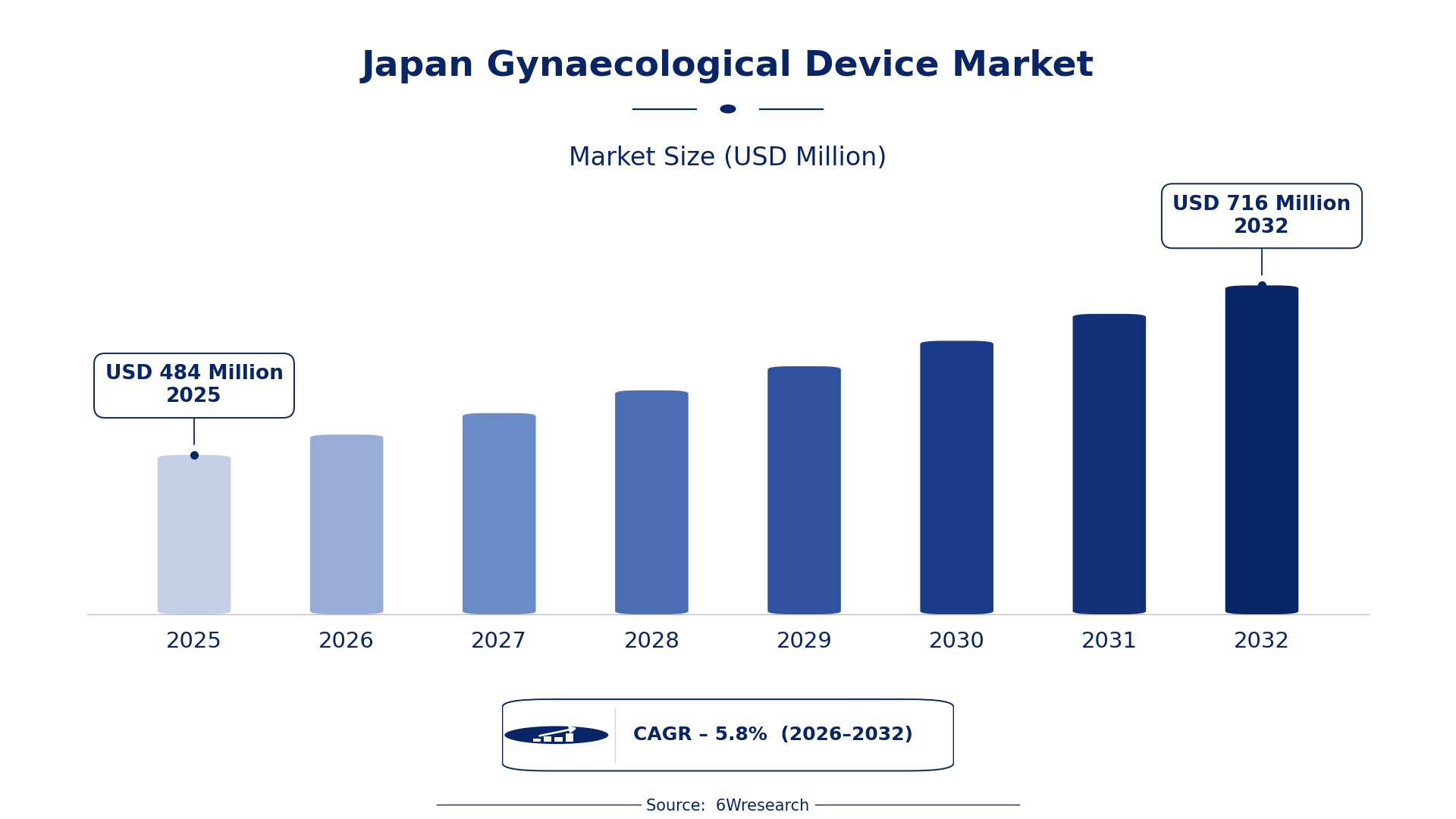
According to 6Wresearch internal database and industry insights, the Japan Gynaecological Device Market was valued at USD 484 Million in 2025 and is projected to reach USD 716 Million by 2032, growing at a CAGR of approximately 5.8% during 2026–2032.
Japan Gynaecological Device Market Highlights
| Report Metric | Details |
| Report Name | Japan Gynaecological Device Market (2026-2032) |
| Market Size 2025 | USD 484 Million |
| Market Size 2032 | USD 716 Million |
| Absolute Growth 2025–2032 | USD 232 Million |
| CAGR 2026–2032 | 5.8% |
| Peak Annual Growth | 6.5% in 2026 |
| Forecast Period | 2026–2032 |
| Historical Data | 2022–2025 |
| Base Year | 2025 |
| Leading Product Type, 2025 | Gynaecology Endoscopy Devices (32% share) |
| Leading Disease Type, 2025 | Menorrhagia (39% share) |
| Leading End-Users, 2025 | Hospitals / Ambulatory Surgical Centers (51% share) |
| Fastest-Growing Product Type | Endometrial Abalation Devices (8.3% CAGR) |
| Fastest-Growing Disease Type | Endometrial Cancer (8.5% CAGR) |
| Fastest-Growing End-Users | Gynaecological/Obstetrics Clinic (7.3% CAGR) |
| Growing Sector | gynaecological healthcare |
| Key End Users | hospitals, ambulatory surgical centers, gynaecological clinics |
Japan Gynaecological Device Market Year-wise Growth Rate and Key Drivers (2022–2032)
This graph illustrates the annual growth rates of the market from 2022 to 2032, highlighting a steady upward trajectory and projected market expansion over the forecast period.
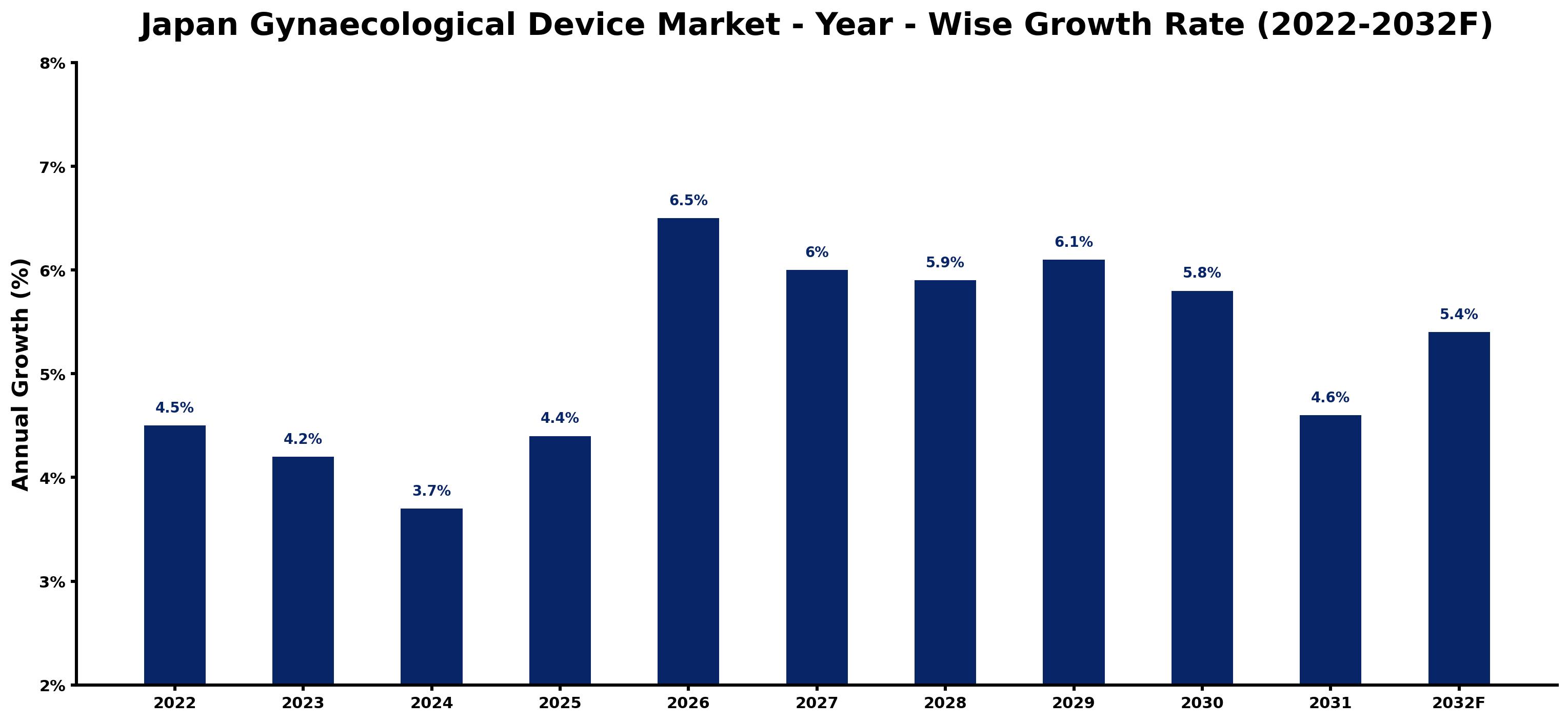
The following figures match every annual growth estimate with the main market development of that year, giving the reasoning behind each rise or slowdown.
| Year | Estimated Annual Growth (%) | Market Rationale |
| 2022 | 4.5 | The market experienced steady growth due to strong healthcare services and an aging population. |
| 2023 | 4.2 | Demand growth slowed slightly as healthcare facilities adapted to evolving patient needs. |
| 2024 | 3.7 | Growth continued to decelerate as hospitals focused on managing costs amid rising expenses. |
| 2025 | 4.4 | The market rebounded with increased investments in gynaecological services and technology upgrades. |
| 2026 | 6.5 | Demand is expected to surge as new outpatient procedures gain popularity, driving device purchases. |
| 2027 | 6.0 | Growth will slow as market saturation begins to impact new device adoption rates. |
| 2028 | 5.9 | Demand is projected to remain stable as hospitals maintain existing equipment while considering upgrades. |
| 2029 | 6.1 | Renewed interest in advanced technologies is expected to boost device sales. |
| 2030 | 5.8 | Competition among existing suppliers will decelerate growth as market dynamics shift. |
| 2031 | 4.6 | Demand is projected to continue slowing as healthcare budgets face tighter scrutiny. |
| 2032 | 5.4 | The market is expected to grow as new technologies emerge and patient awareness increases. |
Note: Market size estimations and growth projections presented in this report are based on 6Wresearch's proprietary forecasting methodology, utilizing the latest available industry data, government publications, and primary research inputs.
Japan Gynaecological Device Market Synopsis
Gynaecological devices serve as vital medical instruments for diagnosing and treating female reproductive health issues, crafted from advanced materials and technologies. The Japan Gynaecological Device Market is growing, driven by an aging population, with 29.3% of individuals aged 65 or older, alongside a rise in healthcare expenditure, which reached approximately JPY 46.7 trillion in fiscal 2022. The increasing preference for minimally invasive procedures and outpatient services fuels investments in gynaecological technologies, particularly in urban healthcare centres like Tokyo.
Market Dynamics Impact Analysis (2026–2032)
| Factor | Type | Impact | Primary Segment Affected |
| Increasing prevalence of menorrhagia among women drives demand for endometrial ablation devices. | Driver | High | Endometrial Abalation Devices |
| The rise in outpatient procedures is boosting the demand for gynaecology endoscopy devices. | Driver | High | Gynaecology Endoscopy Devices |
| The growing aging population presents opportunities for expanding gynaecological services. | Opportunity | High | Gynaecology Endoscopy Devices |
| Investment in women's health initiatives is increasing, creating demand for various gynaecological devices. | Opportunity | High | Gynaecology Endoscopy Devices |
| High costs associated with advanced gynaecological devices may limit access for smaller healthcare facilities. | Restraint | Medium | Gynaecology Endoscopy Devices |
| Stringent regulatory requirements can delay the introduction of new devices into the market. | Restraint | Medium | Gynaecology Endoscopy Devices |
| Supply chain disruptions can impact the availability of critical components for device manufacturing. | Challenge | High | Gynaecology Endoscopy Devices |
| Competition among suppliers may lead to price wars, affecting profitability for manufacturers. | Challenge | High | Gynaecology Endoscopy Devices |
Evaluation of Drivers in Japan Gynaecological Device Market (2026–2032)
Key forces behind demand, with the segment each one moves most, are listed below.
| Drivers | Primary Segment Affected | Why It Matters (Evidence) |
| The increasing number of hospitals providing gynaecological services boosts device demand. | Gynaecology Endoscopy Devices | Japan has over 8,100 hospitals offering gynaecological services, leading to higher procurement of devices. |
| The rise in outpatient procedures increases the need for minimally invasive devices. | Endometrial Abalation Devices | Endometrial ablation devices are increasingly used in outpatient settings, promoting higher sales. |
| Growing awareness of women's health issues drives demand for diagnostic imaging systems. | Cervical Cancer | Diagnostic imaging systems are vital for early detection of cervical cancer in Japan. |
| Rising healthcare expenditure supports investments in advanced gynaecological technologies. | Gynaecology Endoscopy Devices | Japan's national medical care expenditure was about JPY 46.7 trillion in fiscal 2022. |
| The prevalence of conditions like fibroids leads to higher demand for specific treatment devices. | Fibroids | Menorrhagia affects about 1 in 5 women, driving demand for endometrial ablation devices. |
The strongest pull on demand comes from the increasing number of hospitals providing gynaecological services, which leads to higher procurement of endometrial ablation devices. The rise in outpatient procedures is increasing the need for minimally invasive devices, particularly in urban healthcare settings. Growing awareness of women's health issues drives demand for diagnostic imaging systems, crucial for early detection of cervical cancer. Rising healthcare expenditure, approximately JPY 46.7 trillion in fiscal 2022, supports investments in advanced gynaecological technologies, while the prevalence of conditions like fibroids, affecting 1 in 5 women, boosts the demand for specific treatment devices.
Evaluation of Restraints in Japan Gynaecological Device Market
The main factors holding the market back are set out below.
| Market Restraint | Primary Segment Affected | Why It Matters (Evidence) |
| High costs associated with advanced gynaecological devices limit access for smaller healthcare facilities. | Gynaecology Endoscopy Devices | The average cost of advanced devices can be prohibitive for smaller hospitals, affecting procurement. |
| Stringent regulatory requirements delay the introduction of new devices into the market. | Gynaecology Endoscopy Devices | Compliance with JIS standards and PMD Act can extend the approval process for new devices. |
| Supply chain disruptions impact the availability of critical components for device manufacturing. | Gynaecology Endoscopy Devices | Global supply chain issues have caused delays in obtaining essential materials for production. |
| Market saturation limits growth opportunities for new entrants in the gynaecological device sector. | Gynaecology Endoscopy Devices | Established players dominate the market, making it challenging for new companies to gain traction. |
| Competition among suppliers may lead to price wars, affecting profitability for manufacturers. | Gynaecology Endoscopy Devices | Intense competition can force manufacturers to lower prices, impacting their profit margins. |
Japan Gynaecological Device Market Challenges
Clinics struggle with a shortage of skilled professionals, as Japan's aging population has diminished the workforce, causing delays in patient care and increasing operational costs. Hospitals experience fierce competition among suppliers, which leads to price reductions that can compromise product quality, forcing them to invest more in replacements. Rising raw material costs, driven by global supply chain issues, are escalating expenses for producers, which burdens hospitals financially. Inefficiencies in the distribution network for gynaecological devices can result in delayed access to essential treatments, adversely affecting health outcomes for women.
Trends in the Japan Gynaecological Device Market
These developments are changing demand patterns in the Japan Gynaecological Device Market.
- Shift towards Outpatient Gynaecological Procedures: The Tokyo region is experiencing a shift towards outpatient gynaecological procedures, with a growing preference for minimally invasive techniques. Approximately 70% of gynaecological surgeries now occur in outpatient settings, reflecting changing patient preferences.
- Transition from Traditional to Advanced Imaging Systems: There is a transition from traditional imaging systems to advanced diagnostic imaging technologies in Japan. In 2023, the Ministry of Health launched a programme to improve women's health services, enhancing the quality of diagnostic tools available.
- Emergence of Telemedicine in Gynaecological Care: Telemedicine is becoming increasingly important in gynaecological care, allowing remote consultations and follow-ups. This trend is particularly beneficial for rural areas, where access to specialists is limited, positively impacting patient care.
- Prioritisation of Women's Health Initiatives: Government funding for women's health initiatives has increased by 15% since 2022, highlighting a prioritisation of women's health issues. This funding supports the development and distribution of innovative gynaecological devices.
Investment Opportunities in the Japan Gynaecological Device Market
The opportunities below stand out in the Japan Gynaecological Device Market for new entrants and existing suppliers.
- Gap in Advanced Gynaecological Device Supply: Japan's healthcare expenditure reached JPY 46.7 trillion, indicating a gap in the supply of advanced gynaecological devices. Investing in outpatient facilities can help meet this demand, particularly in urban areas.
- Partnerships for Device Development: Forming partnerships with local healthcare providers can facilitate the entry of new gynaecological devices into the market. Collaborating with hospitals in Tokyo can improve distribution and adoption rates.
- Investment in Minimally Invasive Technologies: There is a growing opportunity to invest in minimally invasive gynaecological technologies, particularly endometrial ablation devices. Targeting hospitals and ambulatory surgical centres can lead to increased sales.
- Focus on Women's Health Programs: The increasing government funding for women's health initiatives presents an opportunity to supply innovative gynaecological devices. Engaging with the Japan Society of Obstetrics and Gynecology can support market entry.
Government Initiatives in the Japan Gynaecological Device Market
The PMD Act, enacted in 2014, regulates the approval process and safety standards for pharmaceuticals and medical devices in Japan. This law ensures that gynaecological devices meet strict safety and efficacy standards, impacting how producers develop and market their products. The Act against Unjustifiable Premiums and Misleading Representations prohibits misleading advertising, ensuring that buyers receive accurate information about these devices.
The Pharmaceuticals and Medical Devices Agency (PMDA) oversees the review of pharmaceuticals and medical devices, ensuring compliance with safety standards. This agency also monitors post-market safety, which is essential for maintaining the quality of gynaecological devices. The Japan Agency for Medical Research and Development (AMED) funds medical research and development projects, supporting innovation in women's health technologies.
Future Insight of the Japan Gynaecological Device Market
Advancements in diagnostic imaging systems will enhance early detection of cervical cancer, improving patient outcomes. By 2032, new JIS standards will ensure higher quality and safety in gynaecological devices, benefiting both suppliers and buyers. Government initiatives focused on women's health will channel increased funding towards innovative treatments and technologies, stimulating sector growth. With approximately 15 million women aged 15-49 in Japan, demand for gynaecological services is expected to rise, creating opportunities for suppliers to broaden their product offerings.
Market Segmentation Analysis
Japan Gynaecological Device Market report covers a detailed analysis of the following market segments:
By Product Type – Gynaecology Endoscopy Devices Lead, Endometrial Abalation Devices Expected to Grow Fastest
According to Ravi Bhandari, Research Head at 6Wresearch, Gynaecology Endoscopy Devices held 32% of the Japan Gynaecological Device Market by product type in 2025. Gynaecology Endoscopy Devices command the largest share owing to their essential role in minimally invasive procedures, which are preferred for reduced recovery times. With a substantial installed base across over 8,000 hospitals in Japan, the demand for these devices remains strong. Endometrial Abalation Devices are projected to grow fastest, at a CAGR of 8.3% during 2026–2032. Endometrial Ablation Devices are experiencing rapid growth as they are increasingly utilised in outpatient settings, catering to the significant prevalence of menorrhagia affecting 1 in 5 women. The ongoing rise in awareness regarding treatment options will likely sustain this growth trajectory. Suppliers should focus on enhancing the availability of endometrial ablation devices to meet the increasing outpatient demand.
By Disease Type – Menorrhagia Leads, Endometrial Cancer Expected to Grow Fastest
The largest disease type category in 2025 was Menorrhagia, at 39% of revenue. Menorrhagia leads the market as it is a common condition directly treated with specific devices, creating a consistent demand from healthcare providers. The high incidence rate among women in Japan drives the need for effective treatment solutions. The quickest growth will come from Endometrial Cancer, forecast to expand at a CAGR of 8.5% between 2026 and 2032. Endometrial Cancer is the fastest-growing segment due to the increasing focus on surgical procedures for early detection and treatment, particularly in light of rising awareness and diagnostic capabilities. This growth is likely to accelerate as healthcare initiatives expand. Buyers will benefit from advancements in treatment technologies for endometrial cancer, improving patient outcomes.
By End-Users – Hospitals / Ambulatory Surgical Centers Lead, Gynaecological/Obstetrics Clinic Expected to Grow Fastest
Hospitals / Ambulatory Surgical Centers accounted for 51% of the market by end-users in 2025. Hospitals and Ambulatory Surgical Centers lead the market as primary users of gynaecological devices, benefiting from their comprehensive facilities and high patient volumes. These centres are equipped to conduct a range of procedures, ensuring a steady demand for advanced medical instruments. Gynaecological/Obstetrics Clinic is set to record the highest CAGR in this split, 7.3% over 2026–2032. Gynaecological/Obstetrics Clinics are rapidly expanding as they provide specialised services tailored to women's health, reflecting a growing focus on personalised care. This trend is expected to continue as more clinics adopt advanced technologies to enhance service delivery. Suppliers should direct their efforts towards gynaecological clinics to capitalise on the increasing demand for specialised women's health services.
Key Attractiveness of the Report
- 10 Years of Market Numbers
- Historical Data Starting from 2022 to 2025
- Base Year 2025
- Forecast Data until 2032
- Key Performance Indicators Impacting the Market
- Major Upcoming Developments and Projects
Key Highlights of the Report:
- Japan Gynaecological Device Market Outlook
- Market Size of Japan Gynaecological Device Market, 2025
- Forecast of Japan Gynaecological Device Market, 2032
- Historical Data and Forecast of Japan Gynaecological Device Revenues & Volume for the Period 2022-2032
- Japan Gynaecological Device Market Trend Evolution
- Japan Gynaecological Device Market Drivers and Challenges
- Japan Gynaecological Device Price Trends
- Japan Gynaecological Device Porter's Five Forces
- Japan Gynaecological Device Industry Life Cycle
- Historical Data and Forecast of Japan Gynaecological Device Market Revenues & Volume By Product Type for the Period 2022-2032
- Historical Data and Forecast of Japan Gynaecological Device Market Revenues & Volume By Gynaecology Endoscopy Devices for the Period 2022-2032
- Historical Data and Forecast of Japan Gynaecological Device Market Revenues & Volume By Endometrial Abalation Devices for the Period 2022-2032
- Historical Data and Forecast of Japan Gynaecological Device Market Revenues & Volume By Fluid Management Systems for the Period 2022-2032
- Historical Data and Forecast of Japan Gynaecological Device Market Revenues & Volume By Female Sterilization and Contraceptive Devices for the Period 2022-2032
- Historical Data and Forecast of Japan Gynaecological Device Market Revenues & Volume By Hand-Held Instruments for the Period 2022-2032
- Historical Data and Forecast of Japan Gynaecological Device Market Revenues & Volume By Daignostic Imaging Systems for the Period 2022-2032
- Historical Data and Forecast of Japan Gynaecological Device Market Revenues & Volume By Disease Type for the Period 2022-2032
- Historical Data and Forecast of Japan Gynaecological Device Market Revenues & Volume By Pelvic Organ PRoLApse for the Period 2022-2032
- Historical Data and Forecast of Japan Gynaecological Device Market Revenues & Volume By Breast Cancer for the Period 2022-2032
- Historical Data and Forecast of Japan Gynaecological Device Market Revenues & Volume By Menorrhagia for the Period 2022-2032
- Historical Data and Forecast of Japan Gynaecological Device Market Revenues & Volume By Fetal Monitoring for the Period 2022-2032
- Historical Data and Forecast of Japan Gynaecological Device Market Revenues & Volume By Cervical Cancer for the Period 2022-2032
- Historical Data and Forecast of Japan Gynaecological Device Market Revenues & Volume By Endometrial Cancer for the Period 2022-2032
- Historical Data and Forecast of Japan Gynaecological Device Market Revenues & Volume By Fibroids for the Period 2022-2032
- Historical Data and Forecast of Japan Gynaecological Device Market Revenues & Volume By Other Diseases for the Period 2022-2032
- Historical Data and Forecast of Japan Gynaecological Device Market Revenues & Volume By End-Users for the Period 2022-2032
- Historical Data and Forecast of Japan Gynaecological Device Market Revenues & Volume By Hospitals / Ambulatory Surgical Centers for the Period 2022-2032
- Historical Data and Forecast of Japan Gynaecological Device Market Revenues & Volume By Gynaecological/Obstetrics Clinic for the Period 2022-2032
- Historical Data and Forecast of Japan Gynaecological Device Market Revenues & Volume By Other End Users for the Period 2022-2032
- Japan Gynaecological Device Import Export Trade Statistics
- Market Opportunity Assessment By Product Type
- Market Opportunity Assessment By Disease Type
- Market Opportunity Assessment By End-Users
- Japan Gynaecological Device Top Companies Market Share
- Japan Gynaecological Device Competitive Benchmarking By Technical and Operational Parameters
- Japan Gynaecological Device Company Profiles
- Japan Gynaecological Device Key Strategic Recommendations
Market Covered
The study includes the following segmentation.
By Product Type
- Gynaecology Endoscopy Devices
- Endometrial Abalation Devices
- Fluid Management Systems
- Female Sterilization and Contraceptive Devices
- Hand-Held Instruments
- Daignostic Imaging Systems
By Disease Type
- Pelvic Organ PRoLApse
- Breast Cancer
- Menorrhagia
- Fetal Monitoring
- Cervical Cancer
- Endometrial Cancer
- Fibroids
- Other Diseases
By End-Users
- Hospitals / Ambulatory Surgical Centers
- Gynaecological/Obstetrics Clinic
- Other End Users































