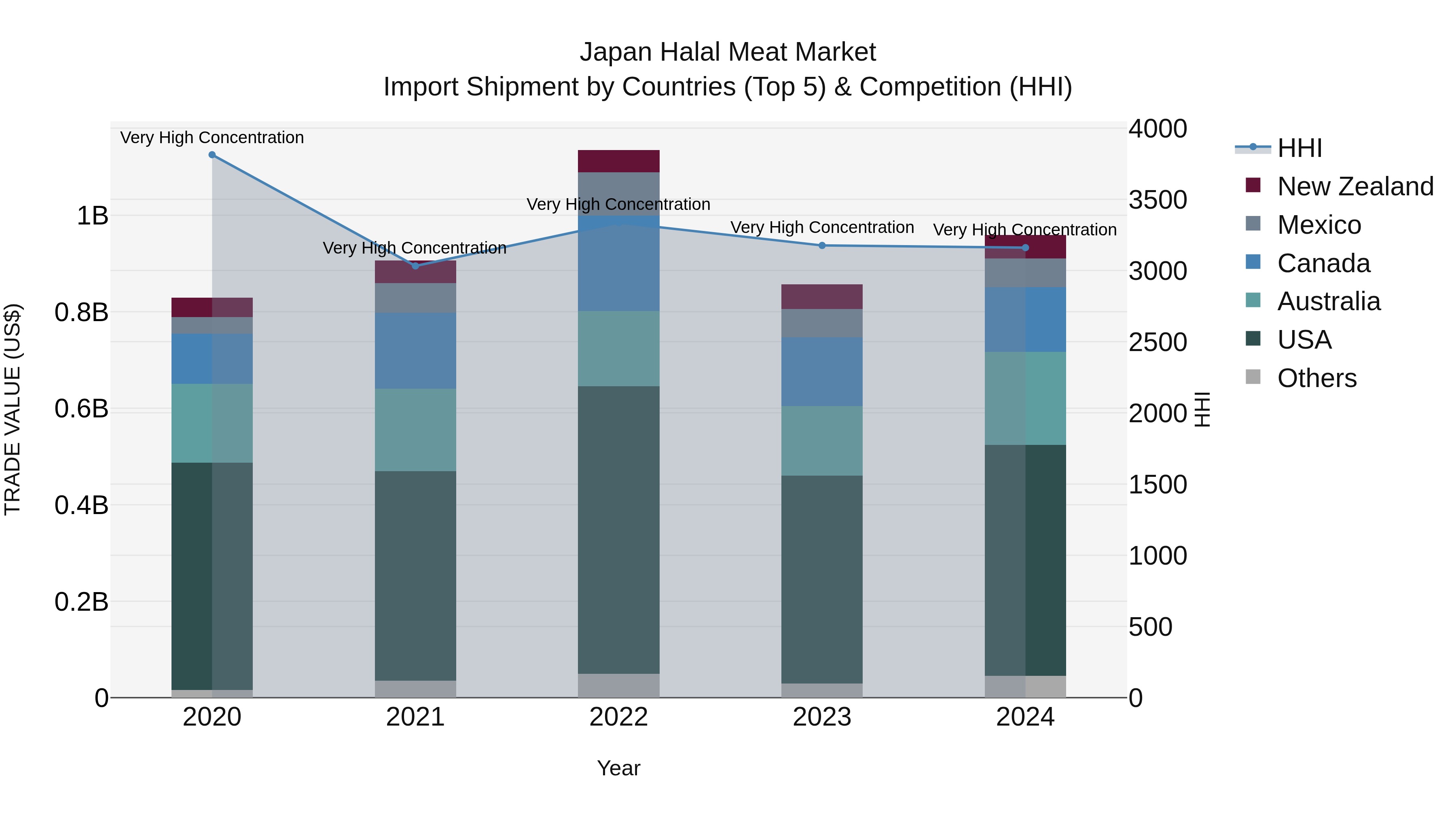
Japan Halal Meat Market Import Shipment by Countries (Top 5) & Competition (HHI)
In 2024, Japan continued to see a significant demand for halal meat imports, with top exporting countries being the USA, Australia, Canada, Mexico, and New Zealand. The market remained highly concentrated, indicating strong competition among these key players. The compound annual growth rate (CAGR) from 2020 to 2024 was steady at 3.71%, with a notable growth spike of 11.98% from 2023 to 2024. This data suggests a promising outlook for the halal meat import market in Japan, driven by diverse sourcing and increasing consumer preferences for halal-certified products.
Japan Halal Meat Market Overview
The Japan Halal Meat Market is experiencing significant growth driven by the increasing Muslim population in the country and a growing demand for halal-certified products. Halal meat, which adheres to Islamic dietary laws, is gaining popularity not only among Muslim consumers but also among non-Muslims who seek high-quality and ethically sourced meat products. The market offers a wide range of halal meat products, including beef, lamb, chicken, and processed meat items, catering to diverse consumer preferences. Key players in the Japan Halal Meat Market are focusing on expanding their product offerings, ensuring strict halal compliance, and enhancing distribution channels to meet the rising demand. Additionally, government initiatives to promote halal products and certification processes are contributing to the market`s growth trajectory.
Japan Halal Meat Market Trends
The Japan Halal meat market is experiencing steady growth due to the increasing demand for Halal-certified products among the Muslim population in the country. The market is driven by the rising awareness of Halal dietary requirements and the growing Muslim population in Japan, including tourists and expatriates. Convenience stores and supermarkets are expanding their Halal meat offerings, catering to the diverse needs of consumers. Additionally, e-commerce platforms are playing a significant role in providing access to a wider range of Halal meat products. The trend towards healthier eating habits and the emphasis on food safety and quality are also influencing consumer preferences towards Halal meat products. Overall, the Japan Halal meat market is expected to continue its growth trajectory as companies focus on diversifying their product offerings to meet the increasing demand.
Japan Halal Meat Market Challenges
In the Japan Halal Meat Market, some of the key challenges faced include the limited availability of halal-certified meat products, strict regulations and certifications required for halal products, and the high costs associated with halal certification and compliance. Additionally, there may be cultural barriers and lack of awareness among consumers regarding halal meat, which can limit the market potential. Importing halal meat can also be a challenge due to logistical issues and quality control concerns. Furthermore, competition from non-halal meat products and the need for ongoing education and training within the industry pose additional hurdles for businesses operating in the Japan Halal Meat Market. Overcoming these challenges requires strategic partnerships, investment in infrastructure, and targeted marketing efforts to tap into the growing demand for halal products in Japan.
Japan Halal Meat Market Investment Opportunities
The Japan Halal meat market presents promising investment opportunities due to the increasing demand for Halal-certified products among the Muslim population in Japan. With a growing Muslim population and a rising awareness of Halal dietary requirements, there is a need for a wider variety of Halal meat options in the market. Investing in Halal meat processing facilities, distribution channels, and retail outlets could be lucrative. Additionally, there is potential for partnerships with Halal certification agencies to ensure compliance with Halal standards and gain trust among consumers. Collaborating with local suppliers and producers to source high-quality Halal meat products can also be a strategic investment move in tapping into this niche market segment.
Japan Halal Meat Market Government Policy
The Japanese government has taken steps to promote the halal meat market in the country, recognizing the growing demand for halal products among Muslim consumers. This includes the establishment of halal certification bodies, such as the Japan Muslim Association, to ensure that halal standards are met in the production and distribution of halal meat. The government has also implemented regulations to support the importation and labeling of halal meat products, in line with international halal standards. Additionally, the promotion of halal tourism in Japan has further boosted the demand for halal meat, leading to increased availability of halal options in restaurants and supermarkets. Overall, the government`s policies aim to cater to the needs of Muslim consumers and enhance the competitiveness of the Japan halal meat market.
Japan Halal Meat Market Future Outlook
The Japan Halal Meat Market is expected to witness significant growth in the coming years due to the increasing Muslim population in the country and the rising demand for halal-certified products. The government`s initiatives to attract Muslim tourists and promote halal tourism are also driving the market expansion. Additionally, the growing awareness among non-Muslim consumers about the quality and hygiene standards of halal meat is further fueling market growth. Key players in the industry are increasingly focusing on expanding their product offerings and distribution channels to cater to the growing demand. Overall, the Japan Halal Meat Market is projected to experience steady growth in the foreseeable future, with opportunities for new entrants and existing players to capitalize on the expanding market potential.
Key Highlights of the Report:
- Japan Halal Meat Market Outlook
- Market Size of Japan Halal Meat Market, 2024
- Forecast of Japan Halal Meat Market, 2031
- Historical Data and Forecast of Japan Halal Meat Revenues & Volume for the Period 2018 - 2031
- Japan Halal Meat Market Trend Evolution
- Japan Halal Meat Market Drivers and Challenges
- Japan Halal Meat Price Trends
- Japan Halal Meat Porter's Five Forces
- Japan Halal Meat Industry Life Cycle
- Historical Data and Forecast of Japan Halal Meat Market Revenues & Volume By Product Type for the Period 2018 - 2031
- Historical Data and Forecast of Japan Halal Meat Market Revenues & Volume By Fresh Food for the Period 2018 - 2031
- Historical Data and Forecast of Japan Halal Meat Market Revenues & Volume By Processed Food for the Period 2018 - 2031
- Japan Halal Meat Import Export Trade Statistics
- Market Opportunity Assessment By Product Type
- Japan Halal Meat Top Companies Market Share
- Japan Halal Meat Competitive Benchmarking By Technical and Operational Parameters
- Japan Halal Meat Company Profiles
- Japan Halal Meat Key Strategic Recommendations






































