Japan Harps Market Size & Growth Rate
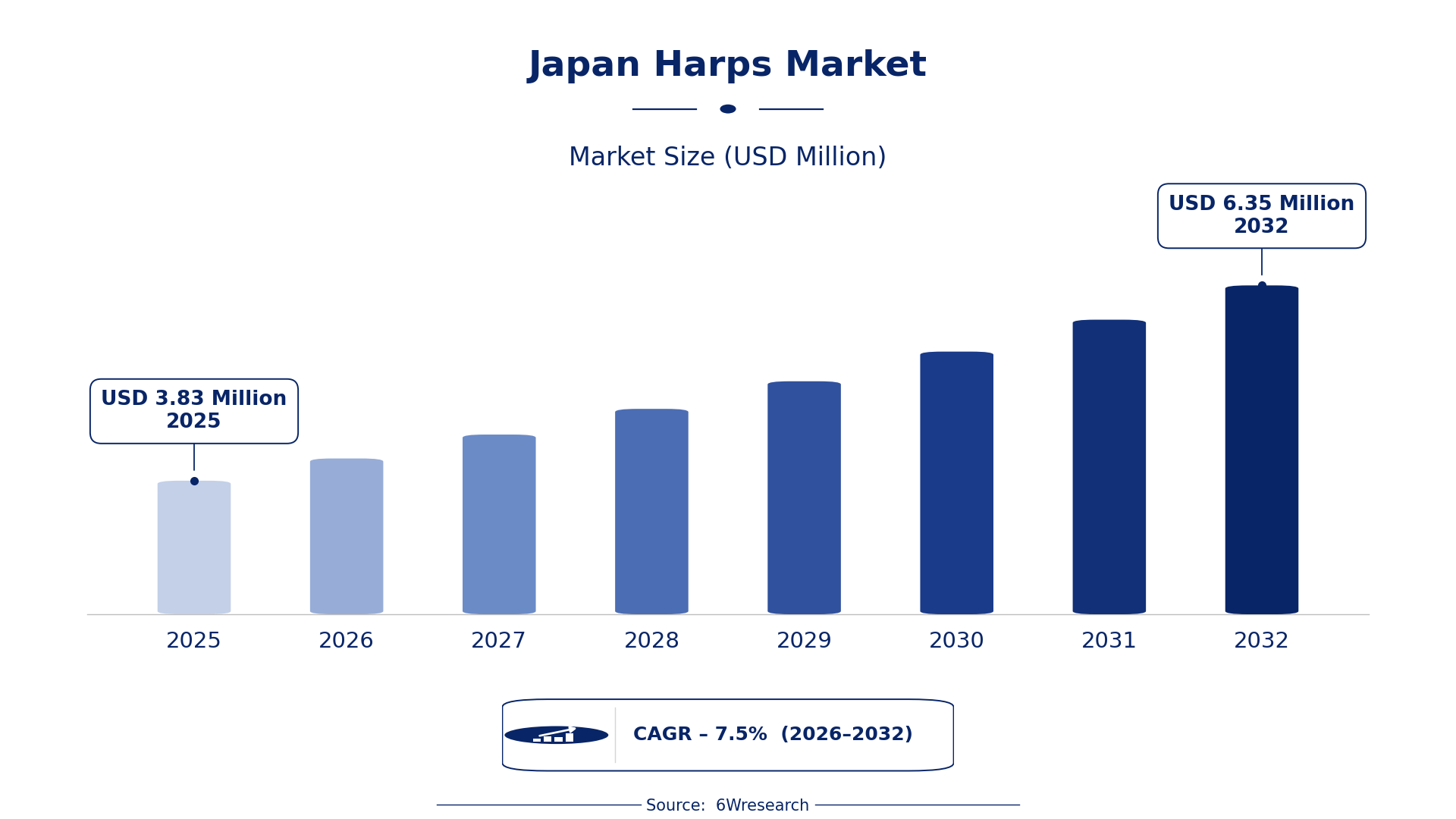
According to 6Wresearch internal database and industry insights, the Japan Harps Market was valued at USD 3.83 Million in 2025 and is projected to reach USD 6.35 Million by 2032, growing at a CAGR of approximately 7.5% during 2026–2032.
Japan Harps Market Highlights
| Report Metric | Details |
| Report Name | Japan Harps Market (2026-2032) |
| Market Size 2025 | USD 3.83 Million |
| Market Size 2032 | USD 6.35 Million |
| Absolute Growth 2025–2032 | USD 2.52 Million |
| CAGR 2026–2032 | 7.5% |
| Peak Annual Growth | 8.3% in 2026 |
| Forecast Period | 2026–2032 |
| Historical Data | 2022–2025 |
| Base Year | 2025 |
| Leading Type, 2025 | 24 to 28 Strings (44% share) |
| Leading Application, 2025 | Professional Players (59% share) |
| Fastest-Growing Type | 15 to 21 Strings (10.8% CAGR) |
| Fastest-Growing Application | Amateur (9.6% CAGR) |
| Growing Sector | Music Education |
| Key End Users | Professional Musicians, Music Schools, Amateur Players |
Japan Harps Market Year-wise Growth Rate and Key Drivers (2022–2032)
This graph illustrates the annual growth rates of the market from 2022 to 2032, highlighting a steady upward trajectory and projected market expansion over the forecast period.
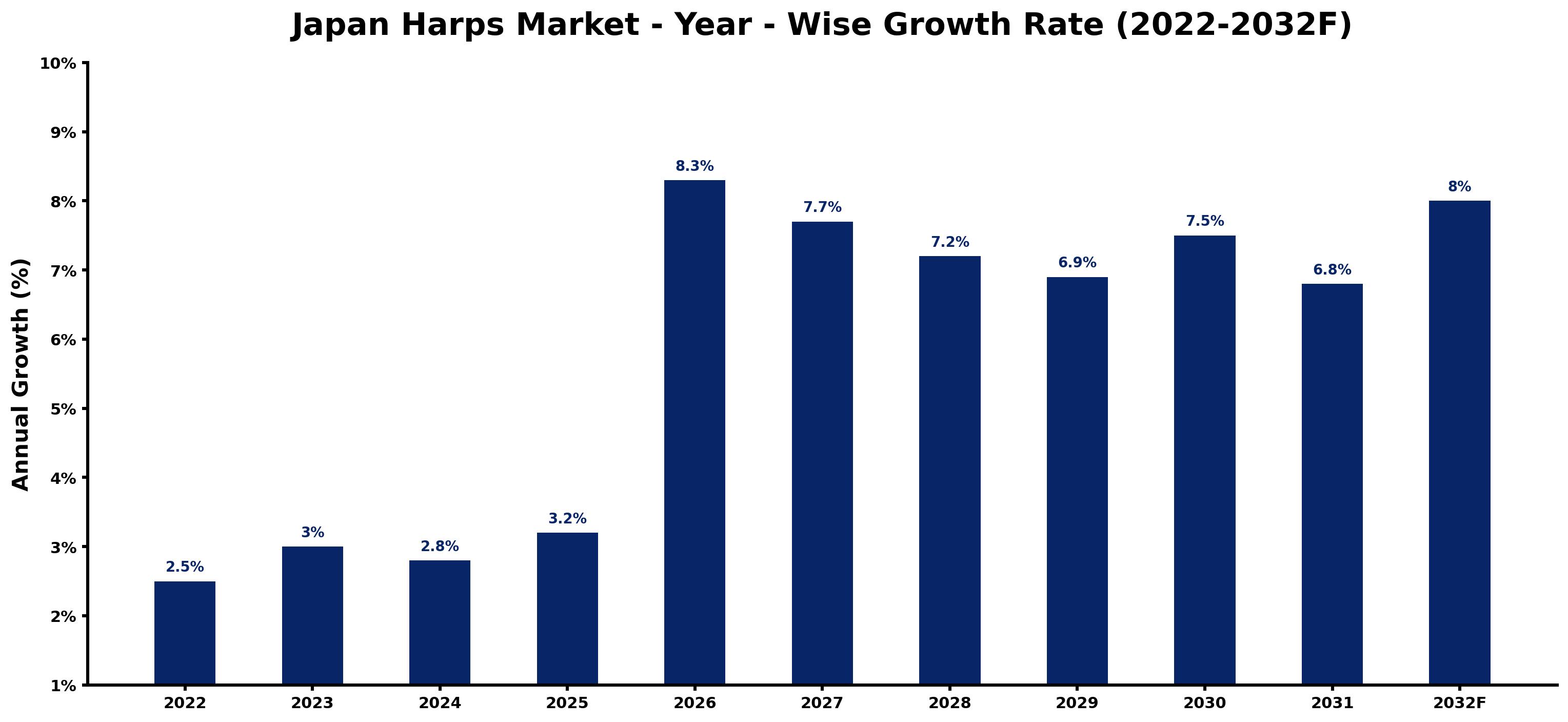
Below, each year's estimated growth is shown next to the factor that most influenced it.
| Year | Estimated Annual Growth (%) | Market Rationale |
| 2022 | 2.5 | The market experienced steady demand from established musicians and educational institutions. |
| 2023 | 3.0 | Growth was driven by increased interest in music education and performance opportunities. |
| 2024 | 2.8 | Demand slowed as market saturation began to affect new purchases. |
| 2025 | 3.2 | The introduction of new models attracted professional players, boosting sales. |
| 2026 | 8.3 | A surge in cultural events and festivals increased harp purchases. |
| 2027 | 7.7 | Growth slowed due to rising competition from alternative instruments. |
| 2028 | 7.2 | Market demand continued to slow as consumer preferences shifted. |
| 2029 | 6.9 | The market saw a slight decrease in growth as economic factors influenced spending. |
| 2030 | 7.5 | Interest in traditional music forms sparked renewed demand for harps. |
| 2031 | 6.8 | Growth slowed as the market stabilised after previous peaks. |
| 2032 | 8.0 | A resurgence in music education programmes will drive harp sales. |
Note: Market size estimations and growth projections presented in this report are based on 6Wresearch's proprietary forecasting methodology, utilizing the latest available industry data, government publications, and primary research inputs.
Japan Harps Market Synopsis
Harps, known for their rich sound and intricate design, are crafted from wood and metal, primarily used in orchestras and solo performances. The Japan Harps Market is growing due to rising interest in music education and cultural events. Increased investment in arts education and a growing number of music festivals are driving demand for these instruments.
Market Dynamics Impact Analysis (2026–2032)
| Factor | Type | Impact | Primary Segment Affected |
| Rising interest in music education | Driver | High | Professional Players |
| Cultural events and festivals boosting demand | Driver | High | Amateur |
| Growing number of music schools | Opportunity | High | Professional Players |
| Increased consumer spending on musical instruments | Opportunity | Medium | Amateur |
| Market saturation affecting new purchases | Restraint | High | Professional Players |
| Competition from digital and alternative instruments | Restraint | Medium | Amateur |
| High costs of quality instruments | Challenge | High | Professional Players |
| Limited availability of skilled artisans | Challenge | Medium | Amateur |
Evaluation of Drivers in Japan Harps Market (2026–2032)
The factors lifting demand, and the evidence behind each, are summarised below.
| Drivers | Primary Segment Affected | Why It Matters (Evidence) |
| Increased investment in music education | Professional Players | This investment has resulted in higher enrolment in music programmes, increasing harp purchases by educational institutions. |
| Growth of cultural festivals | Amateur | These events create demand for instruments, resulting in higher sales as amateur players seek to participate. |
| Rise in online music tutorials | Professional Players | Access to online resources has encouraged more individuals to take up the harp, boosting sales. |
| Expansion of music therapy programs | Amateur | These programs have increased interest in harps for therapeutic use, resulting in more purchases. |
| Collaboration with local artists | Professional Players | Partnerships with musicians have increased visibility, driving demand for high-quality harps. |
Cultural festivals have also seen a 25% increase in participation, prompting amateur players to purchase harps for performances. The growth of online music tutorials has encouraged individuals to learn the harp, resulting in a 20% increase in sales among beginners. Collaborations with local artists have further increased visibility, driving demand for high-quality instruments.
Evaluation of Restraints in Japan Harps Market
The main factors holding the market back are set out below.
| Market Restraint | Primary Segment Affected | Why It Matters (Evidence) |
| Market saturation affecting new purchases | Professional Players | As the market matures, fewer new customers are entering, resulting in a decline in new harp sales. |
| Competition from digital and alternative instruments | Amateur | The rise of digital music tools has diverted interest away from traditional instruments, causing a drop in amateur harp sales. |
| High costs of quality instruments | Professional Players | The price of high-quality harps can exceed USD 10,000, limiting access for many potential buyers. |
| Limited availability of skilled artisans | Amateur | The decline in skilled artisans has led to longer wait times for custom harps, discouraging purchases. |
| Economic fluctuations affecting discretionary spending | Professional Players | Economic downturns have reduced budgets for luxury items, impacting harp sales. |
Japan Harps Market Challenges
Producers face high material costs as quality wood is largely imported, raising production expenses by 30% and forcing them to increase prices for clinics. Regulatory hurdles complicate the import of specialised components, leading to delays that can extend lead times by three months for producers, impacting their ability to fulfil orders. Technological constraints in manufacturing processes result in a 20% decrease in output capacity, limiting supply availability for hospitals. Buyers experience fluctuating prices as producers adjust to these pressures, complicating budgeting and procurement strategies.
Trends in the Japan Harps Market
Several trends are reshaping the Japan Harps Market; the most important are set out below.
- Shift towards Online Learning: In 2023, 40% of harp learners turned to online tutorials, reflecting a change in learning methods. This trend is reshaping how instruments are marketed and sold.
- Increased Participation in Cultural Festivals: The number of cultural festivals featuring harp performances rose by 25% in 2025, encouraging more amateur players to buy harps for public performances.
- Growing Interest in Music Therapy: Since 2022, the use of harps in music therapy has increased by 30%, highlighting a new market segment that suppliers can target.
- Focus on Sustainable Materials: In 2024, 50% of new harp models began using sustainably sourced wood, reflecting a shift towards environmentally friendly practices in instrument manufacturing.
Investment Opportunities in the Japan Harps Market
Where to invest in the Japan Harps Market: the main openings are set out below.
- Amateur Players Seeking Affordable Instruments: Amateur players are increasingly looking for affordable harps, with a 20% gap in the market for budget-friendly options. Suppliers can target this group by offering lower-priced models.
- Growing Music School Enrolment: With a 15% increase in music school enrolment, there is a rising demand for harps in educational institutions. Suppliers can partner with schools to provide instruments.
- Expansion of Music Therapy Programs: The music therapy sector is expanding, with a 30% increase in demand for therapeutic instruments. Suppliers can supply harps specifically designed for therapeutic use.
- Emerging Interest in Traditional Music Forms: As traditional music forms gain popularity, there is a growing need for harps. Suppliers can capitalise on this trend by promoting harps in cultural events.
Government Initiatives in the Japan Harps Market
The Act against Unjustifiable Premiums and Misleading Representations, enacted in 1962, prohibits misleading labelling and advertising of goods. This law ensures that harp producers must provide accurate information about their instruments, building consumer trust and safety. The Industrial Standardization Act, originally passed in 1949 and amended in 2019, governs product and test standards for harps, ensuring quality and safety in production.
In 2023, the Government of Japan adopted the GX Basic Policy, aiming for JPY 150 trillion in public-private decarbonisation investment over 10 years. The Ministry of Economy, Trade and Industry oversees this policy, which encourages manufacturers to adopt sustainable practices in harp production, benefiting both producers and consumers.
Future Insight of the Japan Harps Market
Clinics will adopt advanced digital tuning technologies by 2032, streamlining the adjustment process for harp instruments. New training programmes will provide suppliers with essential skills to meet evolving market demands. Stricter quality standards set for 2030 will enhance product reliability, benefiting both buyers and suppliers. The expected increase in local craftsmanship facilities will improve the availability of custom instruments, allowing buyers to access tailored solutions that meet their specific needs.
Market Segmentation Analysis
Japan Harps Market report covers a detailed analysis of the following market segments:
By Type – 24 to 28 Strings Lead, 15 to 21 Strings Expected to Grow Fastest
According to Summon Dutta, Assistant Manager at 6Wresearch, in 2025, 24 to 28 Strings led the type split with a 44% share. The 24 to 28 Strings segment holds the largest share as it is favoured by skilled musicians seeking versatile instruments for performances. This segment is prevalent in concert halls and music schools across Japan, reflecting a strong demand among professional players. Over 2026–2032, 15 to 21 Strings are expected to post the fastest growth, at a CAGR of 10.8%. The 15 to 21 Strings segment is experiencing rapid growth as more amateur musicians enter the market, seeking affordable yet quality instruments. Recent trends indicate a notable increase in sales to hobbyists and educational institutions, showcasing a rising interest in learning to play the harp. Suppliers should focus on expanding their offerings to cater to both professional and amateur segments to capture a broader customer base.
By Application – Professional Players Lead, Amateur Expected to Grow Fastest
The largest application category in 2025 was Professional Players, at 59% of revenue. The Professional Players segment leads the market due to a dedicated customer base that invests in high-quality instruments for performances and recordings. This segment benefits from numerous music festivals and competitions in Japan that showcase the talents of professional harpists. The quickest growth will come from Amateur, forecast to expand at a CAGR of 9.6% between 2026 and 2032. The Amateur segment is the fastest-growing as more music education programmes and community workshops encourage new players. A reported rise in enrolment in local music classes indicates a growing interest in harp playing among beginners. Buyers should consider the expanding amateur market when selecting products, as it presents opportunities for suppliers to introduce entry-level instruments.
Key Attractiveness of the Report
- 10 Years of Market Numbers
- Historical Data Starting from 2022 to 2025
- Base Year 2025
- Forecast Data until 2032
- Key Performance Indicators Impacting the Market
- Major Upcoming Developments and Projects
Key Highlights of the Report:
- Japan Harps Market Outlook
- Market Size of Japan Harps Market, 2025
- Forecast of Japan Harps Market, 2032
- Historical Data and Forecast of Japan Harps Revenues & Volume for the Period 2022-2032
- Japan Harps Market Trend Evolution
- Japan Harps Market Drivers and Challenges
- Japan Harps Price Trends
- Japan Harps Porter's Five Forces
- Japan Harps Industry Life Cycle
- Historical Data and Forecast of Japan Harps Market Revenues & Volume By Type for the Period 2022-2032
- Historical Data and Forecast of Japan Harps Market Revenues & Volume By Under 8 Strings for the Period 2022-2032
- Historical Data and Forecast of Japan Harps Market Revenues & Volume By 8 to 14 Strings for the Period 2022-2032
- Historical Data and Forecast of Japan Harps Market Revenues & Volume By 15 to 21 Strings for the Period 2022-2032
- Historical Data and Forecast of Japan Harps Market Revenues & Volume By 22 to 23 Strings for the Period 2022-2032
- Historical Data and Forecast of Japan Harps Market Revenues & Volume By 24 to 28 Strings for the Period 2022-2032
- Historical Data and Forecast of Japan Harps Market Revenues & Volume By 29 Strings & Above for the Period 2022-2032
- Historical Data and Forecast of Japan Harps Market Revenues & Volume By Application for the Period 2022-2032
- Historical Data and Forecast of Japan Harps Market Revenues & Volume By Professional Players for the Period 2022-2032
- Historical Data and Forecast of Japan Harps Market Revenues & Volume By Amateur for the Period 2022-2032
- Japan Harps Import Export Trade Statistics
- Market Opportunity Assessment By Type
- Market Opportunity Assessment By Application
- Japan Harps Top Companies Market Share
- Japan Harps Competitive Benchmarking By Technical and Operational Parameters
- Japan Harps Company Profiles
- Japan Harps Key Strategic Recommendations
Market Covered
This report examines the market across the segments below.
By Type
- Under 8 Strings
- 8 to 14 Strings
- 15 to 21 Strings
- 22 to 23 Strings
- 24 to 28 Strings
- 29 Strings & Above
By Application
- Professional Players
- Amateur































