Japan Healthcare Cyber Security Market Size & Growth Rate
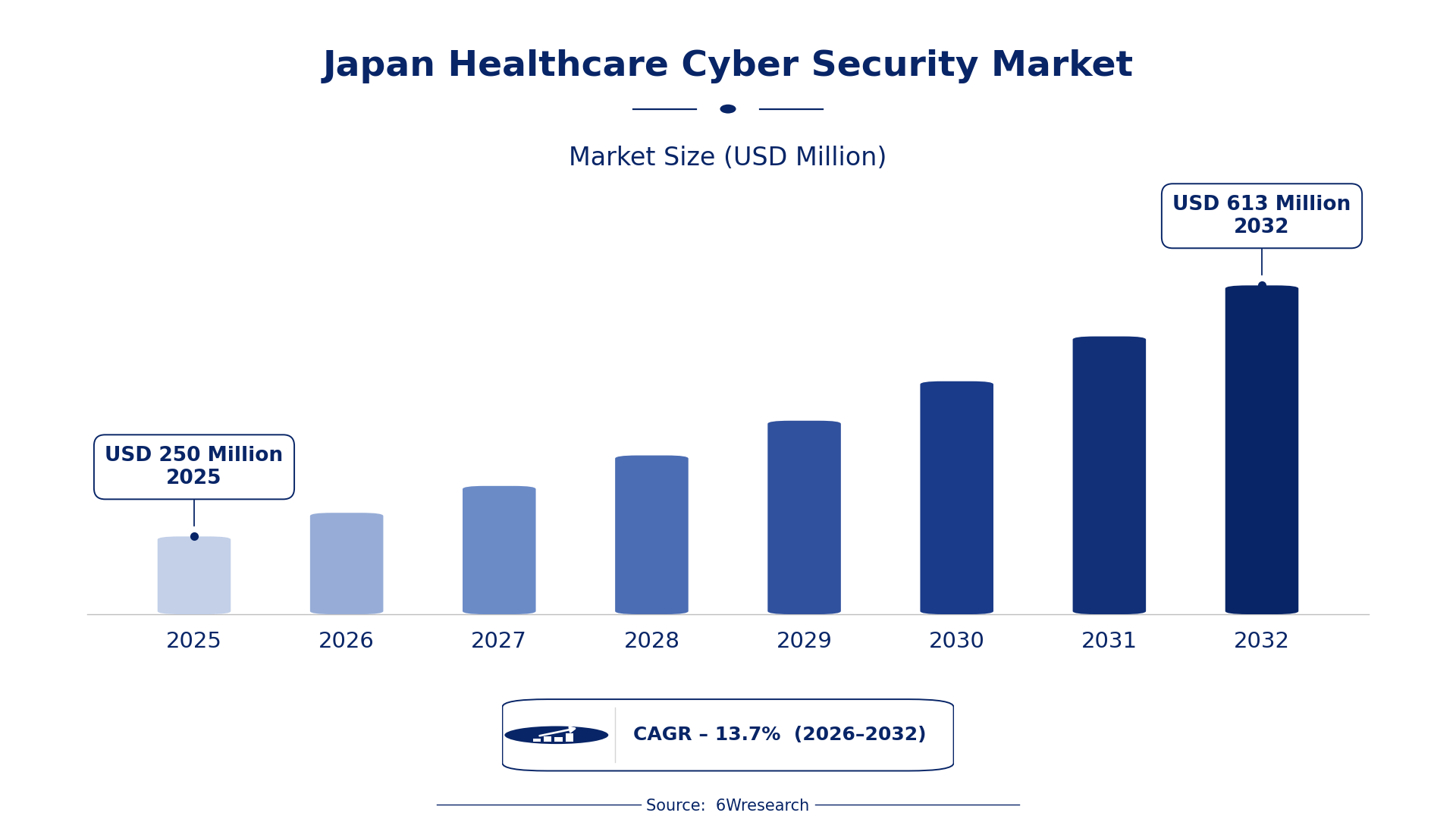
According to 6Wresearch internal database and industry insights, the Japan Healthcare Cyber Security Market was valued at USD 250 Million in 2025 and is projected to reach USD 613 Million by 2032, growing at a CAGR of approximately 13.7% during 2026–2032.
Japan Healthcare Cyber Security Market Highlights
| Report Metric | Details |
| Report Name | Japan Healthcare Cyber Security Market (2026-2032) |
| Market Size 2025 | USD 250 Million |
| Market Size 2032 | USD 613 Million |
| Absolute Growth 2025–2032 | USD 363 Million |
| CAGR 2026–2032 | 13.7% |
| Peak Annual Growth | 16.0% in 2026 |
| Forecast Period | 2026–2032 |
| Historical Data | 2022–2025 |
| Base Year | 2025 |
| Leading Type, 2025 | Solutions (64% share) |
| Leading Type of Threat, 2025 | Malware (38% share) |
| Leading End-use, 2025 | Hospitals (46% share) |
| Fastest-Growing Type | Services (17.8% CAGR) |
| Fastest-Growing Type of Threat | Advanced Persistent Threat (19.4% CAGR) |
| Fastest-Growing End-use | Medical Devices (17.0% CAGR) |
| Growing Sector | Hospitals |
| Key End Users | Hospitals, Medical Device Manufacturers, Healthcare Service Providers |
Japan Healthcare Cyber Security Market Year-wise Growth Rate and Key Drivers (2022–2032)
This graph illustrates the annual growth rates of the market from 2022 to 2032, highlighting a steady upward trajectory and projected market expansion over the forecast period.
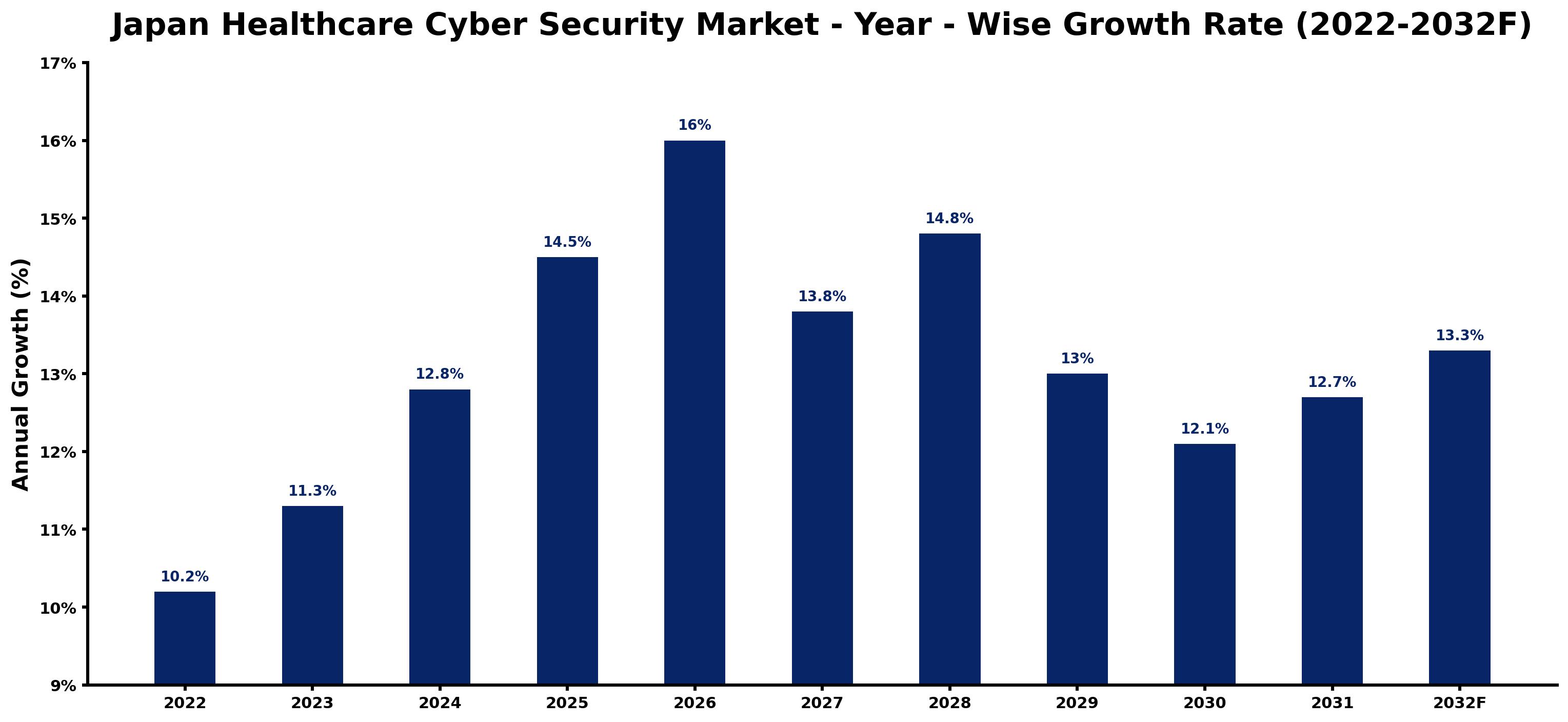
The yearly estimates that follow link every growth rate to its principal driver, so readers can see why the pace changed in each period.
| Year | Estimated Annual Growth (%) | Market Rationale |
| 2022 | 10.2 | The healthcare sector faced increasing cyber threats, prompting investments in security solutions. |
| 2023 | 11.3 | Demand for cybersecurity solutions grew as the number of reported incidents rose. |
| 2024 | 12.8 | Healthcare facilities expanded their cybersecurity measures in response to regulatory pressures. |
| 2025 | 14.5 | The implementation of new standards further accelerated the adoption of cybersecurity solutions. |
| 2026 | 16.0 | Investment in cybersecurity solutions peaked as hospitals upgraded their systems to comply with regulations. |
| 2027 | 13.8 | A slight slowdown occurred as hospitals stabilised their cybersecurity budgets after rapid growth. |
| 2028 | 14.8 | Increased awareness of cyber threats led to renewed investments in advanced security measures. |
| 2029 | 13.0 | The market continued to grow, but at a slower pace as facilities adjusted their strategies. |
| 2030 | 12.1 | Healthcare organisations focused on long-term cybersecurity strategies to maintain compliance. |
| 2031 | 12.7 | Demand for cybersecurity solutions rose again as hospitals implemented new technologies. |
| 2032 | 13.3 | The market is expected to grow steadily as ongoing threats necessitate continuous investment. |
Note: Market size estimations and growth projections presented in this report are based on 6Wresearch's proprietary forecasting methodology, utilizing the latest available industry data, government publications, and primary research inputs.
Japan Healthcare Cyber Security Market Synopsis
Healthcare Cyber Security involves protecting sensitive patient data and healthcare systems from cyber threats through advanced software solutions and expert services. In 2023, Japan's healthcare sector invested over 200 billion yen in cybersecurity solutions, driven by a 15% rise in reported cyber incidents. The increasing digitisation of healthcare practices and regulatory requirements highlight the urgent need for effective cybersecurity measures across hospitals and healthcare facilities.
Market Dynamics Impact Analysis (2026–2032)
| Factor | Type | Impact | Primary Segment Affected |
| Increasing digitisation in healthcare systems | Driver | High | Solutions |
| Rising number of cyber incidents reported in healthcare | Driver | High | Services |
| Growing demand for compliance with cybersecurity regulations | Opportunity | High | Hospitals |
| Investment in advanced cybersecurity technologies | Opportunity | Medium | Medical Devices |
| Shortage of trained cybersecurity professionals in healthcare | Restraint | High | Services |
| High costs associated with implementing comprehensive cybersecurity measures | Restraint | Medium | Solutions |
| Complexity of integrating new cybersecurity solutions into existing systems | Challenge | High | Medical Devices |
| Rapidly evolving cyber threats requiring constant updates and training | Challenge | Medium | Hospitals |
Evaluation of Drivers in Japan Healthcare Cyber Security Market (2026–2032)
These are the developments adding the most demand over the forecast period.
| Drivers | Primary Segment Affected | Why It Matters (Evidence) |
| Investment in cybersecurity solutions | Solutions | In 2023, Japan's healthcare sector invested over 200 billion yen in cybersecurity, improving data protection. |
| Rising cyber incidents | Services | The reported 15% increase in cyber incidents in 2023 prompted healthcare facilities to seek better services. |
| Compliance with regulations | Hospitals | Hospitals are mandated to implement cybersecurity measures under the Health Insurance Act, driving demand. |
| Technological advancements | Medical Devices | The adoption of ISO/IEC 27001 standard in healthcare organisations boosts demand for advanced cybersecurity technologies. |
| Training for healthcare professionals | Services | With over 8 million registered healthcare professionals, training in cybersecurity is essential for compliance. |
Buyers are adding capacity as the healthcare sector invested over 200 billion yen in cybersecurity solutions in 2023, spurred by a 15% rise in reported cyber incidents. The adoption of ISO/IEC 27001 standard improves data protection, prompting healthcare organisations to seek advanced technologies. With over 8 million healthcare professionals requiring cybersecurity training, the demand for skilled services continues to grow.
Evaluation of Restraints in Japan Healthcare Cyber Security Market
Several factors work against faster growth; the main ones are summarised below.
| Market Restraint | Primary Segment Affected | Why It Matters (Evidence) |
| Shortage of trained cybersecurity professionals | Services | The lack of qualified personnel in Japan's healthcare sector limits the effective implementation of cybersecurity measures. |
| High costs of cybersecurity solutions | Solutions | The substantial investment required for cybersecurity systems can deter smaller healthcare facilities from upgrading. |
| Complex integration of new systems | Medical Devices | Integrating advanced cybersecurity measures into existing medical devices poses technical challenges for healthcare providers. |
| Evolving cyber threats | Hospitals | Rapidly changing cyber threats necessitate constant updates, which can strain hospital resources and budgets. |
| Regulatory compliance pressures | Services | Healthcare facilities face increasing pressure to comply with regulations, complicating service delivery. |
Japan Healthcare Cyber Security Market Challenges
In 2023, Japan's healthcare sector invested over 200 billion yen in cybersecurity solutions, yet many hospitals struggle to cover these costs, resulting in inadequate protection for patient data. Regulatory requirements from the Pharmaceuticals and Medical Devices Agency can delay the implementation of vital cybersecurity measures, increasing operational expenses for healthcare providers. Supply chain disruptions occur when procuring advanced cybersecurity software, causing delays in securing sensitive information for clinics. Skills shortages remain critical, as over 8 million registered healthcare professionals need cybersecurity training, hindering the sector's ability to effectively address the 15% rise in reported cyber incidents in 2023.
Trends in the Japan Healthcare Cyber Security Market
The following changes are redrawing the Japan Healthcare Cyber Security Market.
- Shift towards Advanced Cybersecurity Solutions: Tokyo is experiencing a shift towards advanced cybersecurity solutions as hospitals upgrade their systems to meet new standards. In 2023, the government allocated 5 billion yen for cybersecurity initiatives, indicating strong support for this transition.
- Increased Focus on Cybersecurity Training: Healthcare professionals are prioritising cybersecurity training, driven by the need for compliance. In 2023, over 8 million healthcare professionals required training, highlighting the growing importance of skilled personnel in the sector.
- Emergence of New Cybersecurity Standards: The introduction of the Cybersecurity Strategy for Healthcare 2023 marks a shift in compliance-driven cybersecurity standards. This initiative aims to improve data protection measures across healthcare facilities, reflecting the sector's evolving needs.
- Growing Demand for Medical Device Security: Medical devices are becoming a focal point for cybersecurity investments, with hospitals recognising the need for enhanced protection. The market for medical device cybersecurity is expected to grow as healthcare providers seek to safeguard sensitive patient data.
Investment Opportunities in the Japan Healthcare Cyber Security Market
Investors looking at the Japan Healthcare Cyber Security Market should consider the following areas.
- Gap in Cybersecurity Solutions: With Japan's healthcare sector investing over 200 billion yen in cybersecurity solutions, there is a gap in advanced offerings. Hospitals are looking for local partners to strengthen their cybersecurity capabilities.
- Investment in Medical Device Security: The increasing reliance on medical devices creates an opportunity for suppliers to provide cybersecurity solutions. Collaborating with hospitals can facilitate entry into this growing market.
- Rising Demand for Compliance Services: As hospitals strive to meet regulatory requirements, the demand for compliance services is on the rise. Engaging with healthcare associations can help service providers tap into this opportunity.
- Need for Enhanced Cybersecurity Training: The requirement for cybersecurity training for over 8 million healthcare professionals presents an opportunity for educational institutions. Developing training programmes can address this critical need in the sector.
Government Initiatives in the Japan Healthcare Cyber Security Market
The Medical Care Act, established in 1948, sets standards for hospitals and clinics, including requirements for data protection measures. This law influences healthcare cybersecurity by ensuring that facilities maintain adequate safeguards for patient information.
The Pharmaceuticals and Medical Devices Agency (PMDA) oversees compliance with cybersecurity regulations in medical devices. Established in 2015, PMDA ensures that manufacturers adhere to cybersecurity standards, promoting safety and security in healthcare.
Future Insight of the Japan Healthcare Cyber Security Market
Investment in cybersecurity initiatives will reach 5 billion yen by 2032, creating a surge in demand for new security technologies. Urban areas like Tokyo and Osaka will lead in adopting advanced cybersecurity measures, ensuring better protection for patient data. Training programmes will be established to equip healthcare professionals with necessary skills, improving their ability to combat cyber threats. New standards will emerge, promoting consistent data protection practices across healthcare facilities.
Market Segmentation Analysis
Japan Healthcare Cyber Security Market report covers a detailed analysis of the following market segments:
By Type – Solutions Lead, Services Expected to Grow Fastest
According to Vasudha, AM at 6Wresearch, in 2025, Solutions led the type split with a 64% share. Solutions dominate the market as they are vital for safeguarding healthcare systems against cyber threats. The substantial investment of over 200 billion yen in cybersecurity solutions in 2023 highlights their essential role in protecting sensitive patient data. Services are projected to grow fastest, at a CAGR of 17.8% during 2026–2032. Services are experiencing rapid growth as healthcare organisations increasingly require ongoing support for implementing and managing cybersecurity measures. The 15% rise in reported cyber incidents in 2023 underscores the pressing need for these services to address vulnerabilities. Suppliers should enhance service offerings to align with the growing demand for comprehensive cybersecurity management.
By Type of Threat – Malware Leads, Advanced Persistent Threat Expected to Grow Fastest
Malware held 38% of the Japan Healthcare Cyber Security Market by type of threat in 2025. Malware is the predominant threat type due to its significant risk to the integrity of healthcare data. The rising number of cyber incidents in the sector illustrates the ongoing vulnerability of healthcare systems to malware attacks. Advanced Persistent Threat is set to record the highest CAGR in this split, 19.4% over 2026–2032. Advanced Persistent Threats are advancing quickly because of their sophisticated nature, specifically targeting sensitive healthcare information. This trend signifies a troubling shift towards more complex and targeted cyber threats in the healthcare sector. Buyers must focus on advanced threat detection and response capabilities to counter the increasing sophistication of cyber threats.
By End-use – Hospitals Lead, Medical Devices Expected to Grow Fastest
The largest end-use category in 2025 was Hospitals, at 46% of revenue. Hospitals are the largest end-use segment as they are the primary users of cybersecurity solutions to protect patient data and systems. With over 8,100 hospitals in Japan, the demand for robust cybersecurity measures remains high. The quickest growth will come from Medical Devices, forecast to expand at a CAGR of 17.0% between 2026 and 2032. Medical Devices are the fastest-growing segment as they increasingly rely on cybersecurity to prevent hacking. Ensuring cybersecurity in medical devices is critical for maintaining patient safety and meeting regulatory standards. Suppliers should customise their offerings to address the specific cybersecurity needs of medical devices, ensuring compliance and protection.
Key Attractiveness of the Report
- 10 Years of Market Numbers
- Historical Data Starting from 2022 to 2025
- Base Year 2025
- Forecast Data until 2032
- Key Performance Indicators Impacting the Market
- Major Upcoming Developments and Projects
Key Highlights of the Report:
- Japan Healthcare Cyber Security Market Outlook
- Market Size of Japan Healthcare Cyber Security Market, 2025
- Forecast of Japan Healthcare Cyber Security Market, 2032
- Historical Data and Forecast of Japan Healthcare Cyber Security Revenues & Volume for the Period 2022-2032
- Japan Healthcare Cyber Security Market Trend Evolution
- Japan Healthcare Cyber Security Market Drivers and Challenges
- Japan Healthcare Cyber Security Price Trends
- Japan Healthcare Cyber Security Porter's Five Forces
- Japan Healthcare Cyber Security Industry Life Cycle
- Historical Data and Forecast of Japan Healthcare Cyber Security Market Revenues & Volume By Type for the Period 2022-2032
- Historical Data and Forecast of Japan Healthcare Cyber Security Market Revenues & Volume By Solutions for the Period 2022-2032
- Historical Data and Forecast of Japan Healthcare Cyber Security Market Revenues & Volume By Services for the Period 2022-2032
- Historical Data and Forecast of Japan Healthcare Cyber Security Market Revenues & Volume By Type of Threat for the Period 2022-2032
- Historical Data and Forecast of Japan Healthcare Cyber Security Market Revenues & Volume By Malware for the Period 2022-2032
- Historical Data and Forecast of Japan Healthcare Cyber Security Market Revenues & Volume By DDoS for the Period 2022-2032
- Historical Data and Forecast of Japan Healthcare Cyber Security Market Revenues & Volume By Advanced Persistent Threat for the Period 2022-2032
- Historical Data and Forecast of Japan Healthcare Cyber Security Market Revenues & Volume By Spyware for the Period 2022-2032
- Historical Data and Forecast of Japan Healthcare Cyber Security Market Revenues & Volume By Lost or Stolen Devices for the Period 2022-2032
- Historical Data and Forecast of Japan Healthcare Cyber Security Market Revenues & Volume By Others for the Period 2022-2032
- Historical Data and Forecast of Japan Healthcare Cyber Security Market Revenues & Volume By End-use for the Period 2022-2032
- Historical Data and Forecast of Japan Healthcare Cyber Security Market Revenues & Volume By Pharmaceuticals for the Period 2022-2032
- Historical Data and Forecast of Japan Healthcare Cyber Security Market Revenues & Volume By Medical Devices for the Period 2022-2032
- Historical Data and Forecast of Japan Healthcare Cyber Security Market Revenues & Volume By Payers for the Period 2022-2032
- Historical Data and Forecast of Japan Healthcare Cyber Security Market Revenues & Volume By Hospitals for the Period 2022-2032
- Historical Data and Forecast of Japan Healthcare Cyber Security Market Revenues & Volume By Others for the Period 2022-2032
- Japan Healthcare Cyber Security Import Export Trade Statistics
- Market Opportunity Assessment By Type
- Market Opportunity Assessment By Type of Threat
- Market Opportunity Assessment By End-use
- Japan Healthcare Cyber Security Top Companies Market Share
- Japan Healthcare Cyber Security Competitive Benchmarking By Technical and Operational Parameters
- Japan Healthcare Cyber Security Company Profiles
- Japan Healthcare Cyber Security Key Strategic Recommendations
Market Covered
Segments analysed in this report are listed below.
By Type
- Solutions
- Services
By Type of Threat
- Malware
- DDoS
- Advanced Persistent Threat
- Spyware
- Lost or Stolen Devices
- Others
By End-use
- Pharmaceuticals
- Medical Devices
- Payers
- Hospitals
- Others






































