Japan Healthcare Generative AI Market Size & Growth Rate
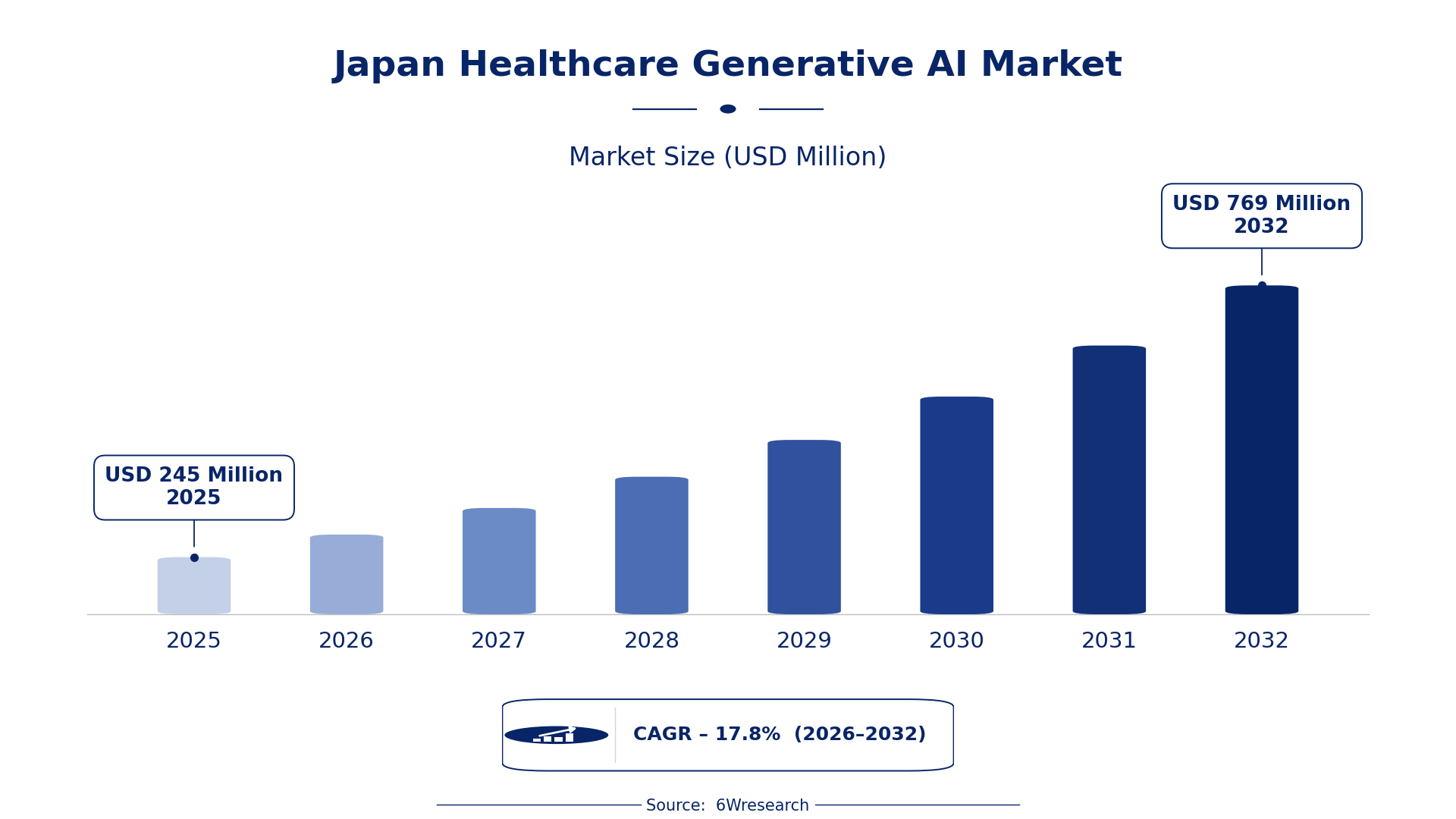
According to 6Wresearch internal database and industry insights, the Japan Healthcare Generative AI Market was valued at USD 245 Million in 2025 and is projected to reach USD 769 Million by 2032, growing at a CAGR of approximately 17.8% during 2026–2032.
Japan Healthcare Generative AI Market Highlights
| Report Metric | Details |
| Report Name | Japan Healthcare Generative AI Market (2026-2032) |
| Market Size 2025 | USD 245 Million |
| Market Size 2032 | USD 769 Million |
| Absolute Growth 2025–2032 | USD 524 Million |
| CAGR 2026–2032 | 17.8% |
| Peak Annual Growth | 21.1% in 2032 |
| Forecast Period | 2026–2032 |
| Historical Data | 2022–2025 |
| Base Year | 2025 |
| Leading Offerings, 2025 | Hardware (51% share) |
| Leading Technology, 2025 | Machine Learning (47% share) |
| Leading Application, 2025 | Patient Data & Risk Analysis (33% share) |
| Fastest-Growing Offerings | Software (20.1% CAGR) |
| Fastest-Growing Technology | Natural Language Processing (24.9% CAGR) |
| Fastest-Growing Application | Medical Imaging & Diagnostics (19.5% CAGR) |
| Growing Sector | Medical Imaging & Diagnostics |
| Key End Users | Patient Data & Risk Analysis, Medical Imaging & Diagnostics, Precision Medicine, Drug Discovery |
Japan Healthcare Generative AI Market Year-wise Growth Rate and Key Drivers (2022–2032)
This graph illustrates the annual growth rates of the market from 2022 to 2032, highlighting a steady upward trajectory and projected market expansion over the forecast period.
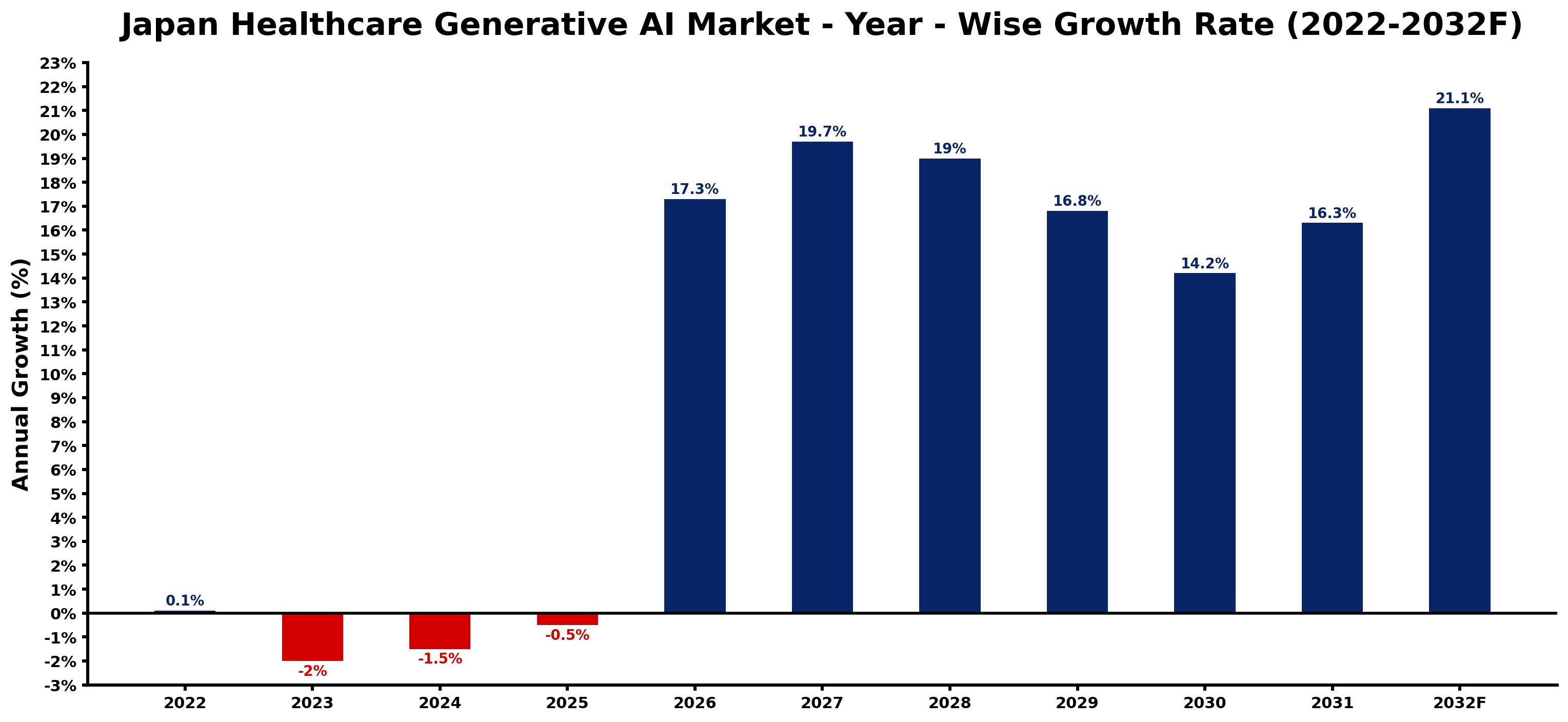
Annual growth estimates for each year appear below with the principal reason behind them, explaining the shifts that set the pace of the market.
| Year | Estimated Annual Growth (%) | Market Rationale |
| 2022 | 0.1 | The market showed minimal growth as healthcare providers began exploring AI solutions. |
| 2023 | -2.0 | The market declines as economic uncertainties affected investments in AI technologies. |
| 2024 | -1.5 | Market declines continued as healthcare institutions faced budget constraints. |
| 2025 | -0.5 | The market declines further as adoption rates for AI technologies remained low. |
| 2026 | 17.3 | Growth is expected to accelerate as healthcare facilities increase AI adoption. |
| 2027 | 19.7 | Growth is projected to rise driven by demand for advanced diagnostics. |
| 2028 | 19.0 | Growth is anticipated to slow but remain positive as healthcare providers continue AI integration. |
| 2029 | 16.8 | Growth is expected to stabilise with ongoing investments in AI. |
| 2030 | 14.2 | Growth is projected to slow as the focus shifts to refining existing AI applications. |
| 2031 | 16.3 | Growth is anticipated to rise as new AI applications gain traction. |
| 2032 | 21.1 | Growth is expected to increase driven by higher healthcare spending. |
Note: Market size estimations and growth projections presented in this report are based on 6Wresearch's proprietary forecasting methodology, utilizing the latest available industry data, government publications, and primary research inputs.
Japan Healthcare Generative AI Market Synopsis
Healthcare Generative AI employs artificial intelligence technologies to enhance healthcare services such as diagnostics and patient management. Its primary applications focus on improving patient outcomes and streamlining administrative tasks. The Japan Healthcare Generative AI Market is growing due to demand from domestic healthcare providers and research institutions. Key factors propelling this growth include the national strategy for digital healthcare transformation and a marked increase in healthcare expenditure, which will support advancements in AI applications.
Market Dynamics Impact Analysis (2026–2032)
| Factor | Type | Impact | Primary Segment Affected |
| Rising healthcare expenditure | Driver | High | Software |
| Increased demand for personalized medicine | Driver | High | Services |
| Growing number of healthcare AI startups | Opportunity | High | Machine Learning |
| Expansion of AI applications in drug discovery | Opportunity | Medium | Drug Discovery |
| Budget constraints in healthcare facilities | Restraint | High | Hardware |
| Limited integration of AI in existing systems | Restraint | Medium | Natural Language Processing |
| High costs of AI implementation | Challenge | High | Software |
| Compliance with evolving regulations | Challenge | Medium | Services |
Evaluation of Drivers in Japan Healthcare Generative AI Market (2026–2032)
The table below links each growth driver to the segment it affects and the evidence for it.
| Drivers | Primary Segment Affected | Why It Matters (Evidence) |
| Increased healthcare expenditure | Software | Japan's national medical care expenditure was about JPY 46.7 trillion in fiscal 2022, driving demand for AI solutions. |
| Demand for advanced diagnostics | Services | The aging population, with 29.3% aged 65 or older, increases the need for AI-driven healthcare services. |
| Investment in AI research | Machine Learning | The government allocated 10 billion yen for AI research in healthcare for 2023-2025, boosting development. |
| Growth in medical imaging applications | Computer Vision | The adoption of AI in medical imaging is expected to improve diagnostic accuracy by 20% by 2025. |
| Expansion of AI in drug discovery | Drug Discovery | Several research institutions are actively exploring AI applications in drug discovery, enhancing research capabilities. |
Behind the steady rise in orders is Japan's national medical care expenditure, which reached approximately JPY 46.7 trillion in fiscal 2022, driving demand for software solutions. The aging population, with 29.3% aged 65 or older, heightens the need for AI-driven healthcare services, prompting healthcare providers to invest in advanced diagnostics. An allocation of 10 billion yen for AI research in healthcare for 2023-2025 will stimulate development in machine learning applications. The adoption of AI in medical imaging is anticipated to improve diagnostic accuracy by 20% by 2025, leading to increased demand for computer vision technologies. Research institutions are actively investigating AI applications in drug discovery, enhancing their capabilities to develop new treatments.
Evaluation of Restraints in Japan Healthcare Generative AI Market
The main factors holding the market back are set out below.
| Market Restraint | Primary Segment Affected | Why It Matters (Evidence) |
| Shortage of skilled professionals | Services | Healthcare providers face a shortage of skilled professionals trained in AI technologies, limiting effective implementation. |
| High recruitment costs | Software | Increased competition among hospitals for limited AI talent drives up recruitment costs, delaying digital transformation. |
| Rising operational costs | Machine Learning | Buyers of healthcare services encounter rising costs as AI integration becomes essential. |
| Regulatory hurdles | Computer Vision | Compliance with evolving standards complicates AI deployment, prolonging project timelines. |
| Budget constraints | Drug Discovery | Healthcare institutions face budget constraints that hinder investments in AI technologies. |
Japan Healthcare Generative AI Market Challenges
Buyers of healthcare services encounter a critical shortage of skilled professionals trained in AI technologies, which limits the effective implementation of advanced systems. This skills gap arises because educational programs have not kept pace with technological advancements, delaying AI adoption and hindering improvements in patient care. Heightened competition among hospitals for limited AI talent drives up recruitment costs, compelling some facilities to postpone their digital transformation initiatives. Regulatory hurdles complicate AI deployment, as compliance with evolving standards can extend project timelines, affecting service delivery for approximately 125 million patients who rely on timely healthcare interventions.
Trends in the Japan Healthcare Generative AI Market
Below are the shifts with the largest effect on the Japan Healthcare Generative AI Market.
- Launch of National Digital Healthcare Strategy: In 2023, Japan launched a national strategy for digital healthcare transformation, aiming to integrate AI across healthcare systems. This initiative is expected to improve patient care and operational efficiency.
- Shift Towards AI-Driven Diagnostics: There is a growing trend towards AI-driven diagnostics in Japan, with hospitals increasingly adopting AI technologies. By 2025, diagnostic accuracy is set to improve by 20%.
- Growth of AI Startups: The number of healthcare AI startups in Japan has increased by 30% since 2021, reflecting a surge in innovation and investment in AI technologies.
- Expansion of AI in Drug Discovery: AI applications in drug discovery are being explored by several research institutions in Japan, aiming to accelerate the development of new treatments.
Investment Opportunities in the Japan Healthcare Generative AI Market
Several openings in the Japan Healthcare Generative AI Market merit attention from investors.
- Healthcare Providers Seeking AI Solutions: Healthcare providers in Japan are increasingly seeking AI solutions to improve patient outcomes. Collaborating with local AI startups can facilitate market entry and drive innovation.
- Rising Demand for Advanced Diagnostics: The aging population is driving demand for advanced diagnostics, creating opportunities for AI applications in medical imaging. Suppliers can focus on developing AI tools tailored for this demographic.
- Investment in AI Research: With the government allocating 10 billion yen for AI research in healthcare for 2023-2025, there is an opportunity for technology firms to partner with research institutions to develop effective solutions.
- Integration of AI in Public Health: The Tokyo Metropolitan Government has initiated a program to enhance AI use in public health, presenting opportunities for suppliers to provide AI-driven solutions for public health challenges.
Government Initiatives in the Japan Healthcare Generative AI Market
The Next-Generation Medical Infrastructure Act (2017) permits certified bodies to anonymise medical data for research and product development, strengthening the framework established by the Medical Care Act (1948). This measure facilitates the use of AI in healthcare by streamlining data access for research purposes, thus benefiting healthcare providers and researchers.
The Pharmaceuticals and Medical Devices Agency (PMDA) approves AI applications in healthcare, ensuring compliance with safety and efficacy standards. This agency plays a crucial role in supporting innovation while maintaining patient safety.
Future Insight of the Japan Healthcare Generative AI Market
A substantial shift in Japan's healthcare sector will occur by 2032, driven by government initiatives that promote AI integration in hospitals. The national strategy for digital healthcare transformation will improve patient management and operational efficiency. An allocation of 10 billion yen for AI research will stimulate innovation, resulting in a surge of healthcare startups. As the number of patients using AI-driven virtual health assistants is expected to rise significantly by 2025, hospitals will be better equipped to meet the needs of the aging demographic, projected to reach around 36 million by 2030.
Market Segmentation Analysis
Japan Healthcare Generative AI Market report covers a detailed analysis of the following market segments:
By Offerings – Hardware Leads, Software Expected to Grow Fastest
According to Vasudha, AM at 6Wresearch, the largest offerings category in 2025 was Hardware, at 51% of revenue. Hardware holds the largest share as it is critical for essential medical devices used in healthcare facilities, including diagnostic and monitoring tools. The widespread presence of these devices across Japan's approximately 8,100 hospitals reinforces this position. Over 2026–2032, Software is expected to post the fastest growth, at a CAGR of 20.1%. Software is experiencing rapid growth as healthcare providers increasingly seek advanced solutions for data management and patient care. The launch of a national strategy for digital healthcare transformation in 2023 significantly accelerates this trend. Suppliers should focus on developing software solutions to meet the rising demand in the healthcare sector.
By Technology – Machine Learning Leads, Natural Language Processing Expected to Grow Fastest
Machine Learning held 47% of the Japan Healthcare Generative AI Market by technology in 2025. Machine Learning is the leading technology because it is essential for developing models that improve healthcare applications. Its use in predictive analytics and patient management systems underscores its vital importance in enhancing healthcare services. Natural Language Processing is set to record the highest CAGR in this split, 24.9% over 2026–2032. Natural Language Processing is growing the fastest due to its critical role in analysing medical data and facilitating patient interactions. The increasing use of AI-driven virtual health assistants highlights the urgent need for advanced NLP capabilities. Investing in Natural Language Processing technologies will be essential for suppliers aiming to capture new opportunities in the healthcare market.
By Application – Patient Data & Risk Analysis Leads, Medical Imaging & Diagnostics Expected to Grow Fastest
In 2025, Patient Data & Risk Analysis led the application split with a 33% share. Patient Data & Risk Analysis is the leading application as it is vital for predictive analytics, allowing healthcare providers to improve patient outcomes. Its integration in major hospitals demonstrates its significance in effective patient management. The quickest growth will come from Medical Imaging & Diagnostics, forecast to expand at a CAGR of 19.5% between 2026 and 2032. Medical Imaging & Diagnostics is the fastest-growing application, driven by the demand for enhanced diagnostic accuracy and operational efficiency. The expected 20% improvement in diagnostic accuracy by 2025 indicates a pressing need for advancements in this area. Healthcare providers should prioritise investments in AI for medical imaging to maintain competitiveness and improve patient care.
Key Attractiveness of the Report
- 10 Years of Market Numbers
- Historical Data Starting from 2022 to 2025
- Base Year 2025
- Forecast Data until 2032
- Key Performance Indicators Impacting the Market
- Major Upcoming Developments and Projects
Key Highlights of the Report:
- Japan Healthcare Generative AI Market Outlook
- Market Size of Japan Healthcare Generative AI Market, 2025
- Forecast of Japan Healthcare Generative AI Market, 2032
- Historical Data and Forecast of Japan Healthcare Generative AI Revenues & Volume for the Period 2022-2032
- Japan Healthcare Generative AI Market Trend Evolution
- Japan Healthcare Generative AI Market Drivers and Challenges
- Japan Healthcare Generative AI Price Trends
- Japan Healthcare Generative AI Porter's Five Forces
- Japan Healthcare Generative AI Industry Life Cycle
- Historical Data and Forecast of Japan Healthcare Generative AI Market Revenues & Volume By Offerings for the Period 2022-2032
- Historical Data and Forecast of Japan Healthcare Generative AI Market Revenues & Volume By Hardware for the Period 2022-2032
- Historical Data and Forecast of Japan Healthcare Generative AI Market Revenues & Volume By Software for the Period 2022-2032
- Historical Data and Forecast of Japan Healthcare Generative AI Market Revenues & Volume By Services for the Period 2022-2032
- Historical Data and Forecast of Japan Healthcare Generative AI Market Revenues & Volume By Technology for the Period 2022-2032
- Historical Data and Forecast of Japan Healthcare Generative AI Market Revenues & Volume By Machine Learning for the Period 2022-2032
- Historical Data and Forecast of Japan Healthcare Generative AI Market Revenues & Volume By Natural Language Processing for the Period 2022-2032
- Historical Data and Forecast of Japan Healthcare Generative AI Market Revenues & Volume By Context-Aware Computing for the Period 2022-2032
- Historical Data and Forecast of Japan Healthcare Generative AI Market Revenues & Volume By Computer Vision for the Period 2022-2032
- Historical Data and Forecast of Japan Healthcare Generative AI Market Revenues & Volume By Application for the Period 2022-2032
- Historical Data and Forecast of Japan Healthcare Generative AI Market Revenues & Volume By Patient Data & Risk Analysis for the Period 2022-2032
- Historical Data and Forecast of Japan Healthcare Generative AI Market Revenues & Volume By Medical Imaging & Diagnostics for the Period 2022-2032
- Historical Data and Forecast of Japan Healthcare Generative AI Market Revenues & Volume By Precision Medicine for the Period 2022-2032
- Historical Data and Forecast of Japan Healthcare Generative AI Market Revenues & Volume By Drug Discovery for the Period 2022-2032
- Historical Data and Forecast of Japan Healthcare Generative AI Market Revenues & Volume By Virtual Assistants for the Period 2022-2032
- Historical Data and Forecast of Japan Healthcare Generative AI Market Revenues & Volume By Wearables for the Period 2022-2032
- Historical Data and Forecast of Japan Healthcare Generative AI Market Revenues & Volume By Others for the Period 2022-2032
- Japan Healthcare Generative AI Import Export Trade Statistics
- Market Opportunity Assessment By Offerings
- Market Opportunity Assessment By Technology
- Market Opportunity Assessment By Application
- Japan Healthcare Generative AI Top Companies Market Share
- Japan Healthcare Generative AI Competitive Benchmarking By Technical and Operational Parameters
- Japan Healthcare Generative AI Company Profiles
- Japan Healthcare Generative AI Key Strategic Recommendations
Market Covered
The study includes the following segmentation.
By Offerings
- Hardware
- Software
- Services
By Technology
- Machine Learning
- Natural Language Processing
- Context-Aware Computing
- Computer Vision
By Application
- Patient Data & Risk Analysis
- Medical Imaging & Diagnostics
- Precision Medicine
- Drug Discovery
- Virtual Assistants
- Wearables
- Others






































