Japan Hepatobiliary Disorders Market Size & Growth Rate
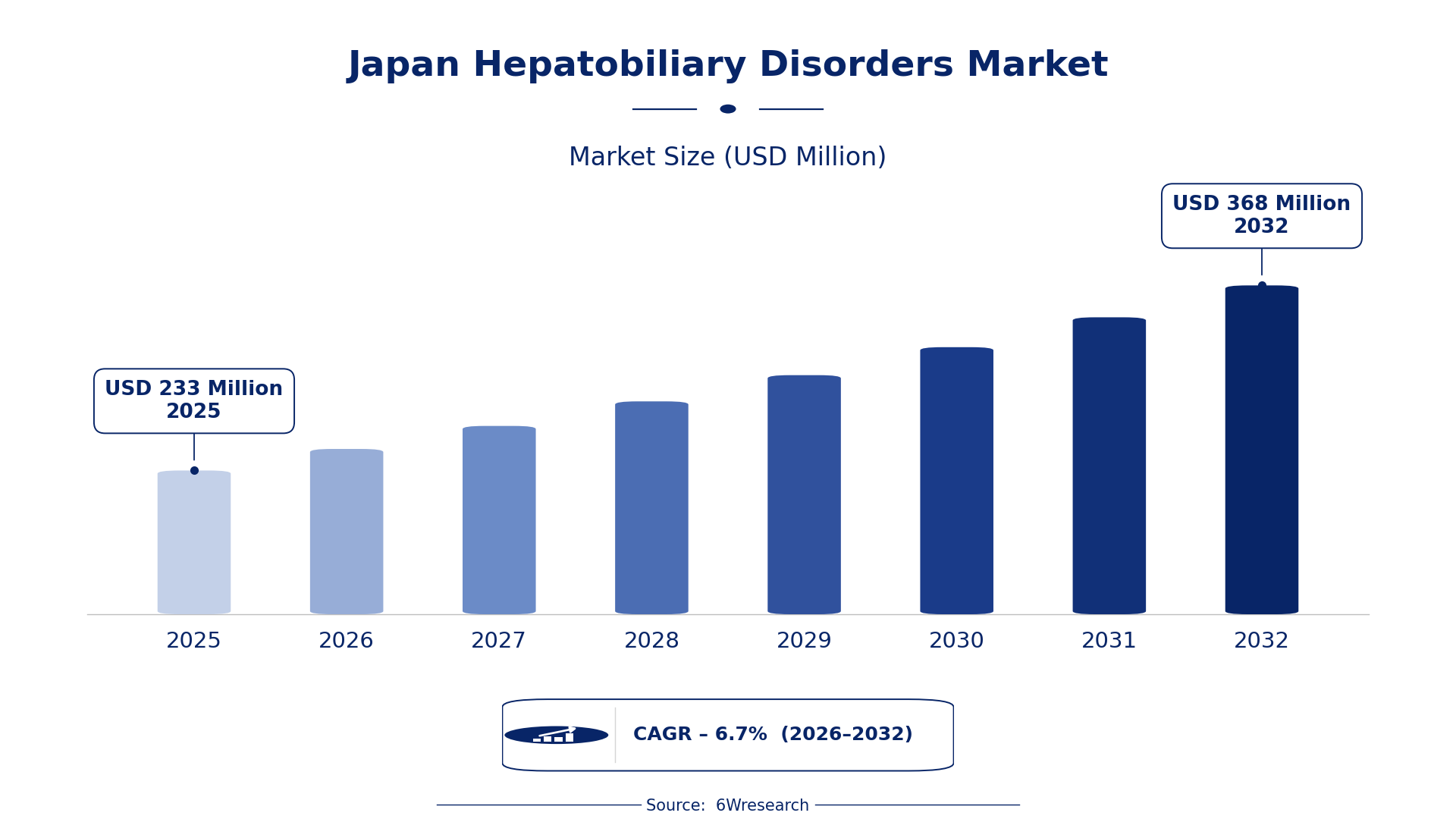
According to 6Wresearch internal database and industry insights, the Japan Hepatobiliary Disorders Market was valued at USD 233 Million in 2025 and is projected to reach USD 368 Million by 2032, growing at a CAGR of approximately 6.7% during 2026–2032.
Japan Hepatobiliary Disorders Market Highlights
| Report Metric | Details |
| Report Name | Japan Hepatobiliary Disorders Market (2026-2032) |
| Market Size 2025 | USD 233 Million |
| Market Size 2032 | USD 368 Million |
| Absolute Growth 2025–2032 | USD 135 Million |
| CAGR 2026–2032 | 6.7% |
| Peak Annual Growth | 8.1% in 2027 |
| Forecast Period | 2026–2032 |
| Historical Data | 2022–2025 |
| Base Year | 2025 |
| Leading Disorder Type, 2025 | Liver Cirrhosis (42% share) |
| Leading Diagnostic Method, 2025 | Fibroscan (48% share) |
| Leading Distribution Channel, 2025 | Specialty Pharmacies (36% share) |
| Leading End User, 2025 | Gastroenterology Clinics (43% share) |
| Fastest-Growing Disorder Type | Biliary Strictures (9.5% CAGR) |
| Fastest-Growing Diagnostic Method | Cholangiography (10.0% CAGR) |
| Fastest-Growing Distribution Channel | Online Portals (8.8% CAGR) |
| Fastest-Growing End User | Hepatology Labs (8.9% CAGR) |
| Growing Sector | Hepatobiliary care |
| Key End Users | Hospitals, gastroenterology clinics, research institutes |
Japan Hepatobiliary Disorders Market Year-wise Growth Rate and Key Drivers (2022–2032)
This graph illustrates the annual growth rates of the market from 2022 to 2032, highlighting a steady upward trajectory and projected market expansion over the forecast period.
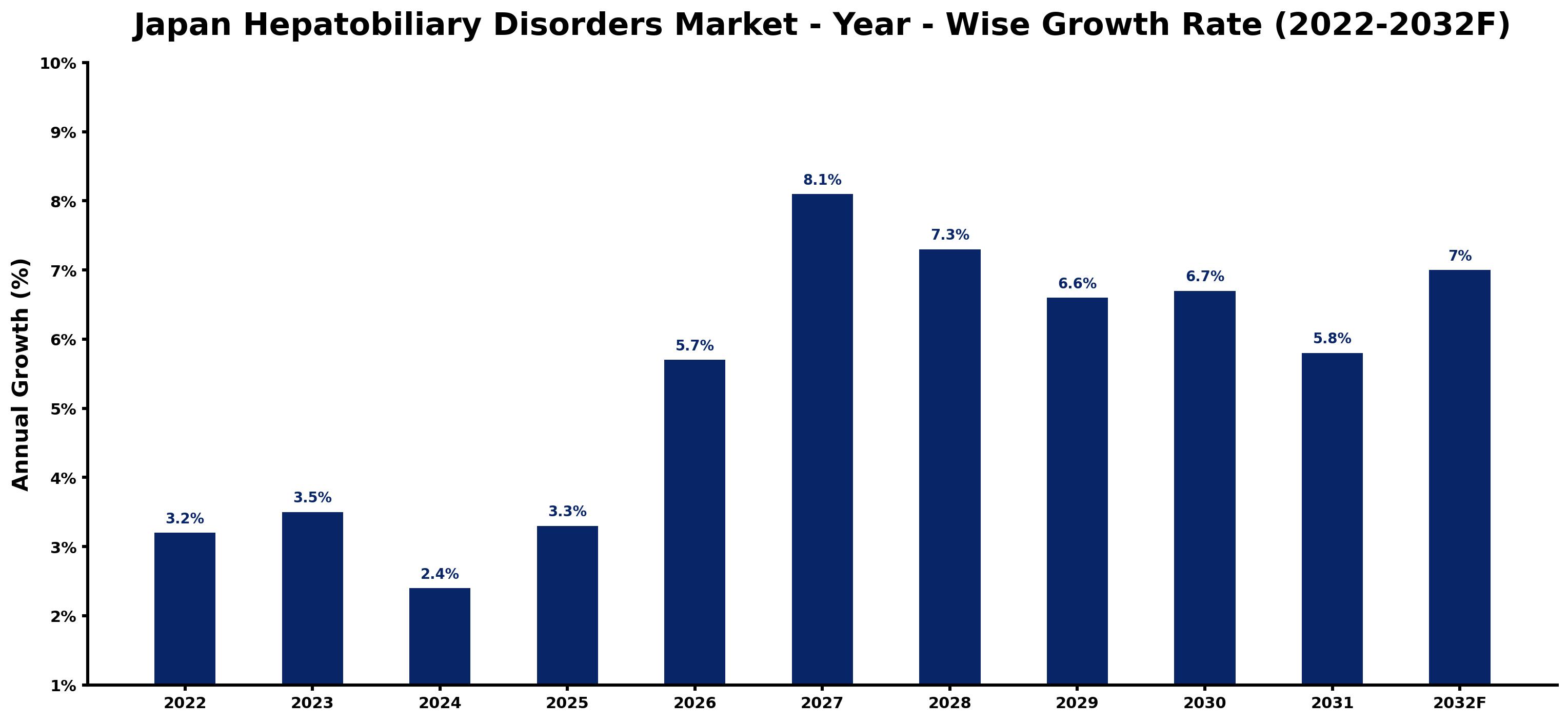
The following figures match every annual growth estimate with the main market development of that year, giving the reasoning behind each rise or slowdown.
| Year | Estimated Annual Growth (%) | Market Rationale |
| 2022 | 3.2 | The healthcare system supported steady management of liver diseases in Japan. |
| 2023 | 3.5 | Increased awareness of liver health contributed to growth faster than the previous year. |
| 2024 | 2.4 | A slight slowdown occurred as demand stabilised amid ongoing treatment programmes. |
| 2025 | 3.3 | Growth picked up again due to rising patient numbers seeking hepatobiliary care. |
| 2026 | 5.7 | Demand is expected to surge as healthcare facilities expand their diagnostic capabilities. |
| 2027 | 8.1 | The market is projected to peak with investments in liver disease management initiatives. |
| 2028 | 7.3 | Growth is expected to slow slightly as the market adjusts to peak levels of demand. |
| 2029 | 6.6 | Continued focus on liver health will maintain demand, though at a slower pace. |
| 2030 | 6.7 | Investment in new diagnostic technologies will drive growth higher once more. |
| 2031 | 5.8 | A slight slowdown is projected as the market matures and competition intensifies. |
| 2032 | 7.0 | Growth will accelerate again as new treatment options become available. |
Note: Market size estimations and growth projections presented in this report are based on 6Wresearch's proprietary forecasting methodology, utilizing the latest available industry data, government publications, and primary research inputs.
Japan Hepatobiliary Disorders Market Synopsis
Hepatobiliary disorders include diseases affecting the liver and bile ducts, primarily caused by infections and metabolic conditions. In Japan, approximately 1.5 million cases of liver diseases were reported in 2022, supported by a healthcare system that facilitates effective management. The Japan Hepatobiliary Disorders Market is expanding due to rising patient awareness, advancements in diagnostic methods like Fibroscan, and increased investment in liver disease research, with ¥5 billion allocated for research initiatives in 2023.
Market Dynamics Impact Analysis (2026–2032)
| Factor | Type | Impact | Primary Segment Affected |
| Increasing prevalence of liver diseases | Driver | High | Liver Cirrhosis |
| Growing adoption of non-invasive diagnostic tools | Driver | High | Fibroscan |
| Expansion of gastroenterology clinics | Opportunity | High | Gastroenterology Clinics |
| Rising demand for advanced imaging techniques | Opportunity | High | Cholangiography |
| Limited access to specialized care in rural areas | Restraint | Medium | Gastroenterology Clinics |
| High costs associated with advanced treatments | Restraint | Medium | Alcoholic Liver Disease |
| Long wait times for liver transplants | Challenge | High | Liver Cirrhosis |
| Competition among diagnostic methods | Challenge | Medium | Liver Cirrhosis |
Evaluation of Drivers in Japan Hepatobiliary Disorders Market (2026–2032)
The following drivers explain most of the expected growth.
| Drivers | Primary Segment Affected | Why It Matters (Evidence) |
| Rising cases of liver diseases | Liver Cirrhosis | Approximately 1.5 million cases reported in 2022 drive demand for treatment. |
| Increased use of Fibroscan | Fibroscan | Widely used in over 200 hospitals enhances diagnostic accuracy and patient management. |
| Growth of gastroenterology clinics | Gastroenterology Clinics | Clinics in Osaka serve over 2 million, increasing access to specialized care. |
| Advancements in cholangiography techniques | Cholangiography | Critical in over 80% of hepatobiliary surgeries, boosting demand for imaging services. |
| Rising prevalence of Nonalcoholic Steatohepatitis | Nonalcoholic Steatohepatitis | Estimated at 25% among adults in urban areas, increasing the need for management. |
Orders keep climbing as the prevalence of liver diseases rises, with approximately 1.5 million cases reported in 2022. The widespread adoption of Fibroscan in over 200 hospitals improves diagnostic capabilities, prompting more patients to seek treatment. Gastroenterology clinics in Osaka serve a population of over 2 million, increasing access to specialized care. Advancements in cholangiography, critical in over 80% of hepatobiliary surgeries, drive demand for imaging services. The estimated prevalence of Nonalcoholic Steatohepatitis among urban adults necessitates effective management strategies, further boosting demand.
Evaluation of Restraints in Japan Hepatobiliary Disorders Market
The key brakes on demand, and where they bite hardest, are shown below.
| Market Restraint | Primary Segment Affected | Why It Matters (Evidence) |
| Limited access to specialized care in rural areas | Gastroenterology Clinics | Patients in rural regions face challenges accessing specialized hepatobiliary services, limiting treatment options. |
| High costs associated with advanced treatments | Alcoholic Liver Disease | The financial burden of treatment can deter patients from seeking necessary care, impacting overall health outcomes. |
| Long wait times for liver transplants | Liver Cirrhosis | An average wait time of approximately 6 months can delay critical treatment, affecting patient survival rates. |
| Competition among diagnostic methods | Biliary Strictures | Emerging technologies may challenge established diagnostic practices, affecting market access and patient choices. |
| Limited awareness of liver health | Viral Hepatitis | Public awareness campaigns are needed to encourage early diagnosis and treatment, impacting overall disease management. |
Japan Hepatobiliary Disorders Market Challenges
In Japan, approximately 1.5 million cases of liver diseases strain hospitals, leading to increased treatment costs for patients. Stringent guidelines from the Japan Society of Hepatology impede the integration of new diagnostic technologies, causing delays in patient access to necessary care. In the competitive Tokyo region, gastroenterology clinics must reduce prices to attract patients, which can compromise care quality and limit choices for buyers. A lack of hepatology specialists results in longer wait times for essential procedures, with liver transplants averaging around 6 months, leaving patients frustrated and in need of timely interventions.
Trends in the Japan Hepatobiliary Disorders Market
Below are the shifts with the largest effect on the Japan Hepatobiliary Disorders Market.
- Shift from Traditional to Non-Invasive Diagnostics: In Japan, the use of Fibroscan has increased since 2022, with over 200 hospitals adopting this technology. This shift towards non-invasive methods improves patient comfort and diagnostic accuracy.
- Emergence of Advanced Imaging Techniques: Since 2023, cholangiography has become a critical diagnostic method in over 80% of hepatobiliary surgeries, reflecting a trend towards more sophisticated imaging solutions in clinical practice.
- Increased Public Engagement in Liver Health: The Ministry of Health, Labour and Welfare's liver disease prevention program launched in 2023 aims to raise public awareness, impacting patient engagement and treatment uptake.
- Expansion of Gastroenterology Clinics: The Tokyo region has seen an increase in gastroenterology clinics, serving a population of over 2 million, which improves access to specialised liver care.
Investment Opportunities in the Japan Hepatobiliary Disorders Market
The following areas offer the clearest openings for investors and suppliers in the Japan Hepatobiliary Disorders Market.
- Investing in Partnerships with Local Healthcare Providers: Collaborating with local healthcare providers can improve service delivery in urban areas, where demand is high, as seen in Osaka's gastroenterology clinics.
- Supply of Advanced Diagnostic Equipment: There is a growing need for advanced diagnostic tools like Fibroscan, particularly in urban hospitals, driven by rising liver disease cases, estimated at 1.5 million in 2022.
- Investment in Liver Disease Research: With ¥5 billion allocated for liver disease research initiatives in 2023, opportunities exist for stakeholders to contribute to new treatment solutions.
- Development of Telehealth Services: As online portals gain traction, particularly in urban settings, there is an opportunity to invest in telehealth services for liver disease management.
Government Initiatives in the Japan Hepatobiliary Disorders Market
The Medical Care Act of 1948 sets essential standards for hospitals and clinics, ensuring adequate facilities and staffing for hepatobiliary disorder management. This legislation directly impacts how healthcare providers deliver services, influencing patient access to necessary treatments. The Ministry of Health, Labour and Welfare allocated ¥5 billion for liver disease research initiatives in 2023, improving the capacity for new treatment options.
The Digital Agency, established in 2021, leads government digital transformation efforts, including the implementation of common system standards. This initiative supports healthcare providers in adopting digital solutions, enhancing service delivery for hepatobiliary disorder management.
Future Insight of the Japan Hepatobiliary Disorders Market
By 2032, the government’s ¥5 billion allocation for liver disease research will drive the development of new treatment options, creating demand for healthcare facilities. Diagnostic advancements such as standardised blood panels will improve disease detection and monitoring, allowing hospitals to enhance patient care. The liver disease prevention program initiated in 2023 will raise public awareness, leading to increased demand for preventive healthcare measures. Enhanced collaboration among healthcare providers will streamline processes, improving efficiency for both buyers and suppliers in the hepatobiliary disorder market.
Market Segmentation Analysis
Japan Hepatobiliary Disorders Market report covers a detailed analysis of the following market segments:
By Disorder Type – Liver Cirrhosis Leads, Biliary Strictures Expected to Grow Fastest
According to Saurav Kr Singh, Senior Research Analyst at 6Wresearch, Liver Cirrhosis held 42% of the Japan Hepatobiliary Disorders Market by disorder type in 2025. Liver Cirrhosis holds the largest share due to its status as a primary condition necessitating comprehensive management and treatment. The high incidence of liver diseases, with around 1.5 million cases reported, underscores the critical need for effective therapeutic approaches. Biliary Strictures are projected to grow fastest, at a CAGR of 9.5% during 2026–2032. Biliary Strictures is growing rapidly because of the increasing need for surgical interventions and ongoing monitoring. The rising number of procedures related to bile duct issues is a significant factor contributing to this sub-segment's growth. Suppliers should focus on developing surgical solutions to meet the escalating demand for Biliary Strictures.
By Diagnostic Method – Fibroscan Leads, Cholangiography Expected to Grow Fastest
Fibroscan took 48% of diagnostic method revenue in 2025, more than any other category. Fibroscan is the leading diagnostic method as it is a widely utilised non-invasive tool for assessing liver conditions. Its presence in over 200 hospitals across Japan illustrates its essential role in the management of liver diseases. Cholangiography is set to record the highest CAGR in this split, 10.0% over 2026–2032. Cholangiography is experiencing the fastest growth due to its crucial role in imaging bile ducts during surgeries. Its use in over 80% of hepatobiliary surgeries is driving its increasing adoption. Buyers may benefit from investing in advanced imaging technologies like Cholangiography to improve diagnostic accuracy.
By Distribution Channel – Specialty Pharmacies Lead, Online Portals Expected to Grow Fastest
Specialty Pharmacies accounted for 36% of the market by distribution channel in 2025. Specialty Pharmacies lead the distribution channel by providing essential medications for liver disorder management. Their established position within the healthcare framework makes them a vital resource for patients seeking treatment options. The quickest growth will come from Online Portals, forecast to expand at a CAGR of 8.8% between 2026 and 2032. Online Portals are rapidly gaining traction as they offer convenient access to information on liver disease management. The shift towards digital health solutions is likely to increase their relevance in the market. Suppliers should enhance their online presence to cater to the growing demand for digital information and services.
By End User – Gastroenterology Clinics Lead, Hepatology Labs Expected to Grow Fastest
In 2025, Gastroenterology Clinics led the end user split with a 43% share. Gastroenterology Clinics are the leading end user due to their specialised care for liver disorders, catering to a large patient population. Their concentration in urban centres, especially Tokyo and Osaka, reinforces their dominant position. Over 2026–2032, Hepatology Labs are expected to post the fastest growth, at a CAGR of 8.9%. Hepatology Labs are experiencing the fastest growth as they focus specifically on liver disease diagnostics, responding to the rising demand for specialised testing. The increase in liver disease cases necessitates more targeted diagnostic services. Suppliers should focus on Hepatology Labs to align with the growing emphasis on specialised diagnostics in liver disease management.
Key Attractiveness of the Report
- 10 Years of Market Numbers
- Historical Data Starting from 2022 to 2025
- Base Year 2025
- Forecast Data until 2032
- Key Performance Indicators Impacting the Market
- Major Upcoming Developments and Projects
Key Highlights of the Report:
- Japan Hepatobiliary Disorders Market Outlook
- Market Size of Japan Hepatobiliary Disorders Market, 2025
- Forecast of Japan Hepatobiliary Disorders Market, 2032
- Historical Data and Forecast of Japan Hepatobiliary Disorders Revenues & Volume for the Period 2022-2032F
- Japan Hepatobiliary Disorders Market Trend Evolution
- Japan Hepatobiliary Disorders Market Drivers and Challenges
- Japan Hepatobiliary Disorders Price Trends
- Japan Hepatobiliary Disorders Porter's Five Forces
- Japan Hepatobiliary Disorders Industry Life Cycle
- Historical Data and Forecast of Japan Hepatobiliary Disorders Market Revenues & Volume By Disorder Type for the Period 2022-2032F
- Historical Data and Forecast of Japan Hepatobiliary Disorders Market Revenues & Volume By Liver Cirrhosis for the Period 2022-2032F
- Historical Data and Forecast of Japan Hepatobiliary Disorders Market Revenues & Volume By Biliary Strictures for the Period 2022-2032F
- Historical Data and Forecast of Japan Hepatobiliary Disorders Market Revenues & Volume By Viral Hepatitis for the Period 2022-2032F
- Historical Data and Forecast of Japan Hepatobiliary Disorders Market Revenues & Volume By Alcoholic Liver Disease for the Period 2022-2032F
- Historical Data and Forecast of Japan Hepatobiliary Disorders Market Revenues & Volume By Nonalcoholic Steatohepatitis for the Period 2022-2032F
- Historical Data and Forecast of Japan Hepatobiliary Disorders Market Revenues & Volume By Diagnostic Method for the Period 2022-2032F
- Historical Data and Forecast of Japan Hepatobiliary Disorders Market Revenues & Volume By Fibroscan for the Period 2022-2032F
- Historical Data and Forecast of Japan Hepatobiliary Disorders Market Revenues & Volume By Cholangiography for the Period 2022-2032F
- Historical Data and Forecast of Japan Hepatobiliary Disorders Market Revenues & Volume By ELISA for the Period 2022-2032F
- Historical Data and Forecast of Japan Hepatobiliary Disorders Market Revenues & Volume By Blood Panels for the Period 2022-2032F
- Historical Data and Forecast of Japan Hepatobiliary Disorders Market Revenues & Volume By Biopsy for the Period 2022-2032F
- Historical Data and Forecast of Japan Hepatobiliary Disorders Market Revenues & Volume By Distribution Channel for the Period 2022-2032F
- Historical Data and Forecast of Japan Hepatobiliary Disorders Market Revenues & Volume By Specialty Pharmacies for the Period 2022-2032F
- Historical Data and Forecast of Japan Hepatobiliary Disorders Market Revenues & Volume By Online Portals for the Period 2022-2032F
- Historical Data and Forecast of Japan Hepatobiliary Disorders Market Revenues & Volume By Hospital Labs for the Period 2022-2032F
- Historical Data and Forecast of Japan Hepatobiliary Disorders Market Revenues & Volume By Clinics for the Period 2022-2032F
- Historical Data and Forecast of Japan Hepatobiliary Disorders Market Revenues & Volume By Medical Stores for the Period 2022-2032F
- Historical Data and Forecast of Japan Hepatobiliary Disorders Market Revenues & Volume By End User for the Period 2022-2032F
- Historical Data and Forecast of Japan Hepatobiliary Disorders Market Revenues & Volume By Gastroenterology Clinics for the Period 2022-2032F
- Historical Data and Forecast of Japan Hepatobiliary Disorders Market Revenues & Volume By Hepatology Labs for the Period 2022-2032F
- Historical Data and Forecast of Japan Hepatobiliary Disorders Market Revenues & Volume By Liver Clinics for the Period 2022-2032F
- Historical Data and Forecast of Japan Hepatobiliary Disorders Market Revenues & Volume By De-addiction Centers for the Period 2022-2032F
- Historical Data and Forecast of Japan Hepatobiliary Disorders Market Revenues & Volume By Research Institutes for the Period 2022-2032F
- Japan Hepatobiliary Disorders Import Export Trade Statistics
- Market Opportunity Assessment By Disorder Type
- Market Opportunity Assessment By Diagnostic Method
- Market Opportunity Assessment By Distribution Channel
- Market Opportunity Assessment By End User
- Japan Hepatobiliary Disorders Top Companies Market Share
- Japan Hepatobiliary Disorders Competitive Benchmarking By Technical and Operational Parameters
- Japan Hepatobiliary Disorders Company Profiles
- Japan Hepatobiliary Disorders Key Strategic Recommendations
Market Covered
Coverage by segment is as follows.
By Disorder Type
- Liver Cirrhosis
- Biliary Strictures
- Viral Hepatitis
- Alcoholic Liver Disease
- Nonalcoholic Steatohepatitis
By Diagnostic Method
- Fibroscan
- Cholangiography
- ELISA
- Blood Panels
- Biopsy
By Distribution Channel
- Specialty Pharmacies
- Online Portals
- Hospital Labs
- Clinics
- Medical Stores
By End User
- Gastroenterology Clinics
- Hepatology Labs
- Liver Clinics
- De-addiction Centers
- Research Institutes































