Japan Hepatology Therapeutics Market Size & Growth Rate
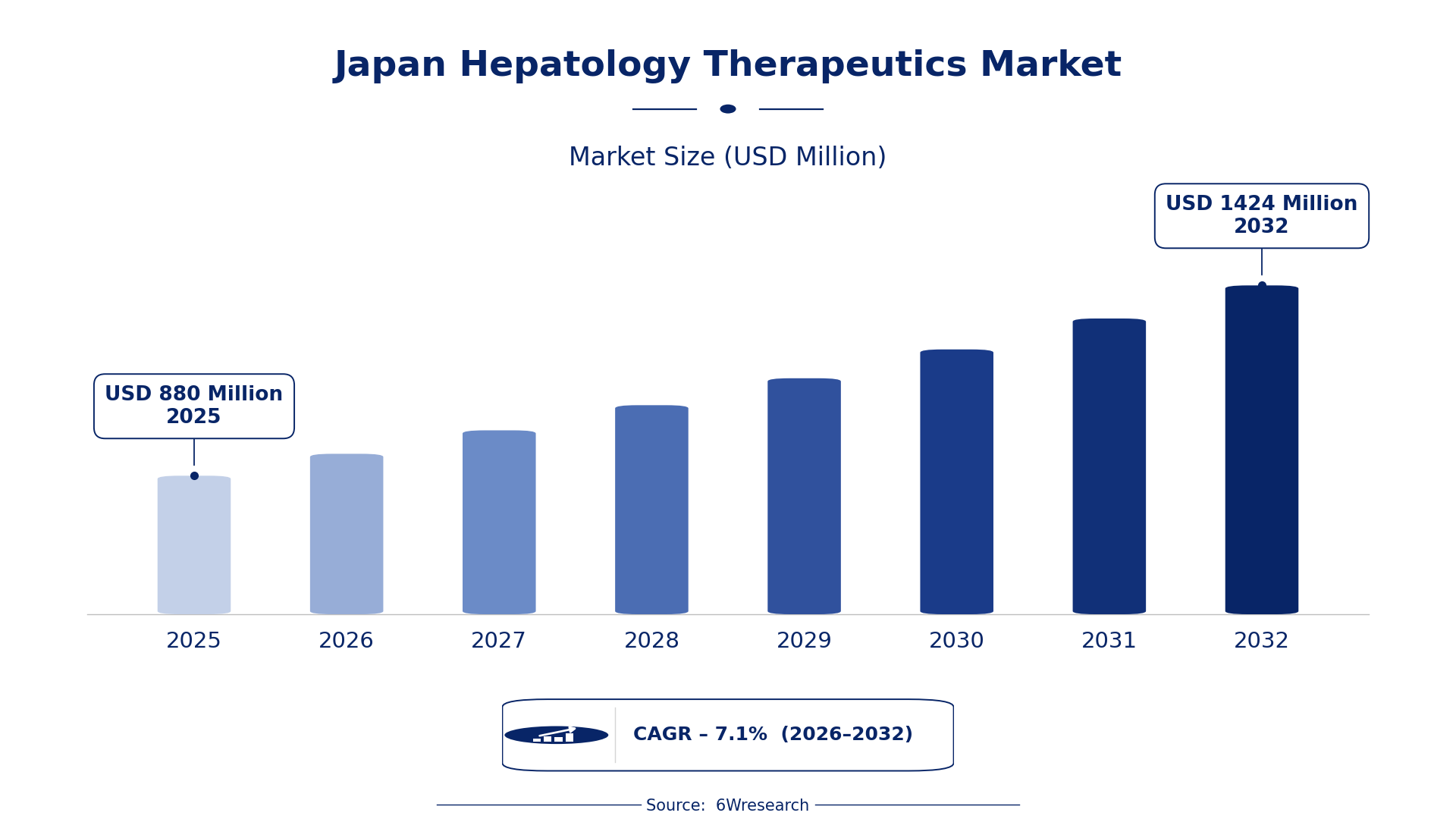
According to 6Wresearch internal database and industry insights, the Japan Hepatology Therapeutics Market was valued at USD 880 Million in 2025 and is projected to reach USD 1,424 Million by 2032, growing at a CAGR of approximately 7.1% during 2026–2032.
Japan Hepatology Therapeutics Market Highlights
| Report Metric | Details |
| Report Name | Japan Hepatology Therapeutics Market (2026-2032) |
| Market Size 2025 | USD 880 Million |
| Market Size 2032 | USD 1,424 Million |
| Absolute Growth 2025–2032 | USD 544 Million |
| CAGR 2026–2032 | 7.1% |
| Peak Annual Growth | 8.1% in 2026 |
| Forecast Period | 2026–2032 |
| Historical Data | 2022–2025 |
| Base Year | 2025 |
| Leading Drug Type, 2025 | Antivirals (43% share) |
| Leading Condition Treated, 2025 | Hepatitis B (34% share) |
| Leading Sales Channel, 2025 | Hospital Pharmacies (42% share) |
| Leading End User, 2025 | Liver Clinics (37% share) |
| Fastest-Growing Drug Type | Steroids (10.4% CAGR) |
| Fastest-Growing Condition Treated | Autoimmune Hepatitis (9.2% CAGR) |
| Fastest-Growing Sales Channel | Direct Sales (9.3% CAGR) |
| Fastest-Growing End User | Hepatology Departments (9.1% CAGR) |
| Growing Sector | Liver disease treatment |
| Key End Users | Healthcare providers, liver clinics, hepatology departments, gastroenterologists |
Japan Hepatology Therapeutics Market Year-wise Growth Rate and Key Drivers (2022–2032)
This graph illustrates the annual growth rates of the market from 2022 to 2032, highlighting a steady upward trajectory and projected market expansion over the forecast period.
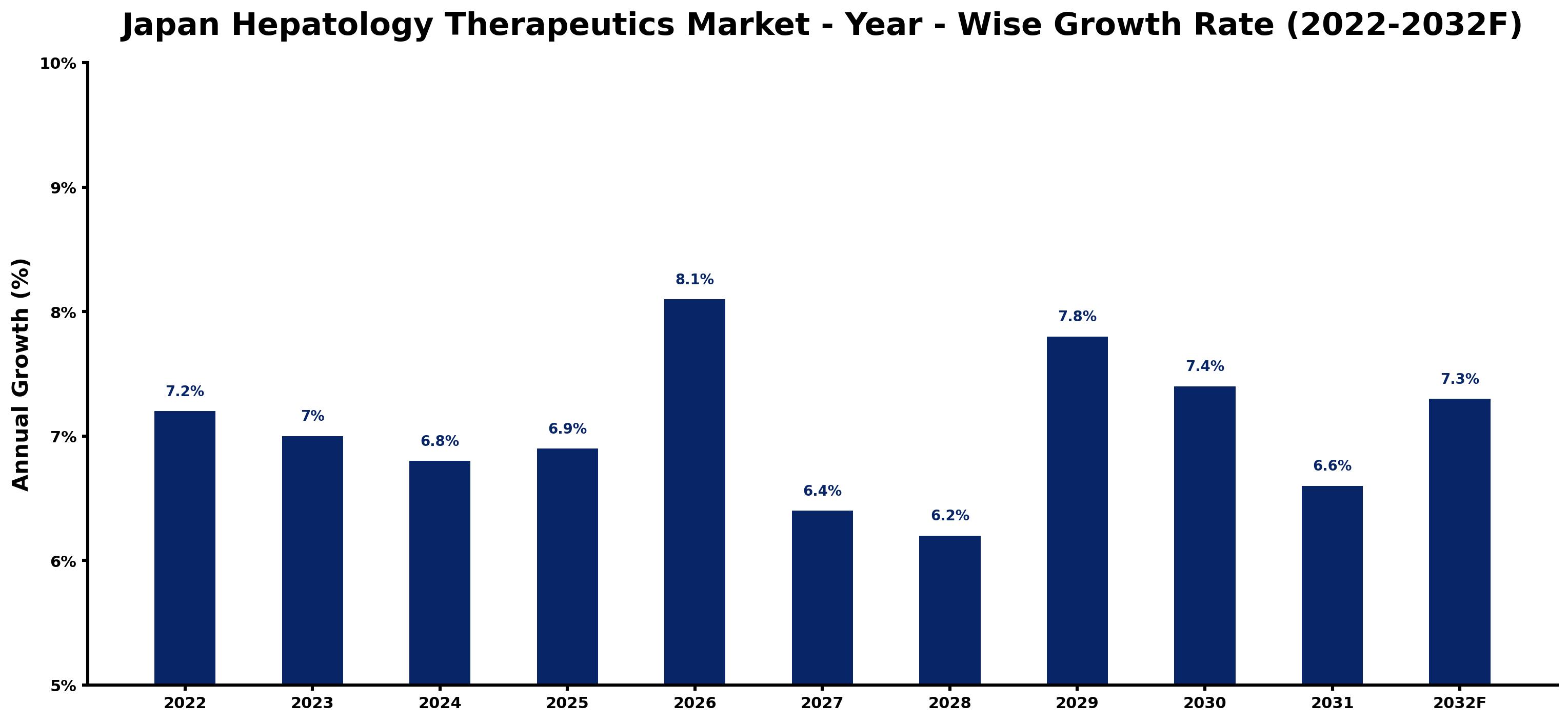
The table below sets out the estimated growth rate for each year and the main factor behind it.
| Year | Estimated Annual Growth (%) | Market Rationale |
| 2022 | 7.2 | The market experienced steady demand due to ongoing treatment needs for liver diseases. |
| 2023 | 7.0 | Growth slowed as healthcare providers adjusted to new treatment protocols and patient management strategies. |
| 2024 | 6.8 | Demand continued to slow as the market stabilised after previous peaks in treatment uptake. |
| 2025 | 6.9 | Growth picked up as new therapies gained approval and awareness increased among patients. |
| 2026 | 8.1 | The market surged with the introduction of new antiviral therapies and improved treatment regimens. |
| 2027 | 6.4 | Growth slowed as the market matured and competition intensified among therapeutic options. |
| 2028 | 6.2 | Demand continued to slow as healthcare systems focused on cost management and efficiency. |
| 2029 | 7.8 | Growth accelerated as patient awareness campaigns increased treatment uptake for chronic hepatitis. |
| 2030 | 7.4 | The market experienced slower growth as treatment saturation began to impact new patient enrolments. |
| 2031 | 6.6 | Growth slowed as healthcare providers faced challenges in managing long-term treatment plans. |
| 2032 | 7.3 | Demand increased again as new guidelines and therapies emerged, revitalising treatment strategies. |
Note: Market size estimations and growth projections presented in this report are based on 6Wresearch's proprietary forecasting methodology, utilizing the latest available industry data, government publications, and primary research inputs.
Japan Hepatology Therapeutics Market Synopsis
Hepatology therapeutics focus on medications designed to treat liver diseases such as viral hepatitis and autoimmune conditions. These drugs are produced through chemical synthesis and fermentation processes, primarily aimed at managing chronic hepatitis infections and preventing transplant rejection. The Japan Hepatology Therapeutics Market is expanding due to the high prevalence of chronic hepatitis B, with over 1 million patients, and the launch of a national hepatitis elimination program in 2023, which drives demand from healthcare providers and patients alike.
Market Dynamics Impact Analysis (2026–2032)
| Factor | Type | Impact | Primary Segment Affected |
| High prevalence of chronic hepatitis B patients drives demand for effective antiviral treatments. | Driver | High | Antivirals |
| The introduction of innovative therapies enhances treatment options for autoimmune hepatitis. | Driver | High | Steroids |
| Rising number of liver transplant centers creates demand for immunosuppressants. | Opportunity | High | Immunosuppressants |
| Increased funding for liver disease research opens avenues for new drug development. | Opportunity | High | Hepatitis B |
| Limited awareness among patients can restrict treatment uptake. | Restraint | Medium | Chronic Hepatitis C |
| Stringent regulatory requirements can delay drug approvals and market entry. | Restraint | Medium | Antivirals |
| High costs associated with advanced therapies can limit access for patients. | Challenge | High | Hepatitis B |
| Competition among drug manufacturers may lead to pricing pressures. | Challenge | Medium | Steroids |
Evaluation of Drivers in Japan Hepatology Therapeutics Market (2026–2032)
Below are the drivers that matter most for revenue growth, with supporting evidence.
| Drivers | Primary Segment Affected | Why It Matters (Evidence) |
| High prevalence of chronic hepatitis B patients drives demand for effective antiviral treatments. | Antivirals | With over 1 million patients in Japan, healthcare providers are increasingly prescribing antiviral therapies to manage chronic infections. |
| The introduction of new therapies improves treatment options for autoimmune hepatitis. | Steroids | Recent developments in steroid formulations are leading to increased prescriptions among specialists treating autoimmune conditions. |
| Rising number of liver transplant centers creates demand for immunosuppressants. | Immunosuppressants | As the number of liver transplant facilities grows, the need for effective post-transplant care drives the demand for these drugs. |
| Increased funding for liver disease research opens avenues for new drug development. | Hepatitis B | The government allocates approximately 5 billion yen annually for liver disease research, supporting innovation in treatment options. |
| Growing awareness of hepatitis C treatments boosts patient enrolment in treatment programs. | Chronic Hepatitis C | As awareness campaigns reach more patients, the uptake of direct-acting antivirals is increasing significantly. |
Spending rises because the high prevalence of chronic hepatitis B, affecting over 1 million patients, drives healthcare providers to prescribe antiviral treatments. The introduction of new therapies for autoimmune hepatitis improves treatment options, leading to increased prescriptions among specialists. The rising number of liver transplant centres creates a higher demand for immunosuppressants, as more facilities are now operational in Japan.
Evaluation of Restraints in Japan Hepatology Therapeutics Market
The table below lists the restraints and the evidence behind each.
| Market Restraint | Primary Segment Affected | Why It Matters (Evidence) |
| Limited awareness among patients can restrict treatment uptake. | Chronic Hepatitis C | Despite effective treatments, many patients remain unaware of their condition, resulting in lower treatment rates. |
| Stringent regulatory requirements can delay drug approvals and market entry. | Antivirals | Manufacturers face lengthy approval processes, which can postpone the availability of new therapies. |
| High costs associated with advanced therapies can limit access for patients. | Hepatitis B | The financial burden of new antiviral treatments may deter patients from seeking necessary care. |
| Market saturation in certain therapeutic areas may limit growth potential. | Immunosuppressants | As treatment options expand, the market may face challenges in differentiating products. |
| Competition among drug manufacturers may lead to pricing pressures. | Steroids | Intense competition can drive down prices, impacting profitability for manufacturers. |
Japan Hepatology Therapeutics Market Challenges
Over 1 million patients with chronic hepatitis B face delays due to lengthy drug approval processes overseen by the Ministry of Health, Labour and Welfare, which can extend wait times for necessary therapies. Intense competition among over 300 hospitals drives prices down, squeezing profit margins for producers and limiting their capacity to invest in new drug development. A shortage of specialised skills in hepatology among healthcare providers may lead to inadequate treatment, resulting in longer recovery times for patients. Compliance with ISO 9001 standards in pharmaceutical manufacturing raises operational costs, making medications less affordable for buyers.
Trends in the Japan Hepatology Therapeutics Market
Four trends stand out in the Japan Hepatology Therapeutics Market.
- Shift towards New Treatment Protocols: In Japan, the introduction of new antiviral therapies is changing treatment protocols for chronic hepatitis. The national hepatitis elimination program launched in 2023 aims to increase treatment rates, targeting a reduction in chronic hepatitis cases by 50% by 2030.
- Emergence of Specialty Pharmacies: Specialty pharmacies are increasing in number to cater to complex liver disease treatments. Currently, there are over 300 hospitals with hepatology departments, driving demand for tailored pharmaceutical services.
- Growing Focus on Patient Education: Healthcare providers are placing greater emphasis on patient education regarding liver disease management. This shift is evidenced by recent campaigns in Tokyo and Osaka, aiming to improve awareness among the aging population.
- Integration of Telemedicine in Hepatology Care: Telemedicine is becoming increasingly popular in hepatology care, especially in rural areas. This trend is supported by clinical guidelines from the Japan Society of Hepatology, facilitating better access to specialists.
Investment Opportunities in the Japan Hepatology Therapeutics Market
Where to invest in the Japan Hepatology Therapeutics Market: the main openings are set out below.
- Increased Government Funding for Research: The Japanese government allocates approximately 5 billion yen annually for liver disease research, creating opportunities for new drug development. This funding supports research institutions and clinical trials, particularly in urban areas like Tokyo.
- Expansion of Liver Clinics: With over 300 hospitals offering hepatology departments, there is a growing need for specialized services. Investing in liver clinics can meet the rising demand for comprehensive liver care, especially in metropolitan regions.
- Growing Market for Immunosuppressants: The rising number of liver transplant centres indicates a significant opportunity for immunosuppressant suppliers. As patient numbers increase, partnerships with clinical distributors can enhance market entry.
- Development of Direct-Acting Antivirals: As the prevalence of hepatitis C remains high, the demand for direct-acting antivirals is expanding. Suppliers can benefit by focusing on new formulations to meet the needs of healthcare providers.
Government Initiatives in the Japan Hepatology Therapeutics Market
The GX Promotion Act, enacted in 2023, establishes a streamlined legal framework for hepatology drug approvals, building on previous laws such as the Chemical Substances Control Law of 1973. This act simplifies the approval process for new therapies, ensuring quicker access to essential treatments for patients.
The Japan Agency for Medical Research and Development oversees funding for liver disease research initiatives, supporting various projects aimed at improving liver disease management. Substantial funding is allocated for clinical trials, enhancing the development of new hepatology therapeutics.
Future Insight of the Japan Hepatology Therapeutics Market
The national hepatitis elimination programme will drive increased funding for liver disease research, resulting in advancements in treatment methodologies. New liver transplant facilities will emerge, improving access to essential care in underserved regions. Enhanced clinical guidelines from the Japan Society of Hepatology will refine treatment protocols, improving patient outcomes. With an annual budget of 5 billion yen allocated for research, suppliers can expect a rise in the introduction of innovative hepatology therapeutics, addressing the high prevalence of liver cancer.
Market Segmentation Analysis
Japan Hepatology Therapeutics Market report covers a detailed analysis of the following market segments:
By Drug Type – Antivirals Lead, Steroids Expected to Grow Fastest
According to Saurav Kr Singh, Senior Research Analyst at 6Wresearch, in 2025, Antivirals led the drug type split with a 43% share. Antivirals hold the largest market share due to their proven effectiveness in treating viral hepatitis, a condition affecting over 1 million patients in Japan. This segment is supported by established clinical guidelines and a robust network of treatment facilities, ensuring widespread use. The quickest growth will come from Steroids, forecast to expand at a CAGR of 10.4% between 2026 and 2032. Steroids are experiencing rapid growth as their application in treating autoimmune hepatitis becomes more recognised, with ongoing clinical trials validating their effectiveness. The increased funding for research in this area is likely to further boost their market presence. Suppliers should expand their offerings in both antivirals and steroids to meet the growing demand.
By Condition Treated – Hepatitis B Leads, Autoimmune Hepatitis Expected to Grow Fastest
Hepatitis B took 34% of condition treated revenue in 2025, more than any other category. Hepatitis B is the leading condition treated, reflecting a concentrated effort in therapeutic interventions, especially following the launch of the national hepatitis elimination program in 2023. The high prevalence of this condition necessitates ongoing management and treatment strategies. Autoimmune Hepatitis is projected to grow fastest, at a CAGR of 9.2% during 2026–2032. Autoimmune Hepatitis is rapidly gaining traction, driven by increased awareness and improved diagnostic capabilities among healthcare professionals. The support from clinical guidelines is expected to accelerate the adoption of treatments for this condition. Buyers should focus on therapies targeting Hepatitis B while also considering emerging treatments for Autoimmune Hepatitis.
By Sales Channel – Hospital Pharmacies Lead, Direct Sales Expected to Grow Fastest
Hospital Pharmacies accounted for 42% of the market by sales channel in 2025. Hospital Pharmacies are the primary sales channel, providing essential access to patients and healthcare providers within treatment environments. Their established connections with hospitals facilitate effective drug distribution and management, ensuring availability of necessary therapies. Over 2026–2032, Direct Sales is expected to post the fastest growth, at a CAGR of 9.3%. Direct Sales are witnessing notable growth, particularly for specialty drugs that require customised distribution methods. This trend signals a shift in how healthcare facilities procure and manage their therapeutic options. Suppliers may need to revise their distribution strategies to leverage the increasing importance of direct sales.
By End User – Liver Clinics Lead, Hepatology Departments Expected to Grow Fastest
Liver Clinics held 37% of the Japan Hepatology Therapeutics Market by end user in 2025. Liver Clinics serve as the main treatment facilities for liver disease patients across Japan, providing specialised care tailored to their needs. Their focused approach enables comprehensive management of liver conditions, making them crucial in the treatment landscape. Hepatology Departments are set to record the highest CAGR in this split, 9.1% over 2026–2032. Hepatology Departments are the fastest-growing segment, indicating a trend towards more specialised care within hospitals. Their expanding role in managing complex liver diseases underscores the need for advanced treatment solutions. Buyers should assess the capabilities of both Liver Clinics and Hepatology Departments when selecting treatment providers.
Key Attractiveness of the Report
- 10 Years of Market Numbers
- Historical Data Starting from 2022 to 2025
- Base Year 2025
- Forecast Data until 2032
- Key Performance Indicators Impacting the Market
- Major Upcoming Developments and Projects
Key Highlights of the Report:
- Japan Hepatology Therapeutics Market Outlook
- Market Size of Japan Hepatology Therapeutics Market, 2025
- Forecast of Japan Hepatology Therapeutics Market, 2032
- Historical Data and Forecast of Japan Hepatology Therapeutics Revenues & Volume for the Period 2022-2032F
- Japan Hepatology Therapeutics Market Trend Evolution
- Japan Hepatology Therapeutics Market Drivers and Challenges
- Japan Hepatology Therapeutics Price Trends
- Japan Hepatology Therapeutics Porter's Five Forces
- Japan Hepatology Therapeutics Industry Life Cycle
- Historical Data and Forecast of Japan Hepatology Therapeutics Market Revenues & Volume By Drug Type for the Period 2022-2032F
- Historical Data and Forecast of Japan Hepatology Therapeutics Market Revenues & Volume By Antivirals for the Period 2022-2032F
- Historical Data and Forecast of Japan Hepatology Therapeutics Market Revenues & Volume By Steroids for the Period 2022-2032F
- Historical Data and Forecast of Japan Hepatology Therapeutics Market Revenues & Volume By Interferons for the Period 2022-2032F
- Historical Data and Forecast of Japan Hepatology Therapeutics Market Revenues & Volume By Ursodeoxycholic Acid for the Period 2022-2032F
- Historical Data and Forecast of Japan Hepatology Therapeutics Market Revenues & Volume By Immunosuppressants for the Period 2022-2032F
- Historical Data and Forecast of Japan Hepatology Therapeutics Market Revenues & Volume By Condition Treated for the Period 2022-2032F
- Historical Data and Forecast of Japan Hepatology Therapeutics Market Revenues & Volume By Hepatitis B for the Period 2022-2032F
- Historical Data and Forecast of Japan Hepatology Therapeutics Market Revenues & Volume By Autoimmune Hepatitis for the Period 2022-2032F
- Historical Data and Forecast of Japan Hepatology Therapeutics Market Revenues & Volume By Chronic Hepatitis C for the Period 2022-2032F
- Historical Data and Forecast of Japan Hepatology Therapeutics Market Revenues & Volume By Bile Disorders for the Period 2022-2032F
- Historical Data and Forecast of Japan Hepatology Therapeutics Market Revenues & Volume By Post Transplant for the Period 2022-2032F
- Historical Data and Forecast of Japan Hepatology Therapeutics Market Revenues & Volume By Sales Channel for the Period 2022-2032F
- Historical Data and Forecast of Japan Hepatology Therapeutics Market Revenues & Volume By Hospital Pharmacies for the Period 2022-2032F
- Historical Data and Forecast of Japan Hepatology Therapeutics Market Revenues & Volume By Direct Sales for the Period 2022-2032F
- Historical Data and Forecast of Japan Hepatology Therapeutics Market Revenues & Volume By Online Stores for the Period 2022-2032F
- Historical Data and Forecast of Japan Hepatology Therapeutics Market Revenues & Volume By Specialty Pharmacies for the Period 2022-2032F
- Historical Data and Forecast of Japan Hepatology Therapeutics Market Revenues & Volume By Clinical Distributors for the Period 2022-2032F
- Historical Data and Forecast of Japan Hepatology Therapeutics Market Revenues & Volume By End User for the Period 2022-2032F
- Historical Data and Forecast of Japan Hepatology Therapeutics Market Revenues & Volume By Liver Clinics for the Period 2022-2032F
- Historical Data and Forecast of Japan Hepatology Therapeutics Market Revenues & Volume By Hepatology Departments for the Period 2022-2032F
- Historical Data and Forecast of Japan Hepatology Therapeutics Market Revenues & Volume By Gastroenterologists for the Period 2022-2032F
- Historical Data and Forecast of Japan Hepatology Therapeutics Market Revenues & Volume By Biliary Disease Units for the Period 2022-2032F
- Historical Data and Forecast of Japan Hepatology Therapeutics Market Revenues & Volume By Liver Transplant Centers for the Period 2022-2032F
- Japan Hepatology Therapeutics Import Export Trade Statistics
- Market Opportunity Assessment By Drug Type
- Market Opportunity Assessment By Condition Treated
- Market Opportunity Assessment By Sales Channel
- Market Opportunity Assessment By End User
- Japan Hepatology Therapeutics Top Companies Market Share
- Japan Hepatology Therapeutics Competitive Benchmarking By Technical and Operational Parameters
- Japan Hepatology Therapeutics Company Profiles
- Japan Hepatology Therapeutics Key Strategic Recommendations
Market Covered
Coverage by segment is as follows.
By Drug Type
- Antivirals
- Steroids
- Interferons
- Ursodeoxycholic Acid
- Immunosuppressants
By Condition Treated
- Hepatitis B
- Autoimmune Hepatitis
- Chronic Hepatitis C
- Bile Disorders
- Post Transplant
By Sales Channel
- Hospital Pharmacies
- Direct Sales
- Online Stores
- Specialty Pharmacies
- Clinical Distributors
By End User
- Liver Clinics
- Hepatology Departments
- Gastroenterologists
- Biliary Disease Units
- Liver Transplant Centers































