Japan Heterocyclic compounds Market Size & Growth Rate
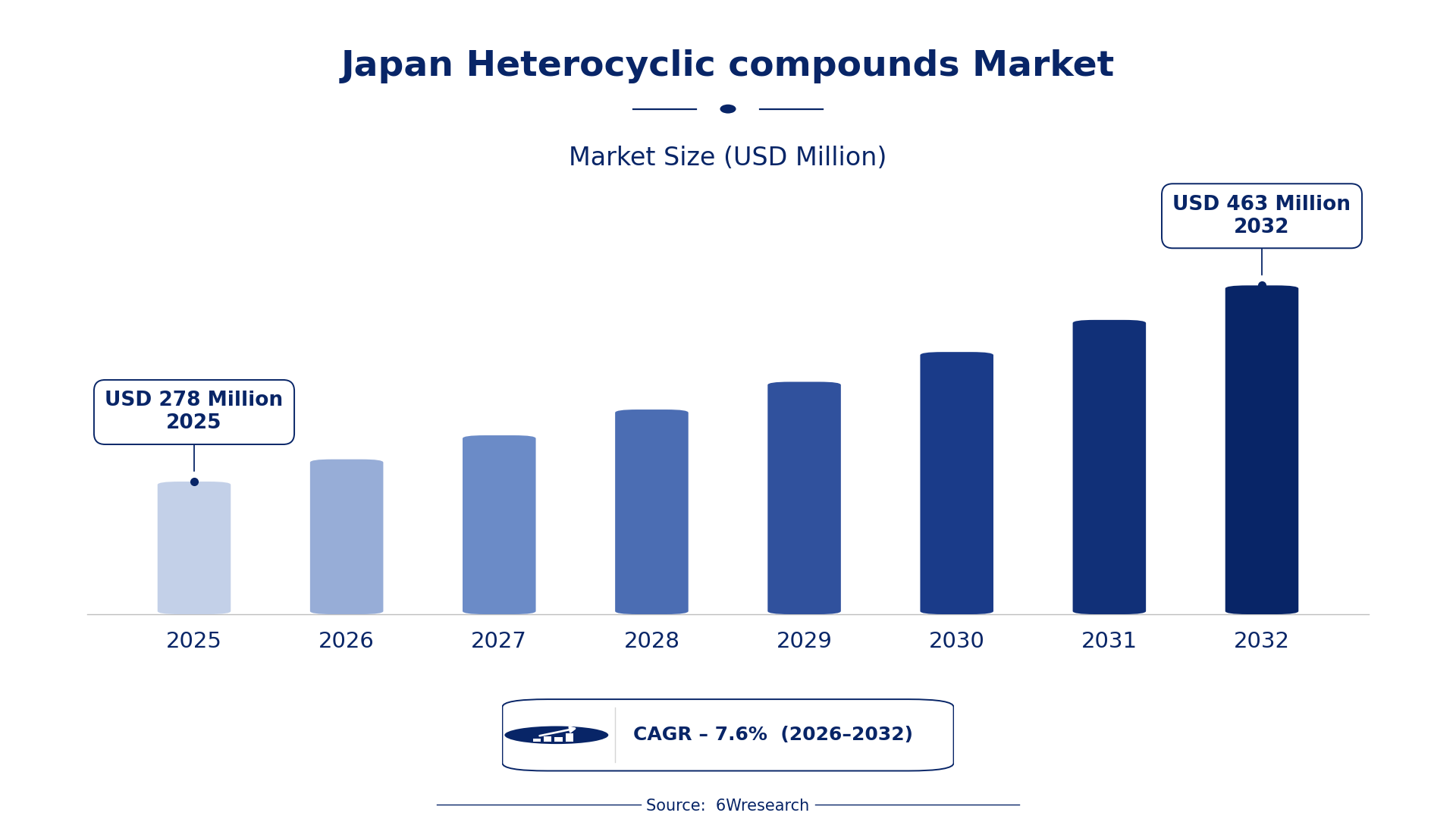
According to 6Wresearch internal database and industry insights, the Japan Heterocyclic compounds Market was valued at USD 278 Million in 2025 and is projected to reach USD 463 Million by 2032, growing at a CAGR of approximately 7.6% during 2026–2032.
Japan Heterocyclic compounds Market Highlights
| Report Metric | Details |
| Report Name | Japan Heterocyclic compounds Market (2026-2032) |
| Market Size 2025 | USD 278 Million |
| Market Size 2032 | USD 463 Million |
| Absolute Growth 2025–2032 | USD 185 Million |
| CAGR 2026–2032 | 7.6% |
| Peak Annual Growth | 8.8% in 2032 |
| Forecast Period | 2026–2032 |
| Historical Data | 2022–2025 |
| Base Year | 2025 |
| Leading Application, 2025 | Agrochemicals And Pharmaceuticals (30% share) |
| Fastest-Growing Application | Organic Compounds (10.9% CAGR) |
| Growing Sector | Agrochemicals |
| Key End Users | Pharmaceutical manufacturers, agrochemical producers, chemical suppliers |
Japan Heterocyclic compounds Market Year-wise Growth Rate and Key Drivers (2022–2032)
This graph illustrates the annual growth rates of the market from 2022 to 2032, highlighting a steady upward trajectory and projected market expansion over the forecast period.
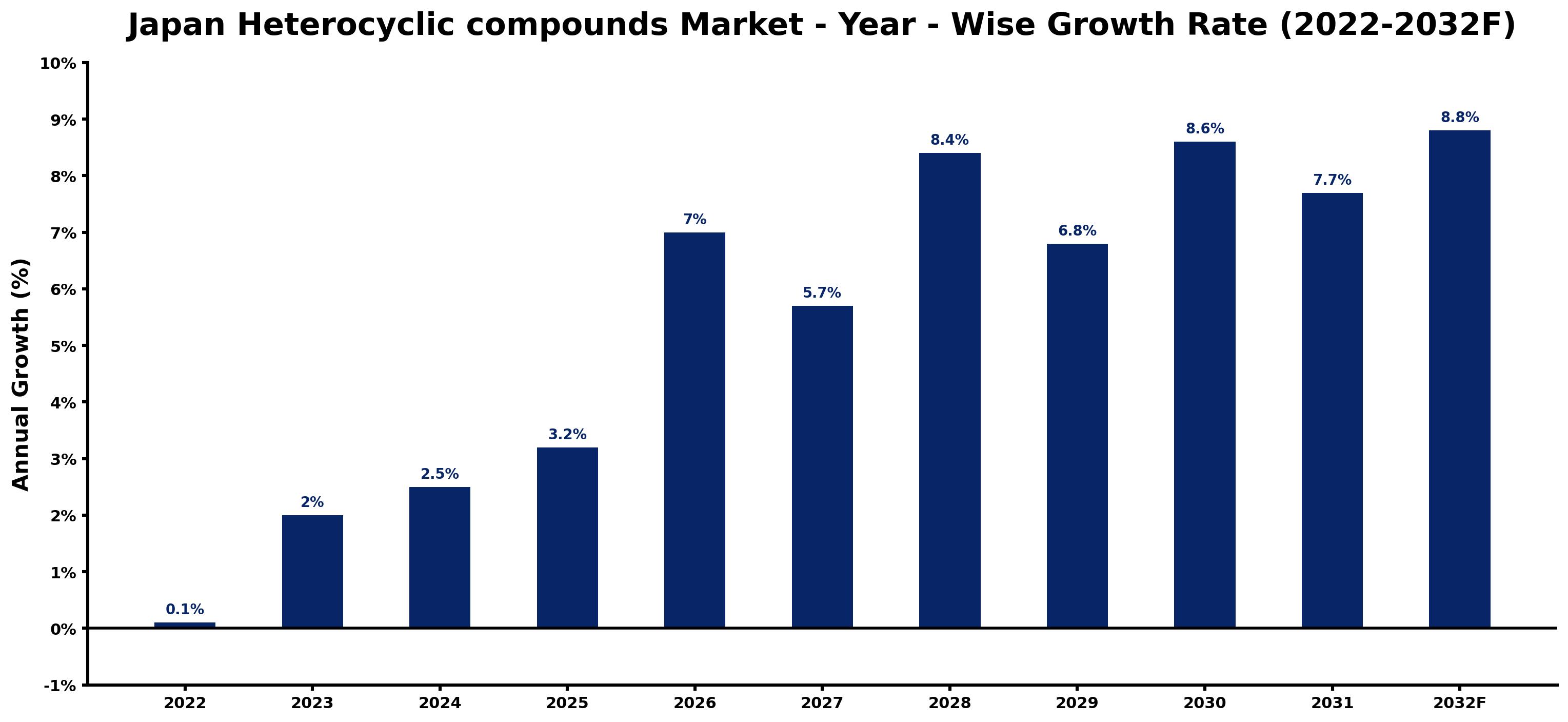
Each row of the following table gives one year's estimated growth and the event or demand shift that explains it.
| Year | Estimated Annual Growth (%) | Market Rationale |
| 2022 | 0.1 | The market experienced minimal growth due to stable demand from existing users. |
| 2023 | 2.0 | Growth accelerated as pharmaceutical companies increased production to meet rising healthcare needs. |
| 2024 | 2.5 | Continued expansion in agrochemicals contributed to further growth in the market. |
| 2025 | 3.2 | The market reached a peak growth rate as investments in chemical research intensified. |
| 2026 | 7.0 | Demand surged as new drug formulations entered the market, driving higher purchases. |
| 2027 | 5.7 | Growth slowed as market saturation in certain segments began to take effect. |
| 2028 | 8.4 | A rebound occurred as new agrochemical products gained traction among farmers. |
| 2029 | 6.8 | Growth moderated as competition increased among suppliers in the chemical sector. |
| 2030 | 8.6 | A renewed focus on sustainable practices led to increased investments in green chemistry. |
| 2031 | 7.7 | Growth decelerated as the market adjusted to new regulatory standards and practices. |
| 2032 | 8.8 | The market peaked as demand for heterocyclic compounds in pharmaceuticals surged. |
Note: Market size estimations and growth projections presented in this report are based on 6Wresearch's proprietary forecasting methodology, utilizing the latest available industry data, government publications, and primary research inputs.
Japan Heterocyclic compounds Market Synopsis
Heterocyclic compounds are organic compounds featuring a ring structure with at least one non-carbon atom, primarily used in pharmaceuticals and agrochemicals. The Japan Heterocyclic compounds Market is propelled by the pharmaceutical industry, valued at approximately 9 trillion yen, which depends on these compounds, present in over 50% of modern pharmaceuticals. The agrochemical market, expected to reach 1.5 trillion yen by 2025, is another major demand source, as these compounds are key ingredients in over 80% of agrochemical formulations.
Market Dynamics Impact Analysis (2026–2032)
| Factor | Type | Impact | Primary Segment Affected |
| Growing pharmaceutical production | Driver | High | Agrochemicals And Pharmaceuticals |
| Rising demand for sustainable agrochemical solutions | Driver | High | Agrochemicals And Pharmaceuticals |
| Investment in chemical research and innovation | Opportunity | High | Organic Compounds |
| Expansion of agrochemical formulations | Opportunity | High | Pesticides |
| Regulatory compliance costs | Restraint | Medium | Agrochemicals And Pharmaceuticals |
| Market saturation in certain segments | Restraint | Medium | Organic Compounds |
| Supply chain disruptions | Challenge | High | Agrochemicals And Pharmaceuticals |
| Intense competition among suppliers | Challenge | High | Pesticides |
Evaluation of Drivers in Japan Heterocyclic compounds Market (2026–2032)
The following drivers explain most of the expected growth.
| Drivers | Primary Segment Affected | Why It Matters (Evidence) |
| Increased pharmaceutical production | Agrochemicals And Pharmaceuticals | The pharmaceutical sector's value of approximately 9 trillion yen drives demand for heterocyclic compounds in drug formulation. |
| Growing agrochemical market | Pesticides | Projected to reach 1.5 trillion yen by 2025, the agrochemical market's expansion increases the need for heterocyclic compounds. |
| Rising investment in chemical research | Organic Compounds | Japan's government invested 200 billion yen in chemical research, boosting demand for new organic compounds. |
| Sustainable practices in chemical manufacturing | Agrochemicals And Pharmaceuticals | The promotion of sustainable practices increases the demand for eco-friendly heterocyclic compounds. |
| Technological advancements in synthesis methods | Pesticides | Advancements in synthesis methods improve the production efficiency of heterocyclic compounds. |
Spending rises because the pharmaceutical industry in Japan, valued at approximately 9 trillion yen, drives demand for heterocyclic compounds, essential in over 50% of modern pharmaceuticals. The agrochemical market is projected to reach 1.5 trillion yen by 2025, increasing the need for these compounds in pesticide formulations. Advances in synthesis methods improve efficiency, resulting in greater purchases from chemical manufacturers. Consequently, producers are responding to the growing demand for high-quality formulations.
Evaluation of Restraints in Japan Heterocyclic compounds Market
The following restraints limit how fast demand can grow.
| Market Restraint | Primary Segment Affected | Why It Matters (Evidence) |
| High costs associated with regulatory compliance | Agrochemicals And Pharmaceuticals | Compliance with the Chemical Substances Control Law increases operational costs for producers, affecting pricing strategies. |
| Market saturation in organic compounds | Organic Compounds | With many suppliers in the organic compounds segment, competition limits price increases and profit margins. |
| Supply chain disruptions affecting availability | Pesticides | Recent global supply chain issues have delayed the delivery of essential raw materials, impacting production schedules. |
| Increased competition among suppliers | Agrochemicals And Pharmaceuticals | The influx of new entrants in the market has intensified competition, resulting in price wars. |
| Technological barriers to entry for new firms | Organic Compounds | High investment in technology and R&D is required to compete, limiting new market entrants. |
Japan Heterocyclic compounds Market Challenges
Pharmaceutical companies face delays of up to six months due to a skills shortage in chemical synthesis, hindering timely drug development. Buyers encounter rising costs as limited domestic suppliers of heterocyclic compounds result in price increases of around 15% for essential raw materials. Stringent pesticide regulations enforced by the Ministry of Agriculture, Forestry and Fisheries create supply chain disruptions, causing agrochemical product launch delays that can extend up to a year. Fluctuating raw material costs, influenced by global market trends, can inflate production expenses by 10%, impacting profitability for manufacturers.
Trends in the Japan Heterocyclic compounds Market
The trends below show where the Japan Heterocyclic compounds Market is heading.
- Shift in Agrochemical Formulations: Farmers are increasingly adopting eco-friendly agrochemical solutions, with over 80% of formulations now containing heterocyclic compounds. This shift began in 2021 as sustainability became a priority in agriculture.
- Transition to Advanced Synthesis Techniques: The adoption of new synthesis methods for heterocyclic compounds has accelerated since 2022, improving production efficiency and quality. This trend is evident in the Tokyo region, a major hub for chemical manufacturing.
- Emergence of Sustainable Chemistry Practices: In 2023, the Tokyo Metropolitan Government launched initiatives supporting sustainable chemistry, reshaping supplier strategies and increasing demand for eco-friendly chemical products.
- Prioritisation of Pharmaceutical Innovations: The pharmaceutical sector is focusing on novel drug formulations, with heterocyclic compounds playing a key role. In 2022, over 50% of new drugs developed incorporated these compounds.
Investment Opportunities in the Japan Heterocyclic compounds Market
Below are the investment opportunities with the strongest case in the Japan Heterocyclic compounds Market.
- Investment Gap in Sustainable Practices: With the agrochemical market projected to reach 1.5 trillion yen by 2025, there is a strong opportunity for investment in sustainable practices. Agrochemical producers are actively seeking eco-friendly solutions.
- Growing Demand for Organic Compounds: The organic compounds segment is experiencing a gap in supply, with a projected CAGR of 10.9% from 2026 to 2032. Chemical manufacturers are encouraged to explore partnerships to meet this demand.
- Entry into the Japanese Market: Now is an opportune time for foreign firms to enter the Japanese market, especially in agrochemicals. Collaborating with local partners can facilitate market access and compliance with regulations.
- Expansion of Pharmaceutical Applications: The pharmaceutical sector is expanding rapidly, with a focus on new drug formulations. Suppliers should consider investing in R&D to align with this trend.
Government Initiatives in the Japan Heterocyclic compounds Market
The Chemical Substances Control Law mandates that chemical producers evaluate and control substances used in manufacturing. This law ensures that heterocyclic compounds meet safety and environmental standards, affecting production processes and compliance costs.
In 2021, the Japanese government allocated 200 billion yen to support chemical research and innovation through the Ministry of Economy, Trade and Industry. This funding aims to improve the competitiveness of the chemical sector, benefiting producers and buyers alike.
Future Insight of the Japan Heterocyclic compounds Market
A policy-driven shift towards green chemistry will prompt suppliers to adopt sustainable practices in response to regulatory changes. The Japanese government's investment of 200 billion yen in chemical research will facilitate advancements in synthetic methods, boosting production efficiency. Buyers will benefit from improved product quality as JIS standards ensure safer and more effective chemical products. The pharmaceutical industry, valued at approximately 9 trillion yen, will increasingly rely on heterocyclic compounds to meet growing domestic demand.
Market Segmentation Analysis
Japan Heterocyclic compounds Market report covers a detailed analysis of the following market segments:
By Application – Agrochemicals And Pharmaceuticals Lead, Organic Compounds Expected to Grow Fastest
According to Ravi Bhandari, Research Head at 6Wresearch, Agrochemicals And Pharmaceuticals accounted for 30% of the market by application in 2025. Agrochemicals and Pharmaceuticals hold the largest share due to their critical role in drug formulation and agricultural applications, with heterocyclic compounds being integral to over 50% of modern pharmaceuticals. The concentration of chemical manufacturing in the Tokyo region ensures a robust supply chain for these essential compounds. Organic Compounds are set to record the highest CAGR in this split, 10.9% over 2026–2032. Organic Compounds are experiencing rapid growth as they serve as fundamental building blocks in various organic syntheses, driven by the increasing demand for complex chemical formulations. The Japanese government's investment of 200 billion yen in chemical research and innovation is likely to accelerate this trend further. This means suppliers should refine their approaches to cater to the heightened demand in both the pharmaceutical and agrochemical markets.
Key Attractiveness of the Report
- 10 Years of Market Numbers
- Historical Data Starting from 2022 to 2025
- Base Year 2025
- Forecast Data until 2032
- Key Performance Indicators Impacting the Market
- Major Upcoming Developments and Projects
Key Highlights of the Report:
- Japan Heterocyclic compounds Market Outlook
- Market Size of Japan Heterocyclic compounds Market, 2025
- Forecast of Japan Heterocyclic compounds Market, 2032
- Historical Data and Forecast of Japan Heterocyclic compounds Revenues & Volume for the Period 2022-2032
- Japan Heterocyclic compounds Market Trend Evolution
- Japan Heterocyclic compounds Market Drivers and Challenges
- Japan Heterocyclic compounds Price Trends
- Japan Heterocyclic compounds Porter's Five Forces
- Japan Heterocyclic compounds Industry Life Cycle
- Historical Data and Forecast of Japan Heterocyclic compounds Market Revenues & Volume By Application for the Period 2022-2032
- Historical Data and Forecast of Japan Heterocyclic compounds Market Revenues & Volume By Agrochemicals And Pharmaceuticals for the Period 2022-2032
- Historical Data and Forecast of Japan Heterocyclic compounds Market Revenues & Volume By Organic Compounds for the Period 2022-2032
- Historical Data and Forecast of Japan Heterocyclic compounds Market Revenues & Volume By Corrosion Inhibitors, Sanitisers, Anti-ordinates, And Developers for the Period 2022-2032
- Historical Data and Forecast of Japan Heterocyclic compounds Market Revenues & Volume By Pesticides, Dyes And Plastics for the Period 2022-2032
- Japan Heterocyclic compounds Import Export Trade Statistics
- Market Opportunity Assessment By Application
- Japan Heterocyclic compounds Top Companies Market Share
- Japan Heterocyclic compounds Competitive Benchmarking By Technical and Operational Parameters
- Japan Heterocyclic compounds Company Profiles
- Japan Heterocyclic compounds Key Strategic Recommendations
Market Covered
The study includes the following segmentation.
By Application
- Agrochemicals And Pharmaceuticals
- Organic Compounds
- Corrosion Inhibitors
- Sanitisers
- Anti-ordinates
- Developers
- Pesticides
- Dyes And Plastics































