Japan High Frequency Trading Market Size & Growth Rate
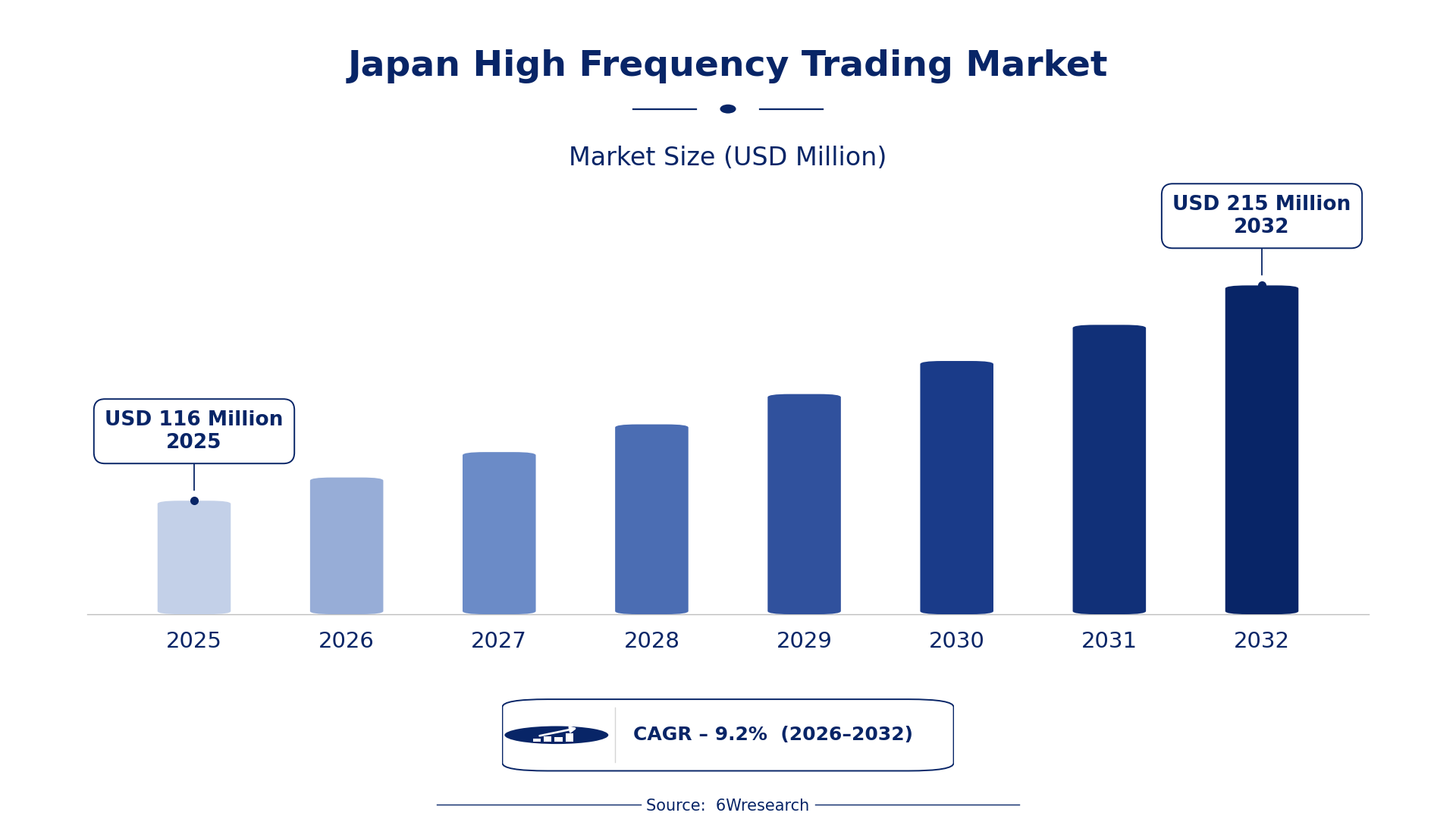
According to 6Wresearch internal database and industry insights, the Japan High Frequency Trading Market was valued at USD 116 Million in 2025 and is projected to reach USD 215 Million by 2032, growing at a CAGR of approximately 9.2% during 2026–2032.
Japan High Frequency Trading Market Highlights
| Report Metric | Details |
| Report Name | Japan High Frequency Trading Market (2026-2032) |
| Market Size 2025 | USD 116 Million |
| Market Size 2032 | USD 215 Million |
| Absolute Growth 2025–2032 | USD 99 Million |
| CAGR 2026–2032 | 9.2% |
| Peak Annual Growth | 10.8% in 2028 |
| Forecast Period | 2026–2032 |
| Historical Data | 2022–2025 |
| Base Year | 2025 |
| Leading Product Type, 2025 | Trading Platforms (36% share) |
| Leading Technology Used, 2025 | FPGA Based (40% share) |
| Leading Distribution Channel, 2025 | Fintech Providers (38% share) |
| Leading End User, 2025 | Institutional Traders (50% share) |
| Fastest-Growing Product Type | Market Data Feeds (13.3% CAGR) |
| Fastest-Growing Technology Used | API Integrated (13.0% CAGR) |
| Fastest-Growing Distribution Channel | Online Subscription (12.7% CAGR) |
| Fastest-Growing End User | Hedge Funds (12.0% CAGR) |
| Growing Sector | financial services |
| Key End Users | institutional traders, hedge funds, algo traders, brokerage firms |
Japan High Frequency Trading Market Year-wise Growth Rate and Key Drivers (2022–2032)
This graph illustrates the annual growth rates of the market from 2022 to 2032, highlighting a steady upward trajectory and projected market expansion over the forecast period.
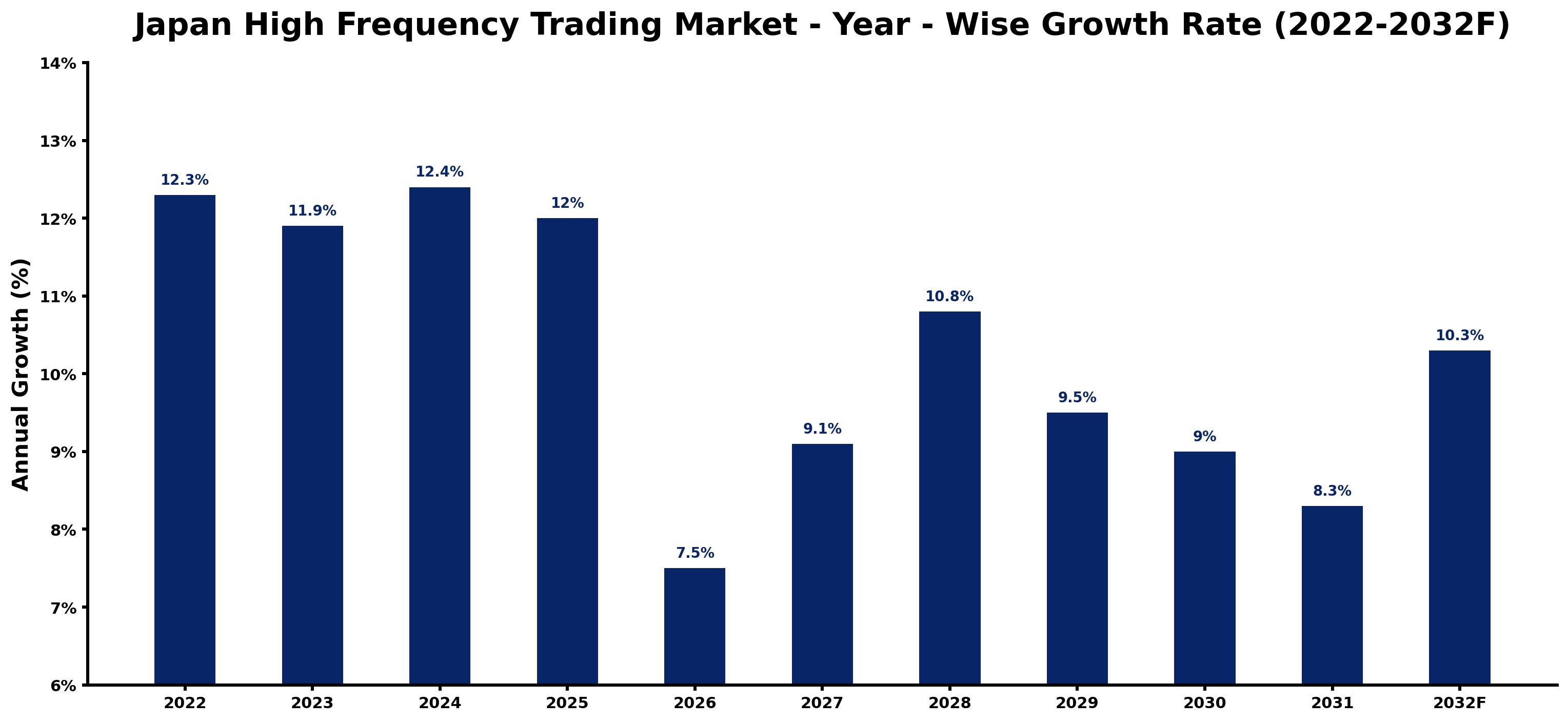
For each year, the table pairs the estimated growth rate with the leading influence on demand, showing how the drivers changed across the period.
| Year | Estimated Annual Growth (%) | Market Rationale |
| 2022 | 12.3 | Demand was strong as institutional traders increasingly adopted high-frequency trading strategies. |
| 2023 | 11.9 | Growth slowed due to market saturation and increased competition among trading firms. |
| 2024 | 12.4 | Market activity surged as new algorithmic trading guidelines were implemented, boosting efficiency. |
| 2025 | 12.0 | Growth moderated as firms adjusted to evolving market conditions and regulatory changes. |
| 2026 | 7.5 | Demand growth is expected to slow as the market begins to stabilise after rapid expansion. |
| 2027 | 9.1 | Increased investments in fintech solutions will drive a resurgence in trading activities. |
| 2028 | 10.8 | A peak in growth is projected as the introduction of co-location services improves trading speeds. |
| 2029 | 9.5 | Growth is expected to slow as the market faces challenges from regulatory scrutiny and technology costs. |
| 2030 | 9.0 | Demand will continue to rise, albeit at a slower pace, as firms focus on efficiency. |
| 2031 | 8.3 | Growth is projected to decelerate as market participants adapt to new trading technologies. |
| 2032 | 10.3 | A rebound in growth is expected as algorithmic trading practices become more refined. |
Note: Market size estimations and growth projections presented in this report are based on 6Wresearch's proprietary forecasting methodology, utilizing the latest available industry data, government publications, and primary research inputs.
Japan High Frequency Trading Market Synopsis
High Frequency Trading (HFT) is a technology-driven trading strategy that executes orders at extremely high speeds using sophisticated algorithms. The primary users of HFT in Japan include institutional traders and hedge funds, who utilise this technology for market making and liquidity provision. The Japan High Frequency Trading Market is expanding due to increased trading volumes on platforms like the Tokyo Stock Exchange, where approximately 60% of trades were executed using HFT in 2022. Infrastructure improvements and new guidelines are further driving demand, indicating a strong future for HFT in the financial services sector.
Market Dynamics Impact Analysis (2026–2032)
| Factor | Type | Impact | Primary Segment Affected |
| Growing adoption of algorithmic trading strategies | Driver | High | Trading Platforms |
| Increased demand for real-time market data | Driver | High | Market Data Feeds |
| Expansion of fintech companies offering HFT solutions | Opportunity | High | Fintech Providers |
| Rising need for low-latency trading services | Opportunity | High | Co-Location Services |
| Regulatory scrutiny affecting trading practices | Restraint | High | Market Data Feeds |
| High costs associated with HFT technology implementation | Restraint | High | Network Equipment |
| Competition from traditional trading methods | Challenge | Medium | Institutional Traders |
| Technological advancements requiring constant upgrades | Challenge | Medium | Algo Traders |
Evaluation of Drivers in Japan High Frequency Trading Market (2026–2032)
The following drivers explain most of the expected growth.
| Drivers | Primary Segment Affected | Why It Matters (Evidence) |
| Increased trading volumes on exchanges | Trading Platforms | In 2022, 60% of trades on the Tokyo Stock Exchange were executed using HFT, driving demand for advanced trading platforms. |
| Demand for faster execution speeds | Co-Location Services | The average latency for trades in Japan's HFT market is under 1 millisecond, necessitating co-location services for competitive advantage. |
| Growth in hedge funds employing HFT strategies | Market Data Feeds | Japan has over 100 registered hedge funds utilizing HFT, increasing the need for real-time data feeds. |
| Technological advancements in trading algorithms | API Integrated | The adoption of API integration is rising, with a projected CAGR of 13.0%, improving trading system connectivity. |
| Support for fintech innovation | Fintech Providers | The Tokyo Metropolitan Government supports fintech innovation through various programs, encouraging the growth of HFT solutions. |
What keeps demand rising is the increasing trading volumes on exchanges, where approximately 60% of trades on the Tokyo Stock Exchange were executed using HFT in 2022. This surge has led to a heightened need for advanced trading platforms that can handle such volumes efficiently. The average latency for trades in Japan's HFT market is under 1 millisecond, driving demand for co-location services that improve execution speeds. The presence of over 100 registered hedge funds employing high-frequency trading strategies has boosted the need for real-time market data feeds.
Evaluation of Restraints in Japan High Frequency Trading Market
The table below lists the restraints and the evidence behind each.
| Market Restraint | Primary Segment Affected | Why It Matters (Evidence) |
| Regulatory scrutiny affecting trading practices | Market Data Feeds | The Financial Services Agency regulates high-frequency trading activities, which can restrict operational flexibility for firms. |
| High costs associated with HFT technology implementation | Network Equipment | Investments in low-latency network equipment can be substantial, impacting profitability for smaller trading firms. |
| Competition from traditional trading methods | Institutional Traders | Institutional traders face pressure from traditional trading methods that may offer lower costs and less complexity. |
| Technological advancements requiring constant upgrades | Algo Traders | The fast-paced evolution of trading technologies necessitates regular investments, straining budgets for many firms. |
| Market saturation leading to diminishing returns | Hedge Funds | As more funds adopt HFT, the competitive edge diminishes, making it harder to achieve high returns. |
Japan High Frequency Trading Market Challenges
High-frequency trading in Japan faces challenges due to inadequate technology infrastructure, leading to trade execution delays that can cost traders up to 0.5% per transaction. The fierce competition among over 200 fintech companies drives down profit margins, compelling firms to invest millions in sophisticated algorithms. Domestic buyers encounter hurdles from evolving guidelines issued by the Financial Services Agency, which can postpone trading approvals by weeks, affecting liquidity provision. The average latency of under 1 millisecond limits firms' global competitiveness, resulting in missed opportunities for market makers and lower trading volumes.
Trends in the Japan High Frequency Trading Market
Buyers and suppliers in the Japan High Frequency Trading Market are adjusting to the following trends.
- Surge in HFT Adoption: In 2022, approximately 60% of trades on the Tokyo Stock Exchange were executed using high-frequency trading, indicating a growing reliance on algorithmic strategies among institutional investors.
- Shift Towards Co-Location Services: The Tokyo Stock Exchange launched a new co-location service in 2023, enabling firms to place servers close to trading venues. This change improves low-latency trading capabilities, which is critical for high-frequency trading success.
- Emergence of API Integration: API integration is becoming increasingly important in Japan's HFT market, with a projected CAGR of 13.0%. This shift allows traders to connect their systems seamlessly with exchanges, improving execution efficiency.
- Focus on Real-Time Data Feeds: The demand for real-time market data feeds is surging as hedge funds and institutional traders require immediate access to information. This trend is driving innovations in data delivery technologies.
Investment Opportunities in the Japan High Frequency Trading Market
The following opportunities in the Japan High Frequency Trading Market pair current demand with a clear way in.
- Supply Advanced Trading Platforms: With 60% of trades executed via HFT, there is a growing need for advanced trading platforms. Fintech providers can capitalise on this demand by offering tailored solutions to institutional traders.
- Invest in Low-Latency Network Equipment: The average latency for trades in Japan's HFT market is under 1 millisecond, indicating a need for low-latency network equipment. Suppliers can target hedge funds looking to improve their trading capabilities.
- Launch New Co-Location Services: The introduction of co-location services presents an opportunity for firms to improve trading speeds. Providers can collaborate with exchanges to offer these services to institutional traders.
- Develop Real-Time Data Solutions: As the demand for real-time data feeds increases, there is an opportunity to develop innovative data solutions. Fintech companies can target hedge funds and trading firms needing timely information.
Government Initiatives in the Japan High Frequency Trading Market
The Financial Services Agency (FSA) regulates high-frequency trading activities in Japan, ensuring compliance with trading standards. The introduction of new guidelines in 2023 has further clarified algorithmic trading practices, impacting how firms operate in the HFT space. This regulatory framework is vital for maintaining market integrity and protecting investors.
In 2023, the Tokyo Metropolitan Government allocated USD 10 million to support fintech innovation through various programmes. The Digital Agency oversees these initiatives, which aim to improve the technological capabilities of financial services, including high-frequency trading. This funding is intended to promote growth and competitiveness in the fintech sector.
Future Insight of the Japan High Frequency Trading Market
By 2032, the adoption of ISO 20022 for financial messaging will streamline communication between trading systems, improving transaction efficiency. The introduction of new services will further reduce latency, strengthening firms' market positions. Increased investment in fintech will spur the creation of advanced trading strategies that benefit both buyers and suppliers. As the Bank of Japan evaluates HFT's effects on market stability, clearer regulations will promote higher participation from institutional investors in high-frequency trading.
Market Segmentation Analysis
Japan High Frequency Trading Market report covers a detailed analysis of the following market segments:
By Product Type – Trading Platforms Lead, Market Data Feeds Expected to Grow Fastest
According to Saurav Kr Singh, Senior Research Analyst at 6Wresearch, Trading Platforms took 36% of product type revenue in 2025, more than any other category. Trading Platforms hold the largest share due to their crucial role in executing trades swiftly, essential for market participants. The Tokyo Stock Exchange exemplifies the reliance on these platforms, where a significant percentage of trades are conducted using HFT. Over 2026–2032, Market Data Feeds are expected to post the fastest growth, at a CAGR of 13.3%. Market Data Feeds are experiencing rapid growth as they provide real-time data that is vital for making informed trading decisions. The increasing presence of over 200 fintech companies in Japan is propelling the demand for these feeds, boosting their market potential. Suppliers should focus on enhancing the quality and speed of market data feeds to seize opportunities in this expanding segment.
By Technology Used – FPGA Based Leads, API Integrated Expected to Grow Fastest
FPGA Based held 40% of the Japan High Frequency Trading Market by technology used in 2025. FPGA Based technology leads the market as it is specifically engineered for processing trades at remarkable speeds, making it essential for high-frequency trading. Its prevalent use across major trading platforms ensures minimal latency and high efficiency in operations. API Integrated is projected to grow fastest, at a CAGR of 13.0% during 2026–2032. API Integrated technology is witnessing swift growth as it facilitates seamless integration of trading systems with exchanges, which improves overall efficiency. The trend towards interconnected trading environments is a key factor driving this rapid expansion. Buyers will benefit from investing in API Integrated solutions to streamline their trading processes and improve execution times.
By Distribution Channel – Fintech Providers Lead, Online Subscription Expected to Grow Fastest
Fintech Providers accounted for 38% of the market by distribution channel in 2025. Fintech Providers dominate the market as they are the primary developers and suppliers of high-frequency trading solutions, directly addressing the specific needs of the market. Their comprehensive offerings are crucial for institutional traders seeking advanced trading capabilities. Online Subscription is set to record the highest CAGR in this split, 12.7% over 2026–2032. Online Subscription channels are growing rapidly as they provide flexible access to trading platforms, appealing to a broader audience. The increasing shift towards digital solutions in finance is a notable factor behind this trend. Suppliers should enhance online subscription models to attract a wider range of users in the high-frequency trading market.
By End User – Institutional Traders Lead, Hedge Funds Expected to Grow Fastest
The largest end user category in 2025 was Institutional Traders, at 50% of revenue. Institutional Traders represent the largest user group of high-frequency trading strategies, employing these technologies to efficiently manage substantial volumes of trades. Their significant presence in the market drives the demand for sophisticated trading solutions. The quickest growth will come from Hedge Funds, forecast to expand at a CAGR of 12.0% between 2026 and 2032. Hedge Funds are increasingly adopting high-frequency trading strategies, leveraging the advantages of speed and efficiency in trade execution. Their urgent need for rapid trading capabilities is a primary factor contributing to this growth. Suppliers must tailor their offerings to meet the specific requirements of hedge funds to capture this expanding user base.
Key Attractiveness of the Report
- 10 Years of Market Numbers
- Historical Data Starting from 2022 to 2025
- Base Year 2025
- Forecast Data until 2032
- Key Performance Indicators Impacting the Market
- Major Upcoming Developments and Projects
Key Highlights of the Report:
- Japan High Frequency Trading Market Outlook
- Market Size of Japan High Frequency Trading Market, 2025
- Forecast of Japan High Frequency Trading Market, 2032
- Historical Data and Forecast of Japan High Frequency Trading Revenues & Volume for the Period 2022-2032F
- Japan High Frequency Trading Market Trend Evolution
- Japan High Frequency Trading Market Drivers and Challenges
- Japan High Frequency Trading Price Trends
- Japan High Frequency Trading Porter's Five Forces
- Japan High Frequency Trading Industry Life Cycle
- Historical Data and Forecast of Japan High Frequency Trading Market Revenues & Volume By Product Type for the Period 2022-2032F
- Historical Data and Forecast of Japan High Frequency Trading Market Revenues & Volume By Trading Platforms for the Period 2022-2032F
- Historical Data and Forecast of Japan High Frequency Trading Market Revenues & Volume By Market Data Feeds for the Period 2022-2032F
- Historical Data and Forecast of Japan High Frequency Trading Market Revenues & Volume By Network Equipment for the Period 2022-2032F
- Historical Data and Forecast of Japan High Frequency Trading Market Revenues & Volume By Co-Location Services for the Period 2022-2032F
- Historical Data and Forecast of Japan High Frequency Trading Market Revenues & Volume By Technology Used for the Period 2022-2032F
- Historical Data and Forecast of Japan High Frequency Trading Market Revenues & Volume By FPGA Based for the Period 2022-2032F
- Historical Data and Forecast of Japan High Frequency Trading Market Revenues & Volume By API Integrated for the Period 2022-2032F
- Historical Data and Forecast of Japan High Frequency Trading Market Revenues & Volume By Low-Latency NICs for the Period 2022-2032F
- Historical Data and Forecast of Japan High Frequency Trading Market Revenues & Volume By Proximity Hosting for the Period 2022-2032F
- Historical Data and Forecast of Japan High Frequency Trading Market Revenues & Volume By Distribution Channel for the Period 2022-2032F
- Historical Data and Forecast of Japan High Frequency Trading Market Revenues & Volume By Fintech Providers for the Period 2022-2032F
- Historical Data and Forecast of Japan High Frequency Trading Market Revenues & Volume By Online Subscription for the Period 2022-2032F
- Historical Data and Forecast of Japan High Frequency Trading Market Revenues & Volume By Direct Sales for the Period 2022-2032F
- Historical Data and Forecast of Japan High Frequency Trading Market Revenues & Volume By Data Centers for the Period 2022-2032F
- Historical Data and Forecast of Japan High Frequency Trading Market Revenues & Volume By End User for the Period 2022-2032F
- Historical Data and Forecast of Japan High Frequency Trading Market Revenues & Volume By Institutional Traders for the Period 2022-2032F
- Historical Data and Forecast of Japan High Frequency Trading Market Revenues & Volume By Hedge Funds for the Period 2022-2032F
- Historical Data and Forecast of Japan High Frequency Trading Market Revenues & Volume By Algo Traders for the Period 2022-2032F
- Historical Data and Forecast of Japan High Frequency Trading Market Revenues & Volume By Brokerage Firms for the Period 2022-2032F
- Japan High Frequency Trading Import Export Trade Statistics
- Market Opportunity Assessment By Product Type
- Market Opportunity Assessment By Technology Used
- Market Opportunity Assessment By Distribution Channel
- Market Opportunity Assessment By End User
- Japan High Frequency Trading Top Companies Market Share
- Japan High Frequency Trading Competitive Benchmarking By Technical and Operational Parameters
- Japan High Frequency Trading Company Profiles
- Japan High Frequency Trading Key Strategic Recommendations
Market Covered
This report examines the market across the segments below.
By Product Type
- Trading Platforms
- Market Data Feeds
- Network Equipment
- Co-Location Services
By Technology Used
- FPGA Based
- API Integrated
- Low-Latency NICs
- Proximity Hosting
By Distribution Channel
- Fintech Providers
- Online Subscription
- Direct Sales
- Data Centers
By End User
- Institutional Traders
- Hedge Funds
- Algo Traders
- Brokerage Firms































