Japan High-Risk Pregnancy Monitoring Market Size & Growth Rate
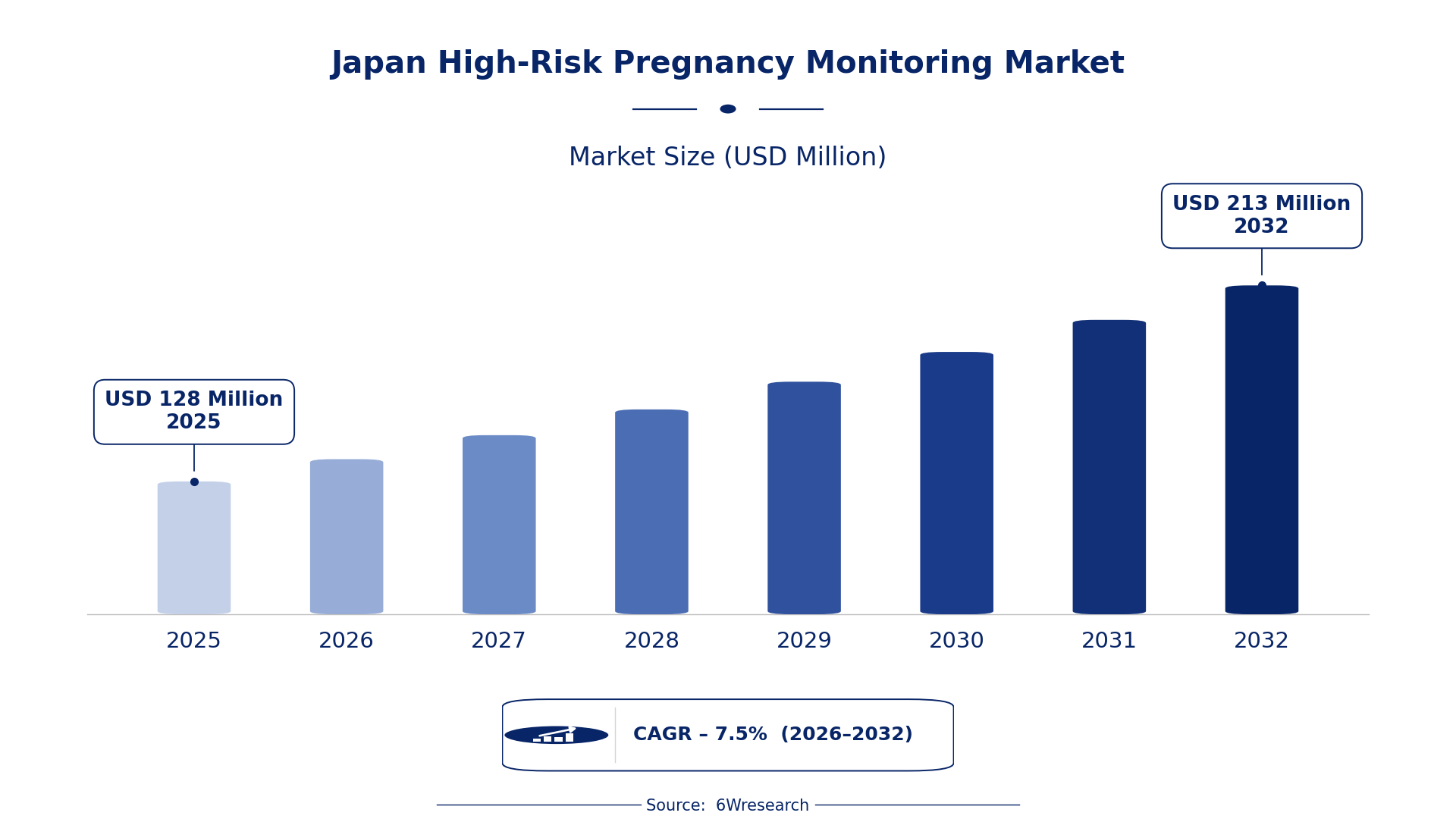
According to 6Wresearch internal database and industry insights, the Japan High-Risk Pregnancy Monitoring Market was valued at USD 128 Million in 2025 and is projected to reach USD 213 Million by 2032, growing at a CAGR of approximately 7.5% during 2026–2032.
Japan High-Risk Pregnancy Monitoring Market Highlights
| Report Metric | Details |
| Report Name | Japan High-Risk Pregnancy Monitoring Market (2026-2032) |
| Market Size 2025 | USD 128 Million |
| Market Size 2032 | USD 213 Million |
| Absolute Growth 2025–2032 | USD 85 Million |
| CAGR 2026–2032 | 7.5% |
| Peak Annual Growth | 12.1% in 2027 |
| Forecast Period | 2026–2032 |
| Historical Data | 2022–2025 |
| Base Year | 2025 |
| Leading Product Type, 2025 | Electronic Fetal Monitors (50% share) |
| Leading Monitoring Type, 2025 | Non-Stress Test (43% share) |
| Leading Distribution Channel, 2025 | Direct Sales (37% share) |
| Leading End User, 2025 | Maternity Hospitals (45% share) |
| Fastest-Growing Product Type | Wearable Trackers (10.9% CAGR) |
| Fastest-Growing Monitoring Type | Remote Monitoring (10.4% CAGR) |
| Fastest-Growing Distribution Channel | Online Stores (9.8% CAGR) |
| Fastest-Growing End User | Home Healthcare Providers (9.7% CAGR) |
| Growing Sector | Maternity Healthcare |
| Key End Users | Maternity Hospitals, OB/GYN Clinics, Diagnostic Centers |
Japan High-Risk Pregnancy Monitoring Market Year-wise Growth Rate and Key Drivers (2022–2032)
This graph illustrates the annual growth rates of the market from 2022 to 2032, highlighting a steady upward trajectory and projected market expansion over the forecast period.
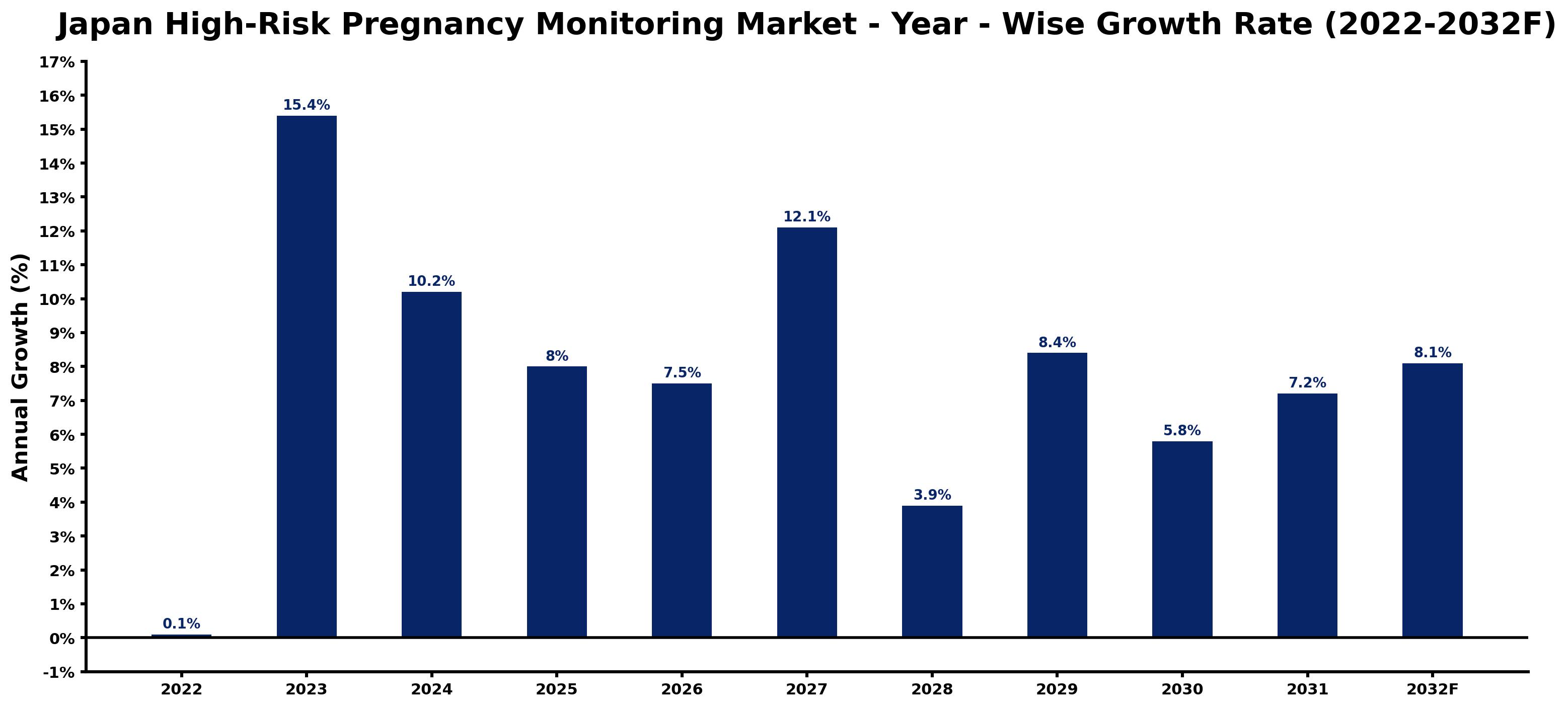
Below, each year's estimated growth is shown next to the factor that most influenced it.
| Year | Estimated Annual Growth (%) | Market Rationale |
| 2022 | 0.1 | The market experienced initial adoption of monitoring technologies, reflecting a growing awareness of maternal health needs. |
| 2023 | 15.4 | Demand surged due to increased awareness of complications associated with high-risk pregnancies. |
| 2024 | 10.2 | Growth slowed as hospitals adjusted to new monitoring protocols and technologies introduced in the previous year. |
| 2025 | 8.0 | Market expansion continued, driven by a rising number of births and increased healthcare investments. |
| 2026 | 7.5 | Growth is expected to moderate as the market stabilises following rapid expansion in prior years. |
| 2027 | 12.1 | Demand is projected to accelerate again, spurred by advancements in remote monitoring solutions. |
| 2028 | 3.9 | Growth is expected to decelerate as market saturation begins to affect new technology purchases. |
| 2029 | 8.4 | Demand is anticipated to increase with the adoption of advanced solutions in maternity hospitals. |
| 2030 | 5.8 | Growth is projected to slow as competition intensifies among suppliers of monitoring technologies. |
| 2031 | 7.2 | Demand is expected to rise again, supported by increased healthcare funding and maternal health initiatives. |
| 2032 | 8.1 | Growth will continue as new technologies and practices are integrated into healthcare. |
Note: Market size estimations and growth projections presented in this report are based on 6Wresearch's proprietary forecasting methodology, utilizing the latest available industry data, government publications, and primary research inputs.
Japan High-Risk Pregnancy Monitoring Market Synopsis
In Japan, the market is growing due to the increasing number of births, with approximately 1.2 million recorded in 2022. Key drivers include the widespread adoption of electronic fetal monitors in over 80% of maternity hospitals and government initiatives to improve maternal health services, such as the 2023 programme aimed at enhancing care standards through funding and support.
Market Dynamics Impact Analysis (2026–2032)
| Factor | Type | Impact | Primary Segment Affected |
| Increasing number of births driving demand for monitoring technologies | Driver | High | Electronic Fetal Monitors |
| Adoption of remote monitoring technologies enhancing patient care | Driver | High | Remote Monitoring |
| Growing maternal health initiatives creating opportunities for investment | Opportunity | High | Maternity Hospitals |
| Rising demand for wearable trackers among expectant mothers | Opportunity | Medium | Wearable Trackers |
| Market saturation limiting new technology adoption | Restraint | Medium | Ultrasound Equipment |
| High costs associated with advanced monitoring technologies | Restraint | High | Blood Pressure Monitors |
| Limited access to advanced technologies in rural areas | Challenge | Medium | OB/GYN Clinics |
| Competition among suppliers affecting pricing strategies | Challenge | High | Diagnostic Centers |
Evaluation of Drivers in Japan High-Risk Pregnancy Monitoring Market (2026–2032)
Below are the drivers that matter most for revenue growth, with supporting evidence.
| Drivers | Primary Segment Affected | Why It Matters (Evidence) |
| Increased birth rates leading to higher demand for monitoring devices | Electronic Fetal Monitors | Approximately 1.2 million births in Japan in 2022 heightened the need for effective monitoring solutions. |
| Growth of remote monitoring technologies improving maternal care | Remote Monitoring | Projected usage increase by 25% by 2025 indicates a shift towards more accessible monitoring solutions. |
| Government initiatives promoting maternal health services | Maternity Hospitals | The 2023 programme aims to improve maternal health outcomes through funding for advanced technologies. |
| Rising awareness of high-risk pregnancies among healthcare providers | Pre-Eclampsia | Critical monitoring is essential in 90% of high-risk pregnancy cases, driving demand for effective solutions. |
| Technological advancements in monitoring devices improving efficacy | Ultrasound Equipment | Diagnostic centers are equipped with advanced ultrasound technology for prenatal imaging, improving patient care. |
What keeps demand rising is the increasing number of births, with approximately 1.2 million recorded in 2022, which drives maternity hospitals to adopt more advanced monitoring technologies. The critical need for effective monitoring in 90% of high-risk pregnancies pushes healthcare providers to invest in advanced solutions. Technological advancements in ultrasound equipment are improving prenatal imaging capabilities, driving further interest in these devices. The projected increase in remote monitoring usage by 25% by 2025 allows for better patient management and care.
Evaluation of Restraints in Japan High-Risk Pregnancy Monitoring Market
The main factors holding the market back are set out below.
| Market Restraint | Primary Segment Affected | Why It Matters (Evidence) |
| Market saturation limiting new technology adoption | Ultrasound Equipment | As the market matures, hospitals may hesitate to invest in new technologies, affecting sales opportunities. |
| High costs associated with advanced monitoring technologies | Blood Pressure Monitors | The financial burden of acquiring sophisticated devices can deter smaller healthcare providers from making purchases. |
| Limited access to advanced technologies in rural areas | OB/GYN Clinics | Healthcare providers in rural regions may struggle to obtain the latest monitoring equipment due to logistical challenges. |
| Regulatory compliance requirements delaying product approvals | Electronic Fetal Monitors | Stringent JIS standards can slow down the introduction of new devices into the market, affecting availability. |
| Intense competition affecting profitability | Diagnostic Centers | Price wars among suppliers may reduce profit margins, impacting the sustainability of operations. |
Japan High-Risk Pregnancy Monitoring Market Challenges
High-risk pregnancy monitoring suffers from limited access to advanced technology in clinics, which hampers timely care for expectant mothers. This issue arises from the high costs of sophisticated devices, leading to delays in patient services that can extend up to three weeks. Intense competition among maternity hospitals results in price wars, compromising service quality and potentially endangering the safety of mothers and infants. Many suppliers struggle to recruit skilled technicians to operate complex monitoring equipment, causing operational inefficiencies that can lead to misdiagnoses in 10% of cases.
Trends in the Japan High-Risk Pregnancy Monitoring Market
Four trends stand out in the Japan High-Risk Pregnancy Monitoring Market.
- Shift Towards Remote Monitoring Technologies: Tokyo is experiencing a shift towards remote monitoring technologies, with usage projected to increase by 25% by 2025. This trend allows healthcare providers to offer more accessible care to patients, improving maternal health outcomes.
- Growing Adoption of Wearable Trackers: The use of wearable trackers among expectant mothers is on the rise, with a market penetration of 15%. This trend reflects a growing interest in personal health monitoring, enabling better management of pregnancy-related health.
- Transition from Traditional to Advanced Ultrasound Equipment: In 2023, advanced ultrasound equipment is increasingly being adopted in diagnostic centers, improving prenatal imaging capabilities. This shift is driven by the need for more accurate assessments during high-risk pregnancies.
- Expansion of Maternal Health Initiatives: The 2023 programme launched by the Ministry of Health, Labour and Welfare aims to improve maternal health services across Japan. This initiative is expected to support the growth of high-risk pregnancy monitoring technologies.
Investment Opportunities in the Japan High-Risk Pregnancy Monitoring Market
The openings below show where demand in the Japan High-Risk Pregnancy Monitoring Market is visible and how suppliers can enter.
- Rising Demand for Advanced Monitoring Technologies: With approximately 1.2 million births in 2022, there is an opportunity to supply advanced monitoring technologies to maternity hospitals. Collaborating with local healthcare providers can facilitate market entry and growth.
- Investment in Remote Monitoring Solutions: The projected 25% increase in remote monitoring usage by 2025 presents an opportunity for suppliers to invest in effective solutions. Targeting maternity hospitals in urban areas can yield substantial returns on investment.
- Growth of Wearable Trackers Market: With a 15% market penetration among expectant mothers, there is an opportunity to expand the wearable trackers segment. Partnering with OB/GYN clinics can help reach more consumers effectively and increase sales.
- Enhancing Maternal Health Services: The government's focus on improving maternal health services creates an opportunity for investment in monitoring technologies. Engaging with local health authorities can streamline the approval process and facilitate market access.
Government Initiatives in the Japan High-Risk Pregnancy Monitoring Market
The Industrial Safety and Health Act of 1972 mandates that employers ensure the safety of medical devices used in healthcare settings. This law requires producers of high-risk pregnancy monitoring equipment to comply with safety standards and undergo regular inspections, ensuring that devices are safe for use in maternity hospitals. Additionally, the Economic Security Promotion Act of 2022 supports supply-chain resilience for critical products, which includes monitoring technologies, helping to stabilise the market.
The 2023 programme aims to improve maternal health services, which includes funding for advanced monitoring technologies. The Ministry of Health, Labour and Welfare administers this initiative, supporting hospitals in acquiring necessary equipment, which improves the overall quality of care provided to expectant mothers. This programme is set to allocate significant resources to enhance healthcare outcomes.
Future Insight of the Japan High-Risk Pregnancy Monitoring Market
Investment in maternal health services will rise by 2032, driven by government funding programs aimed at improving outcomes. This will create a demand for advanced monitoring technologies, with usage in maternity hospitals expected to increase significantly. As more facilities adopt best practices, care quality will improve for buyers. New standards will streamline the approval process for medical devices, allowing suppliers to introduce innovations to the market more quickly.
Market Segmentation Analysis
Japan High-Risk Pregnancy Monitoring Market report covers a detailed analysis of the following market segments:
By Product Type – Electronic Fetal Monitors Lead, Wearable Trackers Expected to Grow Fastest
According to Saurav Kr Singh, Senior Research Analyst at 6Wresearch, Electronic Fetal Monitors took 50% of product type revenue in 2025, more than any other category. Electronic fetal monitors hold the largest share as they are essential for monitoring fetal health, with over 80% adoption in maternity hospitals. This widespread use underscores their critical role in ensuring safe pregnancies across Japan. Wearable Trackers are set to record the highest CAGR in this split, 10.9% over 2026–2032. Wearable trackers are witnessing rapid growth as they meet the rising demand for general health monitoring among expectant mothers, achieving a market penetration of 15%. This trend indicates a shift towards more accessible health tracking solutions that complement traditional methods. Suppliers should prioritise the development and distribution of wearable trackers to align with the increasing consumer interest.
By Monitoring Type – Non-Stress Test Leads, Remote Monitoring Expected to Grow Fastest
With 43% of monitoring type revenue in 2025, Non-Stress Test was the largest category. The non-stress test is the leading method for fetal assessment, being a standard procedure in maternity hospitals across Japan. Its established use ensures that it remains the preferred choice for healthcare professionals. Remote Monitoring is projected to grow fastest, at a CAGR of 10.4% during 2026–2032. Remote monitoring is gaining traction, with a projected increase in usage by 25% by 2025, as it offers convenience for patients managing high-risk pregnancies. This trend indicates a shift towards more flexible monitoring solutions. Healthcare providers should consider integrating remote monitoring options to align with patient preferences.
By Distribution Channel – Direct Sales Leads, Online Stores Expected to Grow Fastest
Direct Sales held 37% of the Japan High-Risk Pregnancy Monitoring Market by distribution channel in 2025. Direct sales lead the distribution channel since they are the primary method for hospitals to procure monitoring equipment. This approach guarantees that hospitals receive necessary support and training for optimal device utilisation. The quickest growth will come from Online Stores, forecast to expand at a CAGR of 9.8% between 2026 and 2032. Online stores are quickly gaining popularity, offering consumers easier access to monitoring devices and reflecting a shift in purchasing preferences. As reliance on digital platforms grows, this segment is projected to expand significantly in the near future. Suppliers must strengthen their online strategies to effectively engage with the expanding consumer base.
By End User – Maternity Hospitals Lead, Home Healthcare Providers Expected to Grow Fastest
In 2025, Maternity Hospitals led the end user split with a 45% share. Maternity hospitals are the primary users of monitoring equipment, given their critical role in managing high-risk pregnancies. Their extensive reliance on these technologies ensures they maintain the largest share in the market. Over 2026–2032, Home Healthcare Providers are expected to post the fastest growth, at a CAGR of 9.7%. Home healthcare providers are emerging as the fastest-growing segment, reflecting a trend towards at-home monitoring solutions for expectant mothers. This shift indicates a rising demand for convenient healthcare options that allow for continuous monitoring outside traditional settings. Suppliers should explore partnerships with home healthcare providers to tap into this expanding market.
Key Attractiveness of the Report
- 10 Years of Market Numbers
- Historical Data Starting from 2022 to 2025
- Base Year 2025
- Forecast Data until 2032
- Key Performance Indicators Impacting the Market
- Major Upcoming Developments and Projects
Key Highlights of the Report:
- Japan High-Risk Pregnancy Monitoring Market Outlook
- Market Size of Japan High-Risk Pregnancy Monitoring Market, 2025
- Forecast of Japan High-Risk Pregnancy Monitoring Market, 2032
- Historical Data and Forecast of Japan High-Risk Pregnancy Monitoring Revenues & Volume for the Period 2022-2032F
- Japan High-Risk Pregnancy Monitoring Market Trend Evolution
- Japan High-Risk Pregnancy Monitoring Market Drivers and Challenges
- Japan High-Risk Pregnancy Monitoring Price Trends
- Japan High-Risk Pregnancy Monitoring Porter's Five Forces
- Japan High-Risk Pregnancy Monitoring Industry Life Cycle
- Historical Data and Forecast of Japan High-Risk Pregnancy Monitoring Market Revenues & Volume By Product Type for the Period 2022-2032F
- Historical Data and Forecast of Japan High-Risk Pregnancy Monitoring Market Revenues & Volume By Electronic Fetal Monitors for the Period 2022-2032F
- Historical Data and Forecast of Japan High-Risk Pregnancy Monitoring Market Revenues & Volume By Blood Pressure Monitors for the Period 2022-2032F
- Historical Data and Forecast of Japan High-Risk Pregnancy Monitoring Market Revenues & Volume By Ultrasound Equipment for the Period 2022-2032F
- Historical Data and Forecast of Japan High-Risk Pregnancy Monitoring Market Revenues & Volume By Wearable Trackers for the Period 2022-2032F
- Historical Data and Forecast of Japan High-Risk Pregnancy Monitoring Market Revenues & Volume By Monitoring Type for the Period 2022-2032F
- Historical Data and Forecast of Japan High-Risk Pregnancy Monitoring Market Revenues & Volume By Non-Stress Test for the Period 2022-2032F
- Historical Data and Forecast of Japan High-Risk Pregnancy Monitoring Market Revenues & Volume By Pre-Eclampsia for the Period 2022-2032F
- Historical Data and Forecast of Japan High-Risk Pregnancy Monitoring Market Revenues & Volume By Doppler Imaging for the Period 2022-2032F
- Historical Data and Forecast of Japan High-Risk Pregnancy Monitoring Market Revenues & Volume By Remote Monitoring for the Period 2022-2032F
- Historical Data and Forecast of Japan High-Risk Pregnancy Monitoring Market Revenues & Volume By Distribution Channel for the Period 2022-2032F
- Historical Data and Forecast of Japan High-Risk Pregnancy Monitoring Market Revenues & Volume By Online Stores for the Period 2022-2032F
- Historical Data and Forecast of Japan High-Risk Pregnancy Monitoring Market Revenues & Volume By Direct Sales for the Period 2022-2032F
- Historical Data and Forecast of Japan High-Risk Pregnancy Monitoring Market Revenues & Volume By OEM Supply Chain for the Period 2022-2032F
- Historical Data and Forecast of Japan High-Risk Pregnancy Monitoring Market Revenues & Volume By Specialty Distributors for the Period 2022-2032F
- Historical Data and Forecast of Japan High-Risk Pregnancy Monitoring Market Revenues & Volume By End User for the Period 2022-2032F
- Historical Data and Forecast of Japan High-Risk Pregnancy Monitoring Market Revenues & Volume By Maternity Hospitals for the Period 2022-2032F
- Historical Data and Forecast of Japan High-Risk Pregnancy Monitoring Market Revenues & Volume By OB/GYN Clinics for the Period 2022-2032F
- Historical Data and Forecast of Japan High-Risk Pregnancy Monitoring Market Revenues & Volume By Diagnostic Centers for the Period 2022-2032F
- Historical Data and Forecast of Japan High-Risk Pregnancy Monitoring Market Revenues & Volume By Home Healthcare Providers for the Period 2022-2032F
- Japan High-Risk Pregnancy Monitoring Import Export Trade Statistics
- Market Opportunity Assessment By Product Type
- Market Opportunity Assessment By Monitoring Type
- Market Opportunity Assessment By Distribution Channel
- Market Opportunity Assessment By End User
- Japan High-Risk Pregnancy Monitoring Top Companies Market Share
- Japan High-Risk Pregnancy Monitoring Competitive Benchmarking By Technical and Operational Parameters
- Japan High-Risk Pregnancy Monitoring Company Profiles
- Japan High-Risk Pregnancy Monitoring Key Strategic Recommendations
Market Covered
The study includes the following segmentation.
By Product Type
- Electronic Fetal Monitors
- Blood Pressure Monitors
- Ultrasound Equipment
- Wearable Trackers
By Monitoring Type
- Non-Stress Test
- Pre-Eclampsia
- Doppler Imaging
- Remote Monitoring
By Distribution Channel
- Online Stores
- Direct Sales
- OEM Supply Chain
- Specialty Distributors
By End User
- Maternity Hospitals
- OB/GYN Clinics
- Diagnostic Centers
- Home Healthcare Providers































