Japan High-Throughput Screening AI Market Size & Growth Rate
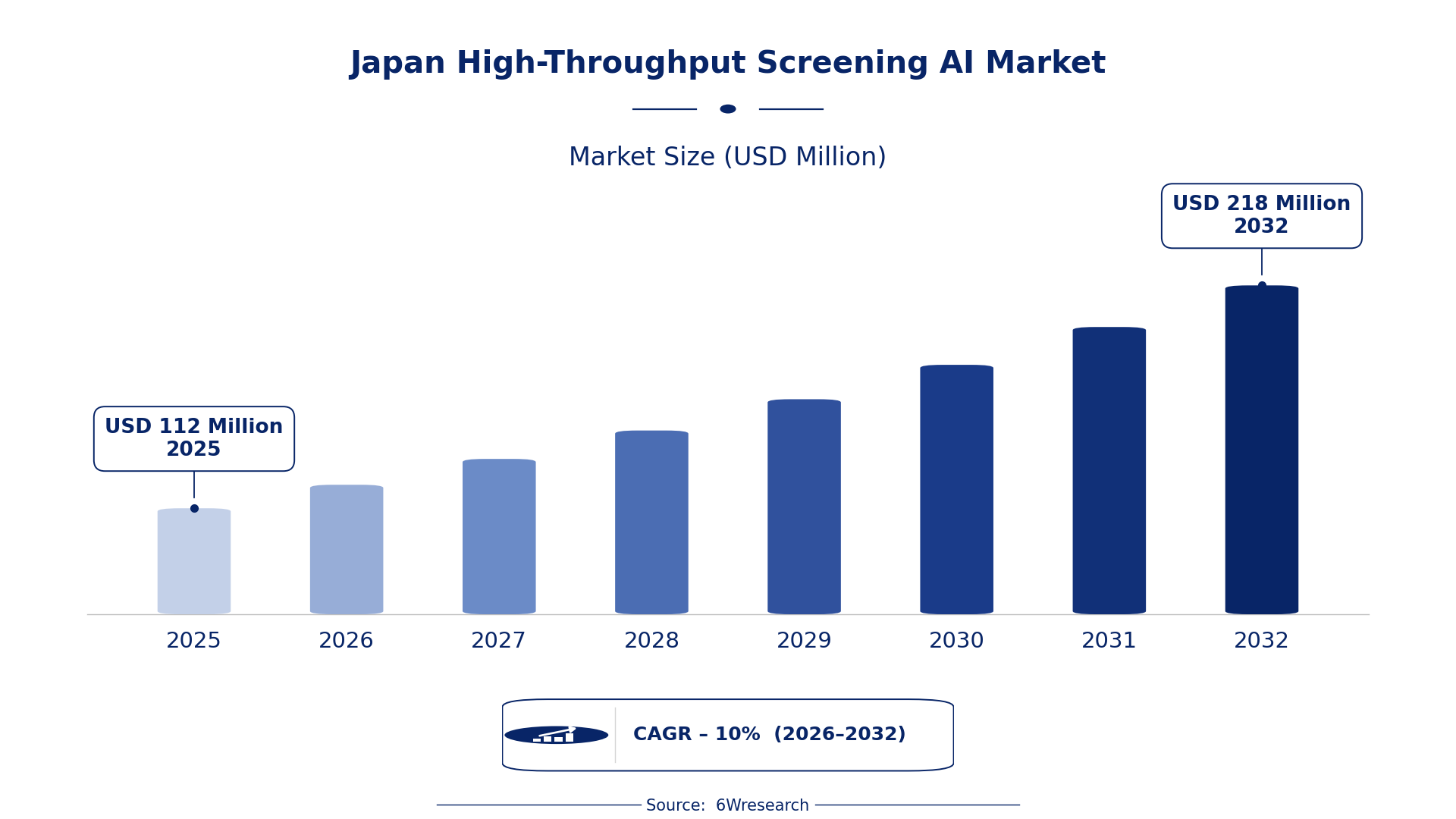
According to 6Wresearch internal database and industry insights, the Japan High-Throughput Screening AI Market was valued at USD 112 Million in 2025 and is projected to reach USD 218 Million by 2032, growing at a CAGR of approximately 10% during 2026–2032.
Japan High-Throughput Screening AI Market Highlights
| Report Metric | Details |
| Report Name | Japan High-Throughput Screening AI Market (2026-2032) |
| Market Size 2025 | USD 112 Million |
| Market Size 2032 | USD 218 Million |
| Absolute Growth 2025–2032 | USD 106 Million |
| CAGR 2026–2032 | 10% |
| Peak Annual Growth | 11.8% in 2032 |
| Forecast Period | 2026–2032 |
| Historical Data | 2022–2025 |
| Base Year | 2025 |
| Leading Application Area, 2025 | Drug Discovery (46% share) |
| Leading AI Technology, 2025 | Machine Learning (47% share) |
| Leading Distribution Channel, 2025 | Direct Sales (39% share) |
| Leading End User, 2025 | Biotech Firms (47% share) |
| Fastest-Growing Application Area | Biomarker Identification (12.5% CAGR) |
| Fastest-Growing AI Technology | Deep Learning (14.1% CAGR) |
| Fastest-Growing Distribution Channel | AI SaaS Platforms (13.8% CAGR) |
| Fastest-Growing End User | Pharmaceutical R&D Labs (13.4% CAGR) |
| Growing Sector | biotechnology |
| Key End Users | biotech firms, pharmaceutical R&D labs, clinical research units |
Japan High-Throughput Screening AI Market Year-wise Growth Rate and Key Drivers (2022–2032)
This graph illustrates the annual growth rates of the market from 2022 to 2032, highlighting a steady upward trajectory and projected market expansion over the forecast period.
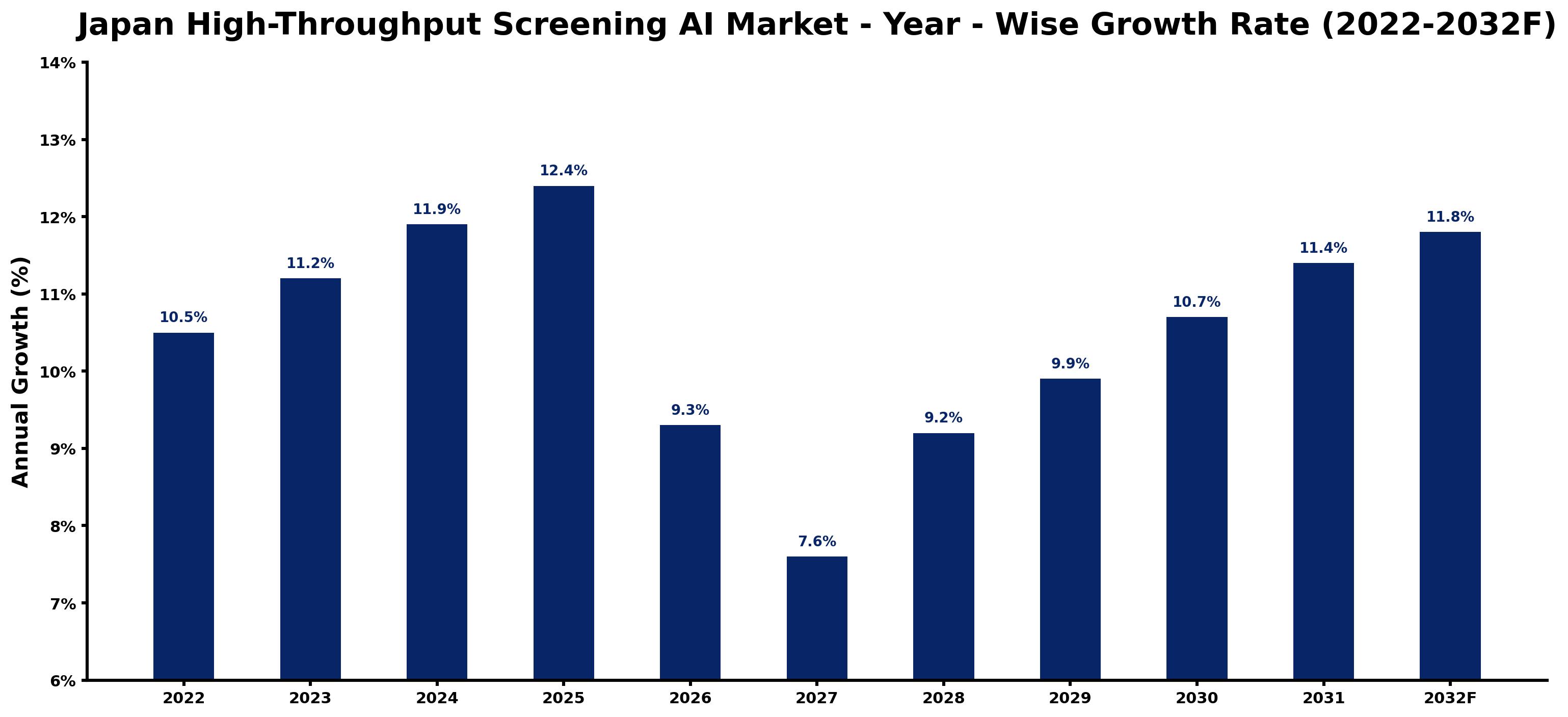
Each row of the following table gives one year's estimated growth and the event or demand shift that explains it.
| Year | Estimated Annual Growth (%) | Market Rationale |
| 2022 | 10.5 | The market saw steady growth due to increased interest in drug discovery technologies. |
| 2023 | 11.2 | Demand accelerated as pharmaceutical companies expanded their research and development budgets. |
| 2024 | 11.9 | Growth continued as more biotech firms adopted AI solutions for enhanced efficiency. |
| 2025 | 12.4 | The peak growth year was marked by a surge in AI-driven drug discovery collaborations. |
| 2026 | 9.3 | Growth is expected to slow as the market adjusts to rapid technological advancements. |
| 2027 | 7.6 | A further slowdown is projected as companies refine their integration strategies for AI. |
| 2028 | 9.2 | Growth is expected to pick up again as deep learning applications gain traction in laboratories. |
| 2029 | 9.9 | Demand is projected to rise as the number of clinical trials utilizing AI tools increases significantly. |
| 2030 | 10.7 | Growth is expected to continue as predictive modeling becomes standard in pharmaceutical research and development. |
| 2031 | 11.4 | The market is projected to expand as new drug approvals increase, driving AI adoption. |
| 2032 | 11.8 | The market is expected to peak as AI technologies become integral to the drug development process. |
Note: Market size estimations and growth projections presented in this report are based on 6Wresearch's proprietary forecasting methodology, utilizing the latest available industry data, government publications, and primary research inputs.
Japan High-Throughput Screening AI Market Synopsis
High-Throughput Screening AI employs advanced computational techniques to accelerate drug discovery and development processes. By analysing vast datasets, it identifies potential drug candidates efficiently. The Japan High-Throughput Screening AI Market is expanding, driven by over 1,200 active biotech firms and substantial pharmaceutical R&D expenditure, which reached approximately 1.5 trillion JPY in 2022. Increasing collaborations in drug discovery and a government target to boost new drug approvals by 20% by 2025 further stimulate demand for these technologies.
Market Dynamics Impact Analysis (2026–2032)
| Factor | Type | Impact | Primary Segment Affected |
| Growing number of biotech firms | Driver | High | Drug Discovery |
| Increased R&D expenditure | Driver | High | Biomarker Identification |
| Emerging AI SaaS platforms | Opportunity | Medium | AI SaaS Platforms |
| Government funding for AI in healthcare | Opportunity | High | Biotech Firms |
| High costs of AI implementation | Restraint | High | Pharmaceutical R&D Labs |
| Limited awareness of AI benefits | Restraint | Medium | Clinical Research Units |
| Talent shortages in AI expertise | Challenge | High | Drug Discovery |
| Regulatory hurdles for AI tools | Challenge | Medium | Biomarker Identification |
Evaluation of Drivers in Japan High-Throughput Screening AI Market (2026–2032)
Below are the drivers that matter most for revenue growth, with supporting evidence.
| Drivers | Primary Segment Affected | Why It Matters (Evidence) |
| Increased adoption of machine learning algorithms | Drug Discovery | Machine learning is used in over 50% of drug discovery projects, improving efficiency. |
| Rising pharmaceutical R&D budgets | Biomarker Identification | Japan's pharmaceutical R&D expenditure reached approximately 1.5 trillion JPY, boosting demand for advanced solutions. |
| Growing collaborations in AI-driven drug discovery | Compound Screening | The number of AI-driven drug discovery collaborations has doubled in the last two years, indicating a strong trend towards integration. |
| Expansion of AI applications in toxicity prediction | Toxicity Prediction | Deep learning techniques are now standard in toxicity prediction models across various labs, enhancing reliability. |
| Increasing clinical trials utilising AI tools | Clinical Research Units | The number of clinical trials using AI tools has surged by 30% in the last year, reflecting a growing acceptance of these technologies. |
Volumes grow on the back of increased adoption of machine learning algorithms, which are now used in over 50% of drug discovery projects. Pharmaceutical R&D budgets have risen, with expenditure reaching approximately 1.5 trillion JPY, driving demand for advanced solutions. Collaborations in AI-driven drug discovery have doubled recently, indicating a strong trend towards integration. Deep learning techniques are becoming standard in toxicity prediction models across various labs, further improving reliability. The number of clinical trials utilizing AI tools has surged by 30% in the last year, reflecting a growing acceptance of these technologies in research.
Evaluation of Restraints in Japan High-Throughput Screening AI Market
These restraints slow adoption and weigh on supplier margins.
| Market Restraint | Primary Segment Affected | Why It Matters (Evidence) |
| High costs associated with AI implementation | Drug Discovery | Implementing AI solutions requires substantial investment, limiting accessibility for smaller firms. |
| Limited awareness of AI benefits among researchers | Biomarker Identification | Many researchers are unaware of the advantages AI can provide, hindering adoption. |
| Regulatory challenges in AI tool approvals | Clinical Research Units | Strict regulations can delay the approval process for AI applications in clinical settings. |
| Talent shortages in AI and data science fields | Pharmaceutical R&D Labs | A lack of skilled professionals in AI and data science restricts effective implementation. |
| Concerns over data privacy and security | Toxicity Prediction | Data privacy issues can deter firms from fully adopting AI in toxicity assessments. |
Japan High-Throughput Screening AI Market Challenges
High-Throughput Screening AI faces a critical skills shortage, as over 1,200 biotech firms in Japan struggle to recruit professionals with expertise in advanced computational techniques. This shortage stems from insufficient educational programmes, causing delays in drug discovery projects for producers. Many facilities utilise outdated technology, leading to operational inefficiencies and increased costs for buyers. Regulatory challenges from the Pharmaceutical and Medical Devices Agency complicate the approval process for new AI applications, resulting in longer timelines for drug development and impacting the competitiveness of producers in the market.
Trends in the Japan High-Throughput Screening AI Market
Several trends are reshaping the Japan High-Throughput Screening AI Market; the most important are set out below.
- Shift from Traditional Methods to AI-Driven Approaches: The pharmaceutical sector is increasingly adopting AI-driven methods for drug discovery, as seen in Tokyo's biotech firms, which have reported a 30% increase in AI tool usage.
- Transition from In-House Development to AI SaaS Platforms: AI SaaS platforms are gaining traction in Japan, particularly in Osaka, where adoption is expected to rise significantly by 2025, improving accessibility for smaller firms.
- Emergence of Deep Learning in Toxicity Prediction: Deep learning techniques are becoming standard in toxicity prediction models, particularly in research labs in Tokyo, with over 50% of labs adopting these methods.
- Growing Collaborations in AI-Driven Drug Discovery: The number of collaborations in AI-driven drug discovery has doubled, with over 1,200 biotech firms in Japan actively engaging in partnerships to enhance innovation.
Investment Opportunities in the Japan High-Throughput Screening AI Market
The opportunities below stand out in the Japan High-Throughput Screening AI Market for new entrants and existing suppliers.
- Timing is ripe for AI SaaS platforms: With the expected rise in adoption of AI SaaS platforms by 2025, firms should invest in these solutions to meet growing demand from biotech firms in Tokyo.
- Investment in AI for healthcare: The Japanese government allocated 10 billion JPY for AI research in healthcare, presenting an opportunity for firms to partner with research institutions to develop effective solutions.
- Supply of predictive modeling tools: Predictive modeling is becoming standard in pharmaceutical R&D, creating a demand for suppliers of advanced modeling tools in Osaka's research facilities.
- Entry through local partnerships: Firms can enter the market by forming joint ventures with local biotech companies, utilising their established networks and expertise.
Government Initiatives in the Japan High-Throughput Screening AI Market
The Act on the Rational Use of Energy, established in 1979, mandates large energy users to enhance energy efficiency and report their energy consumption. This law impacts producers of High-Throughput Screening AI by encouraging them to adopt energy-efficient technologies, reducing operational costs. The Clinical Trials Act, enacted in 2017, sets forth rules for conducting and disclosing clinical research, ensuring transparency and safety in drug development processes. Compliance with this act is crucial for pharmaceutical R&D labs utilising AI technologies, as it affects their operational protocols and timelines.
In 2023, the government allocated 10 billion JPY for AI research in healthcare, administered by the Ministry of Health. This funding supports various initiatives aimed at integrating AI into healthcare, including High-Throughput Screening AI applications. The Japan Agency for Medical Research and Development (AMED) also funds biomarker identification projects, facilitating advancements in targeted therapies. These investments are pivotal for enhancing the capabilities of biotech firms and pharmaceutical R&D labs, ultimately driving growth in the market.
Future Insight of the Japan High-Throughput Screening AI Market
The rise of advanced algorithms will transform drug discovery by 2032, enabling faster identification of potential drug candidates. Government funding initiatives will stimulate growth, with 10 billion JPY allocated for AI research in healthcare. The number of clinical trials leveraging AI tools has increased by 30% in the past year, enhancing research efficiency. By 2025, the adoption of AI SaaS platforms will provide buyers with streamlined solutions, improving operations in pharmaceutical R&D labs.
Market Segmentation Analysis
Japan High-Throughput Screening AI Market report covers a detailed analysis of the following market segments:
By Application Area – Drug Discovery Leads, Biomarker Identification Expected to Grow Fastest
According to Saurav Kr Singh, Senior Research Analyst at 6Wresearch, Drug Discovery held 46% of the Japan High-Throughput Screening AI Market by application area in 2025. Drug discovery holds the largest share due to its critical role in identifying viable drug candidates, with over 1,200 biotech firms in Japan actively engaged in this area. This sector is essential for meeting the increasing demand for rapid drug development in a competitive landscape. Biomarker Identification is set to record the highest CAGR in this split, 12.5% over 2026–2032. Biomarker identification is experiencing rapid growth as it plays a crucial role in developing targeted therapies, supported by funding initiatives from the Japan Agency for Medical Research and Development. As the focus on precision medicine intensifies, this segment's growth is poised to accelerate further. Suppliers should concentrate on solutions that support drug discovery and biomarker identification to align with market demands.
By AI Technology – Machine Learning Leads, Deep Learning Expected to Grow Fastest
Machine Learning took 47% of ai technology revenue in 2025, more than any other category. Machine learning leads the market as it is widely used for data analysis and pattern recognition, making it a fundamental tool in over 50% of drug discovery projects. Its established presence in the industry ensures a strong installed base and continued investment. The quickest growth will come from Deep Learning, forecast to expand at a CAGR of 14.1% between 2026 and 2032. Deep learning is growing rapidly due to its importance in processing complex biological data, with applications in toxicity prediction models across various labs. As the technology matures, its adoption will likely expand, further increasing its market share. Buyers should invest in advanced machine learning and deep learning solutions to stay competitive in drug development.
By Distribution Channel – Direct Sales Leads, AI SaaS Platforms Expected to Grow Fastest
With 39% of distribution channel revenue in 2025, Direct Sales was the largest category. Direct sales is the leading distribution method, providing personalised engagement with clients and tailored offerings that effectively address specific needs. This approach has established strong relationships with biotech firms and pharmaceutical companies, ensuring consistent demand. Over 2026–2032, AI SaaS Platforms are expected to post the fastest growth, at a CAGR of 13.8%. AI SaaS platforms are rapidly growing as a preferred delivery method for software, driven by the need for scalable and flexible solutions in healthcare. This shift is likely to transform how technologies are accessed and utilised in the market. Suppliers need to enhance their direct sales strategies while developing robust AI SaaS offerings to seize emerging opportunities.
By End User – Biotech Firms Lead, Pharmaceutical R&D Labs Expected to Grow Fastest
Biotech Firms accounted for 47% of the market by end user in 2025. Biotech firms represent the largest end user group, as they rely heavily on screening technologies to accelerate their drug discovery processes. Their active involvement in the market guarantees a steady demand for advanced solutions tailored to their needs. Pharmaceutical R&D Labs are projected to grow fastest, at a CAGR of 13.4% during 2026–2032. Pharmaceutical R&D labs are the fastest-growing end user segment, increasingly adopting high-throughput solutions to enhance efficiency in drug development. The notable rise in clinical trials utilising AI tools underscores a strong trend towards this segment's expansion. Suppliers should prioritise the specific needs of biotech firms and pharmaceutical R&D labs to optimise their market potential.
Key Attractiveness of the Report
- 10 Years of Market Numbers
- Historical Data Starting from 2022 to 2025
- Base Year 2025
- Forecast Data until 2032
- Key Performance Indicators Impacting the Market
- Major Upcoming Developments and Projects
Key Highlights of the Report:
- Japan High-Throughput Screening AI Market Outlook
- Market Size of Japan High-Throughput Screening AI Market, 2025
- Forecast of Japan High-Throughput Screening AI Market, 2032
- Historical Data and Forecast of Japan High-Throughput Screening AI Revenues & Volume for the Period 2022-2032F
- Japan High-Throughput Screening AI Market Trend Evolution
- Japan High-Throughput Screening AI Market Drivers and Challenges
- Japan High-Throughput Screening AI Price Trends
- Japan High-Throughput Screening AI Porter's Five Forces
- Japan High-Throughput Screening AI Industry Life Cycle
- Historical Data and Forecast of Japan High-Throughput Screening AI Market Revenues & Volume By Application Area for the Period 2022-2032F
- Historical Data and Forecast of Japan High-Throughput Screening AI Market Revenues & Volume By Drug Discovery for the Period 2022-2032F
- Historical Data and Forecast of Japan High-Throughput Screening AI Market Revenues & Volume By Biomarker Identification for the Period 2022-2032F
- Historical Data and Forecast of Japan High-Throughput Screening AI Market Revenues & Volume By Toxicity Prediction for the Period 2022-2032F
- Historical Data and Forecast of Japan High-Throughput Screening AI Market Revenues & Volume By Compound Screening for the Period 2022-2032F
- Historical Data and Forecast of Japan High-Throughput Screening AI Market Revenues & Volume By AI Technology for the Period 2022-2032F
- Historical Data and Forecast of Japan High-Throughput Screening AI Market Revenues & Volume By Machine Learning for the Period 2022-2032F
- Historical Data and Forecast of Japan High-Throughput Screening AI Market Revenues & Volume By Deep Learning for the Period 2022-2032F
- Historical Data and Forecast of Japan High-Throughput Screening AI Market Revenues & Volume By Predictive Modeling for the Period 2022-2032F
- Historical Data and Forecast of Japan High-Throughput Screening AI Market Revenues & Volume By Image Recognition for the Period 2022-2032F
- Historical Data and Forecast of Japan High-Throughput Screening AI Market Revenues & Volume By Distribution Channel for the Period 2022-2032F
- Historical Data and Forecast of Japan High-Throughput Screening AI Market Revenues & Volume By Direct Sales for the Period 2022-2032F
- Historical Data and Forecast of Japan High-Throughput Screening AI Market Revenues & Volume By AI SaaS Platforms for the Period 2022-2032F
- Historical Data and Forecast of Japan High-Throughput Screening AI Market Revenues & Volume By Online Platforms for the Period 2022-2032F
- Historical Data and Forecast of Japan High-Throughput Screening AI Market Revenues & Volume By OEM AI Providers for the Period 2022-2032F
- Historical Data and Forecast of Japan High-Throughput Screening AI Market Revenues & Volume By End User for the Period 2022-2032F
- Historical Data and Forecast of Japan High-Throughput Screening AI Market Revenues & Volume By Biotech Firms for the Period 2022-2032F
- Historical Data and Forecast of Japan High-Throughput Screening AI Market Revenues & Volume By Pharmaceutical R&D Labs for the Period 2022-2032F
- Historical Data and Forecast of Japan High-Throughput Screening AI Market Revenues & Volume By Clinical Research Units for the Period 2022-2032F
- Historical Data and Forecast of Japan High-Throughput Screening AI Market Revenues & Volume By Hospitals & CROs for the Period 2022-2032F
- Japan High-Throughput Screening AI Import Export Trade Statistics
- Market Opportunity Assessment By Application Area
- Market Opportunity Assessment By AI Technology
- Market Opportunity Assessment By Distribution Channel
- Market Opportunity Assessment By End User
- Japan High-Throughput Screening AI Top Companies Market Share
- Japan High-Throughput Screening AI Competitive Benchmarking By Technical and Operational Parameters
- Japan High-Throughput Screening AI Company Profiles
- Japan High-Throughput Screening AI Key Strategic Recommendations
Market Covered
Coverage by segment is as follows.
By Application Area
- Drug Discovery
- Biomarker Identification
- Toxicity Prediction
- Compound Screening
By AI Technology
- Machine Learning
- Deep Learning
- Predictive Modeling
- Image Recognition
By Distribution Channel
- Direct Sales
- AI SaaS Platforms
- Online Platforms
- OEM AI Providers
By End User
- Biotech Firms
- Pharmaceutical R&D Labs
- Clinical Research Units
- Hospitals & CROs































