Japan Higher Education Game-Based Learning Market Size & Growth Rate
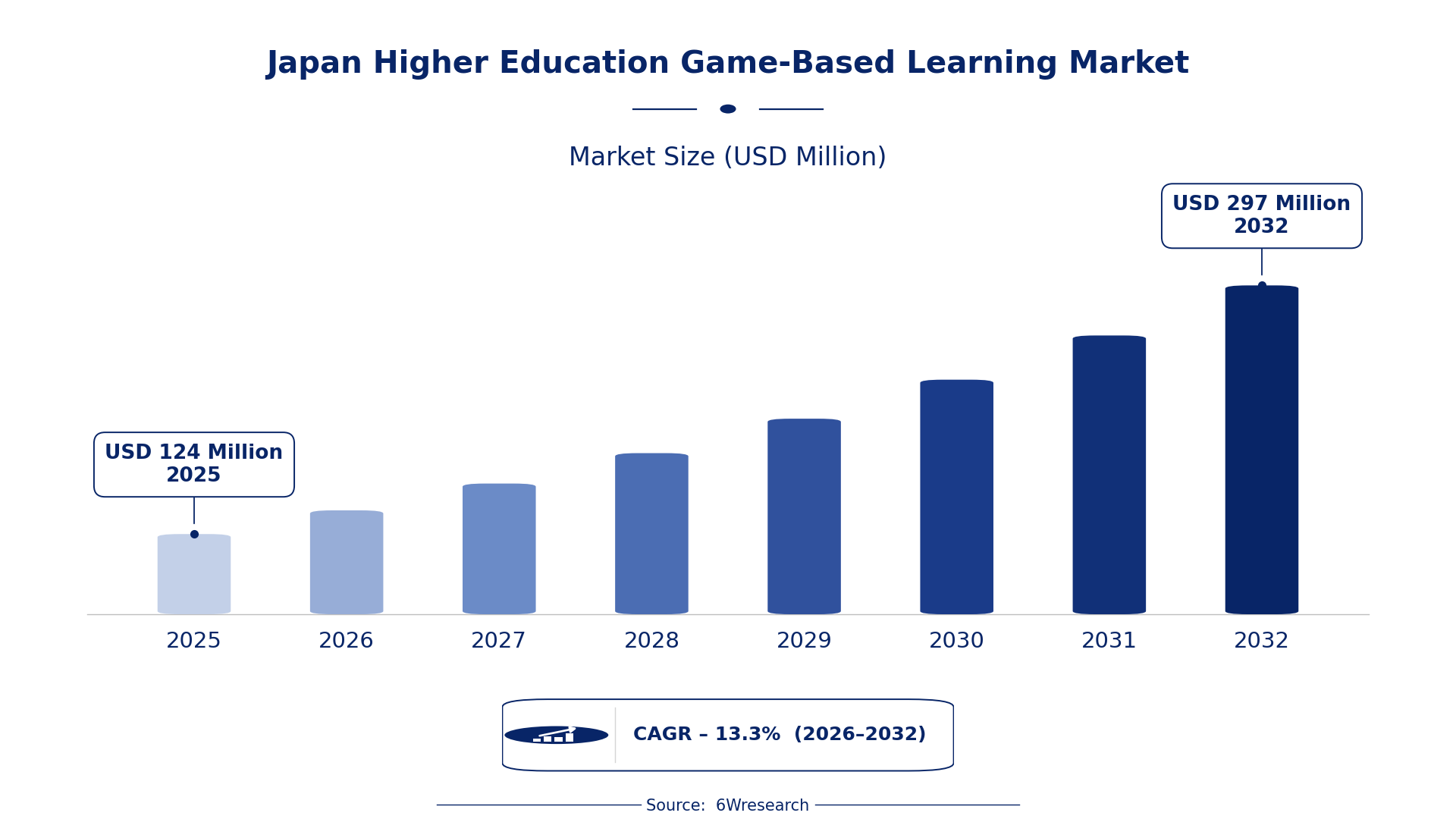
According to 6Wresearch internal database and industry insights, the Japan Higher Education Game-Based Learning Market was valued at USD 124 Million in 2025 and is projected to reach USD 297 Million by 2032, growing at a CAGR of approximately 13.3% during 2026–2032.
Japan Higher Education Game-Based Learning Market Highlights
| Report Metric | Details |
| Report Name | Japan Higher Education Game-Based Learning Market (2026-2032) |
| Market Size 2025 | USD 124 Million |
| Market Size 2032 | USD 297 Million |
| Absolute Growth 2025–2032 | USD 173 Million |
| CAGR 2026–2032 | 13.3% |
| Peak Annual Growth | 15.2% in 2028 |
| Forecast Period | 2026–2032 |
| Historical Data | 2022–2025 |
| Base Year | 2025 |
| Leading Game Type, 2025 | Simulation-Based Learning (37% share) |
| Leading Learning Platform, 2025 | PC & Web (45% share) |
| Leading Application Area, 2025 | STEM Education (40% share) |
| Leading Distribution Channel, 2025 | Online Platforms (37% share) |
| Leading End User, 2025 | Universities & Colleges (51% share) |
| Fastest-Growing Game Type | Interactive Quizzes (18.2% CAGR) |
| Fastest-Growing Learning Platform | Mobile Apps (19.7% CAGR) |
| Fastest-Growing Application Area | Language Learning (15.5% CAGR) |
| Fastest-Growing Distribution Channel | Direct Sales (17.0% CAGR) |
| Fastest-Growing End User | Students & Faculties (17.6% CAGR) |
| Growing Sector | STEM Education |
| Key End Users | Universities & Colleges, Educational Institutes, Faculty & Educators, Students & Faculties |
Japan Higher Education Game-Based Learning Market Year-wise Growth Rate and Key Drivers (2022–2032)
This graph illustrates the annual growth rates of the market from 2022 to 2032, highlighting a steady upward trajectory and projected market expansion over the forecast period.
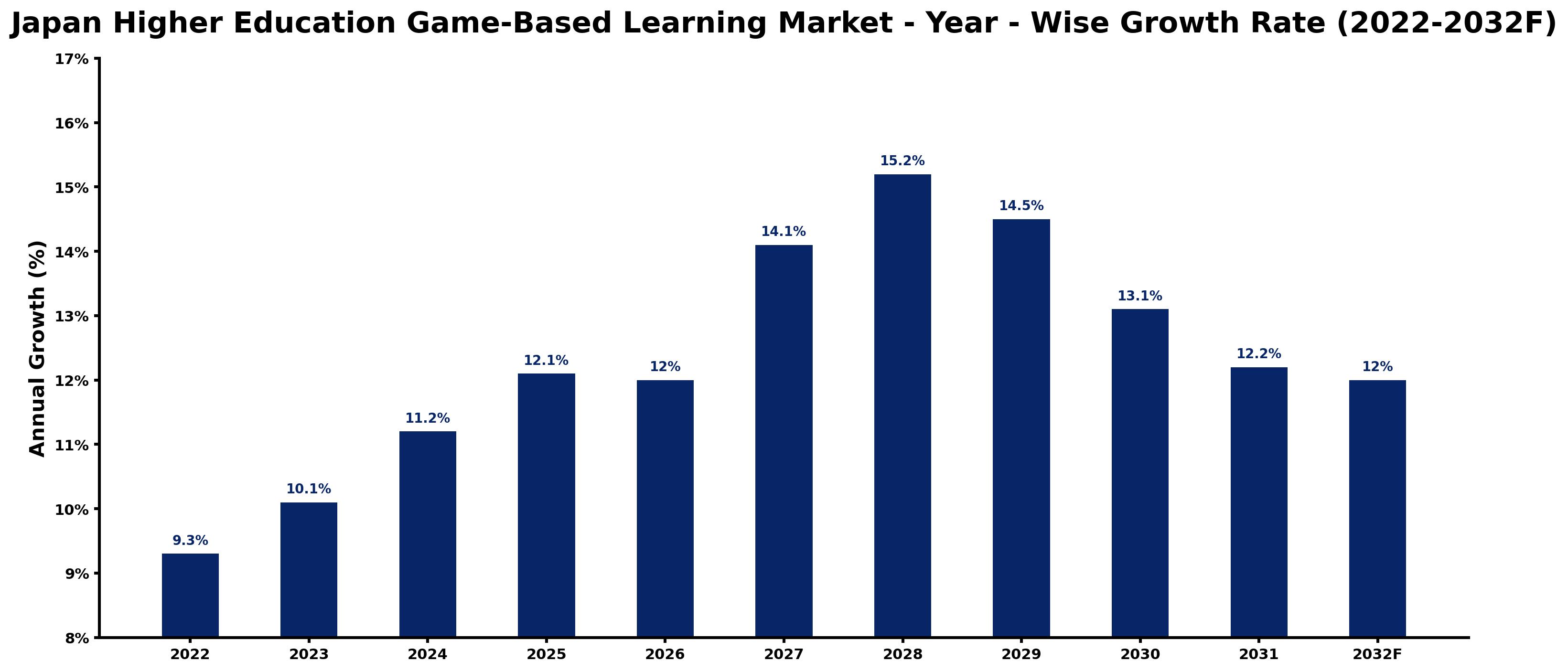
Annual growth estimates for each year appear below with the principal reason behind them, explaining the shifts that set the pace of the market.
| Year | Estimated Annual Growth (%) | Market Rationale |
| 2022 | 9.3 | The market showed steady growth with increased adoption of game-based learning tools. |
| 2023 | 10.1 | Growth accelerated as 70% of universities reported using game-based learning solutions. |
| 2024 | 11.2 | Demand continued to rise, driven by the integration of gamified assessments in curricula. |
| 2025 | 12.1 | The market peaked with investments in STEM education and digital tools. |
| 2026 | 12.0 | Growth is expected to slow slightly as universities adjust to new learning technologies. |
| 2027 | 14.1 | Demand is projected to surge again, supported by rising interest in professional skills training. |
| 2028 | 15.2 | The market will reach its peak growth rate, reflecting strong engagement in gamified learning. |
| 2029 | 14.5 | Growth is expected to slow as the market matures and competition intensifies. |
| 2030 | 13.1 | A further slowdown is projected as institutions focus on refining existing technologies. |
| 2031 | 12.2 | The market will continue to grow, albeit at a reduced rate, as new strategies emerge. |
| 2032 | 12.0 | Growth is projected to stabilise as educational institutions adapt to technological advancements. |
Note: Market size estimations and growth projections presented in this report are based on 6Wresearch's proprietary forecasting methodology, utilizing the latest available industry data, government publications, and primary research inputs.
Japan Higher Education Game-Based Learning Market Synopsis
Higher Education Game-Based Learning in Japan includes digital tools that apply game mechanics to improve educational experiences, particularly in STEM education and language learning. With over 780 universities adopting these solutions, the Japan Higher Education Game-Based Learning Market is expanding due to rising investments in engaging educational methods and the growing popularity of gamified assessments. In 2023, 70% of universities reported using game-based learning, indicating a shift towards interactive educational practices, driven by both domestic institutions and international collaborations.
Market Dynamics Impact Analysis (2026–2032)
| Factor | Type | Impact | Primary Segment Affected |
| Growing adoption of gamified assessments in educational programs drives demand. | Driver | High | Gamified Assessment |
| Increased investment in VR/AR technologies enhances immersive learning experiences. | Driver | High | VR/AR |
| Expansion of mobile apps for education presents new market opportunities. | Opportunity | High | Mobile Apps |
| Rising interest in professional skills training creates demand for gamified solutions. | Opportunity | High | Professional Skills |
| Limited awareness of game-based learning benefits among some educational institutions. | Restraint | High | Gamified Assessment |
| High development costs for VR/AR technologies can deter investment. | Restraint | High | VR/AR |
| Competition from traditional teaching methods limits market penetration. | Challenge | High | Interactive Quizzes |
| Insufficient training for faculty on implementing game-based learning tools. | Challenge | High | Mobile Apps |
Evaluation of Drivers in Japan Higher Education Game-Based Learning Market (2026–2032)
The main growth drivers and the segments they affect most are set out below.
| Drivers | Primary Segment Affected | Why It Matters (Evidence) |
| 70% of universities using game-based learning solutions increases demand. | Gamified Assessment | This trend prompts educational institutions to invest in gamified tools for better student engagement. |
| Increased investment in VR/AR technologies drives immersive learning experiences. | VR/AR | Educational institutes are adopting these technologies to create engaging learning environments. |
| The number of educational apps available increased by 25% last year, driving demand. | Mobile Apps | This growth reflects a tech-savvy student population seeking accessible learning tools. |
| Support for educational practices boosts market growth. | STEM Education | This backing encourages universities to integrate game-based learning into their curricula. |
| 40% of educational programs included gamified assessments, increasing engagement. | Interactive Quizzes | This integration leads to higher student participation and improved learning outcomes. |
Spending rises because 70% of universities are now using game-based learning solutions, prompting increased investment in gamified tools. The number of educational apps available has surged by 25%, reflecting a tech-savvy student population eager for accessible learning. Support for educational practices drives the integration of game-based learning in various subjects.
Evaluation of Restraints in Japan Higher Education Game-Based Learning Market
The following restraints limit how fast demand can grow.
| Market Restraint | Primary Segment Affected | Why It Matters (Evidence) |
| Limited awareness of game-based learning benefits among some educational institutions. | Gamified Assessment | This lack of understanding hinders adoption rates, particularly in traditional universities. |
| High development costs for VR/AR technologies can deter investment. | VR/AR | Many educational institutions struggle to allocate sufficient budgets for these advanced tools. |
| Competition from traditional teaching methods limits market penetration. | Interactive Quizzes | Some educators prefer conventional assessments, which slows the transition to gamified approaches. |
| Insufficient training for faculty on implementing game-based learning tools. | Mobile Apps | Without proper training, educators may hesitate to adopt new technologies. |
| Regulatory compliance requirements can complicate the development of educational software. | Cloud-Based | Producers must navigate complex standards, which can delay product launches. |
Japan Higher Education Game-Based Learning Market Challenges
A shortage of skilled developers in game-based learning hampers progress in Japan. Many universities struggle to find qualified personnel, delaying the rollout of effective educational tools for producers. Buyers encounter issues as only 40% of educational programs currently incorporate gamified assessments, which limits student engagement and retention. High costs associated with software development deter educational institutions from investing, resulting in fewer options for buyers. Intense competition exists among over 780 universities, making it challenging for smaller producers to secure resources and market presence.
Trends in the Japan Higher Education Game-Based Learning Market
Buyers and suppliers in the Japan Higher Education Game-Based Learning Market are adjusting to the following trends.
- Rise in Game-Based Learning Adoption: In 2023, 70% of universities reported using game-based learning, indicating a shift towards gamified educational methods. This trend is reshaping curricula, improving student engagement and learning outcomes.
- Growth of Mobile Learning Solutions: The increase in mobile apps for education is driven by a tech-savvy student population. In the last year, the number of educational apps rose by 25%, making learning more accessible.
- Focus on STEM Education: Tokyo and Osaka are leading regions in adopting game-based educational technologies, with 40% of programs incorporating gamified assessments. This focus is essential for preparing students for future careers.
- Integration of VR/AR in Learning: Educational institutes are increasingly investing in VR/AR technologies for immersive learning experiences. This trend is expected to expand significantly, improving the quality of education.
Investment Opportunities in the Japan Higher Education Game-Based Learning Market
The openings below show where demand in the Japan Higher Education Game-Based Learning Market is visible and how suppliers can enter.
- Demand for Mobile Learning Platforms: Tokyo is experiencing a rise in demand for mobile learning solutions, with a 25% increase in educational apps. Suppliers can enter this market by partnering with local educational institutes.
- Growth in Professional Skills Training: Universities are increasingly incorporating gamification into professional skills training programs. This presents an opportunity for suppliers to develop tailored gamified solutions for educational institutes.
- Expansion of Gamified Assessments: With 40% of educational programs including gamified assessments, there is a growing need for assessment tools. Suppliers can target universities and colleges looking to enhance engagement.
- Enhancement of Digital Literacy Programs: The 2023 MEXT program aims to improve digital literacy through game-based learning. Suppliers can collaborate with educational institutions to provide necessary tools and resources.
Government Initiatives in the Japan Higher Education Game-Based Learning Market
The Industrial Standardization Act, established in 1949 and amended in 2019, governs product and test standards for educational software. This law ensures that game-based learning tools meet quality and safety requirements, benefiting both producers and users.
The Digital Agency, established in September 2021, leads government digital transformation efforts. It funds initiatives to improve educational technology, approving projects that integrate game-based learning into curricula and supporting educational institutions in their adoption of these tools.
Future Insight of the Japan Higher Education Game-Based Learning Market
Investment in digital learning tools will surge, creating robust demand for game-based solutions. By 2032, the number of students enrolled in higher education is expected to reach approximately 3 million, driving the need for advanced educational technologies. Digital literacy initiatives will enhance student capabilities, improving the overall quality of education. The adoption of immersive technologies will redefine learning experiences, setting new standards for student engagement.
Market Segmentation Analysis
Japan Higher Education Game-Based Learning Market report covers a detailed analysis of the following market segments:
By Game Type – Simulation-Based Learning Leads, Interactive Quizzes Expected to Grow Fastest
According to Vasu Joshi, Associate Consultant at 6Wresearch, the largest game type category in 2025 was Simulation-Based Learning, at 37% of revenue. Simulation-Based Learning holds the largest share as it is extensively used for practical training and immersive experiences across various academic disciplines. For instance, many universities employ this method to enhance hands-on learning in fields like engineering and healthcare. The quickest growth will come from Interactive Quizzes, forecast to expand at a CAGR of 18.2% between 2026 and 2032. The rapid growth of Interactive Quizzes stems from their effectiveness in assessment and engagement, with 40% of educational programs incorporating gamified assessments in 2023. This trend indicates a shift towards interactive learning methodologies that resonate well with students. Suppliers should focus on developing innovative quiz-based tools to meet the rising demand for interactive learning solutions.
By Learning Platform – PC & Web Leads, Mobile Apps Expected to Grow Fastest
With 45% of learning platform revenue in 2025, PC & Web was the largest category. PC & Web platforms dominate the market as the primary means for accessing game-based learning tools, with a large installed base among educational institutions. The majority of universities utilise these platforms to deliver their digital learning content effectively. Over 2026–2032, Mobile Apps are expected to post the fastest growth, at a CAGR of 19.7%. Mobile Apps are experiencing rapid growth due to the increasing demand for on-the-go learning solutions, driven by a tech-savvy student population. The 25% increase in educational apps over the last year highlights this trend. Buyers should consider mobile compatibility in their learning solutions to cater to the preferences of modern students.
By Application Area – STEM Education Leads, Language Learning Expected to Grow Fastest
STEM Education took 40% of application area revenue in 2025, more than any other category. STEM Education is the leading application area for game-based learning, as it plays a vital role in engaging students in complex subjects such as mathematics and science. Numerous universities have integrated simulation-based learning into their STEM curricula to improve educational outcomes. Language Learning is projected to grow fastest, at a CAGR of 15.5% during 2026–2032. Language Learning is witnessing the fastest growth, leveraging gamification techniques to enhance student engagement and retention rates. The increasing adoption of gamified assessments in language programs underscores this shift towards more interactive learning approaches. Suppliers should prioritise the creation of language learning tools that incorporate gamification to capitalise on this expanding trend.
By Distribution Channel – Online Platforms Lead, Direct Sales Expected to Grow Fastest
Online Platforms held 37% of the Japan Higher Education Game-Based Learning Market by distribution channel in 2025. Online Platforms are the primary distribution method for game-based learning solutions, providing easy access to a wide array of educational tools. This channel is particularly favoured by universities and colleges for its convenience and ability to reach a larger audience. Direct Sales is set to record the highest CAGR in this split, 17.0% over 2026–2032. Direct Sales are gaining traction, especially for larger institutional contracts, as educational institutions seek tailored solutions. This approach allows for more personalised engagement with clients, improving the overall sales experience. Suppliers may need to refine their direct sales strategies to effectively engage larger educational institutions.
By End User – Universities & Colleges Lead, Students & Faculties Expected to Grow Fastest
In 2025, Universities & Colleges led the end user split with a 51% share. Universities & Colleges represent the largest user group for game-based learning solutions, with over 780 institutions actively utilising these tools. This extensive adoption indicates a strong commitment to integrating game-based learning into higher education. The quickest growth will come from Students & Faculties, forecast to expand at a CAGR of 17.6% between 2026 and 2032. Students & Faculties are the fastest-growing beneficiaries of these tools, as they directly engage with game-based learning in their educational activities. The increasing demand for interactive learning experiences drives this growth. Suppliers should focus on creating user-friendly tools that cater specifically to the needs of students and faculty.
Key Attractiveness of the Report
- 10 Years of Market Numbers
- Historical Data Starting from 2022 to 2025
- Base Year 2025
- Forecast Data until 2032
- Key Performance Indicators Impacting the Market
- Major Upcoming Developments and Projects
Key Highlights of the Report:
- Japan Higher Education Game-Based Learning Market Outlook
- Market Size of Japan Higher Education Game-Based Learning Market, 2025
- Forecast of Japan Higher Education Game-Based Learning Market, 2032
- Historical Data and Forecast of Japan Higher Education Game-Based Learning Market Revenues & Volume for the Period 2022-2032F
- Japan Higher Education Game-Based Learning Market Trend Evolution
- Japan Higher Education Game-Based Learning Market Drivers and Challenges
- Japan Higher Education Game-Based Learning Market Price Trends
- Japan Higher Education Game-Based Learning Market Porter's Five Forces
- Japan Higher Education Game-Based Learning Market Industry Life Cycle
- Historical Data and Forecast of Japan Higher Education Game-Based Learning Market Revenues & Volume By Game Type for the Period 2022-2032F
- Historical Data and Forecast of Japan Higher Education Game-Based Learning Market Revenues & Volume By Simulation-Based Learning for the Period 2022-2032F
- Historical Data and Forecast of Japan Higher Education Game-Based Learning Market Revenues & Volume By Interactive Quizzes for the Period 2022-2032F
- Historical Data and Forecast of Japan Higher Education Game-Based Learning Market Revenues & Volume By Role-Playing Games for the Period 2022-2032F
- Historical Data and Forecast of Japan Higher Education Game-Based Learning Market Revenues & Volume By Gamified Assessment for the Period 2022-2032F
- Historical Data and Forecast of Japan Higher Education Game-Based Learning Market Revenues & Volume By Learning Platform for the Period 2022-2032F
- Historical Data and Forecast of Japan Higher Education Game-Based Learning Market Revenues & Volume By PC & Web for the Period 2022-2032F
- Historical Data and Forecast of Japan Higher Education Game-Based Learning Market Revenues & Volume By Mobile Apps for the Period 2022-2032F
- Historical Data and Forecast of Japan Higher Education Game-Based Learning Market Revenues & Volume By VR/AR for the Period 2022-2032F
- Historical Data and Forecast of Japan Higher Education Game-Based Learning Market Revenues & Volume By Cloud-Based for the Period 2022-2032F
- Historical Data and Forecast of Japan Higher Education Game-Based Learning Market Revenues & Volume By Application Area for the Period 2022-2032F
- Historical Data and Forecast of Japan Higher Education Game-Based Learning Market Revenues & Volume By STEM Education for the Period 2022-2032F
- Historical Data and Forecast of Japan Higher Education Game-Based Learning Market Revenues & Volume By Language Learning for the Period 2022-2032F
- Historical Data and Forecast of Japan Higher Education Game-Based Learning Market Revenues & Volume By Professional Skills for the Period 2022-2032F
- Historical Data and Forecast of Japan Higher Education Game-Based Learning Market Revenues & Volume By Performance Tracking for the Period 2022-2032F
- Historical Data and Forecast of Japan Higher Education Game-Based Learning Market Revenues & Volume By Distribution Channel for the Period 2022-2032F
- Historical Data and Forecast of Japan Higher Education Game-Based Learning Market Revenues & Volume By Online Platforms for the Period 2022-2032F
- Historical Data and Forecast of Japan Higher Education Game-Based Learning Market Revenues & Volume By Direct Sales for the Period 2022-2032F
- Historical Data and Forecast of Japan Higher Education Game-Based Learning Market Revenues & Volume By Specialty Distributors for the Period 2022-2032F
- Historical Data and Forecast of Japan Higher Education Game-Based Learning Market Revenues & Volume By OEM Channels for the Period 2022-2032F
- Historical Data and Forecast of Japan Higher Education Game-Based Learning Market Revenues & Volume By End User for the Period 2022-2032F
- Historical Data and Forecast of Japan Higher Education Game-Based Learning Market Revenues & Volume By Universities & Colleges for the Period 2022-2032F
- Historical Data and Forecast of Japan Higher Education Game-Based Learning Market Revenues & Volume By Students & Faculties for the Period 2022-2032F
- Historical Data and Forecast of Japan Higher Education Game-Based Learning Market Revenues & Volume By Educational Institutes for the Period 2022-2032F
- Historical Data and Forecast of Japan Higher Education Game-Based Learning Market Revenues & Volume By Faculty & Educators for the Period 2022-2032F
- Japan Higher Education Game-Based Learning Market Import Export Trade Statistics
- Market Opportunity Assessment By Game Type
- Market Opportunity Assessment By Learning Platform
- Market Opportunity Assessment By Application Area
- Market Opportunity Assessment By Distribution Channel
- Market Opportunity Assessment By End User
- Japan Higher Education Game-Based Learning Market Top Companies Market Share
- Japan Higher Education Game-Based Learning Market Competitive Benchmarking By Technical and Operational Parameters
- Japan Higher Education Game-Based Learning Market Company Profiles
- Japan Higher Education Game-Based Learning Market Key Strategic Recommendations
Market Covered
The report covers the following segments.
By Game Type
- Simulation-Based Learning
- Interactive Quizzes
- Role-Playing Games
- Gamified Assessment
By Learning Platform
- PC & Web
- Mobile Apps
- VR/AR
- Cloud-Based
By Application Area
- STEM Education
- Language Learning
- Professional Skills
- Performance Tracking
By Distribution Channel
- Online Platforms
- Direct Sales
- Specialty Distributors
- OEM Channels
By End User
- Universities & Colleges
- Students & Faculties
- Educational Institutes
- Faculty & Educators































