Japan HIV Treatment Market Size & Growth Rate
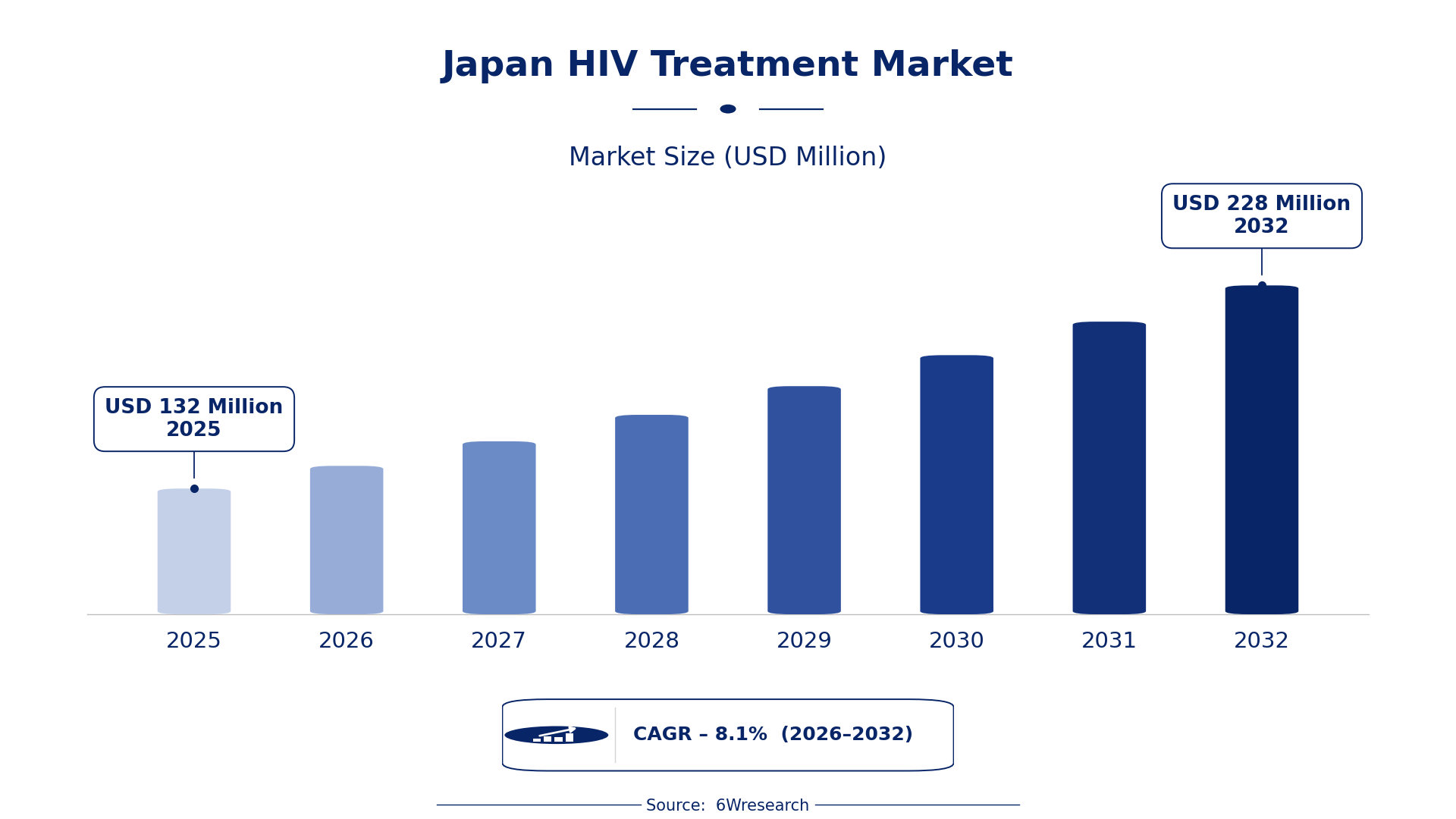
According to 6Wresearch internal database and industry insights, the Japan HIV Treatment Market was valued at USD 132 Million in 2025 and is projected to reach USD 228 Million by 2032, growing at a CAGR of approximately 8.1% during 2026–2032.
Japan HIV Treatment Market Highlights
| Report Metric | Details |
| Report Name | Japan HIV Treatment Market (2026-2032) |
| Market Size 2025 | USD 132 Million |
| Market Size 2032 | USD 228 Million |
| Absolute Growth 2025–2032 | USD 96 Million |
| CAGR 2026–2032 | 8.1% |
| Peak Annual Growth | 9.2% in 2032 |
| Forecast Period | 2026–2032 |
| Historical Data | 2022–2025 |
| Base Year | 2025 |
| Leading Treatment Type, 2025 | Antiretroviral Therapy (ART) (43% share) |
| Leading Stage of Infection, 2025 | Early & Late Stage (43% share) |
| Leading Distribution Channel, 2025 | Government Programs (44% share) |
| Leading End User, 2025 | National HIV Missions (39% share) |
| Fastest-Growing Treatment Type | Preventive Therapies (11.4% CAGR) |
| Fastest-Growing Stage of Infection | PrEP/PEP (11.8% CAGR) |
| Fastest-Growing Distribution Channel | NGOs & Health Missions (10.7% CAGR) |
| Fastest-Growing End User | At-Risk Populations (10.6% CAGR) |
| Growing Sector | HIV Treatment |
| Key End Users | Healthcare providers, National health initiatives, At-risk populations |
Japan HIV Treatment Market Year-wise Growth Rate and Key Drivers (2022–2032)
This graph illustrates the annual growth rates of the market from 2022 to 2032, highlighting a steady upward trajectory and projected market expansion over the forecast period.
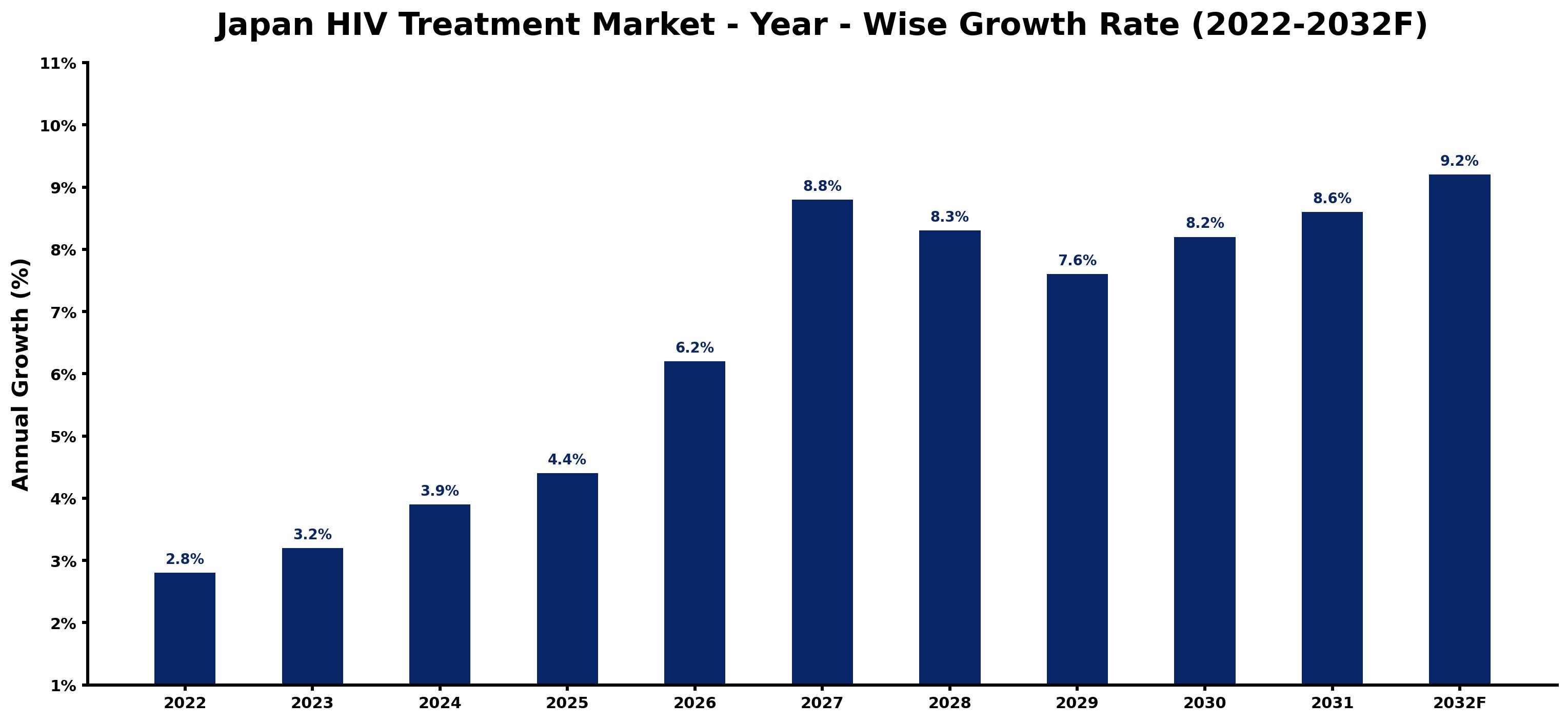
The table below sets out the estimated growth rate for each year and the main factor behind it.
| Year | Estimated Annual Growth (%) | Market Rationale |
| 2022 | 2.8 | The market experienced steady growth due to ongoing healthcare initiatives. |
| 2023 | 3.2 | Demand increased as awareness campaigns for HIV prevention gained traction. |
| 2024 | 3.9 | Healthcare providers expanded access to antiretroviral therapy, boosting treatment rates. |
| 2025 | 4.4 | The introduction of new preventive therapies contributed to higher market growth. |
| 2026 | 6.2 | Increased funding for national health initiatives will accelerate treatment accessibility. |
| 2027 | 8.8 | The success of the PrEP program will lead to a surge in preventive therapy uptake. |
| 2028 | 8.3 | Growth is expected to slow slightly as the market adjusts to previous rapid expansions. |
| 2029 | 7.6 | Demand will remain strong, but competition among treatment options will intensify. |
| 2030 | 8.2 | New guidelines for treatment protocols are projected to drive further growth. |
| 2031 | 8.6 | Continued investment in healthcare infrastructure will support rising treatment demand. |
| 2032 | 9.2 | The market is expected to peak as new therapies and government support align. |
Note: Market size estimations and growth projections presented in this report are based on 6Wresearch's proprietary forecasting methodology, utilizing the latest available industry data, government publications, and primary research inputs.
Japan HIV Treatment Market Synopsis
HIV treatment in Japan primarily involves antiretroviral therapy (ART), which is essential for managing viral loads and preventing disease progression. Approximately 1.2 million people live with HIV in Japan, with many receiving ART through public health programs. This combination of support and demand is driving growth in the sector.
Market Dynamics Impact Analysis (2026–2032)
| Factor | Type | Impact | Primary Segment Affected |
| Growing government funding for HIV prevention programs | Driver | High | Government Programs |
| Rising demand for preventive therapies among at-risk populations | Driver | High | Preventive Therapies |
| Expansion of HIV treatment access through national health initiatives | Opportunity | High | National HIV Missions |
| Increasing need for long-acting injectables to improve treatment adherence | Opportunity | Medium | Long-Acting Injectables |
| Limited awareness of HIV among younger populations | Restraint | Medium | At-Risk Populations |
| Competition from alternative treatment options affecting ART uptake | Restraint | Medium | Antiretroviral Therapy (ART) |
| Challenges in reaching rural populations with treatment services | Challenge | High | Clinics & Hospitals |
| Supply chain issues affecting the availability of certain therapies | Challenge | Medium | Preventive Therapies |
Evaluation of Drivers in Japan HIV Treatment Market (2026–2032)
The factors lifting demand, and the evidence behind each, are summarised below.
| Drivers | Primary Segment Affected | Why It Matters (Evidence) |
| Increased government funding for HIV prevention programs | Government Programs | The government allocates ¥10 billion annually, improving access to treatment and prevention services. |
| Growing awareness of preventive therapies among at-risk populations | Preventive Therapies | National HIV testing campaigns promote preventive measures, leading to higher uptake of therapies, increasing demand. |
| Expansion of ART availability in healthcare facilities | Antiretroviral Therapy (ART) | Over 90% of hospitals provide ART, ensuring widespread access for patients and boosting treatment rates. |
| Success of the PrEP program launched in 2019 | PrEP/PEP | The program has reduced new infections, driving demand for preventive therapies and increasing patient engagement. |
| Rising focus on treatment adherence through long-acting injectables | Long-Acting Injectables | These therapies provide convenience, encouraging more patients to maintain their regimens and improving health outcomes. |
Purchasing is picking up as funding for HIV prevention initiatives increases, with ¥10 billion allocated annually. The success of the PrEP program has led to a rise in preventive therapy uptake among at-risk populations. More than 90% of hospitals nationwide provide antiretroviral therapy, ensuring widespread access to treatment. The growing focus on long-acting injectables supports improved adherence, further boosting demand. National HIV testing campaigns have raised awareness, contributing to higher treatment rates across the country, with approximately 30,000 people receiving ART through public health programs in 2021.
Evaluation of Restraints in Japan HIV Treatment Market
Below are the constraints most often cited by buyers and suppliers, with the segment each affects.
| Market Restraint | Primary Segment Affected | Why It Matters (Evidence) |
| Limited awareness of HIV among younger populations | At-Risk Populations | Many young individuals lack knowledge about HIV, hindering prevention efforts and treatment uptake, affecting overall treatment rates. |
| Competition from alternative treatment options affecting ART uptake | Antiretroviral Therapy (ART) | The availability of various treatment options can divert patients from standard ART, impacting market share. |
| Supply chain issues affecting availability of certain therapies | Preventive Therapies | Disruptions in the supply chain can lead to shortages of essential preventive treatments, delaying patient access. |
| Challenges in reaching rural populations with treatment services | Clinics & Hospitals | Healthcare facilities in rural areas often lack resources, limiting access to HIV treatments and affecting patient outcomes. |
| Regulatory hurdles delaying the introduction of new therapies | Long-Acting Injectables | Strict regulations can slow the approval process for new treatment options, impacting timely availability. |
Japan HIV Treatment Market Challenges
In 2022, approximately 1.2 million people were living with HIV in Japan, highlighting the urgent need for timely access to treatment. Complex chemical processes in synthesising antiretroviral therapy create production delays, costing healthcare providers crucial time in managing patient care. Regulatory hurdles can extend the approval process for new treatments, frustrating buyers who may wait several months for new options. Heightened competition from new entrants can pressure existing suppliers to lower prices, potentially compromising the quality of care provided in hospitals.
Trends in the Japan HIV Treatment Market
The trends below show where the Japan HIV Treatment Market is heading.
- Shift from Traditional to Preventive Therapies: Japan is experiencing a shift towards preventive therapies, particularly with the success of the PrEP program. In 2021, approximately 30,000 people received ART through public health programs, highlighting the growing focus on prevention.
- Expansion of Long-Acting Injectables: The market is moving towards long-acting injectables, which provide convenience for patients. This trend is supported by increasing demand for sustained treatment options, with healthcare facilities adapting to these new therapies.
- Increased Focus on Youth Education: There is a growing emphasis on educating youth about HIV prevention, particularly through national campaigns. The government launched a campaign in 2023 to raise awareness of PrEP among high-risk groups, targeting younger populations.
- Growth of National HIV Missions: National HIV Missions are expanding their reach to reduce HIV prevalence. With targeted initiatives, these missions aim to improve access to treatment and preventive services across urban and rural areas.
Investment Opportunities in the Japan HIV Treatment Market
The opportunities below stand out in the Japan HIV Treatment Market for new entrants and existing suppliers.
- Investment in Preventive Therapies: The demand for preventive therapies is rising, particularly among at-risk populations. With the PrEP program's success, healthcare providers can invest in expanding these services to meet growing needs, improving community health.
- Supply of Long-Acting Injectables: There is an opportunity to supply long-acting injectables, which improve treatment adherence. Clinics and hospitals are increasingly looking for these solutions to support patient outcomes and treatment success.
- Expansion of Government Programs: The government’s commitment to HIV prevention creates opportunities for new initiatives. National HIV Missions are seeking partnerships to broaden their outreach and treatment services, improving community health.
- Development of Educational Campaigns: Investing in educational campaigns targeting youth can significantly impact HIV prevention. The government’s focus on awareness initiatives provides a platform for new programs that can enhance public health.
Government Initiatives in the Japan HIV Treatment Market
The Medical Care Act (1948) establishes guidelines for healthcare facilities, including those providing HIV treatment, ensuring adequate staffing and resources for patient care. The Water Supply Act (1957) and the Sewerage Act (1958) set essential standards for public health, indirectly impacting HIV treatment by ensuring safe water and sanitation. Recent updates to the NHI drug price standard ensure that reimbursement prices for HIV medications remain accessible, promoting wider availability of treatments.
In 2022, the government allocated ¥10 billion for HIV prevention programs, administered by the Ministry of Health, Labour and Welfare. This funding supports various initiatives, including national testing campaigns and educational outreach, aimed at reducing HIV prevalence and improving treatment access for affected populations.
Future Insight of the Japan HIV Treatment Market
By 2032, targeted government initiatives like the 'HIV Zero Project' will reshape Japan's HIV treatment landscape, aiming to eliminate new infections. The PrEP program will expand, increasing access for high-risk groups and significantly reducing transmission rates. Technological advancements will streamline the production of antiretroviral therapy, improving availability for healthcare providers. National awareness campaigns will encourage timely testing and treatment, benefiting both buyers and suppliers in the healthcare sector.
Market Segmentation Analysis
Japan HIV Treatment Market report covers a detailed analysis of the following market segments:
By Treatment Type – Antiretroviral Therapy (ART) Leads, Preventive Therapies Expected to Grow Fastest
According to Saurav Kr Singh, Senior Research Analyst at 6Wresearch, Antiretroviral Therapy (ART) accounted for 43% of the market by treatment type in 2025. Antiretroviral Therapy (ART) commands the largest share due to its critical role in managing the health of approximately 1.2 million individuals living with HIV in Japan. Its widespread availability in over 90% of hospitals ensures that it remains the primary treatment option for healthcare professionals. Over 2026–2032, Preventive Therapies are expected to post the fastest growth, at a CAGR of 11.4%. Preventive Therapies are experiencing rapid growth as awareness increases, particularly following the launch of the PrEP program in 2019 targeting at-risk groups. This initiative is vital for curbing new infections and complements existing treatment protocols. Suppliers should focus on expanding preventive therapy options to align with the rising demand.
By Stage of Infection – Early & Late Stage Leads, PrEP/PEP Expected to Grow Fastest
The largest stage of infection category in 2025 was Early & Late Stage, at 43% of revenue. Early & Late Stage treatments dominate the market as they are vital for managing HIV at all infection stages, ensuring timely care for patients. The ongoing clinical trials for new treatments further underscore the importance of this segment. PrEP/PEP is set to record the highest CAGR in this split, 11.8% over 2026–2032. PrEP/PEP is experiencing the fastest growth, largely driven by government campaigns that promote awareness among high-risk groups. This focus on prevention is essential for curbing transmission rates and complements existing treatment protocols. Buyers should emphasise access to preventive therapies to improve overall treatment effectiveness.
By Distribution Channel – Government Programs Lead, NGOs & Health Missions Expected to Grow Fastest
In 2025, Government Programs led the distribution channel split with a 44% share. Government Programs dominate the distribution channel by ensuring structured access to HIV treatments, reinforced by an annual budget of ¥10 billion dedicated to prevention efforts. These programs are essential for the effective management of HIV within the healthcare framework. NGOs & Health Missions are projected to grow fastest, at a CAGR of 10.7% during 2026–2032. NGOs & Health Missions are witnessing swift growth as they significantly contribute to community education and treatment access. Their outreach initiatives effectively fill care gaps, enhancing the overall treatment landscape. Suppliers need to partner with NGOs to improve treatment accessibility and community outreach.
By End User – National HIV Missions Lead, At-Risk Populations Expected to Grow Fastest
National HIV Missions took 39% of end user revenue in 2025, more than any other category. National HIV Missions are the leading end users, concentrating on reducing HIV prevalence through coordinated efforts across the nation. Their initiatives are supported by the Ministry of Health, Labour and Welfare, ensuring a robust framework for treatment delivery. The quickest growth will come from At-Risk Populations, forecast to expand at a CAGR of 10.6% between 2026 and 2032. At-Risk Populations are the fastest-growing segment as targeted services are increasingly recognised as crucial for effective prevention and treatment. This focus aligns with national objectives aimed at eliminating new infections by 2030. Providers should customise their services to address the unique needs of at-risk populations to enhance their effectiveness.
Key Attractiveness of the Report
- 10 Years of Market Numbers
- Historical Data Starting from 2022 to 2025
- Base Year 2025
- Forecast Data until 2032
- Key Performance Indicators Impacting the Market
- Major Upcoming Developments and Projects
Key Highlights of the Report:
- Japan HIV Treatment Market Outlook
- Market Size of Japan HIV Treatment Market, 2025
- Forecast of Japan HIV Treatment Market, 2032
- Historical Data and Forecast of Japan HIV Treatment Revenues & Volume for the Period 2022-2032F
- Japan HIV Treatment Market Trend Evolution
- Japan HIV Treatment Market Drivers and Challenges
- Japan HIV Treatment Price Trends
- Japan HIV Treatment Porter's Five Forces
- Japan HIV Treatment Industry Life Cycle
- Historical Data and Forecast of Japan HIV Treatment Market Revenues & Volume By Treatment Type for the Period 2022-2032F
- Historical Data and Forecast of Japan HIV Treatment Market Revenues & Volume By Antiretroviral Therapy (ART) for the Period 2022-2032F
- Historical Data and Forecast of Japan HIV Treatment Market Revenues & Volume By Preventive Therapies for the Period 2022-2032F
- Historical Data and Forecast of Japan HIV Treatment Market Revenues & Volume By Immune Boosting Regimens for the Period 2022-2032F
- Historical Data and Forecast of Japan HIV Treatment Market Revenues & Volume By Long-Acting Injectables for the Period 2022-2032F
- Historical Data and Forecast of Japan HIV Treatment Market Revenues & Volume By Stage of Infection for the Period 2022-2032F
- Historical Data and Forecast of Japan HIV Treatment Market Revenues & Volume By Early & Late Stage for the Period 2022-2032F
- Historical Data and Forecast of Japan HIV Treatment Market Revenues & Volume By PrEP/PEP for the Period 2022-2032F
- Historical Data and Forecast of Japan HIV Treatment Market Revenues & Volume By Complementary for the Period 2022-2032F
- Historical Data and Forecast of Japan HIV Treatment Market Revenues & Volume By Monthly Injections for the Period 2022-2032F
- Historical Data and Forecast of Japan HIV Treatment Market Revenues & Volume By Distribution Channel for the Period 2022-2032F
- Historical Data and Forecast of Japan HIV Treatment Market Revenues & Volume By Government Programs for the Period 2022-2032F
- Historical Data and Forecast of Japan HIV Treatment Market Revenues & Volume By Clinics & Hospitals for the Period 2022-2032F
- Historical Data and Forecast of Japan HIV Treatment Market Revenues & Volume By NGOs & Health Missions for the Period 2022-2032F
- Historical Data and Forecast of Japan HIV Treatment Market Revenues & Volume By Clinical Trial Networks for the Period 2022-2032F
- Historical Data and Forecast of Japan HIV Treatment Market Revenues & Volume By End User for the Period 2022-2032F
- Historical Data and Forecast of Japan HIV Treatment Market Revenues & Volume By National HIV Missions for the Period 2022-2032F
- Historical Data and Forecast of Japan HIV Treatment Market Revenues & Volume By At-Risk Populations for the Period 2022-2032F
- Historical Data and Forecast of Japan HIV Treatment Market Revenues & Volume By HIV Support Communities for the Period 2022-2032F
- Historical Data and Forecast of Japan HIV Treatment Market Revenues & Volume By Specialized Health Clinics for the Period 2022-2032F
- Japan HIV Treatment Import Export Trade Statistics
- Market Opportunity Assessment By Treatment Type
- Market Opportunity Assessment By Stage of Infection
- Market Opportunity Assessment By Distribution Channel
- Market Opportunity Assessment By End User
- Japan HIV Treatment Top Companies Market Share
- Japan HIV Treatment Competitive Benchmarking By Technical and Operational Parameters
- Japan HIV Treatment Company Profiles
- Japan HIV Treatment Key Strategic Recommendations
Market Covered
The report covers the following segments.
By Treatment Type
- Antiretroviral Therapy (ART)
- Preventive Therapies
- Immune Boosting Regimens
- Long-Acting Injectables
By Stage of Infection
- Early & Late Stage
- PrEP/PEP
- Complementary
- Monthly Injections
By Distribution Channel
- Government Programs
- Clinics & Hospitals
- NGOs & Health Missions
- Clinical Trial Networks
By End User
- National HIV Missions
- At-Risk Populations
- HIV Support Communities
- Specialized Health Clinics































