Japan HIV Vaccine Research Market Size & Growth Rate
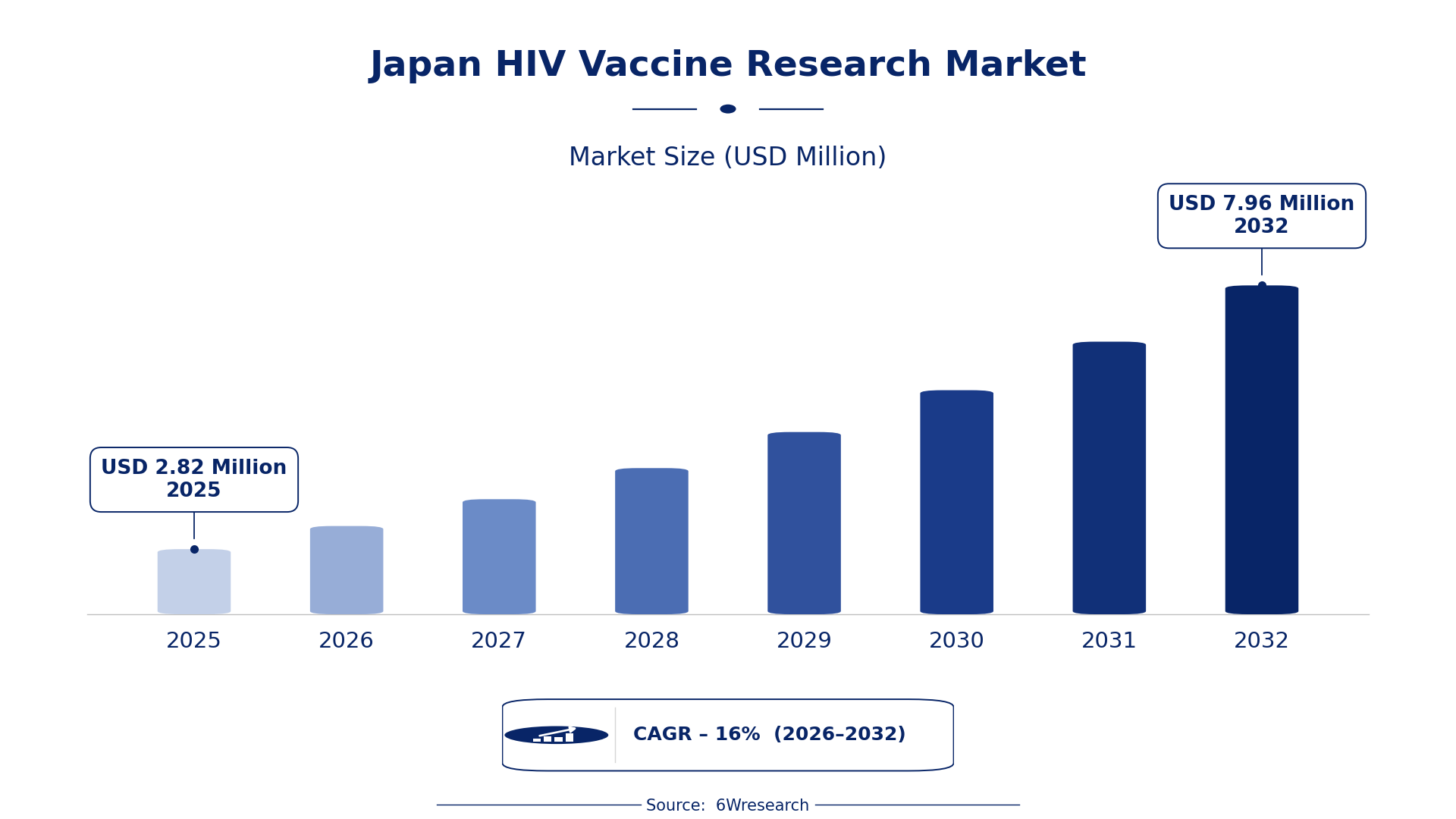
According to 6Wresearch internal database and industry insights, the Japan HIV Vaccine Research Market was valued at USD 2.82 Million in 2025 and is projected to reach USD 7.96 Million by 2032, growing at a CAGR of approximately 16% during 2026–2032.
Japan HIV Vaccine Research Market Highlights
| Report Metric | Details |
| Report Name | Japan HIV Vaccine Research Market (2026-2032) |
| Market Size 2025 | USD 2.82 Million |
| Market Size 2032 | USD 7.96 Million |
| Absolute Growth 2025–2032 | USD 5.14 Million |
| CAGR 2026–2032 | 16% |
| Peak Annual Growth | 17.5% in 2032 |
| Forecast Period | 2026–2032 |
| Historical Data | 2022–2025 |
| Base Year | 2025 |
| Leading Research Focus, 2025 | DNA-Based Vaccines (37% share) |
| Leading Vaccine Type, 2025 | Nucleic Acid (51% share) |
| Leading Distribution Channel, 2025 | Academic Labs (48% share) |
| Leading End User, 2025 | Biomedical Researchers (40% share) |
| Fastest-Growing Research Focus | Vector-Based Vaccines (20.8% CAGR) |
| Fastest-Growing Vaccine Type | Viral Vector (23.2% CAGR) |
| Fastest-Growing Distribution Channel | Clinical Trial Sites (20.1% CAGR) |
| Fastest-Growing End User | Vaccine Developers (21.5% CAGR) |
| Growing Sector | biomedical research |
| Key End Users | academic institutions, biomedical researchers, R&D institutions |
Japan HIV Vaccine Research Market Year-wise Growth Rate and Key Drivers (2022–2032)
This graph illustrates the annual growth rates of the market from 2022 to 2032, highlighting a steady upward trajectory and projected market expansion over the forecast period.
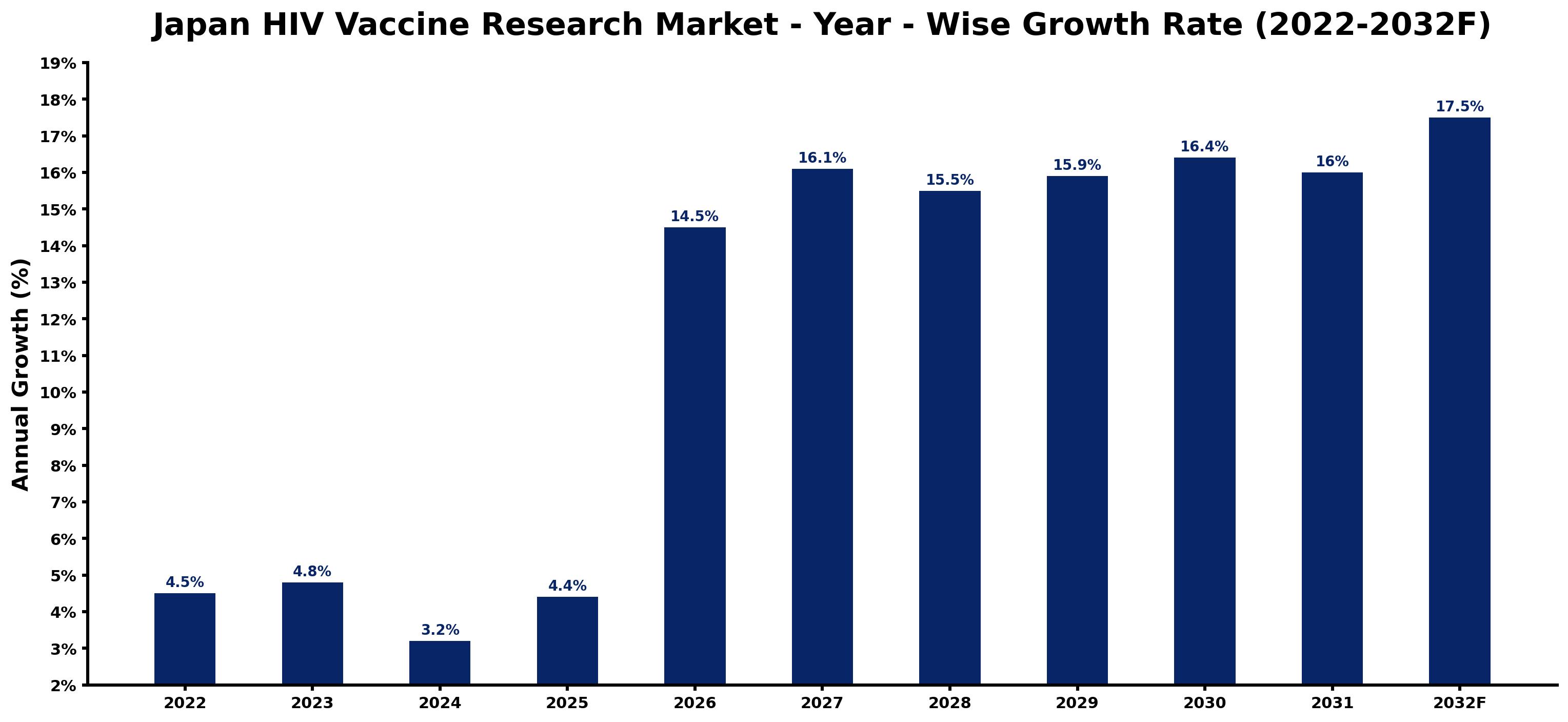
Below, each year's estimated growth is shown next to the factor that most influenced it.
| Year | Estimated Annual Growth (%) | Market Rationale |
| 2022 | 4.5 | The market experienced steady growth due to ongoing research initiatives. |
| 2023 | 4.8 | Demand increased as Japan allocated more funding for vaccine research. |
| 2024 | 3.2 | Growth slowed as some projects faced delays in clinical trials. |
| 2025 | 4.4 | Investment in R&D rose, leading to faster growth than the previous year. |
| 2026 | 14.5 | The market is expected to surge as new vaccine technologies gain traction. |
| 2027 | 16.1 | Demand will continue to rise with more trials enrolling participants. |
| 2028 | 15.5 | Growth is projected to slow slightly as some projects reach maturation stages. |
| 2029 | 15.9 | Increased collaboration with international health bodies is expected to spur demand. |
| 2030 | 16.4 | Research advancements will lead to renewed interest in vaccine development. |
| 2031 | 16.0 | Growth will moderate as the market stabilises after rapid expansion. |
| 2032 | 17.5 | The peak growth year is driven by breakthroughs in vaccine efficacy. |
Note: Market size estimations and growth projections presented in this report are based on 6Wresearch's proprietary forecasting methodology, utilizing the latest available industry data, government publications, and primary research inputs.
Japan HIV Vaccine Research Market Synopsis
HIV vaccine research involves developing vaccines to prevent HIV infection using technologies such as DNA, mRNA, and viral vectors. The Japan HIV Vaccine Research Market is expanding due to increased funding, with the Japanese government allocating ¥5 billion for vaccine initiatives in 2023. Over 50 active research projects are currently underway, driving collaboration and innovation in this critical area. Key buyer groups include academic institutions and biomedical researchers, who are instrumental in advancing vaccine development efforts.
Market Dynamics Impact Analysis (2026–2032)
| Factor | Type | Impact | Primary Segment Affected |
| Increased government funding for research initiatives | Driver | High | Academic Labs |
| Growing international collaborations in vaccine development | Driver | High | R&D Institutions |
| Expansion of clinical trial sites for vaccine testing | Opportunity | High | Clinical Trial Sites |
| Rising interest in mRNA technology for rapid vaccine development | Opportunity | Medium | mRNA-Based Vaccines |
| Regulatory hurdles in vaccine approval processes | Restraint | High | Vaccine Developers |
| Limited public awareness about HIV vaccine research | Restraint | Medium | Biomedical Researchers |
| Competition for funding among various health research sectors | Challenge | High | Biomedical Researchers |
| Challenges in recruiting participants for clinical trials | Challenge | Medium | Clinical Trial Sites |
Evaluation of Drivers in Japan HIV Vaccine Research Market (2026–2032)
Demand rests on the following drivers, each shown with the segment it touches most.
| Drivers | Primary Segment Affected | Why It Matters (Evidence) |
| Increased government funding for vaccine research | Academic Labs | The Japanese government allocated ¥5 billion for vaccine research initiatives, enabling more projects to commence. |
| Growing international collaborations in vaccine development | R&D Institutions | Japan participates in over 50 global initiatives, facilitating knowledge sharing and resource pooling in HIV vaccine research. |
| Expansion of clinical trial sites for vaccine testing | Clinical Trial Sites | Over 1,000 participants have been enrolled in trials, boosting the capacity for testing new vaccine candidates. |
| Rising interest in mRNA technology for rapid vaccine development | mRNA-Based Vaccines | Ten ongoing trials are exploring mRNA vaccines, reflecting a shift towards quicker development timelines. |
| Increased focus on safety profiles of vaccine candidates | Protein Subunit Vaccines | Safety concerns drive research towards protein subunit vaccines, appealing to cautious stakeholders. |
Clinical trial sites have enrolled over 1,000 participants, boosting the testing capacity for new vaccine candidates. The exploration of mRNA technology is reflected in ten ongoing trials, which accelerates the development process and attracts interest from biomedical researchers.
Evaluation of Restraints in Japan HIV Vaccine Research Market
Several factors work against faster growth; the main ones are summarised below.
| Market Restraint | Primary Segment Affected | Why It Matters (Evidence) |
| Regulatory hurdles in vaccine approval processes | Vaccine Developers | The Ministry of Health, Labour and Welfare oversees stringent regulations, delaying vaccine approvals and impacting market entry. |
| Limited public awareness about HIV vaccine research | Biomedical Researchers | A lack of awareness hampers recruitment efforts for clinical trials, limiting participant availability. |
| Competition for funding among various health research sectors | Biomedical Researchers | With multiple health initiatives vying for limited resources, securing funding for HIV vaccine research becomes challenging. |
| Challenges in recruiting participants for clinical trials | Clinical Trial Sites | Recruitment difficulties can lead to delays in trial timelines, impacting overall research progress. |
| Dependence on international collaborations for technology transfer | R&D Institutions | Reliance on foreign partnerships may slow down the pace of innovation in domestic vaccine development. |
Japan HIV Vaccine Research Market Challenges
In Japan, strict regulations from the Ministry of Health, Labour and Welfare can delay vaccine approvals, causing setbacks for researchers who depend on timely access to new treatments. Competition among research institutions results in duplicated efforts, costing buyers up to ¥1 billion in wasted resources that could support unique projects. Limited funding from the ¥5 billion allocated for vaccine research initiatives in 2023 restricts buyers' ability to pursue comprehensive studies, impacting the pace of HIV vaccine development. Suppliers of essential materials experience disruptions due to complex compliance requirements, which can lead to delays in obtaining necessary components for ongoing trials.
Trends in the Japan HIV Vaccine Research Market
Below are the shifts with the largest effect on the Japan HIV Vaccine Research Market.
- Shift from Traditional to mRNA Vaccine Technologies: Japan is increasingly adopting mRNA technology for HIV vaccine development, with ten ongoing trials exploring this approach. This shift enables quicker responses to emerging health threats, reflecting a change in research focus.
- Growing Collaboration in Global Vaccine Research: In 2023, Japan participated in over 50 international collaborations aimed at HIV vaccine research. This engagement promotes knowledge sharing and accelerates the development of effective vaccines.
- Increased Investment in Biomedical Research Facilities: Tokyo and Osaka are becoming key hubs for biomedical research, supported by a ¥5 billion government investment in 2023. This funding is expected to strengthen research capabilities in these regions.
- Expansion of Clinical Trial Sites for Vaccine Testing: The number of clinical trial sites in Japan is increasing, with over 1,000 participants enrolled in trials. This expansion is crucial for testing new vaccine candidates effectively.
Investment Opportunities in the Japan HIV Vaccine Research Market
Investors looking at the Japan HIV Vaccine Research Market should consider the following areas.
- Local Partnerships for Vaccine Development: Investing in local partnerships with academic labs is timely, as Japan has over 50 active research projects. Collaborating with these institutions can drive innovation and accelerate development.
- Expansion of Clinical Trial Infrastructure: With clinical trial sites enrolling over 1,000 participants, there is a pressing need for more infrastructure. Investing in these facilities can facilitate faster vaccine testing and approval.
- Focus on mRNA Vaccine Technologies: Current interest in mRNA technologies presents an opportunity to supply advanced solutions. Collaborating with research institutions can aid in developing these advanced vaccine candidates.
- Support for Recombinant Vaccine Development: The Japanese government’s strategic plan to enhance vaccine development by 2025 creates opportunities for suppliers of recombinant technologies. Engaging with R&D institutions can facilitate market entry.
Government Initiatives in the Japan HIV Vaccine Research Market
The NHI drug price standard, revised regularly, sets reimbursement prices for drugs in Japanese medical care, affecting pricing strategies for HIV vaccines. Compliance with these standards is essential for vaccine developers to ensure market access and profitability.
The Japan Agency for Medical Research and Development funds various vaccine research initiatives, including HIV vaccine studies. This agency's support is vital for biomedical researchers seeking to advance their projects and secure necessary approvals.
Future Insight of the Japan HIV Vaccine Research Market
By 2032, clinical trial sites will increasingly integrate diverse participant demographics, improving trial outcomes and speeding up regulatory approvals. Collaboration between domestic research institutions and international health organisations will facilitate breakthroughs in vaccine technologies. The adoption of advanced methodologies will streamline development processes, benefiting both buyers and suppliers. With over 1,000 participants enrolled in ongoing trials, the Japanese government's strategic plan will promote sustained innovation in HIV vaccine development.
Market Segmentation Analysis
Japan HIV Vaccine Research Market report covers a detailed analysis of the following market segments:
By Research Focus – DNA-Based Vaccines Lead, Vector-Based Vaccines Expected to Grow Fastest
According to Saurav Kr Singh, Senior Research Analyst at 6Wresearch, in 2025, DNA-Based Vaccines led the research focus split with a 37% share. DNA-based vaccines hold the largest share as they are extensively utilised in developing novel vaccine candidates, particularly in academic labs across Japan. Their prominence is supported by over 50 active research projects focused on HIV prevention. Vector-Based Vaccines are set to record the highest CAGR in this split, 20.8% over 2026–2032. Vector-based vaccines are experiencing rapid growth due to their ability to induce strong immune responses, with 10 ongoing trials exploring this technology. The increasing focus on robust immune activation is driving their swift adoption in research settings. Suppliers must prioritise advancements in vector-based technologies to meet the growing demand in research.
By Vaccine Type – Nucleic Acid Leads, Viral Vector Expected to Grow Fastest
The largest vaccine type category in 2025 was Nucleic Acid, at 51% of revenue. Nucleic acid vaccines dominate the market as they are foundational for various vaccine types, with significant backing from the Japan Agency for Medical Research and Development. Their versatility in research applications solidifies their leading position within HIV vaccine development. Over 2026–2032, Viral Vector is expected to post the fastest growth, at a CAGR of 23.2%. Viral vector vaccines are the fastest-growing segment due to their critical role in delivering genetic material into cells, essential for effective vaccine development. The integration of this technology in multiple trials is propelling its rapid uptake among researchers. Buyers should consider investing in viral vector technologies to stay competitive in the evolving vaccine market.
By Distribution Channel – Academic Labs Lead, Clinical Trial Sites Expected to Grow Fastest
With 48% of distribution channel revenue in 2025, Academic Labs was the largest category. Academic labs lead the distribution channel as they are the primary sites for vaccine research and development, housing many of the country’s over 300 biomedical researchers. Their established infrastructure effectively supports ongoing projects and fosters collaboration among scientists. Clinical Trial Sites are projected to grow fastest, at a CAGR of 20.1% during 2026–2032. Clinical trial sites are witnessing the fastest growth as they are essential for testing vaccine efficacy and safety, with over 1,000 participants already enrolled in trials. This focus on real-world testing is crucial for advancing vaccine candidates towards approval. Suppliers should strengthen partnerships with clinical trial sites to facilitate timely vaccine testing and approval.
By End User – Biomedical Researchers Lead, Vaccine Developers Expected to Grow Fastest
Biomedical Researchers took 40% of end user revenue in 2025, more than any other category. Biomedical researchers represent the largest end user group, being key players in vaccine development efforts across Japan’s active research landscape. Their expertise and involvement in over 50 projects are vital for the success of ongoing initiatives in HIV vaccine research. The quickest growth will come from Vaccine Developers, forecast to expand at a CAGR of 21.5% between 2026 and 2032. Vaccine developers are the fastest-growing end user segment, responsible for bringing vaccines to market and responding to the strategic plan for enhanced vaccine development by 2025. Their role in translating research into practical solutions is increasingly critical for public health. Buyers must align their strategies with vaccine developers to ensure successful market entry of new products.
Key Attractiveness of the Report
- 10 Years of Market Numbers
- Historical Data Starting from 2022 to 2025
- Base Year 2025
- Forecast Data until 2032
- Key Performance Indicators Impacting the Market
- Major Upcoming Developments and Projects
Key Highlights of the Report:
- Japan HIV Vaccine Research Market Outlook
- Market Size of Japan HIV Vaccine Research Market, 2025
- Forecast of Japan HIV Vaccine Research Market, 2032
- Historical Data and Forecast of Japan HIV Vaccine Research Revenues & Volume for the Period 2022-2032F
- Japan HIV Vaccine Research Market Trend Evolution
- Japan HIV Vaccine Research Market Drivers and Challenges
- Japan HIV Vaccine Research Price Trends
- Japan HIV Vaccine Research Porter's Five Forces
- Japan HIV Vaccine Research Industry Life Cycle
- Historical Data and Forecast of Japan HIV Vaccine Research Market Revenues & Volume By Research Focus for the Period 2022-2032F
- Historical Data and Forecast of Japan HIV Vaccine Research Market Revenues & Volume By DNA-Based Vaccines for the Period 2022-2032F
- Historical Data and Forecast of Japan HIV Vaccine Research Market Revenues & Volume By Vector-Based Vaccines for the Period 2022-2032F
- Historical Data and Forecast of Japan HIV Vaccine Research Market Revenues & Volume By mRNA-Based Vaccines for the Period 2022-2032F
- Historical Data and Forecast of Japan HIV Vaccine Research Market Revenues & Volume By Protein Subunit Vaccines for the Period 2022-2032F
- Historical Data and Forecast of Japan HIV Vaccine Research Market Revenues & Volume By Vaccine Type for the Period 2022-2032F
- Historical Data and Forecast of Japan HIV Vaccine Research Market Revenues & Volume By Nucleic Acid for the Period 2022-2032F
- Historical Data and Forecast of Japan HIV Vaccine Research Market Revenues & Volume By Viral Vector for the Period 2022-2032F
- Historical Data and Forecast of Japan HIV Vaccine Research Market Revenues & Volume By Synthetic RNA for the Period 2022-2032F
- Historical Data and Forecast of Japan HIV Vaccine Research Market Revenues & Volume By Recombinant for the Period 2022-2032F
- Historical Data and Forecast of Japan HIV Vaccine Research Market Revenues & Volume By Distribution Channel for the Period 2022-2032F
- Historical Data and Forecast of Japan HIV Vaccine Research Market Revenues & Volume By Academic Labs for the Period 2022-2032F
- Historical Data and Forecast of Japan HIV Vaccine Research Market Revenues & Volume By Clinical Trial Sites for the Period 2022-2032F
- Historical Data and Forecast of Japan HIV Vaccine Research Market Revenues & Volume By R&D Institutions for the Period 2022-2032F
- Historical Data and Forecast of Japan HIV Vaccine Research Market Revenues & Volume By Sponsored Trials for the Period 2022-2032F
- Historical Data and Forecast of Japan HIV Vaccine Research Market Revenues & Volume By End User for the Period 2022-2032F
- Historical Data and Forecast of Japan HIV Vaccine Research Market Revenues & Volume By Biomedical Researchers for the Period 2022-2032F
- Historical Data and Forecast of Japan HIV Vaccine Research Market Revenues & Volume By Vaccine Developers for the Period 2022-2032F
- Historical Data and Forecast of Japan HIV Vaccine Research Market Revenues & Volume By Immunology Centers for the Period 2022-2032F
- Historical Data and Forecast of Japan HIV Vaccine Research Market Revenues & Volume By International Health Bodies for the Period 2022-2032F
- Japan HIV Vaccine Research Import Export Trade Statistics
- Market Opportunity Assessment By Research Focus
- Market Opportunity Assessment By Vaccine Type
- Market Opportunity Assessment By Distribution Channel
- Market Opportunity Assessment By End User
- Japan HIV Vaccine Research Top Companies Market Share
- Japan HIV Vaccine Research Competitive Benchmarking By Technical and Operational Parameters
- Japan HIV Vaccine Research Company Profiles
- Japan HIV Vaccine Research Key Strategic Recommendations
Market Covered
Segments analysed in this report are listed below.
By Research Focus
- DNA-Based Vaccines
- Vector-Based Vaccines
- mRNA-Based Vaccines
- Protein Subunit Vaccines
By Vaccine Type
- Nucleic Acid
- Viral Vector
- Synthetic RNA
- Recombinant
By Distribution Channel
- Academic Labs
- Clinical Trial Sites
- R&D Institutions
- Sponsored Trials
By End User
- Biomedical Researchers
- Vaccine Developers
- Immunology Centers
- International Health Bodies































