Japan Holistic Health Market Size & Growth Rate
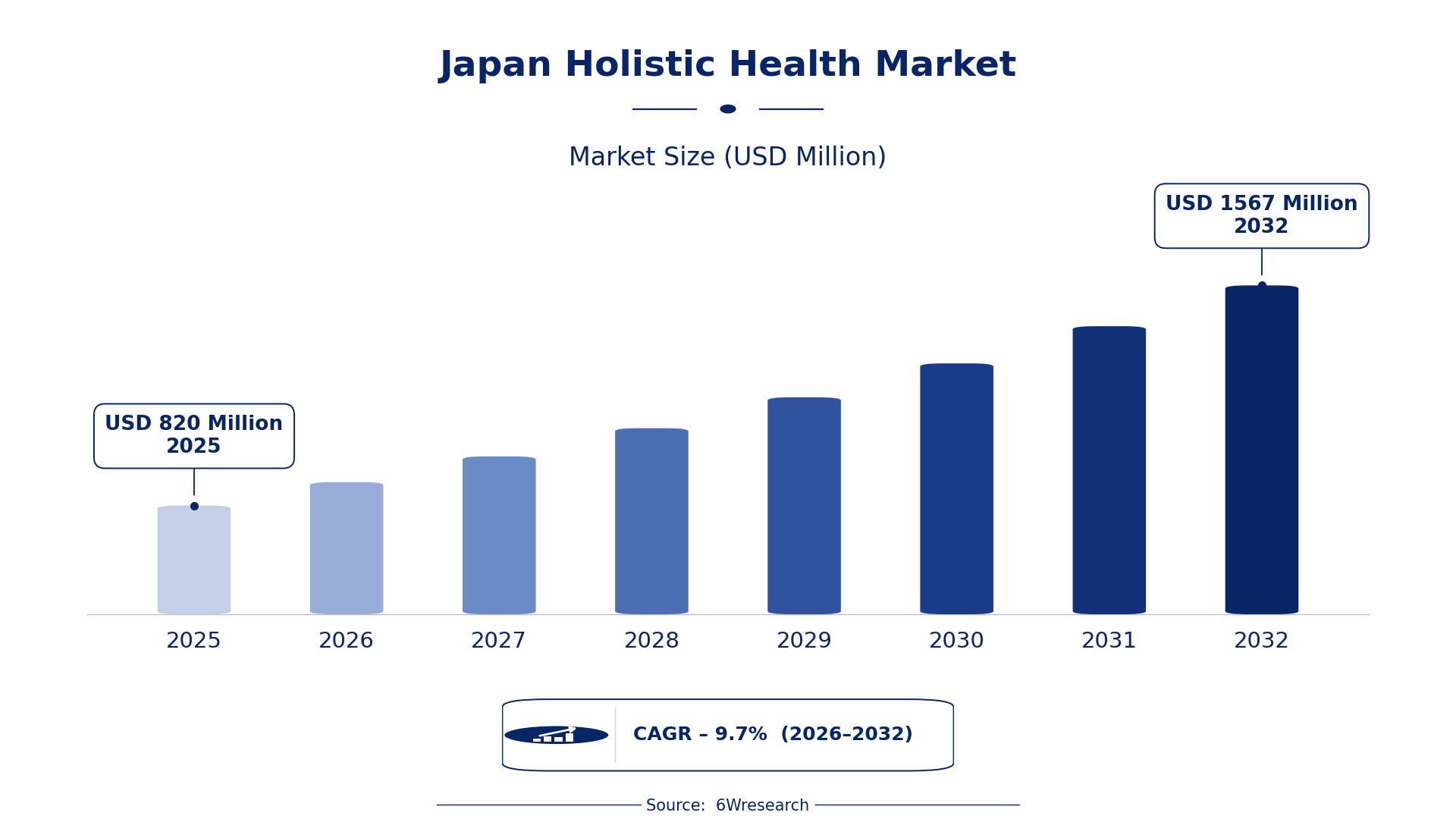
According to 6Wresearch internal database and industry insights, the Japan Holistic Health Market was valued at USD 820 Million in 2025 and is projected to reach USD 1,567 Million by 2032, growing at a CAGR of approximately 9.7% during 2026–2032.
Japan Holistic Health Market Highlights
| Report Metric | Details |
| Report Name | Japan Holistic Health Market (2026-2032) |
| Market Size 2025 | USD 820 Million |
| Market Size 2032 | USD 1,567 Million |
| Absolute Growth 2025–2032 | USD 747 Million |
| CAGR 2026–2032 | 9.7% |
| Peak Annual Growth | 10.6% in 2032 |
| Forecast Period | 2026–2032 |
| Historical Data | 2022–2025 |
| Base Year | 2025 |
| Leading Product/Service Type, 2025 | Herbal Supplements (50% share) |
| Leading Therapy Focus, 2025 | Immune Support (44% share) |
| Leading Distribution Channel, 2025 | Online Platforms (42% share) |
| Leading End User, 2025 | Health-Conscious Individuals (40% share) |
| Fastest-Growing Product/Service Type | Meditation Programs (13.0% CAGR) |
| Fastest-Growing Therapy Focus | Stress Relief (13.2% CAGR) |
| Fastest-Growing Distribution Channel | Wellness Apps (12.5% CAGR) |
| Fastest-Growing End User | Lifestyle Consumers (12.6% CAGR) |
| Growing Sector | Holistic Health Services |
| Key End Users | Health-Conscious Individuals, Integrative Therapy Users, Personalized Care Clients |
Japan Holistic Health Market Year-wise Growth Rate and Key Drivers (2022–2032)
This graph illustrates the annual growth rates of the market from 2022 to 2032, highlighting a steady upward trajectory and projected market expansion over the forecast period.
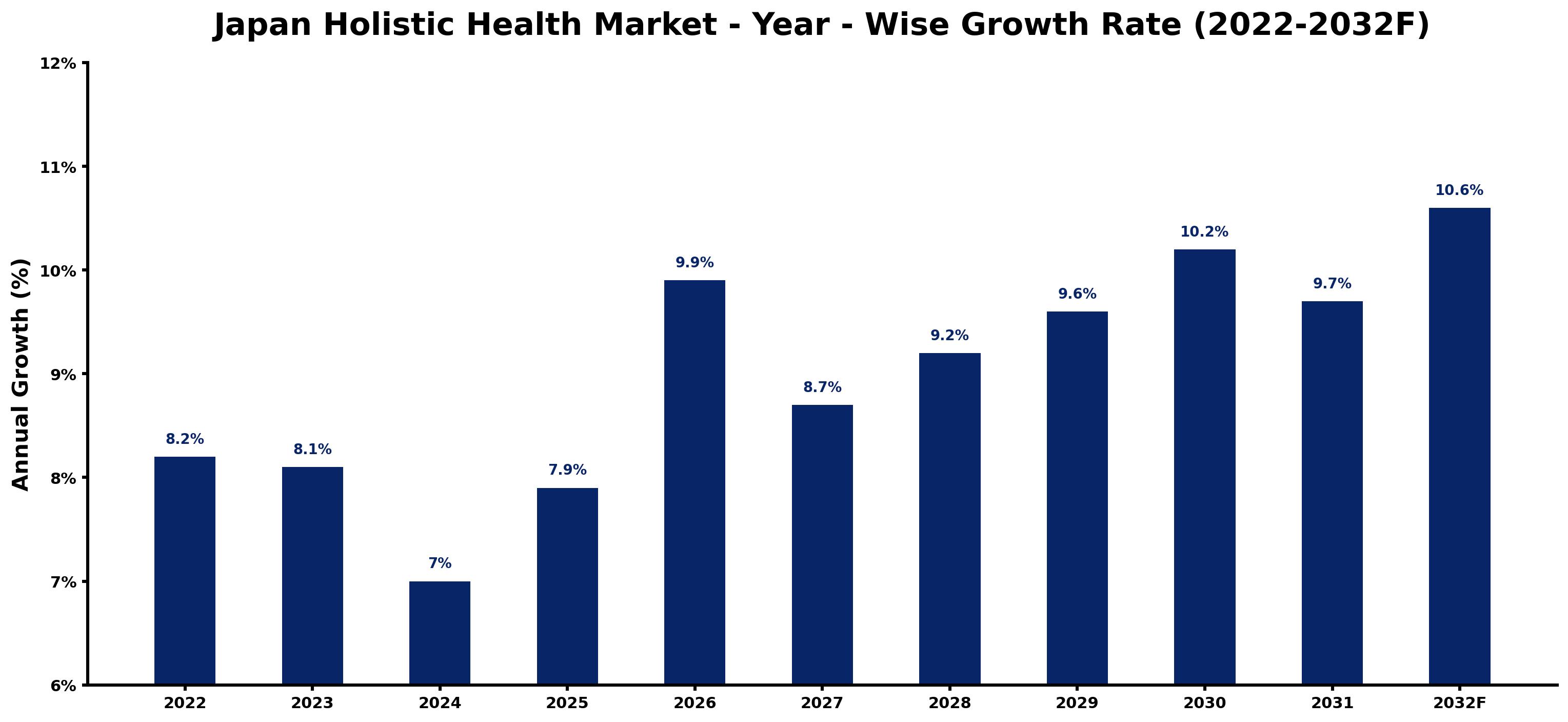
Annual growth estimates for each year appear below with the principal reason behind them, explaining the shifts that set the pace of the market.
| Year | Estimated Annual Growth (%) | Market Rationale |
| 2022 | 8.2 | The market showed strong demand from health-conscious individuals and wellness centers. |
| 2023 | 8.1 | Growth slowed slightly due to market saturation in certain holistic health practices. |
| 2024 | 7.0 | Demand continued to slow as consumers became more selective about holistic health products. |
| 2025 | 7.9 | Growth accelerated as wellness centers expanded offerings to meet diverse consumer needs. |
| 2026 | 9.9 | Demand is expected to surge as more individuals turn to holistic approaches for health maintenance. |
| 2027 | 8.7 | Growth is projected to slow as competition increases among wellness providers and product offerings. |
| 2028 | 9.2 | Demand will pick up again as urban wellness centers introduce new services. |
| 2029 | 9.6 | Growth is expected to continue as more consumers engage in holistic health practices for stress relief. |
| 2030 | 10.2 | Demand will rise as technology integration in wellness apps improves user experience. |
| 2031 | 9.7 | Growth is projected to slow as market maturity sets in, leading to increased competition. |
| 2032 | 10.6 | Demand is expected to peak as holistic health becomes mainstream in preventive care. |
Note: Market size estimations and growth projections presented in this report are based on 6Wresearch's proprietary forecasting methodology, utilizing the latest available industry data, government publications, and primary research inputs.
Japan Holistic Health Market Synopsis
Holistic health encompasses practices aimed at promoting overall well-being through natural methods, including herbal supplements, meditation, and nutritional coaching. The Japan Holistic Health Market is expanding, driven by a growing population of health-conscious individuals and increasing urban wellness centers. The rise of online platforms has further boosted accessibility, with over 30% of adults engaging in meditation, reflecting a shift towards preventive care and mental well-being. This growth is fuelled by rising consumer interest in personalized health solutions and diverse service offerings.
Market Dynamics Impact Analysis (2026–2032)
| Factor | Type | Impact | Primary Segment Affected |
| Increasing interest in preventive care and natural remedies | Driver | High | Herbal Supplements |
| Growing awareness of mental health benefits from meditation | Driver | High | Meditation Programs |
| Health-conscious individuals seeking tailored wellness solutions | Opportunity | High | Nutritional Coaching |
| Urban wellness centers expanding their holistic service offerings | Opportunity | High | Health & Wellness Centers |
| Regulatory challenges surrounding herbal supplement approvals | Restraint | Medium | Herbal Supplements |
| Limited awareness of Ayurvedic treatments among consumers | Restraint | Medium | Ayurvedic Treatments |
| High competition among wellness providers in urban areas | Challenge | High | Health & Wellness Centers |
| Consumer skepticism towards the effectiveness of holistic methods | Challenge | Medium | Meditation Programs |
Evaluation of Drivers in Japan Holistic Health Market (2026–2032)
The main growth drivers and the segments they affect most are set out below.
| Drivers | Primary Segment Affected | Why It Matters (Evidence) |
| Aging population increasingly seeking preventive health solutions | Herbal Supplements | 29.3% of Japan's population was aged 65 or older in September 2024, driving demand for health products. |
| Rising adoption of meditation for stress management | Meditation Programs | Over 30% of Japanese adults engage in some form of meditation, boosting program enrollment. |
| Growth of online platforms providing holistic health resources | Wellness Apps | Online platforms for holistic health have seen a 20% increase in users since 2021, improving access. |
| Expansion of wellness centers offering diverse services | Health & Wellness Centers | Tokyo is a major hub for wellness centers, catering to a growing urban population. |
| Consumer focus on personalized health solutions | Nutritional Coaching | Guidelines from the Japanese Society for Nutritional Science increase trust in nutritional coaching. |
Orders keep climbing as Japan's aging population seeks preventive health solutions, with 29.3% aged 65 or older in September 2024. The rise of online platforms has led to a 20% increase in users since 2021, improving access to holistic resources. Urban wellness centers are expanding their offerings, catering to health-conscious individuals looking for diverse services. The emphasis on personalized health solutions is reflected in the growing interest in tailored nutritional coaching, increasing consumer confidence in these services.
Evaluation of Restraints in Japan Holistic Health Market
The main factors holding the market back are set out below.
| Market Restraint | Primary Segment Affected | Why It Matters (Evidence) |
| Regulatory hurdles in obtaining approvals for herbal supplements | Herbal Supplements | Herbal supplements face strict regulations, complicating market entry for new products. |
| Limited consumer awareness of Ayurvedic treatments | Ayurvedic Treatments | Ayurvedic treatments are less common, leading to slower adoption rates among consumers. |
| High competition among wellness centers in urban areas | Health & Wellness Centers | The rapid growth of wellness centers in cities has intensified competition for clients. |
| Skepticism towards the effectiveness of holistic health methods | Meditation Programs | Consumer doubts about holistic methods can hinder participation in meditation programs. |
| Market saturation in certain holistic health practices | Nutritional Coaching | The increasing number of providers has led to a crowded market, making differentiation challenging. |
Japan Holistic Health Market Challenges
Producers in the holistic health market face high costs due to a skills shortage, as only 30% of wellness center staff possess adequate training in holistic practices, resulting in inconsistent service quality for clients. Limited availability of natural ingredients disrupts supply chains, causing delays in product access for urban wellness centers. Buyers encounter rising prices due to stringent regulatory compliance; herbal supplements must adhere to the Food Sanitation Act, increasing costs by up to 15%. Operational expenses for wellness centers are escalating, linked to Japan's national medical care expenditure of JPY 46.7 trillion, forcing clients to pay more for services.
Trends in the Japan Holistic Health Market
Several trends are reshaping the Japan Holistic Health Market; the most important are set out below.
- Shift towards Digital Wellness Solutions: The rise of wellness apps has transformed how consumers engage with holistic health, with the market projected to grow by 15% by 2025. This change reflects a growing preference for digital tools that track health and wellness.
- Integration of Meditation in Corporate Wellness Programs: Since 2023, many companies have integrated meditation programs into their corporate wellness initiatives, promoting mental health among employees. This trend highlights the increasing recognition of mental well-being in the workplace.
- Growing Popularity of Ayurvedic Treatments: Ayurvedic treatments have gained traction in urban wellness centers, reflecting a shift towards alternative therapies. This trend is bolstered by increasing interest in holistic approaches to health.
- Expansion of Health & Wellness Centers: Urban areas are seeing a rise in health & wellness centers, which provide diverse holistic health services. This growth is driven by the increasing demand for tailored wellness solutions.
Investment Opportunities in the Japan Holistic Health Market
The opportunities below stand out in the Japan Holistic Health Market for new entrants and existing suppliers.
- Health-Conscious Individuals Seeking Personalized Solutions: With a large portion of the population focusing on health, there is a growing demand for personalized nutritional coaching. This presents an opportunity for wellness centers to tailor services to individual needs, especially in urban areas where health consciousness is rising.
- Urban Wellness Centers Expanding Offerings: Tokyo's wellness centers are increasingly diversifying their services, creating opportunities for new holistic health providers to enter the market. This expansion is fuelled by rising consumer interest in tailored health solutions, with a projected 20% increase in service offerings by 2025.
- Growing Demand for Wellness Apps: The Japanese market for wellness apps is projected to grow by 15% by 2025, indicating a gap for innovative digital health solutions. Companies can capitalize on this trend by developing user-friendly applications that cater to health-conscious individuals.
- Increasing Interest in Meditation Programs: As corporate wellness initiatives embrace meditation, there is a ripe opportunity for providers to offer tailored programs. This trend is reflected in the increasing number of companies prioritising employee mental health, with over 30% of firms implementing such programs.
Government Initiatives in the Japan Holistic Health Market
The Clinical Trials Act, effective from 2018, sets clear rules for conducting and disclosing clinical research, ensuring transparency in the holistic health sector. This law builds on previous regulations to ensure that holistic health practices are backed by scientific evidence, increasing consumer trust in these methods.
In 2023, the Ministry of Health, Labour and Welfare launched a program promoting mental health awareness, with funding of JPY 2 billion. The agency aims to support initiatives that improve public understanding of mental well-being and its importance in holistic health.
Future Insight of the Japan Holistic Health Market
By 2032, urban wellness centers will adopt ISO 9001 standards, promoting consistent quality across services. A government initiative focusing on mental health will lead to the integration of meditation into corporate wellness programs. The Japan Holistic Health Association will broaden educational outreach, enhancing practitioner skills and service delivery. With projections indicating a significant rise in the wellness apps market by 2025, buyers will benefit from more accessible holistic health solutions.
Market Segmentation Analysis
Japan Holistic Health Market report covers a detailed analysis of the following market segments:
By Product/Service Type – Herbal Supplements Lead, Meditation Programs Expected to Grow Fastest
According to Saurav Kr Singh, Senior Research Analyst at 6Wresearch, Herbal Supplements held 50% of the Japan Holistic Health Market by product/service type in 2025. Herbal supplements dominate the market as they are extensively utilised for health enhancement and preventive care, particularly among Japan's ageing population. This segment benefits from stringent regulations under the Food Sanitation Act, ensuring quality and safety for consumers. Meditation Programs are set to record the highest CAGR in this split, 13.0% over 2026–2032. Meditation programs are experiencing rapid growth due to their importance in promoting mental well-being and stress management, especially within corporate wellness initiatives that are gaining traction. The increasing awareness of mental health issues among the population further fuels this demand. Suppliers should consider expanding their offerings in meditation programs to capitalise on this upward trend.
By Therapy Focus – Immune Support Leads, Stress Relief Expected to Grow Fastest
In 2025, Immune Support led the therapy focus split with a 44% share. Immune support therapies are essential for maintaining health, particularly during seasonal changes, making them a primary focus for health-conscious consumers. The relevance of this segment is highlighted by Japan's substantial medical care expenditure, which reached JPY 46.7 trillion in 2022. Stress Relief is projected to grow fastest, at a CAGR of 13.2% during 2026–2032. Stress relief therapies are gaining popularity as they are crucial for mental health and well-being, with over 30% of Japanese adults engaging in meditation practices. Government initiatives that promote mental health awareness further bolster this growing interest. Providers should enhance their offerings in stress relief therapies to align with the increasing consumer demand.
By Distribution Channel – Online Platforms Lead, Wellness Apps Expected to Grow Fastest
Online Platforms accounted for 42% of the market by distribution channel in 2025. Online platforms serve as the main channel for accessing holistic health resources, reflecting the ongoing digitalisation of health services in Japan. The 20% increase in users of online platforms since 2021 underscores their growing importance in the market. The quickest growth will come from Wellness Apps, forecast to expand at a CAGR of 12.5% between 2026 and 2032. Wellness apps are becoming a preferred tool for tracking health and wellness, contributing to their rapid growth in the market. The projected significant expansion of the wellness app market by 2025 indicates a shift towards digital health solutions. Vendors must invest in app development to remain competitive in the changing distribution environment.
By End User – Health-Conscious Individuals Lead, Lifestyle Consumers Expected to Grow Fastest
With 40% of end user revenue in 2025, Health-Conscious Individuals was the largest category. Health-conscious individuals represent the primary users of holistic health products, driven by a strong cultural emphasis on wellness and preventive care. This group is particularly engaged with the extensive range of available holistic health services and products. Over 2026–2032, Lifestyle Consumers are expected to post the fastest growth, at a CAGR of 12.6%. Lifestyle consumers are increasingly engaging in wellness trends, although they are not the primary users of holistic health products. Their growing interest reflects a wider societal shift towards health and wellness practices. Marketers should tailor strategies to attract lifestyle consumers, recognising their potential to influence broader market trends.
Key Attractiveness of the Report
- 10 Years of Market Numbers
- Historical Data Starting from 2022 to 2025
- Base Year 2025
- Forecast Data until 2032
- Key Performance Indicators Impacting the Market
- Major Upcoming Developments and Projects
Key Highlights of the Report:
- Japan Holistic Health Market Outlook
- Market Size of Japan Holistic Health Market, 2025
- Forecast of Japan Holistic Health Market, 2032
- Historical Data and Forecast of Japan Holistic Health Revenues & Volume for the Period 2022-2032F
- Japan Holistic Health Market Trend Evolution
- Japan Holistic Health Market Drivers and Challenges
- Japan Holistic Health Price Trends
- Japan Holistic Health Porter's Five Forces
- Japan Holistic Health Industry Life Cycle
- Historical Data and Forecast of Japan Holistic Health Market Revenues & Volume By Product/Service Type for the Period 2022-2032F
- Historical Data and Forecast of Japan Holistic Health Market Revenues & Volume By Herbal Supplements for the Period 2022-2032F
- Historical Data and Forecast of Japan Holistic Health Market Revenues & Volume By Meditation Programs for the Period 2022-2032F
- Historical Data and Forecast of Japan Holistic Health Market Revenues & Volume By Ayurvedic Treatments for the Period 2022-2032F
- Historical Data and Forecast of Japan Holistic Health Market Revenues & Volume By Nutritional Coaching for the Period 2022-2032F
- Historical Data and Forecast of Japan Holistic Health Market Revenues & Volume By Therapy Focus for the Period 2022-2032F
- Historical Data and Forecast of Japan Holistic Health Market Revenues & Volume By Immune Support for the Period 2022-2032F
- Historical Data and Forecast of Japan Holistic Health Market Revenues & Volume By Stress Relief for the Period 2022-2032F
- Historical Data and Forecast of Japan Holistic Health Market Revenues & Volume By Detoxification for the Period 2022-2032F
- Historical Data and Forecast of Japan Holistic Health Market Revenues & Volume By Whole-Body Wellness for the Period 2022-2032F
- Historical Data and Forecast of Japan Holistic Health Market Revenues & Volume By Distribution Channel for the Period 2022-2032F
- Historical Data and Forecast of Japan Holistic Health Market Revenues & Volume By Online Platforms for the Period 2022-2032F
- Historical Data and Forecast of Japan Holistic Health Market Revenues & Volume By Wellness Apps for the Period 2022-2032F
- Historical Data and Forecast of Japan Holistic Health Market Revenues & Volume By Alternative Clinics for the Period 2022-2032F
- Historical Data and Forecast of Japan Holistic Health Market Revenues & Volume By Health & Wellness Centers for the Period 2022-2032F
- Historical Data and Forecast of Japan Holistic Health Market Revenues & Volume By End User for the Period 2022-2032F
- Historical Data and Forecast of Japan Holistic Health Market Revenues & Volume By Health-Conscious Individuals for the Period 2022-2032F
- Historical Data and Forecast of Japan Holistic Health Market Revenues & Volume By Lifestyle Consumers for the Period 2022-2032F
- Historical Data and Forecast of Japan Holistic Health Market Revenues & Volume By Integrative Therapy Users for the Period 2022-2032F
- Historical Data and Forecast of Japan Holistic Health Market Revenues & Volume By Personalized Care Clients for the Period 2022-2032F
- Japan Holistic Health Import Export Trade Statistics
- Market Opportunity Assessment By Product/Service Type
- Market Opportunity Assessment By Therapy Focus
- Market Opportunity Assessment By Distribution Channel
- Market Opportunity Assessment By End User
- Japan Holistic Health Top Companies Market Share
- Japan Holistic Health Competitive Benchmarking By Technical and Operational Parameters
- Japan Holistic Health Company Profiles
- Japan Holistic Health Key Strategic Recommendations
Market Covered
The report covers the following segments.
By Product/Service Type
- Herbal Supplements
- Meditation Programs
- Ayurvedic Treatments
- Nutritional Coaching
By Therapy Focus
- Immune Support
- Stress Relief
- Detoxification
- Whole-Body Wellness
By Distribution Channel
- Online Platforms
- Wellness Apps
- Alternative Clinics
- Health & Wellness Centers
By End User
- Health-Conscious Individuals
- Lifestyle Consumers
- Integrative Therapy Users
- Personalized Care Clients































