Japan Home Care AI Market Size & Growth Rate
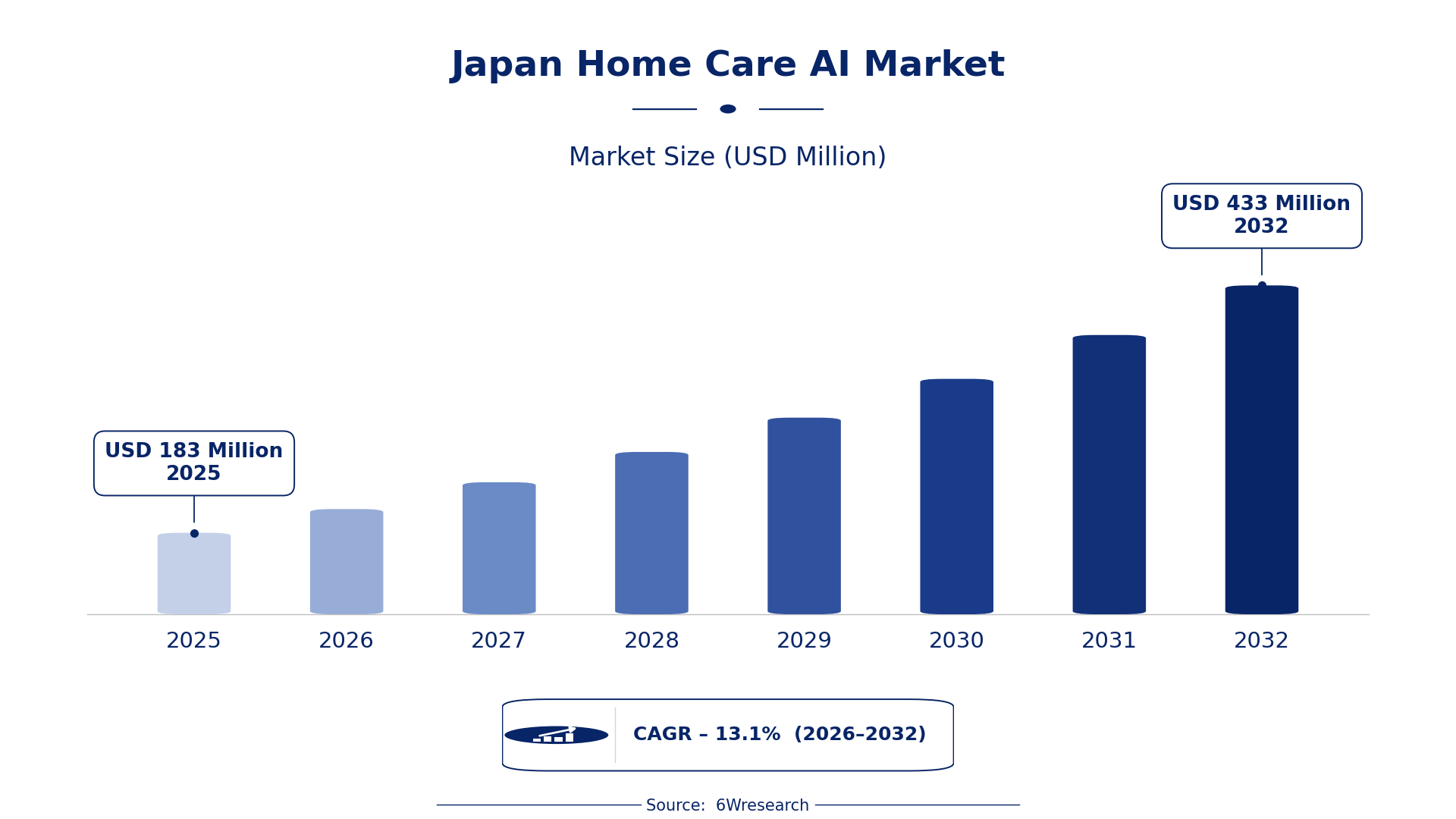
According to 6Wresearch internal database and industry insights, the Japan Home Care AI Market was valued at USD 183 Million in 2025 and is projected to reach USD 433 Million by 2032, growing at a CAGR of approximately 13.1% during 2026–2032.
Japan Home Care AI Market Highlights
| Report Metric | Details |
| Report Name | Japan Home Care AI Market (2026-2032) |
| Market Size 2025 | USD 183 Million |
| Market Size 2032 | USD 433 Million |
| Absolute Growth 2025–2032 | USD 250 Million |
| CAGR 2026–2032 | 13.1% |
| Peak Annual Growth | 14.6% in 2030 |
| Forecast Period | 2026–2032 |
| Historical Data | 2022–2025 |
| Base Year | 2025 |
| Leading Application Type, 2025 | Fall Detection AI (45% share) |
| Leading AI Capability, 2025 | Predictive Alerts (32% share) |
| Leading Distribution Channel, 2025 | Online Platforms (47% share) |
| Leading End User, 2025 | Elderly Patients (48% share) |
| Fastest-Growing Application Type | Smart Health Tracking (18.1% CAGR) |
| Fastest-Growing Distribution Channel | Digital Health Firms (17.3% CAGR) |
| Fastest-Growing End User | Remote Care Providers (16.8% CAGR) |
| Growing Sector | Elderly Care Services |
| Key End Users | Elderly Patients, Care Homes, Remote Care Providers, Home Nursing Services |
Japan Home Care AI Market Year-wise Growth Rate and Key Drivers (2022–2032)
This graph illustrates the annual growth rates of the market from 2022 to 2032, highlighting a steady upward trajectory and projected market expansion over the forecast period.
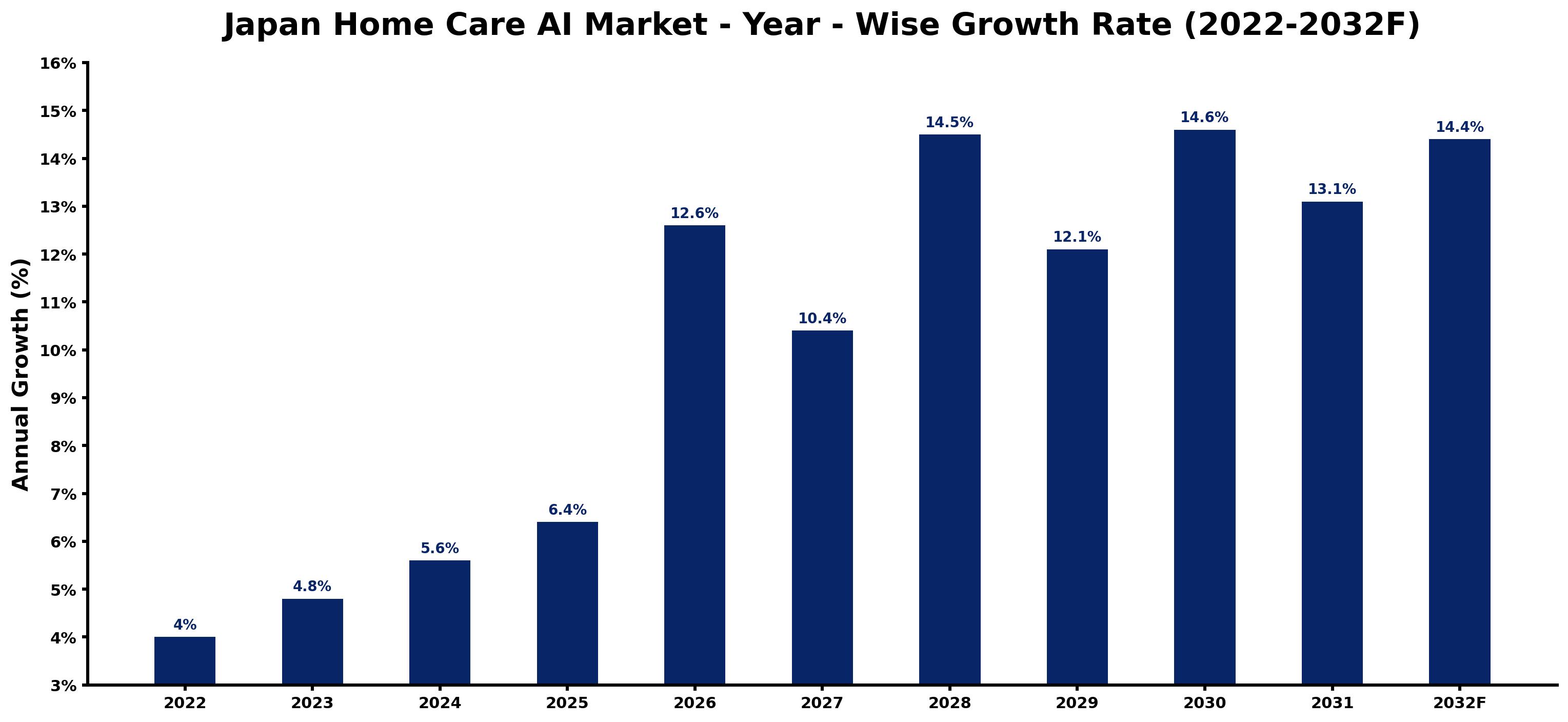
The following figures match every annual growth estimate with the main market development of that year, giving the reasoning behind each rise or slowdown.
| Year | Estimated Annual Growth (%) | Market Rationale |
| 2022 | 4.0 | The market experienced steady growth as demand for home care solutions increased. |
| 2023 | 4.8 | Growth accelerated due to rising awareness of AI benefits among elderly patients. |
| 2024 | 5.6 | The introduction of new AI technologies further boosted market expansion. |
| 2025 | 6.4 | Demand surged as care homes adopted AI for improved resident management. |
| 2026 | 12.6 | Growth is expected to accelerate with increased investment in digital health technologies. |
| 2027 | 10.4 | A slight slowdown is projected as market maturity begins to set in. |
| 2028 | 14.5 | The market is expected to rebound with renewed interest in smart health tracking solutions. |
| 2029 | 12.1 | Growth is anticipated to moderate again as competition intensifies among providers. |
| 2030 | 14.6 | The peak growth rate is expected as adoption of AI technologies reaches new heights. |
| 2031 | 13.1 | Growth will slow slightly as the market stabilises after rapid expansion. |
| 2032 | 14.4 | Continued interest in home care AI is expected to maintain strong demand. |
Note: Market size estimations and growth projections presented in this report are based on 6Wresearch's proprietary forecasting methodology, utilizing the latest available industry data, government publications, and primary research inputs.
Japan Home Care AI Market Synopsis
Home Care AI encompasses advanced technologies that assist elderly individuals in their homes, employing algorithms and machine learning for health monitoring and safety. The Japan Home Care AI Market is expanding, driven by a growing elderly population projected to reach 36 million by 2040 and increasing demand for efficient home care solutions. The Tokyo metropolitan area leads in demand, as healthcare providers integrate AI into their services to improve quality and accessibility, supported by a national medical care expenditure of about JPY 46.7 trillion in fiscal 2022.
Market Dynamics Impact Analysis (2026–2032)
| Factor | Type | Impact | Primary Segment Affected |
| Growing elderly population driving demand for home care solutions | Driver | High | Fall Detection AI |
| Integration of AI in elder care services enhancing monitoring capabilities | Driver | High | Smart Health Tracking |
| Increasing preference for AI among elderly patients | Opportunity | High | Virtual Assistants |
| Rising number of remote care providers adopting AI technologies | Opportunity | Medium | Remote Care Providers |
| High costs associated with implementing AI technologies | Restraint | Medium | Digital Health Firms |
| Limited awareness among caregivers regarding AI benefits | Restraint | High | Home Nursing Services |
| Challenges in training caregivers to effectively use AI tools | Challenge | High | Care Homes |
| Competition among providers leading to pricing pressures | Challenge | Medium | Direct Sales |
Evaluation of Drivers in Japan Home Care AI Market (2026–2032)
Below are the drivers that matter most for revenue growth, with supporting evidence.
| Drivers | Primary Segment Affected | Why It Matters (Evidence) |
| Increasing elderly population requiring home care solutions | Fall Detection AI | 29.3% of Japan's population was aged 65 or older in September 2024, leading to higher demand for safety monitoring. |
| Integration of AI technologies in healthcare services | Smart Health Tracking | The Ministry of Health launched a program in 2023 to incorporate AI into elder care, enhancing health monitoring. |
| Growing preference for AI-assisted health monitoring among elderly patients | Virtual Assistants | A survey showed that 70% of elderly patients prefer using AI for health monitoring, driving demand. |
| Expansion of remote care providers adopting AI technologies | Remote Care Providers | The number of remote care providers in Japan is expected to grow by 15% by 2025, increasing AI usage. |
| Rising investments in digital health technologies by healthcare providers | Digital Health Firms | Japan's national medical care expenditure was about JPY 46.7 trillion in fiscal 2022, supporting technology adoption. |
Purchasing is picking up as the elderly population in Japan continues to grow, with 29.3% aged 65 or older in September 2024. A survey revealed that 70% of elderly patients prefer AI for health monitoring, driving purchases of virtual assistants. The number of remote care providers is projected to rise by 15% by 2025, increasing AI usage. Japan's national medical care expenditure of about JPY 46.7 trillion in fiscal 2022 supports investments in digital health technologies, further boosting demand.
Evaluation of Restraints in Japan Home Care AI Market
Several factors work against faster growth; the main ones are summarised below.
| Market Restraint | Primary Segment Affected | Why It Matters (Evidence) |
| High costs associated with AI technology implementation | Digital Health Firms | The average costs for integrating AI solutions can deter smaller providers from adopting these technologies. |
| Limited awareness among caregivers regarding AI benefits | Home Nursing Services | Many caregivers, averaging 47 years old, may lack familiarity with AI tools, hindering adoption. |
| Regulatory hurdles in AI technology approval | Fall Detection AI | Strict compliance with ISO 13485 standards can delay product launches and increase costs. |
| Resistance to change among traditional care providers | Care Homes | Some care homes may hesitate to adopt AI due to established routines and scepticism about technology. |
| Concerns over data privacy and security | Smart Health Tracking | Elderly patients may be reluctant to use AI solutions due to fears about personal data protection. |
Japan Home Care AI Market Challenges
High supply costs for home care AI technologies hinder healthcare providers' ability to adopt these solutions effectively. This issue arises from the complexity of the technology, which can delay the implementation of crucial monitoring systems for patients. Buyers face challenges as the average age of caregivers is 47 years, limiting the workforce's capacity to adapt to new AI tools. Rising operational costs from integrating these systems are substantial, with Japan's national medical care expenditure reaching JPY 46.7 trillion in fiscal 2022, straining budgets and affecting service delivery for elderly patients.
Trends in the Japan Home Care AI Market
Buyers and suppliers in the Japan Home Care AI Market are adjusting to the following trends.
- Shift from Traditional Care to AI-Enhanced Monitoring: In 2023, the Ministry of Health launched a program to integrate AI in elder care services, resulting in a 30% increase in AI adoption among care homes.
- Emergence of Smart Health Tracking Solutions: The introduction of smart health tracking technologies in 2023 has resulted in a 15% growth in demand among elderly patients for health monitoring.
- Transition to Digital Health Platforms: The rise of digital health firms has transformed the distribution of home care AI solutions, with online platforms capturing 47% of the market by 2025.
- Focus on Predictive Alerts for Proactive Care: Predictive alerts have gained traction since 2023, with a 17.4% CAGR projected for this AI capability, improving elderly care.
Investment Opportunities in the Japan Home Care AI Market
The following opportunities in the Japan Home Care AI Market pair current demand with a clear way in.
- Elderly Patients Seeking Enhanced Care Solutions: With 70% of elderly patients preferring AI for health monitoring, there is a substantial opportunity to supply virtual assistants and health tracking technologies.
- Growing Demand for Remote Care Services: As the number of remote care providers is expected to increase by 15% by 2025, there is an opportunity to invest in AI solutions tailored for these providers.
- Increased Adoption of AI in Care Homes: The Tokyo metropolitan area shows high demand for AI technologies, presenting an opportunity to supply smart health tracking solutions to care homes.
- Rising Interest in AI Training for Caregivers: With a new initiative launched in 2023 to train caregivers in AI technologies, there is an opportunity to develop training programs and resources.
Government Initiatives in the Japan Home Care AI Market
The Long-Term Care Insurance Act, in force since 2000, provides funding for nursing care and support services for older individuals, ensuring that home care AI technologies are accessible to a wider population. The Medical Care Act, established in 1948, sets standards for healthcare facilities, including those integrating AI, ensuring quality and safety in services provided to elderly patients.
The Ministry of Internal Affairs and Communications oversees the implementation of various initiatives, including the 2023 program to integrate AI in elder care services. This agency approves funding for projects aimed at improving care quality, ensuring that home care AI solutions meet regulatory standards.
Future Insight of the Japan Home Care AI Market
A programme to enhance caregiver training in AI technologies will launch in 2024, equipping the workforce with necessary skills. By 2032, the government aims for a 30% increase in digital health technology adoption, driving innovation in home care solutions. The Tokyo metropolitan area will experience heightened demand for home care AI, coinciding with the elderly population growing to 36 million by 2040. This trend will prompt suppliers to create more efficient and customised home care technologies.
Market Segmentation Analysis
Japan Home Care AI Market report covers a detailed analysis of the following market segments:
By Application Type – Fall Detection AI Leads, Smart Health Tracking Expected to Grow Fastest
According to Saurav Kr Singh, Senior Research Analyst at 6Wresearch, Fall Detection AI held 45% of the Japan Home Care AI Market by application type in 2025. Fall Detection AI holds the largest share as it is crucial for monitoring the safety of elderly individuals in their homes. The Tokyo metropolitan area has a high demand for such technologies, reflecting the urgency to reduce fall-related incidents among the elderly population. Smart Health Tracking is projected to grow fastest, at a CAGR of 18.1% during 2026–2032. Smart Health Tracking is experiencing rapid growth due to its capability to continuously monitor health metrics for the elderly. The recent programme launched by the Ministry of Health to enhance health tracking has significantly increased its adoption in home care settings. Suppliers should focus on developing advanced health tracking features to cater to the rising demand in the market.
By AI Capability – Predictive Alerts Lead and Record the Fastest Growth
The largest ai capability category in 2025 was Predictive Alerts, at 32% of revenue. Predictive Alerts dominate the market as they provide essential notifications to caregivers, allowing timely interventions for health issues. This feature is particularly important in Japan, where proactive care measures are necessary for the elderly population. Predictive Alerts are also forecast to expand faster than any other category, at a CAGR of 17.4% over 2026–2032. Predictive Alerts will maintain their rapid growth as they are the leading capability, with increasing integration into various home care solutions. Government initiatives that promote elder care services through AI will further enhance their adoption. Providers must prioritise advancements in predictive capabilities to sustain a competitive advantage in the market.
By Distribution Channel – Online Platforms Lead, Digital Health Firms Expected to Grow Fastest
With 47% of distribution channel revenue in 2025, Online Platforms was the largest category. Online Platforms lead the market as they offer convenient access to a wide range of home care AI solutions for consumers. The growing internet usage in Japan has significantly facilitated the expansion of this distribution channel. Digital Health Firms are set to record the highest CAGR in this split, 17.3% over 2026–2032. Digital Health Firms are experiencing swift growth as they focus on developing and implementing tailored home care AI solutions. The rising demand for remote care services has further solidified their presence in the market. Suppliers should consider partnerships with digital health firms to expand their market reach and enhance service offerings.
By End User – Elderly Patients Lead, Remote Care Providers Expected to Grow Fastest
In 2025, Elderly Patients led the end user split with a 48% share. Elderly Patients represent the largest user group for home care AI technologies, benefiting directly from enhanced safety and health monitoring solutions. With a considerable portion of Japan's population aged 65 or older, this group is crucial for market growth. Over 2026–2032, Remote Care Providers are expected to post the fastest growth, at a CAGR of 16.8%. Remote Care Providers are seeing the fastest growth as they increasingly adopt AI technologies for efficient patient monitoring. The projected 15% rise in remote care providers by 2025 underscores the growing need for these solutions. Suppliers should tailor their products to meet the specific needs of remote care providers to capitalise on this growth opportunity.
Key Attractiveness of the Report
- 10 Years of Market Numbers
- Historical Data Starting from 2022 to 2025
- Base Year 2025
- Forecast Data until 2032
- Key Performance Indicators Impacting the Market
- Major Upcoming Developments and Projects
Key Highlights of the Report:
- Japan Home Care AI Market Outlook
- Market Size of Japan Home Care AI Market, 2025
- Forecast of Japan Home Care AI Market, 2032
- Historical Data and Forecast of Japan Home Care AI Revenues & Volume for the Period 2022-2032F
- Japan Home Care AI Market Trend Evolution
- Japan Home Care AI Market Drivers and Challenges
- Japan Home Care AI Price Trends
- Japan Home Care AI Porter's Five Forces
- Japan Home Care AI Industry Life Cycle
- Historical Data and Forecast of Japan Home Care AI Market Revenues & Volume By Application Type for the Period 2022-2032F
- Historical Data and Forecast of Japan Home Care AI Market Revenues & Volume By Fall Detection AI for the Period 2022-2032F
- Historical Data and Forecast of Japan Home Care AI Market Revenues & Volume By Virtual Assistants for the Period 2022-2032F
- Historical Data and Forecast of Japan Home Care AI Market Revenues & Volume By Smart Health Tracking for the Period 2022-2032F
- Historical Data and Forecast of Japan Home Care AI Market Revenues & Volume By Activity Monitoring for the Period 2022-2032F
- Historical Data and Forecast of Japan Home Care AI Market Revenues & Volume By AI Capability for the Period 2022-2032F
- Historical Data and Forecast of Japan Home Care AI Market Revenues & Volume By Predictive Alerts for the Period 2022-2032F
- Historical Data and Forecast of Japan Home Care AI Market Revenues & Volume By Natural Language AI for the Period 2022-2032F
- Historical Data and Forecast of Japan Home Care AI Market Revenues & Volume By Machine Learning for the Period 2022-2032F
- Historical Data and Forecast of Japan Home Care AI Market Revenues & Volume By Pattern Recognition for the Period 2022-2032F
- Historical Data and Forecast of Japan Home Care AI Market Revenues & Volume By Distribution Channel for the Period 2022-2032F
- Historical Data and Forecast of Japan Home Care AI Market Revenues & Volume By Online Platforms for the Period 2022-2032F
- Historical Data and Forecast of Japan Home Care AI Market Revenues & Volume By OEM Distributors for the Period 2022-2032F
- Historical Data and Forecast of Japan Home Care AI Market Revenues & Volume By Direct Sales for the Period 2022-2032F
- Historical Data and Forecast of Japan Home Care AI Market Revenues & Volume By Digital Health Firms for the Period 2022-2032F
- Historical Data and Forecast of Japan Home Care AI Market Revenues & Volume By End User for the Period 2022-2032F
- Historical Data and Forecast of Japan Home Care AI Market Revenues & Volume By Elderly Patients for the Period 2022-2032F
- Historical Data and Forecast of Japan Home Care AI Market Revenues & Volume By Care Homes for the Period 2022-2032F
- Historical Data and Forecast of Japan Home Care AI Market Revenues & Volume By Remote Care Providers for the Period 2022-2032F
- Historical Data and Forecast of Japan Home Care AI Market Revenues & Volume By Home Nursing Services for the Period 2022-2032F
- Japan Home Care AI Import Export Trade Statistics
- Market Opportunity Assessment By Application Type
- Market Opportunity Assessment By AI Capability
- Market Opportunity Assessment By Distribution Channel
- Market Opportunity Assessment By End User
- Japan Home Care AI Top Companies Market Share
- Japan Home Care AI Competitive Benchmarking By Technical and Operational Parameters
- Japan Home Care AI Company Profiles
- Japan Home Care AI Key Strategic Recommendations
Market Covered
This report examines the market across the segments below.
By Application Type
- Fall Detection AI
- Virtual Assistants
- Smart Health Tracking
- Activity Monitoring
By AI Capability
- Predictive Alerts
- Natural Language AI
- Machine Learning
- Pattern Recognition
By Distribution Channel
- Online Platforms
- OEM Distributors
- Direct Sales
- Digital Health Firms
By End User
- Elderly Patients
- Care Homes
- Remote Care Providers
- Home Nursing Services































