Japan Hospital Infrastructure Market Size & Growth Rate
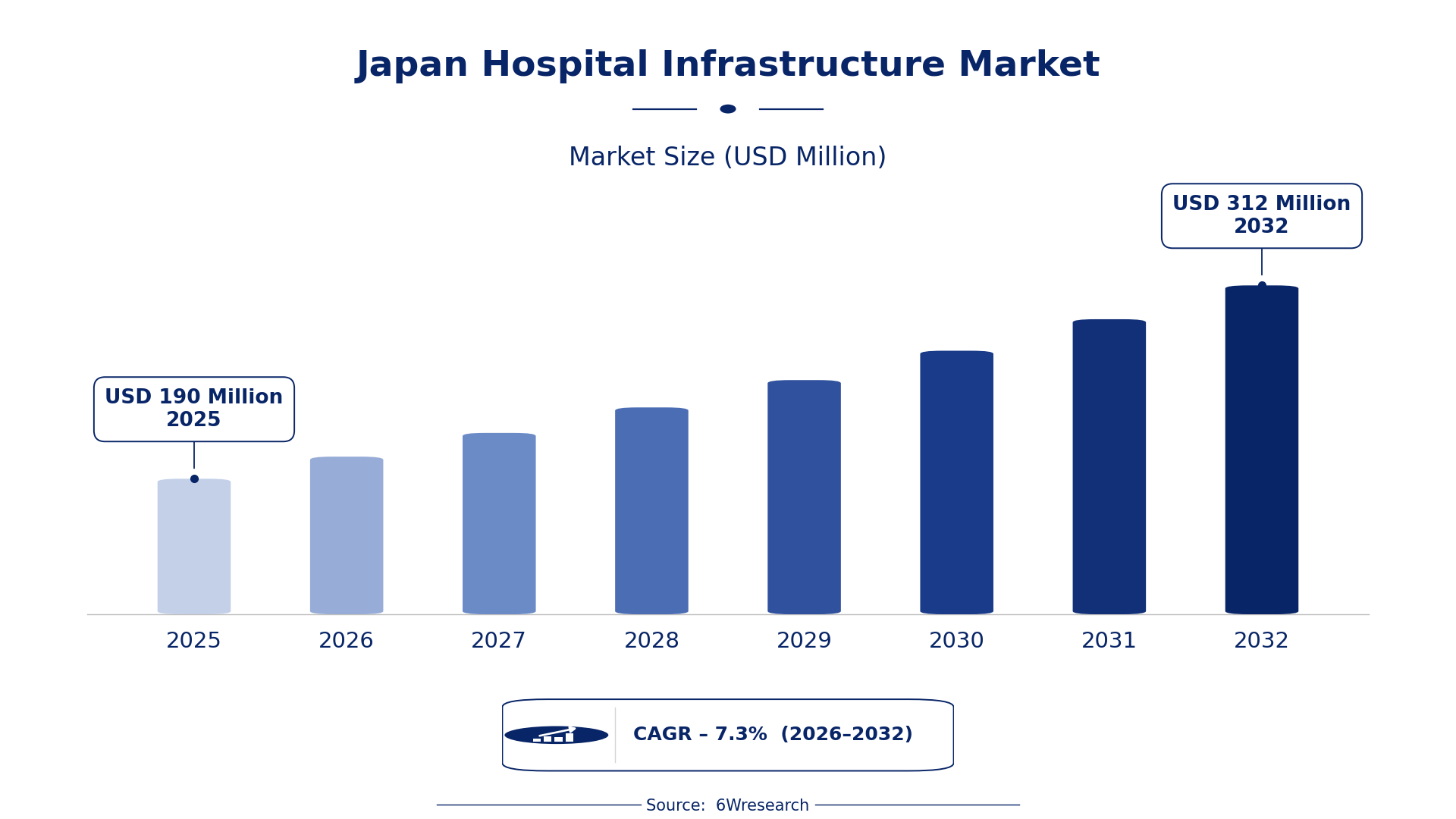
According to 6Wresearch internal database and industry insights, the Japan Hospital Infrastructure Market was valued at USD 190 Million in 2025 and is projected to reach USD 312 Million by 2032, growing at a CAGR of approximately 7.3% during 2026–2032.
Japan Hospital Infrastructure Market Highlights
| Report Metric | Details |
| Report Name | Japan Hospital Infrastructure Market (2026-2032) |
| Market Size 2025 | USD 190 Million |
| Market Size 2032 | USD 312 Million |
| Absolute Growth 2025–2032 | USD 122 Million |
| CAGR 2026–2032 | 7.3% |
| Peak Annual Growth | 8.3% in 2026 |
| Forecast Period | 2026–2032 |
| Historical Data | 2022–2025 |
| Base Year | 2025 |
| Leading Infrastructure Type, 2025 | Modular OTs (43% share) |
| Leading Material/Design, 2025 | Stainless Steel Panels (38% share) |
| Leading Distribution Channel, 2025 | Hospital Builders (38% share) |
| Leading End User, 2025 | Surgical Facilities (38% share) |
| Fastest-Growing Infrastructure Type | Negative Pressure Rooms (9.9% CAGR) |
| Fastest-Growing Material/Design | Smart Ventilation (10.2% CAGR) |
| Fastest-Growing Distribution Channel | HVAC Providers (8.9% CAGR) |
| Fastest-Growing End User | Isolation Rooms (9.3% CAGR) |
| Growing Sector | critical care facilities |
| Key End Users | hospital builders, healthcare providers, infrastructure contractors |
Japan Hospital Infrastructure Market Year-wise Growth Rate and Key Drivers (2022–2032)
This graph illustrates the annual growth rates of the market from 2022 to 2032, highlighting a steady upward trajectory and projected market expansion over the forecast period.
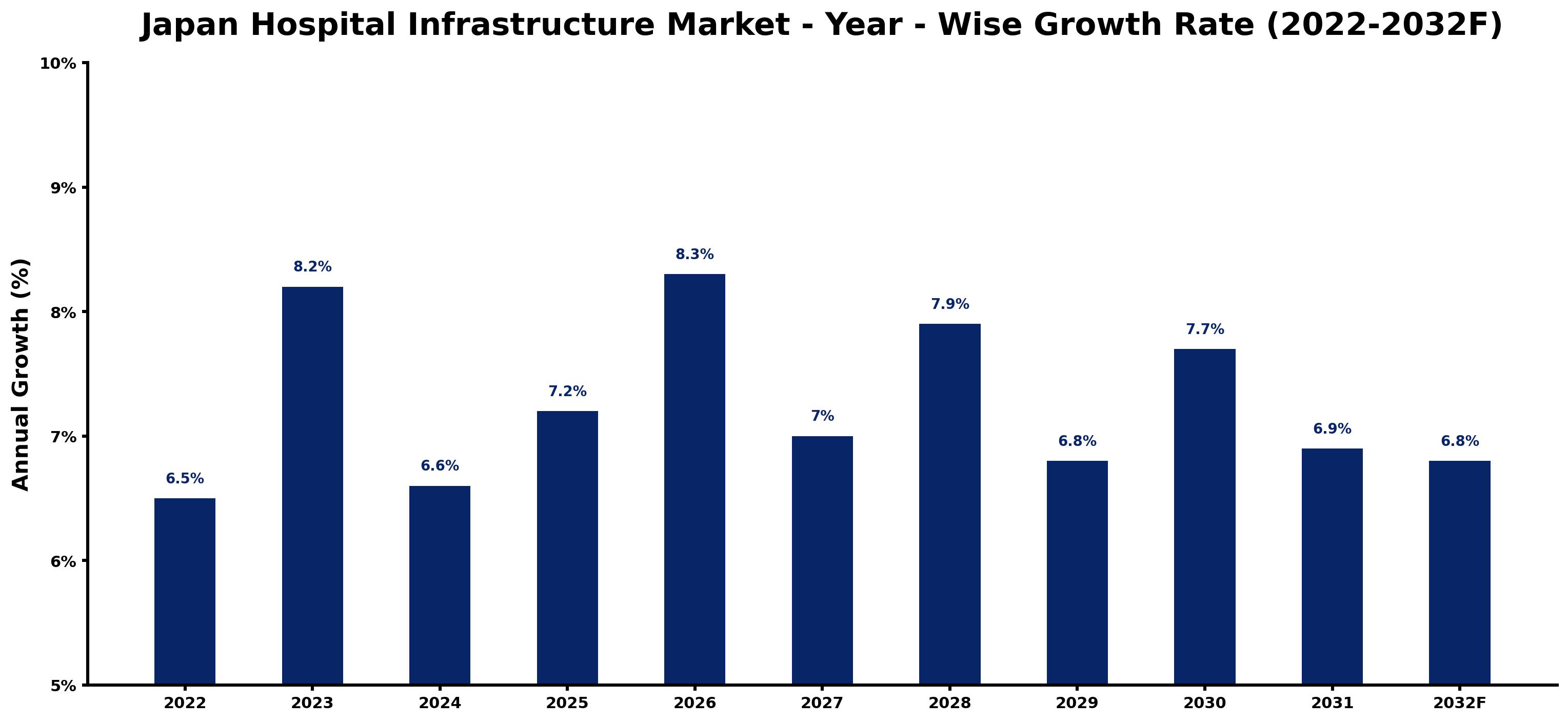
Annual growth estimates for each year appear below with the principal reason behind them, explaining the shifts that set the pace of the market.
| Year | Estimated Annual Growth (%) | Market Rationale |
| 2022 | 6.5 | Demand was steady as healthcare providers focused on maintaining existing facilities. |
| 2023 | 8.2 | Growth accelerated due to increased investments in hospital infrastructure following the Tokyo 2020 Olympics. |
| 2024 | 6.6 | Demand slowed slightly as projects faced delays from supply chain issues. |
| 2025 | 7.2 | Investment in healthcare infrastructure rose as the aging population increased care needs. |
| 2026 | 8.3 | The market is projected to peak as government initiatives spur new hospital construction projects. |
| 2027 | 7.0 | Growth is expected to moderate as the market adjusts to the rapid expansion of previous years. |
| 2028 | 7.9 | Demand is anticipated to increase again as healthcare facilities expand to accommodate more patients. |
| 2029 | 6.8 | A slowdown is expected as the market stabilises after several years of rapid growth. |
| 2030 | 7.7 | Growth is forecast to pick up as new technologies are integrated into hospital designs. |
| 2031 | 6.9 | Demand is likely to slow as the market matures and new projects become less frequent. |
| 2032 | 6.8 | The market will continue to grow as ongoing investments in healthcare infrastructure persist. |
Note: Market size estimations and growth projections presented in this report are based on 6Wresearch's proprietary forecasting methodology, utilizing the latest available industry data, government publications, and primary research inputs.
Japan Hospital Infrastructure Market Synopsis
Hospital infrastructure in Japan encompasses the essential physical and organizational structures for healthcare delivery, including buildings, equipment, and services. The Japan Hospital Infrastructure Market is expanding due to rising demand from healthcare providers, driven by an aging population and substantial government investments. In 2022, Japan's national medical care expenditure reached approximately JPY 46.7 trillion, highlighting the urgency for infrastructure improvements. The Tokyo metropolitan area serves as a hub for advanced hospital facilities, further fuelling growth in this sector.
Market Dynamics Impact Analysis (2026–2032)
| Factor | Type | Impact | Primary Segment Affected |
| Aging population driving demand for healthcare services | Driver | High | ICU Construction |
| Government initiatives increasing funding for healthcare infrastructure | Driver | High | Hospital Builders |
| Expansion of ICU facilities due to rising patient needs | Opportunity | High | ICU Construction |
| Increased focus on infection control measures in hospitals | Opportunity | High | Negative Pressure Rooms |
| High construction costs affecting project timelines | Restraint | Medium | Hospital Builders |
| Supply chain disruptions delaying equipment availability | Restraint | Medium | Hospital Builders |
| Labor shortages impacting construction timelines | Challenge | High | Hospital Builders |
| Rising material costs affecting project budgets | Challenge | High | Hospital Builders |
Evaluation of Drivers in Japan Hospital Infrastructure Market (2026–2032)
Key forces behind demand, with the segment each one moves most, are listed below.
| Drivers | Primary Segment Affected | Why It Matters (Evidence) |
| Increased healthcare expenditure | ICU Construction | Japan's national medical care expenditure was about JPY 46.7 trillion in fiscal 2022, prompting investments in ICU facilities. |
| Government funding initiatives | Hospital Builders | The Japanese government allocated ¥500 billion for healthcare infrastructure improvements in 2022, boosting hospital construction. |
| Growing elderly population | ICU Construction | 29.3% of Japan's population was aged 65 or older in September 2024, increasing demand for critical care facilities. |
| Focus on infection control | Negative Pressure Rooms | Negative pressure rooms are mandated in hospitals dealing with infectious diseases, driving their construction. |
| Technological advancements in hospital design | Smart Ventilation | Smart ventilation systems are being adopted in 30% of new hospital builds, improving air quality. |
What keeps demand rising is the increasing healthcare expenditure, which reached approximately JPY 46.7 trillion in 2022. The aging population intensifies the need for ICU facilities, with 29.3% aged 65 or older by September 2024. Infection control measures drive demand for negative pressure rooms, essential for managing infectious diseases. Technological advancements lead to the adoption of smart ventilation systems in 30% of new builds, improving air quality and patient comfort.
Evaluation of Restraints in Japan Hospital Infrastructure Market
Below are the constraints most often cited by buyers and suppliers, with the segment each affects.
| Market Restraint | Primary Segment Affected | Why It Matters (Evidence) |
| High construction costs delaying projects | Hospital Builders | Rising material costs have increased overall project budgets, causing delays in hospital construction timelines. |
| Supply chain disruptions affecting equipment availability | Hospital Builders | Supply chain issues have delayed the procurement of essential medical equipment for new facilities. |
| Labor shortages impacting construction timelines | Hospital Builders | A shortage of skilled labor has slowed down construction processes, affecting project completion dates. |
| Regulatory compliance costs for hospital standards | Hospital Builders | Compliance with standards set by the Ministry of Health, Labour and Welfare raises construction costs. |
| Limited availability of suitable land for new hospitals | Hospital Builders | Urban areas face land scarcity, complicating the establishment of new healthcare facilities. |
Japan Hospital Infrastructure Market Challenges
Hospitals struggle with supply chain disruptions that delay the procurement of essential materials, such as stainless steel panels used in 70% of surgical facilities. This issue arises from global shortages and logistical challenges, extending project timelines by up to six months for builders. Intense competition among suppliers results in price fluctuations, raising costs by 15% for hospitals acquiring advanced equipment. A lack of skilled labour in construction trades leads to project delays of up to three months, complicating timely upgrades necessary for accommodating an aging population. Compliance with standards like ISO 9001 can inflate project budgets by about 10%, straining financial resources for healthcare providers.
Trends in the Japan Hospital Infrastructure Market
Four trends stand out in the Japan Hospital Infrastructure Market.
- Shift towards Modular Operating Theatres: In 2023, the trend towards modular operating theatres gained momentum, with 43% of new surgical facilities adopting this design. This shift improves operational efficiency and reduces construction time.
- Increased Adoption of Antibacterial Paint: Since 2022, the use of antibacterial paint has surged, now featured in over 60% of new hospital projects. This trend reflects a heightened focus on infection control in healthcare settings.
- Growing Implementation of Smart Ventilation Systems: Beginning in 2023, smart ventilation systems are being integrated into 30% of new hospital builds, improving air quality and patient comfort in healthcare facilities.
- Expansion of Isolation Rooms in Hospitals: In 2023, hospitals began expanding isolation rooms to manage infectious diseases more effectively, with a notable rise in demand for these critical spaces.
Investment Opportunities in the Japan Hospital Infrastructure Market
The following opportunities in the Japan Hospital Infrastructure Market pair current demand with a clear way in.
- Investment in ICU Construction: With approximately 30,000 ICU beds in Japan, the demand for ICU construction is rising. The aging population increases the need for critical care facilities, presenting a strong opportunity for investors.
- Supply of Negative Pressure Rooms: As infection control becomes paramount, the construction of negative pressure rooms is essential. Hospitals are mandated to have these facilities, creating a market for suppliers.
- Development of Smart Ventilation Systems: The growing adoption of smart ventilation systems in hospitals presents an opportunity for technology providers. Collaborating with hospital builders can facilitate market entry.
- Enhancement of Modular Operating Theatres: The shift towards modular operating theatres opens avenues for construction firms. Partnering with hospital planners can streamline the development of these efficient surgical spaces.
Government Initiatives in the Japan Hospital Infrastructure Market
The Healthcare Infrastructure Development Program, launched in 2023, aims to improve facility standards across Japan. This program builds on the Medical Care Act of 1948, which sets essential standards for hospitals and clinics, ensuring quality healthcare delivery.
In 2022, the Ministry of Health, Labour and Welfare approved funding of ¥500 billion for healthcare infrastructure improvements. This funding supports various projects aimed at upgrading hospital facilities and services.
Future Insight of the Japan Hospital Infrastructure Market
By 2032, a shift towards enhanced healthcare infrastructure will drive upgrades in hospital facilities, prompting suppliers to incorporate advanced technologies such as smart ventilation systems, which are currently adopted in 30% of new builds. The introduction of noise-canceling walls will create better patient recovery environments, aligning with a focus on patient-centric designs. Increased government funding for infrastructure improvements is expected, with allocations projected to reach ¥600 billion annually. As the aging population expands, hospitals will enhance critical care units, requiring new construction methods to meet rising demands.
Market Segmentation Analysis
Japan Hospital Infrastructure Market report covers a detailed analysis of the following market segments:
By Infrastructure Type – Modular OTs Lead, Negative Pressure Rooms Expected to Grow Fastest
According to Saurav Kr Singh, Senior Research Analyst at 6Wresearch, Modular OTs accounted for 43% of the market by infrastructure type in 2025. Modular operating theatres are vital for effective surgical procedures, particularly in a healthcare system with a high volume of surgeries. Their implementation in the Tokyo metropolitan area exemplifies the trend towards optimising surgical workflows and enhancing patient care. The quickest growth will come from Negative Pressure Rooms, forecast to expand at a CAGR of 9.9% between 2026 and 2032. The rise in infectious diseases has led to a swift increase in the adoption of negative pressure rooms, which are essential for controlling infections in healthcare environments. Recent government mandates have accelerated their integration into hospital designs, ensuring readiness for health crises. Suppliers should focus on providing solutions that enhance infection control to meet the growing demand for negative pressure rooms.
By Material/Design – Stainless Steel Panels Lead, Smart Ventilation Expected to Grow Fastest
The largest material/design category in 2025 was Stainless Steel Panels, at 38% of revenue. Stainless steel panels are widely utilised in hospital construction for their superior hygiene properties, making them a top choice for surgical facilities. Their use in approximately 70% of surgical environments in Japan underscores their importance in maintaining cleanliness standards. Over 2026–2032, Smart Ventilation is expected to post the fastest growth, at a CAGR of 10.2%. Smart ventilation systems are increasingly preferred as hospitals strive to improve air quality, particularly in light of ongoing health concerns. The adoption rate of around 30% in new hospital builds indicates a shift towards advanced environmental controls in healthcare settings. Buyers should consider incorporating smart ventilation systems into new projects to enhance patient safety and comfort.
By Distribution Channel – Hospital Builders Lead, HVAC Providers Expected to Grow Fastest
In 2025, Hospital Builders led the distribution channel split with a 38% share. Hospital builders play a crucial role in constructing hospital facilities, directly affecting the quality and capacity of healthcare infrastructure. Their involvement in over 8,100 hospitals across Japan highlights their significance in the market. HVAC Providers are projected to grow fastest, at a CAGR of 8.9% during 2026–2032. HVAC providers are becoming more essential as hospitals prioritise air quality and infection control, leading to increased demand for their services. The growing focus on advanced ventilation solutions aligns with rising investments in healthcare infrastructure. Suppliers must strengthen collaborations with HVAC providers to align with the evolving infrastructure requirements of hospitals.
By End User – Surgical Facilities Lead, Isolation Rooms Expected to Grow Fastest
Surgical Facilities took 38% of end user revenue in 2025, more than any other category. Surgical facilities are a core element of hospital infrastructure, serving as the foundation for various surgical procedures. Their importance is reflected in high occupancy rates and the demand for advanced surgical environments within Japan's healthcare system. Isolation Rooms are set to record the highest CAGR in this split, 9.3% over 2026–2032. Isolation rooms are increasingly critical as hospitals adapt to manage infectious diseases, resulting in a significant rise in their construction. This trend is largely driven by the aging population, necessitating improved infection control measures in healthcare settings. Healthcare providers should prioritise the development of isolation rooms to ensure readiness for managing infectious diseases.
Key Attractiveness of the Report
- 10 Years of Market Numbers
- Historical Data Starting from 2022 to 2025
- Base Year 2025
- Forecast Data until 2032
- Key Performance Indicators Impacting the Market
- Major Upcoming Developments and Projects
Key Highlights of the Report:
- Japan Hospital Infrastructure Market Outlook
- Market Size of Japan Hospital Infrastructure Market, 2025
- Forecast of Japan Hospital Infrastructure Market, 2032
- Historical Data and Forecast of Japan Hospital Infrastructure Revenues & Volume for the Period 2022-2032F
- Japan Hospital Infrastructure Market Trend Evolution
- Japan Hospital Infrastructure Market Drivers and Challenges
- Japan Hospital Infrastructure Price Trends
- Japan Hospital Infrastructure Porter's Five Forces
- Japan Hospital Infrastructure Industry Life Cycle
- Historical Data and Forecast of Japan Hospital Infrastructure Market Revenues & Volume By Infrastructure Type for the Period 2022-2032F
- Historical Data and Forecast of Japan Hospital Infrastructure Market Revenues & Volume By Modular OTs for the Period 2022-2032F
- Historical Data and Forecast of Japan Hospital Infrastructure Market Revenues & Volume By Negative Pressure Rooms for the Period 2022-2032F
- Historical Data and Forecast of Japan Hospital Infrastructure Market Revenues & Volume By ICU Construction for the Period 2022-2032F
- Historical Data and Forecast of Japan Hospital Infrastructure Market Revenues & Volume By Patient Rooms for the Period 2022-2032F
- Historical Data and Forecast of Japan Hospital Infrastructure Market Revenues & Volume By Material/Design for the Period 2022-2032F
- Historical Data and Forecast of Japan Hospital Infrastructure Market Revenues & Volume By Stainless Steel Panels for the Period 2022-2032F
- Historical Data and Forecast of Japan Hospital Infrastructure Market Revenues & Volume By Smart Ventilation for the Period 2022-2032F
- Historical Data and Forecast of Japan Hospital Infrastructure Market Revenues & Volume By Antibacterial Paint for the Period 2022-2032F
- Historical Data and Forecast of Japan Hospital Infrastructure Market Revenues & Volume By Noise-Canceling Walls for the Period 2022-2032F
- Historical Data and Forecast of Japan Hospital Infrastructure Market Revenues & Volume By Distribution Channel for the Period 2022-2032F
- Historical Data and Forecast of Japan Hospital Infrastructure Market Revenues & Volume By Hospital Builders for the Period 2022-2032F
- Historical Data and Forecast of Japan Hospital Infrastructure Market Revenues & Volume By HVAC Providers for the Period 2022-2032F
- Historical Data and Forecast of Japan Hospital Infrastructure Market Revenues & Volume By Infra Contractors for the Period 2022-2032F
- Historical Data and Forecast of Japan Hospital Infrastructure Market Revenues & Volume By Hospital Planners for the Period 2022-2032F
- Historical Data and Forecast of Japan Hospital Infrastructure Market Revenues & Volume By End User for the Period 2022-2032F
- Historical Data and Forecast of Japan Hospital Infrastructure Market Revenues & Volume By Surgical Facilities for the Period 2022-2032F
- Historical Data and Forecast of Japan Hospital Infrastructure Market Revenues & Volume By Isolation Rooms for the Period 2022-2032F
- Historical Data and Forecast of Japan Hospital Infrastructure Market Revenues & Volume By Critical Care Units for the Period 2022-2032F
- Historical Data and Forecast of Japan Hospital Infrastructure Market Revenues & Volume By General Wards for the Period 2022-2032F
- Japan Hospital Infrastructure Import Export Trade Statistics
- Market Opportunity Assessment By Infrastructure Type
- Market Opportunity Assessment By Material/Design
- Market Opportunity Assessment By Distribution Channel
- Market Opportunity Assessment By End User
- Japan Hospital Infrastructure Top Companies Market Share
- Japan Hospital Infrastructure Competitive Benchmarking By Technical and Operational Parameters
- Japan Hospital Infrastructure Company Profiles
- Japan Hospital Infrastructure Key Strategic Recommendations
Market Covered
The study includes the following segmentation.
By Infrastructure Type
- Modular OTs
- Negative Pressure Rooms
- ICU Construction
- Patient Rooms
By Material/Design
- Stainless Steel Panels
- Smart Ventilation
- Antibacterial Paint
- Noise-Canceling Walls
By Distribution Channel
- Hospital Builders
- HVAC Providers
- Infra Contractors
- Hospital Planners
By End User
- Surgical Facilities
- Isolation Rooms
- Critical Care Units
- General Wards































