Japan Human Resource Technology Market Size & Growth Rate
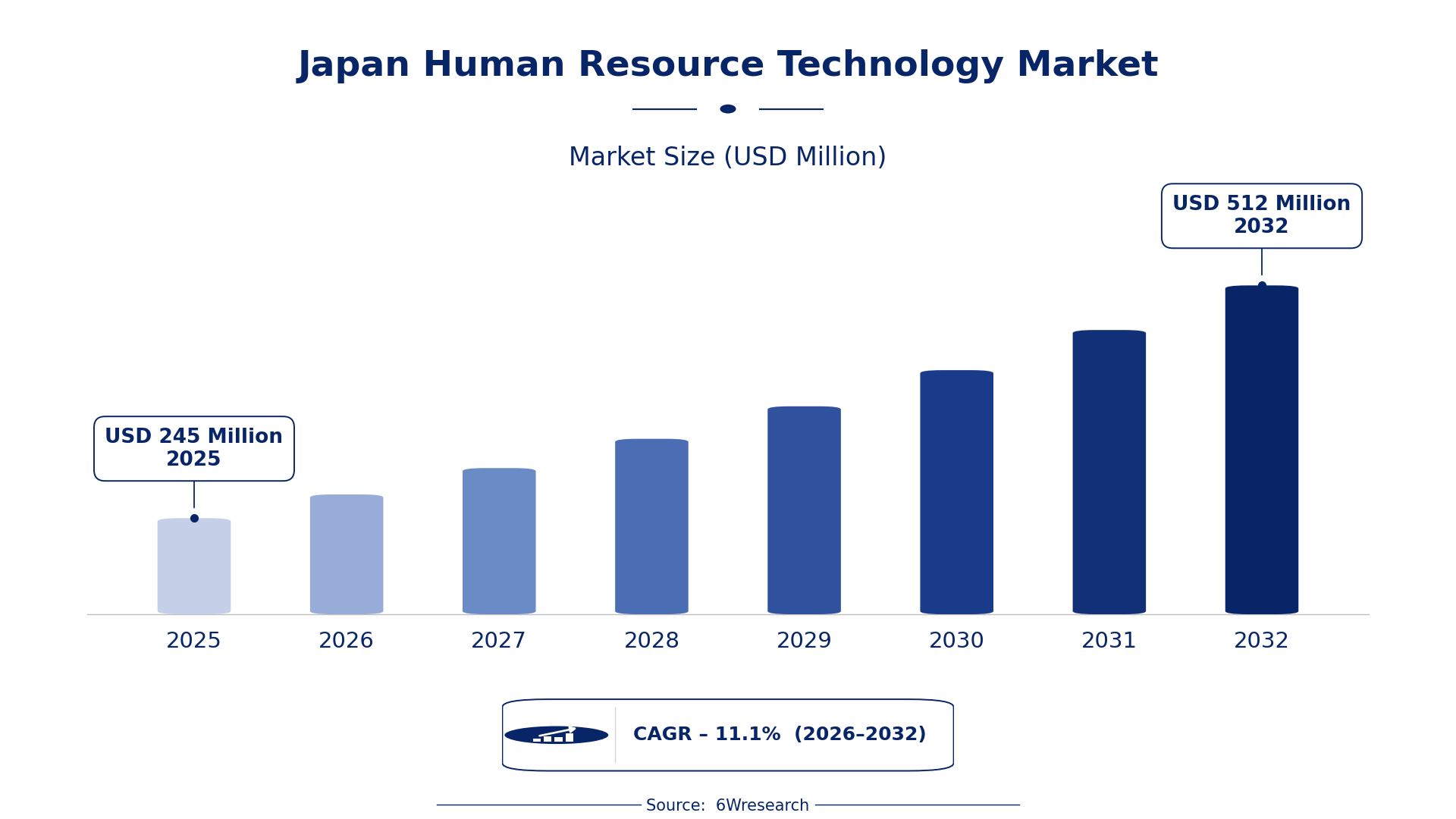
According to 6Wresearch internal database and industry insights, the Japan Human Resource Technology Market was valued at USD 245 Million in 2025 and is projected to reach USD 512 Million by 2032, growing at a CAGR of approximately 11.1% during 2026–2032.
Japan Human Resource Technology Market Highlights
| Report Metric | Details |
| Report Name | Japan Human Resource Technology Market (2026-2032) |
| Market Size 2025 | USD 245 Million |
| Market Size 2032 | USD 512 Million |
| Absolute Growth 2025–2032 | USD 267 Million |
| CAGR 2026–2032 | 11.1% |
| Peak Annual Growth | 11.7% in 2032 |
| Forecast Period | 2026–2032 |
| Historical Data | 2022–2025 |
| Base Year | 2025 |
| Leading Solution Type, 2025 | Talent Acquisition (44% share) |
| Leading Deployment Mode, 2025 | On-premises (58% share) |
| Leading End User, 2025 | IT & Telecom (40% share) |
| Fastest-Growing Solution Type | Learning Management (15.1% CAGR) |
| Fastest-Growing Deployment Mode | Cloud-based (15.5% CAGR) |
| Fastest-Growing End User | Healthcare (14.1% CAGR) |
| Growing Sector | Healthcare |
| Key End Users | IT & Telecom, Healthcare, Retail |
Japan Human Resource Technology Market Year-wise Growth Rate and Key Drivers (2022–2032)
This graph illustrates the annual growth rates of the market from 2022 to 2032, highlighting a steady upward trajectory and projected market expansion over the forecast period.
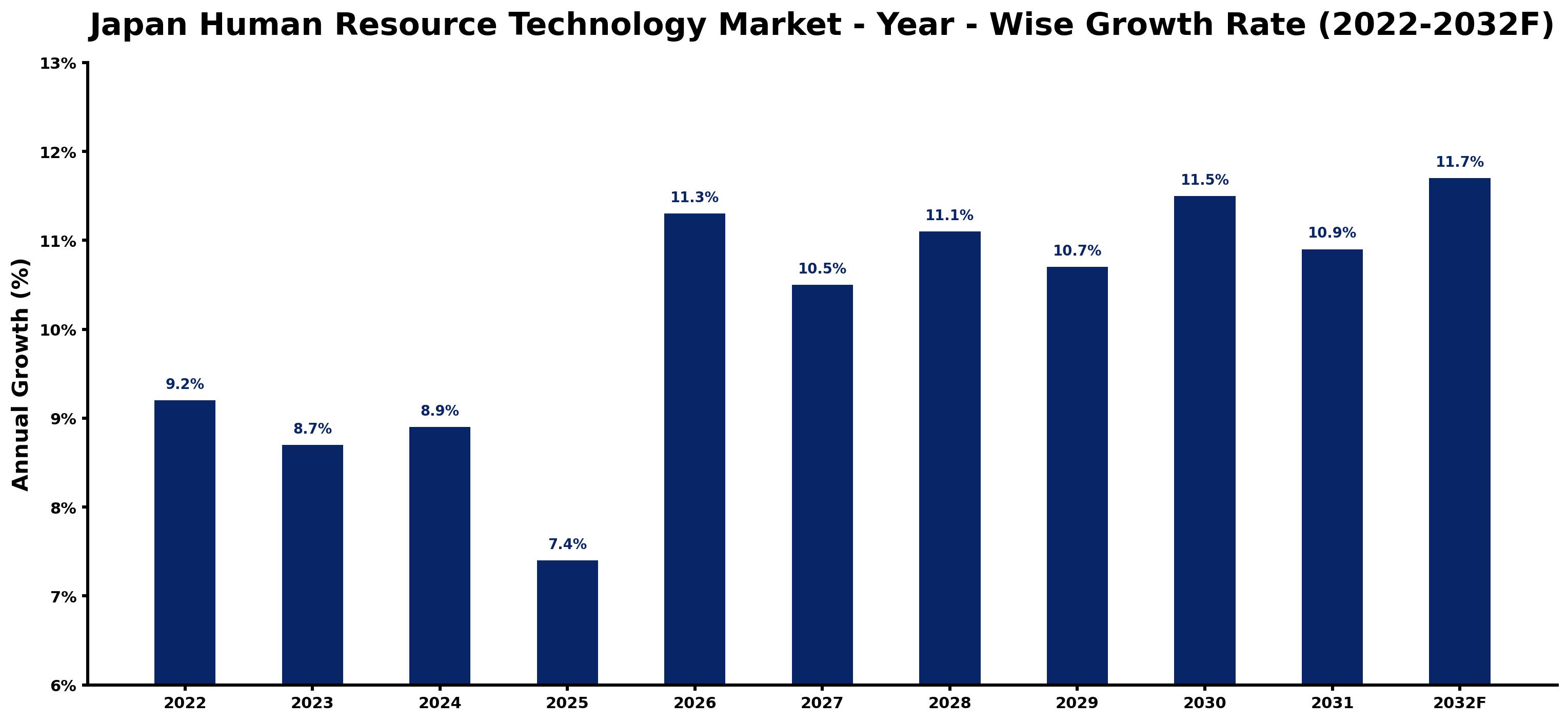
The following figures match every annual growth estimate with the main market development of that year, giving the reasoning behind each rise or slowdown.
| Year | Estimated Annual Growth (%) | Market Rationale |
| 2022 | 9.2 | The market experienced strong activity, driven by increased digitalisation efforts across sectors. |
| 2023 | 8.7 | Growth slowed as companies adjusted to market conditions and focused on existing technologies. |
| 2024 | 8.9 | Demand increased due to rising investments in employee training and development solutions. |
| 2025 | 7.4 | Growth slowed as companies consolidated their HR technology investments and strategies. |
| 2026 | 11.3 | Investment in cloud-based solutions surged, providing greater flexibility for HR operations. |
| 2027 | 10.5 | Demand slowed slightly as the market stabilised after rapid cloud adoption. |
| 2028 | 11.1 | Growth accelerated with new initiatives in workforce planning and management technologies. |
| 2029 | 10.7 | Demand slowed as market saturation began to influence purchasing decisions. |
| 2030 | 11.5 | Investment in HR technology rose again, driven by a focus on efficiency and productivity. |
| 2031 | 10.9 | Growth slowed as companies evaluated the effectiveness of their HR technology investments. |
| 2032 | 11.7 | Demand surged with the introduction of advanced HR analytics solutions. |
Note: Market size estimations and growth projections presented in this report are based on 6Wresearch's proprietary forecasting methodology, utilizing the latest available industry data, government publications, and primary research inputs.
Japan Human Resource Technology Market Synopsis
Human Resource Technology includes software solutions that streamline HR processes such as recruitment and training. In Japan, the market was valued at approximately 200 billion yen in 2022, driven by strong demand from sectors like IT and healthcare. Growth stems from rising investments in digital skills and workforce digitalisation initiatives, particularly in major regions including Tokyo and Osaka. By 2025, cloud-based solutions are expected to dominate the market, reflecting a shift towards flexibility and efficiency in HR operations.
Market Dynamics Impact Analysis (2026–2032)
| Factor | Type | Impact | Primary Segment Affected |
| Rising investment in cloud-based HR solutions | Driver | High | Cloud-based |
| Growing demand for efficient HR processes in IT & Telecom | Driver | High | IT & Telecom |
| Increasing adoption of HR technology in healthcare | Opportunity | High | Healthcare |
| Demand for Learning Management Systems in various sectors | Opportunity | Medium | Learning Management |
| Market saturation affecting new technology adoption | Restraint | Medium | Cloud-based |
| High costs of implementing advanced HR technologies | Restraint | High | Talent Acquisition |
| Limited workforce skilled in advanced HR technology | Challenge | High | Workforce Planning |
| Slow adaptation to changing HR technology trends | Challenge | Medium | Others |
Evaluation of Drivers in Japan Human Resource Technology Market (2026–2032)
The main growth drivers and the segments they affect most are set out below.
| Drivers | Primary Segment Affected | Why It Matters (Evidence) |
| Investment in cloud-based HR solutions | Cloud-based | This investment enhances operational flexibility, with cloud solutions projected to dominate by 2025. |
| Demand for efficient HR processes in IT & Telecom | IT & Telecom | The sector accounts for about 30% of HR technology usage, driving more purchases for efficiency. |
| Healthcare sector's increasing HR technology adoption | Healthcare | The sector has seen a 20% increase since 2020, leading to more purchases for staff management. |
| Growing need for Learning Management Systems | Learning Management | This segment is expected to grow significantly by 2025, prompting more investments in training solutions. |
| Digital skills enhancement initiatives | Others | The 2023 government program promotes digital skills, leading to increased HR technology investments. |
Much of the new demand traces back to increasing investment in cloud-based HR solutions, which are projected to dominate the market by 2025. The IT sector drives purchases for more efficient HR processes, accounting for about 30% of HR technology usage. The healthcare sector has experienced a 20% increase in HR technology adoption since 2020, prompting investments in staff management solutions. Demand for Learning Management Systems is rising as companies seek to improve employee training capabilities.
Evaluation of Restraints in Japan Human Resource Technology Market
The following restraints limit how fast demand can grow.
| Market Restraint | Primary Segment Affected | Why It Matters (Evidence) |
| Market saturation affecting new technology adoption | Cloud-based | As the market matures, companies are more hesitant to adopt new technologies, slowing growth. |
| High costs of implementing advanced HR technologies | Talent Acquisition | The initial investment required for advanced HR systems can deter smaller companies from upgrading. |
| Limited workforce skilled in advanced HR technology | Workforce Planning | A shortage of skilled professionals limits the effective implementation of new HR systems. |
| Slow adaptation to changing HR technology trends | Others | Some companies struggle to keep pace with rapid advancements, affecting their competitiveness. |
| Resistance to change within traditional companies | On-premises | Established firms may hesitate to transition to cloud solutions, limiting market growth. |
Japan Human Resource Technology Market Challenges
Intense competition among producers exerts pressure on prices, resulting in reduced profit margins for software developers in Japan. Rapid technological advancements compel producers to allocate considerable resources for R&D, with expenditures potentially exceeding 15% of their revenue. A shortage of skilled data analytics professionals is hindering HR technology firms, causing delays in product launches that affect over 1 million users. Supply chain disruptions for software components can lead to project delays, impacting the timely implementation of HR systems for businesses across various sectors.
Trends in the Japan Human Resource Technology Market
Several trends are reshaping the Japan Human Resource Technology Market; the most important are set out below.
- Shift towards Cloud-based HR Solutions: Tokyo is experiencing a transition towards cloud-based HR solutions, with adoption rates expected to rise by 2025. This change enables companies to enhance flexibility and efficiency in their HR operations.
- Emergence of Digital Skills Enhancement Programs: Since 2023, new digital skills enhancement programs have been launched, focusing on improving workforce capabilities in HR technology. This initiative is set to increase the number of skilled HR professionals in Japan.
- Growing Demand for Learning Management Systems: The demand for Learning Management Systems has surged, especially in sectors like healthcare, where training is crucial. This segment is projected to grow substantially by 2025, reflecting a shift in training methodologies.
- Increased Focus on Workforce Digitalisation: The healthcare sector is prioritising workforce digitalisation, with a 20% rise in HR technology adoption since 2020. This trend is transforming how healthcare organisations manage their staff and training.
Investment Opportunities in the Japan Human Resource Technology Market
Below are the investment opportunities with the strongest case in the Japan Human Resource Technology Market.
- Gap in Advanced HR Technology Adoption: With a projected market size of USD 512 million by 2032, there exists a clear gap in advanced HR technology adoption. Companies in healthcare require effective solutions to manage their growing workforce efficiently.
- Healthcare Sector's Need for HR Solutions: The healthcare sector is increasingly implementing HR technology to manage large staff efficiently. Investing in tailored solutions for this sector can yield substantial returns, particularly in urban areas.
- Supply of Learning Management Systems: The rising demand for Learning Management Systems offers an opportunity to provide effective training solutions. Collaborating with educational institutions can facilitate market entry.
- Entry through Local Partnerships: With the rise of cloud-based solutions, forming joint ventures with local firms can simplify market entry. This strategy is particularly effective in regions like Osaka, where HR technology adoption is on the rise.
Government Initiatives in the Japan Human Resource Technology Market
The Long-Term Care Insurance Act, enacted in 1997 and effective from 2000, funds support services for older people. This legislation has encouraged the adoption of HR technology in the healthcare sector to effectively manage workforce needs. Additionally, the Next-Generation Medical Infrastructure Act of 2017 supports the integration of HR technology in healthcare settings by permitting the use of anonymised medical data for research and product development.
The Digital Agency oversees government digital transformation initiatives and common system standards. This agency funds projects aimed at improving digital skills in HR, focusing on enhancing workforce management capabilities across various sectors.
Future Insight of the Japan Human Resource Technology Market
A new digital skills programme will support workforce capabilities, improving HR technology utilisation by 2032. Cloud-based solutions are projected to dominate, representing over 70% of the market by 2025. The Learning Management System segment will experience notable growth, improving employee training outcomes. Increased adoption of ISO 9001 certification among providers will elevate quality standards, benefiting buyers through enhanced service reliability.
Market Segmentation Analysis
Japan Human Resource Technology Market report covers a detailed analysis of the following market segments:
By Solution Type – Talent Acquisition Leads, Learning Management Expected to Grow Fastest
According to Bhawna Singh, Assistant Manager at 6Wresearch, Talent Acquisition held 44% of the Japan Human Resource Technology Market by solution type in 2025. The Talent Acquisition segment holds the largest share as it is essential for recruiting processes, with over 1 million HR technology users in Japan relying on these solutions. This segment's prominence is underscored by the adoption of standards like JIS Q 15001, which enhances compliance and efficiency in hiring. The quickest growth will come from Learning Management, forecast to expand at a CAGR of 15.1% between 2026 and 2032. The Learning Management segment is growing rapidly as organisations increasingly focus on employee training and development, supported by government initiatives aimed at enhancing digital skills in HR. This prioritisation of upskilling will likely drive further adoption of Learning Management Systems in the future. Suppliers should enhance features that support recruitment and training to seize market opportunities.
By Deployment Mode – On-premises Lead, Cloud-based Expected to Grow Fastest
With 58% of deployment mode revenue in 2025, On-premises was the largest category. On-premises solutions dominate the market due to their popularity among traditional companies that prefer maintaining control over HR systems. This preference is particularly evident in established sectors where data security and customisation are paramount. Cloud-based is set to record the highest CAGR in this split, 15.5% over 2026–2032. Cloud-based deployment is gaining momentum as organisations seek flexibility and scalability in their HR solutions, reflecting a broader trend towards digital transformation. The anticipated dominance of cloud solutions by 2025 indicates a significant shift in buyer preferences. Buyers should consider transitioning to cloud-based solutions to take advantage of flexibility and scalability.
By End User – IT & Telecom Leads, Healthcare Expected to Grow Fastest
IT & Telecom took 40% of end user revenue in 2025, more than any other category. The IT & Telecom sector accounts for approximately 30% of HR technology usage in Japan, demonstrating a high demand for efficient HR solutions to manage a dynamic workforce. The rapid technological advancements in this sector necessitate robust HR systems for effective talent management. Healthcare is projected to grow fastest, at a CAGR of 14.1% during 2026–2032. The Healthcare sector is experiencing the fastest growth in HR technology adoption, driven by the need for effective management of large staff and compliance with regulatory standards. A 20% increase in adoption since 2020 highlights the urgency for improved HR processes in this vital industry. Suppliers should tailor their offerings to meet the specific needs of the healthcare sector to capture this growth.
Key Attractiveness of the Report
- 10 Years of Market Numbers
- Historical Data Starting from 2022 to 2025
- Base Year 2025
- Forecast Data until 2032
- Key Performance Indicators Impacting the Market
- Major Upcoming Developments and Projects
Key Highlights of the Report:
- Japan Human Resource Technology Market Outlook
- Market Size of Japan Human Resource Technology Market,2025
- Forecast of Japan Human Resource Technology Market, 2032
- Historical Data and Forecast of Japan Human Resource Technology Revenues & Volume for the Period 2022-2032
- Japan Human Resource Technology Market Trend Evolution
- Japan Human Resource Technology Market Drivers and Challenges
- Japan Human Resource Technology Price Trends
- Japan Human Resource Technology Porter's Five Forces
- Japan Human Resource Technology Industry Life Cycle
- Historical Data and Forecast of Japan Human Resource Technology Market Revenues & Volume By Solution Type for the Period 2022-2032
- Historical Data and Forecast of Japan Human Resource Technology Market Revenues & Volume By Talent Acquisition for the Period 2022-2032
- Historical Data and Forecast of Japan Human Resource Technology Market Revenues & Volume By Learning Management for the Period 2022-2032
- Historical Data and Forecast of Japan Human Resource Technology Market Revenues & Volume By Workforce Planning for the Period 2022-2032
- Historical Data and Forecast of Japan Human Resource Technology Market Revenues & Volume By Others for the Period 2022-2032
- Historical Data and Forecast of Japan Human Resource Technology Market Revenues & Volume By Deployment Mode for the Period 2022-2032
- Historical Data and Forecast of Japan Human Resource Technology Market Revenues & Volume By On-premises for the Period 2022-2032
- Historical Data and Forecast of Japan Human Resource Technology Market Revenues & Volume By Cloud-based for the Period 2022-2032
- Historical Data and Forecast of Japan Human Resource Technology Market Revenues & Volume By End User for the Period 2022-2032
- Historical Data and Forecast of Japan Human Resource Technology Market Revenues & Volume By IT & Telecom for the Period 2022-2032
- Historical Data and Forecast of Japan Human Resource Technology Market Revenues & Volume By Healthcare for the Period 2022-2032
- Historical Data and Forecast of Japan Human Resource Technology Market Revenues & Volume By Retail for the Period 2022-2032
- Historical Data and Forecast of Japan Human Resource Technology Market Revenues & Volume By Others for the Period 2022-2032
- Japan Human Resource Technology Import Export Trade Statistics
- Market Opportunity Assessment By Solution Type
- Market Opportunity Assessment By Deployment Mode
- Market Opportunity Assessment By End User
- Japan Human Resource Technology Top Companies Market Share
- Japan Human Resource Technology Competitive Benchmarking By Technical and Operational Parameters
- Japan Human Resource Technology Company Profiles
- Japan Human Resource Technology Key Strategic Recommendations
Market Covered
Coverage by segment is as follows.
By Solution Type
- Talent Acquisition
- Learning Management
- Workforce Planning
- Others
By Deployment Mode
- On-premises
- Cloud-based
By End User
- IT & Telecom
- Healthcare
- Retail
- Others































