Japan Hydraulic Hand Pumps Market Size & Growth Rate
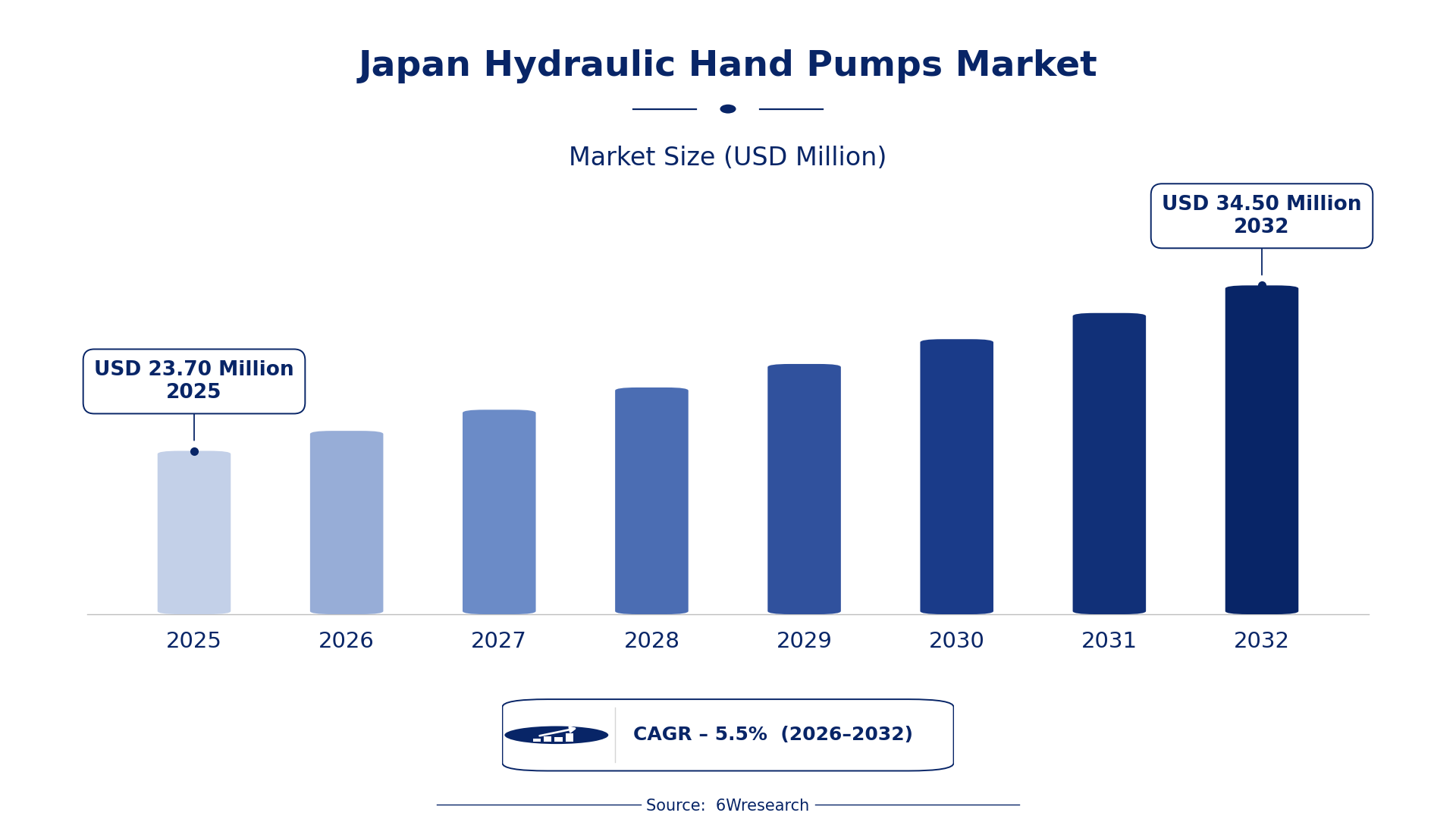
According to 6Wresearch internal database and industry insights, the Japan Hydraulic Hand Pumps Market was valued at USD 23.70 Million in 2025 and is projected to reach USD 34.50 Million by 2032, growing at a CAGR of approximately 5.5% during 2026–2032.
Japan Hydraulic Hand Pumps Market Highlights
| Report Metric | Details |
| Report Name | Japan Hydraulic Hand Pumps Market (2026-2032) |
| Market Size 2025 | USD 23.70 Million |
| Market Size 2032 | USD 34.50 Million |
| Absolute Growth 2025–2032 | USD 10.80 Million |
| CAGR 2026–2032 | 5.5% |
| Peak Annual Growth | 6.7% in 2030 |
| Forecast Period | 2026–2032 |
| Historical Data | 2022–2025 |
| Base Year | 2025 |
| Leading Type, 2025 | Single Acting (65% share) |
| Leading Application, 2025 | Lifting (49% share) |
| Fastest-Growing Type | Double Acting (7.5% CAGR) |
| Fastest-Growing Application | Bending (7.6% CAGR) |
| Growing Sector | Construction |
| Key End Users | Construction companies, automotive manufacturers, industrial equipment suppliers |
Japan Hydraulic Hand Pumps Market Year-wise Growth Rate and Key Drivers (2022–2032)
This graph illustrates the annual growth rates of the market from 2022 to 2032, highlighting a steady upward trajectory and projected market expansion over the forecast period.
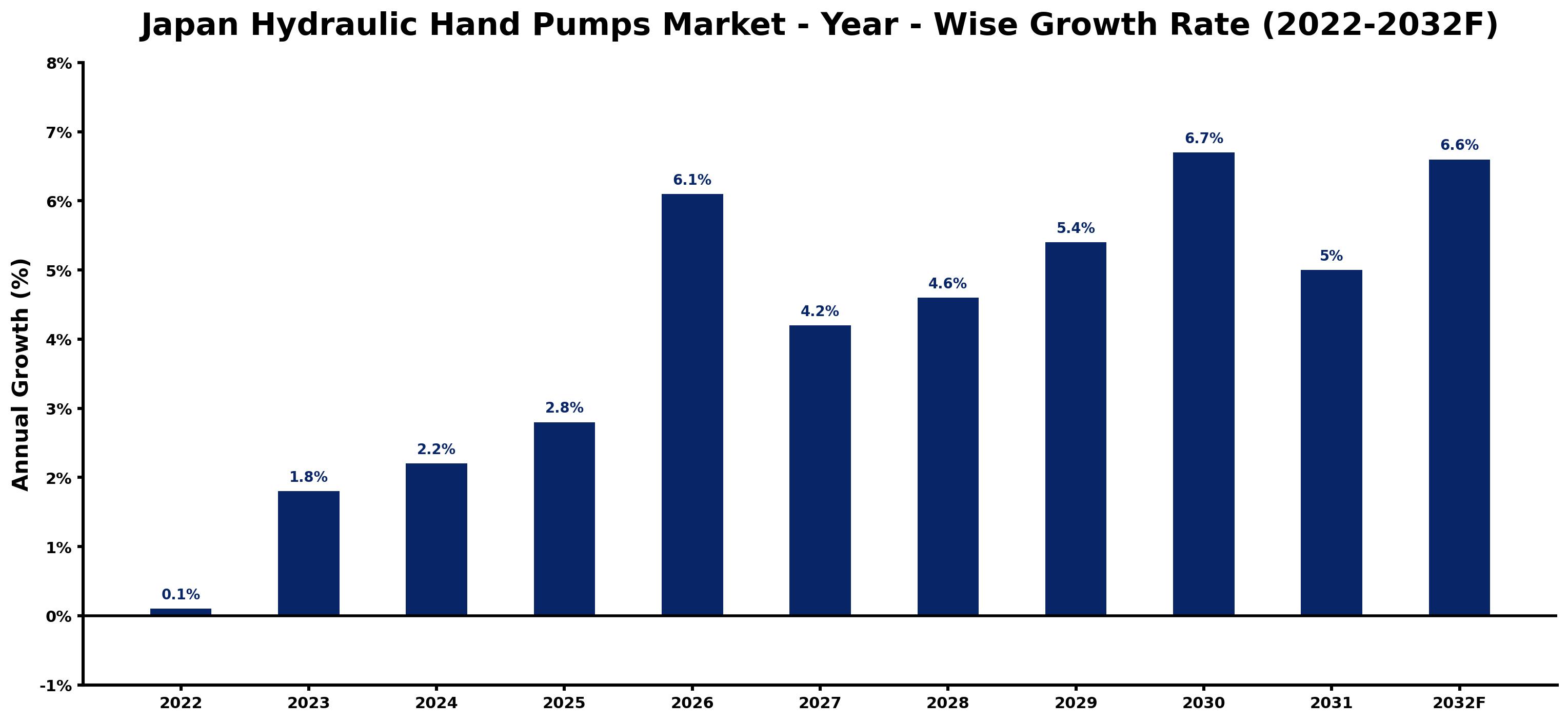
Each row of the following table gives one year's estimated growth and the event or demand shift that explains it.
| Year | Estimated Annual Growth (%) | Market Rationale |
| 2022 | 0.1 | The market showed minimal growth as demand stabilised after previous fluctuations. |
| 2023 | 1.8 | Growth accelerated due to increased construction activity in key regions like Tokyo. |
| 2024 | 2.2 | Continued expansion in the construction sector supported higher demand for hydraulic hand pumps. |
| 2025 | 2.8 | The market reached a historical peak as infrastructure projects gained momentum. |
| 2026 | 6.1 | Growth is expected to surge as investments in hydraulic technologies increase. |
| 2027 | 4.2 | The market will experience a slowdown as growth rates normalise after the peak. |
| 2028 | 4.6 | Demand is projected to increase again as construction projects continue to drive purchases. |
| 2029 | 5.4 | The market will maintain momentum with rising demand from the automotive sector. |
| 2030 | 6.7 | A peak in growth is expected as major infrastructure investments are implemented. |
| 2031 | 5.0 | Growth will slow as the market begins to stabilise after rapid expansions. |
| 2032 | 6.6 | Demand is expected to rise again due to ongoing investments in hydraulic technologies. |
Note: Market size estimations and growth projections presented in this report are based on 6Wresearch's proprietary forecasting methodology, utilizing the latest available industry data, government publications, and primary research inputs.
Japan Hydraulic Hand Pumps Market Synopsis
The Japan Hydraulic Hand Pumps Market is expanding due to increased investments in infrastructure projects, particularly in key regions such as Tokyo and Osaka. The construction industry accounted for approximately 20% of demand in 2023, while the adoption of standards like JIS B 8361 ensures product quality. This combination of factors is attracting further investment in hydraulic technologies and broadening market opportunities.
Market Dynamics Impact Analysis (2026–2032)
| Factor | Type | Impact | Primary Segment Affected |
| Increased construction activity in regions like Tokyo | Driver | High | Lifting |
| Growing automotive sector demand for assembly and maintenance | Driver | High | Pushing and Pulling |
| Expansion of infrastructure projects in urban areas | Opportunity | High | Lifting |
| Rising demand for efficient hydraulic solutions in manufacturing | Opportunity | High | Double Acting |
| Market saturation in certain applications limiting growth | Restraint | Medium | Single Acting |
| High competition among over 1,000 registered manufacturers | Restraint | Medium | Double Acting |
| Rising material costs affecting production | Challenge | High | Single Acting |
| Technological advancements requiring continuous investment | Challenge | High | Pushing and Pulling |
Evaluation of Drivers in Japan Hydraulic Hand Pumps Market (2026–2032)
Key forces behind demand, with the segment each one moves most, are listed below.
| Drivers | Primary Segment Affected | Why It Matters (Evidence) |
| Increased construction projects | Lifting | The construction industry employs hydraulic hand pumps extensively, accounting for approximately 20% of demand. |
| Automotive sector growth | Pushing and Pulling | The automotive sector's use of hydraulic hand pumps for assembly drives higher purchases. |
| Investment in hydraulic technologies | Double Acting | Promoting hydraulic technologies increases demand for advanced solutions. |
| Urban infrastructure development | Lifting | Infrastructure projects in urban areas boost the need for hydraulic lifting solutions. |
| Adoption of JIS B 8361 standards | Single Acting | Compliance with standards improves product reliability, increasing buyer confidence. |
Buyers are adding capacity as the construction industry in Japan employs hydraulic hand pumps extensively, accounting for approximately 20% of demand. In 2023, the automotive sector also drove purchases, with hydraulic hand pumps essential for assembly and maintenance tasks. Urban infrastructure development further boosts demand, as projects in Tokyo and Osaka require reliable lifting solutions. Compliance with JIS B 8361 standards improves product reliability, encouraging buyers to invest in high-quality hydraulic hand pumps. Continuous advancements in hydraulic technologies are expected to enhance product offerings and attract new buyers in various sectors.
Evaluation of Restraints in Japan Hydraulic Hand Pumps Market
The main factors holding the market back are set out below.
| Market Restraint | Primary Segment Affected | Why It Matters (Evidence) |
| Market saturation in lifting applications | Single Acting | The lifting segment faces saturation, limiting growth opportunities for manufacturers. |
| High competition among manufacturers | Double Acting | Over 1,000 registered manufacturers increase competition, affecting pricing strategies. |
| Rising material costs | Single Acting | Increasing costs for steel and aluminum impact production expenses for manufacturers. |
| Technological advancements requiring investment | Pushing and Pulling | Continuous technological advancements necessitate ongoing investments, straining budgets. |
| Limited awareness of hydraulic solutions | Double Acting | Some industries lack awareness of the benefits of hydraulic hand pumps, hindering adoption. |
Japan Hydraulic Hand Pumps Market Challenges
Producers of hydraulic hand pumps in Japan face challenges with compliance to the JIS B 8361 standard, raising production costs by 15% due to necessary adjustments. Buyers in the construction industry encounter project delays as the lengthy approval processes for new hydraulic technologies can extend timelines by several months. Rising material costs, particularly steel, have surged by 10% over the past year, forcing manufacturers to increase prices that strain buyers' budgets. Supply chain disruptions have resulted in a 20% increase in delivery times for components, complicating operations for automotive sector clients reliant on timely assembly.
Trends in the Japan Hydraulic Hand Pumps Market
Buyers and suppliers in the Japan Hydraulic Hand Pumps Market are adjusting to the following trends.
- Shift from Single Acting to Double Acting Pumps: Tokyo is experiencing a shift towards double acting hydraulic hand pumps, reflecting a growing need for more efficient pressure generation. This change is supported by a projected 7.5% CAGR for double acting pumps from 2026 to 2032.
- Increased Focus on Compliance with JIS Standards: Manufacturers in Osaka are prioritising compliance with JIS B 8361 standards, improving product reliability. This trend is clear as over 70% of manufacturers have adopted these standards to meet buyer expectations.
- Growth in Hydraulic Applications in Automotive Sector: The automotive sector is increasingly adopting hydraulic hand pumps for assembly and maintenance tasks, reflecting a notable increase in demand in 2023. This trend supports the need for high-quality hydraulic solutions.
- Expansion of Infrastructure Projects in Urban Areas: Infrastructure projects in urban areas are expanding, particularly in Tokyo, where government funding has increased significantly over the next decade. This investment boosts the demand for hydraulic hand pumps.
Investment Opportunities in the Japan Hydraulic Hand Pumps Market
The opportunities below stand out in the Japan Hydraulic Hand Pumps Market for new entrants and existing suppliers.
- Investment in Urban Infrastructure Projects: Tokyo is experiencing a surge in urban infrastructure projects, with government funding of JPY 150 trillion over 10 years. Suppliers can engage with local contractors to meet the rising demand for hydraulic hand pumps.
- Growing Demand for Double Acting Pumps: The automotive sector's increasing reliance on double acting hydraulic hand pumps presents an opportunity, with a projected growth rate of 7.5%. Manufacturers should focus on developing efficient solutions for this buyer group.
- Expansion of Hydraulic Technologies in Manufacturing: Manufacturers in the construction sector are seeking advanced hydraulic technologies, with a market gap of approximately 20%. Suppliers can enter by partnering with local manufacturers to provide innovative solutions.
- Rising Adoption of JIS Standards: As compliance with JIS standards becomes essential, manufacturers can invest in certification processes to enhance credibility. This trend is particularly relevant for manufacturers targeting the automotive sector.
Government Initiatives in the Japan Hydraulic Hand Pumps Market
The Water Supply Act of 1957 sets standards for drinking-water quality and supply, impacting hydraulic hand pump producers by ensuring compliance with quality regulations. The Industrial Standardization Act, amended in 2019, governs JIS product and test standards, affecting manufacturers' operations and product specifications.
In 2023, the government allocated JPY 150 trillion for public-private decarbonisation investment, administered by the Ministry of Economy, Trade and Industry. This funding supports infrastructure projects that boost hydraulic equipment usage, benefiting both producers and buyers.
Future Insight of the Japan Hydraulic Hand Pumps Market
Government funding for infrastructure projects will drive a shift towards advanced hydraulic technologies, prompting manufacturers to adopt efficient production methods. By 2032, urban areas like Tokyo and Osaka will experience heightened demand for hydraulic hand pumps as construction activities rise. New industry standards will emerge, encouraging suppliers to innovate and improve product quality. Buyers will benefit from enhanced performance and reliability in hydraulic systems, aligning with the growing emphasis on efficiency in both construction and automotive sectors.
Market Segmentation Analysis
Japan Hydraulic Hand Pumps Market report covers a detailed analysis of the following market segments:
By Type – Single Acting Leads, Double Acting Expected to Grow Fastest
According to Ravi Bhandari, Research Head at 6Wresearch, the largest type category in 2025 was Single Acting, at 65% of revenue. Single acting hydraulic hand pumps dominate the market due to their widespread use in lifting tasks across various sectors, particularly in construction. This is highlighted by the construction industry, which accounted for approximately 20% of hydraulic hand pump demand in 2023. Over 2026–2032, Double Acting is expected to post the fastest growth, at a CAGR of 7.5%. Double acting hydraulic hand pumps are experiencing rapid growth as they offer more efficient pressure generation, essential for demanding applications. The government's recent funding for infrastructure projects is likely to accelerate the adoption of double acting pumps further. Suppliers must ensure a robust supply of double acting pumps to meet the rising demand in the market.
By Application – Lifting Leads, Bending Expected to Grow Fastest
Lifting took 49% of application revenue in 2025, more than any other category. Lifting applications dominate the market as they are vital for the construction and manufacturing sectors, where hydraulic hand pumps are essential for handling heavy loads. The prominent use of these pumps in major industrial regions like Tokyo and Osaka highlights their critical role in lifting operations. Bending is set to record the highest CAGR in this split, 7.6% over 2026–2032. Bending applications are experiencing swift growth due to rising demand in metalworking processes that necessitate precise hydraulic pressure. This trend is likely to be reinforced by the growing emphasis on advanced manufacturing techniques within Japan. Buyers in the metalworking industry should explore hydraulic hand pumps specifically designed for bending applications to improve their operational effectiveness.
Key Attractiveness of the Report
- 10 Years of Market Numbers
- Historical Data Starting from 2022 to 2025
- Base Year 2025
- Forecast Data until 2032
- Key Performance Indicators Impacting the Market
- Major Upcoming Developments and Projects
Key Highlights of the Report:
- Japan Hydraulic Hand Pumps Market Outlook
- Market Size of Japan Hydraulic Hand Pumps Market, 2025
- Forecast of Japan Hydraulic Hand Pumps Market, 2032
- Historical Data and Forecast of Japan Hydraulic Hand Pumps Revenues & Volume for the Period 2022-2032
- Japan Hydraulic Hand Pumps Market Trend Evolution
- Japan Hydraulic Hand Pumps Market Drivers and Challenges
- Japan Hydraulic Hand Pumps Price Trends
- Japan Hydraulic Hand Pumps Porter's Five Forces
- Japan Hydraulic Hand Pumps Industry Life Cycle
- Historical Data and Forecast of Japan Hydraulic Hand Pumps Market Revenues & Volume By Type for the Period 2022-2032
- Historical Data and Forecast of Japan Hydraulic Hand Pumps Market Revenues & Volume By Single Acting for the Period 2022-2032
- Historical Data and Forecast of Japan Hydraulic Hand Pumps Market Revenues & Volume By Double Acting for the Period 2022-2032
- Historical Data and Forecast of Japan Hydraulic Hand Pumps Market Revenues & Volume By Application for the Period 2022-2032
- Historical Data and Forecast of Japan Hydraulic Hand Pumps Market Revenues & Volume By Lifting for the Period 2022-2032
- Historical Data and Forecast of Japan Hydraulic Hand Pumps Market Revenues & Volume By Bending for the Period 2022-2032
- Historical Data and Forecast of Japan Hydraulic Hand Pumps Market Revenues & Volume By Pushing and Pulling for the Period 2022-2032
- Historical Data and Forecast of Japan Hydraulic Hand Pumps Market Revenues & Volume By Holding for the Period 2022-2032
- Historical Data and Forecast of Japan Hydraulic Hand Pumps Market Revenues & Volume By Others for the Period 2022-2032
- Japan Hydraulic Hand Pumps Import Export Trade Statistics
- Market Opportunity Assessment By Type
- Market Opportunity Assessment By Application
- Japan Hydraulic Hand Pumps Top Companies Market Share
- Japan Hydraulic Hand Pumps Competitive Benchmarking By Technical and Operational Parameters
- Japan Hydraulic Hand Pumps Company Profiles
- Japan Hydraulic Hand Pumps Key Strategic Recommendations
Market Covered
Segments analysed in this report are listed below.
By Type
- Single Acting
- Double Acting
By Application
- Lifting
- Bending
- Pushing and Pulling
- Holding
- Others































