Japan Hydrocolloids in Dairy Market Size & Growth Rate
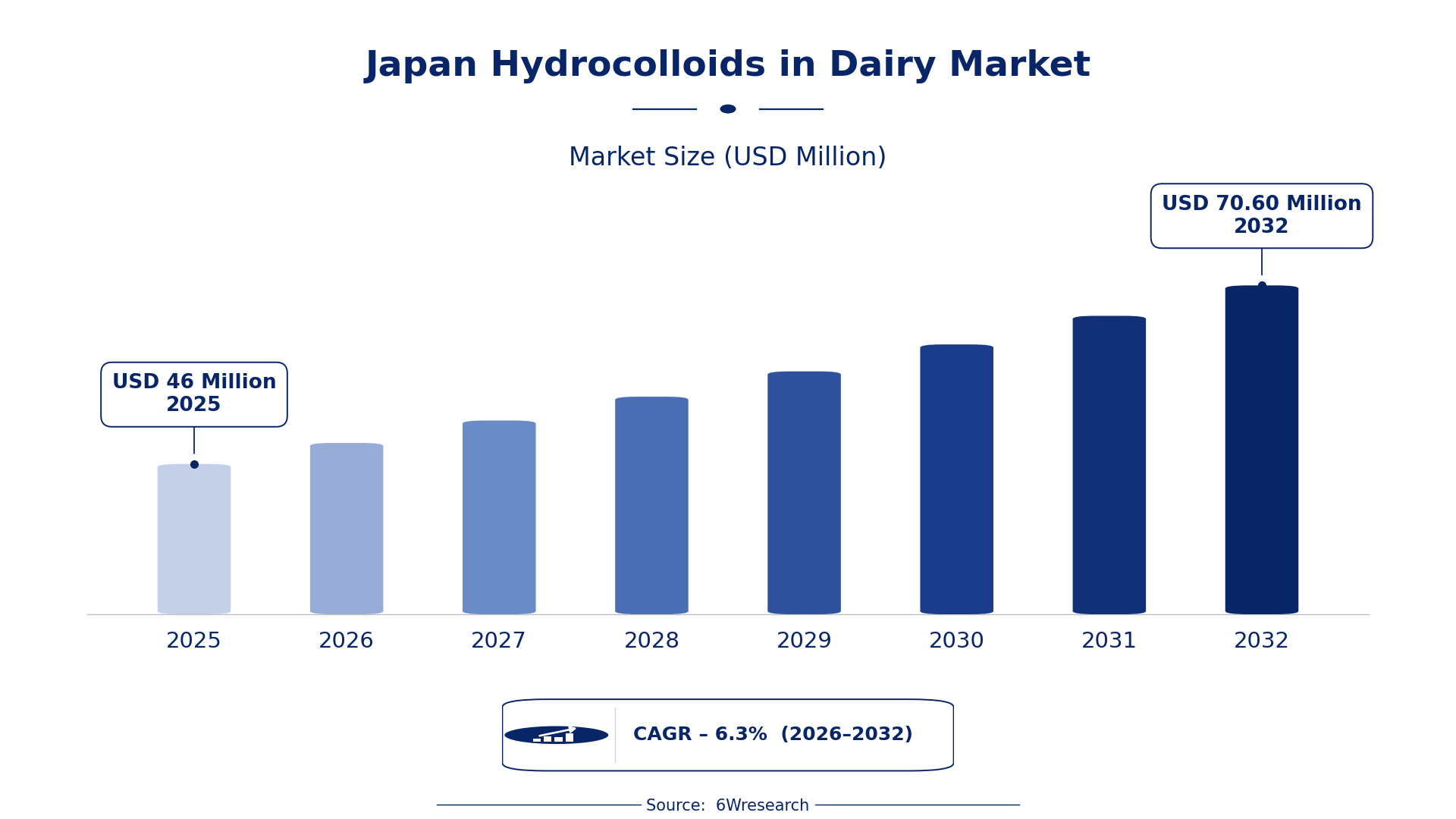
According to 6Wresearch internal database and industry insights, the Japan Hydrocolloids in Dairy Market was valued at USD 46 Million in 2025 and is projected to reach USD 70.60 Million by 2032, growing at a CAGR of approximately 6.3% during 2026–2032.
Japan Hydrocolloids in Dairy Market Highlights
| Report Metric | Details |
| Report Name | Japan Hydrocolloids in Dairy Market (2026-2032) |
| Market Size 2025 | USD 46 Million |
| Market Size 2032 | USD 70.60 Million |
| Absolute Growth 2025–2032 | USD 24.60 Million |
| CAGR 2026–2032 | 6.3% |
| Peak Annual Growth | 7.2% in 2026 |
| Forecast Period | 2026–2032 |
| Historical Data | 2022–2025 |
| Base Year | 2025 |
| Leading Hydrocolloid Type, 2025 | Carrageenan (36% share) |
| Leading Dairy Product, 2025 | Yogurt (34% share) |
| Leading Functionality, 2025 | Stabilizer (52% share) |
| Leading End User, 2025 | Dairy Product Manufacturers (36% share) |
| Fastest-Growing Hydrocolloid Type | Gelatin (8.7% CAGR) |
| Fastest-Growing Dairy Product | Ice Cream (9.1% CAGR) |
| Fastest-Growing Functionality | Emulsifier (8.1% CAGR) |
| Fastest-Growing End User | Yogurt Brands (8.0% CAGR) |
| Growing Sector | Dairy Products |
| Key End Users | Dairy Product Manufacturers, Ice Cream Producers, Yogurt Brands, Processed Cheese Makers |
Japan Hydrocolloids in Dairy Market Year-wise Growth Rate and Key Drivers (2022–2032)
This graph illustrates the annual growth rates of the market from 2022 to 2032, highlighting a steady upward trajectory and projected market expansion over the forecast period.
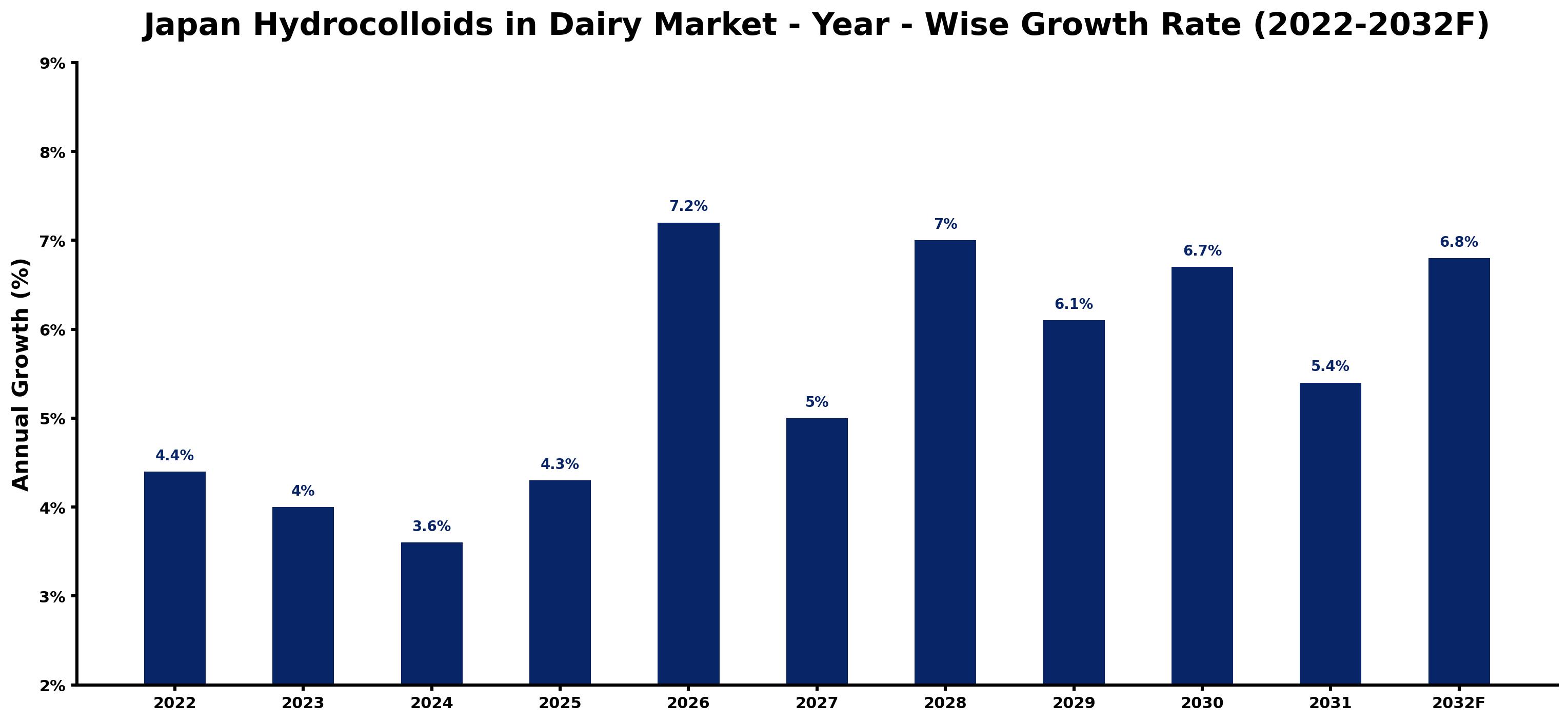
The yearly estimates that follow link every growth rate to its principal driver, so readers can see why the pace changed in each period.
| Year | Estimated Annual Growth (%) | Market Rationale |
| 2022 | 4.4 | The market experienced steady growth, driven by rising dairy consumption in Japan. |
| 2023 | 4.0 | Growth slowed slightly due to market saturation and increased competition among dairy producers. |
| 2024 | 3.6 | The market continued to slow as manufacturers faced challenges in sourcing raw materials. |
| 2025 | 4.3 | Growth accelerated as consumer preferences shifted towards healthier dairy options. |
| 2026 | 7.2 | The market peaked with strong demand for new dairy products and formulations. |
| 2027 | 5.0 | Growth slowed as the market began to stabilise after the peak in 2026. |
| 2028 | 7.0 | Demand increased again, driven by new product launches in the ice cream segment. |
| 2029 | 6.1 | The market experienced a slowdown as competition intensified among dairy brands. |
| 2030 | 6.7 | Growth is expected to resume as technological advancements improve production efficiency. |
| 2031 | 5.4 | The market is projected to slow again as manufacturers adjust to changing consumer preferences. |
| 2032 | 6.8 | Growth is anticipated to pick up as dairy consumption is projected to rise with new health trends. |
Note: Market size estimations and growth projections presented in this report are based on 6Wresearch's proprietary forecasting methodology, utilizing the latest available industry data, government publications, and primary research inputs.
Japan Hydrocolloids in Dairy Market Synopsis
Hydrocolloids in dairy are natural polysaccharides used primarily as thickening and stabilizing agents, improving the texture and shelf-life of products such as yogurt and ice cream. Growth in the Japan Hydrocolloids in Dairy Market is driven by rising domestic consumption, which reached 8.5 million tons in 2022, and increasing demand from dairy product manufacturers. Key factors include advancements in dairy processing technology and a focus on product innovation, particularly in regions like Hokkaido, renowned for its dairy production.
Market Dynamics Impact Analysis (2026–2032)
| Factor | Type | Impact | Primary Segment Affected |
| Rising dairy consumption in Japan is driving demand for hydrocolloids, particularly in yogurt and ice cream production. | Driver | High | Yogurt |
| Technological advancements in dairy processing enable manufacturers to create innovative products, increasing the use of hydrocolloids. | Driver | High | Ice Cream |
| The growing trend towards health-conscious eating is creating opportunities for new dairy products that utilise hydrocolloids for improved texture. | Opportunity | High | Flavored Milk |
| Investment in dairy technology is rising, providing opportunities for suppliers of hydrocolloids to expand their market reach. | Opportunity | High | Dairy Product Manufacturers |
| High competition among dairy producers can limit profit margins for hydrocolloid suppliers, affecting their pricing strategies. | Restraint | Medium | Dairy Product Manufacturers |
| Sourcing of raw materials for hydrocolloids can be inconsistent, impacting supply chains for dairy manufacturers. | Restraint | Medium | Ice Cream Producers |
| Buyers face challenges in meeting stringent food safety standards, which can delay product launches. | Challenge | High | Yogurt Brands |
| Suppliers may struggle with fluctuating prices of hydrocolloids, affecting their cost structures and competitiveness. | Challenge | Medium | Processed Cheese Makers |
Evaluation of Drivers in Japan Hydrocolloids in Dairy Market (2026–2032)
Key forces behind demand, with the segment each one moves most, are listed below.
| Drivers | Primary Segment Affected | Why It Matters (Evidence) |
| Increased dairy consumption drives demand for hydrocolloids in yogurt production, with consumption reaching 8.5 million tons in 2022. | Yogurt | This trend leads manufacturers to improve product texture and stability. |
| Technological advancements in dairy processing boost the adoption of hydrocolloids, particularly in ice cream production. | Ice Cream | This results in better product quality and consumer satisfaction. |
| Health-conscious consumers are seeking dairy products with improved nutritional profiles, increasing the use of hydrocolloids. | Flavored Milk | Manufacturers are responding by reformulating products to meet these demands. |
| Investment in dairy technology has risen by 20% in the last three years, supporting hydrocolloid usage. | Dairy Product Manufacturers | This improves production capabilities and product innovation. |
| The Japanese Dairy Association promotes hydrocolloids for product innovation, driving their use in new dairy applications. | Gelatin | This encourages manufacturers to explore diverse formulations. |
The strongest pull on demand comes from rising dairy consumption, which reached 8.5 million tons in 2022, prompting manufacturers to improve product quality. Investment in dairy technology has increased by 20% over the past three years, enabling better hydrocolloid applications. Consumers are increasingly seeking dairy products with enhanced nutritional profiles, prompting manufacturers to reformulate offerings. The promotion of hydrocolloids for innovation encourages diverse product development, particularly in yogurt and ice cream, where texture and stability are critical.
Evaluation of Restraints in Japan Hydrocolloids in Dairy Market
Below are the constraints most often cited by buyers and suppliers, with the segment each affects.
| Market Restraint | Primary Segment Affected | Why It Matters (Evidence) |
| High competition among dairy producers limits profit margins for hydrocolloid suppliers, affecting pricing strategies. | Dairy Product Manufacturers | This pressure can lead to reduced investment in quality hydrocolloids. |
| Inconsistent sourcing of raw materials for hydrocolloids impacts supply chains for dairy manufacturers. | Ice Cream Producers | This can result in production delays and increased costs. |
| Stringent food safety standards require rigorous testing, delaying product launches for buyers. | Yogurt Brands | Compliance can be time-consuming and costly. |
| Fluctuating prices of hydrocolloids create uncertainty in cost structures for suppliers. | Processed Cheese Makers | This can affect competitiveness and profit margins. |
| Limited awareness of hydrocolloid benefits among some dairy producers restricts market growth. | Dairy Product Manufacturers | This results in underutilisation of available technologies. |
Japan Hydrocolloids in Dairy Market Challenges
Japan's dairy processing sector employed over 50,000 individuals in 2022, yet skills shortages hinder growth and innovation for producers. High production costs, driven by expensive raw materials, inflate prices for domestic manufacturers, reducing their competitiveness against imports. Regulatory compliance with ISO 22000 and JIS Z 2801 standards can delay product launches and increase expenses for suppliers. Competition from imported dairy products, often cheaper due to lower production costs abroad, pressures local suppliers to lower prices, ultimately squeezing their profit margins.
Trends in the Japan Hydrocolloids in Dairy Market
The following changes are redrawing the Japan Hydrocolloids in Dairy Market.
- Shift towards Healthier Dairy Products: In 2023, the Japanese government launched a programme to promote dairy consumption among youth, aiming to improve nutritional awareness. This initiative is expected to boost demand for healthier dairy options, leading to greater use of hydrocolloids for texture and stability.
- Transition from Traditional to New Dairy Products: Since 2022, there has been a noticeable shift in consumer preferences towards new dairy products. This trend is reflected in the production of flavoured milk, which now accounts for 15% of total dairy product sales in Japan, driving demand for hydrocolloids.
- Emergence of Plant-Based Dairy Alternatives: In 2023, the rise of plant-based dairy alternatives is reshaping the market. This shift is prompting traditional dairy producers to explore hydrocolloid applications to enhance the texture of these new products.
- Increased Focus on Sustainable Dairy Practices: With the GX Basic Policy adopted in 2023, there is a growing emphasis on sustainability in the dairy sector. This policy aims for JPY 150 trillion in public-private decarbonisation investment, encouraging dairy producers to adopt hydrocolloids that support sustainable practices.
Investment Opportunities in the Japan Hydrocolloids in Dairy Market
The openings below show where demand in the Japan Hydrocolloids in Dairy Market is visible and how suppliers can enter.
- Investment in Hydrocolloid Production: With investment in dairy technology rising, there is an opportunity to supply high-quality hydrocolloids to dairy product manufacturers. This is particularly relevant in regions like Hokkaido, known for its dairy production, where demand for new products is increasing.
- Expansion of Ice Cream Offerings: The growing popularity of ice cream, projected to increase significantly, presents a chance to supply hydrocolloids that improve texture. Ice cream producers are actively seeking new formulations to meet consumer preferences.
- Development of Health-Conscious Dairy Products: The current trend towards health-conscious eating creates an opportunity to supply hydrocolloids that enhance the nutritional profile of flavoured milk. Dairy product manufacturers are looking to innovate and meet these consumer demands.
- Collaboration with Dairy Associations: Engaging with the Japanese Dairy Association can facilitate entry into the market for hydrocolloids. This partnership can help suppliers align with industry trends and standards, improving market reach.
Government Initiatives in the Japan Hydrocolloids in Dairy Market
The Food Sanitation Act amendment, fully applied in June 2021, mandates HACCP-based hygiene management for food businesses, including dairy producers. This law ensures that hydrocolloids used in dairy products meet stringent safety standards, promoting consumer confidence in the market. Additionally, the Act against Unjustifiable Premiums and Misleading Representations prohibits misleading labelling, ensuring that consumers receive accurate information about dairy products.
The Consumer Affairs Agency oversees funding and support for the dairy industry, with ¥500 million allocated in 2023 to improve production capabilities. This funding supports initiatives that promote the use of hydrocolloids in dairy applications, aiding manufacturers in meeting consumer demands for quality and innovation.
Future Insight of the Japan Hydrocolloids in Dairy Market
Youth will drive changes in dairy consumption, with targeted programmes expected to increase demand for products by 2032. Investment in dairy technology has risen by 20% over the last three years, indicating a trend towards improved production efficiency. The Ministry of Agriculture, Forestry and Fisheries' support will strengthen local supply chains. As the Japanese Dairy Association promotes hydrocolloids, suppliers can explore new applications, allowing them to diversify and enhance their product offerings.
Market Segmentation Analysis
Japan Hydrocolloids in Dairy Market report covers a detailed analysis of the following market segments:
By Hydrocolloid Type – Carrageenan Leads, Gelatin Expected to Grow Fastest
According to Saurav Kr Singh, Senior Research Analyst at 6Wresearch, in 2025, Carrageenan led the hydrocolloid type split with a 36% share. Carrageenan holds the largest share as it is widely utilised as a stabiliser in dairy products, ensuring the desired texture and consistency. Its critical application in various dairy items, such as yogurt, illustrates its importance in maintaining product quality. Over 2026–2032, Gelatin is expected to post the fastest growth, at a CAGR of 8.7%. Gelatin is experiencing rapid growth due to its increasing incorporation into yogurt and desserts, appealing to consumers seeking enhanced texture. The rising trend for innovative dairy desserts is propelling this segment forward, indicating a shift in consumer preferences. Suppliers should focus on increasing the availability of gelatin to meet the growing demand in the dairy sector.
By Dairy Product – Yogurt Leads, Ice Cream Expected to Grow Fastest
With 34% of dairy product revenue in 2025, Yogurt was the largest category. Yogurt dominates the market as it is a staple dairy product in Japan, with production levels reaching 1.4 million tons in 2022. This high production volume underscores its significance in the dairy industry and its broad acceptance among consumers. The quickest growth will come from Ice Cream, forecast to expand at a CAGR of 9.1% between 2026 and 2032. Ice cream is witnessing the fastest growth, driven by a notable increase in production, reflecting a broader trend towards indulgent dairy products. This growth indicates shifting consumer preferences towards creamier and textured treats, suggesting a lucrative opportunity for suppliers. Manufacturers should consider expanding their ice cream offerings to capitalise on the increasing consumer interest in this segment.
By Functionality – Stabilizer Leads, Emulsifier Expected to Grow Fastest
Stabilizer took 52% of functionality revenue in 2025, more than any other category. Stabilizers are essential in the dairy industry, preventing separation and ensuring product quality, which establishes them as the most widely used functionality. Their fundamental role in maintaining the integrity of various dairy products solidifies their leading position in the market. Emulsifier is projected to grow fastest, at a CAGR of 8.1% during 2026–2032. Emulsifiers are rapidly gaining traction as they improve the blending of ingredients, particularly in new product formulations. The increasing focus on product innovation in the dairy sector is driving this growth, suggesting a need for suppliers to adapt. Suppliers must invest in emulsifier technologies to support manufacturers seeking to innovate their dairy offerings.
By End User – Dairy Product Manufacturers Lead, Yogurt Brands Expected to Grow Fastest
Dairy Product Manufacturers accounted for 36% of the market by end user in 2025. Dairy product manufacturers are the primary users of hydrocolloids, utilising them to ensure product stability and quality across a diverse range of dairy items. Their significant role in the production process reinforces their leading position in the market. Yogurt Brands are set to record the highest CAGR in this split, 8.0% over 2026–2032. Yogurt brands are experiencing the fastest growth as they increasingly depend on hydrocolloids for product stabilization and texture enhancement. The rising popularity of yogurt products is fuelling this demand, indicating a shift in market dynamics. Suppliers should tailor their offerings to meet the specific needs of yogurt brands to capture this expanding market segment.
Key Attractiveness of the Report
- 10 Years of Market Numbers
- Historical Data Starting from 2022 to 2025
- Base Year 2025
- Forecast Data until 2032
- Key Performance Indicators Impacting the Market
- Major Upcoming Developments and Projects
Key Highlights of the Report:
- Japan Hydrocolloids in Dairy Market Outlook
- Market Size of Japan Hydrocolloids in Dairy Market, 2025
- Forecast of Japan Hydrocolloids in Dairy Market, 2032
- Historical Data and Forecast of Japan Hydrocolloids in Dairy Revenues & Volume for the Period 2022-2032F
- Japan Hydrocolloids in Dairy Market Trend Evolution
- Japan Hydrocolloids in Dairy Market Drivers and Challenges
- Japan Hydrocolloids in Dairy Price Trends
- Japan Hydrocolloids in Dairy Porter's Five Forces
- Japan Hydrocolloids in Dairy Industry Life Cycle
- Historical Data and Forecast of Japan Hydrocolloids in Dairy Market Revenues & Volume By Hydrocolloid Type for the Period 2022-2032F
- Historical Data and Forecast of Japan Hydrocolloids in Dairy Market Revenues & Volume By Carrageenan for the Period 2022-2032F
- Historical Data and Forecast of Japan Hydrocolloids in Dairy Market Revenues & Volume By Guar Gum for the Period 2022-2032F
- Historical Data and Forecast of Japan Hydrocolloids in Dairy Market Revenues & Volume By Gelatin for the Period 2022-2032F
- Historical Data and Forecast of Japan Hydrocolloids in Dairy Market Revenues & Volume By Xanthan Gum for the Period 2022-2032F
- Historical Data and Forecast of Japan Hydrocolloids in Dairy Market Revenues & Volume By Dairy Product for the Period 2022-2032F
- Historical Data and Forecast of Japan Hydrocolloids in Dairy Market Revenues & Volume By Flavored Milk for the Period 2022-2032F
- Historical Data and Forecast of Japan Hydrocolloids in Dairy Market Revenues & Volume By Ice Cream for the Period 2022-2032F
- Historical Data and Forecast of Japan Hydrocolloids in Dairy Market Revenues & Volume By Yogurt for the Period 2022-2032F
- Historical Data and Forecast of Japan Hydrocolloids in Dairy Market Revenues & Volume By Cheese Spreads for the Period 2022-2032F
- Historical Data and Forecast of Japan Hydrocolloids in Dairy Market Revenues & Volume By Functionality for the Period 2022-2032F
- Historical Data and Forecast of Japan Hydrocolloids in Dairy Market Revenues & Volume By Stabilizer for the Period 2022-2032F
- Historical Data and Forecast of Japan Hydrocolloids in Dairy Market Revenues & Volume By Thickener for the Period 2022-2032F
- Historical Data and Forecast of Japan Hydrocolloids in Dairy Market Revenues & Volume By Texture Enhancer for the Period 2022-2032F
- Historical Data and Forecast of Japan Hydrocolloids in Dairy Market Revenues & Volume By Emulsifier for the Period 2022-2032F
- Historical Data and Forecast of Japan Hydrocolloids in Dairy Market Revenues & Volume By End User for the Period 2022-2032F
- Historical Data and Forecast of Japan Hydrocolloids in Dairy Market Revenues & Volume By Dairy Product Manufacturers for the Period 2022-2032F
- Historical Data and Forecast of Japan Hydrocolloids in Dairy Market Revenues & Volume By Ice Cream Producers for the Period 2022-2032F
- Historical Data and Forecast of Japan Hydrocolloids in Dairy Market Revenues & Volume By Yogurt Brands for the Period 2022-2032F
- Historical Data and Forecast of Japan Hydrocolloids in Dairy Market Revenues & Volume By Processed Cheese Makers for the Period 2022-2032F
- Japan Hydrocolloids in Dairy Import Export Trade Statistics
- Market Opportunity Assessment By Hydrocolloid Type
- Market Opportunity Assessment By Dairy Product
- Market Opportunity Assessment By Functionality
- Market Opportunity Assessment By End User
- Japan Hydrocolloids in Dairy Top Companies Market Share
- Japan Hydrocolloids in Dairy Competitive Benchmarking By Technical and Operational Parameters
- Japan Hydrocolloids in Dairy Company Profiles
- Japan Hydrocolloids in Dairy Key Strategic Recommendations
Market Covered
The following segment groups are covered in the report.
By Hydrocolloid Type
- Carrageenan
- Guar Gum
- Gelatin
- Xanthan Gum
By Dairy Product
- Flavored Milk
- Ice Cream
- Yogurt
- Cheese Spreads
By Functionality
- Stabilizer
- Thickener
- Texture Enhancer
- Emulsifier
By End User
- Dairy Product Manufacturers
- Ice Cream Producers
- Yogurt Brands
- Processed Cheese Makers































