Japan Hydrodynamic Oil System Market Size & Growth Rate
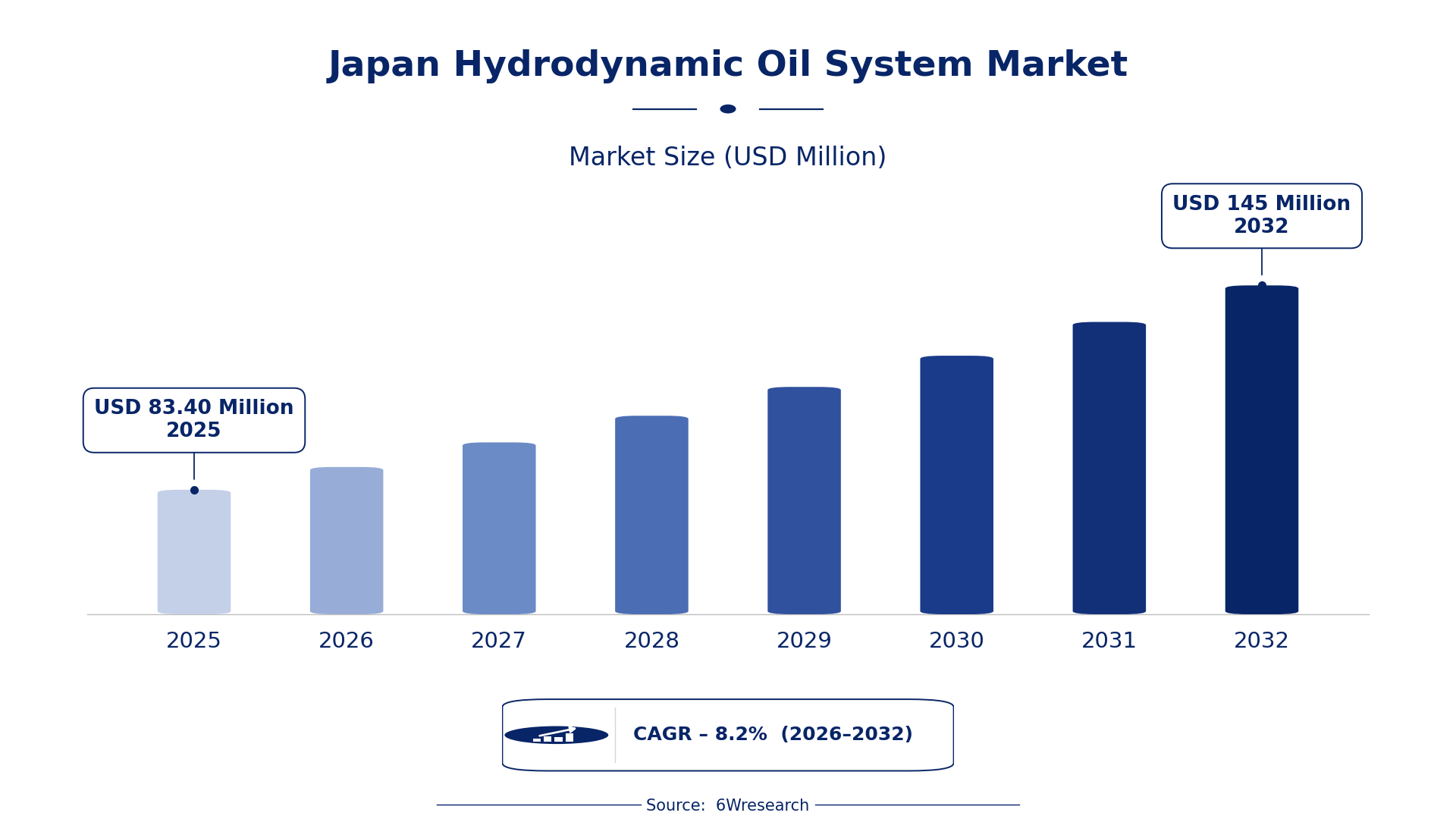
According to 6Wresearch internal database and industry insights, the Japan Hydrodynamic Oil System Market was valued at USD 83.40 Million in 2025 and is projected to reach USD 145 Million by 2032, growing at a CAGR of approximately 8.2% during 2026–2032.
Japan Hydrodynamic Oil System Market Highlights
| Report Metric | Details |
| Report Name | Japan Hydrodynamic Oil System Market (2026-2032) |
| Market Size 2025 | USD 83.40 Million |
| Market Size 2032 | USD 145 Million |
| Absolute Growth 2025–2032 | USD 61.60 Million |
| CAGR 2026–2032 | 8.2% |
| Peak Annual Growth | 8.9% in 2026 |
| Forecast Period | 2026–2032 |
| Historical Data | 2022–2025 |
| Base Year | 2025 |
| Leading System Type, 2025 | Circulating Oil Systems (50% share) |
| Leading Application Area, 2025 | Turbines (43% share) |
| Leading Fluid Type, 2025 | Mineral Oil (37% share) |
| Leading End User, 2025 | Power Plants (44% share) |
| Fastest-Growing System Type | Lubrication Systems (11.3% CAGR) |
| Fastest-Growing Application Area | Compressors & Gearboxes (9.9% CAGR) |
| Fastest-Growing Fluid Type | Synthetic Oil (11.9% CAGR) |
| Fastest-Growing End User | Oil & Gas Operators (10.6% CAGR) |
| Growing Sector | Power Generation |
| Key End Users | Oil & Gas Operators, Power Plants, Industrial Facilities, Shipping Industry |
Japan Hydrodynamic Oil System Market Year-wise Growth Rate and Key Drivers (2022–2032)
This graph illustrates the annual growth rates of the market from 2022 to 2032, highlighting a steady upward trajectory and projected market expansion over the forecast period.
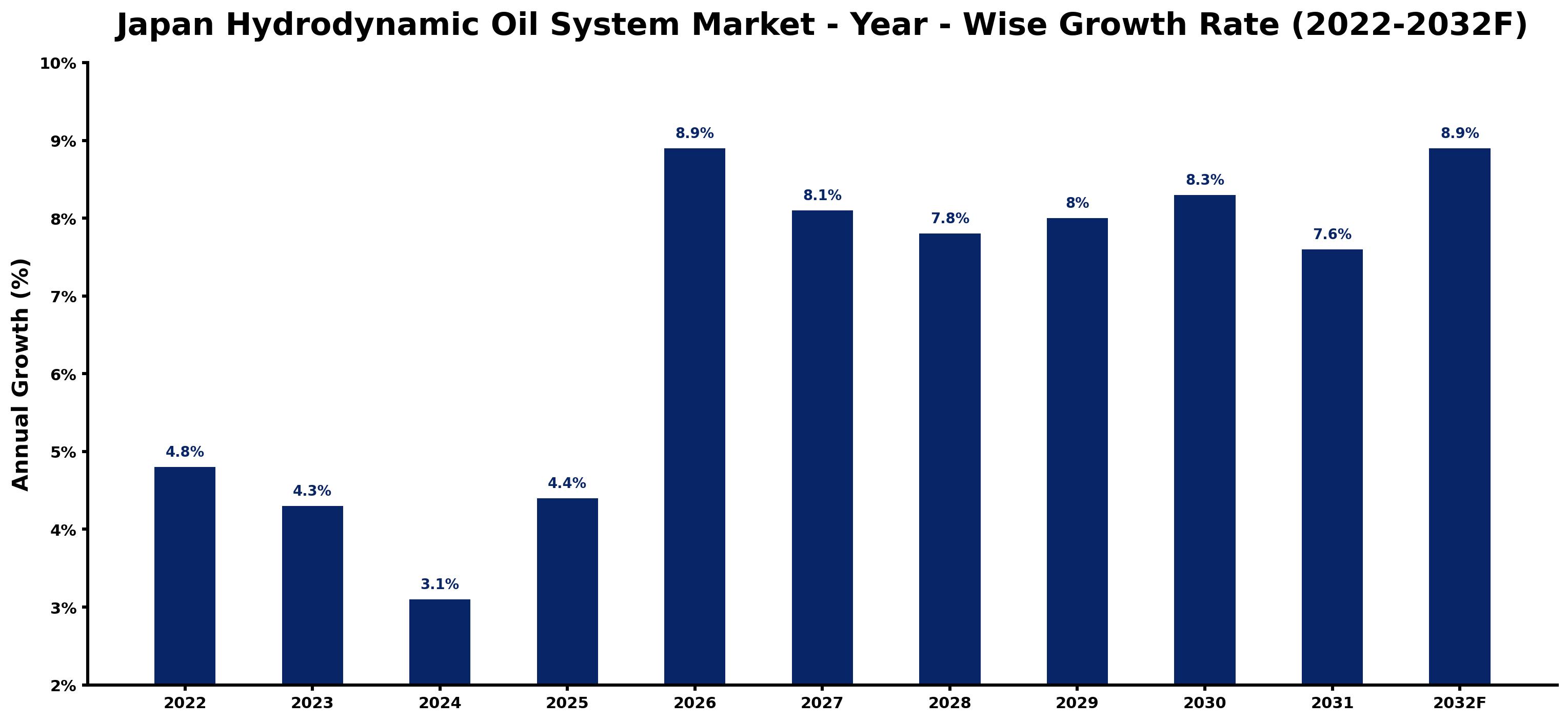
Below, each year's estimated growth is shown next to the factor that most influenced it.
| Year | Estimated Annual Growth (%) | Market Rationale |
| 2022 | 4.8 | The market showed strong activity with reliance on hydrodynamic systems in various sectors. |
| 2023 | 4.3 | Growth slowed due to market saturation in some industrial applications and rising competition. |
| 2024 | 3.1 | The market continued to grow, but at a reduced pace as demand stabilised in established sectors. |
| 2025 | 4.4 | Demand increased as industrial facilities sought efficiency improvements and upgraded their systems. |
| 2026 | 8.9 | The peak growth year is expected to reflect heightened investment in energy efficiency and advanced lubrication technologies. |
| 2027 | 8.1 | Growth is projected to slow slightly as the market adjusts to new operational standards and technologies. |
| 2028 | 7.8 | The market is expected to maintain a steady pace as industries continue to adopt hydrodynamic systems. |
| 2029 | 8.0 | Demand will rise again as power plants expand capacity and seek reliable lubrication solutions. |
| 2030 | 8.3 | Growth is projected to continue as synthetic oils gain popularity among industrial users for their performance benefits. |
| 2031 | 7.6 | The market will experience a slight slowdown as competition intensifies among lubricant suppliers. |
| 2032 | 8.9 | Demand is expected to surge again as industries embrace advanced lubrication technologies and sustainability practices. |
Note: Market size estimations and growth projections presented in this report are based on 6Wresearch's proprietary forecasting methodology, utilizing the latest available industry data, government publications, and primary research inputs.
Japan Hydrodynamic Oil System Market Synopsis
Hydrodynamic oil systems serve as critical lubrication and cooling mechanisms that improve machinery performance and extend longevity. In Japan, the oil and gas industry, along with power generation, fuels demand for these systems, primarily from domestic users and industrial facilities. The Japan Hydrodynamic Oil System Market is expanding due to investments in energy efficiency, with the country aiming for a 46% reduction in greenhouse gas emissions by 2030, prompting upgrades in lubrication technologies across various sectors, including power plants and industrial facilities.
Market Dynamics Impact Analysis (2026–2032)
| Factor | Type | Impact | Primary Segment Affected |
| Increased investment in energy efficiency initiatives | Driver | High | Lubrication Systems |
| Growing adoption of synthetic oils for high-performance applications | Driver | High | Synthetic Oil |
| Rising demand for efficient cooling systems in industrial applications | Opportunity | High | Cooling Oil Systems |
| Expansion of power generation capacity in urban areas | Opportunity | Medium | Power Plants |
| Regulatory compliance costs for lubricant quality standards | Restraint | High | Mineral Oil |
| Market saturation in established sectors leading to slower growth | Restraint | Medium | Circulating Oil Systems |
| High costs associated with advanced lubrication technologies | Challenge | High | Hydraulic Equipment |
| Capacity constraints in production facilities for high-quality lubricants | Challenge | Medium | Compressors & Gearboxes |
Evaluation of Drivers in Japan Hydrodynamic Oil System Market (2026–2032)
The factors lifting demand, and the evidence behind each, are summarised below.
| Drivers | Primary Segment Affected | Why It Matters (Evidence) |
| Investment in energy efficiency upgrades | Lubrication Systems | This drives demand as industries seek to reduce operational costs and emissions, with Japan targeting a 46% cut in greenhouse gases by 2030. |
| Increased use of synthetic oils | Synthetic Oil | Adoption is rising due to their superior performance, with over 30% market share in industrial applications. |
| Expansion of power generation facilities | Power Plants | This leads to higher demand for hydrodynamic systems, supported by Japan's 1,000 GW power generation capacity. |
| Focus on reducing friction in machinery | Circulating Oil Systems | This is essential for operational efficiency, with the industrial sector producing around 1.2 million tons of lubricants in 2022. |
| Growing shipping industry requirements | Marine Engines | With over 1,000 vessels, the need for advanced lubrication systems is critical for performance and reliability. |
Much of the new demand traces back to investments in energy efficiency and technological advancements. The oil and gas sector employs over 150,000 people, many of whom rely on hydrodynamic systems for operational longevity. In 2022, Japan's industrial sector produced approximately 1.2 million tons of lubricants, reflecting a strong market presence. The Tokyo metropolitan area is a hub for power plants, further driving demand for efficient lubrication solutions. The installed base of hydraulic equipment in Japan exceeds 500,000 units, necessitating more efficient hydrodynamic systems as industries seek to optimise performance.
Evaluation of Restraints in Japan Hydrodynamic Oil System Market
These restraints slow adoption and weigh on supplier margins.
| Market Restraint | Primary Segment Affected | Why It Matters (Evidence) |
| Regulatory compliance costs for lubricant quality standards | Mineral Oil | Compliance with the JIS K 2211 standard increases operational costs for producers and buyers. |
| Market saturation in established sectors | Circulating Oil Systems | This leads to slower growth rates as competition intensifies among suppliers. |
| High costs associated with advanced lubrication technologies | Hydraulic Equipment | Investments in new technologies can deter smaller operators from upgrading their systems. |
| Limited availability of high-quality raw materials | Synthetic Oil | This can restrict production capabilities and increase prices for end-users. |
| Inconsistent demand from the shipping industry | Marine Engines | Fluctuations in global trade impact the need for advanced lubrication systems. |
Japan Hydrodynamic Oil System Market Challenges
Synthetic oils now command over 30% market share in industrial applications, raising operational costs for buyers who depend on these products for machinery efficiency. Strict adherence to the JIS K 2211 standard complicates supply for importers, leading to delays that can extend lead times by up to three months. Producers face heightened competition as Japan pursues a 46% reduction in greenhouse gas emissions by 2030, potentially inflating prices for end users. Technological advancements in hydrodynamic systems require continuous investment, which can strain budgets for oil and gas sector facilities needing reliable solutions.
Trends in the Japan Hydrodynamic Oil System Market
Below are the shifts with the largest effect on the Japan Hydrodynamic Oil System Market.
- Shift towards Synthetic Oils in Industrial Applications: The adoption of synthetic oils is increasing in Japan, with a market share of over 30% in industrial applications. This shift is driven by the need for improved performance and longevity in machinery.
- Transition to Energy-Efficient Power Generation: Power plants in the Tokyo metropolitan area are increasingly investing in hydrodynamic systems to improve operational efficiency. This trend aligns with Japan's goal of a 46% reduction in greenhouse gas emissions by 2030.
- Emergence of Bio-Oils in Sustainable Practices: Bio-oils are gaining traction as part of Japan's sustainability efforts. This shift is supported by government initiatives promoting environmentally friendly lubricants.
- Focus on Advanced Lubrication Technologies in Shipping: The shipping industry is prioritising advanced lubrication systems to improve marine engine performance. With over 1,000 vessels in Japan, this trend is critical for maintaining operational reliability.
Investment Opportunities in the Japan Hydrodynamic Oil System Market
The following areas offer the clearest openings for investors and suppliers in the Japan Hydrodynamic Oil System Market.
- Investment in Power Generation Facilities: The Tokyo metropolitan area presents opportunities for investment in power generation facilities, with a capacity of approximately 1,000 GW. This sector is projected to grow as demand for efficient lubrication systems rises.
- Expansion of Industrial Facilities: Industrial facilities across Japan are seeking advanced lubrication solutions, creating a demand gap of approximately 1.2 million tons of lubricants. Collaborating with local manufacturers can facilitate market entry.
- Partnerships in the Shipping Industry: The shipping industry requires advanced lubrication systems for over 1,000 vessels. Forming joint ventures with local suppliers can help meet this growing demand.
- Funding for Energy Efficiency Improvements: In 2023, the government allocated funds to improve energy efficiency in industrial sectors, including lubrication systems. This creates opportunities for suppliers to align with government initiatives.
Government Initiatives in the Japan Hydrodynamic Oil System Market
The Waste Management and Public Cleansing Act of 1970 governs the treatment and disposal of industrial waste, impacting producers of hydrodynamic systems. Compliance with this law ensures that manufacturers adhere to environmental standards, promoting sustainable practices in the industry. The Industrial Standardization Act, amended in 2019, governs the JIS product and test standards, ensuring that lubricants meet quality requirements for safety and performance.
Buyers in the oil and gas sector benefit from the GX Basic Policy adopted in 2023, which aims for about JPY 150 trillion of public-private decarbonisation investment over ten years. This funding supports the adoption of advanced lubrication technologies, enabling companies to improve operational efficiency and reduce emissions.
Future Insight of the Japan Hydrodynamic Oil System Market
The investment pipeline for energy efficiency initiatives will propel demand for advanced hydrodynamic oil systems by 2032. Government allocations for enhancing industrial lubrication technologies will stimulate innovation among suppliers. The installed base of hydraulic equipment, estimated at over 500,000 units, will require upgrades to meet evolving efficiency standards. As Japan's shipping industry grows, the demand for high-performance lubrication solutions will open new opportunities for suppliers to introduce cutting-edge products.
Market Segmentation Analysis
Japan Hydrodynamic Oil System Market report covers a detailed analysis of the following market segments:
By System Type – Circulating Oil Systems Lead, Lubrication Systems Expected to Grow Fastest
According to Saurav Kr Singh, Senior Research Analyst at 6Wresearch, Circulating Oil Systems held 50% of the Japan Hydrodynamic Oil System Market by system type in 2025. Circulating oil systems hold the largest market share because they are essential for continuous lubrication in machinery. Their widespread application in Japan's power generation sector, which has a capacity of approximately 1,000 GW, underscores their critical importance. Over 2026–2032, Lubrication Systems are expected to post the fastest growth, at a CAGR of 11.3%. Lubrication systems are rapidly growing due to their vital role in reducing wear and tear on moving parts across various applications. The emphasis on energy efficiency in industrial operations, as promoted by the Ministry of Economy, Trade and Industry, is a key factor driving this segment's growth. Suppliers should prioritise the development of advanced lubrication systems to meet the rising demands of industrial users.
By Application Area – Turbines Lead, Compressors & Gearboxes Expected to Grow Fastest
Turbines took 43% of application area revenue in 2025, more than any other category. Turbines dominate the market as they are key components in energy generation, directly impacting overall efficiency. Their significant role in Japan's power generation framework makes them a primary focus for hydrodynamic oil systems. The quickest growth will come from Compressors & Gearboxes, forecast to expand at a CAGR of 9.9% between 2026 and 2032. Compressors and gearboxes are experiencing the fastest growth due to their crucial function in maintaining operational reliability across various industries. The increasing emphasis on optimising machinery performance is propelling demand for these applications. Buyers in the industrial sector ought to invest in advanced lubrication solutions for compressors and gearboxes to enhance equipment reliability.
By Fluid Type – Mineral Oil Leads, Synthetic Oil Expected to Grow Fastest
The largest fluid type category in 2025 was Mineral Oil, at 37% of revenue. Mineral oil is the predominant fluid type, widely used for its availability and cost-effectiveness across various applications. This extensive adoption is particularly noticeable in sectors such as power generation and manufacturing. Synthetic Oil is projected to grow fastest, at a CAGR of 11.9% during 2026–2032. Synthetic oil is rapidly gaining traction as it is favoured for high-performance applications that demand superior lubrication properties. The transition towards synthetic oils is being propelled by the need for improved efficiency and reduced environmental impact in industrial operations. Suppliers should prioritise the promotion of synthetic oil solutions to address the growing demand for high-performance lubricants.
By End User – Power Plants Lead, Oil & Gas Operators Expected to Grow Fastest
Power Plants accounted for 44% of the market by end user in 2025. Power plants represent the largest end user group, being major consumers of hydrodynamic systems that are essential for improving operational efficiency. Their extensive energy generation activities require reliable lubrication solutions to maximise performance. Oil & Gas Operators are set to record the highest CAGR in this split, 10.6% over 2026–2032. Oil and gas operators are seeing the fastest growth as they depend on hydrodynamic systems for operational efficiency and equipment longevity. The ongoing advancements in the oil and gas sector in Japan are significantly contributing to this rapid expansion. Buyers in the oil and gas sector should concentrate on investing in advanced lubrication systems to ensure optimal equipment performance.
Key Attractiveness of the Report
- 10 Years of Market Numbers
- Historical Data Starting from 2022 to 2025
- Base Year 2025
- Forecast Data until 2032
- Key Performance Indicators Impacting the Market
- Major Upcoming Developments and Projects
Key Highlights of the Report:
- Japan Hydrodynamic Oil System Market Outlook
- Market Size of Japan Hydrodynamic Oil System Market, 2025
- Forecast of Japan Hydrodynamic Oil System Market, 2032
- Historical Data and Forecast of Japan Hydrodynamic Oil System Revenues & Volume for the Period 2022-2032F
- Japan Hydrodynamic Oil System Market Trend Evolution
- Japan Hydrodynamic Oil System Market Drivers and Challenges
- Japan Hydrodynamic Oil System Price Trends
- Japan Hydrodynamic Oil System Porter's Five Forces
- Japan Hydrodynamic Oil System Industry Life Cycle
- Historical Data and Forecast of Japan Hydrodynamic Oil System Market Revenues & Volume By System Type for the Period 2022-2032F
- Historical Data and Forecast of Japan Hydrodynamic Oil System Market Revenues & Volume By Circulating Oil Systems for the Period 2022-2032F
- Historical Data and Forecast of Japan Hydrodynamic Oil System Market Revenues & Volume By Lubrication Systems for the Period 2022-2032F
- Historical Data and Forecast of Japan Hydrodynamic Oil System Market Revenues & Volume By Cooling Oil Systems for the Period 2022-2032F
- Historical Data and Forecast of Japan Hydrodynamic Oil System Market Revenues & Volume By Filtered Flow Systems for the Period 2022-2032F
- Historical Data and Forecast of Japan Hydrodynamic Oil System Market Revenues & Volume By Application Area for the Period 2022-2032F
- Historical Data and Forecast of Japan Hydrodynamic Oil System Market Revenues & Volume By Turbines for the Period 2022-2032F
- Historical Data and Forecast of Japan Hydrodynamic Oil System Market Revenues & Volume By Compressors & Gearboxes for the Period 2022-2032F
- Historical Data and Forecast of Japan Hydrodynamic Oil System Market Revenues & Volume By Hydraulic Equipment for the Period 2022-2032F
- Historical Data and Forecast of Japan Hydrodynamic Oil System Market Revenues & Volume By Marine Engines for the Period 2022-2032F
- Historical Data and Forecast of Japan Hydrodynamic Oil System Market Revenues & Volume By Fluid Type for the Period 2022-2032F
- Historical Data and Forecast of Japan Hydrodynamic Oil System Market Revenues & Volume By Mineral Oil for the Period 2022-2032F
- Historical Data and Forecast of Japan Hydrodynamic Oil System Market Revenues & Volume By Synthetic Oil for the Period 2022-2032F
- Historical Data and Forecast of Japan Hydrodynamic Oil System Market Revenues & Volume By High-Viscosity Oil for the Period 2022-2032F
- Historical Data and Forecast of Japan Hydrodynamic Oil System Market Revenues & Volume By Bio-Oil for the Period 2022-2032F
- Historical Data and Forecast of Japan Hydrodynamic Oil System Market Revenues & Volume By End User for the Period 2022-2032F
- Historical Data and Forecast of Japan Hydrodynamic Oil System Market Revenues & Volume By Power Plants for the Period 2022-2032F
- Historical Data and Forecast of Japan Hydrodynamic Oil System Market Revenues & Volume By Oil & Gas Operators for the Period 2022-2032F
- Historical Data and Forecast of Japan Hydrodynamic Oil System Market Revenues & Volume By Industrial Facilities for the Period 2022-2032F
- Historical Data and Forecast of Japan Hydrodynamic Oil System Market Revenues & Volume By Shipping Industry for the Period 2022-2032F
- Japan Hydrodynamic Oil System Import Export Trade Statistics
- Market Opportunity Assessment By System Type
- Market Opportunity Assessment By Application Area
- Market Opportunity Assessment By Fluid Type
- Market Opportunity Assessment By End User
- Japan Hydrodynamic Oil System Top Companies Market Share
- Japan Hydrodynamic Oil System Competitive Benchmarking By Technical and Operational Parameters
- Japan Hydrodynamic Oil System Company Profiles
- Japan Hydrodynamic Oil System Key Strategic Recommendations
Market Covered
The study includes the following segmentation.
By System Type
- Circulating Oil Systems
- Lubrication Systems
- Cooling Oil Systems
- Filtered Flow Systems
By Application Area
- Turbines
- Compressors & Gearboxes
- Hydraulic Equipment
- Marine Engines
By Fluid Type
- Mineral Oil
- Synthetic Oil
- High-Viscosity Oil
- Bio-Oil
By End User
- Power Plants
- Oil & Gas Operators
- Industrial Facilities
- Shipping Industry































