Japan Hydroforming Part Market Size & Growth Rate
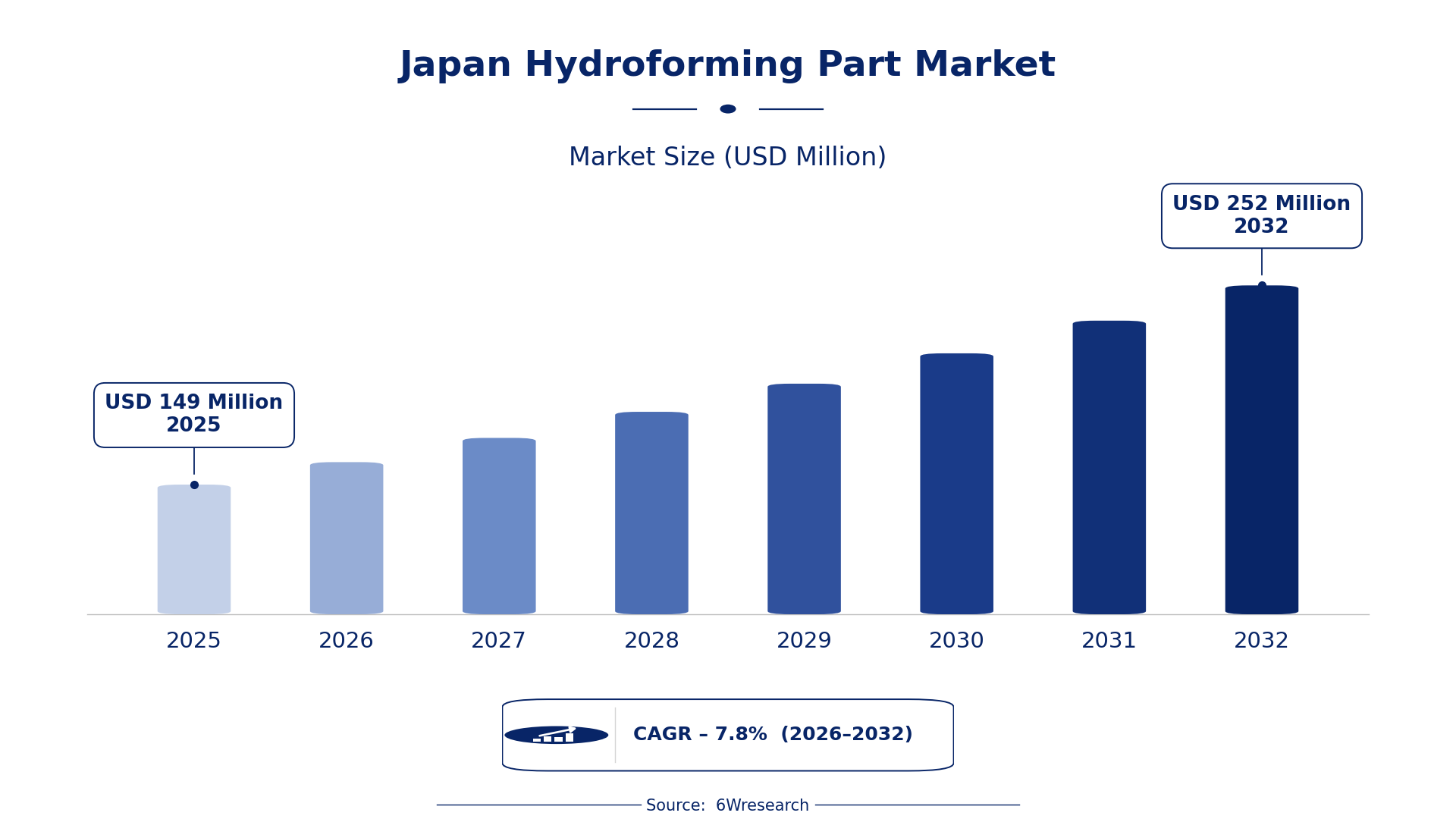
According to 6Wresearch internal database and industry insights, the Japan Hydroforming Part Market was valued at USD 149 Million in 2025 and is projected to reach USD 252 Million by 2032, growing at a CAGR of approximately 7.8% during 2026–2032.
Japan Hydroforming Part Market Highlights
| Report Metric | Details |
| Report Name | Japan Hydroforming Part Market (2026-2032) |
| Market Size 2025 | USD 149 Million |
| Market Size 2032 | USD 252 Million |
| Absolute Growth 2025–2032 | USD 103 Million |
| CAGR 2026–2032 | 7.8% |
| Peak Annual Growth | 8.9% in 2032 |
| Forecast Period | 2026–2032 |
| Historical Data | 2022–2025 |
| Base Year | 2025 |
| Leading Part Type, 2025 | Chassis Frames (48% share) |
| Leading Material Used, 2025 | High-Strength Steel (50% share) |
| Leading End-Use Sector, 2025 | Automotive (41% share) |
| Leading End User, 2025 | Vehicle OEMs (46% share) |
| Fastest-Growing Part Type | Exhaust Components (10.9% CAGR) |
| Fastest-Growing Material Used | Aluminum Alloy (11.2% CAGR) |
| Fastest-Growing End-Use Sector | Transportation (10.1% CAGR) |
| Fastest-Growing End User | Truck Manufacturers (10.2% CAGR) |
| Growing Sector | Transportation |
| Key End Users | Automotive, Transportation, Construction, Sports Equipment |
Japan Hydroforming Part Market Year-wise Growth Rate and Key Drivers (2022–2032)
This graph illustrates the annual growth rates of the market from 2022 to 2032, highlighting a steady upward trajectory and projected market expansion over the forecast period.
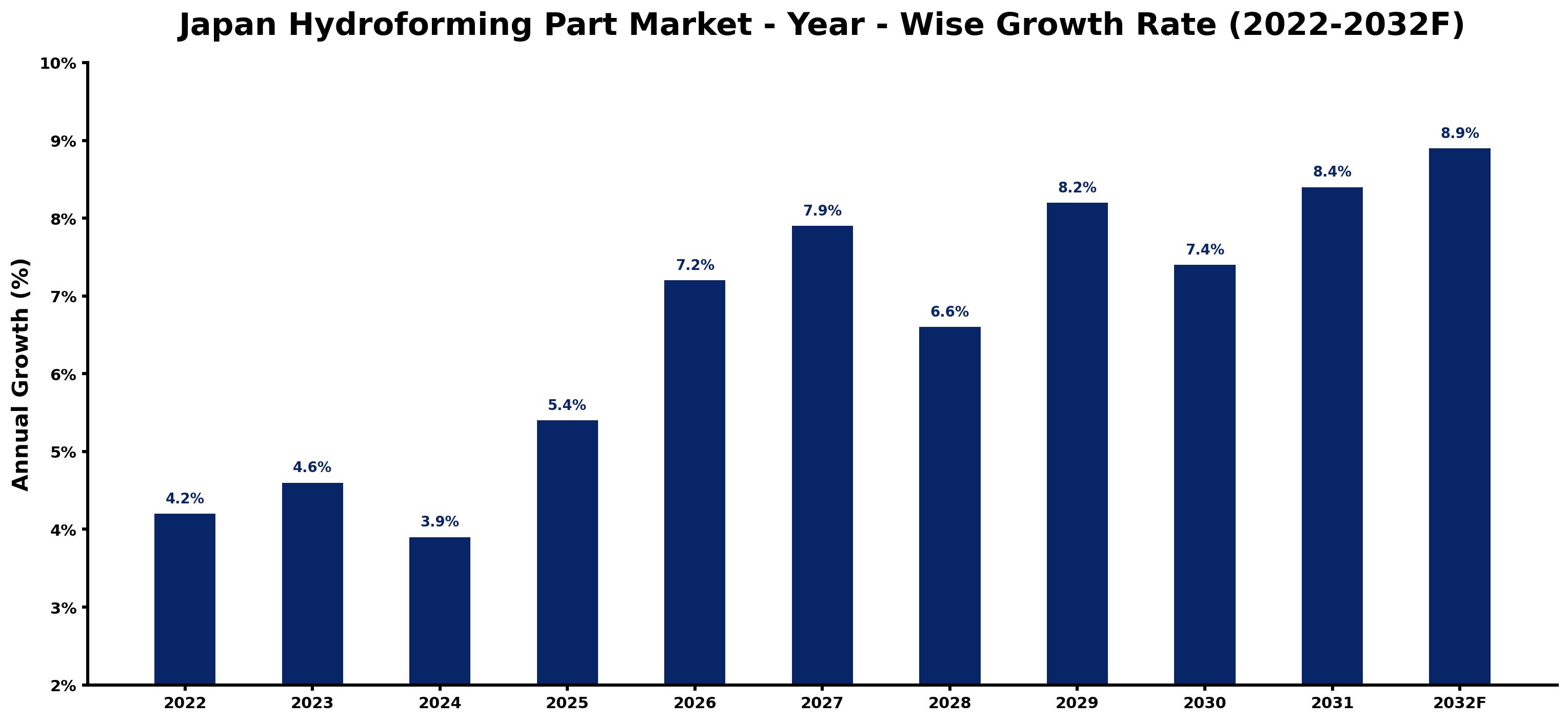
Annual growth estimates for each year appear below with the principal reason behind them, explaining the shifts that set the pace of the market.
| Year | Estimated Annual Growth (%) | Market Rationale |
| 2022 | 4.2 | The automotive sector showed steady production levels, sustaining demand for hydroformed parts. |
| 2023 | 4.6 | Increased vehicle production and lightweighting trends accelerated the need for hydroforming technology. |
| 2024 | 3.9 | The market experienced a slowdown as manufacturers adjusted to supply chain challenges. |
| 2025 | 5.4 | A surge in vehicle output and innovation in automotive design boosted hydroforming demand. |
| 2026 | 7.2 | Growing investments in advanced manufacturing technologies will propel market growth further. |
| 2027 | 7.9 | The automotive industry's focus on lightweight materials will continue to drive demand upward. |
| 2028 | 6.6 | Market growth is projected to slow as manufacturers face rising material costs and competition. |
| 2029 | 8.2 | Demand is expected to surge again due to heightened interest in sustainable automotive solutions. |
| 2030 | 7.4 | Market growth is projected to slow as manufacturers consolidate operations amid economic uncertainties. |
| 2031 | 8.4 | The automotive sector's recovery and new projects will stimulate demand for hydroformed parts. |
| 2032 | 8.9 | The market is expected to peak as vehicle manufacturers adopt advanced hydroforming techniques widely. |
Note: Market size estimations and growth projections presented in this report are based on 6Wresearch's proprietary forecasting methodology, utilizing the latest available industry data, government publications, and primary research inputs.
Japan Hydroforming Part Market Synopsis
The Japan Hydroforming Part Market is driven by the automotive industry, which produced 8.3 million vehicles in 2022, creating demand for advanced components. Growth stems from a shift towards lightweight materials and advanced manufacturing technologies, with the automotive sector contributing 4% to Japan's GDP in 2022. The increasing focus on sustainability further expands market potential as manufacturers aim to improve efficiency and reduce emissions.
Market Dynamics Impact Analysis (2026–2032)
| Factor | Type | Impact | Primary Segment Affected |
| Growing demand for lightweight automotive components drives hydroforming part production. | Driver | High | Chassis Frames |
| Increased focus on sustainability and efficiency in manufacturing processes enhances demand for hydroformed parts. | Driver | High | Exhaust Components |
| Rising investments in infrastructure projects create opportunities for structural tubes in construction applications. | Opportunity | High | Structural Tubes |
| The expanding bicycle market necessitates advanced designs, increasing demand for hydroformed bicycle frames. | Opportunity | Medium | Bicycle Frames |
| Stringent quality standards for automotive parts increase production costs for manufacturers. | Restraint | High | Chassis Frames |
| Supply chain disruptions related to high-strength steel raise material costs, impacting production timelines. | Restraint | Medium | Exhaust Components |
| Intense competition from lower-cost foreign manufacturers pressures local suppliers to lower prices. | Challenge | High | Structural Tubes |
| Technological advancements require continuous investment, which can strain smaller manufacturers financially. | Challenge | Medium | Bicycle Frames |
Evaluation of Drivers in Japan Hydroforming Part Market (2026–2032)
The table below links each growth driver to the segment it affects and the evidence for it.
| Drivers | Primary Segment Affected | Why It Matters (Evidence) |
| Increased vehicle production | Chassis Frames | Japan's automotive sector produced 8.3 million vehicles in 2022, boosting demand for hydroformed components. |
| Adoption of lightweight materials | Aluminum Alloy | The growing focus on vehicle lightweighting initiatives is driving the use of aluminum alloy in manufacturing, with demand projected to rise by 11.2%. |
| Technological advancements in manufacturing | Exhaust Components | Innovations in manufacturing processes are enhancing production capabilities and efficiency in the sector. |
| Rising demand for high-performance bicycles | Bicycle Frames | Japan's bicycle market was valued at approximately $1 billion in 2023, increasing demand for hydroforming in high-performance designs. |
| Infrastructure investments | Structural Tubes | Japan's projected $100 billion infrastructure investment in 2023 is expected to increase demand for structural tubes in construction applications. |
The strongest pull on demand comes from the automotive sector, which produced 8.3 million vehicles in 2022, leading to increased purchases of hydroformed parts. Manufacturers are prioritising lightweight materials to improve fuel efficiency, particularly with aluminum alloy usage expected to rise by 11.2%. Innovations in manufacturing processes are improving production capabilities, while the bicycle market, valued at approximately $1 billion in 2023, is pushing for high-performance designs that require hydroforming. Infrastructure investments projected at $100 billion in 2023 will stimulate demand for structural tubes in construction applications.
Evaluation of Restraints in Japan Hydroforming Part Market
The main factors holding the market back are set out below.
| Market Restraint | Primary Segment Affected | Why It Matters (Evidence) |
| Rising material costs are impacting production budgets and timelines for manufacturers in the hydroforming sector. | Chassis Frames | The increased cost of high-strength steel has raised production expenses, affecting profit margins. |
| Compliance with stringent quality standards for automotive parts limits the market's expansion. | Bicycle Frames | Manufacturers must adhere to rigorous standards, increasing operational costs and production timelines. |
| Supply chain disruptions for key materials have caused delays in production schedules. | Exhaust Components | Manufacturers face challenges in sourcing high-quality materials, impacting their ability to meet demand. |
| Limited availability of skilled workers in advanced manufacturing technologies hampers innovation. | Structural Tubes | A shortage of qualified personnel affects the implementation of new production techniques. |
| Intense competition from lower-cost foreign manufacturers pressures local suppliers to reduce prices. | Automotive | This competition can erode profit margins for domestic producers, impacting their market position. |
Japan Hydroforming Part Market Challenges
Quality standards for automotive parts create substantial costs for manufacturers, often delaying production timelines by three months. Regulatory compliance in Japan necessitates adherence to ISO 9001, which can increase operational expenses for producers striving to meet these benchmarks. Supply chain issues related to high-strength steel have raised material costs, affecting manufacturers reliant on timely access to these inputs. Competition from lower-cost foreign manufacturers pressures local suppliers to reduce prices, threatening profit margins for domestic producers in the hydroforming market.
Trends in the Japan Hydroforming Part Market
The trends below show where the Japan Hydroforming Part Market is heading.
- Shift from Traditional to Lightweight Materials: Since 2022, there has been a notable shift towards lightweight materials in automotive manufacturing, with aluminum alloy usage rising by 11.2%. This trend is illustrated by initiatives like the Tokyo Motor Show, which showcases advancements in lightweight vehicle designs.
- Transition from Conventional to Advanced Hydroforming Techniques: Beginning in 2023, manufacturers are increasingly adopting advanced hydroforming techniques to produce complex parts. This change is supported by the Japan Automobile Manufacturers Association, which promotes progress in manufacturing processes.
- Emergence of Sustainable Manufacturing Practices: In 2021, the Green Growth Strategy was introduced, focusing on sustainability in manufacturing. This initiative aims to reduce carbon emissions, influencing suppliers to adopt eco-friendly production methods.
- Prioritisation of High-Performance Bicycle Designs: Since 2023, bicycle manufacturers have been prioritising hydroforming for high-performance designs, with the market valued at approximately $1 billion. This shift is driven by rising consumer demand for lightweight and durable bicycles.
Investment Opportunities in the Japan Hydroforming Part Market
Where to invest in the Japan Hydroforming Part Market: the main openings are set out below.
- Vehicle OEMs Seeking Advanced Components: With the automotive sector producing 8.3 million vehicles in 2022, there is a pressing need for advanced hydroformed components. Collaborating with vehicle OEMs will enable suppliers to meet this demand effectively.
- Growing Demand for Lightweight Solutions: As the automotive industry increasingly focuses on lightweight materials, suppliers can capitalise on this trend by providing hydroformed parts. The projected growth in aluminum alloy usage presents a timely opportunity for investment.
- Infrastructure Firms Requiring Structural Tubes: Japan's projected $100 billion infrastructure investment in 2023 creates a demand for structural tubes. Suppliers can engage with infrastructure firms to supply these essential components.
- Bicycle Manufacturers Adopting Hydroforming: With Japan's bicycle market valued at approximately $1 billion in 2023, there is a clear opportunity for suppliers to provide hydroformed parts. Partnering with bicycle manufacturers will facilitate market entry.
Government Initiatives in the Japan Hydroforming Part Market
The Economic Security Promotion Act, enacted in 2022, supports supply-chain resilience for critical products and materials, building on previous regulations. This law mandates that manufacturers adopt measures to ensure the availability of essential materials, directly impacting hydroforming part producers by requiring them to evaluate their supply chains. Additionally, the Ministry of Economy, Trade and Industry has allocated funding for projects aimed at enhancing manufacturing capabilities, promoting innovation and efficiency in the production of hydroformed parts.
The Ministry of Economy, Trade and Industry oversees the implementation of various manufacturing initiatives, approving funding for projects that promote advanced manufacturing technologies. This support encourages producers to invest in processes that improve the quality and efficiency of hydroformed parts. The agency has committed to funding several projects aimed at enhancing production capabilities, ensuring that manufacturers can meet growing demand.
Future Insight of the Japan Hydroforming Part Market
New manufacturing facilities focused on hydroforming technology will emerge by 2032, driven by government initiatives promoting advanced manufacturing practices. The Tokyo Motor Show will continue to serve as a key venue for unveiling innovations, influencing buyer preferences for high-performance components. Infrastructure investments, projected at $120 billion, will enhance demand for structural tubes in construction projects. As automotive manufacturers shift towards lightweight alloys, suppliers will find new opportunities to meet the changing needs of the market.
Market Segmentation Analysis
Japan Hydroforming Part Market report covers a detailed analysis of the following market segments:
By Part Type – Chassis Frames Lead, Exhaust Components Expected to Grow Fastest
According to Saurav Kr Singh, Senior Research Analyst at 6Wresearch, Chassis Frames held 48% of the Japan Hydroforming Part Market by part type in 2025. Chassis frames hold the largest share as they are essential for vehicle structures, providing necessary strength while reducing weight. The production of 8.3 million vehicles in Japan in 2022 illustrates the high demand for these components in the automotive industry. Exhaust Components are set to record the highest CAGR in this split, 10.9% over 2026–2032. Exhaust components are experiencing rapid growth due to their critical role in efficient exhaust systems, which are increasingly emphasised in modern vehicle designs. The Tokyo Motor Show highlights innovations in exhaust technologies, which are driving their adoption and further market expansion. Suppliers must focus on developing exhaust components to leverage this growth trend effectively.
By Material Used – High-Strength Steel Leads, Aluminum Alloy Expected to Grow Fastest
The largest material used category in 2025 was High-Strength Steel, at 50% of revenue. High-strength steel commands the largest share owing to its extensive application in automotive contexts, valued for its durability and reliability. This material is essential in creating chassis frames, which play a key role in vehicle safety and performance. Over 2026–2032, Aluminum Alloy is expected to post the fastest growth, at a CAGR of 11.2%. Aluminum alloy is experiencing the fastest growth as it is preferred for lightweight applications, particularly in initiatives aimed at reducing vehicle weight. The rising demand for lightweight alloys in the automotive sector is propelling this trend forward. Buyers should consider increasing their procurement of aluminium alloy products to align with the growing need for lightweight vehicle components.
By End-Use Sector – Automotive Leads, Transportation Expected to Grow Fastest
Automotive took 41% of end-use sector revenue in 2025, more than any other category. The automotive sector is the largest user of hydroformed parts, reflecting its extensive reliance on these components for vehicle production. With the sector accounting for 4% of Japan's GDP in 2022, its significance to the economy is clear. The quickest growth will come from Transportation, forecast to expand at a CAGR of 10.1% between 2026 and 2032. Transportation is the fastest-growing sector for hydroformed parts, as it includes various applications that are becoming more prevalent. Government initiatives promoting sustainable manufacturing practices are likely to boost this segment's growth further. Suppliers should explore opportunities within the transportation sector to maximise their reach in this expanding market.
By End User – Vehicle OEMs Lead, Truck Manufacturers Expected to Grow Fastest
In 2025, Vehicle OEMs led the end user split with a 46% share. Vehicle OEMs are the primary users of hydroformed parts, as they require these components for the production of vehicles. Their substantial purchasing power and demand for quality parts make them the leading end user. Truck Manufacturers are projected to grow fastest, at a CAGR of 10.2% during 2026–2032. Truck manufacturers are rapidly increasing their use of hydroformed parts to ensure structural integrity in their vehicles. This trend is supported by the growing emphasis on durability and performance in the trucking industry. Suppliers should strengthen relationships with truck manufacturers to benefit from this expanding market.
Key Attractiveness of the Report
- 10 Years of Market Numbers
- Historical Data Starting from 2022 to 2025
- Base Year 2025
- Forecast Data until 2032
- Key Performance Indicators Impacting the Market
- Major Upcoming Developments and Projects
Key Highlights of the Report:
- Japan Hydroforming Part Market Outlook
- Market Size of Japan Hydroforming Part Market, 2025
- Forecast of Japan Hydroforming Part Market, 2032
- Historical Data and Forecast of Japan Hydroforming Part Revenues & Volume for the Period 2022-2032F
- Japan Hydroforming Part Market Trend Evolution
- Japan Hydroforming Part Market Drivers and Challenges
- Japan Hydroforming Part Price Trends
- Japan Hydroforming Part Porter's Five Forces
- Japan Hydroforming Part Industry Life Cycle
- Historical Data and Forecast of Japan Hydroforming Part Market Revenues & Volume By Part Type for the Period 2022-2032F
- Historical Data and Forecast of Japan Hydroforming Part Market Revenues & Volume By Chassis Frames for the Period 2022-2032F
- Historical Data and Forecast of Japan Hydroforming Part Market Revenues & Volume By Exhaust Components for the Period 2022-2032F
- Historical Data and Forecast of Japan Hydroforming Part Market Revenues & Volume By Structural Tubes for the Period 2022-2032F
- Historical Data and Forecast of Japan Hydroforming Part Market Revenues & Volume By Bicycle Frames for the Period 2022-2032F
- Historical Data and Forecast of Japan Hydroforming Part Market Revenues & Volume By Material Used for the Period 2022-2032F
- Historical Data and Forecast of Japan Hydroforming Part Market Revenues & Volume By High-Strength Steel for the Period 2022-2032F
- Historical Data and Forecast of Japan Hydroforming Part Market Revenues & Volume By Aluminum Alloy for the Period 2022-2032F
- Historical Data and Forecast of Japan Hydroforming Part Market Revenues & Volume By Stainless Steel for the Period 2022-2032F
- Historical Data and Forecast of Japan Hydroforming Part Market Revenues & Volume By Lightweight Alloy for the Period 2022-2032F
- Historical Data and Forecast of Japan Hydroforming Part Market Revenues & Volume By End-Use Sector for the Period 2022-2032F
- Historical Data and Forecast of Japan Hydroforming Part Market Revenues & Volume By Automotive for the Period 2022-2032F
- Historical Data and Forecast of Japan Hydroforming Part Market Revenues & Volume By Transportation for the Period 2022-2032F
- Historical Data and Forecast of Japan Hydroforming Part Market Revenues & Volume By Construction for the Period 2022-2032F
- Historical Data and Forecast of Japan Hydroforming Part Market Revenues & Volume By Sports Equipment for the Period 2022-2032F
- Historical Data and Forecast of Japan Hydroforming Part Market Revenues & Volume By End User for the Period 2022-2032F
- Historical Data and Forecast of Japan Hydroforming Part Market Revenues & Volume By Vehicle OEMs for the Period 2022-2032F
- Historical Data and Forecast of Japan Hydroforming Part Market Revenues & Volume By Truck Manufacturers for the Period 2022-2032F
- Historical Data and Forecast of Japan Hydroforming Part Market Revenues & Volume By Infrastructure Firms for the Period 2022-2032F
- Historical Data and Forecast of Japan Hydroforming Part Market Revenues & Volume By Bicycle Manufacturers for the Period 2022-2032F
- Japan Hydroforming Part Import Export Trade Statistics
- Market Opportunity Assessment By Part Type
- Market Opportunity Assessment By Material Used
- Market Opportunity Assessment By End-Use Sector
- Market Opportunity Assessment By End User
- Japan Hydroforming Part Top Companies Market Share
- Japan Hydroforming Part Competitive Benchmarking By Technical and Operational Parameters
- Japan Hydroforming Part Company Profiles
- Japan Hydroforming Part Key Strategic Recommendations
Market Covered
The following segment groups are covered in the report.
By Part Type
- Chassis Frames
- Exhaust Components
- Structural Tubes
- Bicycle Frames
By Material Used
- High-Strength Steel
- Aluminum Alloy
- Stainless Steel
- Lightweight Alloy
By End-Use Sector
- Automotive
- Transportation
- Construction
- Sports Equipment
By End User
- Vehicle OEMs
- Truck Manufacturers
- Infrastructure Firms
- Bicycle Manufacturers































