Japan Hydroforming Technology Market Size & Growth Rate
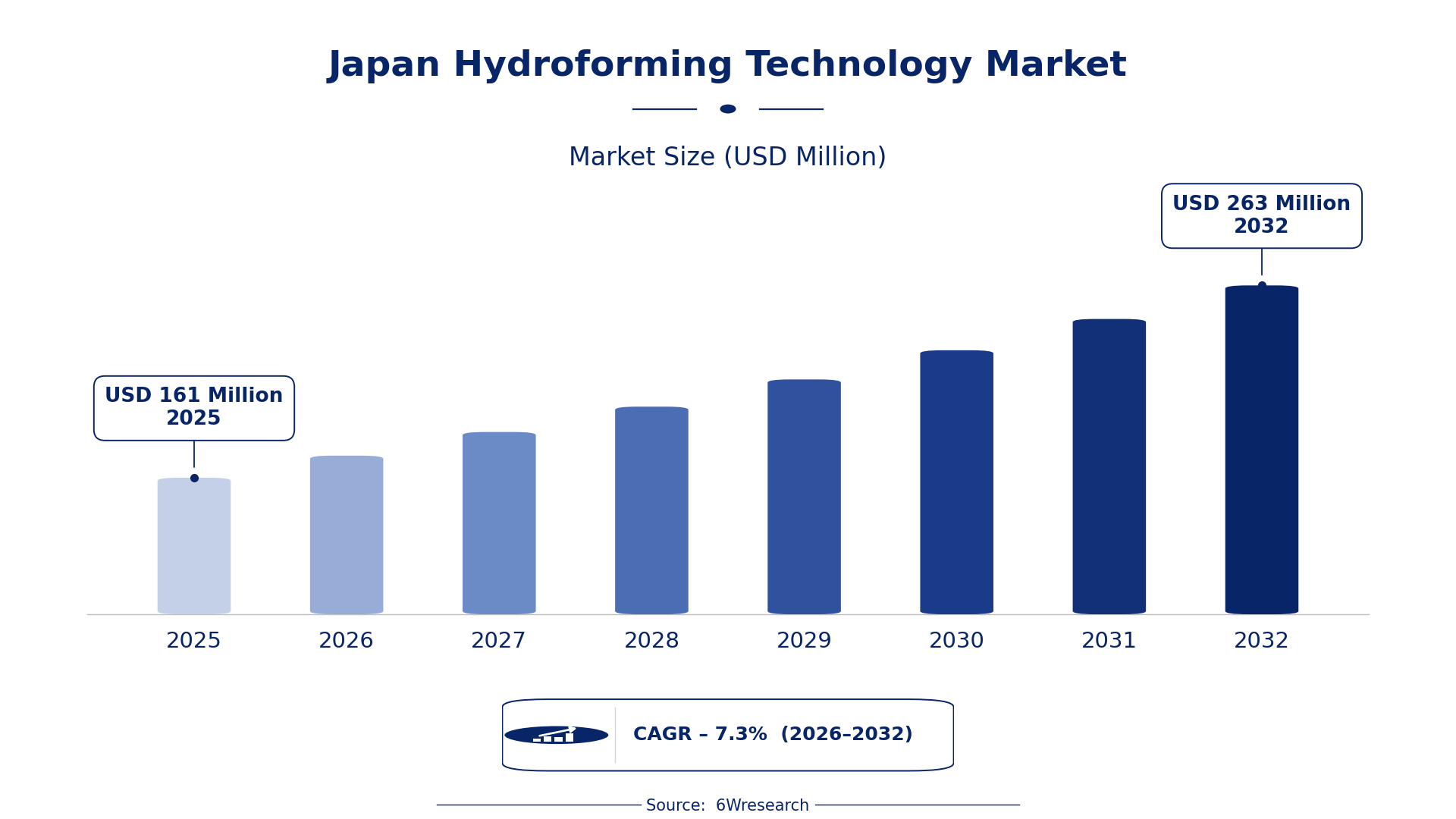
According to 6Wresearch internal database and industry insights, the Japan Hydroforming Technology Market was valued at USD 161 Million in 2025 and is projected to reach USD 263 Million by 2032, growing at a CAGR of approximately 7.3% during 2026–2032.
Japan Hydroforming Technology Market Highlights
| Report Metric | Details |
| Report Name | Japan Hydroforming Technology Market (2026-2032) |
| Market Size 2025 | USD 161 Million |
| Market Size 2032 | USD 263 Million |
| Absolute Growth 2025–2032 | USD 102 Million |
| CAGR 2026–2032 | 7.3% |
| Peak Annual Growth | 8.3% in 2028 |
| Forecast Period | 2026–2032 |
| Historical Data | 2022–2025 |
| Base Year | 2025 |
| Leading Technology Type, 2025 | Tube Hydroforming (42% share) |
| Leading Process Type, 2025 | High-Pressure Forming (53% share) |
| Leading Material Handled, 2025 | Steel/Aluminum Tubes (55% share) |
| Leading End User, 2025 | Automotive Manufacturers (39% share) |
| Fastest-Growing Technology Type | Sheet Hydroforming (10.0% CAGR) |
| Fastest-Growing Process Type | Thermal Assisted (10.5% CAGR) |
| Fastest-Growing Material Handled | High-Strength Alloys (10.1% CAGR) |
| Fastest-Growing End User | Aerospace OEMs (9.2% CAGR) |
| Growing Sector | automotive manufacturing |
| Key End Users | automotive manufacturers, aerospace OEMs, metal forming industries |
Japan Hydroforming Technology Market Year-wise Growth Rate and Key Drivers (2022–2032)
This graph illustrates the annual growth rates of the market from 2022 to 2032, highlighting a steady upward trajectory and projected market expansion over the forecast period.
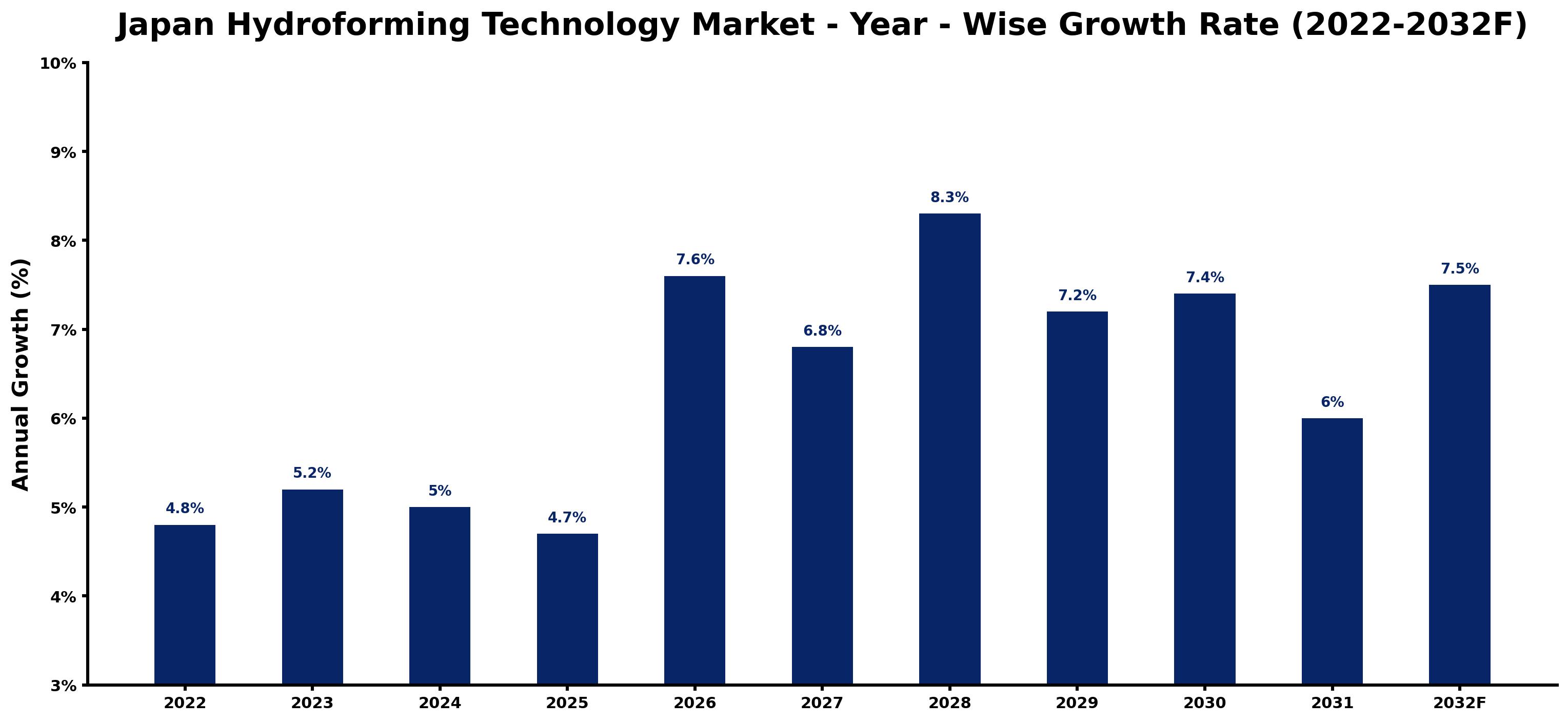
The following figures match every annual growth estimate with the main market development of that year, giving the reasoning behind each rise or slowdown.
| Year | Estimated Annual Growth (%) | Market Rationale |
| 2022 | 4.8 | The automotive sector maintained steady production levels, supporting hydroforming demand. |
| 2023 | 5.2 | Increased vehicle production and technological advancements drove higher adoption rates. |
| 2024 | 5.0 | A slight slowdown occurred as manufacturers adjusted to market conditions. |
| 2025 | 4.7 | Demand continued to grow, albeit at a slower pace, due to market saturation. |
| 2026 | 7.6 | Investment in advanced manufacturing technologies is expected to spur renewed interest in hydroforming. |
| 2027 | 6.8 | Growth is projected to moderate as companies focus on optimising existing production capabilities. |
| 2028 | 8.3 | A surge in demand for lightweight automotive parts is expected to lead to peak growth. |
| 2029 | 7.2 | The market is projected to experience a slowdown as capacity adjustments take effect. |
| 2030 | 7.4 | Technological upgrades in manufacturing processes will revitalise interest in hydroforming. |
| 2031 | 6.0 | A decrease in growth rate will reflect market maturation and increased competition. |
| 2032 | 7.5 | Rising demand for aerospace components is expected to boost hydroforming adoption. |
Note: Market size estimations and growth projections presented in this report are based on 6Wresearch's proprietary forecasting methodology, utilizing the latest available industry data, government publications, and primary research inputs.
Japan Hydroforming Technology Market Synopsis
Hydroforming technology is a manufacturing process that uses high-pressure fluid to shape metals into complex forms, primarily for automotive and aerospace applications. The Japan Hydroforming Technology Market is projected to reach USD 161 million by 2025, driven by the automotive industry's production of 8.3 million vehicles in 2022 and the aerospace sector's focus on lightweight materials. Key factors include the increasing use of high-strength aluminum alloys and support from industry associations for advanced manufacturing practices.
Market Dynamics Impact Analysis (2026–2032)
| Factor | Type | Impact | Primary Segment Affected |
| Growing demand for lightweight automotive components | Driver | High | High-Pressure Forming |
| Investment in advanced manufacturing technologies | Driver | High | Tube Hydroforming |
| Increasing focus on lightweight materials in aerospace | Opportunity | High | Sheet Hydroforming |
| Expansion of automotive manufacturing capabilities | Opportunity | High | Internal Pressure Forming |
| Limited awareness of hydroforming benefits among manufacturers | Restraint | Medium | High-Pressure Forming |
| High initial investment costs for hydroforming equipment | Restraint | Medium | Tube Hydroforming |
| Competition from alternative forming technologies | Challenge | High | Sheet Hydroforming |
| Supply chain disruptions affecting material availability | Challenge | High | Internal Pressure Forming |
Evaluation of Drivers in Japan Hydroforming Technology Market (2026–2032)
Below are the drivers that matter most for revenue growth, with supporting evidence.
| Drivers | Primary Segment Affected | Why It Matters (Evidence) |
| Increased vehicle production in Japan | High-Pressure Forming | The automotive industry produced 8.3 million vehicles in 2022, driving demand for hydroformed components. |
| Investment in lightweight materials | Tube Hydroforming | High-strength aluminum alloys are increasingly used, attracting manufacturers to hydroforming technology. |
| Technological advancements in manufacturing | Sheet Hydroforming | The adoption of advanced technologies supports the production of complex shapes, increasing demand from manufacturers. |
| Support from industry associations | Internal Pressure Forming | Industry associations promote innovation, encouraging manufacturers to adopt hydroforming processes. |
| Focus on sustainability in manufacturing | High-Pressure Forming | The push for lightweight components in vehicles aligns with environmental goals, boosting hydroforming adoption. |
What keeps demand rising is the automotive industry's production of 8.3 million vehicles in 2022, which drives the need for hydroformed components. The growing use of high-strength aluminum alloys in automotive manufacturing, with around 30% adoption, attracts manufacturers to hydroforming. Advances in production techniques enable the creation of complex shapes, particularly in aerospace applications, leading to increased demand. Regions like Tokyo and Aichi are key areas where this technology is gaining traction, further supporting market growth.
Evaluation of Restraints in Japan Hydroforming Technology Market
Several factors work against faster growth; the main ones are summarised below.
| Market Restraint | Primary Segment Affected | Why It Matters (Evidence) |
| Limited awareness of hydroforming benefits | High-Pressure Forming | Many manufacturers are unaware of hydroforming's advantages, hindering wider adoption in production processes. |
| High initial investment costs for equipment | Tube Hydroforming | Upfront costs deter smaller manufacturers from investing in hydroforming technology. |
| Competition from alternative forming technologies | Sheet Hydroforming | Rival technologies may offer lower costs, affecting hydroforming's market share. |
| Supply chain disruptions affecting material availability | Internal Pressure Forming | Material shortages can delay production schedules and impact hydroforming operations. |
| Regulatory compliance challenges | High-Pressure Forming | Manufacturers must navigate complex regulations, increasing operational costs. |
Japan Hydroforming Technology Market Challenges
Outdated machinery hampers producers' ability to fully utilise hydroforming technology, as many facilities have not upgraded since the early 2000s. This situation stems from high capital expenditure, which can delay production schedules for automotive parts by up to three months. Importers face rising operational costs, particularly for high-strength aluminum alloys, causing prices to increase by 15% for buyers. A skills gap exists, with only 30% of the workforce trained in advanced hydroforming techniques, resulting in inefficiencies that can slow production rates for manufacturers. Buyers struggle with limited availability of complex geometries, leading to longer lead times and increased costs for custom parts.
Trends in the Japan Hydroforming Technology Market
The following changes are redrawing the Japan Hydroforming Technology Market.
- Shift towards Lightweight Materials in Automotive: The automotive sector is increasingly adopting lightweight materials to improve fuel efficiency. This trend is reflected in the production of 8.3 million vehicles in 2022, driving demand for hydroforming technology.
- Transition from Traditional to Advanced Manufacturing Techniques: Manufacturers are moving from traditional forming methods to advanced hydroforming processes to create complex geometries. The adoption of the JIS B 1501 standard in 2023 supports this shift, improving production capabilities.
- Aerospace OEMs Prioritising Hydroforming for Structural Components: Aerospace OEMs are prioritising hydroforming technology to produce lightweight structural components, reflecting the industry's focus on efficiency and performance. The aerospace sector is projected to grow significantly in the coming years.
- Emergence of High-Pressure Forming as a Preferred Technique: High-pressure forming is becoming the preferred technique for automotive applications due to its ability to create complex shapes. The technology's adoption is anticipated to grow as manufacturers seek to improve production efficiency.
Investment Opportunities in the Japan Hydroforming Technology Market
Where to invest in the Japan Hydroforming Technology Market: the main openings are set out below.
- Investment in Hydroforming Technology: With the aerospace sector expanding, there is a strong opportunity for suppliers of hydroforming equipment. Automotive manufacturers in regions like Tokyo and Aichi are actively seeking advanced solutions to enhance their production capabilities.
- Supply Advanced Materials for Hydroforming Applications: The increasing use of high-strength aluminum alloys creates a demand for suppliers of these materials. Manufacturers in the automotive sector are looking for partnerships to improve their material offerings.
- Expand Hydroforming Capabilities in Key Regions: Demand for hydroforming technology is rising in Tokyo and Aichi, where automotive production is concentrated. Establishing local partnerships can facilitate market entry and growth.
- Address the Knowledge Gap in Hydroforming: With limited awareness of hydroforming benefits, there is an opportunity to provide educational resources and training. Targeting automotive manufacturers can help increase adoption rates.
Government Initiatives in the Japan Hydroforming Technology Market
The Economic Security Promotion Act, enacted in 2022, supports supply-chain resilience for critical products, including hydroforming technology. This measure encourages manufacturers to invest in advanced processes, ensuring a stable supply of essential materials. The Ministry of Economy, Trade and Industry aims to strengthen Japan's manufacturing capabilities through this initiative, with a focus on promoting innovation and efficiency in production.
The Japan Automobile Manufacturers Association utilises the Economic Security Promotion Act to advocate for innovation in manufacturing. By leveraging this scheme, automotive manufacturers can access funding for advanced technologies, enabling them to adopt hydroforming processes more effectively. This support is vital for improving competitiveness in both domestic and international markets.
Future Insight of the Japan Hydroforming Technology Market
New hydroforming facilities will come online in Tokyo and Aichi by 2032, supported by government initiatives that prioritise advanced manufacturing technologies. The aerospace market in Japan is projected to reach $30 billion by 2025, creating opportunities for suppliers to develop new applications and materials. As the adoption of hydroforming technology in automotive manufacturing climbs to 50%, buyers will gain access to a broader range of complex shapes at competitive prices. Enhanced training programmes will prepare the workforce with essential skills, ensuring a more efficient production process that benefits both buyers and suppliers.
Market Segmentation Analysis
Japan Hydroforming Technology Market report covers a detailed analysis of the following market segments:
By Technology Type – Tube Hydroforming Leads, Sheet Hydroforming Expected to Grow Fastest
According to Saurav Kr Singh, Senior Research Analyst at 6Wresearch, with 42% of technology type revenue in 2025, Tube Hydroforming was the largest category. Tube hydroforming holds the largest share as it is extensively used for creating complex automotive parts, which are essential for vehicle assembly. The significant production of 8.3 million vehicles in Japan in 2022 highlights the strong reliance on this technology within the automotive sector. The quickest growth will come from Sheet Hydroforming, forecast to expand at a CAGR of 10.0% between 2026 and 2032. Sheet hydroforming is witnessing rapid growth driven by the aerospace industry's focus on lightweight materials, which are crucial for enhancing fuel efficiency in aircraft design. This trend is expected to continue as the aerospace market evolves towards more advanced manufacturing techniques. Suppliers should prioritise the development of sheet hydroforming capabilities to capture opportunities in the growing aerospace sector.
By Process Type – High-Pressure Forming Leads, Thermal Assisted Expected to Grow Fastest
The largest process type category in 2025 was High-Pressure Forming, at 53% of revenue. High-pressure forming dominates the market as it is widely used in automotive parts manufacturing, ensuring the production of high-quality components. This process aligns with the automotive industry's substantial output, reinforcing its market position. Thermal Assisted is projected to grow fastest, at a CAGR of 10.5% during 2026–2032. Thermal assisted processes are gaining traction due to their application in specialised manufacturing, which caters to specific material requirements. This niche growth reflects a trend towards more tailored manufacturing solutions. Buyers may benefit from exploring thermal assisted processes for specialised applications to meet evolving production needs.
By Material Handled – Steel/Aluminum Tubes Lead, High-Strength Alloys Expected to Grow Fastest
In 2025, Steel/Aluminum Tubes led the material handled split with a 55% share. Steel and aluminium tubes are the primary materials utilised in hydroforming, playing a vital role in the manufacturing of various components. Their widespread application in the automotive industry reinforces their dominant position in the market. High-Strength Alloys are set to record the highest CAGR in this split, 10.1% over 2026–2032. High-strength alloys are rapidly gaining popularity as they are increasingly used in applications requiring enhanced properties, particularly in automotive manufacturing. This trend aligns with the industry's focus on improving performance and safety standards. Suppliers need to expand their offerings of high-strength alloys to meet the rising demand for advanced material solutions.
By End User – Automotive Manufacturers Lead, Aerospace OEMs Expected to Grow Fastest
Automotive Manufacturers held 39% of the Japan Hydroforming Technology Market by end user in 2025. Automotive manufacturers represent the largest end-user segment for hydroformed components, reflecting the high demand for advanced manufacturing processes in vehicle production. The substantial output from this sector solidifies its leading position in the market. Over 2026–2032, Aerospace OEMs are expected to post the fastest growth, at a CAGR of 9.2%. Aerospace OEMs are significantly increasing their use of hydroforming for lightweight structural components, driven by the industry's need for efficiency and performance improvements. This growth indicates a broader shift towards advanced manufacturing practices within aerospace. Suppliers should focus on creating customised solutions for the aerospace sector to take advantage of the increasing demand.
Key Attractiveness of the Report
- 10 Years of Market Numbers
- Historical Data Starting from 2022 to 2025
- Base Year 2025
- Forecast Data until 2032
- Key Performance Indicators Impacting the Market
- Major Upcoming Developments and Projects
Key Highlights of the Report:
- Japan Hydroforming Technology Market Outlook
- Market Size of Japan Hydroforming Technology Market, 2025
- Forecast of Japan Hydroforming Technology Market, 2032
- Historical Data and Forecast of Japan Hydroforming Technology Revenues & Volume for the Period 2022-2032F
- Japan Hydroforming Technology Market Trend Evolution
- Japan Hydroforming Technology Market Drivers and Challenges
- Japan Hydroforming Technology Price Trends
- Japan Hydroforming Technology Porter's Five Forces
- Japan Hydroforming Technology Industry Life Cycle
- Historical Data and Forecast of Japan Hydroforming Technology Market Revenues & Volume By Technology Type for the Period 2022-2032F
- Historical Data and Forecast of Japan Hydroforming Technology Market Revenues & Volume By Tube Hydroforming for the Period 2022-2032F
- Historical Data and Forecast of Japan Hydroforming Technology Market Revenues & Volume By Sheet Hydroforming for the Period 2022-2032F
- Historical Data and Forecast of Japan Hydroforming Technology Market Revenues & Volume By Warm Hydroforming for the Period 2022-2032F
- Historical Data and Forecast of Japan Hydroforming Technology Market Revenues & Volume By Dual Chamber Systems for the Period 2022-2032F
- Historical Data and Forecast of Japan Hydroforming Technology Market Revenues & Volume By Process Type for the Period 2022-2032F
- Historical Data and Forecast of Japan Hydroforming Technology Market Revenues & Volume By Internal Pressure Forming for the Period 2022-2032F
- Historical Data and Forecast of Japan Hydroforming Technology Market Revenues & Volume By High-Pressure Forming for the Period 2022-2032F
- Historical Data and Forecast of Japan Hydroforming Technology Market Revenues & Volume By Thermal Assisted for the Period 2022-2032F
- Historical Data and Forecast of Japan Hydroforming Technology Market Revenues & Volume By Integrated Flow for the Period 2022-2032F
- Historical Data and Forecast of Japan Hydroforming Technology Market Revenues & Volume By Material Handled for the Period 2022-2032F
- Historical Data and Forecast of Japan Hydroforming Technology Market Revenues & Volume By Steel/Aluminum Tubes for the Period 2022-2032F
- Historical Data and Forecast of Japan Hydroforming Technology Market Revenues & Volume By Thin Metal Sheets for the Period 2022-2032F
- Historical Data and Forecast of Japan Hydroforming Technology Market Revenues & Volume By High-Strength Alloys for the Period 2022-2032F
- Historical Data and Forecast of Japan Hydroforming Technology Market Revenues & Volume By Complex Geometries for the Period 2022-2032F
- Historical Data and Forecast of Japan Hydroforming Technology Market Revenues & Volume By End User for the Period 2022-2032F
- Historical Data and Forecast of Japan Hydroforming Technology Market Revenues & Volume By Automotive Manufacturers for the Period 2022-2032F
- Historical Data and Forecast of Japan Hydroforming Technology Market Revenues & Volume By Aerospace OEMs for the Period 2022-2032F
- Historical Data and Forecast of Japan Hydroforming Technology Market Revenues & Volume By Metal Forming Industries for the Period 2022-2032F
- Historical Data and Forecast of Japan Hydroforming Technology Market Revenues & Volume By Industrial Fabricators for the Period 2022-2032F
- Japan Hydroforming Technology Import Export Trade Statistics
- Market Opportunity Assessment By Technology Type
- Market Opportunity Assessment By Process Type
- Market Opportunity Assessment By Material Handled
- Market Opportunity Assessment By End User
- Japan Hydroforming Technology Top Companies Market Share
- Japan Hydroforming Technology Competitive Benchmarking By Technical and Operational Parameters
- Japan Hydroforming Technology Company Profiles
- Japan Hydroforming Technology Key Strategic Recommendations
Market Covered
Segments analysed in this report are listed below.
By Technology Type
- Tube Hydroforming
- Sheet Hydroforming
- Warm Hydroforming
- Dual Chamber Systems
By Process Type
- Internal Pressure Forming
- High-Pressure Forming
- Thermal Assisted
- Integrated Flow
By Material Handled
- Steel/Aluminum Tubes
- Thin Metal Sheets
- High-Strength Alloys
- Complex Geometries
By End User
- Automotive Manufacturers
- Aerospace OEMs
- Metal Forming Industries
- Industrial Fabricators































